Search

band annie's Weblog

I have a parallel blog in French at http://anniebannie.net

Category

Syria

Aleppo is our Guernica — and some are cheering on the Luftwaffe

Imagine Guernica. On April 26, 1937, during the Spanish Civil War, the Basque town was bombed for three hours by Hitler’s Luftwaffe in support of Francisco Franco’s fascist regime, leaving over 1,600 people dead. Picasso immortalized the episode in a celebrated painting, Neruda wrote poems about it, and it became an enduring metaphor for people’s suffering in war.

Now imagine a different response to Guernica. Imagine people applauding the bombings, reproaching the victims, and slandering the witnesses. If you can imagine that, then you know Aleppo.

Aleppo — one of the last major rebel strongholds — is on the verge of collapse. Backed by the Iranian Revolutionary Guard Corps (IRGC), the Lebanese Hezbollah, and US-equipped Iraqi militias, the Syrian regime army is advancing from the south; from the east, the Islamic State (IS) is rampaging ahead; and, exploiting the stretched rebel defences, the Kurdish YPG is sneaking in from the north. All have been assisted, directly or indirectly, by the relentless attrition of Russian bombs.

But as the conflict moves toward a grim denouement, its mounting toll has elicited a curious response. Many in the west, including prominent liberals, have used the logic of lesser-evilism to welcome this outcome. But to sustain this argument, they’ve had to battle the stubborn resistance of facts.

The balance of atrocities could not be clearer. Consider these facts:

The UN has stopped counting the dead in Syria. But even before the regime’s August 2013 chemical attack, which killed more than 1,400 civilians, Paulo Sérgio Pinheiro, special investigator for the UN Human Rights Council, had found the regime responsible for eight of the nine massacres perpetrated until then; a year later, even after the rise of IS, the equation remained unchanged. Despite IS’s extreme violence, Pineheiro noted, the regime “remains responsible for the majority of the civilian casualties, killing and maiming scores of civilians daily”. Since its entry into the war, Russia has surpassed the regime’s kill rate; it has also helped ISIS expand its territory by targeting the rebels fighting it.

But if the balance of atrocities is clear, their moral implications have not been as acutely felt. This in part has to do with the muddled way the story has been reported. On Sunday, when one of Hollywood’s most politically active and humane figures weighed in to condemn the media for “misleading the public on Syria”, one could only welcome the intervention.

Except, Mark Ruffalo, the Oscar-nominated star of Spotlight, was not indicting the media for failing the people of Syria; he was condemning it for being insufficiently sympathetic to the regime and Russia. He was recommending to his 2.23 million Twitter followers an article by Boston Globe columnist Stephen Kinzer in which he alleges that the “American press is reporting the opposite of what is actually happening”; that it unfairly describes everything Russia and Iran do as “negative and destabilizing”; and it fails to report that in the Assad regime and Russia’s assault on Aleppo, its inhabitants are “finally see[ing] glimmers of hope”. Kinzer’s basis for these claims? A comment “on social media” and the opinion of a “Beirut-based analyst” (in reality a pro-Hizbullah activist who is a contributor to the Russian news outlet RT and the Iranian supreme leader’s personal news site).

To compensate for its fact deficit, Kinzer liberally sprinkles his article with straw men. He claims that journalists are misleading the public by describing Jabhat al-Nusra, as “moderates,” not as “the local al-Qaeda franchise”. As a matter of fact, no one refers to Nusra as “moderates”, and a Nexis search of major newspapers reveals virtually no article that doesn’t refer to it without mentioning its al-Qaeda affiliation.

This article was a sequel to another, published three days after Russia started a series of attacks on MSF-run hospitals, which was boldly titled: “On Syria: Thank you, Russia!” In it Kinzer prescribed that “Russia’s policy should be ours: prevent the fall of Bashar al-Assad’s government, craft a new regime that would include Assad or his supporters, and then work for a cease-fire.” However, to accede to the opposition’s demand for a cease-fire, he insisted, would be to “guarantee continued war”. In a subsequent TV interview, Kinzer lauded the foreign policy wisdom of Donald Trump. (Similar sentiments have also been expressed by his Irish counterpart, Patrick Cockburn of The Independent).

Ruffalo wasn’t the only one promoting this nonsense. Beyond the agoraphobic netherworld of internet conspiracists, it was also warmly received bybestselling authors, Daily Show producers, liberal academics, Pulitzer Prize-winners, and think-tankers.

Why do bien pensant liberals like Ruffalo fall for such dross? Ideological blinkers? Or has dissent become all about aesthetics? It seems at any given moment maintaining an adversarial posture is more important than substantive engagement with an issue. Why bother with details when one can derive them from general principles? And if the reality of an issue contradicts one’s preconceived notions, then reality itself must be brought into question. Shooting the messenger is always a reliable option. But dressed up as criticism of “the mainstream media”, “the establishment”, or “Washington”, even a full-throated defence of fascism acquires the sheen of fearless truth-telling.

There are few things more commonplace than an Oedipal disdain for one’s own government. In this solipsistic worldview, one has no need to understand the dynamics of a foreign crisis; they can be deduced remotely. If you hate your own government then, by virtue of being in its bad books, a Putin or an Assad becomes an ally.

Conversely, if people elsewhere are rising up against their far more repressive states, their cause is tainted because of a sympathetic word they might have received from your government. And all the images of agony do not add up to a tear of sorrow as long as they are relayed by a hated “mainstream media”. Indeed, victims are reproached for eroding ideological certainties by intruding into our consciousness through their spectacular suffering. (Kinzer, unsurprisingly, resents the media’s “obsession with daily suffering”.)

Trapped in the vortex of these paranoid fantasies, these anti-humanist do-gooders have failed to notice that what they consider a brave dissent is actually official US policy. A hint of the administration’s thinking on the subject is offered by two of Obama’s former advisors on Syria — Philip Gordonand Steven Simon. Both have penned op-eds showing their preference for Assad. The administration’s record confirms this. Since the beginning, the administration withheld meaningful support from the Syrian opposition, but now it has explicitly acceded to a Russian plan to preserve Assad. And Assad is winning.

Courage used to mean the ability to stand up for something, regardless of the consequences. It now means standing down from principle and letting others bear the consequences of one’s “difficult” decisions.

Aleppo is our Guernica — and too many are cheering on the Luftwaffe.

source

Voices from the road

jano


She likes it when her friends call her Jano.
Aged 53, Jano comes from Aleppo, one of Syria’s most war-ravaged cities. She is now waiting for her asylum request to be processed at a refugee camp in Nijmegen, in the east of the Netherlands.
She spends her days knitting woolly scarves and hats, and gives them out as gifts to the children in the camp. There is no warmth without love, she says. And whenever she sees a child cry, she walks up to him to hug him, and says: “Don’t cry, we’ve cried enough.” 
Jano talks a lot about what happened to her on the way to the Netherlands, along the migrant trail. 
“In Serbia, I had to get through a forest. It was after midnight, and there, in the dark, I fell into a muddy swamp. I was stuck there for three whole hours. I was travelling alone, so there was no one with me to help me out,” she said.
One of the things that Jano remembers most about being on the journey to the Netherlands is the silence. “Any sound can give you away, and create problems for the others travelling the route,” she says.
“I got stuck in the swamp, and I was sinking deeper and deeper, until I saw the shadows of two men. ‘Help me,’ I whispered. And they pulled me out, but I lost my boots in the mud. I walked in the forest for several more hours, barefoot, all night long. When I reached a town, I managed to buy shoes and treat the wounds on my feet,” she recalls.
Jano also thinks back to another moment on her journey. “I was climbing a steep hill one night. I was very scared. The smuggler told us that we might slip and die if we weren’t careful. And I realised that if any of us fell, he wouldn’t just die, he would also cause trouble for the others, because the police might notice us. At one point I was about to fall, and a man helped me. He said in a deep voice: ‘I’ll hold you, I won’t let you fall.’” 
For the rest of that climb, she kept on relying on him. And he relied on her too: at one point he was about to slip, and she helped him up. He held her hand and thanked her. They were then separated, just before dawn. “I never knew his name, or found out what he looked like,” she says.
Jano talks about Aleppo like a sorrowful husband who has lost his widow, or a mother grieving her children, or a bride who has become separated from a groom on the eve of their wedding day. She also remembers how people had to live without electricity and running water for many months before she finally decided to flee.
She also tries to think of the future. She wants to learn to ride a bike, she is learning how to use a smartphone, and is picking up some words in Dutch. She doesn’t want to rely on others to get around. 
Jano wants a new life.
Story and photo by
Ola Shams

“Iran the Protector”

Qunfuz

Robin Yassin-Kassab

iran

Iran executes more people than any country except China. Many victims are Ahwazi Arabs or from other minorities. Many are political dissidents. And many, of course, are Shia Muslims.

This was published at al-Araby al-Jadeed/ the New Arab.

I recently gave a talk in a radical bookshop in Scotland. The talk was about my and Leila al-Shami’s “Burning Country: Syrians in Revolution and War”, a book which aims to amplify grassroots Syrian revolutionary voices and perspectives. My talk was of course critical of the Iranian and Russian interventions to rescue the Assad regime.

During the question and answer session afterwards, a young man declared: “You’ve spoken against Iran. You’ve made a good case. But the fact remains, Iran is the protector of Shia Muslims throughout the region.”

In reply I asked him to consider the Syrian town of al-Qusayr at two different moments: summer 2006 and summer 2013.

During the July 2006 war between Israel and Hizbullah, hundreds of thousands of Lebanese fled south Lebanon and south Beirut – the Hizbullah heartlands where Israeli strikes were fiercest – and sought refuge inside Syria. Syrians welcomed them into their homes, schools and mosques. Several thousand were sheltered in Qusayr, a Sunni agricultural town between Homs and the Lebanese border.

It made no difference that most of these refugees were Shia Muslims. They were just Muslims, and Arabs, and they were paying the price of a resistance war against Israeli occupation and assault. That’s how they were seen.

Their political leadership was also widely admired. The kind of people who would resist the pressure to pin up posters of Hafez or Bashaar al-Assad might still raise Hassan Nasrallah’s picture. During the 2006 war, very many Syrians of all backgrounds donated money to the refugees and to Hizbullah itself. The famous actress Mai Skaf was one such benefactor.

How quickly things changed. By 2012 Mai Skaf was embroiled in an online war with Hizbullah. “I collected 100,000 liras for our Lebanese brethren who fled the July 2006 war to Syria,” she posted on Facebook, “bought them TV sets and satellite dishes to follow what was happening in their countries, and bought their children shoes and pajamas. Now I am telling Hassan Nasrallah that I regret doing that and I want him to either withdraw his thugs from Syria or give me back my money.”

Which brings us to the second moment for comparison: summer 2013. Throughout May, hundreds of Hizbullah fighters led a devastating assault on Qusayr. Because they were local men defending their homes, the Free Syrian Army were able to resist the onslaught for weeks, but were finally defeated. A Shia flag was then hung over the town’s main Sunni mosque, a signal of sectarian conquest. Shortly afterwards the regime burnt the Homs Land Registry, and Alawi and Shia families were invited to occupy homes abandoned by the families of Qusayr.

So a militia designed to resist foreign occupation became an occupier itself. The supposed assistant of the oppressed became the fighting arm of the oppressor. In Shia symbology, Hizbullah, rather than defending Hussain, was serving Yazeed.

The backlash hit fast. Qusayr fell on June 5th. On June 11th 60 Shia, most civilians, were massacred at Hatla in Deir al-Zor.

Why did Hizbullah intervene against the Syrian revolution? Various excuses were offered up: to protect the Lebanese borders, or to protect the shrine of the Prophet’s grandaughter Zainab outside Damascus. None of them explained Hizbullah’s participation in battles as far afield as Hama or Aleppo. Why would Nasrallah choose to infuriate Lebanese Sunnis, to make Lebanese Shia targets of sectarian revenge attacks, to deplete and downgrade his anti-Zionist fighting force?

From a Lebanese perspective, it makes no sense. And as a community, the Lebanese Shia could have taken a very different line. In 2012, for instance, the respected Shia leader Sayyed Hani Fahs called on Lebanese Shia to “support the Arab uprisings… particularly the Syrian [one] which will triumph, God willing… Among the [factors] that guarantee a [good] future for us in Lebanon is for Syria to be stable, free, and ruled by a democratic, pluralist and modern state.”

But still Hizbullah steered its constituency away from revolutionary solidarity and into a deadly embrace with the Assad regime. Sheikh Subhi al-Tufayli, who led Hizbullah between 1989 and 1991, blamed Iran: “I was secretary general of the party,” he said, “and I know that the decision is Iranian, and the alternative would have been a confrontation with the Iranians. I know that the Lebanese in Hizbullah, and Sayyed Hassan Nasrallah more than anyone, are not convinced about this war. … Iran and Hizbullah bear responsibility for every Syrian killed, every tree felled, and every house destroyed.”

Iranian counter-revolutionary policy not only uses Arab Shia as cannon fodder, but bears huge responsibilty too for the anti-Shia backlash on the Syrian battlefield and in regional public opinion. The Iranian state, therefore, is not a protector of Arab Shia but a threat to their security and wellbeing.

Likewise in Iraq, where before the 2003 invasion and occupation a third of marriages were cross-sect Sunni Shia. Today, after the civil war’s ethnic cleansing, and with ISIS facing not a unified Iraqi army but a collection of Iran-backed Shia militias, it’s hard to see how the country’s sectarian relations can ever be healed. The Iranian state’s undue influence on Iraq’s military and political life has helped strangle both communal coexistence and the possibility of democracy. And Iranian officials openly boast their imperialism. “Three Arab capitals have today ended up in the hands of Iran and belong to the Islamic Iranian revolution,” Ali Reza Zakani, an MP close to Supreme Guide Ali Khamenei, said last year (he was referring to Beirut, Damascus and Baghdad).

Of course, more players than just Iran are responsible for Iraq’s dysfunction. The United States must be blamed for the occupation, and the Saddam Hussain regime which fanned sectarianism to divide and rule, specifically to put down the 1991 southern uprising. Sectarian TV channels from the Gulf don’t help. And historically, the British and French states did their fair share of damage (and sectarian engineering) during the post-Ottoman carve-up.

None of these states protected people. And this is because they are states.

The young man who spoke up for Iran wasn’t a Shia Muslim. He was a Catholic, he said, who’d grown up in the Gulf. And he was also a leftist.

But this is something that leftists, when they were internationalists, once understood: states are designed to protect the property, position and privilege of the various elites which run them, not to safeguard the interests of ordinary people. This means Iran is not the protector of the Shia, Saudi Arabia is not the protector of the Sunnis, and Israel is not the protector of the Jews. Need it be said that the Assad regime is the deadliest enemy of Alawis?

source

The Road to Geneva: the Who, When, and How of Syria’s Peace Talks

The Road to Geneva: the Who, When, and How of Syria’s Peace Talks

Posted by: ARON LUNDFRIDAY, JANUARY 29, 2016

A new round of Syrian peace talks, known as Geneva III, was supposed to begin on January 25 but ended up being postponed to January 29. Now that the day has arrived, they’re still not quite ready to begin—but UN envoy Staffan de Mistura is putting on a brave face. He has already met with the Syrian government delegation headed by President Bashar al-Assad’s UN representative Bashar al-Jaafari, but other invitees remain absent.

The reasons for these delays are complex, but the primary issue is a dispute over who should be allowed to represent the Syrian opposition and perhaps whether it is useful to think in terms of a single Syrian opposition at all. Opposition groups and individuals who participated in the December Riyadh meeting as well as Russian-backed individuals have been invited in various capacities, while so far Kurdish groups are excluded. And while no one expects any significant progress toward a resolution of the Syria conflict to emerge from the meetings, de Mistura is hard at work trying to establish Geneva III as a framework for conflict management and the mitigation of Syrians’ horrific suffering.

source

Malek Jandali

Why Not?


Posted: 15 Jan 2016 10:58 AM PST

Switzerland joins Denmark in confiscating the assets of refugees. Why not? Go ahead, take everything. From Damascus to Berlin, the journey of a Syrian refugee, or any refugee, is to be exploited thoroughly. The road to sanctuary, dignity and self respect as a human being lies through a gauntlet of lies, abuse and degradation. Syrians have to debase themselves utterly before they are worthy of pity. Why not? It starts from home. It starts from a country where you are fleeced as soon as you start trying to make a living. As early as you can remember you are taught in Syria that to get by you have to bribe somebody. Nothing is impossible, and when something isn’t working properly, be it a university exam that you just can’t seem to pass, to a job or work transaction that seems to never progress, it’s all about finding the man at the choke point, the man who wants a favour.

In the days when Syrians could, only just, travel the world and return back, they were greeted by the fat security officials at the airport who would single a suitable “victim”, someone with a Syrian passport, of course. It wouldn’t do to show somebody with a real passport, a human being’s passport, how barbaric we are. No, that wouldn’t do at all. But a Syrian or Arab is OK, because he could be exploited.

“Have you any presents for us?” the official would ask, rubbing his hands. If you don’t understand what he means, he’ll make you understand. He’ll um and ah, at the things in your suitcase. “Oh this wouldn’t do at all. Oh this might need to be taxed. Oh this might be banned under the new security regulations”, he’d say. Then, out of sheer frustration, you would pay him. Something, anything. Cigarettes would do, anything. Just pay so you can be on your way.

You leave the stable called Syria behind, and you get people smugglers, you get corrupt soldiers on the border. If you aren’t driving an expensive car and look average, border police make you wait in the sun and keep you “in line” while beating you with rubber hoses – that’s what they did on the border crossings to Lebanon by the way. You make it somewhere else, like Turkey, and you pay somebody to find you a flat, you pay them extra, just a place, any place. They raise the prices. If somebody else pays them more, you get turfed out. Then you have to pay money for visas, for transport, for “arrangements”. It might pay off, it might not. You might end up as fish food in the sea, or your body turns into a leaky bag of skin and fluids after you suffocate in a refrigerator in wheels somewhere on a motorway in Austria.

Why not? Let’s exploit Syrians, everybody else has. These refugees are “rich”, “they have money”. They are all “coming to rape European women” after all. Besides, they have diseases, they “hide terrorists” amongst each other. Why not? Fleece them. Maybe next Europe can start putting refugees in specially walled off compounds, and force them to wear special badges – no, badges won’t do, it’ll be special identity cards or papers. To mark them as special, to watch, to keep an eye on. Why not? A people with no home, no sanctuary, no respect or dignity even from their own, why should anybody else respect them? Why not also force Syrians – because that’s what the word ‘refugee’ has become synonymous with – to walk barefoot across Europe, wearing sack cloth and with ash on their heads? That way everyone can be sure that they really are desperate and worthy of assistance.

No need for conspiracy: US seeks ‘regime preservation’ in Syria

December 26, 2015 § Leave a comment

by Charles Davis
obama-assad-1
The problem I have with Seymour Hersh’s latest thinly and anonymously sourced conspiracy theory about Syria is not that I find it implausible that the U.S. government would conspire to preserve the regime of Syrian dictator Bashar al-Assad — by, in part, passing it intelligence on “jihadists” through a third party — but that we already know this is the case and need not rely on the word of a chatty “former adviser” to the Pentagon who happens to be friends with a famous journalist.

The real problem for Hersh and others like him these days is that ever since the Arab Spring came to Syria in 2011 they have cast in terms of conspiracy, abandoning class analysis to suggest it was, from the start, or damn near close it, a U.S-Israeli plot to effect regime change, not the predictable and indeed predicted result of authoritarian neoliberalism, poverty and the closing off of any means for Syrians to achieve meaningful reform through politics or pacifism.

Reality has not been kind to this narrative. When the U.S. began bombing Syria in September 2014, it came not for the Assad regime but for the Islamic State, al-Nusra and even a couple factions associated with the Free Syrian Army. “Before the international coalition struck a couple of military targets of Daesh inside Syrian territory, Secretary [of State John] Kerry asked me to deliver a message to the Syrians,” recalls Iraqi Foreign Minister Ibrahim Jafari. “I agreed to deliver this message to Syrians.”

After the bombing began, the Council on Foreign Relations’ president emeritus, Leslie Gelb, while advocating an open alliance with the Syrian dictator, noted that “Assad seems to be turning off his air-defense system when U.S. aircraft attack his territory.” Of course he was: He was informed of the strikes ahead of time and those strikes were targeting those who weren’t him, furthering his long-stated desire to be part of a U.S.-led war on terror, again.

The Obama administration’s train-and-equip program for rebels was explicitly directed at the Islamic State. “You should not shoot a bullet against the regime,” one commander recalls being told. When the program inevitably failed, rebels unwilling to serve the United States’ ISIS-only policy, the Obama administration redirected its money to Syria’s Kurdish militias, who enjoy an uneasy truce with the Assad regime.

Rather than concede that President Obama was more swayed by Washington’s stability-minded “realists” than the neoconservatives of George W. Bush’s first term, Hersh — who claimed the Assad regime’s chemical weapons attacks were “false flags” designed to spur intervention — is required to embrace conspiracy, while the more sophisticated embrace dull revisionism. If the U.S. isn’t set on regime change now, it goes, that’s only because it recognizes what the Islamophobic left and right have been saying for the last four years: that every Syrian outside the Assad regime and its base is a jihadist, or a potential one.

In fact, according to Hersh, this belated realization only came after patriots at the Pentagon bravely decided to undermine the policy of the elected president of the United States and to funnel intelligence to the Assad regime, staving off its collapse. That such a subversion of democracy is now welcome, from a journalist of the left, speaks to the strange times in which we now live.

Thankfully, I suppose, no such subversion was ever required. Contra the dumbed down regime change narrative, the U.S. would have much preferred a stable Assad remaining in power for many years to come when the uprising against him broke out nearly five years ago. “There’s a different leader in Syria now,” said former Secretary of State Hillary Clinton in May 2011, after hundreds of Syrians had been killed in the previous weeks by that leader’s security forces. “Many of the members of Congress of both parties who have gone to Syria in recent months have said they believe he’s a reformer.”

In August 2012, after the death toll had reached the thousands, President Obama was forced to lay out his famous “red line” — which, in fact, was a message to the Syrian government that conventional slaughter was fine, but don’t make it any harder for the imperialist, humanitarian West to look the other way than it already is.

Here’s something: When the Assad regime tested that red line and in fact crossed it, Obama, unlike as in Libya, went to Congress for authorization to carry out strikes he clearly did not want to carry out — and then eagerly agreed with Russia to accept a deal proposed by Israel to save the Assad regime from even the threat of a few bombings instead.

Israeli Prime Minister Benjamin Netanyahu did not publicly claim credit for that deal, a former adviser told The New York Times, for fear “somebody will say it’s an Israeli idea, Israeli conspiracy, maybe it’s a reason to stop it.”

Neither Hersh nor any Assadist “anti-imperialists” have been interested in noting this Israeli conspiracy, not-so-oddly enough: It undermines the narrative they’ve sunk too many years into defending. The realization one has been defending an Israeli-preferred fascist responsible for the deaths of over 200,000 people… but from the left? Yikes.

U.S. officials may, if pressed — and not wrongly — see Assad the man as a liability when it comes to preserving that U.S./Israeli-friendy “stability,” but their actions have, for years, belied whatever humanitarian rhetoric they still shamelessly mutter. Their actions, in fact, show their agreement with what the RAND Institute found to be the Washington consensus back in 2013: Collapse of the Assad regime is “perceived to be the worst possible outcome for U.S. strategic interests.”

There’s no need for the Pentagon to go around a president who pursues the same “stability”-focused, jihadist-obsessed policy they desire (and which much of the left has now embraced). And you don’t need a convoluted conspiracy theory to explain U.S. policy in Syria, but as it dawns on discredited journalists and pro-war “antiwar” idiots on the world’s social media that their views, in fact, are shared by every major imperialist power, expect a good deal more of it. Admitting error is far too much to ask from those who long ago doubled down on apologism for mass murder.

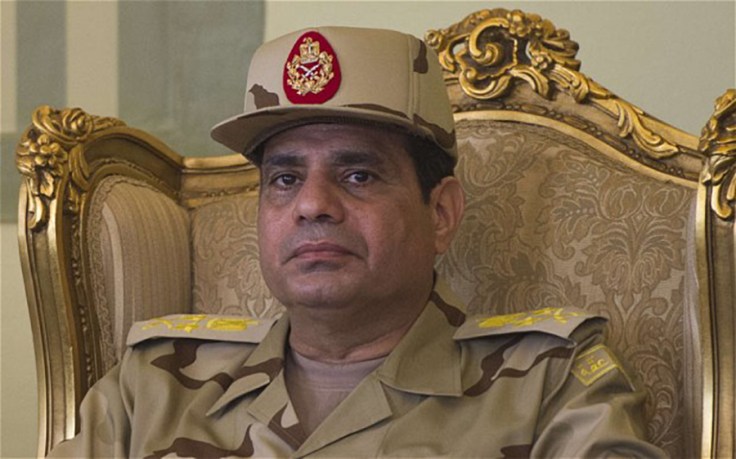
The Facetious Chronicles of Al-Sisi the Fascisi

The Egyptian Neroah churns a half-smile while Cairo slow-burns and Egypt dies. AFP PHOTO / KHALED DESOUKIKHALED DESOUKI/AFP/Getty Images

It turned out to be true. It was the most disgusting capricious report one could imagine, so much not only I but also so many other Syrian activists could not believe it, but it turned out to be true. Al-Sisi, the Wankertator of Egypt, and the jaundiced junta supporting him, did in fact hoist this attached banner in the streets of Cairo.

The banner shows  smiling Al-Sisi sporting his military uniform standing next to a child waving at the dead body of Aylan, the Syrian Kurdish child who drowned off the cast of Turkey in September 2015, and whose death brought international attention to the plight of Syrian refugees, at least for a few weeks, before governments decided to ignore it again. The text accompanying the banner said: “A child who lost his army.”

For those who don’t get how macabre this gesture is, bear in mind that Aylan and his family were trying to escape the violent and bloody repression of the Assad regime’s army, the army that was to be protecting them, when their boat overturned and they drowned. Al-Sisi’s people are standing the truth on its head in order to justify their repression at home and their support of the maniacal regime of Bashar Al-Assad.

There is something so macabre and anathematic about dictators’ continued existence in this day and age, something that poisons the soul and militates against one’s own sense of humanity. No justification works anymore. They are neither father figures, nor modernizers, nor peacemakers, but maniacal ravishers and a deadly plague. Yes, they have some popular support, but some people are willing to make peace with cancer knowing that they would die of it, but, no matter what they think, they have no right to kill the rest of us. Because this particular cancer does not discriminate. This applies to Al-Sisi’s supporters as well as those of his earlier Islamist iteration: Mursi, the little horsy that couldn’t deceive enough people for a long enough time to sacralize his Islamist agenda in the form of a constitution.

Being critical of both sides of Egypt’s malaise wins me no admirers neither in Egyptian or Syrian circles. Some Syrians expect me to support Mursi and oppose Al-Sisi based on their positions towards the Syrian conflict, not their overall policies and worldview. But no can do.

When Al-Sisi mounted his coup, I was sad and wrote something like this on Facebook page: this is what the Muslim Brotherhood’s blind hubris managed to accomplish – it facilitate a return to military rule. I don’t support coup d’état’s but I cannot support religious autocracy, even if its wannabe founders came as a result of a popular vote. Indeed, the inability to understand that winning an election does not entitle one to rule as he and his party pleased, refashioning the state in their image and according to their particularistic vision, this inability does emanate from wishful stupidity but from willful blindness and Machiavellian machinations. Willingness to compromise is the only way out of this crisis, but many people cannot handle compromise it seems, and nuance is not something that they are used to. To them, I cannot be against Al-Sisi’s coup and not for MB. I am either for this side, or that side. And being with a side means treating its representatives as heroes. And our heroes are always saints, our villains perfectly villains, the ones inside and the ones outside. And our victimhood, for we are victims after all, we must be victims seeing how weak and insignificant we are, there is no denying this, not by any stretch of the imagination, our victimhood is always a perfect undeserved one, one to which we did absolutely nothing to contribute. It’s always the other’s fault: the others inside, and the others outside. That makes all of us guilty, therefore, none of us is.

So, here it is Egypt a victim of terrorism, but that infamous recent terrorist attack didn’t happen. This is probably why Egypt needs to maintain its position on the list of worst offenders against journalists.

source

Syria’s Opposition Conferences: Results and Expectations

Syria’s Opposition Conferences: Results and Expectations

Posted by: ARON LUND FRIDAY, DECEMBER 11, 2015

Now they’re all done—three conferences for three sets of self-proclaimed representatives of the Syrian opposition. One in Damascus, one in Syrian Kurdistan, and one in the Saudi capital of Riyadh. For a thorough background, have a look at Wednesday’s post on Syria in Crisis. For the latest on what did and didn’t happen, read on.

THE USUAL FARE FROM DAMASCUS

The government-approved conference in Damascus was billed as a meeting of what was termed the “patriotic opposition” and it took place under the slogan “Voice of the Interior,” Sawt al-Dakhel. Some moderate old school dissidents were in attendance, but most delegates were Assad-friendly reformists, non-revolutionary civil society figures, government-linked tribal leaders, or others of that general inclination. One of the best-known participants, Majd Niazi, is such a stalwart ally of the government that she was discreetly dropped from a series of Kremlin-sponsored negotiations earlier this year because the other participants found it impossible to take her so-called opposition party seriously.

As I wrote on Wednesday, the meeting in Damascus was essentially a media ploy, set up to delegitimize the meeting in Riyadh and broadcast images of an ostensible internal opposition criticizing the foreign-backed exiles. Some of the participants are undoubtedly sincere in their politics, but the meeting itself had nothing to do with independent anti-government forces organizing themselves.

The conference drew little attention except in Syrian state media and that reporting consisted mostly of quotes from delegates who attacked the Riyadh conference. According to a private newspaper owned by the president’s cousin, most speeches were about condemning foreign intervention, including one given by an Iranian diplomat.

THE KURDISH COUNTER-CONFERENCE

The meeting in Syrian Kurdistan was more deserving of the opposition label, although its participants have little in common with most of the people meeting in Riyadh. The conference had originally been advertised for the city of Rumeilan, but it seems it ended up being moved to nearby Derik, known as Malikiya in Arabic. More than a hundred delegates took part.

This conference too, was organized largely in response to the meeting in Riyadh, after Turkish pressure made sure to exclude the dominant Kurdish force in Syria from those talks. Since 2012, Syrian Kurdistan has been under the control of groups loyal to the Iraq-based leadership of the Kurdistan Workers’ Party, or PKK. They use a variety of acronyms and front groups when operating in Syria, but the most recent one—which includes a few smaller Arab and Syriac groups—is a military umbrella organization called the Syrian Democratic Forces, or SDF.

The PKK leadership has played its cards beautifully since the Syrian war began. Having muscled out all Kurdish rivals, the group now receives military backing from the United States through the SDF, while other groups in the PKK sphere, such as the Democratic Union Party, or PYD, work hand in hand with Russia. They have hostile relations with nearly all of the mainstream Arab opposition, not to mention the jihadists, but this is offset by tense yet working ties to Assad. Materially speaking they have done better than any other group in the war. Though they would have been a very poor fit for the delegation chosen in Riyadh, as they are at daggers drawn with most of the other armed groups invited there, the Kurds would seem perfectly placed to benefit from any future peace talks. But instead, due to Turkey’s relentless hostility to the PKK—regardless of the acronym du jour—they fear being excluded altogether.

Now, to outmaneuver Ankara and ensure Kurdish participation in the peace talks, whether as a part of the mainstream opposition or in a separate third-force role—which would frankly speaking be a better fit—the PKK has started to reconfigure its political approach. Using the new SDF coalition, the organization strives to conceal its own commanding role while adding non-Kurds to the group and presenting it as a national opposition alliance rather than as a narrow regional or ethnic project. In this way, they’re playing to what could be a critical mass of interested actors, collectively able to override Turkish objections: Americans, Europeans, Russians, Iranians, and the Syrian government.

To this end, the Derik conference has elected a political counterpart to the SDF, a 42-member body which will be known as the Democratic Syrian Assembly. While most of the groups involved in the conference were either PKK fronts or closely tied to the PKK and its network in Syria, there were also a few other local groups and figures tolerated by the PKK loyalists, as well as a number of Arab and Syriac dissidents.

Of the non-local, non-PKK delegates, most appear to be linked in one way or another to the industrious exile dissident Haitham Mannaa. A leftist intellectual and human rights activist based between Paris and Geneva, Mannaa recently split from the National Coordination Body, a moderate coalition based in Damascus (its remaining leadership has grown close to the Russians and the group took part in the Riyadh conference). He then enlisted the help of his allies in exile and in Syria to create three new organizations: his own Qamh Movement, the Gathering of the Pact for Dignity and Rights, and the more broadly-based Cairo Group. All of which were present in Derik.

THE RIYADH CONFERENCE

Now, let’s move on to the main course: the Riyadh conference. Wrapped up on time, on December 10, the event was met with widespread and unsurprising acclaim from the organizing governments and other nations sympathetic to the Syrian opposition. “We welcome the positive outcome of the gathering of the Syrian opposition in Riyadh,” wrote the U.S. State Department in a congratulatory message, hailing the “broad and representative group of 116 participants.”

At the meeting, a final statement was adopted that laid out the principles for the upcoming negotiations with the government of Syrian President Bashar al-Assad. Among them, according to a widely circulated draft, was “faith in the civilian nature of the Syrian state and its sovereignty over all of Syria’s territory, on the basis of administrative decentralization.” The document also expressed a commitment to “a democratic mechanism through a pluralistic system that represents all segments of the Syrian people, men and women, without discrimination or exclusion on a religious, sectarian, or ethnic basis,” organized by way of “free and fair elections.” The delegates promised to “work to preserve the institutions of the Syrian state, although it will be necessary to reorganize the structure and formation of its military and security institutions.” There would be a state monopoly on armed force. They condemned terrorism and stressed their refusal of “the presence of any foreign fighters.”

Regarding the upcoming talks, the delegates expressed their readiness to engage in a UN-supervised political process such as that described in the November 14 Vienna communiqué, which calls for Syrian-Syrian negotiations by January 2016 and a ceasefire by June of the same year. However, they asked the international community to “force the Syrian regime to perform measures ascertaining its good faith before the start of the negotiating process,” such as an end to death sentences and starvation tactics and a release of prisoners. The start of a ceasefire was linked to the creation of a transitional government, as sketched out in the Geneva Communiqué of 2012. Regarding the most crucial question of all, the conference stated that “Bashar al-Assad and his clique” have to leave power at the start of the transition—not at the end of it.

Last but not least, the delegates also agreed to create a High Negotiations Committee, tasked with electing and overseeing a team of 15 negotiators who will face the government delegation and decide the future of the country. And that, of course, was where it got tricky.

AHRAR AL-SHAM PULLS OUT

Syrian opposition meetings are typically marred by any number of angry walkouts, but in this case there were only two.

The first came in the form of Haitham Mannaa’s last-minute announcement of a boycott. It was slightly disingenuous as by that time it was already clear that Mannaa’s allies were headed to the Kurdish conference instead. Most of the people involved shrugged it off.

A more damaging blowup came when Ahrar al-Sham, the most powerful and most hawkish Islamist armed group among the attendees, was asked to sign off on the agreement. Having already criticized the inclusion of Russia-friendly groups like the National Coordination Body, Ahrar al-Sham balked at what it saw as a watered down and secular-leaning statement and a High Negotiations Committee stacked with anti-Islamist, doveish, and borderline regime-friendly factions.

The armed rebels at the meeting—various Free Syrian Army groups, Ahrar al-Sham, the Islam Army, Ajnad al-Sham, and others—had been pushing to demand half of the seats on the High Negotiations Committee. They got a third instead and most were fine with that. But just as the talks were being wrapped up, around four or five a clock in the afternoon, Ahrar al-Sham issued a public statement saying they were withdrawing from the conference. This caused serious concern among both dissidents and organizers, since Ahrar al-Sham’s integration with the rebel mainstream was one of the main goals of the Riyadh conference.

Different sources at the conference have provided me with different accounts and chronologies, but it appears that the Ahrar al-Sham delegate, Labib Nahhas, who is one of the group’s most well-known doves, simply decided to go ahead and attend the signing ceremony anyway—perhaps after securing support from one or more leaders who were not present. The signing took place at around half past six that evening and Nahhas put his name down as a representative of Ahrar al-Sham.

Then, the confusion began. When reporters pointed out out that Nahhas’s signature was on the document, several high-ranking Ahrar al-Sham leaders (who were not present in Riyadh) responded on social media by confirming their decision to withdraw and not sign. At the time of writing, the fog hasn’t quite cleared, but it appears that Nahhas was more or less acting on his own in signing the statement and that Ahrar al-Sham’s leadership in Turkey and Syria has indeed opted to boycott the meeting. Several sources tell me that this is a manifestation of a longstanding struggle between hawks and doves inside Ahrar al-Sham. But there also seems to be an external element to the conflict. Ahrar al-Sham’s leaders and members inside Syria are being pressured by their Nusra Front allies to abandon all peace talks. But, their leaders are simultaneously browbeaten by foreign diplomats who insist that the group must firmly commit to the UN process or risk losing support, and that it may even end up on a terrorist black list.

If Ahrar al-Sham backs away from Nahhas’s signature, or tries to hedge its bets, it would not necessarily be fatal to the outcome of the Riyadh conference. The group might be dragged onboard again later—and, for the moment, the Saudis and other organizers are simply going to proceed as if there were no dispute, in the hope that Ahrar al-Sham’s leaders will come around in the end. Ahrar al-Sham might also decide that ambiguity is in its best interest and simply let all sides believe what they like. But if the group ends up publicly distancing itself from the conference, it would be very bad news for anyone who had hoped to see broad-based unity and a credible diplomatic delegation emerging from the meeting in Riyadh.

THE HIGH NEGOTIATIONS COMMITTEE

Even though the Riyadh conference has ended, there are still last-minute fixes being done to the composition of the High Negotiations Committee. Several versions of its membership are currently circulating. What seems to have been agreed upon is a list of 34 members. It originally stood at 32, after the addition of extra rebels, but is now up two more after negotiations and renegotiations.

Of the 34 members, nine come from the National Coalition, Syria’s main alliance of politicians in exile. They include people like current National Coalition President Khaled Khoja, his predecessor George Sabra, veteran dissidents like Riad Seif and Soheir al-Atassi, Mohammed Farouq Teifour of the Muslim Brotherhood, the Kurdish politician Abdelhakim Bashar, and the former Syrian prime minister Riad Hejab.

Another five are drawn from the National Coalition’s main rival, the much smaller and more moderate National Coordination Body. Among them are Safwan Akkash, a communist politician who serves as the group’s secretary, and the veteran Nasserite dissidents Mohammed Hejazi and Ahmed al-Esrawi.

Nine others are listed as independents, though many of them are in fact linked to political groups. There, we find Louai Hussein, an Alawite leftist intellectual and former prisoner of conscience, who is the head of the Building the Syrian State Movement, a small pacifist group. There’s also Ahmed al-Jarba, a former National Coalition president with strong ties to Saudi Arabia.

Finally, eleven members are drawn from the armed rebel groups, up from six when the conference began. It remains somewhat unclear how their seats are going to be distributed and whether they will be at the free disposal of certain groups or tied to individuals elected at the conference. Several names have been mentioned, however, including Mohammed Alloush of the Islam Army and Labib Nahhas, the Ahrar al-Sham delegate (it remains to be seen whether he will take his seat). There are also representatives of various Free Syrian Army factions, apparently including Bashir Menla of the Jabal Turkman Battalion and Hassan Hajj Ali of the Suqour al-Jabal Brigade.

THE COMPOSITION OF THE COMMISSION

While the list isn’t yet confirmed, a few things stand out. The most obvious problem is the fact that Abdelhakim Bashar was the only Kurd elected to the Higher Negotiations Committee. Bashar is a senior leader of the National Coalition and closely aligned with the Kurdistan Democratic Party in Iraq, which backs his Kurdish National Council.

Abdulbaset Sieda, himself a Kurd and active in Kurdish nationalist causes for decades, is not happy. “Many Kurds are bothered by this,” he tells me. “To have only one Kurd among 33 or 34 persons elected, that’s completely unacceptable.” He puts some of the blame on the Kurdish National Council itself, saying that it should have tried to secure places for a delegation of its own in Riyadh, to ensure Kurdish representation through the electoral system. With no pre-arranged constituency for Kurdish participation, the voting procedure took care of the rest.

“Every delegation was allowed to appoint its own representatives after negotiating their number of seats on the Higher Negotiations Committee,” explains Sieda. “The National Coalition ended up with nine seats at its disposal, so we tried to create a pluralistic ticket and make sure that we appointed one Kurd, one Alawite, one Christian, one member of the Muslim Brotherhood, one representative of the clans, and so on. Among the nine, we appointed Abdelhakim Bashar.”

“The National Coordination Body also had a Kurdish member in their delegation to Riyadh, Khalaf Dahoud—he is close to the PYD—but they did not put him in their five-person quota. I don’t know why. Then there were a few Kurds among the independents, but since the independents were from many different groups and could not decide beforehand who should hold their eight or nine seats, they had to hold an internal vote about it. That ended with no Kurd being appointed on their ticket either.”

“Now, the idea is that the High Negotiations Committee will appoint a delegation to meet the government,” says Sieda, clearly troubled by the outcome of the vote, although he says it happened more by accident and oversight than by design. “Hopefully we can correct the error then by making sure there are Kurds among the negotiators.”

At the moment, however, the Higher Negotiations Committee is overwhelmingly Arab, despite a couple of Turkmen dissidents (Khaled Khoja and Bashir Menla). On the other hand, there are at least some representatives of all the main religious minorities, including Alawites (such as Mondher Makhous), Christians (Hind Qabawat), and Druze (Yahia Qodmani). Bedouin tribes are also represented, Salem al-Meslet being a prominent figure in the Jabbour tribe and Ahmed al-Jarba a leader of the eastern Shammar confederation. More generally speaking, the political portion of the list has a strong secular streak, although this will be significantly diluted by the eleven rebel appointees.

As for the catastrophic under-representation of women—only Hind Qabawat and Soheir al-Atassi, as far as I can tell—it is unfortunately standard fare in Syrian politics. And non-Syrian politics too, for that matter.

source

Blog at WordPress.com.

Up ↑