Search

band annie's Weblog

I have a parallel blog in French at http://anniebannie.net

Category

Syria

Syria specialisation in torture

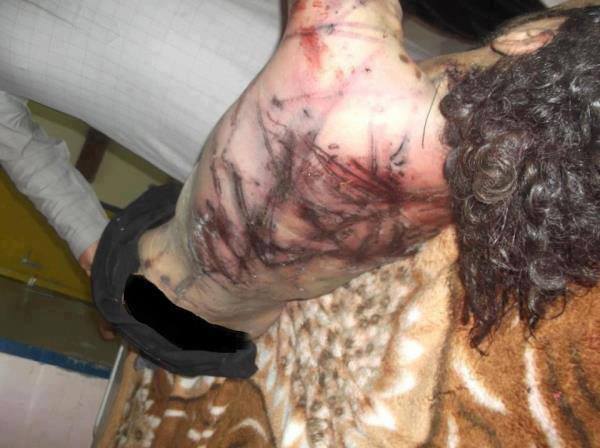
Radio Free Syria ‪#‎Hama‬: These are some of the horrific scars left on just one recent former detainee by torture in one of the Assad regime’s detention centres.

yort

The detainee’s face, torso and other body parts were also horribly disfigured by his torturers, who also hung him by his arms from a hook in the cell ceiling for days on end while carrying out their monstrous and inhuman brutality.

This is not unusual, not an isolated incident; this is the nightmarish norm for Assad regime detainees, male and female, young and old, many of whom are imprisoned and tortured simply for voicing opposition to or protesting peacefully against the regime.

Many die under torture in regime detention –

70 people were documented killed under torture in regime detention in the first week of Ramadan this year alone.

Those are only the documented cases.  These crimes against humanity did not begin with the revolution; this has been the Assad regime’s standard ‘punishment’ for dissidents for over 40 years.

Indeed, so globally infamous is the Assad regime’s unparalleled talent for torture that other nations have even outsourced their own inhumanity to the regime’s universally acknowledged world leaders in the field.

In the words of Bob Baer, former CIA agent, writing about the CIA’s ‘extraordinary rendition’ program in the ‘War on Terror’, “If you want a serious interrogation, you send a prisoner to Jordan. If you want them to be tortured, you send them to Syria.”

pet

Yassin-Kassab versus Landis

Qunfuz

Robin Yassin-Kassab

Thanks to Joshua Landis for posting (at Syriacomment) this dispute, which originally took place on Sultan Saoud al-Qassimi’s facebook page. I earlier took issue with Syriacomment’s coverage here.

Sultan Sooud: Great read by Joshua Landis on Obama’s three options on Syria. The one, two and three state solutions.

Racan Alhoch: I love orientalist solutions. They are always a modified version of the Sykes-picot. The best solution would be for people like Landis to fuck off.

Joshua Landis: Rocan, I am not sure what is orientalist about these possible outcomes. If Assad hangs on to the south is Syria and the rebels hold the north it will not be because of the west. It will be a Syrian solution. If the rebels are able to conquer Damascus it will probably be thanks to help from the West.


Ruba Ali Al-Hassani: Joshua, a solution and an outcome are two different things. Not all outcomes are solutions to the problems which created them. The current civil war is not an outcome of deep divisions amongst Syrians. Rather, it is an outcome of external meddling in a conflict between the people and their dictator. Foreign militants have been brought in, recruiting a few Syrians, with the funding of external players, pitting them against each other on the basis of sectarianism. This is what escalated matters.
Borders in the Middle East have a long history with being drawn and redrawn by colonial powers, or in resistance to them. Therefore, it is Orientalist to come along and tell Syrians that they cannot solve their problems, and that the best way is to keep them apart from each other through another attempt to redraw their borders. Only when the Syrians ask for that kind of “solution” will it ever be okay…

Robin Yassin-Kassab: this is not at all a great read, for several reasons. the first is that it contains a plain untruth. the coastal region does not have an alawi majority. the mountains of the coastal region have an alawi majority, though there are also christian and sunni communities. the coastal cities have sunni majorities.

Joshua Landis: Robin, so do Lebanon’s coastal cities have a majority Sunni population. I am not sure what your point is. The Ottoman legacy is that there is a Sunni majority in the cities and the plains. In 1920 Alawites and Sunnis shared no town of over 200. Demographic segregation was very stark. There is much greater mixing today. It is hard to see where this bloodshed ends. That is the problem. There are no good solutions. Do you think the US should pump in the weapons until Sunni rebel militias have conquered Damascus and the coast?

Dick Gregory: “Do you think the US should pump in the weapons until Sunni rebel militias have conquered Damascus and the coast?” – I think not calling the FSA a Sunni rebel militia would be a start. I assume the point is that to create a mini-Alawite state would require the ethnic cleansing or cowing of the majority, and so is an even more impractical alternative to a revolution for all Syrians.
The suggestion that Obama could get the F̶S̶A̶ Sunni militias to fight one war against Assad and another against radical Islamists simultaneously is also highly questionable, and that they are likely to massacre non-Sunnis en masse in the event of victory re-writes the history of the conflict. Not a well written article

Robin Yassin-Kassab: i am not sure what landis’s point is. so what if lebanon’s cities have majority sunni populations? i never argued for the separation of lebanon from syria (I wasn’t here, obviously). lebanon is lebanon, with its own sectarian set up, and even with that set up, it isn’t supposed to be a shia or druze or maroni or sunni or alawi state. landis writes in his article that there is an alawi majority in the coastal region. i pointed out that this is not true. that’s my point: the truth. the importance of not twisting facts to fit our poor arguments. beyond that, i do not think that setting up an alawi state is a good idea or an acceptable outcome. it would involve a massive ethnic cleansing of sunnis from tartus, banyas and lattakia, and of alawis from homs and damascus. it would also leave syria without a port. it would also destabilise turkey. if it were under the control of this criminal family, it would be a threat to humanity. so far there has been no mass slaughter of alawi civilians, no ethnic cleansing of alawis to mirror the massacres and ethnic cleansings perpetrated by the regime. yet landis keeps on scaremongering. the revolution certainly has a sectarian aspect now, after the best efforts of assad and his allies, setting up sectarian death squads, attacking sunni heritage, etc. landis has been painting it as sectarian from the very start, however, ignoring the coordination committees in favour of salafists. thankyou, Dick, for your comment. it’s a slander to call the fsa a sunni militia. yes, it has a sunni majority (like syria) and a sunni character. i’ve just been in syria and turkey where i spent time with ismailis and christians amongst others. the ismaili was telling me in detail about the armed struggle (led by ismailis) around selemiyyeh. yes, i think the us, europe, the arabs, japan… should allow the syrian people to arm themselves to defend themselves from genocide and to end this child nmurdering regime. because the child murderers represent a tiny majority of the population, they lose as soon as the other side gets any sort of weapons supply. i don’t agree that it would take forever for the resistance to liberate damascus. or the coast for that matter – but the coast could be ‘won’ by negotiation once the people there see the regime has no future.

Robin Yassin-Kassab: you always say, ‘i don’t know what your point is.’ when you reported hussain harmoush’s tv post-torture ‘confession’ as if it meant something, and even discussed it… ‘hmm, harmoush says he was paid by the muslim brothers, and by the martians… very interesting’, and then i complained, your answer was something like…’everyone who reads syria comment is well educated and they understand that he was tortured and that his words don’t mean much.’ that’s a great response. so when you write that the coastal region has an alawi majority, it doesn’t matter that it isn’t true because you expect your audience to be intelligent enough to understand. you should write that the fsa is a communist organisation backed by nepal, just for fun, because your audience is clever enough….

Joshua Landis: Robin, lots of accusations. Let’s take the first one – the ethnic or religious population of the Coastal region. Can you tell me what the religious make up of the Coastal region is? Until 1960, when the last census was taken that listed Syrians by religion the Coastal region was predominately Alawite. Of course this depends on where you draw the line in the East, but your argument is that the Sunni majority in the coastal cities is larger than the Alawi majority in the Mountains. This has never been true so far as I know, but I welcome being corrected by any statistics you can provide. I quote the following from something I wrote in 1997. I highlight the sentence most important for our discussion:

“Although Alawites constituted roughly seventy percent of the region’s population [The Alawite state created by the French] of 350,000, they held sway over no town with more than 1000 inhabitants. “

“When the French arrived in the Alawite territory in 1920, the separation between the Alawite and Sunni communities could hardly have been more profound, a fact used to justify their policy of dividing the region from the rest of Syria. In the “Dawla al `Alawiyyin” (the State of the Alawites) established in 1922, not one Alawite was registered as a permanent resident of Latakia, the regional capital (26,000 inhabitants in 1935), or in the other Sunni dominated coastal cities: Jablah (6,300), Tartus (4,500), and Banyas (2,170). The only city that permitted Alawites to live within its walls was Safita, a Christian town high in the Alawite Mountains (total population 2,600, with 300 Alawites).

Although Alawites constituted roughly seventy percent of the region’s population of 350,000, they held sway over no town with more than 1000 inhabitants.

The division of urban and rural populations along sectarian lines in the Alawite region was almost absolute. The Sunni population was entrenched in the cities, where it exercised a monopoly on political power, education, and prestige. Sunnis, Weulersse writes, lived like “parasites” off the Alawites who were scattered in small hamlets throughout the countryside and mountains. Even in 1945, the year the muhafaza of Latakia was finally united with Syria, the number of Alawites who lived permanently in major Syria cities was minuscule. Latakia had a population of only 600 Alawites; Aleppo had 480, and Damascus only 40. These numbers indicate the extent to which the Alawite community remained a closed society, inward looking, and cut off from the main currents of Syrian intellectual and urban life right up to independence.

Today, most Alawites over the age of 45 can recount personal stories of Sunni school children throwing stones at Alawites as they walked to or from school. The alienation of Alawites from Sunni society and their bitter experience of persecution made creating a common sense of nationalism particularly difficult following independence. Even within the most progressive political parties which took shape during the 1940s, tension and mistrust between Alawites and Sunnis was never far below the surface and often threatened to rise to the surface.”

Robin Yassin-Kassab: i don’t know why you are telling me about the historical persecution of alawites. as you know, i have myself written about this on several occasions. I have often pointed to this as necessary historical context to the sectarianism of the assad regime. you don’t need to prove yet again your emotional ties to the alawi community. it’s perfectly obvious and always has been. yes, i would presume that an urban majority constitutes more people than a rural majority. that seems like plain logic to me. in any case, you yourself on previous occasions have described the coastal region as having a sunni majority. i’m sure that if you were to draw a line around the mountains you could find an alawi majority, but i don’t think that would be in the interests of alawis, sunnis or anyone else…..it’s always important to recognise past oppressions, but these do not justify present genocides or ethnic cleansings, nor carving up countries on ethno-sectarian lines. the holocaust does not excuse slaughter in sabra and shatila or gaza. the safavids do not excuse saddam hussain. saddam hussain does not excuse the exclusion of iraqi sunnis. ibn taymiyya does not excuse assad.

Robin Yassin-Kassab: in any case, in perfect orientalist style you are ignoring contemporary history in favour of the distant past. ‘alawis’ have been in charge for over 40 years.alawis have been living in the cities, making friends with sunnis, in some cases marrying sunnis. in this time the regime actually oppressed alawi ulama and community leaders and deliberately kept sectarian hatreds bubbling for divide and rule reasons. they had four decades to address the problem, to manage a public conversation and reconciliation. they chose to do the opposite. and when challenged by a democratic movement for secular rights, they deliberately lit the fuse of sectarian conflict by implicating alawis in their death squads and massacres, and by their propaganda.

Joshua Landis: Robin, I couldn’t agree with you more about oppression. I in no way wish to defend the Assad regime, which is guilty of brutal and indiscriminate killing of the worst kind. I have emotional ties to all Syrians. My point is about the demographic realities of Syria. If one draws a line down the Eastern side of the Alawite mountains, where the Alawite majority population gives way to a predominantly Sunni majority and counted the religious distribution of all those to the West of that line, the Alawites would be the majority. That is my simple contention. It does not mean that they deserve a state or could maintain one or that it would be fair for the Sunnis of the coastal cities. I am simply trying to establish some basis for understanding the region. Would you agree to that simple statistic?

Joshua Landis: Robin, You are absolutely correct about the deeply sectarian nature of this regime and its response to the uprising. In fact, my first article for the Economist, dated, Jun 14th 2011, was entitled “Deeply Sectarian.” We are in perfect agreement about the sectarian nature of the regime and ensuing mess it has created.

Robin Yassin-Kassab: joshua, i think of you as a well-meaning person, but i can’t help but think too that your skewed commentary on the revolution has helped assad confuse the issue in the west. no, i don’t think i would agree with your simple statistic. i think the sunni majority in the cities probably outweighs the alawi majority in the mountains – but of course i can’t prove it, and it may be that now, at this precise moment, there is a slight alawi majority because so many alawis from damascus and homs have moved to tartus to flee violence.

Robin Yassin-Kassab: ruth – i very nearly ‘liked’ your comment but didn’t for the simple reason that most alawis have not actually benefitted from the regime. some certainly have, but many more haven’t. they’ve been terrified by regime propaganda and implicated in the regime’s crimes. now they are losing thousands of young men fighting for this monster. most are victims of the regime. if over the last decades the community had been allowed to develop itself, to produce its own leaders, to initiate its own dialogue with sunnis, it (and all of us) would not be in this situation now

Joshua Landis: Why don’t we leave this on the happy note that you consider me “well meaning.” I, of course, do not think my analysis has been skewed. On the contrary, my warning that this struggle would end up much like Iraq or Lebanon — i.e. going sectarian — has proven to be the case. You have argued from the beginning that my commentary has caused this, but I would humbly suggest that is to give me much too much agency and importance. I have simply described what I believe to be the reality of the Syrian situation. I believe that I have been fairly accurate. Of course, I have made my share of mistakes, but not, for the most part, on the big things. I wrote early that this would go sectarian, that the regime was deeply sectarian, and would turn this into a sectarian struggle because Alawites feel persecuted and have a history of being persecuted, which they have not gotten over. I have tried to inject as much history into this as possible – and I think the history is important and not just some distant baggage that should be ignored. The Alawites should have gotten over their persecution and “minority complex” and Assad should have given up power in the first weeks of this uprising in favor of a constitutional convention, but he did not.

So we are where we are, which is very ugly. Sunnis now feel like a persecuted minority, and with good reason, they have been persecuted. I doubt there will be an “Alawite state” – even one with a big Sunni minority residing in it – established on the coast. Most probably the “status quo” will prevail for some time.

The status quo is the division of Syria into a revolutionary forces controlled North and North-East and government controlled South and Southwest. This will leave the Assad government ruling over a large Sunni majority and Damascus, which will be very unstable. I suspect the North will also be very unstable because the FSA and other militas agree on little beyond their desire to rid themselves of the oppression of the regime.

The US and the West wants to hurt Hizbullah and Iran, but I am not sure if it has “Syria’s” interests uppermost in its calculations. My essay about the three possible scenarios is meant to underline this. I try not to pick “a best scenario”, but simply point out the difficulties with each.

Maxwell Ryder: Robin, you are a sharp knife in a drawer full of dull knives. Thank you for each post. I couldn’t agree more, though I did not like the “dick” part.

Robin Yassin-Kassab: of course i don’t think your commentary caused this. i think (like you, it seems) that assad and his allies caused this. i think your commentary (indirectly) helped assad get his sectarian message across to the west from the earliest days. you didn’t so much bear witness to the ways in which assad lit the sectarian fuse as focus on the sectarianism of the opposition, even at the start when the remarkable thing was how a sectarian society was able to produce such a non-sectarian discourse. you focussed on obscure salafists rather than the central local coordination committees. you are probably right about the status quo, which is a disaster for syria and, increasingly, for the region and the wider muslim world. my contention is that the opposition has the vast majority on its side. it has been able to conquer vast swathes of the country for this reason, despite being so poorly armed. therefore i believe that a serious effort to arm the opposition would allow it a reasonably speedy victory. then syria could start the difficult process of picking up the pieces. because commentary like yours is dominant, however, there probably won’t be a serious effort to arm the opposition, and the status quo will continue. even now after hixbullah’s open involvement, the west and the arabs are only talking about ‘restoring the balance’. in other words, let syria bleed. let the wound expand.

Robin Yassin-Kassab: Maxwell – thanks. the ‘dick part’ was not the insult you think it was. i was referring to my friend Dick Gregory, who commented above.

Joshua Landis: I agree that Alawites, to the extent that we can generalize, are oppressed and have little if any freedom of choice. Assad treats Alawites as he treats the rest of Syrians, as his slaves. But I would caution that this does not mean that Alawites will turn against the regime any time soon. They feel like the knife is at their throat. At least that is what many say, now that this struggle has become very sectarian. Almost every Alawite i have talked to gives me a five minute soliloquy on how he or she is not an Assad supporter and how Assad has gotten them to this terrible situation, but then they go on to reproduce the Assad line about Sunni extremism and how they must defend themselves, etc. I think understanding their dilemma is important to any solution. One cannot just dismiss their fears or this war will drag on for a very long time.

Robin Yassin-Kassab: i agree with that. we must also remember the brave minority of alawites who, despite their well-founded fears, are working for the revolution in public or in private. during my recent trip i heard about alawis secretly providing food and medicine to the besieged areas.

source
Along Sectarian Fault Lines, a ‘New Normal’ Emerges

QALAAT AL-MADIQ, HAMA PROVINCE / Just a few years ago, Syrian students in this Sunni town had to pledge allegiance to Baath party principles and express loyalty to Bashar al-Assad. Now the graffiti on classroom walls here points to the transformation of Syrian culture and identity over two years of war.

Qalaat al-Madiq is surrounded by Alawite villages and ringed by Syrian Army checkpoints. But the regime’s control stops there.

An ancient castle overlooks the sectarian fault lines in modern Syria. Courtesy Mohammed Sergie

An ancient castle overlooks the sectarian fault lines in modern Syria. Courtesy Mohammed Sergie

At the local high school, slogans expressing love for death and martyrdom are wedged between calls for freedom and the names of various rebel groups operating in the region. Photographs celebrating top graduates from years past have been partially defaced, removing any sign of the posters of Bashar and his father Hafez al-Assad that students were forced to pose with over decades of the family’s rule.

“We can’t control this generation even if we wanted to,” says a teacher at the school. “These kids are living the revolution.”

Teachers try to stick to the curriculum, preparing students for national standardized tests that are still offered in the town, which sits at the foot of an 800-year-old castle overlooking the sectarian fault line of the Orontes River in Hama province. But many older students have abandoned their studies to link up with rebel groups, or have fled to safer areas near the Turkish border.

“We are trying to lead normal lives, but there’s a lot of death and poverty around us,” the teacher says.

Syrian soldiers stationed at the castle and further east routinely shell the Sunni town, damaging two classrooms at the elementary school and a mosque in April. (Both locations were empty at the time.)

At the time, Bassel, a fifth grade student, rushed to his school to inspect the damage. Still a typical kid, he says he was disappointed to find out that his classroom wasn’t hit. “It isn’t fair that I have to go to school when the other kids get to play.” Life continues as normally as possible in this town, increasingly punctuated by violence and deepening sectarian tensions.

Government employees report for duty at the water plant and grain silo, and technicians look after the electric grid. Many shops have reopened after government soldiers and militias from neighboring Alawite villages looted and burned the market in the fall.

Abdul Kareem owned a children’s clothing store on the town’s main street, but he lost his goods in the last government offensive and couldn’t afford to restock the business. Now he lives off his dwindling savings and rents out the space to a food vendor for a meager income.

“We know the people who looted the Qalaat. They are the same people we used to visit and drink [alcohol] with, and I never imaged they had so much hatred in their hearts,” he says. The pro-Assad militia members left their own graffiti in the town. Alongside  the familiar pro-Assad slogans, there is this message: “We ruled you and oppressed you, if you rule us don’t show us mercy.”

The town’s castle soars over the Ghab plain surrounding the Orontes River, a strategic perch that controls the entrance to Alawite land in the mountain range that separates  the Orontes from the Mediterranean Sea. Many residents trace their heritage to the castle. (It was inhabited by 300 families until 2012, when it was shelled and occupied by the Syrian military.)

Abdul Kareem grew up inside the castle, and his father was still living there last year. His eldest son, a scrawny 17-year-old who was once a promising student, has dropped out of school and spends most of his time with the Farouq Brigade, one of the largest rebel groups in Qalaat Al-Madiq.

“I’ve tutored him for years, and he should be on his way to medical school,” Abdul Kareem says. “I wish he didn’t have to lose his future.”

War has transformed this town. Abdul Kareem and other men in the town used to visit friends in the nearby Christian village of Al Suqaylabiyah for nights of drinking, but now even government employees are reluctant to venture there for fear of harassment from soldiers at checkpoints.

In response, Sunni Islamic identity has been resurgent, and people have become more pious. Many families send their children to the mosque for religious lessons, and much of the graffiti on the school walls carry Islamist and Sunni themes.

Hama, Homs and Latakia provinces are tinder boxes for potential sectarian conflict. They’re expected to be “ground zero” of a coming sectarian war between Sunnis and Alawites. Tensions are already running high. Few residents in Qalaat al-Madiq can imagine a return to the pre-conflict structure, with Alawites in control of the government and state-owned industries.

Grain silo and cemetery in Qalaat al-Madiq. Courtesy Mohammed Sergie

Grain silo and cemetery in Qalaat al-Madiq. Courtesy Mohammed Sergie

Omar, a government employee who still collects a paycheck from his job at the town’s grain silo, says his work is a necessary function and that remaining on the payroll doesn’t mean he supports the Assad regime.

“I saw the shabiha looting and arresting people in the Qalaat from my window at work,” he says. “It’s impossible for me to trust Assad’s army or the Alawite shabiha in our areas again.” The grain silo is running low this year, a result of the collapse of Syria’s agriculture industry.

Omar doesn’t have much to do at work. His view of the historic castle and lush valley provides an idyllic escape, but it’s only a momentary relief. As with many other Sunni towns in Syria, residents here have opened new graveyards to bury their dead. Qalaat al-Madiq’s “martyr’s cemetery,” housed at the grain silo, is always expanding. A constant reminder of war, it spoils Omar’s view.

Intellectuals, Help Syrians! (updated translation)

Introduction by OTW

Yassin

Syrian Opposition Intellectual Yassin Al Haj Saleh, who spent 16 years in the Assad dynasty regime jails as political prisoner.

A few weeks back, I posted a medical report from Yassin Al Haj Saleh, the Syrian intellectual and winner of  Prince Claus Award for 2012, in which he described the chemical weapon attack by the forces of war criminal Bashar al-Assad in the Eastern Ghouta region of Damascus country side. For a few months, Yassin lived there among the people of the Eastern Ghouta, and he recently summed up his experiences there to cast light on what is happening, and at the same time to issue a last call, or better yet, a plea for decency and humanity to western intellectuals and public opinion makers admonishing them to actively take the only humane and progressive act, which is to support the overthrow of the Assad criminal clan and crime partners and to force the stoppage of importing killers from the regime’s allies in Lebanon, Iraq, Iran, and elsewhere. Yesterday, Yassin’s letter was published in the French newspaper Le Monde under the title “Intellectuels, aidez les Syriens !” after being translated from Arabic to French by the Lebanese intellectual and supporter of the Syrian Revolution, Professor Ziad Majed and his colleague Nadia Aissaoui. The letter, written on June, 28, 2013,  appeared earlier today in its Arabic  original in the Republic for Syrian Revolution Studies as well as in the Lebanese newspaper النهار . I tried to find English translation and failed, so I translated the letter from Arabic to English. I do apologize for the rough edges of the translation, and would be more than happy to replace the text with better translation if someone is kind enough to edit it.

Rabi Tawil (AKA Abu Kareem) has kindly offered to edit the translation. The version posted on (8 July, 2013) is the result of his kind and generous help.  It definitely reads much better.


By Yassin Al Haj Saleh

A letter from Syrian writer Yassin Al Haj Saleh to Western Intellectual and Opinion Makers.

Dear friends

About three months ago, I headed to the “liberated” Eastern Ghouta region, leaving behind the capital city of Damascus where life has become suffocating. My clandestine departure necessitated weeks of prior-arrangements in a city , which had been dismembered by hundreds of security barricades, and which Bashar al-Assad is determined to keep as the center of the rule he inherited from his father thirteen years ago.

The Eastern Ghouta region is now inhabited by nearly half of  out of the two million who lived there before the revolution. It has been transformed during the past three months from a bastion  where the armed revolution was first launched in the capital  into an area besieged from all sides. This reversal is largely due to the military and logistical support of  the regime has received from Russia and Iran and from Lebanese and Iraqi Militia that are connected to the latter state. During that time, I myself witnessed the cruel lack of weapons, ammunition and even adequate food supply on the side of the rebel fighters. Many of the fighters on the fronts barely receive two meals a day. If they weren’t mostly local residents defending their towns and their families and living off what also sustains their families, the situation would have been immeasurably worse

968817_543585005704460_1726781563_n

Destruction of lives and livelihood are the hallmarks of the Assad clan response to the Syrian uprising., The photo was uploaded today (7, July, 2013) showing the aftermath of one of Assad’s bombing raids earlier today in the Eastern Ghouta.

The towns and villages which I visited and lived in during the past months are subjected to daily random shelling from airplanes, artillery and rocket launchers. Every day, victims, a majority of whom are civilians, succumb to the violence.  I spent a month at a civil defense authority site, and there, I saw all of those who were killed. Some of them, including children, were blown into unrecognizable pieces. Among the victims was a fetus of six months whose mother suffered a miscarriage from the the terror she suffered during the shelling near her house. Not a day went during that month without civilians getting killed. Usually it is two or three, but on one day it was 9, 28 on another, and 11 on a third. The numbers killed continue to rise and they are rarely less than half a dozen a day, again including a small fully formed fetus. It was said that he was also six month old, also miscarried by yet another terrorized mother.

In addition to civilians, many young fighters die every day to the weapons of a brutal and more powerful military force that receives  far superior support than they do.

The whole region has been without electricity for 8 months. This has caused a reliance on frequently malfunctioning generators with excessive consumption of fuel, which in itself is becoming increasingly scarce commodity due to the tight blockade. Consequently, cooling and storage of food, vitally necessary in the scorching summers of the region, must be dispensed with. Cellular and landline connections are cut-off;and in recent weeks, flour has become scarce. Two weeks have now passed during which we had barely ate any bread,getting by with crushed wheat or rice instead, or by purchasing our meals from the few restaurants that remain.

For my part, I was content with two meals a day, at least temporarily, as it helped reduce my weight by around 10 Kilos (nearly 21 pounds)

We manage communications via Satellite Internet equipment, smuggled in with great difficulty. We use the equipment to deliver news and information to other Syrians and to the world. Such communication equipment is, however, available to only a small percentage of the population. A shell landed nearby few days ago and disrupted the internet connection for some time. It could have been much worse had the shell  landed on our roof and destroyed two month worth of efforts to secure the equipment. But the ultimate tragedy happens every day to an increasing number of inhabitants. Hastily buried, their funeral processions are joined by few hasty mourners, terrorized by the prospect of another shell falling upon their heads. Such has happened more than once; and in one case, which I witnessed, the martyr was buried within less than an hour of his death without his wife and children taking a final look at him. His body was mutilated and some of his limbs were missing, prompting the elders to decide that this should not be the last sight of him to remain in his  wife’s and childrens’ memory.

We, I and a number of friends, both men and women, are still alive. In Damascus we were threatened with arrest and horrific torture which we may not survive. Here we are safe from that, but not from a shell falling on our heads at any time.

Here, we are partners with nearly a million people having lost complete control of our own destiny, and constantly at the edge of the  abyss of the worst possibilities. Each time I reach the threshold of the house returning from the outside, I feel that I have barely survived death by a shell or a  shrapnel.  And yet  death remains a probability entering randomly through the window or the door.

Today, Friday, June 28, three mortars fell between twelve noon and twelve thirty  on a place not far from where we are staying. The timing is too close to the Friday prayer time observed by faithful Muslims, to be a coincidence. I was most struck in my early days here that calls for Friday prayers in one mosque started about nine thirty in the morning, three hours earlier than the usual time, and this were followed by calls from other mosques each within a half an hour of the next. When I inquired about it, I received a surprising explanation: “The purpose is to avoid gathering large numbers of worshipers in the city’s mosques at any specific time to deprive the regime of the opportunity to kill maximum number of people as it usually desires”. The regime has done this before, in the city where I stayed, there are five destroyed mosques.

More painful is that more than two-thirds of the children here do not attend school, their parents fearing for their safety or  because of the the lack of schools nearby. The few functioning schools operate in underground cellars to avoid bombardment.  But this also prevents the children from playing and running in the open air.

All of the hospitals are also underground.

People engage in this struggle with a sense of desperation because of they realize that a terrible massacre awaits them if the regime succeeds in regaining control. Those not murdered immediately will face arrest and torture that is extreme in its brutality. Their choices are limited to death while resisting the fascist aggression of the criminal regime or death, in the ugliest of manners, at the hands of this same regime if they stop resisting.  The  souls of people shiver, as my own soul shivers from its depth at the mere thought of being ruled by the same regime once again, should the people stop their resistance.

During this long stretch in the life of the Syrian revolution, which has gone through a peaceful phase lasting for more than six months, the outcome of the policies of the influential powers of the world were to let Syrians be murdered at an escalating rate, and to reassure the regime that it can do anything with complete impunity. This is reminiscent of the Western Democracies’ behavior regarding Hitler before the Second World War. The current situation is a direct consequence of the failure of those influential powers to support the Syrian rebels, whilst failing to stop the support for the regime from the powers that provide it with  weapons, money and men, even as they continue to step up their support by intervening more openly and directly. Finally, after it became known to the whole world that the Assad clan regime used chemical weapons, which I myself documented two months ago,  as did other friends on the basis of personal experience, and after the regime was assured that its use of air power and long-range missiles against cities and neighborhoods will result in  nothing but faint and timid protest; after all of this,  Western powers decided to support the Syrian rebels with weapons. However, the objective of this support is to restore balance, a balance that they helped tip in the regime’s favor  in the first place.  Restoring balance means prolonging the Syrian conflict so that both sides lose in ways that have known  precedents in the history of Western Democracies, while what is needed is support that guarantees the overthrow of the regime, or at least force its allies to back-off from supporting its openly criminal war.

Restoring balance is not just a short-sighted policy leading not only to prolonging the conflict, but it is utterly inhumane  as well. There are no two equal evils in Syria, as it is unfortunately portrayed in the Western media, and contrary to what United Nations and international organizations reports, notwithstanding that the Syrian conflict is not one between demons and angels.  There is a tyrannical fascist regime, which has murdered approximately 100,000 of its subjects, and there is a varying spectrum of those rebelling against it. The prolonging and increasing cruelty of the conflict has radicalized some of the rebel groups, whilst weakening the resilience of the Syrian society to extremism. The longer the Syrians are left to their fate, the more likely extremists gain strength and  the moderating logic and rationality among Syrians weakens. From both field and personal experience, this is what is actually happening. At the Civil Defense Authority, and whenever new martyrs fell, especially children, I am met with reproachful looks. These looks are from people  who are skeptical about the value of the calm and “rational” words I usually utter and about their utility in such circumstances.

There is only one correct approach that is in the general interest of Syria and from a humanitarian point of view, and that is to help Syrians get rid of the rule of the Assad dynasty that is acting as if it owns the country and as if Syrians are merely its serfs.  Everything will be difficult in post-Assad Syria, but ridding the country of the public criminal incites more moderate interactions within the Syrian society, and allows Syrians to stand in the face of the extremists among them. It is immeasurably worse to prolong the conflict and extend its human and material costs. Even worse is to watch Syrians being murdered with Russia’s weapons, at the hands of local thugs, as well as Lebanese and Iranian militias. Worse also is to impose a settlement that does not punish the criminals, and that doesn’t seriously address any of Syria’s problems.

I hear American and Western politicians sometimes say that there is no military solution to the conflict in Syria. But where is the political solution? And when did Bashar al-Assad , after about 28 months of the revolution, and after the murder of about 100,000 people, state that he was actually ready for serious negotiations with the opposition and to share power? When did he refrain, even for a single day, from committing murder  in the past 850 days? The truth is that there is no political solution without forcing the slaughterer to step down, now and immediately, and along with the leaders of the slaughter in his regime. While this may give rebellious Syrians something important, which is what they have demanded from the outset by peaceful means, it strengthens the position of moderates in their ranks, making it possible to isolate the extremists, leading to a fair Syrian settlement, something that is badly needed in the region, the world, and by Syrians  before anyone else.

Dear friends

We would not have called upon you if it wasn’t for the fact that the Syrian issue is one of the major and most dangerous issues of the world in recent decades. It has caused the uprooting and internal and external displacement of about a third of the population. There are hundreds of thousands of wounded and disabled, and up to quarter of a million prisoners are subjected to horrific torture, including the raping of women and children as documented in the reports of Amnesty International and Human Rights Watch, and by the more reliable of Syrian organizations. The Assad forces have committed numerous massacres, some of which were documented in United Nations reports. All of this so that a ruler, who inherited power without right and without merit from a father who seized power by force and ruled the country with blood,can remain.

Today, we look to you as leaders of public opinion in your countries to pressure your governments to take a strong stand against the killer, a stand that supports the overthrowing the regime of the Assad dynasty. This is the only humanitarian and progressive thing to do. There is nothing more reactionary and fascist in today’s world than a regime that kills its own people, brings in killers from its allied countries and organizations, and incites a sectarian war, which while easy to incite, may be impossible to halt before it it leads to the death of hundreds of thousands of people.

We look forward to your support today. Tomorrow may be too late.

Yassin Al Haj Saleh
June 28, 2013
Eastern Ghouta, Damascus, Syria

translation by OTW and Rabi Tawil (Abu Kareem)


source

The ‘Afghanization’ of Syria: A Fallacy

In 2011 Assad gave an interview to a Western journalist in which he made the following statement:

Syria is the hub now in this region. It is the fault line, and if you play with the ground you will cause an earthquake … Do you want to see another Afghanistan, or tens of Afghanistans?

Since then there has been a growing narrative which not only blames the West for the instability that we see in Afghanistan today, but which equates Western support for Syrian rebels, especially the Free Syrian Army under General Salim Idriss, as akin to the support given to the Afghan mujahideen during the eighties.

This is wrong. Those who draw comparisons between Afghanistan and Syria in order to discourage foreign intervention in the latter are either ignorant or conveniently ignore a very important fact – it was the invasion and occupation of Afghanistan by the Soviet Union in 1979 which caused the disintegration of the Afghan state today, and it is the Russian (along with Iranian) support of Assad today that is leading to the disintegration of Syria.
Lessons from History

Most people today look at Afghanistan as some formless mess. Somehow the arming of the mujahideen during the eighties led to the formation of al Qaeda and then we had 9/11 and after that the world went crazy. There is nothing factually wrong with that narrative, and states, like people, do make mistakes, however, it is conveniently missing one crucial element – what were the Soviets doing in Afghanistan in the first place?

In 1979 the Soviets overthrew the then ruler of Afghanistan, Hafizullah Amin, for fears that he might have been moving the country away from the Soviet orbit. Amin had previously deposed his opponent, Nur Mohammad Taraki, who had been staunchly pro-Soviet but whose policies were causing widespread unrest and rebellion in the country. Though they were both members of the People’s Democratic Party of Afghanistan, the country’s main Marxist opposition before the toppling of Muhammad Daoud Khan’s government in 1978, the Soviets did not think Amin was reliable enough. On October 31st 1979 the Soviet Union launched a series of coordinated attacks, landing their troops in Kabul, to ouster and eventually kill Amin.

A government under a former Afghan diplomat to Czechoslovakia, Babrak Karmal, was formed, but he could not control the country and came to rely on the Soviet troop presence almost entirely owing to the desertion of large parts of the Afghan army. Although the mutinying Afghan military units were quickly crushed owing to Soviet airpower and ground troops, resistance continued in the country against this occupation. By the start of the eighties the Soviet Union was controlling the urban parts of Afghanistan but could not control the countryside.

In order to subdue the population, a deliberate Soviet strategy was pursued to utterly decimate villages and rural areas that were outside their control. Afghans that did not flee were killed by Soviet aerial attacks, ground assaults, and bombardments of these civilian areas. In total it is estimated that about 1.5 million Afghans died during this conflict.

When the West, as well as China and Muslim countries like Pakistan and Saudi Arabia, provided support to the loosely organized mujahideen, it was in reaction to this ongoing national trauma that the Afghans were enduring.

Anybody who reads about the Soviet invasion and occupation of Afghanistan and its aftermath will quickly note parallels with Russia’s involvement in Syria today. There are even stark similarities to the way Assad’s army is dealing with the Syrian revolution. This is hardly surprising owing to the fact that Syria’s army, like that of most Middle Eastern potentates, relies heavily on Soviet and Russian military tactics and training, as well as weapons.In Syria today large swathes of the country that are outside the regime’s control are rendered uninhabitable and indiscriminate attacks on civilian centres have resulted not only in massive casualties but an enormous refugee problem.

Continued Russian assistance and diplomatic cover for Assad’s brutalization of the Syrian people, and with the direct support of Iran and the Shiite militia Hezbullah, parallels with the Soviet Union’s meddling in Afghan affairs over three decades ago.
Granted, the instability in Afghanistan resulted in the rise of the Taliban and al Qaeda, but it is disingenuous to suggest that the West created these monsters to defeat Communism and then forgot about them. Arguably, the real mistake of the West in Afghanistan was not that stinger missiles were given to the Afghan mujahideen, but that the mujahideen were left alone to pick up the pieces of the Soviet invasion of their country. They were abandoned, and when the ferocious Taliban arose to take over the country in 1992 they strung up the country’s president, Muhammad Najibullah, from a lamp post. Ironically Najibullah had himself been a member of the PDPA and would later become the head of the Afghan equivalent of the secret police.  His death marked the final nail in the coffin for the Soviet Union’s adventure in Afghanistan, but the final dismemberment of the Afghan mujahideen that had fought the Soviet Union’s occupation happened on the eve of 9/11, when the Taliban assassinated the charismatic Ahmed Shah Masoud.

Shah Masoud was an engineering graduate from Kabul university who rose to prominence fighting against the Soviet Union and who rejected the Taliban’s strict interpretation of Islam. People today ignorantly equate the mujahideen who fought the Soviets with the Taliban, ignoring the fact that the remnants of the mujahideen were themselves targeted by the Taliban and eventually destroyed. If anything, we can see in Masoud’s death a severance with an Afghanistan that was a normal country, and its final descent into the madness we now see it in.

Rather than helping the mujahideen that had fought the Soviet Union to a standstill to consolidate and help in maintaining the cohesion of the country, the West left them to their own devices. The abandonment of Afghanistan by the West following the Soviet withdrawal also created the vacuum that allowed the “Afghan Arabs” to coagulate into al Qaeda, and from here the rest of the story is known.
Conclusion

The death of Ahmed Shah Masoud is highly symbolic because it marked the  severance of Afghanistan from its “normal” past, a time when the country had functioning universities and government structures. We have not reached that point yet in Syria, but if Assad is allowed to continue his scorched earth policy, a policy inspired directly by the Soviet treatment of Afghanistan, then that link will be broken. Eventually Syria will run out of university graduates and defected professional soldiers willing to lead its rebellion, and we will reach a stage where we have angry religious men who cannot read continuing to fight for reasons they can no longer remember.
It was the Soviet Union which bore the ultimate responsibility for meddling in Afghan affairs, and for creating the conditions that allowed the Taliban to rise to power. Today Russia is doing the exact same thing when it meddles with Syria by aiding its dictator in crushing a popular rebellion and brutalizing the Syrian people.

Assad is responsible for the worst humanitarian crisis since the Cold War and he cannot be allowed to continue destroying the country with Russian and Iranian assistance. It is inconceivable that a regime like his be allowed to continue ruling the country for fear of an “Afghan alternative” when the reality is that aiding the Free Syrian Army will actually lead to the exact opposite. If we are going to make comparisons with Afghanistan, then we should at least do so for the right reasons, and with a clear understanding of history. To do otherwise will condemn us to repeat it.

source

Syria, This happened last year

The Khatib branch refused to receive me. I was almost finished from beating, and seriously, the colour of my body was changed and my smell was awful. Because, in addition to the fact that I was tortured on the ground, the “popular committees” (Regime militia) urinated over me, and my clothes were full of blood. I wonder how is that I stayed alive up to this moment. All what I know is that the security branch of “Hafez Makhlouf” continued beating me demanding me to confess that I am a terrorist and that I killed soldiers in Qodssaia. (PS: At that moment there wasn’t any presence of the Free Army in Qodssaia).

So, they refused to receive me and they sent me to the hospital of Harasta. There, they received me in the entrances with whips, then, they put me in the toilette and gave me a bottle of water to shower in a minute, and then to wear the clothes of patients. They tied my hands with handcuffs, and they tied me to the bed. They tied my leg to the leg of the patient next to me, and they covered my eyes.

We were three in the same bed; we didn’t know the names of each other. Everyone had a number, and if someone asked you something, your name, age or where were you from, you must give him the number. Because there is always a soldier in the room, if he ever hears you speaking, you can say to this life goodbye.

I stayed tow weeks in the hospital. During this whole period, they only gave me a Cetamol pill. But I was whipped hundreds of times by a soldier named Maen. They turned off about 20 cigarettes in my body, the soldier did it, and the doctor as well. Even the nurse, who visited us occasionally to insult us and to turn off her cigarette; then she walks away, to continue here noble mission.

Citing the page “We are all the Free Ghiath Mattar”

https://www.facebook.com/Ghiyath.Matar

The drawing is by artist: Suhair Al-Sibai

https://fbcdn-sphotos-f-a.akamaihd.net/hphotos-ak-ash3/q71/993301_563518600366465_1310046854_n.jpg

On Egypt

Posted by OFF THE WALL

200px-Amal_Abul-Qassem_Donqol

Egyptian Poet Amal Donqol (1940-1983)

It is true that there can be no comparison between the Egyptian Army and the Assad regime armed mafia and security apparatus, but in the end, the army in Egypt did a great harm. To begin with, the political crisis that was brewing in Egypt, deep as it is,  remains a classical political crisis for a developing country just about to join the free world. It is not uncommon  for a political party in such situation to believe that its ballot box victory, even with a slim margin, gives it license to launch major social and political engineering and starts to exclude everyone else, in the absence of firmly established democratic practices and institutions.

This of course is not to belittle the gravity of the MBs failure in Egypt.  And there are many Egyptians and perhaps Syrian refugees living in Egypt who can far better describe the failure and political suicide of the MBs over the past year than I could ever do. Yet, what the army has done is no less than an anti-democratic military coup despite of the fire-works, and the millions of cheering  people in the streets, on TV talk shows, or in living  rooms and coffee shops where trendy people tend to discuss the “islamists” threat and their inability to govern.

I always believed that islamists can not govern in a truly democratic and plural manner, and recent events be it in Turkey or Egypt, along with the abysmal despotic record of Hamas in Gaza, and topped with the  criminal, prehistoric, and stupid practices and decrees of self imposed illegal sharia courts in some  liberated areas of Syria did not reinforce my belief, but only gave me more illustrations of different flavors and degrees of bitterness.

Yet, in Egypt, there was a unique opportunity to solve a  brewing major political crisis through political process. The masses, gathering again in Tahrir square, and with no threat of regime use of military and security forces to squash their movement, had within reach many  peaceful and democratic political tools and actions that could have been taken to force the government and president to resign. This includes but not limited to continued protest, boycotts, and even wide scale nationwide extended civil disobedience.   The army’s rapid, and premeditated interference preempted a political process that would have given the people power even over the army itself. Perhaps that is exactly what the Generals feared.

Some may argue that the political leadership in Egypt failed miserably in establishing the political dialogue required to solve the crisis. But in my opinion, as a Syrian witnessing the catastrophic failure of political leadership within the traditional opposition, or better yet, the complete absence of such leadership, such failure is  the hidden silver lining of the tragedy for it gives the opportunity for the young generation to assume its natural leading role in politics especially in societies as young as those in the Arab region. I know that for fact, for I have met some of the real political leaders of future Syria. Those who are working on the inside, and are tuned to the pulse of their people with no slogans or long poisonous speeches. The military coup has just preempted the rise of the political youth in Egypt in no lesser way than the first military council did by turning a national conscious forming action and movement into a mere election campaign, which is merely a tool.

Then, there is the risk of turning the islamists, once more into the eternal martyrs and victims  and the demonstration, once again, that for Arab secularists, democracy is a relative term since this is the third time in the very recent memory when the islamists favorable ballot box results are thrown away in an Arab country. Echos from Algeria are humming, and knowing what we know today about the dirty role of the Algerian army in that civil war, and the many war crimes  committed by both sides of that conflict, the gravity of the military coup in Egypt begins to sink.

A sad song, a song sung in 1970 by a great poet called Amal Donqol seems very appropriate on this occasion. It is an Arabic warning shout about armies and soldiers. I could not find an appropriate translation, but I hope one day soon to translate this great poem. I hope I am wrong regarding the intention of the Egyptian national army, but nevertheless, damage to democracy has been done. I could not let the Fourth of July, such a great day of my beloved adoptive country; pass without shouting  a warning to the land where civilization was born.

-1-
قلت لكم مرارا
إن الطوابير التي تمر ..
في استعراض عيد الفطر والجلاءْ .
(فتهتف النساء في النوافذ انبهارا)
لا تصنع انتصارا.
إن المدافع التي تصطف على الحدود , في الصحاري
لا تطلق النيران .. إلا حين تستدير للوراء .
إن الرصاصة التي ندفع فيها .. ثمن الكسرة والدواء :
لا تقتل الأعداء
لكنها تقتلنا .. إذا ما رفعنا صوتنا جهارا
تقتلنا , وتقتل الصغارا

-2-
قلت لكم في السنة البعيدة
عن خطر الجنديّ
عن قلبه الأعمى , وعن همته القعيدة
يحرس من يمنحه راتبه الشهريّ
وزيه الرسميّ
ليٌرْهبَ الخصومُ بالجعجعة الجوفاء
والقعقعة الشديدة
لكنه .. إن يحن الموت ..
فداء الوطن المقهور والعقيدة :
فرَّ من الميدانْ
وحاصر السلطانْ
واغتصب الكرسيّ
وأعلن (( الثورة )) في المذياع والجريدة !

-3-
قلت لكم كثيرا
إن كان لابد من هذه الذريّة اللعينة
فليسكنوا الخنادقَ الحصينةْ
(متخذين من مخافر الحدود .. دورا )
لو دخل الواحدُ منهم هذه المدينة :
يدخلها .. حسيرا
يلقي سلاحه .. على أبوابها الأمينة
لأنه .. لا يستقيم مَرَحُ الطفل ..
وحكمة الأب الرزينة
مع المُسدّس المدلّى من حزام الخصر ..
في السوق
وفي مجالس الشورى

********

قلت لكم ..
لكنكم ..
لم تسمعوا هذا العبثْ
ففاضت النارُ على المخّيماتْ
وفاضت .. الجثثْ !
وفاضت الخُوذاتُ والمدرَّعات

أمل دنقل 1970

Syria: A Revolution Denied

Posted: 04 Jul 2013 05:56 AM PDT
Being democratically elected is not a mandate for riding roughshod over the rule of law. After all everybody knows that the Nazis were democratically elected and yet they unleashed the template for the state sanctioned horror that we are seeing in Syria today. So what are we to make of events in Egypt? My view is that it is both a military coup and a popular uprising against Morsi.

To say it is one or the other, or to pretend as if the Muslim Brotherhood dominated government in Egypt, democratically elected or not, is a victim, is to take a simplistic view of a complex region. There is no denying that in spite of whatever support he could claim, Morsi was deeply unpopular and the numbers and crowds on the street calling for him to go were remarkable. This movement was in the same spirit as the uprising which toppled the Mubarak regime, and as with Mubarak, it was the army which stepped in to remove the unpopular ruler. But the Egyptian generals are the king makers and they cannot themselves rule.

That Morsi or even ten more presidents after him would be toppled is hardly surprising after a period of revolution. There are going to be many more administrations that come and go in this way before the country settles into some form of normalcy, but this should not be taken as a bad thing. In fact it holds excellent lessons for Syrians who are working hard to topple Assad. The removal of a decades long regime is not alone the goal of the Arab spring, but the beginning of opportunity. To put it simply the removal of tyrants will not give people the jackpot but rather it will give them the opportunity to buy the lottery ticket – something they have long been denied.

There are plenty of Assad supporters, the same ones who cheered the protests in Turkey for all the wrong reasons, who think that this vindicates Assad and condemns the revolution in Syria. They are wrong. The Muslim Brotherhood and other Islamist groups enjoy far less support in Syria than they do in Egypt, and if anything the toppling of Mursi shows us that when Assad goes then nobody will have the monopoly on rule anymore. When nobody has absolute power then compromises are necessary, and with Assad no longer able to bomb the country we will see Syrians returning from refugee camps, and civil society and coordination committees operating and communicating freely again. We will also see the kinds of protest scenes that Syrians have long looked to their Egyptian cousins at with envy.

Going back to Egypt, the Egyptian military is ruthless, secular and not to be trusted. It is simply playing a game of swapping heads around to find one that is more acceptable for the masses. But it is no contradiction to support the toppling of Morsi whilst also condemning the military coup that removed him. The battle in Egypt is one for the state, whilst in Syria we do not have a state. As such, the Egyptian army must maintain a some form of adherence to the Egyptian rule of law that everybody is trying to dominate. By contrast, we Syrians have neither a state nor a military institution but rather a private army and a regime to face. As such the unprecedented brutality and national trauma that we’re going through as we fight to remove our own dictator is far worse than anything the Egyptians have gone through. It doesn’t mean their fight is any easier, but it does mean that the forces they are fighting to wrest power from do have a grudging respect for the rule of law. This is probably the only thing stopping the Egyptian military from bombing parts of Cairo and imposing martial law.

This is explained partly because Egypt is an old state something that Egyptians have Muhammad Ali to thank for. Syria, on the other hand, remained under the Ottoman yoke for far longer and so we just didn’t get the experience of state building that the children of the Nile did.
Ironically for us the period of the French mandate did lay the groundwork for some form of a Syrian state, and it was Syrian nationalists who chafed against rule from Paris who laid the groundwork for the country’s independence and statehood through their struggle. The Syrian “Independence” flag of green white and black is today the symbol of that almost forgotten Syrian state and the struggle of our forefathers.

The start of the revolution against Assad might have been an attempt at regaining that national spirit, but this has now been sabotaged by Assad’s overwhelming brutalization of Syrians, causing some deep sectarian rifts to re-emerge. This regime survives by creating crises and then solving them. Denying it the ability to sustain the crisis it has created in Syria will again allow some type of Syrian state to emerge. To do this then his power must be destroyed. Alternatively Assad and his allies must be taught that any transgressions will have painful repercussions directly to him, his regime, and his inner circle unless he agrees to negotiate and abide by the rule of law.

That might all be idealistic to hope for but it is realistic to demand. Until that happens Syrians will continue to look on in envy at the incredible scenes of public protest in Egypt, scenes that they were just starting to get used to before their revolution was denied them.

source

Blog at WordPress.com.

Up ↑