Search

band annie's Weblog

I have a parallel blog in French at http://anniebannie.net

Category

Syria

Tammam Azzam: Syrian museum

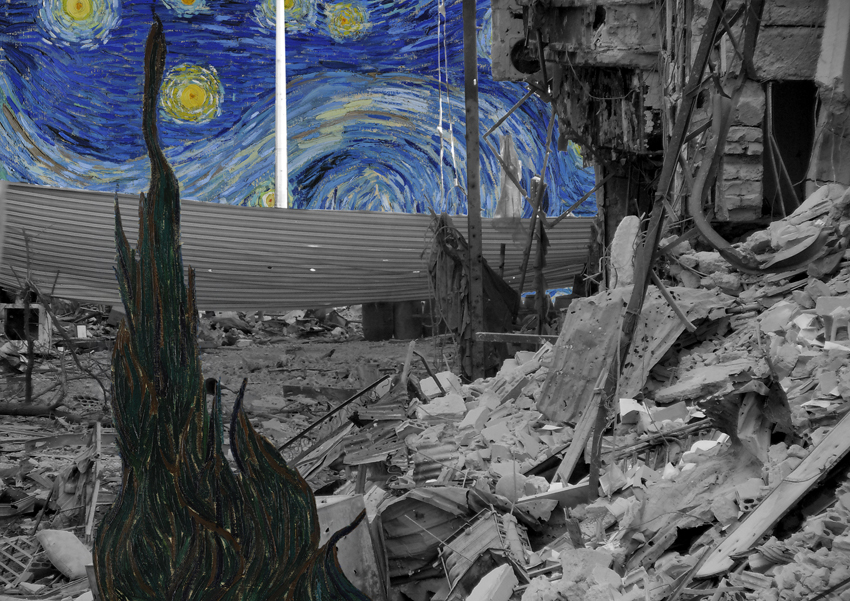
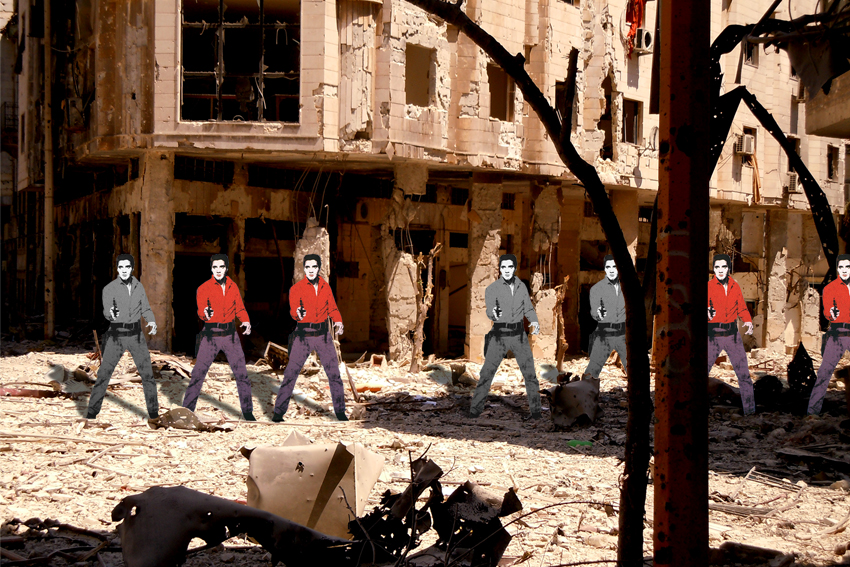
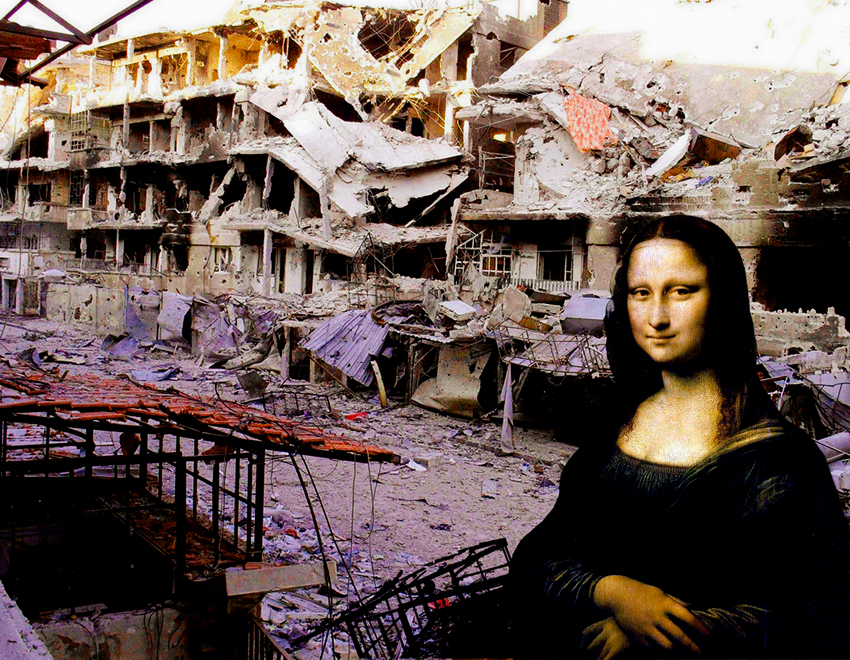
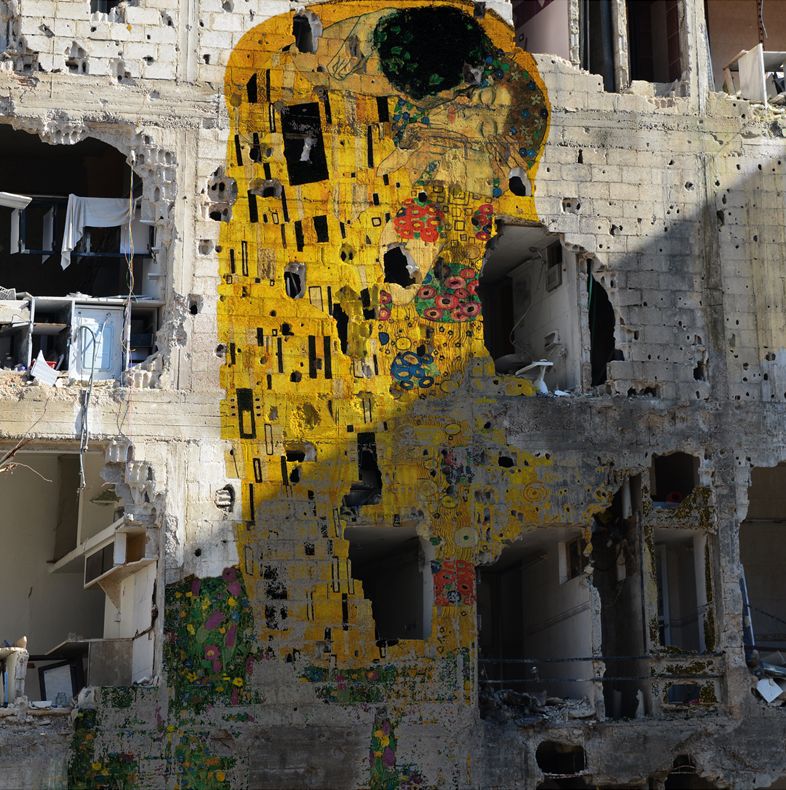
The Syrian Museum series created for the ‘Syria’ exhibition incorporates iconic subjects from the greatest European masters such as da Vinci, Matisse, Goya and Picasso – paralleling the greatest achievements of humanity with the destruction it is also capable of inflicting. Each is particularly relevant to what has befallen Syria. ‘The Syrian Museum’ series uses Western masterpieces not only for their notoriety and instant recognition, but to demonstrate that Syria has no world-class museums and the regime is presently killing its own cultural heritage. Klimt’s ‘The Kiss’ shows the love and relationship between people and I have juxtaposed this with the capacity of hate the regime holds for its people. A work from this series which has gained international popularity on social networking sites is ‘Freedom Graffiti’. Featured on Saatchi’s Facebook page, this work recieved over 15,000 likes overnight and has been featured in such publications as the NY Times and the International Herald Tribune.This digital composition appropriates Gustave Klimt’s ‘The Kiss’ upon a bullet-ridden wall, displaying the love and relationship between people and I have juxtaposed this with the capacity of hate the regime holds for its people.

text by Tammam Azzam

  Tammam Azzam: Syrian museum

Gustav Klimt’s The Kiss (Freedom Graffiti) | 2013 | archival print on cotton paper edition of 25 | 112 X 112 cm

Tammam Azzam: Syrian museum

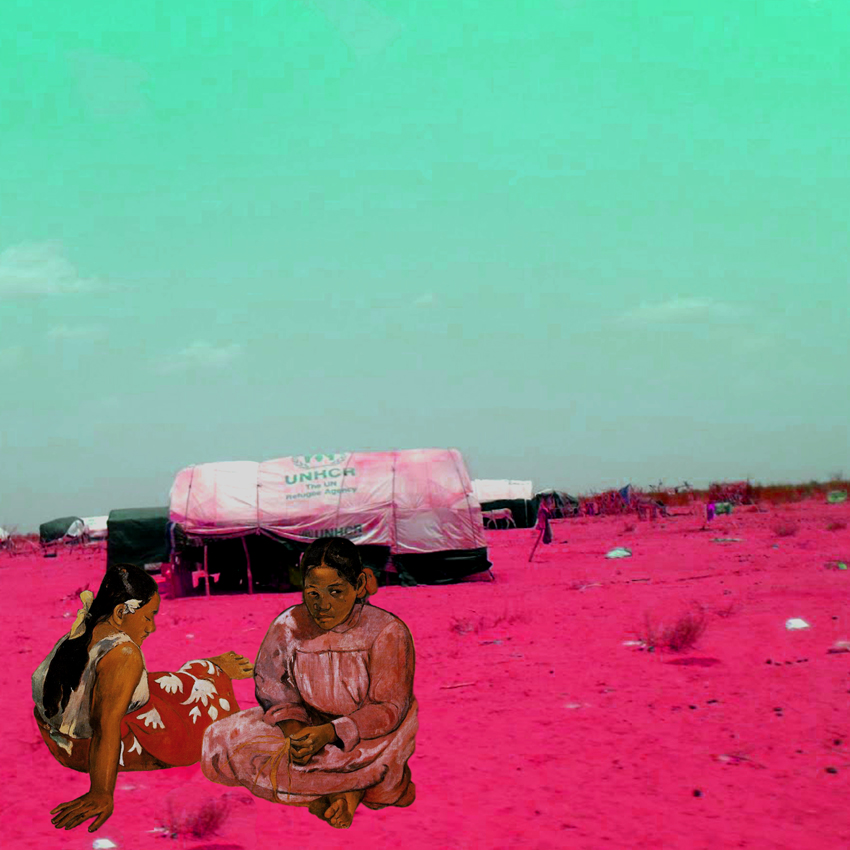
Paul Gauguin’s Tahitian Women (On the Beach) | 2012 | archival print on canvas 45 x 40 cm

Tammam Azzam: Syrian museum

Edvard Munch’s The Scream | 2012 | archival print on canvas 100 x 70 cm

Tammam Azzam: Syrian museum

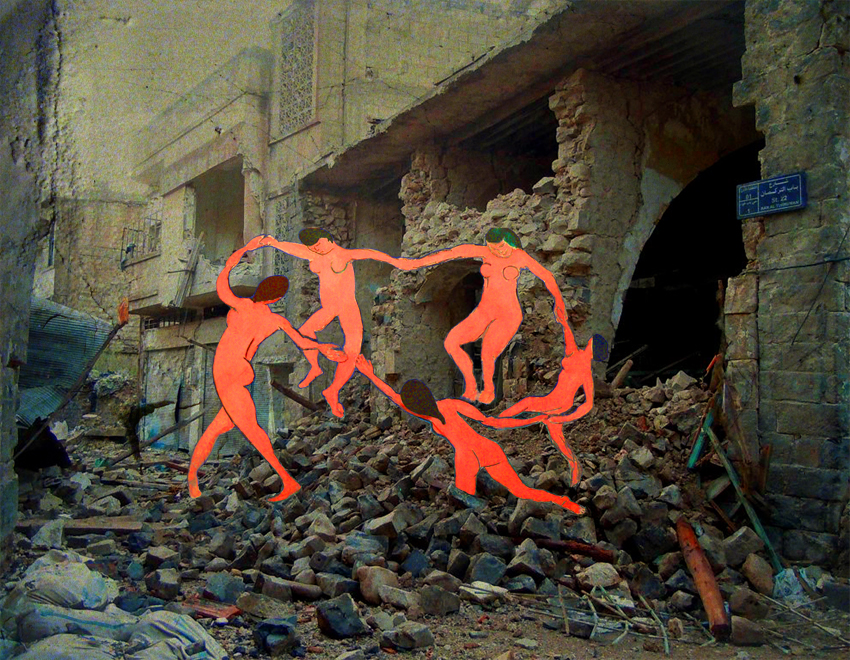
Matisse’s La Danse | 2012 | archival print on canvas | 45 x 60 cm

Tammam Azzam: Syrian museum

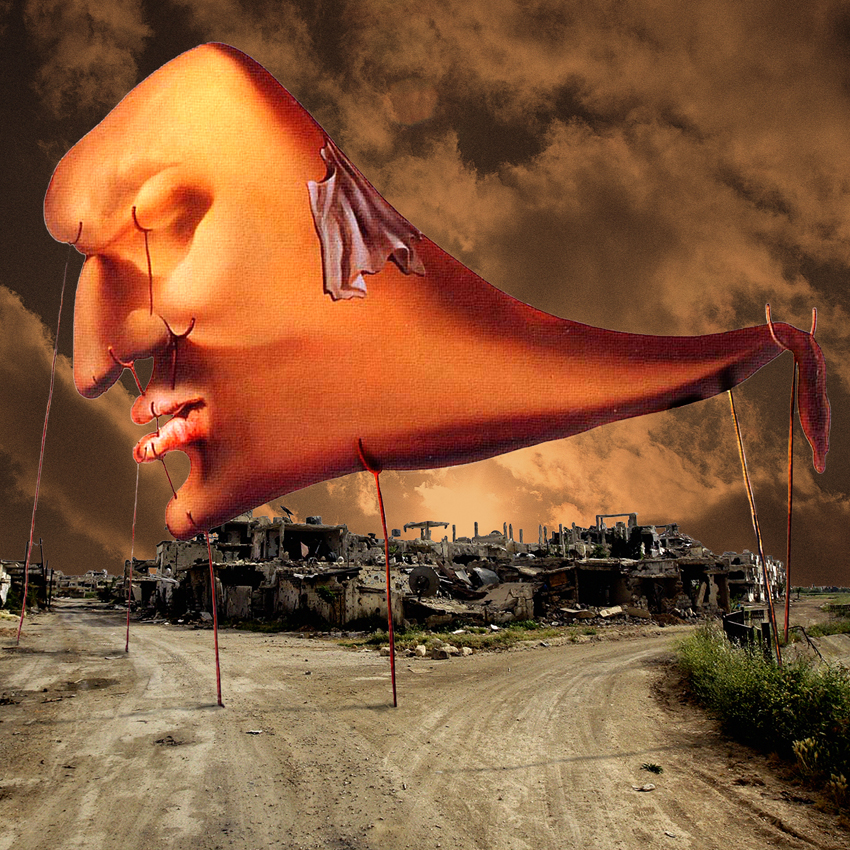
Dali’s Sleep | 2012 | archival print on canvas | 40 x 40 cm

Tammam Azzam: Syrian museum

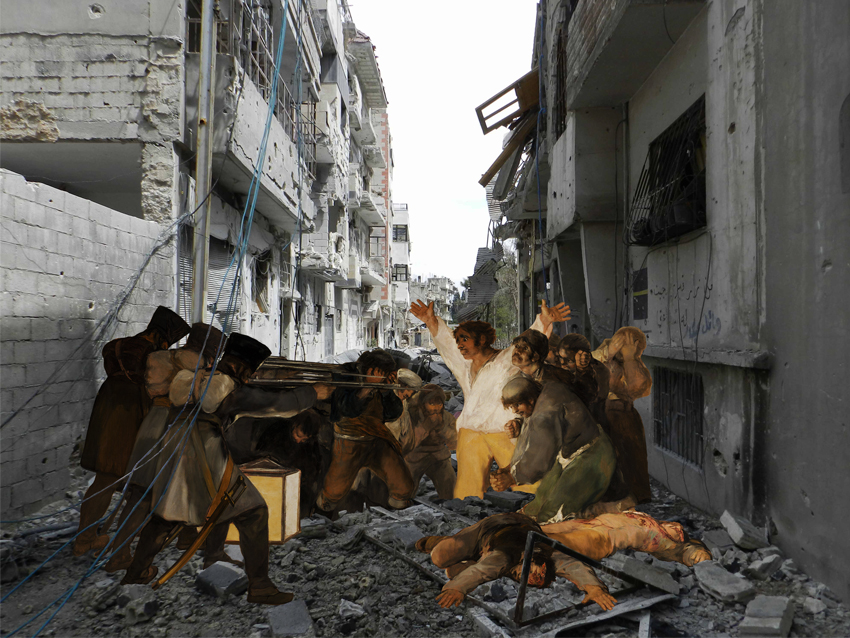
Goya’s The 3rd of May 1808 | 2012 | archival print on canvas | 100 x 133 cm

Tammam Azzam: Syrian museum

Van Gogh’s Starry Night | 70 X 100 cm. Archival Print on Canvas | 2012

Tammam Azzam: Syrian museum

Andy Warhol’s Elvis | 2012 | archival print on canvas | 80 x 120 cm

Tammam Azzam: Syrian museum

Leonardo da Vinci’s Mona Lisa | 2012 | archival print on canvas | 100 x 130 cm

Comments

Post new comment

Your name: *

E-mail: *

The content of this field is kept private and will not be shown publicly.

Comment: *

Biography

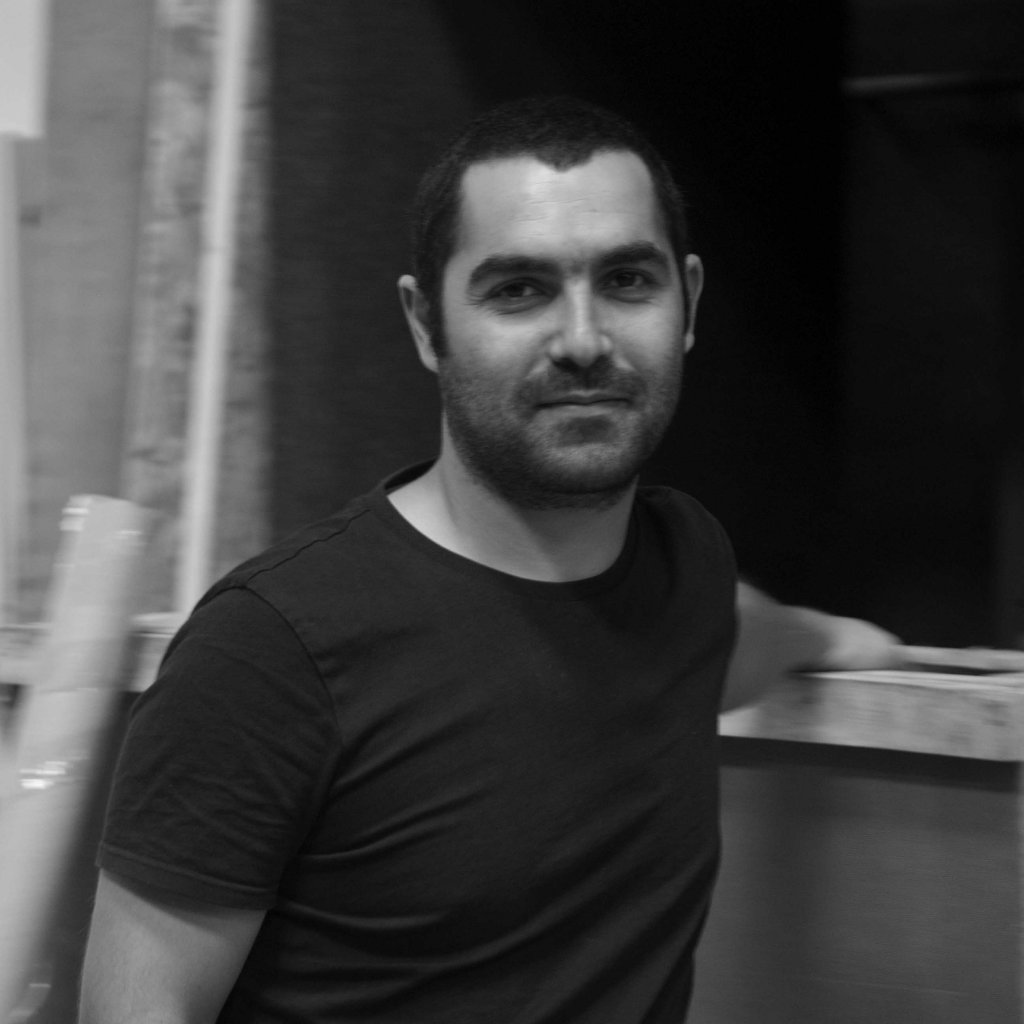
Tammam Azzam
Tammam Azzam

Born in 1980, Damascus, Syria Lives and works in Dubai, UAE
Tammam Azzam graduated from the Faculty of Fine Arts in Damascus with a concentration in Oil Painting and subsequently obtained a Fine Arts Certificate in 2001 from Darat al Funun’s Al Kharif Academy, an esteemed artist workshop series led by Syrian master, Marwan Kassab Bashi. Since joining the Shabab Ayyam Young Artists Programme in 2008, he has been featured in several significant events including the group show, ‘Stories from the Levant’, Scope Art Fair, Basel, in 2009, and Art Miami 2010, and has held solo exhibitions at Ayyam Gallery, Damascus in 2010 and Dubai in 2011 and 2012.

Misconceptions: Syrian Uprising | Shaykh Muhammad al-Yaqoubi |

Syria’s Paolo Dall’Oglio petition

My name is Paolo Dall’Oglio, I am a Jesuit, and for more than thirty years I have promoted in Syria the Islamic-Christian harmony-building.

I took a position in favor of the Syrian democrats crushed by an inhuman and indiscriminate repression that I was hoping not to have to see in the twenty-first century. I was expelled in June 2012, and have since been working full-time in defending the rights of Syrians and the legitimacy of their revolution.

Today we know that Syria is the ring of a regional geopolitical fight to death. In all this, the Churches have not been able to react in time, and Christians, now trapped in the war zones, simply tend to leave the country.

Unfortunately, the Syrian regime has been very clever in using a certain number of clergymen, men and women, for its propaganda in the West, in which it represents itself as the only and ultimate bastion defending Christians persecuted by Islamic terrorism.

This manipulation of the public opinion has succeeded in discrediting to a large extent the Syrian revolutionary effort, both on the ground and abroad, in the eyes of many citizens around the world, and was thus able to create a paralysis of European diplomacy and politics, which ultimately only strengthens the most extremist groups and weakens the civil society.

The strong and instrumental implication of the Churches in the systematic manipulation of lies by the regime cannot but require a conscious and responsible reaction on behalf of the Catholic Church and therefore of the Pope of Rome. The petition I present to your attention will show the most cohesive and mature face of the Italian and international society, and will allow Pope Francis to overcome the resistance of his context which tends to be islamophobic, though often in a typically subtle and indirect way, and to launch his own diplomatic initiative, requesting the intervention of new actors such as Latin America.

This my petition, which is now yours, presents to the Pope the need to counter the current systematic use by the regime of clergymen among the most important in the Middle East, in order to look beyond and meet the expectations of all Syrians who are suffering for freedom, and to prepare a positive future for those Christians who will choose to remain in the country or return.

—-

Here my letter to Pope Francis:

Dear and most esteemed Pope Francis,

Knowing you as a lover of peace in justice, we ask you to personally promote an urgent and inclusive diplomatic initiative for Syria which would ensure the end of the torturous and murdering regime, safeguard the unity in diversity of the country, and allow by means of democratic self-determination with international assistance to exit from the war between armed extremisms.

We ask with confidence Pope Francis to personally inquire about the systematic manipulation of the catholic opinion in the world by accomplices of the Syrian regime, especially clergymen, with the intention to radically deny the democratic revolution, and justify with the excuse of terrorism the repression that is increasingly acquiring genocide character.

191 Dead as Details of Horrific Khanasser Massacre Continue to Emerge

                Mark Bei ● Thursday Jul 25, 2013 at 12:37am


Activists have uncovered details of a horrific massacre that left as many as 191 civilians dead in the southern town of Khanasser on Saturday 22nd of June, reportedly perpetrated by Hezbollah militants and Abul Fadel Al-Abbas Brigade.

    Update #2  

Massacre Victims Were Reportedly Burned Alive and Thrown in Wells

Halab News, a network of media activists in Aleppo, is now reporting that victims of Khanasser Massacre were either burned alive or thrown to their deaths in the towns’ wells, according to testimonies given to the news networks by those who survived the horrific massacre.

21 Families among Massacred in Impoverished Khanasser Town

As activists continue to uncover more details regarding the massacre that took place on the 22nd of June in Rassm Al-Nafel, a small impoverished town of 1,600 located in the southern Aleppo region of Khansser, new reports that emerged following interviews with survivors claim that 21 families were among the 191 deaths, and that the brutal massacre was perpetrated by Hezbollah Militants, along with Abul Fadel Al-Abbass Brigade, a Shiite militia that is fighting alonside the Assad regime in several areas.


        Updated at Jul 25, 2013 at 2:27am

Syrian Poet Abed Ismael Named Writer-in-residence at University of Nevada


By on July 24, 2013 • ( 0 )

The Black Mountain Institute at the University of Nevada, La Vegas, announced its 2013-14 fellowships at the beginning of this month. Their “City of Asylum” residency was granted to Syrian poet-translator Abed Ismael:

Abed Ismael-23Ismael will be one of three residents at the Institute, along with historian-reporter Sally Denton and memoirist Matthew Davis. All three, according to the Las Vegas Review-Journal,  ”are slated to work in offices provided by the university, participate in BMI programs and potentially visit UNLV classrooms throughout their fellowships spanning from late August to mid-May.”

Ismael was born in 1963 in Latakia, Syria. He spent his early years there, later moving to Damascus, where he completed his high-school education and went on to teach at Damascus University. Just before the uprising, he spoke with poet Nathalie Handal about Damascus, telling her about places in the city he treasured, including:

“A famous café in downtown Damascus called ‘Havana’ built in 1945, where poets and politicians used to meet. The place is often associated with the poet  Mohammad al-Maghout (1934-2006), widely acknowledged as the spiritual father of the modern Arabic prose poem, who used to sit there, drink his famous Arabic coffee and compose poems and plays. Although the place has been renovated recently and lost some of its iconic glamour, it is still referred to as the birthplace of many novels, poems, and even “ideologies.’”

In the interview, he pointed to one of his poems about the city, “Mirrors of Damascus,” which was trans. Issa Boullata and published in the collection Unbuttoning the ViolinFrom the poem:

The life, which walks at the end of the night
and sees with its own eyes the perforated barrels
and the rifles trained on our backs
and the telephone receivers hanging down on the pavements
as if a crime has just taken place,
is our life. . .

The life, which passes in front of Parliament
heavily armed with applause. . .

The life, which enters the bedroom
with dark sunglasses
and a revolver at its hip. . . (read the complete poem here)

Ismael’s publications include four collections of poetry and thirteen translations from English into Arabic of works by Walt Whitman, V S Naipaul, Jorge Luis Borges, Noam Chomsky, Harold Bloom and others.

His poems, according to the International Literature Festival Berlin, “are characterized by dark colours which exude human pain. The poem appears as a place of dreams, and his voice, shifting between the first person and other narrative perspectives, conveys a sense of the profound isolation of an individual who retreats from society for self protection  and to avoid the enormous demands placed on them.”

Poems by Ismael:

A number have been translated by Issa Boullata and are available online, including: “Mirrors of Damascus,” “Where does it come from?”, “Statues”, “Don’t wake him up”, “…Days fly”, “Past dates”, “A mere ghost”, “Sorrow”

Three poems are available from Banipal, trans. the author: “Against Romanticism”, “A School Hobby”, “The Damascene Bird”

source

Radio 4′s The World Tonight on Syria

CLICK ON IMAGE ON SYRIA Listen from 8:15 till 16:16bbc_640x360

Fasting for Humanity

If somebody asks me whether I fast Ramadan for some higher deity I’d be lying if I said I was. I don’t know what I’m doing anymore with this stuff. I haven’t for a very long time. When I read posts that were written in the midst of spiritual passion, passion that felt as if it was going to burst out of my chest, I feel as if they were written by somebody else a lifetime ago. I can’t feel like that at the moment, and the reserves that I drew upon then are now completely depleted.

Then I think about stories I’ve heard of Syrians in refugee camps, of people in desperate circumstances that they didn’t ask for and facing trials they weren’t prepared to undergo. I think how easy it is for me to fast knowing I have food ready for me at the end of the day. But what would I do or say if I didn’t? Or if I had children who didn’t? I don’t know but even considering that thought gives me a chill. For all my failings as an individual the past three years have taught me so much more about what it means to be human and fallible.

We like to think of ourselves as paragons of virtue when we speak with the moral clarity of some high priest for this or that dogma. The “Resistance” with a capital “R” for example, or when we refer to the sacrifices necessary to fight some nebulous great Enemy. I used to feel like that. But isn’t it ironic that the great narrative of a titanic clash between good and evil that the resistance narrative uses comes from the same strip of land which introduced that concept into organized religion through Zoroastrianism? Was it not the great clash between Ahura Mazda and a mysterious “hostile spirit” which was the precursor to our own Abrahamic faiths? And within the story of an epic war to end all wars weren’t there also the seeds of oppression? And from oppression didn’t we also see the rise of self deceit?

Most religions emerged out of a genuine desire to do good, but it seems almost universal that the dogmatic hierarchy which follows that initial creative impulse subverts far more than it preserves. Today we have people who wish to uphold that hierarchy as guardians of some supreme truth – possessing the right to absolve any sin and to damn any soul. These people forget that even the Zoroastrians believed the followers of the “Lie” would fall forever into a hell fire of some sort. To hell with the Lie, and to hell with them I say. Isn’t self deceit the greatest of lies?

If I’m fasting, it would be a lie to say I’m doing it for some bearded old man sitting on a throne in the clouds. It’d be far more sincere to say that I’m fasting because it puts me in touch with my humanity and the suffering of others. I can’t give them relief, but I can carry the same burden as them even if for a while. Maybe then they can feel better knowing they are not alone in this world even if nobody can help.

Posted by Maysaloon at 8:30 pm  


Arab TV star Abbas al Nouri of Syria grieves for his nation

The actor has criticism to go around — for Assad, the rebels and Arab leaders in general. Syria ‘lived through a large lie,’ he says, and is paying the price.

BEIRUT — Abbas al Nouri pauses as a particularly loud car roars past the cafe on the main thoroughfare. The overly solicitous waitress lingers, a hint of recognition in her eyes.
for video click here
At the table, the conversation inevitably focuses on Al Nouri’s native Syria.

“The father who cannot listen to his children is a failure, and this is something that destroys the family,” Al Nouri says, the metaphor describing the war pitting armed rebels against the government of President Bashar Assad.

“This revolution happened so that people could express themselves,” he continues, choosing words carefully between drags on his cigarette. “This regime, which is military in nature, did not have the culture to digest the idea that some people have an opinion.”

He shakes his head as he places his teacup on the table. “It couldn’t believe that it can be criticized, so it fired upon the people … and fired upon culture and knowledge even before it started firing at bodies.”

Al Nouri, 60, is known to millions across the Arab world as the star of the smash-hit Syrian television series “Bab al Hara” (“The Neighborhood’s Gate”). In real life he sports a full head of hair, unlike his character, Abu-Issam, a bald barber and doctor in an early-20th century Damascus struggling against French colonial domination. Though he was famous even before “Bab al Hara,” the show — no longer in production but seen year-round in syndication — cemented his reputation as one of the region’s top actors.

Al Nouri has worked steadily since his television debut in 1976, and holds the distinction of starring in the only Arab TV program to win an International Emmy Award. The Jordanian-produced “Al Ijtiyah” (“The Invasion”), a Palestinian-Israeli love story set during the 2002 Israeli assault on the Jenin refugee camp, captured the Emmy in 2008 for best telenovela.

On a recent afternoon, he sat down for an interview after one of his many road trips from Damascus to Beirut, where he was working on a new project, “The Passing,” described as a science-fiction series with social implications.

Politically engaged for decades, Al Nouri isn’t shy about criticizing Arab leaders generally or the Syrian government and some of its extremist enemies in particular.

“I don’t want to take away the freedom of people putting on the hijab,” he says. “But I do want to take away the covering of the brain.”

Asked whether he feared retribution for voicing his opinion, he brushed off any concern.

In his native Damascus, Al Nouri lives in Dumar, a suburb a mile from the presidential palace. The district is northwest of Qaymariya, where his parents still live in a “house like those you would find in the television series I work in,” he says, smiling as he remembers the open-courtyard stone homes of a bygone Damascus.

But the smile fades as he contemplates the new reality of his city, where the 10-minute drive to visit his parents has become an hour-plus slog “that makes you wonder how this city is living between one checkpoint and another.”

Checkpoints also slow the drive between Damascus and Beirut, but a heavy Syrian army presence has kept the route relatively safe. Al Nouri commutes to the Lebanese capital to work and to visit his children, two of whom live here at their father’s insistence. The third attends a university in the United States.

He’s forbidden his children to return to Damascus, he explains, not so much for “the oppression on the street as much as the fall of mortars right and left and the fear from the sky.” He says his parents are too elderly for him to consider moving. “My father is almost 100 years old and my mother is 90. I cannot leave them.”

And, he acknowledges, something else draws him back to the ancient capital.

“Even if I lived in a five-star hotel, being away from the site of the pain hurts even more,” he says. “So I don’t envy those who left, because of the worry they must be enduring.” He expels the smoke from his cigarette slowly, watching it waft away. “And I love Damascus.”

With production companies no longer working in Syria and with many artists in exile, the country’s once-prodigious TV and film industry has all but shut down.

Performers, writers and other creative Syrians have not been immune to the bloodshed. Each side in the conflict has targeted artists for their political stances, though that hasn’t discouraged Al Nouri from expressing his political views.

As for his fellow actors’ mass departure, he’s sympathetic but distressed. “This is painful for them, but also painful for me, because I have lost some real partners, and we need them and they are great stars.”

Al Nouri grew up under Syria’s Baath leadership, which seized power in 1963 and continues to rule. He became politically aware in his university days, when Arab nationalism, the fate of the Palestinians and the existential struggle against Israel were the defining issues on campus and on the street.

He was one of the youngest Syrians to speak on the radio in honor of the late Gamal Abdel Nasser, the Egyptian president, who is still revered in Arab nationalist circles even as Islamist movements have eclipsed his secular, pan-Arab vision. But Al Nouri eschews the nostalgia for those days that’s often heard among Arab intellectuals, instead describing the era as one when “freedom of expression was confiscated in favor of slogans.”

He picks up a spinach-filled fatira pastry before elaborating. “They would chant, ‘Our enemy is Israel!’ or ‘We want democracy!’ — when in reality it was the citizens who were the enemy. Whenever a new slogan would come, there would be new branches of intelligence to protect it.”

Here he pauses again, momentarily uncomfortable with what he wants to say. “I hope people don’t misunderstand me, but we did not deserve independence in the way it should have been,” he says, his voice taking on a regretful tone. Slogans often substituted for democracy and creation of a civil society in much of the Arab world. Syria “lived through a large lie, and what is happening now is an abscess that blew up.”

Like many Syrian intellectuals, he is torn about the revolution. He supports the goal of a more democratic nation, but knows the future could be even worse, perhaps some form of Islamist state or Syria balkanized into sectarian cantons, with foreign powers backing different factions.

“I can’t even look at a nation that still lives the problems that were finished 1,400 years ago,” he says, referring disdainfully to the ultraconservative Salafist rebel brigades that would seek restrictions on free speech and artistic expression. He says he fears “a nation that looks to history but not to the future,” adding, “I want my country to be completely free, with complete dignity.”

But after more than two years of a devastating war that has left more than 100,000 dead and millions homeless and reduced large swaths of the country to rubble, Al Nouri concludes, “People just want a solution, no matter how it is.”

The waitress approaches with knafeh, a cheese pastry dripping with sugar syrup. She finally blurts out what has been on her mind for the last 90 minutes: “Are you Abbas al Nouri from ‘Bab al Hara’?”

Bulos is a special correspondent. Times staff writer Patrick J. McDonnell in Beirut contributed to this report.
Copyright © 2013, Los Angeles Times

Inside Syria: Dispatches from the Times' Patrick J. McDonnell Inside Syria: Dispatches from the Times’ Patrick J. McDonnell

source
Syrian Rap and hope

Blog at WordPress.com.

Up ↑