Search

band annie's Weblog

I have a parallel blog in French at http://anniebannie.net

Category

Syria

Another Halabja?


                            Horrifying reports of Assad’s biggest chemical attack

Bodies pile up following chemical attack.

In the early hours of August 21, a series of alleged chemical attacks struck various suburbs of Damascus, the bulk of them in neighborhoods that together make up an area east of the city center known as Eastern Ghouta. Among the neighborhoods targeted  just after 2 AM were Jobar (the site of a previous chemical disbursal), Zermalka, Ayn Tarma, Douma, Arbeen, Saqba and Harasta. Yet another hit, this one in the southwestern district of Moadamiya, which is close to the elite Fourth Division’s airbase in Mezze, was also reported.

The death toll varies from the high hundreds to over 1,500. But the scores of videos of civilian and rebel victims uploaded to the Internet give a gruesome indicator that the carnage may only increase as more and more sufferers languish without adequate medical care. Some of these videos show young children in a state of total shock, responding listlessly to treatment or marveling at the fact that they are still alive. Others videos show adults foaming at the mouth and convulsing, or corpses lying in neat rows on the ground, wrapped in shrouds.

By early Wednesday evening, a senior Obama administration official told the Wall Street Journal that Washington has “strong indications” that the Assad regime was behind these latest atrocities. Israeli Defense Minister Moshe Ya’alon was the first U.S. ally to state unequivocally that Damascus was indeed the culprit. (Israel’s intelligence on Syria is considered the best in the world.)

I spoke with two doctors from Douma yesterday. The first, Dr. Majed Abu Ali, the communications manager of Douma city medical office, which is part of the medical office of Eastern Ghouta, said that in his district alone, about 630 cases of exposed patients had been observed with symptoms including respiratory failure, muscle spasms, confused mental states, and pinpoint pupils. “Thirty-six of these cases needed ventilation and intubation, and 16 also had to be sent to the ICU.”

Because of how ill-equipped his team was for handling so large a casualty figure all at once, Dr. Abu Ali said that his own personnel did not take the necessary precautions before treating those possibly exposed to a deadly agent. For instance, they failed to remove the tainted clothing of patients and some of the medical staff became exposed secondarily and required their own treatment regimens as a result.

The Douma medical office fielded patients from around eight separate attacks. According to Dr. Abu Ali, the attacks were against rebel-held positions in Eastern Ghouta while the last two struck “civilian neighborhoods.” The latter attacks “were ten times more severe in terms of casualties than the previous ones. Injuries from [the rebel-held areas] numbered around 63. From the civilian areas, around 600,” Dr. Abu Ali reported.

More than 50 percent of those affected were women and children. Not all patients responded to atropine, a drug commonly administered to counteract nerve agent exposure, evidently due to the intense concentration of whatever was used. Thousands of atropine injections were given, and supplies of the medicine were running low.

I also spoke with Dr. Khaled Ad’doumi, director of Douma city medical office, and asked if his staff were able to determine the exact substance used. “We already know from [a] medical study we conducted that the symptoms of exposure to organophosphate compounds are similar to the ones we observed yesterday.” These compounds, alleged to have been used in prior chemical attacks in Syria, including the one in Khan al-Assal which the UN is meant to investigate, are the basis for many industrial pesticides. They are also used to make sarin and VX gas. Dr. Ad’doumi believes adamantly that sarin was used by no one other than the regime.

Gwyn Winfield, the editor of CRBNe, a journal which monitors unconventional weaponry, told Foreign Policy “No doubt it’s a chemical release of some variety — and a military release of some variety.” He thinks, though, that whatever substance was deployed was not in a purified form. In a subsequent appearance on CNN, Winfield said: “It may well be that this was some kind of an Assad homebrew where he has managed to get elements of an organophosphate, mix it with other chemicals, and then delivered it onto these people.” Winfield also noted that the perpetrator can only have come from the military. “This isn’t a small rogue element; this isn’t a small group. This is a concentrated, well-organized attack by a significant player.”

A chemical “cocktail” of varying agents might account for the reported contradictions in symptoms exhibited all over Damascus yesterday.

Dr. Ad’doumi said that most fatalities his office saw were caused by suffocation. “We had to make choices of who is going to die and who will survive because of the shortage of medical supplies and medical personnel.” At the time I spoke to him — around 3 PM EST — he estimated the death toll at 1,600 in Eastern Ghouta alone. (These figures cannot be independently verified.) And exact casualties, he said, could not yet be determined. But of the total number of Syrians affected by the attacks, he claimed that his facility only treated about a quarter.

A major factor Dr. Ad’doumi attributed to the high patient rate is that many Syrians in Damascus kept their windows open all night and were exposed while they slept. My colleague James Miller, who has analyzed much of the evidence emerging from these attacks, told me that a source of his in Damascus believes that so many children were affected because Eastern Ghouta is routinely shelled. He said, “a lot of the kids go to basements when the explosions happen, often to sleep. But the gas was heavy, and stayed low to the ground, traveling right into the basements and trapping them there.”

According to Human Rights Watch (HRW), which reviewed satellite imagery of Eastern Ghouta, “the affected neighborhoods are predominantly residential with some warehouses, markets, and assorted commercial facilities on the periphery, adjacent to the main highways.”

HRW did not have any evidence to suggest that, whatever substance was used, this was the result of a conventional round accidentally striking a chemical or gas facility in the surrounding area. The New York-based NGO also spoke to one doctor working in the medical center at Arbeen who claimed that activists told him 18 missiles were fired “from the direction of the October War Panorama, a military museum in Damascus city, and of Mezzeh military airport, hit Zamalka, Ayn Tarma, Douma, and Moadamiya.”

The Syrian Support Group (SSG), a U.S.-licensed rebel aid provider, cited one very early report that preceded the HRW briefing that was relayed by Mohammed Salaheddine, a journalist with AlanTV and an eyewitness to the early-morning attacks. Salaheddine claimed that four rockets hit Eastern Ghouta, the first striking Zamalka, the second Ayn Tarma, the third Jobar, and the fourth Zamalka again. He said these were all Grad 122-mm rockets and came from the Damascus-Homs highway near the Baghdad Bridge (southern Damascus), and the other two came from Qabun (north of Jobar). (Note that the Baghdad Bridge is near the Nusariyeh chemical research facility, which the regime currently controls.)

These attacks appeared to have preceded a rapid buildup of conventional military forces around Easter Ghouta which, according to Salaheddine, included 30 tanks and “several thousand regime soldiers.” Non-chemical rocket attacks continued from the direction of Mezze Air Base in Moaddamiya, presumably launched by the Fourth Division. “Large explosions could be heard in the background during the call with Mohammad,” the SSG emailed.

Eastern Ghouta is a rebel-held area where the Free Syrian Army-affiliated units, as well as some Salafist-jihadist groups including al-Qaeda, have firmly established themselves to a degree few Syria watchers appreciate. The regime has thrown everything it has against this area, including chemical weapons, because it’s not only a strategic launchpad for further incursions into central Damascus, it is also home to one formidable rebel groups in the south:  Liwa al-Islam.

Last summer, this brigade was responsible for the assassination of several high-ranking members of Assad’s “crisis management cell,” including Bashar’s own brother-in-law and longtime Syrian security chief Assaf Shawkat. Any gains the regime may have made to flush out the rebels from Eastern Ghouta have been swiftly reversed. (One source told me a possible motive the regime may have had to strike so furiously today was that Saudi Arabian-purchased weapons, mainly anti-tank munitions, may have been recently delivered to FSA affiliates in this area. Rebels here have also raided regime stockpiles in recent days.)

Still, many will speculate as to why the regime would launch such a catastrophic chemical attack days after the arrival of a 13-man UN inspection team in Damascus tasked with investigating claims of prior chemical weapons uses. That team had to strenuously negotiate the remit of its mission and agree to only inspect three sites where the alleged attacks took places many months ago and where any soil or blood samples will have long since been degraded. It also agreed not to enter any area in Syria where regime military operations were underway. This of course would include Eastern Ghouta, and that inked stipulation may have been part of the regime’s logic in brazenly gassing so many within a few minutes drive from where the UN inspectors were being hosted. It appears unlikely in the extreme that they will gain access to any of Wednesday’s target sites.

The regime and its main European ally, Russia, also have not coordinated their responses to the latest accusation of war crimes. Damascus denies that any chemical agent was used. “These are lies that serve the propaganda of the terrorists,” one official said. “We would not use such weapons.” The Russian Foreign Ministry, meanwhile, first began by calling for a “professional” forensic investigation, then concluded that the rebels were responsible for a “premeditated provocation”. This made any UN Security Council consensus on reaching a resolution obviously impossible.

If these reports are confirmed, they will amount to the single deadliest deployment of chemical weapons since Saddam Hussein gassed Iraqi Kurds at Halabja in 1988. They will also undoubtedly embarrass whatever remains of the Obama administration’s policy on Syria. A year ago to the day, the president established his so-called “red line” against the Assad regime’s use or mass mobilization of chemical weapons. But since then, and as more evidence of such use (and such mobilization) has accrued and been corroborated by a host of Western and regional intelligence agencies, Washington’s position has been quietly “revised.” One unnamed U.S. intelligence official put it like this to Foreign Policy earlier in the week: “As long as they keep the body count at a certain level, we won’t do anything.”

Leaving aside what an official in even this White House might imaginatively characterize as the appropriate number of asphyxiated per day, it seems clear that a new benchmark has indeed been reached. The deaths of so many in so little time, whatever caused them, cannot have been faked.

“The White House is going to be hard pressed to construct an answer to this one,” Charles Duelfer, a former U.S. weapons inspector, told the Guardian. “It was easy to waffle a bit so long as alleged use was minor and didn’t happen again, but this is really putting the administration in a corner.”

I wish I shared Duelfer’s expectation of what it now takes to shame the United States into action in the Middle East. But perhaps the least that can be said of this latest dispatch from hell is that yesterday was not the best of all days for Gen. Martin Dempsey, chairman of the Joint Chiefs of Staff, to write to Congress yet again reaffirming his boss’s opposition to military intervention in Syria.

source

Regime “chemical strikes” in preparation for Damascus offensive

Jobar smoke. (YouTube)

    The Bashar al-Assad regime conducted its reported chemical weapon strikes Wednesday on rebel-held suburbs of Damascus in preparation for a military campaign on the embattled areas, an activist told NOW amid reports of heavy shelling outside the Syrian capital.


    “The regime was unable to get into [Damascus’] eastern Ghouta [areas] for ten months, so it resorted to using chemical weapons as an introduction to a surge in the area,” Mohammad Salaheddine—an activist media figure in the Damascus suburbs—told NOW hours after reports emerged that over 700 civilians had been killed in sarin gas strikes outside Damascus.


    As the death toll for the attacks continued to mount, heavy artillery and missile fire rained downed on the eastern suburbs of Damascus, with Hezbollah’s Al-Manar television reporting that regime forces had begun a campaign outside the capital.


    The activist Shaam News Network said in the early afternoon that surface-to-surface missiles were striking the Jobar area of the Syrian capital, while Salaheddine warned that regime “convoys are mobilizing in Zabaltani and [Damascus’ nearby] Abbasid Square [area] to surround Jobar.”


    “Air Force Intelligence units are coming from Harasta to hit Zamalka and Ain Tarma and inner [areas of the eastern] Ghouta [suburbs],” the activist also said.


    However, Salaheddine added that “[regime] tanks have not been able to come into [rebel-held eastern Ghouta] yet. The Free Syrian Army destroyed one of them, and there are very strong clashes now.”


    “Now, Zamalka and Ain Tarma are almost completely empty. The residents have left to Ghouta proper, to Al-Basateen and other [areas]” in order to escape the affected areas, he also said.


    Meanwhile, an activist told NOW via Skype that regime forces were also pressing a military campaign in the Moadamiyeh area southwest of Damascus where he is based, but added that the outcome of the clashes remained unclear as heavy fighting continued to rage.


    Moadamiyeh had also reportedly been hit by chemical strike in the series of alleged pre-dawn regime chemical strikes, with the activist Local Coordination Committees saying over 76 civilians had died from exposure to poison gases in the area.


    According to the LCC, “over 755 martyrs fell due to poison gas [strikes] in the Ain Tarma and Zamalka areas [of the Eastern Ghouta suburbs of Damascus] as well as in Moadamiyeh.”


    The Syrian Support Group, a Washington-based organization that advocates for increased support for the Supreme Military Command of the FSA, told NOW that the women and children were sleeping when the attack occurred, and that most of the victims therefore suffocated to death.


    SSG also reported that the concentrated sarin gas was delivered to the suburbs via four Grad missiles.


    Saleheddine told NOW that the series of pre-dawn strikes in eastern Damascus occurred at 2:20 a.m. in the Jobar, Zamalka and Ain Tarma suburbs.


    Read this article in Arabic

    source

    Syria S.O.S

    Local Coordination Committees in Syria – 2m

    Hundreds of martyrs as well as casualties, majority of whom are civilians, among them dozens of women and children as a result of the barbaric use of poisonous gases by the criminal regime in the towns of Eastern Ghouta earlier today, as the locals in these areas were horrifically subjected to the chemical weapons which led to suffocation of the children and overcrowding field hospitals with hundreds of casualties amid extreme shortage of medical supplies to rescue the victims, particularly Atropine.

    The Local Coordination Committees in Syria urgently call on all of the humanitarian international organization, including the Red Cross, Red Crescent, human rights and international community’s organizations to act immediately to save the lives of the civilians in Damascus’ Ghouta and rescue the casualties, as well as to end the medical and nutritional siege imposed on these heavily-populated areas, as the Eastern Ghouta was also shelled by warplanes following the chemical attack that is still ongoing which led to hundreds of casualties and victims, among them entire families.

    We also call on the international community, despite its inaction and procrastination, to work and put an end to the massacres against the Syrian People, in which the regime has used every internationally and morally prohibited weapon amid a deplorable silence and stalemate, indirectly giving the regime a green light to continue using chemical weapons against civilians to this day.

    source : yalla souriya

    Journey to Kafranbel

    Robin Yassin-Kassab

    This account of my trip into Syria’s partially liberated Idlib province was published by the Guardian.

    DSCI0172To cross the border I had to climb a wall three times my height. It was the most frightening part of my trip into liberated Syria.

    At Atmeh camp (where I’d been working, just inside Syria on the Turkish border) there’s no passport control but only a gap in the barbed wire. On the day of our journey, however, the Free Syrian Army and PKK-linked Kurds were facing off nearby and the Turkish authorities blocked access as a result. This meant we had to go through the official border at Bab al-Hawa. Two of our party possessed Syrian passports, and were waved through. Two of us didn’t, and so were smuggled across by Kurdish teenagers.

    We skirted a deserted shack which our escorts pretended was a policeman’s house. One disappeared for a while, pretending to pay an expensive bribe. Our winding path led through a red-soiled olive grove, far away from the border post, but then wound back towards it, and to the wall. I could see the backs of soldiers through the trees, smoking not patrolling.

    There were no security cameras. The boys told me they’d taken Chechens across like this.

    At wallside a whispered negotiation ensued. We soon haggled a price for their service. The next part was more difficult – They wanted us to scale the wall into what was obviously still the Turkish border post.

    I looked at my fellow smugglee. “Do you believe this?” I asked in English.

    “I don’t know. Talk to them some more.”

    So it went on, until at last Abdullah, one of our hosts inside Syria, phoned to advise me to do as the boys said.

    So I climbed too fast for vertigo to strike, scissored my legs over the railings, dropped onto concrete, rolled, picked myself up, then endeavoured to walk across the neatly-trimmed lawn with a nonchalant but entitled and entirely legal air. I strolled through the airconditioned duty free zone and rejoined my companions to wait for the bus through no-man’s-land. (No private cars have been allowed here since a car bombing in February killed thirteen). Sitting in front of me on the bus: a fattish version of Che Guevara, in curls, beard and black beret, but with nogodbutgod printed on the beret.

    On the Syrian side a fighter from the Farouq Battalion glanced at the passports. Behind him, unthreatening men milled about with kalashnikovs. They were of various militias, bearded and clean-shaven, wearing mix-and-match military, sports and farming gear. Behind them, a 6th-Century Byzantine triumphal arch announced in its own way our passage into Syria, a land which possesses an unbroken archeological heritage, from Sumerian times to the present.

    But this was Syria as I’d never seen it. Something unthinkable a year and a half ago: a territory liberated and defended by poorly armed armed volunteers and defectors. Instead of Assad’s blue-eyed visage, therefore, the Free Syrian flag was painted on a barrier. Revolutionary grafitti flourished at the roadside, from Freedom Forever through Zero Hour Approaches, O You Dogs of Assad to Death to the Enemies of God. The triumphalism of the slogans was immediately crushed by the onrush of the small but shocking Bab al-Hawa camp, tents of bright blue flammable plastic planted direct on concrete, a surface which burns in the sun and floods under the merest shower.

    Two ambulances whizzed past towards Turkey, both caked in mud as camouflage from airstrikes.

    At this point we expatriate Syrians were squeezed into a car with friends from Kafranbel, our destination, a rural town in the south of Idlib province become famous for the witty English-language slogans on show at its weekly demonstration. Our driver was Ra’ed Fares of the town’s Revolution Committee. Following the logic of the mud-caked ambulances, we switched off our foreign phones.

    At first the strangest sensation was the normality of the surrounds. A hot and breezy afternoon ran past the windows – stubbled wheat fields, rocky outcrops, smooth-topped tells. But the villages seemed much poorer than before, some of their roads gnarled up by tanks. In one hamlet, Jabhat an-Nusra’s logo was printed on the walls. Our secular hosts explained that the Jabha (designated a terrorist organisation by the US) had liberated this stretch.

    We diverted to avoid al-Fu‘aa, a Shia village still held by the regime, and drove on towards Taftanaz, where the scale of the damage wrought by shelling and aerial bombardment became terribly apparent. We passed streets of crumpled buildings, long banks of debris, shopfront shutters buckled by the vacuum bombs which suck in and ignite the air to create fireballs.

    White paint on the walls warned: Watch out – Taftanaz Airfield Ahead!

    DSCI0146The airfield was liberated in January after two months of siege. The resistance lost many men here – the burnt and cratered fields around offer no cover whatsoever. Now ruined tanks and lopsided helicopters rest inside the perimeter, and Free Army militia sit guard at the entrance.

    Next we drove into Saraqeb, a city of significant size, again notable for its war damage, and victim of a chemical attack in April. We stopped in the busy centre so one of us could vomit into roadside rubbish, while the others (one an uncovered woman) entered a café to eat Haytaliyeh, a local speciality. The Jabha runs a Sharee‘a court here. Its black flag flies atop the famous TV mast. Nevertheless, nobody looked twice at our friend’s unveiled hair. Saraqeb felt not like the Taliban’s Afghanistan but like Syria minus the regime: socially conservative but largely tolerant of difference.

    *

    The media image of the liberated areas suggests the regime has been replaced by heavy-handed militias. At least in Idlib province (Aleppo has suffered much more from thuggery, corruption and Islamist fanaticism, a fact much lamented by the activists and fighters I spoke to), it’s not like that at all. No checkpoint stopped us. The men with guns were locals, and were considered protectors, not oppressors.

    Very many men have fought. They fight for a while, then take time off to visit their families in the camps or to harvest the fields (those which haven’t been burnt). Most have no political aim other than defending themselves by ending the regime. Some are Islamists, usually moderate and democratic. One such is Abu Abdullah, who, before his leg injury, fought with Liwa al-Islam in Douma in the Damascus suburbs. He shocked me with his statement, “We aren’t fighting for freedom, but for Islam,” but the follow-up was more reassuring. “Europe,” he said, “is implementing Islam without being aware of it. It educates its people, it respects their rights, there’s one law for all.”

    This is an Islamist who shakes hands with unveiled women and opines that Christians often have more self-respect than Muslims. He doesn’t fight for ‘freedom’ because to him the word means people doing anything they like, regardless of the rights of others. His vision of an Islamic state is one compatible with democracy; it wouldn’t enforce dress codes or ideological allegiances because (he quotes the Qur’an) “there is no compulsion in religion.” His idealist conception of the future is one free of crime. He illustrated this by example of today’s Douma, where, he assured me, nobody steals, despite the opportunities provided by bombing.

    DSCI0204As for the foreign fighters, Abu Abdullah, like everybody I spoke to, views them with disdain. Syria has enough men, he told me. Syria needs weapons, not men. Foreigners only cause problems. They increase the sectarian element, as Assad and Iran want. They ruin the revolution’s reputation. In any case, most of them aren’t fighting but resting, waiting for ‘the next stage’.

    He muttered against the Turks who, on the one hand, collaborate with the Americans to hold back the heavy weapons which the Free Army so desperately needs (this was certainly true until late June), yet on the other, do nothing to stop the flow of foreign jihadists. “It’s a plot so America can do to us what it did to Afghanistan.” It wasn’t difficult to sympathise with his conspiracy theory. I’d seen how easy it was to cross the border illegally.

    *

    After Saraqeb comes Ebla, an excavated city of the third millenium BC, and after Ebla the once beautiful town of Ma‘arat an-Nou‘man. Here the Crusaders resorted to cannibalism, and here Assad’s forces engage in savage bombardment. Abutting the ongoing battle for control of the Hama-Aleppo motorway, many of Ma‘ara’s apartment blocks are sheared into ragged slices. Shelling resumed shortly after we passed back through the next day.

    The town used to house one of Syria’s finest museums, a collection of Byzantine mosaics in an Ottoman caravanserai. For months the museum stood between the regime barrier and the resistance, and was looted and bombarded by both. Ma‘ara was also once home to Abu Ala’a al-Ma‘ari, the 11th-century atheist and poet, one of the most important of the classical tradition, whose statue was beheaded – to great popular outrage – by Salafist militiamen last February.

    We turned west over heights where fir trees are bent by the wind, and through villages built of breezeblock or local white stone, some depopulated, some overcrowded, according to the vicissitudes of battle.

    DSCI0158We slowed when we reached Kafranbel to note the walls almost everywhere cratered by bullets, a pancaked mosque, and the blasted remains of a secondary school which the regime had used as a barracks until its forces were expelled. Ra’ed pointed out two sites of mass slaughter and a list of martyrs engraved on a plinth at the central roundabout (this reminded me of similar memorials in Palestine). Since the regime was driven out last August, a central stretch of wall has been painted in revolutionary murals. Perhaps the cleverest is a cartoon heart reading ReLOVEution.

    Evening passed pleasantly, surreally, in the Revolution Committee building, on a terrace studded with potted plants overlooking olive trees and a jostle of fat-tailed sheep. There was a waxing midsummer moon, a cool breeze, and the usual Syrian night sounds: animated conversation, laughter, tunes from the ’oud, and a noise like thunder which was the regime launching missiles from Wadi Deif, twelve kilometres away. A safe distance. Kafranbel hadn’t been bombed in all June.

    We ate apples and deliciously sweet plums. Food still tastes better in Syria than anywhere else, at least when you can get it. Manar Ankeer, a young Syrian who refuses to join his family in the Gulf, with kind, sad eyes, and energetic to the point of tension, runs a free bakery which feeds 40 villages. Without this aid (the bakery is funded by expatriate Syrians), some families would starve. (In Turkey I met an activist from Selemiyyeh, a solidly revolutionary Ismaili town, who showed me a photograph of his last meal in Syria – a trapped hedgehog.)

    As we talked, chewed and smoked, Kafranbel’s activists uploaded films, updated Facebook statuses, and planned and painted slogans for the next day’s demonstration. The Free Army’s local commander dropped by for tea and conversation. The woman who drives the Karama (Dignity) Bus from school to shell-shocked school decided which cartoons to screen the following week, which stories to read aloud.

    People are doing what they can. On the ground the revolution continues, not only the fight against the regime but also the protests against Salafist militias in Raqqa and the Kurdish PYD militia in Amouda, as well as the daily effort to self-organise and survive. In the absence of government, not the militias, not the absent Syrian National Coalition, but civil society has stepped into the breach. Not many inside have even heard of the Coalition, whose representatives spend their time in Istanbul hotels instead of with their people on the ground.

    Much more relevant than those outsiders are the grassroots activists, both the locals and those – a photographer and a writer – who’ve escaped from regime-held Damascus. (One of our party had just left the capital, where everyone is off the streets by 8pm. Here people were out walking and playing in pool halls at one in the morning.) The expatriate presence was bolstered by a group of young Syrian American women, Muslim and Christian, so much braver than the elites of the external opposition.DSCI0201

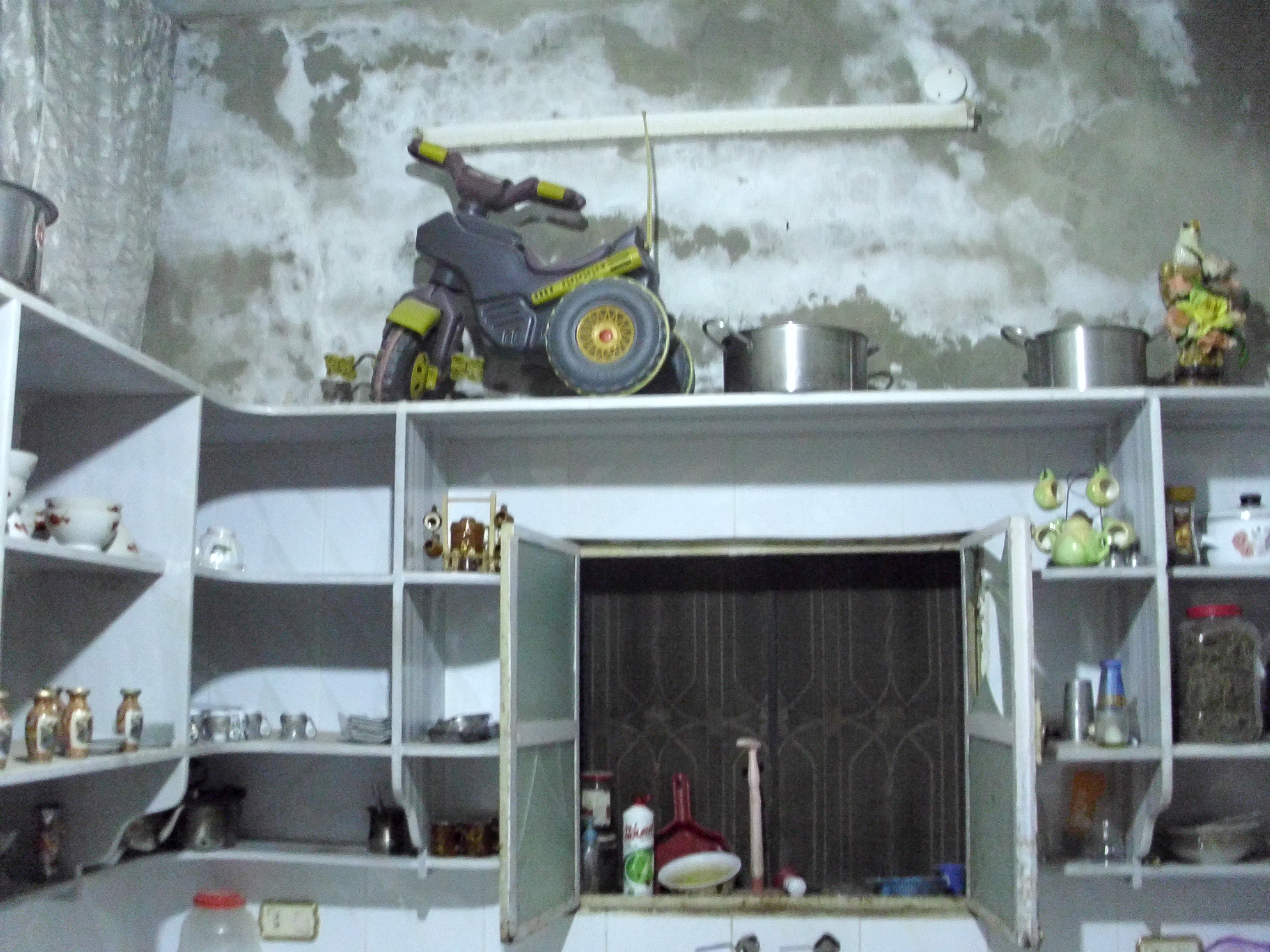
    I slept in Hamood’s house. One wall is raggedly punctured where a rocket struck, and the interior walls, still pitted by shrapnel, have been scrubbed back to the concrete after being blackened by fire. He shows me the damage, then shows off his radishes and parsley, newly planted and vigorously flourishing. The sight of a child’s toy bike on a shelf in the kitchen made me sadder than the rocket damage. Hamood’s wife, children and parents are in a camp inside Turkey.

    Next door a family of ten, displaced from a worse place, share a doorless, windowless building with snakes and rats.

    *

    Before the liberation, the residents held their demonstrations in the fig orchards outside town. After the liberation, the post-Friday prayer gathering became a target for shelling. So this Friday Ra’ed scheduled the protest for 11am, before prayers, and in a sidestreet, so as not to draw a crowd. (He was stopped later by a townsman angry that he’d missed the demonstration). “What’s the point of attracting disaster?” Ra’ed asked. “At this stage, the most important aspect of the protest is the media aspect.”

    It’s this canny media awareness that has made obscure Kafranbel one of the unlikely focal points of the revolution. Each week produces witty and topical slogans in English as well as Arabic. The first, in April 2011, declared Freedom Emerged From Under the Fingernails of Dera‘a’s Children. One threatened to “spank” Kim Jong-Un for his “childish attempt” to deflect attention from Syria. One punned on a Shakespeare quote (O Judgment! Thou Art Fled Brutish Beasts, And UN and Annan Have Lost Their Reason). One, which went viral, offered condolences to the people of Boston after the bombing there, and reminded the world that such things happen in Syria every day.

    This week the slogans read:

    Obama! You Send Us “Weapons” To Only Continue This Conflict?! Send Us Weapons To Win Our Revolution Once And For All!

    And, referring to the sudden death of actor James Gandolfini: We Are So Sorry That Tony Soprano Is Dead. We Wish Assad, the Syrian Mafia Boss, Had Died InsteadDSCI0169

    A cartoon entitled Negotiations Forever depicted the Regime and Free Syria flags hanging above Israeli and Palestinian versions. Another, alluding to the media popularity of the rebel liver-eater video, showed Putin and Assad stirring a pot of blood, and Putin saying, Let’s say…. FSA are cannibals.

    *

    After the protest an activist drove me outside town. Standing on a red pile of rocks, he traced a frontline in the blue distance between the Alawi mountains and the liberated Ghab valley. In the absence of a serious effort to arm the Free Army, it’s likely that the line will remain static for the forseeable future.

    Despite Kafranbel’s stirling efforts, the larger media war has been lost. The Western narrative is that this is no longer a revolution but a civil war, a conflict with its roots not in Assad’s repression but in the theological disputes of the ninth Century. Since the regime and Hizbullah’s joint conquest of al-Qusair, the Syrian people are struggling against the odds.

    The regime probably will eventually fall. If it had fallen a year ago there might have been a happy ending. But by now over a quarter of the population is displaced and far more have been traumatised. The social fabric is torn. If Syria remains one nation, it will be a nation of orphans and widows, of the maimed, the raped, the tormented. How does a country return from this?

    *

    DSCI0161We ate a quick lunch before Ra’ed drove us back north. We stopped in Hass to talk to a pharmacist about Leishmaniasis, a disease spread by sand flies now rampant in the country. Abu Farouq complained that he had the syringes (treatment involves injections into the skin ulcers caused by the disease) but not the medicine to fill the syringes.

    Mercifully, Atmeh was open, which saved us from climbing that wall once again. As we approached the camp through the olive groves, we asked Ra’ed a final, uncomfortable question. “If you’d known what would happen, would you have still joined the revolution?”

    “No,” he said, matter-of-fact. “The price was too high. Just in Kafranbel we’ve had 150 martyrs. As many as that are missing; they’re probably dead too.”

    He rubbed his massive nose.

    “As for me, I can’t cry anymore. I don’t feel properly. I’ve taken pictures of too many battles. I’ve photographed the martyrs.”

    Hands on the wheel, he shrugged his shoulders.

    “But it’s too late now. There’s no going back. We have to finish what we started.”

    Paolo Dall’Oglio dead ? stop ! not confirmed

    /

    Pro-Assad group kills Rev. Paolo Dall’Oglio in North east Syria, Atassi says LOCALS 2013-08-12:

    Senior Official in the Free Syrian Army have confirmed the execution of Rev. Paolo Dall’Oglio, Jesuit Priest in Ar Raqqa, North east Syria.

    Lma al-Attasi, Secretary General of the Syrian national Front affirmed to Zaman Alwasl that the prominent Italian Jesuit, Dall’Oglio, who has been kidnapped by an Islamist group on July 29, was killed in Ar Raqqa, North east Syria.

    Attasi has accused the Assad Intelligence by penetrating the ranks of the Islamic groups and contributing in the murder. “The Assad regime should carry the full responsibility.” Some western governments of hiding the news of Dall’Oglio’s killing, she added.

    Dall’Oglio was an outspoken supporter of the uprising against Syrian President Bashar al-Assad.

    The Rev. Paolo Dall’Oglio, 58, lived for three decades in Syria, where he established an ecumenical community at Mar Musa on the site of an early Christian monastery, engaging in interfaith dialogue with Muslims and forging close ties with the local population.

    He was expelled in 2012 by the Assad government for his support of the rebels.

    The Reuters news agency reported that Dall’Oglio was abducted in the eastern city of Raqqa by members of the Islamic State of Iraq and the Levant, an Islamist group with ties to al-Qaida.

    Zaman Alwasl-Exclusive

    Honeymoon over for foreign journalists in Arab Spring countries?

    An image of Marie Colvin, the American journalist for the Sunday Times who was killed in Syria while on assignment, on the wall of the Newseum, a journalism centre in Washington, DC. Colvin was one of 82 journalists who died reporting the news in 2012. Photos of the journalists were dedicated on May 13. Jose Luis Magana / AP Photo
    French photographer Remi Ochlik, who died last year when the Syrian government shelled the opposition stronghold of Homs. The American journalist Marie Colvin was also killed. Both were working for the Sunday Times, a British newspaper. Corentin Fohlen / AP Photo
    An Egyptian holds a portrait of deposed president Mohamed Morsi during a sit-in outside Rabaa Al-Adawiya, where they welcome western journalists, unlike the anti-Morsi crowds of Tahrir Square. Khaled Desouki / AFP

    It was, surely, one of the most eloquently written pleas for a pay rise ever composed.

    On July 1, the Columbia Journalism Review carried an 1,800-word first-person piece by Francesca Borri, an Italian freelance journalist working in Syria, bemoaning her shabby treatment at the hands of editors who wanted only “the blood, the bang-bang” for their bucks – and a measly 70 bucks a pop at that.

    When, in between contracting typhoid and getting shot in the knee, she tried to write about something more complex, “I am answered with: ‘What’s this? Six thousand words and nobody died?'”

    The article went viral and provoked a storm of the usual polarised responses, from “No words to explain how deep your words reached my soul, Francesca … Fantastic, lyrical, brutal, honest article” to “No one is forcing you to remain in the hell that is Syria … This is one of the most self-absorbed, self-indulgent pity parties I’ve ever read”.

    Since her article appeared, Borri has gone to ground, popping up once to write for The Guardian, to complain that “I want to talk about Syria, not just my role as a freelance journalist”. As one of her correspondents wrote, “More than 100,000 dead and the piece on Syria that went viral worldwide is a piece about journalists.”

    But buried within her original article was a searing indictment of all the foreign journalists who have flocked to Tunisia, Egypt, Libya and Syria to feast on the high drama and vivid imagery of the Arab Spring.

    “We pretend to be here so that nobody will be able to say, ‘But I didn’t know what was happening in Syria’,” she wrote. “The truth is, we are failures … nobody understands anything about Syria – only blood, blood, blood. And that’s why the Syrians cannot stand us now.”

    When she first arrived in Syria, Borri said, “Syrians stopped me and said, ‘Thank you for showing the world the regime’s crimes’. Today, a man stopped me; he told me, ‘Shame on you’.”

    Have western journalists really outstayed their welcome on the fault lines of the Arab Spring?

    It all began so euphorically, and not exactly objectively, as was made clear by an independent analysis last year of the impartiality and accuracy of the BBC’s coverage of 44 key days between December 2010 and January 2012.

    “The voices of regime opponents, expressing their exhilaration and euphoria, predominated in the space of a few weeks in early 2011,” concluded the report, carried out by Loughborough University’s Communication Research Centre in the United Kingdom.

    Some of the large number of western reporters in Tahrir Square, it concluded, had been swept up in the moment and some reporting had taken on “a euphoric character as it captured predominantly the reactions of regime critics rather than supporters … a narrative of revolutionary liberal protesters, ‘the people’, pitted against brutal dictators, was established.”

    As the Arab Spring dragged on, of course, the multiple complexities inevitably began to filter through into western media coverage.

    This, says Gene Policinski, the chief operating officer of the Newseum, the museum of journalism in Washington DC, is “a very common development in long-running news events”. When journalists arrive, “the stories that open tend to be … mixed in with a hope that ‘Now that you’re here, our message will get out’.

    “What happens over time is everything from ‘Why are you talking to the other people, we’re the good guys?’, to exposing the natural rifts, disappointments and sometimes failures that occur within the side that you are covering.”

    It is, says Policinski, a veteran print and broadcast journalist and one of the founding editors of USA Today, always a good idea “to make clear from the start if you are a journalist parachuting into an ongoing news story that you’re not there to tell one side.

    “Western journalists come out of a culture where telling both sides is at least a goal [but] very often in most of the world you’re dealing with people who are familiar with a government-controlled or funded media, where they’re accustomed to only one side of the story being told. When you reach out to that other side it’s often very confusing – they’re not expecting that. ‘You’re here with me now, you must be politically aligned with me’.”

    Ed Giles, an Australian photographer who has worked in the Middle East since 2006 and has been in Cairo for the past two years, says that such disappointed expectations lie behind the antagonism western journalists are currently experiencing in Cairo.

    “Recently there was a brief campaign against CNN from the anti-Morsi, pro-military side of the spectrum, because CNN had been using the word ‘coup’ to describe what was happening,” he says, between assignments for a magazine. “As a side effect of that a lot of TV reporters in particular, but also other western journalists like myself, were hassled.”

    But in his experience, there never really was a honeymoon period for western journalists covering the Arab Spring.

    “I don’t know if attitudes have changed that much,” he says. “It’s always been a bit extreme – there are peaks and troughs. Whenever things are really tense, like they are right now here, and the rhetoric from the various powers-that-be cranks up against ‘foreign hands’, foreign journalists come under scrutiny.”

    As a result, from time to time foreign journalists experience antagonism: “I’ve been yelled at and there have been occasions where I have had to leave a scene where the crowd are angry and they’ve taken the position that journalists and foreigners aren’t welcome, or that you’re a spy.” But “actually I’ve been quite fortunate. I know people who’ve had very much worse experiences than me, who’ve been surrounded by crowds and forced into buildings and had to hide”.

    Matt Bradley, an American former National staffer who has been in Cairo for more than four years and now files from Egypt for The Wall Street Journal, knows all about that – and the curious way in which public opinion can shift suddenly and dangerously.

    In the days before president Hosni Mubarak was toppled in February 2011, “the xenophobia was intense and I was terrified”, he recalls. “I was chased down the street by guys with machetes and clubs because the Mubarak regime was broadcasting on television that America was behind the revolution, even though America had supported Mubarak for 30 years, and people believed this.”

    Ester Meerman, a Dutch photojournalist who files words and pictures from Cairo for newspapers in the Netherlands, is well aware of the anti-American sentiment – and how to avoid it.

    “To be honest, I do always make a huge point of people knowing I am not from the US,” she says, and people’s attitude “changes 100 per cent when I tell them I am from the Netherlands”.

    Recently, says Bradley – a tall, blond-haired American who stands out in a crowd – The Wall Street Journal has despatched an Egyptian-American staff reporter from New York to mingle with the anti-Morsi crowds in Tahrir Square. “I’m not as excited by 200 people threatening to beat me up as I used to be,” says Bradley. But even his Egyptian-American colleague, with his far superior Arabic, is still hassled when people learn he works for an American paper: “They call him a sell-out, accuse him of being an agent.”

    Conversely – and perversely – Bradley currently has no trouble when he visits the pro-Morsi protest camp in Rabaa Al-Adawiya Square, where the Islamists have become much more media-savvy than they used to be.

    “I’m very popular down there,” he says, laughing. “When they see a foreigner, they are very welcoming and open. You’ll have 50 people coming up and wanting to talk and show you around, ‘We want to tell our story’. Whereas if you go to Tahrir, where the anti-Morsi march is – and these are secularists, people who I have an ideological affinity to – they want to see your ID, they suspect you’re a spy, and I’ve had people threaten me.”

    It is, he says, “very strange to be welcomed by people whose thinking I totally disagree with, but who in fact I find to be quite like-minded”. Bradley is used to the swinging pendulum of public opinion in Egypt, but “in the four and a half years I’ve been here, I haven’t seen [it] shift so dramatically, in such a short period of time, against the Brotherhood and the media – really in a matter of less than a week”.

    He, like many observers, is left puzzling over the anti-American fervour in the anti-Morsi camp, which has a direct bearing on how western journalists are perceived and treated.

    America has declined to characterise the removal of Morsi by the army as a coup, and on Thursday John Kerry, the US secretary of state, told a CNN affiliate station in Pakistan that “the military was asked to intervene by millions of people … in effect they were restoring democracy”. Yet on the ground, says Bradley, “for the last month in Tahrir Square there’s been this overwhelming feeling that the United States is backing the Muslim Brotherhood, which is very strange and doesn’t make sense. … the whole memory of the fact that this country voted for Mohammed Morsi last year has been replaced by this idea that ‘Morsi was somehow imposed on us and we heroically threw him off’.”

    Patrick Kingsley, Egypt correspondent for the United Kingdom’s Guardian newspaper since January, has also witnessed the effects of this curious case of mass double-think.

    “There has definitely been a change in the way foreign journalists have been received in Egypt in the past month or two,” he says. Partly this is down to the “upsurge in xenophobia” caused by the new military-backed regime using nationalism to win support for its actions.

    “But foreign journalists are also suddenly mistrusted by the millions of people who backed Morsi’s overthrow because many Egyptians resent the way foreign media has largely portrayed what happened as a coup, rather than a revolution,” he says.

    There have, he says, been “several reports of western journalists getting escorted out of protests by anti-Morsi protesters because of their newspaper’s reporting on events”, but that fate has also befallen journalists working for Al Jazeera’s Arabic channel, based in Qatar and seen as “Brotherhood-friendly”.

    “In my reporting,” says Kingsley, “I have avoided using words that imply a judgement on what is a very complex and nuanced issue – but I have still been criticised for reporting on recent army abuses.”

    Meanwhile, “Morsi supporters have been very hostile to local journalists, because they believe locals will not give them a fair wrap” – as witnessed by protests last week at a media centre in 6th of October City, home to a number of private Arabic satellite TV stations – while they have been welcoming to their western counterparts, “as they think a good international write-up may help persuade diplomats to pressure the army into treating them better.

    “This marks a change from the previous six months, when it was hard to get hold of Brotherhood spokespeople, particularly if they thought your coverage was unfavourable to them.”

    Doubtless, perceptions of journalists, wherever they are from, are shaped by geopolitical events. “Journalists,” says John Downey, professor of comparative media at Loughborough University’s Communication Research Centre, which analysed the BBC’s Arab Spring coverage, “are often seen as appendages to states.”

    For example, in the UK the BBC is, by and large, regarded as an independent, unbiased source of information. In the occupied territories, however, it is not.

    “The BBC’s coverage of Israel’s occupation differs so markedly from the reality on the ground, that it is difficult to see how it can be viewed as a trusted news source on this subject,” says Ameena Saleem, who monitors media coverage in the UK for the Palestine Solidarity Campaign.

    The corporation’s coverage “is focused on rockets fired from Gaza and what it likes to call ‘clashes between Palestinian youth and the Israeli army’. Background and context do not make an appearance.”

    That’s not an uncommon complaint about western journalism in the Middle East.

    In March this year, Atiaf Zaid Alwazir, co-founder of the media advocacy group SupportYemen, wrote a telling opinion article for the Yemen Times. Thanks to a lack of meaningful engagement, she said, “the media narrative on Yemen is completely flawed”. The parachute journalists who were dropped in and out of the country knew very little about it and, as a result, a nation of 24 million people, “from different backgrounds, regions, sects, dialects and landscapes, has been reduced to [stories about] Al Qaeda, wars, poverty, qat, tribalism, or the ancestral home of Osama Bin Laden”.

    Distrust in the western media is nothing new – nor is it exclusively an Arab phenomenon. A Gallup poll in the States last September found that a record 60 per cent of Americans had “little or no trust in the mass media to report the news fully, accurately, and fairly”.

    And, sometimes, that distrust is well-founded.

    Confidence in the impartiality of the western media in the Middle East was surely shaken in 2004 when The New York Times admitted that many of its articles that had wrongly reported the existence of weapons of mass destruction in Iraq prior to the 2003 invasion had “depended at least in part on information from a circle of Iraqi informants, defectors and exiles bent on ‘regime change'”.

    The newspaper, and other media outlets, had been fed juicy bits of misinformation by anti-Saddam groups, and had not sought to verify them independently.

    “Editors at several levels who should have been challenging reporters and pressing for more skepticism were perhaps too intent on rushing scoops into the paper,” read the subsequent mea culpa from the paper.

    “Accounts of Iraqi defectors were not always weighed against their strong desire to have Saddam Hussein ousted. Articles based on dire claims about Iraq tended to get prominent display, while follow-up articles that called the original ones into question were sometimes buried. In some cases, there was no follow-up at all.”

    Some attribute the disconnect between protestors of the Arab Spring and the traditional western media to the rise of citizen journalism, which initially drove global coverage of events. The report commissioned by the BBC Trust into the corporation’s coverage throughout the fast-moving days of 2011 noted that among the jubilant protesters journalists encountered, and to some extent relied upon, “young, liberal, western-facing and technologically adept demonstrators”.

    Certainly, social media was to play a central part as western news organisations scrambled to get reporters, photographers and camera teams on the ground. User-generated content (UGC) – footage taken on video phones, chiefly – came into its own, despite the fact that “it was not clear … who the authors of a significant proportion of UGC were”.

    The report found that some 46 UGC clips used by the BBC had no clear authorship. Among those whose origin was known, only 12 were attributable to government sources while 86 came from opposition activists, demonstrators and other members of “The People”.

    The dangers of reliance on such citizen journalism became apparent in the middle of June 2011, when many news organisations, including the BBC, fell for the hoax that was the “Gay girl in Damascus” blog.

    The author, “Amina Arraf”, had written critically about President Bashar Al Assad’s regime and had been written about by western journalists at length – but interviewed only by email. When a blog entry supposedly written by her cousin reported that Amina had been abducted by armed men, activists launched a much-reported campaign to free her – until the real blogger, one Tom MacMaster, revealed he was a 40-year-old American studying at Edinburgh University.

    The rise of new media may have helped to alter perceptions among the protesters of the Arab Spring of the need for an elite class of professional journalists, no longer seen as the sole conduit through which messages can be broadcast to the world.

    “New media,” says the Newseum’s Gene Policinski, “gives them an opportunity to tell their side much more easily to the large community. And then again, when a discordant story appears written by someone else, perhaps entirely accurate – let’s say about a rift in the leadership of a particular group – that’s often seen as an antagonistic story, contrary to the message they are trying to put out. By reporting on news that’s not flattering, you are contrary to the message that people feel much more empowered to deliver ‘unsullied’.”

    And for this, says Rosie Garthwaite, a former producer-presenter for Al Jazeera in Doha, traditional news organisations may have only themselves to blame.

    Garthwaite, who now runs Media Dante, her own TV production company in Doha, believes a “pullback of investment in the Middle East [by international news organisations] has led to a lower standard and general understanding in journalism, which has been evidenced in the Arab Spring”.

    This has both encouraged and provoked the spread of “citizen journalism”, often seen as a cheap alternative to maintaining expensive staffers on the ground, “but the problem is that you need to have a proper investment in and understanding of a country if you’re going to get to grips with the story”.

    Certainly, media outlets everywhere are struggling to manage – and monetise – the phenomenon, with some big players effectively institutionalising the exploitation of citizen journalism. The Guardian’s Witness project, billed as “Your chance to have videos, photos and stories featured on The Guardian“, grants the paper the right to use contributors’ material in any way it sees fit, without payment. CNN’s iReport – “Share your story, discuss the issues” – likewise grants the organisation a “perpetual, worldwide licence … without payment to you or any third party”.

    Reporters, too, now tweet and blog about the news they are covering (though they, at least, are being paid to do so). Blake Hounshell, now deputy editor of Politico magazine, began tweeting about the Arab unrest in January 2011. In July that year he wrote an article for Foreign Policy, headlined “The revolution will be tweeted”, after watching young protesters tweeting from a demonstration against Hosni Mubarak.

    “These weren’t revolutionaries so much as they were reporters, translating their struggle for the rest of us,” he wrote. Twitter had become “the essential tool for following and understanding the momentous changes sweeping the Arab region”.

    And, in the same way that those momentous changes impact most directly on the people living through them, so the journalists who face the greatest dangers and obstacles in reporting the Arab Spring are not westerners but natives of the countries undergoing upheaval.

    Being a foreign correspondent in a time of war has always been a risky business, as the towering engraved-glass memorial gallery at Washington’s Newseum vividly attests – and particularly so if you happened to be working for The Times of London in the turbulent second half of the 19th century. The first three names etched into the glass panels were all Times correspondents who lost their lives overseas in the line of duty between 1855 and 1870.

    But fast-forward 160 years, and 2,244 lives, to the past four years of the Arab Spring and the two-storey glass offers a sobering insight that puts the concerns of an underpaid Italian stringer in Syria into context.

    The memorial is re-dedicated, and updated, every year, and on May 13 the freshly engraved names of 82 journalists who died covering the news around the world during 2012 were unveiled.

    Thirty of them were killed in Syria, but only four of the 30 journalists who died covering events in Syria in 2012 will resonate with western readers. They are Marie Colvin, the veteran American journalist killed in Homs in February last year while on assignment for the Sunday Times, along with French photographer Remi Ochlik, and Anthony Shadid, the two-times Pulitzer-prize-winning Lebanese-American who was working for The New York Times and suffered a fatal asthma attack the same month while trying to flee Syria, and Mika Yamamoto, a reporter for Japan Press, shot dead in August while travelling with the Free Syrian Army in Aleppo.

    Few in the West will have heard of any of the remaining 26 who died in Syria. All were Syrian journalists, of whom 18 were caught in the crossfire and eight were singled out for assassination by one side or the other.

    Their deaths, memorialised on frosted panes of glass in Washington DC, serve as a brutal reminder that in journalism, as in everyday life, the vagaries of covering the Arab Spring should be seen not so much as a western difficulty, as an Arab tragedy.

    Read more: http://www.thenational.ae/arts-culture/honeymoon-over-for-foreign-journalists-in-arab-spring-countries#ixzz2bSHnUicP
    Follow us: @TheNationalUAE on Twitter | thenational.ae on Facebook

    A Rant for Syria

    What a week it has been. The Khaldiyeh district in Homs was overrun by Assad’s army, the Syrian rebels are in disarray, Syrian women forced to offer “survival sex” in Lebanon, and fatwas in Aleppo banning the croissant. Well, I have to say I am impressed with the historical knowledge and zealousness of whoever thought that one up, after all the croissant was a symbol of the second defeat of the Ottomans at the gates of Vienna. The people there were so jubilant at this victory that an enterprising baker came up with the idea of the “croissant” after seeing the crescents of the Ottomans. In all fairness the Ottomans did also give Europe the inspiration for cappuccinos in return, so we really should call it even. But that hasn’t fazed the hapless zealots who seem intent on righting every historic wrong of the past four hundred years, although I don’t really understand how right it is that the Ottomans were trying to conquer Vienna in the first place, but I guess if the Ottomans lost then that is supposed to be a bad thing, and since they were Muslims and we are Muslims then that means we lost at Vienna, right?

    This is all such a farce, Syria is such a farce. Has anybody looked at Bashar al Assad? What makes me feel like crying is that anybody would think this person is a leader, let alone inspirational. He sits there and pretends to be Mr Big Man in his expensive suits, and I bet you those suits weren’t even tailored by a Syrian – even though Syrians are probably the best tailors in the world, and barbers too (it’s true). His adoring fans celebrate a great “victory” in Homs, as they did in Qusair, and pretend as if they have something to be proud of. Have they even seen what those two places look like now? For goodness’ sake any more victories and there won’t be a country left to rebuild. But they don’t listen or see, they just tell us they feel “sad”. And then we have to listen to their constant drone about how “arming” the revolution was a mistake and a betrayal. Their shooting the jaws off adolescent boys wasn’t reason enough for these jingoistic Assad fans. After all what would people say if they saw Syrians as nothing more than a dysfunctional and inbred family? And how embarrassing would it be for young Hafez and his Acton mummy to shop in London and pretend to be normal if everybody knew that they came from a country that was as unfashionable and icky as Afghanistan. No, weaponizing this conflict was a big mistake, you hear me? and all you people who supported this revolution should be ashamed of yourselves. Think how embarrassed you’ve made Bashar Assad in front of the world. After all everybody knows that even though his allies are Iran and Russia what he and his wife really want is to get “in” with the West. It’s just like with the Ottomans really. They tried to invade Europe, then tried to join it, and all they ever wanted was to be Europeans. But what did the Ottomans get? Croissants thrown right back in their face. Oh the agony.

    Besides, all this revolutionary business distracts us from our sacred mission, Palestine. The rebels you see, are part of a global conspiracy but at the same time we are one and the same, family. You understand. On the radio we have alternating narratives. One narrative wishes to kill these people and squash them like cockroaches. The catchphrases on fascist Assad radio channels like Sham FM is that “God willing we are going to make Syria better than it was. We are going to take it back”. Take it back from whom exactly? And who do you mean by “we”? Oh, yes, “we” is anybody who worships that lame duck you call a president, the one whose only accomplishment in life was to be the son of Hafez Assad. At least that dictator fought his way to power – not that that would ever wipe away his crime in Hama of course.

    The other narrative on those radio channels is that these people we are fighting are “our brothers” and that they can be reasoned with to put their weapons down and “reconcile”. We’ll all sit down around the fire in a bedouin camp, the elders will talk of great things and nod their heads as they drink the bitter coffee, and we will magnanimously forgo the wrongs of the past and agree to unite our ranks once again. We’ll just blame this on the Jews – who are everywhere apparently and had planned this entire Arab Spring just after writing the Protocols of the Elders of Zion.

    People think I’m joking, but we do have Syrians in Syria who believe this stuff. I would know as I’ve met some of them – in fact some of them are even family. That’s what happens to a nation that is cut off from the outside world and stops reading and asking questions. It becomes inbred and stupid. This is the Syria that Assad is trying to defend, because it is the only Syria he can rule over indefinitely. Anything else and people start prodding and poking, sticking their noses in all sorts of things such as elections, free associations, books and other such dangerous and seditious activities. Anyway I’m tired now and I’ve had enough of writing. The only thing I found remotely inspirational and interesting this week was that Youtube video of a young Syrian officer who decided to put his weapon down and actually speak to Syrians instead of killing them. He’s dead, apparently he was killed a few months ago, and now all the pro-Assadists have mental erections because they finally found somebody in their ranks who wasn’t an animal. That’s how it always is in Syria, we never hear of good news until it’s too late.

    source

    BBC Newsnight (09 July 2013) Debate: Should we arm the Syrian op

    Qunfuz

    Robin Yassin-Kassab

    Here’s a Youtube recording of a full BBC Newsnight episode on Syria, in which I participated. The debate was about serious help for the resistance. The help isn’t coming.

    ‘Survival sex’: How NGOs and peacekeepers exploit women in war

    By Vibeke Brask Thomsen/Guest Blogger — July 29, 2013

    It’s easy to associate rape with the Democratic Republic of Congo, a region torn by conflict since 1996. Dubbed the “rape capital of the world,” the country sees four women raped every five minutes, according to a 2011 study published by the American Journal of Public Health. The consequences of rape—HIV/AIDS, unwanted pregnancy, genital damage, and even rejection by communities—have ripped women and families apart.

    But several women in DRC also suffer from a less recognized form of sexualized violence: “survival sex,” the exchange of sexual favors for food or other necessary goods with everyone from NGO workers to UN peacekeepers to local men who have goods that are otherwise scarce. This is not prostitution. It is neither voluntary nor equal.

    “Survival sex is one in which women have no choice, where they believe that the only way they are going to make any money, where they’ll be able to keep their job or get a job, is through engaging in sex or in relationships with individuals,” according to Anneke Van Woudenberg, a DRC expert who is featured in “To Serve With Pride,” a video issued in 2006 by the United Nations Task Force for the Protection of Sexual Exploitation and Abuse by UN and Related Personnel. “It is by no means a relationship of equals.”

    This kind of violence occurs around the world in warzones and refugee areas in which women are inherently made vulnerable.

    Men tasked with providing assistance to refugees from war sometimes end up exploiting them, trading food and other aid for sex. (ISAF Headquarters Public Affairs Office)

    On a recent reporting trip to Jordan, a source told WMC’s Women Under Siege that both local and international NGOs were trading sex with Syrian refugees for aid such as food coupons. A July 24 report on Women in the World quotes a Syrian woman in Lebanon named Maryam, 31, as saying: “One of the men at an NGO told her that if you accept to sleep with me, if we can have sexual relations, every time I have any kind of access to assistance, it will be yours. It will have your name on it.”

    Holocaust scholars have also documented cases of survival sex in which women in concentration camps were forced to have sex with guards in order to obtain a bit of bread, or even with the so-called “righteous,” who hid Jewish women in their houses or fields to “protect” them.

    When the very people meant to help refugees are exploiting them, alarms should be going off at the international level. But even the UN has historically had its share of peacekeepers involved in the sexual exploitation of incredibly vulnerable populations.

    ***

    “We were walking home from school when a driver in a UN car pulled over,” a young Congolese girl’s voice says. “The driver told me he loved me. He had pints of milk in the back of his car, which he gave to my friend and me.”

    The girl and her friend had sex with the men several times, and both became pregnant. The men eventually abandoned the girls and their families cast them out of their homes. Before long, they were forced to give up school to care for their children.

    The story of these girls is told in “To Serve With Pride.” The video documents exploitation and abuse by UN personnel and other humanitarian workers, the people who are supposed to protect vulnerable civilians from sexual abuse and end up becoming the perpetrators of the crimes. [WMC’s Women Under Siege documented more on this subject in our May 2012 report.]

    The UN is tasked with the “collective responsibility to uphold the highest standards and protect all those [it] serve[s],” according to former UN Secretary-General Kofi Annan. In 2011, the UN Security Council adopted a resolution calling for the continuation and strengthening of efforts to implement the policy of zero tolerance of sexual exploitation and abuse in UN missions. More than 10 years before that, the UN Security Council adopted another resolution calling for a gender perspective that includes the special needs of women and girls in conflict and post-conflict situations.

    But statistics published by the UN’s Office of Internal Oversight Services found that of the 60 allegations of sexual exploitation and abuse reported in 2012 throughout UN missions, almost half had occurred in MONUSCO, the UN mission deployed in the Democratic Republic of the Congo. Those 25 cases had been perpetrated by personnel affiliated with the UN, the report said.

    Sexualized violence in the DRC has been extensively documented, but less in the forefront are the abuses committed by humanitarian personnel—those personnel who have been sent to prevent the abuses from happening in the first place. This is yet another form of rape brought on by conflict and dire poverty.

    “To Serve With Pride” tells the chilling account of one woman in a camp: “We have needs in the refugee center, and when we have insufficient relief supplies or other facilities to fulfill these needs, if someone tries to tempt us into exchanging something, then we have to agree.”

    “Where there is desperation, buying sex is cheap and easy,” says the narrator of the video.

    ***

    The reasons these abuses continue are numerous, but three main causes seem to stand out: lack of training, lack of local awareness, and impunity.

    Claus Hjorth Madsen, a Danish officer deployed as a UN Blue Helmet in 2010 in South Sudan, told me in May 2013 that prior to his deployment, he took part in cultural awareness classes and gender-sensitive training, which covered sexual exploitation and abuse and included such topics as ways to interact with local women. He was instructed not to socialize with the local population and not to visit sex workers—such behavior, he said they were told, gives the wrong signal to civilians about the role of peacekeepers.

    But Madsen said that not all UN national staff receive such training: “It is well known that not all countries have the time, resources, or will to provide gender and cultural training to its personnel.” India and Bangladesh, he said, are among those troop contributors that do not provide the same in-depth training that he received. This disparity between trainings highlights the need for a UN-coordinated mechanism that ensures all personnel are trained in accordance with UN standards.

    Experts have also said that local women are not informed of their rights, which leads to “ignorance, illiteracy, poverty, and impunity [as] the main challenges” in stopping sexual exploitation and abuse by humanitarian personnel, according to the director of a local NGO in the DRC who spoke on condition of anonymity. In May 2013, the director, whose organization focuses on human rights and women’s rights, said that local women were not aware of existing complaint mechanisms in the legal framework and therefore didn’t seek justice after being abused.

    The UN’s Protection of Sexual Exploitation and Abuse by UN and Related Personnel Task Force also acknowledges the importance of raising awareness among the local population about their rights, including, for example, their entitlement to aid without any requirement for sexual favors.

    The NGO director emphasizes that victims should be granted adequate assistance, including awareness of their rights, access to safe abortion clinics, and health advice. He suggests that assistance clinics be created, places where victims can report and get fast responses to cases of sexual exploitation and abuse by humanitarian and UN workers.

    The UN must also take steps to ensure that commanding officers are held accountable for their actions or those of their subordinates. In addition, stronger penalties should be enforced for perpetrators of rape. In a report for Refugees International, “Ending Sexual Exploitation & Abuse in UN Peacekeeping Missions,” Sarah Martin says that under current law, perpetrators who are UN personnel are returned to their home countries, with UN instructions to national governments to prosecute. This absence of a mechanism to ensure prosecution leaves victims with no support or reparation measures.

    Unfortunately, many NGOs have no such public or institutional oversight in these cases. And women stuck in the limbo of war and survival will continue to do what they need to in order to feed their children and themselves. As long as no better options exist, women will remain vulnerable in warzones and refugee areas.

    source

    Blog at WordPress.com.

    Up ↑