Search

band annie's Weblog

I have a parallel blog in French at http://anniebannie.net

Category

Syria

Protest on 3rd anniversary of the Syrian Revolution

manif

Comité Belge pour soutenir la Révolution syrienne

Depuis trois ans, les crimes commis par le régime syrien se multiplient sans fin, avec le soutien de la Russie via leurs armes et leurs services secrets, de l’Iran avec l’envoi de snippers et de leurs gardes républicains,de l’Irak avec les miliciens chiites et du Hezbollah libanais,avec les groupes Islamistes et terroristes infiltrés par l’Iran, la Russie et le régime qui prétendent faire la révolution.

Des millions de réfugiés , de déplacés internes ,de milliers de tués (140.000 selon le dernier décompte de l’ONU qui a décidé de ne plus compter….),de disparus, de torturés, d’emprisonnés, de morts de faim, de manque de soins.

Des listes sans fin…

Qui s’intéresse encore à la situation en Syrie ?

Malgré tout, les Syriens continuent leur révolution, poussés par leur espoir de liberté, de démocratie et d’égalité, même si la communauté internationale assiste passivement et participe indirectement aux crimes.

We invite you

on Saturday March 15 ,

from 4pm to 6pm,

Place Flagey

Ixelles

For the Committee

Bernadette van Zuylen

Hasan Addaher

Syria : Sigh of relief after ISIL retreat

Withdrawal of Islamic State of Iraq and the Levant fighters from northern Syrian town gives residents hope.

The Islamic State of Iraq and the Levant recently withdrew from the town of Azaz [Emma Beals/Al Jazeera]
Azaz, Syria Residents of parts of northern Syria say they are breathing easy again after living under the rule of Islamic State of Iraq and the Levant (ISIL) fighters, who hastily retreated from the area after the threat of attack from other rebel groups.The eight-kilometre stretch of road from the Turkish border to the small town of Azaz in Aleppo province is now cleared of ISIL gunmen. The hardline group’s main checkpoint at the town’s entrance – under ISIL control since early August – has been abandoned.ISIL insignia still cover a concrete barrier jutting out across the road, but the tanks that demonstrated the group’s military strength have vanished. Only a solitary sofa remains on the gravel roadside – where, until late last month, ISIL armed guards were stationed around the clock, restricting all movement in and out of the community.

“It feels like the town is smiling, laughing, happy,” Azaz resident Abu Bilal told Al Jazeera.

Battles between ISIL and its rival, al-Qaeda-linked Jabhat al-Nusra, that began in early January have killed thousands of people – the deadliest fighting among opposition forces since Syria’s civil war began three years ago.

At first united in their opposition against Syrian President Bashar al-Assad’s forces, the two groups fell out with one another due to ISIL’s brutality and its demands for strict adherence to its ideology. In late February, Jabhat al-Nusra leader Abu Mohammed al-Golani warned ISIL to end the infighting among rebel groups or be “expelled” from northern Syria.

Before making the surprise retreat on February 28, ISIL had expanded its control north to just a few hundred metres of the Bab al-Salam camp for internally displaced people, which sits next to the border crossing into Turkey.

In mid-February, the group detonated a car bomb in the camp, killing at least two dozen people and terrifying the already traumatised residents.

Abu Ahmad was living right next to the spot where the vehicle detonated. His family’s tent was destroyed in the explosion. “Thanks to God, none of my family were inside at the time. All the children play near the road,” he said.

As Ahmad speaks, his eight-year-old son clings to his mother like a much younger child would, his eyes a steely blue-grey. But now, with the ISIL fighters gone, the family feels some relief from the constant fear, Ahmad said.

ISIL had demanded strict adherence to Islamic law with public beatings and executions for those who disobeyed. “Now that [ISIL] left, we feel better,” Ahmad said.

Appalling conditions

The camp – erected hastily in late 2012 and not long after eastern Aleppo fell into rebel hands – used to have 6,000 residents, but it now houses 17,000 people. Having fled bombings and ISIL rule in Azaz, the 17,000 residents have been living in appalling conditions while they wait for the chance to return home.

Living next to the border crossing has not been easy for the camp’s residents, and any imagined safety because of its proximity to Turkey is just that. A huge battle between other rebel groups and ISIL took place here last September, in which 4×4 vehicles mounted with heavy machine guns surged towards Azaz to try to capture the town.

Since then, northern Syria has grown much more dangerous. Local and foreign journalists have been kidnapped and executed, NGO workers have been targeted for being “spies”, and residents have gone into hiding from ISIL’s unforgiving rule.

The ISIL abandoned Azaz, but signs of the hardline group remain [Emma Beals/Al Jazeera]

The border crossing, a vital supply route to the camp and the north of the country, has been closed periodically, depending on the perceived threat of ISIL.

With inconsistent access to supplies and a situation so dangerous that many NGOs and journalists have stopped coming, the camp and its residents have largely been left on their own for survival.

The stench in the Bab al-Salam camp is overwhelming at times. A combination of a lack of toilet facilities and waterlogged, swampy ground creates pools of green water and mud next to small dry patches of dirt where children play.

“We don’t feel any safety here. We are always afraid, afraid of [ISIL],” said Abu Muhammad, a father of two young sons from Aleppo. They have been living at the camp for more than a year.

‘Tactical withdrawal’

ISIL has retreated to an area spanning from al-Bab in the west through Manbij and Jarabalus towards its stronghold in Raqqa, in Syria’s northeast.

“Azaz eventually had little strategic value to [ISIL] because it was cut off from the rest of its contiguous territory… and they were constantly under siege from rival factions. So the withdrawal was tactical,” explained Aymenn al-Tamimi, a fellow at the Middle East Forum who studies jihadist groups.

Azaz was home to an estimated 50,000 people before the war, but about 10,000 have fled, many because of the ISIL’s harsh rule.

“They were manipulating the religion, they forced people to do the prayers,” said Abu Bilal, a driver who works in the town. “They’d bring the people and chop their heads off in public. I mean that’s a person with a soul, right?”

Many residents were evasive when asked about life under ISIL, fearful of the group’s return and suspicious of a journalist’s questioning. Despite its retreat, ISIL has left behind loyalists and spies.

Liwa al-Tawhid, the rebel brigade now in control of Azaz, continues to root out support for the group. Loud explosions could be heard recently as ISIL booby-traps left behind were detonated.

A year ago, the town’s main street was desolate as Assad’s forces shelled Azaz with Scud missiles, a form of collective punishment against those who supported rebel fighters who took control of the Mennagh military airport a few kilometres away.

Today the town is bustling. Women walk freely along streets, and fruit and vegetables are available for sale in small shops. A man in a wheelchair sells cigarettes from a card table surrounded by a flock of children. Tobacco products had been banned by ISIL.

Supplies are also making their way back into the Bab al-Salam camp. The day ISIL left town, 200 trucks were waiting at the Turkish side of the Oncupinar border crossing when it opened for the day.

Yet maintaining the high spirits may not be easy. With high expectations for life after ISIL, the challenge for Liwa al-Tahwid and Jabhat al-Nusra will be maintaining order and ensuring access to supplies.

But for now, residents are enjoying their small victory. “It’s cheerful. You can leave town without any troubles. Thank God,” said Abu Bilal with a smile.

source

The Salam School

March 8, 2014 § Leave a comment

DSCI0221

This was published at the National.

Syria is my father’s country, where I spent an important part of my young adulthood, where my son was born. Living there was inspiration for my first novel (though it’s set mainly in London). In fact, I fell in love with the country – with its enormous cultural and historical heritage, its climatic extremes, and its warm and endlessly diverse people. Of course there were moments – for example, visiting a broken man who’d been released after 22 years imprisonment for a ‘political offense’ – when I felt like getting the next plane out. And before too long I did move on, because a stagnant dictatorship was no place to build a future.

Then in 2011 the revolution erupted. This instant of hope was followed by a counter-revolutionary repression of unprecedented ferocity. How to respond? For a long time I wrote and spoke to anyone who would listen on one theme: the necessity of funding and arming the Free Army – civilian volunteers and defectors from Bashaar al-Assad’s military. Nobody did arm them, not seriously, and as a result the Free Army lost influence and Islamist factions filled the gap. Assad’s calculated manipulation of sectarian fears and hatreds produced a Sunni backlash. Al-Qa’ida franchises set up emirates near the Turkish border, and the West increasingly understood the Syrian drama not as a battle for freedom, but as a security issue. In illustration of this fact, I was stopped at Edinburgh airport as I started my most recent trip to the Turkish-Syrian border, in December, and questioned under the UK’s Terrorism Act. “Which side do you support?” they asked me. I explained there are many sides now, but the question seemed to be either/or: either the regime or the jihad – and support for the (genocidal) regime was the answer which ticked the ‘no further threat’ box.

They also asked why I was going. The answer: I was lucky enough to know a group of committed and talented Syrian-Americans, including Chicago-based architect and writer Lina Sergie Attar, interviewed below, founder of the Karam Foundation. Karam delivers aid and opportunity to war-struck Syrian communities, and I was on my way to participate in its Zeitouna programme.

How do you act usefully in the face of a tragedy which unfolds on an incomprehensible scale? Syrians and their friends were forced to address this question as Assad’s genocidal repression transformed the popular revolution into a civil war, and as an unthinkable third of the population were made refugees. Every city except two has crumbled in whole or in part under bombardment. Ancient mosques and churches have been reduced to dust. The country’s multicultural social fabric appeared to dissolve.

storytellingSyrians inside the country were propelled into actions they would have formerly found inconceivable: selling a car to buy a Kalashnikov, leaving a teaching job to join a militia, abandoning a proud home for a tent by a border fence. Some have discovered themselves as beasts driven by fear or prejudice: torturing children in dungeons, raping women at checkpoints, slitting old men’s throats, and firing artillery, scud missiles and sarin gas at their neighbours. Many others have revealed unsuspected reserves of compassion, courage and creativity. I’ve met some of these extraordinary ordinary people. A man, for instance, whose immediate family was annihilated in bombing, who now publishes newspapers for adults and children because he believes the right to self-expression is the only important thing left. A man who stays on after his family fled to run a free bakery without which many would starve. A nurse who serves (unpaid of course) in field hospitals, the blood never dry on his hands, who hasn’t dared cross a checkpoint to visit his mother in over a year.

“It is the greatest of all mistakes to do nothing because you can only do little,” wrote 19th Century clergyman Sydney Smith. “Do what you can.” Hazar Mahayni is a Syrian-Canadian pharmacist, a widow in late middle age bursting with energy and good cheer. In October 2012 she also became the organising intelligence behind the Salam School for refugees in Reyhanli, on the Turkish side of the border. This school was the site for December’s Zeitouna activities.

The school is a rented one-storey villa, with new walls to make more classrooms, a small olive grove, and even a menagerie containing rabbits, hens and two goats. It serves 1200 children who crowd the classes in three three-hour shifts, the youngest first. The demographic stretches from the Damascene bourgeoisie to the poor peasantry, but most are from the rural north, the governorates of Idlib, Hama, and Aleppo.

There are over 700,000 refugees in Turkey, some in camps, others living in towns and cities. Turkish prime minister Erdogan’s government has been much more generous than others in the region, allowing Syrians to set up schools, businesses and charities. In Reyhanli I visited a new orphanage and the Watan wool workshop, which sells knitwear produced by refugee women. Just as they are inside the country, Syrians are organising themselves for survival. In the Salam School, a man interrupted my classes twice to ask, first, which children had no fathers or whose fathers had no work, and second, which children had no gloves.
DSCI0217The last is a necessary question because the Levantine winter is bitterly cold – a dry, bone-deep, biting sort of cold. A winter storm struck while I was there, and children froze to death in the snow-covered camps on the Syrian side. The children in Reyhanli are slightly better off. Depending on their resources, they live in rented houses, rooms, shops or warehouses, often separated from the next family by only a curtain. But most refugees have no school to attend. Very young and ragged children in open-toed sandals beg at the traffic lights.

The Salam School’s children are as noisy, as full of tears and laughter, as children anywhere, but many are traumatised or simply lacking care. In one class, a heavy boy called Abdullah got into three fist fights in the first five minutes. I put him outside for a while, then brought him back and focussed some attention on his work. This was enough to make him smile and cooperate.

The school has a warm, humane, and Islamic atmosphere. I witnessed one instance of Muslim obsessive-compulsive disorder, when a small girl leapt to show a teacher a picture she’d drawn of Cinderella. “I’m glad to see you’ve given her a long skirt,” the teacher said in a kindly tone. “But you should have put a scarf on her head too.” Otherwise the environment was openminded, tolerant and cheerful. One drawback is that everyone (as far as I could see) is a Sunni Muslim – nothing unusual for the rural areas, but city kids used to live in more mixed neighbourhoods. And this isn’t the school’s fault, but the demographics of Assad’s expulsion.

Our days began with revolutionary chants (“The revolutionary generation welcomes you!”) and Quranic recitations. The teachers teach what they can of the Syrian curriculum, stripped of its hagiography of Assad pere and fils and of the propagandistic ‘Nationalism’ subject. Corporal punishment (standard in the old education system) is forbidden, but old habits die hard and it still sometimes occurs. Management and teachers are refreshingly open and honest about these challenges.

Hazar says it’s been difficult to involve the teachers – trained  to follow orders in Assad’s system – in collective decision making, but that now they’re making headway. She sees the development of cooperative self-organisation as a revolutionary cultural process every bit as necessary as winning the physical battles.

The staff includes men who have participated in the actual warfare, like Ustaz Ahmad from Banyas, the coastal city where Assad’s shabeeha militia committed throat-slitting massacres. Ahmad slipped away because he was wanted at checkpoints (“They’re still looking for me,” he laughed. “They think I’m still there…”) and joined the Free Army on Jebel al-Akrad. His group ran out of ammunition and then out of food, so he came to Turkey twenty days before I met him.

Or there was the teacher whose husband was once an officer in the national army. He defected because he didn’t want to murder his neighbours. He was captured. Seven months later he died under torture. His body was thrown in a mass grave.

Given that the teachers themselves are traumatised and have lost almost everything, it’s remarkable that so many can smile – more than in an average British school. A teacher called Abdul-Jabbar wins the prize for the most infectious and enchanted smile, something like a flock of birds raising the spirits of all around.

I was in the school for a week as part of the Karam Foundation’s Zeitouna project. Six months ago a five-member core delivered workshops in the tented classrooms of Atmeh camp, just inside Syria. This time our numbers were up to 40 volunteers, and included obvious foreigners, and this time too al-Qa’ida franchises are kidnapping people in the border areas, so Karam decided for our safety we should work on the Turkish side. A series of fortuitous circumstances established a relationship with the Salaam School.

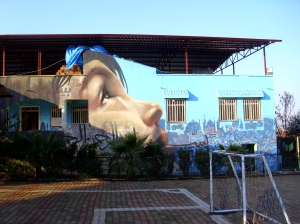
DSCI0027Max Frieder’s Artolution organised large-scale canvas painting (I saw it done but still couldn’t understand how the hands of hundreds of babbling children created pictures that made coherent sense) while the AptART team involved the children in designing and painting a mural for the school wall. The result was impressive, something every child will remember in future years – an uplifted face on a background of calligraphed phrases (In the name of God the Compassionate the Merciful, Cooperating for a Better Future, Love, Hope, Dignity…), upraised hands, grinning faces, and the towers and minarets of a cityscape.

There were workshops in football, calligraphy, digital photography, trust games and journal writing. Game-inventor Rory O’Connor workshopped his wonderful Story Cubes, and left hundreds of these imaginative tools behind to liven Reyhanli’s cold nights. The dental hygiene workshop distributed toothbrushes, while the dental team (all Syrian-Americans) made themselves unpopular by extracting over a hundred teeth daily.

Mine was a storytelling workshop based on the notion that a story needs six things: hero, assistant, problem, secondary obstruction, solution, and conclusion. Among the children’s chosen protagonists were Robin Hood, Batman, my brother the martyr, my father the martyr, and (most often) Sponge Bob. Among the problems to be solved were a dinosaur eating people, a car hitting a pedestrian, my house being shelled, and my cousin stuck in prison.

The activity gave them a way to exercise their fantasy and also to process their real-life stories. And every child has one. When you ask why they came to Turkey, they answer “because Bashaar kept on shelling us,” and then go into specifics. Because we haven’t experienced it, we must imagine here what ‘shelling’ means – not a word in a news story or an element of fantasy-drama but the actual ceiling coming in, a home transformed suddenly into sky cracks and screams. This is what these small children are so matter of fact about, though their eyes flicker and adjust as they speak.

DSCI0059There were stories everywhere I turned. You don’t need a fixer to find victims on the Turkish border, you just ask any man or woman on the street. Even to the last moment, to the cab driver who took me from my friend’s place in Antakya to the airport. Abu Ali was from Lattakia and he happened to know my family. He and his 15-year-old son were arrested together. “They beat my son until he was nearly dead. They beat me until I wished I were dead.” In a cell with 50 others and a hole in the floor as a toilet, which they had to use in front of each other, and nobody was able to wash in the two months Abu Ali was there. Two months of beatings, insults, humiliation, and near starvation. Then father and son were released, for which he thanks God profusely, because “so many die in their prisons.”

This horror has displaced two million outside the country, almost six million inside, and made Syrians the boat people of the decade. While we were there one of our Syrian-American dentists learnt that his nephew had died when the boat he’d hoped would smuggle him to Europe capsized in the winter Mediterranean.

Our work at the Salam School was one drop in a red ocean of suffering which will expand so long as the regime and its backers are permitted to continue their scorched earth policy. Five thousand more refugees leave Syria every day. It puts me in mind of a less optimistic quote, from Henry Thoreau: “There are a thousand hacking at the branches of evil to one who is striking at the root.”

Interview with Lina Sergie Attar

DSCI0066Tell me about the Karam Foundation.

Karam is a non-profit organization founded in 2007. Karam means generosity, and its mission is to spread generosity across the world. Although most directors are Syrian-American, our work was first focused on international aid projects. After 2011, we focussed on Syria’s humanitarian crisis. Karam raised hundreds of thousands of dollars in aid. In 2013, Karam launched a new initiative called Zeitouna.

So what does Zeitouna do?

Zeitouna is a mentorship program for displaced Syrian children. Artist Kinda Hibrawi and I decided to bring them creative mentors to instill a sense of hope. Millions of children have been displaced in the last two and a half years. They have lost everything: their homes, their friends, their communities, even their innocence. Some of them have been displaced for over a year and a half. The lucky ones attend overcrowded, understaffed schools. This is the environment that Zeitouna works within.

zeitouna 2Last year we organized two missions: in the summer, in the Atmeh camp in Syria, and in the winter, the Salam School. We also raised enough funds to build a playground and soccer field in Atmeh, install heating in the Salam School, and send thousands of winterization packages into Syria.

What does Zeitouna mean to the children?

The experience has a profound effect on both children and mentors. I met girls who love science and math and want to become doctors and engineers. It’s important to encourage these girls to stay in school and pursue their dreams despite the hardships. We create powerful bonds with the children. They are the hopes of the future and the ones who will eventually return and rebuild Syria as they desire.

What’s next?

We are planning Zeitouna Summer 2014. Our mission is to reach as many as possible while building lasting bonds with those we have already worked with.

source

Hope : all tyrants die

JAHAN ALMASHAAN ~ Sculptor Syrian Freedom Fighter "ALL TYRANTS DIE" “When I despair, I remember all through history, the ways of Truth And Love have always won.  There have been tyrants and murderers, and for a time they can seem invincible but in the end they always fail. Think of it-Always. “ ~ Mahatma Gandhi
JAHAN ALMASHAAN ~ Sculptor
Syrian Freedom Fighter
“ALL TYRANTS DIE”
“When I despair, I remember all through history, the ways of Truth And Love have always won.
There have been tyrants and murderers, and for a time they can seem invincible but in the end they always fail.
Think of it-Always. “
~ Mahatma Gandhi

The King Never Dies – A true Syrian stor

This is a dramatization of part of the story we all heard, weeping, from Michel Kilo about the little boy in Assad’s jail, a long time ago.  A day to cry for all those the world abandoned, years before the revolution. (Rime Allaf)

In Syria, Western Fundamentalists Are Tweeting From Amongst the Corpses

By / February 12, 2014 5:34 PM EST
          2.14_SelfieJihad
          Western fighters in Syria get into Twitter spats, pose with AK-47s, and provide on-the-ground opinions Muzaffar Salman/Reuters
             “Jihad is the best tourism,” a young Dutchman who calls himself Chechclear posted on his Tumblr. He was riding a camel, grinning, his face filtered into an Instagram haze. Chechclear is one of an estimated 1,700 Europeans fighting in Syria. He’s part of the Islamic State of Iraq and Syria (ISIS), which Al-Qaeda has just officially disowned, and seems to be having the time of his life. He documents his adventure for adoring fans across several social media platforms.

This is the reality of modern jihad, where the faithful chronicle their response to the cause in real time. But if Europeans like Chechclear are living out their Call of Duty fantasies, they do it at the expense of Syrian lives. In the territory it holds in Syria’s North, ISIS is imposing its harsh interpretation of sharia law with torture and beheadings. Its Western fighters are tweeting selfies in the ruins.

In Syria, the battle for territory waged on the ground is matched by a battle for meaning waged on the Internet. Whether they’re Kurds carving out an independent state, revolutionaries or TEDx organizers sympathetic to Assad, Syrians use Twitter, YouTube and Facebook to tell their stories. It’s contested ground, filled with both propaganda and truth. Posting can be deadly. Both the Assad regime and ISIS target citizen journalists for arrest. In the embattled Lebanese city of Tripoli, I interviewed an aid worker who, at the start of the revolution, smuggled memory cards over the border that contained footage of demonstrations. Once he was in Lebanon, he’d upload the footage to Facebook. Assad had blocked access to the Internet once. Activists were terrified he’d do it again.

Each Friday, the town of Kafranbel unfurls handpainted revolutionary banners. Written in English, full of pop culture and black wit, they are made to go viral – visual bombs forcing the Internet, and by extension, the world, to recognize that there are human beings dying inside of Syria. After George Zimmerman was acquitted of killing Trayvon Martin, a Kafranbel banner read “Martin family! The Syrians are the best who know what it’s like to lose loved ones to immune criminals.” Later another banner portrayed ISIS as a Giger-esque alien. ISIS fighters shot and wounded Raed Fares, the activist behind the banners.

But while Syrians use social media to expose war crimes, Chechclear and his fellow Westerners often use it to show off. VICE.com journalist Aris Roussinos published photos of British jihadis posing with their guns aloft, like Rambo, silhouetted against the setting sun. The personal Facebook pages Roussinos discovered bragged about a “five-star jihad,” with swimming pool frolics, chocolate and weapons training in luxury villas.

Western jihadis in Syria get into Twitter spats, pose with AK-47s, and provide on-the-ground opinions to audiences in the hundreds or thousands. Their war is aspirational. They encourage young men, and sometimes young women accompanied by chaperones, to join them.

On Tumblr Ask pages, engineering students ask fighters if they may complete their degree before joining the fight in Syria (the fighter told the student the jihad needed him now), and girls wheedle to marry mujahideen. A British jihadi made macros of a bloody pistol, reading “YODO: You Only Die Once. Why Not Make It a Martyrdom?” Before he was booted off Instagram for posting pictures of corpses, Chechclear pouted for the camera like a fashion blogger, posting selfies of his luxuriant facial hair, with the hashtags #beardlife and #alphamale. Women wearing niqab, i.e., face veils, argued over the appropriateness of complimenting him in the comments.

Westerners who come to fight in Syria most frequently join ISIS, which draws its fighters from across the globe, from Pakistan to Chechnya to Tunis. Formed in April 2013, ISIS splintered off from the Al-Qaeda’s affiliate organization in Iraq. It does not primarily fight the Assad regime, but rather local Kurds, the Syrian-dominated Islamic Front and the Free Syrian Army. This has led many to speculate that ISIS is tolerated by the regime.

Their methods are similar. In December, Amnesty International released a report on conditions in ISIS jails. Children as young as 8 were beaten with generator belts. Prisoners were tortured with electric shocks, and forced to guess the weights of freshly severed heads. Not satisfied with beheading people, ISIS even tweeted a picture of one of their jihadis chopping down a 150-year-old oak tree they accused villagers of worshipping. A Syrian civil society activist was lashed by a masked man who told him, “We don’t recognize anything called revolution. This is a revolution by kafirs [non-believers]. We are here to set up an Islamic state.”

In November, I interviewed Syrian refugees living in tents in Lebanon’s Beka’a Valley. They told me that ISIS murdered their family members and forced the niqab on little girls. According to them, ISIS fighters would place their hand on cars, homes or even women, and say “Allahu Akbar” three times. With this pseudo-religious justification, their coveted “object” was theirs.

“I frankly despise every non-Syrian who comes to fight in Syria, whether they are on the regime side or on the opposition side. It’s our revolution against injustice by the regime. It’s not jihad.” Abdulkader Hariri, a 25-year-old English literature graduate in Raqqa, told me in an email. Meanwhile, Abu Qa’qaa’, an ISIS fighter, tweeted “all women in Raqqa now wear niqab. Progress from Allah!”

“KA,” a Syrian student in the United Kingdom, maintains close ties with relatives in Aleppo and Idlib. He is furious that anyone represents ISIS as part of the Syrian revolution. KA told me his uncle had opened an Internet cafe in his house to make some extra money. But members of ISIS took it over, sold his routers in Turkey and forced him from his home so they could use it as a base. According to KA’s relatives, Westerners often come to fight in Syria as “an adrenaline-filled holiday.”

“The common habit of Western citizens who never experienced real armed combat is to lurk around the Syrian-Turkish border and immediately cross back to Turkey as soon as anything escalates,” KA told me over email. “While they’re still in Syria, they just walk around the cities with Kalashnikovs to assert their dominance as they enjoy the privileges of being in a country with a huge power vacuum and a population of starving and desperate people.”

Despite the views of some Syrians, these Westerners do not see themselves as foreign invaders. They are Muslims, fulfilling their religious obligation to bring Islamic rule to a Muslim country. When they die, the relaxed lips of their corpses will be reimagined on Instagram as the smiles of martyrs seeing paradise.

@Glock19_, fighting in Syria, wrote in his Twitter bio “This Jihad doesnt belong 2 any group… So whats stoppin U?” In December, @Glock19_ complained that locals wouldn’t say hello to him and overcharged mujahideen at shops. Worse, some men prefered to stay with their families in refugee camps instead of taking up arms. “Never came here for these ungrateful syrians” he tweeted. “After the jihad finishes here, if I’m still alive I’ll go to another country and continue jihad. jihad never stops.”

source

Syria’s war must end

By Stephen Hawking, Published: February 14

Stephen Hawking is the author of “A Brief History of Time” and a former professor of mathematics at the University of Cambridge.

The Greek philosopher Aristotle believed that the universe had existed forever. The reason humanity was not more developed, he believed, was that floods or other natural disasters repeatedly set civilization back to the beginning.

Today, humans are developing ever faster. Our knowledge is growing exponentially and with it, our technology. But humans still have the instincts, and in particular the aggressive impulses, that we had in caveman days. Aggression has had definite advantages for survival, but when modern technology meets ancient aggression the entire human race and much of the rest of life on Earth is at risk.

Click here to subscribe.
Today in Syria we see modern technology in the form of bombs, chemicals and other weapons being used to further so-called intelligent political ends.But it does not feel intelligent to watch as more than 100,000 people are killed or while children are targeted. It feels downright stupid, and worse, to prevent humanitarian supplies from reaching clinics where, as Save the Children will document in a forthcoming report, children are having limbs amputated for lack of basic facilities and newborn babies are dying in incubators for lack of power.

What’s happening in Syria is an abomination, one that the world is watching coldly from a distance. Where is our emotional intelligence, our sense of collective justice?

When I discuss intelligent life in the universe, I take this to include the human race, even though much of its behavior throughout history appears not to have been calculated to aid the survival of the species. And while it is not clear that, unlike aggression, intelligence has any long-term survival value, our very human brand of intelligence denotes an ability to reason and plan for not only our own but also our collective futures.

We must work together to end this war and to protect the children of Syria. The international community has watched from the sidelines for three years as this conflict rages, engulfing all hope. As a father and grandfather, I watch the suffering of Syria’s children and must now say: No more.

I often wonder what we must look like to other beings watching from deep space. As we look out at the universe, we are looking back in time, because light leaving distant objects reaches us much, much later. What does the light emitting from Earth today show? When people see our past, will we be proud of what they are shown — how we, as brothers, treat each other? How we allow our brothers to treat our children?

We now know that Aristotle was wrong: The universe has not existed forever. It began about 14 billion years ago. But he was right that great disasters represent major steps backward for civilization. The war in Syria may not represent the end of humanity, but every injustice committed is a chip in the facade of what holds us together. The universal principle of justice may not be rooted in physics but it is no less fundamental to our existence. For without it, before long, human beings will surely cease to exist.

One Day, it Will be an Alawite Who Finally Kills Assad

In the runup to the Geneva 2 peace talks, there was widespread speculation that the opposition team at the negotiations lacked the leverage and influence among rebel brigades on the ground in Syria, to make any agreement meaningful (a point that became moot as the talks concluded with no agreements whatsoever having been reached).

Assad is trapped by the limitations imposed by his own rhetoric. It cant end well for him.

Assad is trapped by the limitations imposed by his own rhetoric. It cant end well for him.

And yet recent events on the ground in Homs, where a UN and Red Crescent aid convoy to besieged rebel areas was shelled and shot up by regime shabihas in the city, and the murder of the British doctor Abbas Khan, just mere hours before his scheduled release from the regime jails, clearly indicate that far from being a president in firm control of his intelligence services and militiamen, Bashar Assad is a man who finds himself trapped by a narrative of his own making.

By failing to defeat an opposition he has consistently painted as posing an existential threat to his own Alawite constituency, a narrative that has also made impossible even minor confidence building measures such as permitting aid to the besieged rebel areas, and the release of high profile prisoners such as Dr Khan, measures which could have been built on to eventually ensure a political arrangement to end the conflict, Assad has trapped himself in a course of action that can only end in one way; his death at the hands of his fellow Alawites.

That there should be bitter opposition to even such minor compromises among the regime’s supporters will come as no surprise to anyone closely following events in Syria. In June 2013, when the Syrian army, backed by units from the Lebanese terrorist organization Hizbollah invaded my home town of Telkelakh, the army and mukhabarat went door to door, ransacking homes and arresting people pretty much at random. A relative of mine in the town at the time, whose son had for years enjoyed close ties to very senior regime officials, thought that his family’s well known relations with the regime would protect him.

When regime shabihas burst into his home, this relative immediately held up a picture of his son shaking hands with none other than El Presidente, the Eye Doctor himself. “Look, look!” he said, “my son with el-doktor Bashar”.

The shabihas took one look at the picture, and broke my relative’s jaw. “Kess emak ‘ala em el doktor Bashar!”

Ouch. Being as close to an honest opinion poll as you are going to get in Assadstanian Syria, that pretty summed up much of the regime rank and file’s feelings towards Assad, an attitude I found confirmed time and again while living in Tartous. Assad has created a narrative where the only acceptable outcome from his constituency’s point of view is a total and crushing defeat of the “takfiri” opposition, a result Assad has found it utterly impossible to deliver on. If you have painted your enemy as nihilistic savages, hell bent on the subjugation of the entire country under an “Islamist emirate”, then the only way the Alawite communities in Homs, Damascus and the coast will be preserved is by the complete and total annihilation of these “takfiris” and their supporters.

What then, ya doktor, are you doing giving up the country’s chemical weapons? The shabihas, who have died in their tens of thousands over the course of the conflict, don’t want to see deals made giving up sarin gas in exchange for the regime’s survival. They want to see that sarin unleashed in massive quantities on rebel areas still holding out in Homs and Damascus.

The mukhabarat, who have no illusions as to what awaits them should the regime fall, do not want to see high profile prisoners such as Dr Khan released just to make Assad look good. Dr Khan’s savage and brutal murder a mere hours before his scheduled release was as much an F-U to Assad as it was an act of revenge against the British. Galloway? Who is George Galloway? If it is Galloway’s dream to become the world’s first Scottish Ayatollah, the mukhabarat, who have also died in their thousands during the war, apparently don’t feel obliged to give up anything to grant him any PR points.

And ya doktor, you have spent months convincing the Alawites of Zahra in Homs that are they besieged on all sides by savage “takfiris” and their NATO-Wahabi-Salafi-Zionist backers. Why then are you allowing aid convoys into their besieged areas? The only surprise of the day wasn’t that the UN and Red Crescent convoy came under attack; it’s that anyone in their right mind actually thought that such a deal could be carried off without a bitter and immediate backlash from the shabihas in Homs.

In Tartous, there was an undeniable air of exasperation and impatience with Assad. On numerous occasions, I heard pining for the perceived wisdom and experience of the father Hafiz, whom it was felt would never have allowed things to reach the stage they did. The regime’s supporters want someone to execute the war efficiently and win it decisively, something Bashar has utterly failed to do despite massive foreign backing from Hizbollah, Iran and Russia.

As the war grinds on, there is an increasing sense of anger towards a man many see as being out of his depths. Whereas Winston Churchill would be out and about visiting parts of the UK hit by Germany bombing raids, Bashar’s continued isolation and seclusion from the world outside of Damascus, is as much about protecting him from his own Alawites as it is from attempts on his life by the opposition.

Of course the Geneva talks failed! Waleed Muallem and Buthaina Shaaban et al would have been lynched by the regime’s own supporters among the delegation if they had uttered so much as a compromising word, let alone discussed any deal to transition to shared power. One does not share power with “takfiris”. In the absence of a clear and decisive military victory by one side over the other, the only way to end the war in Syria would have been a political settlement. Both are outcomes Bashar Assad cannot possibly deliver on. Trapped by his own rhetoric, he is doomed to continue pursuing a course of action which has no hope of ending in a triumph for the regime.

As Alawites continue to die in their thousands, expended by a president who regards them as expendable as rounds of ammunition or liters of tank fuel, as increasingly barbaric barrel bombings and starvation tactics fail to bring the rest of the country under heel once again, Assad’s position will become increasingly untenable among his own constituency.

Failing to deliver on a military victory, and unable to take any steps towards a political settlement, his ability to exert control over elements within his own regime will continue to be undermined. Today, he can’t even deliver a prisoner alive and well to a friendly pro-Iranian British MP, or ensure the safety of a UN aid convoy. In the not too distant future, his inability to influence events will become clearer and more apparent, until his very life will be in danger from those closest to him, looking to replace him with someone who in their view can execute the war more efficiently, and not pussyfoot about unleashing every single drop of chemicals in the regime’s arsenal. The regime’s supporters haven’t died in such numbers only to share power with perceived “takfiris”. “Kess em el doktor Bashar” indeed.

Assad today is a liability, to both his own constituents, the country in opposition to him, and to the region as a whole. His room for political maneuver is almost non-existent, his ability to deliver a military victory completely impossible. Unable to bring the war to a conclusion, incapable of orchestrating a decisive victory in any shape, way or form, the most extreme elements among the regime will dispose of him. Assad’s own rhetoric has made his demise at the hands of his own Alawites inevitable.

source

The lady from Damascus

A   tribute to the Syrian Revolution.
Words by Jean- Pierre Filiu
Music Catherine Vincent
Recorded and shoot in Marseille (France) in 2013

Blog at WordPress.com.

Up ↑