Syrian Refugees at Al-Salam school in Reyhanli, Turkey.
https://www.facebook.com/CampZeitouna
http://karamfoundation.com/
Tuesday 28 January 2014
People are usually surprised when they know I am Syrian, not because I do not have Syrian features as I very much do, but because I do not fit into some of the stereotypes that westerners have about women from my country. I’m a human rights lawyer who decided to take control of my own destiny and oppose a regime that ruled us by horror and abuse for decades. And I am by no means special, as a great majority of my fellow Syrians made a similar choice. They too do not fit into such stereotypes, whether of extremist fighters or of vicious regime apologists. In fact those images are as strange and appalling to us as they are to people here.
For the past three years, I have watched my country falling into ruins due to a brutal regime that turned torture and mass killing into a family legacy. I have lost close friends and family members, and I have seen the neighbourhoods I grew up in levelled to the ground and schools I went to becoming refuges for millions of Syrians displaced by the shelling and violence.
Having that said, I am one of the more privileged Syrians at home or abroad in the sense that I have not been killed by a brutal regime who mainly targets people like me; I’ve not been abused or tortured in its detention centres nor starved under siege in the cities it still controls. I have not been deprived from my freedom of movement in the areas under the extremists control nor exploited in refugee camps. I also have not seen my own children killed or starved. Other Syrians, however have not been so lucky.
Those of us who grew up under the tight fist of the Ba’ath remember wearing military clothes to school and learning to use a Kalashnikov at the tender age of thirteen. And unlike those who enjoyed using and abusing weapons, this upbringing made me a vigorous opponent of arming and militarisation, and as such, my chances of being heard or accounted for decrease as the fighting continues. Those chances dropped significantly when my countrymen were left with no option but armed resistance against the dictator who was slaughtering them for peacefully calling for freedom. The violence and brutality kept rising under the sight of a silent world, until the regime used chemical weapons to destroy a civilian neighbourhood, killing hundreds of men, women and children and leaving the rest of us traumatised and hopeless.
Confining the international reaction to Assad’s use of chemical weapons to a shy request to deliver them was a mistake. It made Syrians feel that it is acceptable for them to die in silence as long as the West approves the means. The international deadlock was another disgrace that left Syrians uncertain about the actual meaning of “international peace and security” and turned the narrative of human rights for all into a mockery. The peace talks today offer the possibility of limiting the continuing harm of those mistakes, and in order for this to be realised, Syrians need to feel heard and represented.
The Syrian Opposition Coalition continues to struggle with many difficulties; however, I still see it as a fair representative of the Syrian people in the process to end this agony. After all, they were the ones who spoke our minds in Montreux when Ahmad al-Jarba declared our opposition to extremists and thugs and praised the recent moves of moderate fighters who forced those extremists to evacuate cities they used to occupy, unlike Assad who got those very thugs out of prison in three pardons in 2011-2012. And while Assad’s representatives overwhelmed us with lies and threats, it was the Coalition who asked for a democratic Syria in which people like us have a place they can call home.
The peace talks are offering a way out of a vicious cycle, it is one of the very few hopes for the vast majority of Syrians who reject extremism and simply want an end to a bloodthirsty and greedy dictatorship. And the success of those talks is our chance to have a place to go back to and hope to fix what forty years of Assad rule can do to a country and a population.
Laila Alodaat is a Syrian human rights lawyer and a trainer of international humanitarian law. She currently work in a human rights law firm in London.
1 of 5


|
|

DAMASCUS, Syria—As the Syrian regime and opposition prepared to leave the war-torn country last weekend to take part in peace talks in Switzerland, dozens of emergency-aid workers waited hours for government permission to evacuate some of those trapped with little food and medicine in a rebel-held Damascus neighborhood.
The Wall Street Journal’s Sam Dagher went to the frontline of the Yarmouk Camp, where tens of thousands of people, mostly Palestinians, have not been allowed to leave the area for about a year. Both sides in the conflict have used access to food and medicine as a weapon, according to human-rights groups and aid workers.
Dagher met those hoping relatives inside the camp would be evacuated. “Let everyone out. We are eating cat and donkey meat, have mercy on us,” 45-year-old Qamar Azeema told Dagher when she was finally allowed to leave on Sunday. Dagher wrote this article, reporting on the desperate conditions inside the camp, and shot video footage on a mobile phone.
While at Yarmouk, Dagher met Eman Kanoun:
Her husband Tayseer Bakeer, son Mohammad, daughters Ghinwa and Hanan Bakeer, her husband and granddaughter Lilas were not among the lucky group to leave on Sunday. Mrs. Kanoun escaped in July to bring her family food, but regime soldiers would not let her back in, she told me.
Dagher asked Mrs. Kanoun what her granddaughter says to her when she speaks to her by phone.
Dagher also met Islam, a 9-year-old girl, whose father and brothers are trapped inside the camp:
He met a woman who had escaped from the camp five months ago.
A woman who gave her name as Umm Mohammad said she escaped from the camp in July with her newborn baby girl Tabarak and other children including daughter Islam. Umm Mohammad told me she could not breastfeed her baby and there was no baby formula. She said they used to crush lentils and rice to make bread out of the mix. “It was bitter whatever we put in it,” she said. Her husband, two stepsons and other relatives remain inside the besieged area. Islam told me she misses them all, especially her father.
Twenty-seven people were evacuated Sunday, including 11-year-old Sultan.
Ameera Kalash, 38, was evacuated with her four children, aged between one and five. This is the first time they have eaten bread and fresh fruit for seven months. Mrs. Kalash told Dagher that supplies are scarce and what little could be found is prohibitively expensive inside the camp.
Mrs. Kalash said that her children used to eat things like dried Tamarind all day. “I have no money, I used to beg to feed them,” she told me. A man interrupted saying, “we are eating cow feed.”
Zamzam Khalil, 95, is a Palestinian refugee who fled to Syria in 1948.
I watched as she was given an emergency nutrition pack to drink by aid workers. She told me how children would pick grass for people to eat. Not even Israel did this to us when we fled Palestine in 1948, she told me. The green pigment on her face is from tattoos commonly worn by Bedouin women across the Middle East.
Dagher also met Sheik Mohammad al-Omari, a cleric who is part of mediation group between regime and rebels inside Yarmouk. He had a message to those meeting in Switzerland.
On the same day Dagher also watched as representatives from UNRWA, a United Nations relief agency, negotiate for hours with a Syrian army general and other security force officials permission to take in 400 parcels of food to those trapped inside Yarmouk.
First they said they would only allow 200. Then they changed their minds and said only 100 and that all food boxes would be searched. I watched as boxes were cut with knives. They found bread and small nylon bags filled with flour. These were tossed out because they were “unauthorized” and could be taken by rebels, army officers said. Two small pickup trucks filled with the food boxes crossed the frontline. Gunfire was heard and the trucks returned with their goods undelivered. Syrian regime forces said the convoy was attacked by rebel snipers and that there would be no more deliveries. I watched as the trucks were turned back.
To highlight the plight of people inside Yarmouk and its lack of access, the United Nations Relief and Works Agency (UNRWA)] launched a social-media campaign generating more than 31.6 million “impressions” and reaching tens of millions around the world.
“Millions of people heard our plea, that we have seen enough reports of starving children, infants with rickets and women dying in childbirth for lack of medical care. We urge the parties to listen to the voice of the international humanitarian community,” said UNRWA spokesperson, Chris Gunness. “A small amount of food aid has been allowed into Yarmouk in the last few days, but this is a drop in the ocean.”
– Compiled by Sarah Marshall
More on this story: Attempts to Send Food, Medicine to Besieged Homs Quarter Falter
Hoşeng Osê now lives in Flanders and has been translated in Dutch so far.
De blinde meeuw
Noordzee…
Ik ben geen soldaat die een mes in de rug kreeg, noch een verradende koning op een schaaktafel.
Denk je niet dat ik de resten van een schipbreuk ben, die op je kust eindigt.
Ik ben de resten van een bloedbad.
Ik draag in mijn hart mijn kruis én mijn graf.
Ik verberg onder mijn tong het geheugen van mijn vaderland voor de oprukkende barbaren.
de verdriet is mijn beker, mij pijn is wijn.
Denk je niet dat ik een kapitein ben, wiens schip hem in de steek liet.
Ik ben een natie wiens vier windstreken hem niet langer herkennen.
Ik ben een treurend gedicht, dat een blinde profeet nog steeds schrijft, voor de kleine zwaluwen.
Zelfs jij, Noordzee?!
Zelfs jij keert mij ook de rug toe?!
Ik ben geen oprukkende Alexander, noch een ambitieuze Napoleon ..
Ik ben gewoon een echo ..
Een nederlaag ..
Gewoon een lijk dat sinds drie duizend jaar,
Nog steeds naar een graf zoekt.
………………………..
Een gemummificeerde tijger
Zijn ogen: twee gloeiende kolen, die vonken uit een diepe put.
Hij zegt: ik ben Jozef, verraders, en ik wil niet uit de put komen.
*****
Verjaagd door de duisternis, verdoemd door het daglicht, slaat hij met zijn nagels de rotsen van de tijd.
Noch de zee kan het vuur der hartstochten in zijn hart doven;
Noch de regen kan het leed, dat zijn geest treft, verzachten.
Alleen de stilte luistert eerbiedig naar zijn gekreun.
*****
Jullie, die Abel duizend keer per minuut doden;
Denk je niet dat ik een gemummificeerde tijger in een museum ben!
Deze wereld die jullie met oorlogen en vernielingen gevuld hebben, is het eeuwige museum, en jullie zijn de mummies!
Ik wandel onder jullie rond.
En omdat jullie gemummificeerde mensen zijn, met duizend maskers,
Wil ik niet eens, dat jullie mijn prooi worden!
Hosheng at 11:40 in this youtube video in Kurdish.
Dear Prime Minister,
We are deeply concerned about the growing Syrian refugee crisis which you have accurately described as ‘the greatest refugee crisis of our time’. As you will know, more than two million people have fled the country, including over one million children, the majority of whom are now living in extremely precarious circumstances. Figures suggest that only around 0.1% of the people fleeing the conflict have found safety in the UK while 97%, are being hosted by the neighbouring countries.
We write to you today to urge you to heed UNHCR’s call to help the countries bordering Syria by establishing a co-ordinated resettlement programme in the UK with a focus on the more vulnerable refugees, including women at risk, those with disabilities, vulnerable older adults and families with children.
We commend you for pledging £600 million in humanitarian aid to assist people in Syria and the region. However, we are extremely concerned to hear reports of domestic violence, sexual abuse and rape from the camps on the border, and with the arrival of winter and freezing temperatures, these are plainly unacceptable environments for many at risk.
Only a resettlement programme will offer a durable solution for the most vulnerable who will struggle to survive in the harsh conditions in the region.
You are well aware of the scale of the crisis which shows no signs of abating. UNHCR has predicted that next year the total Syrian refugee population will increase to over 4 million. Unsurprisingly, given the numbers crossing their borders, Syria’s neighbours are buckling under the strain. We are extremely alarmed to hear that scores of people trying to escape the fighting, including families with small children, are being denied admission by neighbouring countries. According to an April 2013 survey, 71 per cent of Jordanians want the border with Syria to be closed to new arrivals. With thousands of people fleeing Syria everyday, this would be catastrophic.
There is a moral imperative on western countries to show solidarity with Syria’s neighbours by sharing the responsibility of protecting some of the people fleeing Syria.
UNHCR has called for western countries to take 30,000 people through resettlement or humanitarian admission with a focus on the vulnerable, a modest target given the scale of the crisis. So far 18 countries, including Germany, France and the USA, have responded to this call. Despite our proud tradition of protecting refugees, the UK has yet to respond.
We urge you to work with the UNHCR and the international community in the establishment of a global resettlement programme to help the most vulnerable find safety outside of the region. We must play our part in providing a safe haven to Syria’s refugees.
We would be grateful for your thoughts on this issue and would welcome the opportunity to meet with you to discuss it in more detail.
Yours sincerely,
Rt Hon. the Baroness Williams of Crosby
Rt Hon. the Lord Ashdown of Norton-sub-Hamdon GCMG KBE
Lord Ahmed of Rotherham
Lord Avebury
Baroness Berridge
Rt Hon. the Baroness Boothroyd OM
Lord Brennan QC
Viscount Brookeborough DL
Rt Rev. the Lord Bishop of Carlisle
Lord Chidgey
Rt Rev. the Lord Bishop of Coventry
Baroness Cox
Lord Desai
Lord Dholakia
Lord Dubs
Rt Rev. the Lord Bishop of Gloucester
Baroness Goudie
Lord Greaves
Baroness Hamwee
Lord Hannay of Chiswick GCMG
Baroness Howarth of Breckland
Baroness Hooper CMG
Lord Hylton
Lord Judd
Baroness Kennedy of The Shaws QC
Rt Hon Lord Kilclooney of Armagh
Baroness Kinnock of Holyhead
Lord Lester of Herne Hill
Rt Rev. the Lord Bishop of Lichfield
Baroness Lister of Burtersett CBE
Rt Rev. and the Rt Hon. the Lord Bishop of London
Lord Maginnis of Drumglass
Baroness Meacher
Baroness Morgan of Huyton
Lord Parekh
Lord Roberts of Llandudno
Rt Hon. the Lord Roper
Rt Rev. the Lord Bishop of St Albans
Earl of Sandwich
Rt Hon. the Baroness Smith of Basildon
Lord Snape
Baroness Stern CBE
Baroness Suttie
Lord Taverne
Baroness Tonge
Rt. Rev. the Lord Bishop of Truro
Baroness Uddin
Rt. Rev. the Lord Bishop of Wakefield
Rt Hon. the Lord Warner
Baroness Whitaker
Rt Hon. the Lord Whitty
Rt Hon. the Lord Wigley
Rt Rev. and the Rt Hon. the Lord Williams of Oystermouth
Rt Rev. the Lord Bishop of Worcester
Lord Wright of Richmond GCMG
By Dan Hodges World Last updated: January 23rd, 2014

A Syrian woman cries holding her injured son in a taxi as they arrive at a hospital in northern city of Aleppo. (Photo: AFP/Getty)
Can we please stop the crocodile tears over Syria? If there’s one thing more nauseating than the Assad torture factories, it’s the synthetic outrage and faux horror that has greeted their discovery.
Last year the world had an opportunity to send a signal to the Assad regime. Actually, the world had the opportunity to send a signal to itself.
Faced with evidence the Syrian government had been using chemical weapons on its own citizens – effectively choking its own children to death in their beds – we had the chance to take a stand. Not a chance to halt the slaughter overnight, or topple the Assad regime. But to put down a marker that said “You are on notice. We will not simply walk by on the other side. Remember, though the mills of justice grind slowly, yet they grind exceeding small.”
But we chose not to send that signal, or put down any markers. Instead we thought it would be best if we just put our heads down, and scurried on past.
Of course, it didn’t happen quite like that. We had a debate first. A very thorough debate.
During that debate a number of very sophisticated arguments and questions were put forward by those opposed to military intervention. “If we do go in, what would our exit strategy be?” people asked. And as we now know, as they were doing so, somewhere in the bowels of one of Assad’s human meat-processing plants another victim was having a coil of steel wire slipped around their throat.
“What will the targets be?” was another perceptive question. And as it was asked, the steel wire was being pulled taught.
“We need more time. We need more proof” the wise men and women who stood square against the rush to war argued. And as the words left their lips another of Assad’s victims closed their eyes for the final time.
More on Syria
• Assad’s torture camps expose Ban Ki-moon’s naivety
• Syria’s horrors are unimaginable – and beyond our control
• Turkey’s response to the Syrian refugee crisis has been heroic
We have no way of knowing what impact, if any, targeted military intervention would have had on Assad’s thinking. It could have cowed him. It could have made him lash out.
But we know for certain what message our failure to act sent. It told him “They don’t care”. They don’t care if you gas your children. They don’t care if you oppress your people. And they certainly don’t care if you snatch some of your opponents off the streets, throw them in some putrid dungeon and “disappear them”.
And Assad is right. We didn’t care. Oh, we professed to care. “There will be those who believe Thursday’s vote in the House of Commons means that Britain cannot make a difference to the innocent civilians of Syria who are suffering such a humanitarian catastrophe,” wrote Ed Miliband the day after he voted down the government’s plans for a military strike. “I don’t agree.” And everybody nodded sagely in agreement. “Oh yes, there’s lots we can still do,” we told ourselves.
But the truth is there wasn’t. And it didn’t really bother us. We preferred to do nothing. We preferred to protect “our boys”. We preferred to protect the Middle East from further Western “adventurism”. Wwe preferred to protect our consciences from another Iraq.
Fine. But please, let’s not now pile hypocrisy on top of our grotesque abdication of responsibility. No more hand-wringing. No further calls for “something to be done”. Nothing is going to be done. Because we don’t actually want it to be done. Yes, we want the horrors of Syria to disappear. We want Assad to disappear. But we want someone else to make them disappear for us, so we can go back to congratulating ourselves about how we stood tall for peace.
Yesterday I saw some people calling for Assad to be tried for war crimes. I also saw John Kerry again insisting Assad steps down and leaves Syria. I may be wrong about this, but it seems unlikely Assad is going to be going anywhere unless he has some pretty solid guarantees about immunity from future prosecution.
In the meantime he’s already in possession of some other important guarantees. Such as if he doesn’t voluntarily deliver himself up to justice, we’re not going to go in and get him. If he doesn’t voluntarily leave Syria, we’re not going to go in and make him. When his henchmen slip a wire cable around the throat of another victim we’ll say how terrible it is. And then we’ll stand back and let them pull the noose tight.
We had the chance to take a stand against Assad last year. His chemical weapons. His torture chambers. We turned our back on it. So please, no more crocodile tears. The steel noose will be in use again tonight. Let’s not demean ourselves further by pretending that really matters to us.
Listen to our weekly podcast:
see @ source
An edited version of this article was published by al-Jazeera.

Down with ISIS, from Kafranbel
In a hotel lobby on the Turkish side of the Syrian border, Yasser Barish showed photographs of his bombed family home in Saraqeb, Idlib province. One room was still standing – the room Yasser happened to resting in on September 15th 2012 when the plane dropped its bomb. The other rooms were entirely obliterated – ground level rubble was all that remained. Yasser’s mother, grandmother, sister and brother were killed.
Saraqeb is a much fought over strategic crossroads, invaded wholescale by Assad’s army in August 2011 and March 2012. Since November 2012, the regime has had no presence in the town (though its artillery batteries remain in range). At first the Local Coordination Committee provided government, but through the spring of 2013, the al-Qa’ida-linked Islamic State of Iraq and Syria (ISIS) gradually increased its presence in the town.
Yasser told me how they took over Saraqeb. At first only ten representatives came, and they brought with them large amounts of medicine and food. They were humble and generous, and warmed the local people’s hearts. They also brought money, with which they recruited ammunition-starved and hungry local fighters. Then reinforcements arrived – “Libyans, Algerians, a lot of Iraqis, some Afghans and Turks, one white Belgian and one white American” – enough to frighten thieves into good behaviour, which at first increased the organisation’s popularity. But in May 2013 they whipped two men in a public square for an infringement of Islamic family law. In June they took absolute control, forbade drinking and smoking, and made prayer compulsory.
Yasser is part of an independent team which publishes magazines for adults and children – a sign of autonomous revolutionary success in terribly difficult circumstances. The slogan “I have the right to express my opinion” graces the cover of Zeitoun wa Zeitouna, the children’s magazine. Since the culling of his family, Yasser doesn’t care if he lives or dies. But so long as he’s here, he’s dedicated himself to improving local lives – teaching children how to read and encouraging them to tell stories and draw pictures. (The local schools, of course, are closed, and most of the teachers killed or fled.)
But even these simple aims are difficult to achieve, even in the regime’s absence. ISIS closed one printing press (a second ran at a secret location), and arrested and beat Yasser for ‘taking photographs of women’ (the ‘women’ in question were girls under the age of thirteen participating in one of his workshops). In July 2013 he witnessed ISIS attacking Saraqeb’s media centre and its abduction of a Polish journalist.
ISIS should by no means be considered part of the revolutionary opposition. It has fought Free Army divisions as well as Kurdish groups, assassinated Free Army and more moderate Islamist commanders, and abducted revolutionary activists. It serves the regime’s agenda by terrifying minority groups, deterring journalists, and influencing the calculations of men like former American ambassador to Syria Ryan C. Crocker who writes (from a deficit of both information and principle, and with stunning short-sightedness): “We need to come to terms with a future that includes Assad – and consider that as bad as he is, there is something worse.” Indeed, many Syrians are convinced that ISIS is an Assad creation, or even a collaborative work of Assad and the great powers. Why else, they ask, does Turkey, a NATO member, make it so easy for foreign militants to cross the border? Why has the regime bombed the schools and marketplaces of Raqqa (a city in the north east held by ISIS for half a year), but not the well-known ISIS headquarters?
Apparently Ryan Crocker’s assumptions are shared by the British airport police. On the first stage of my trip to the Turkish-Syrian border, I was stopped at Edinburgh airport and examined under Schedule Seven of the UK’s Terrorism Act (2000). I was led to an interview room and asked which of the sides in Syria I supported. I explained that there are by now at least three sides, and I perhaps gave a fuller reply than expected. The question as posed seemed to demand an either/ or response: either the regime or the jihad. I suspect the safe and simple option for a Briton with a Muslim surname heading for the border areas is to say that they support the regime – that is, the side which rapes and tortures children on a vast scale, which bombards residential zones with barrel bombs, scud missiles and sarin gas. That way they’ll tick the ‘no further threat’ box.
But while the West writes off Syria as a security problem, the Syrian revolution is getting its house in order. In early January a long-brewing counterstrike wiped out the mini-states set up by ISIS along much of the Turkish border, strategic positions from which it controlled the passage of men and weapons. The attack responded to anti-ISIS demonstrations all across the north, and was led by the Mujahideen Army and the Syrian Revolutionary Front – groups associated with the Free Army. But many of the anti-ISIS fighters are also Islamists, also fighting for a shareea state, from both Jabhat an-Nusra, (also al-Qa’ida affiliated but more intelligent and disciplined in its dealings with the people) and, more importantly, the Islamic Front.
This alliance of seven leading Islamist factions was cobbled together over the autumn, and so far seems much more disciplined, certainly better armed, than the Free Army ever was. Its eclipsing of the secular Free Army happened not despite Western policy (as much journalism insists, misleadingly describing the Free Army as ‘Western-backed’) but because of it. The vanishing of Obama’s ‘red line’ and his handing the Syria file over to Putin after the mass Sarin gas attacks of August 21st catalysed the Islamist realignment, and probably a burst of Saudi largesse.
Samer, a pro-Front medical worker injured when the regime bombed a field hospital in the Damascus suburbs, stressed the practical importance of Islamist unification: “These are the best, most organised fighters. They aren’t expecting anything from the West. If they work as one, they can defeat the regime.” November’s progress in the eastern Ghouta and the strong defence against Assad and Hizbullah’s offensive in the Qalamoun region may be early proof of this.
Many democratic revolutionaries support the Front because they see it as the force most likely to roll back Assad’s war machine and because they hope its success will undermine more extreme groups – but their support is expressed through gritted teeth. They note that the Islamic Front’s most prominent leaders were released from the regime’s Seidnaya prison in the early days of the revolution, at the same time that secular activists were being hunted down and killed, and point out that ‘Islam’ is not a slogan which minority groups – large sections of which must be won to the anti-Assad cause if Syria is to remain one country – can stand behind. Ahrar al-Sham, the largest organisation in the Front, was implicated by Human Rights Watch in the slaughter in Lattakia province last August – so far the only documented large-scale massacre of Alawi civilians. The organisation denies involvement. Islamic Front leader Zahran Alloush has promised protection to minorities (which implies no automatic equality of citizenship) while also vowing to cleanse Damascus of Shia influence. Furthermore, the Islamic Front says that it is fighting not for democracy but for a shareea state, and therefore rejects popular sovereignty as expressed through democratic elections.
This was put to a man called Qutaiba (like Samer he fears for his family in regime-controlled areas, and doesn’t want his surname used), who is close to several of the Front’s leaders – that it’s for the people, not an armed group, to decide the nature of future government. Qutaiba responded with the medieval concept of ahl al-hal wal-aqd, or ‘those who loose and bind’, as a substitute for democracy – an assembly of clerics and businessmen who would elect and guide a caliph. This sounds a little like British democracy in the nineteenth century – perhaps an advance on Assadist totalitarianism but not a model likely to long satisfy the working classes politicised by the revolutionary process.
“But will they force it on the people?” asked Qutaiba in reply. “These are sons of the people, not dictators. They have laid out how they think the future should be. They haven’t said they’ll impose it by arms.”
Many find hope in the fact that the footsoldiers of the Islamist brigades are often not motivated by ideology but by the need for discipline and weapons, even food – which the Islamists can supply far better than the Free Army. At first sight, it is bewildering that Ahrar ash-Sham and Jabhat al-Nusra liberated two churches in Raqqa from ISIS and removed the black flags that had been posted from their spires. According to local activist Abu Maya, “God willing, the churches will be restored and used again by Christians in Raqqa.” But this is explained by the fact that Jabhat al-Nusra in Raqqa is manned by ex-Free Army fighters.
Something else to consider is this: just as ‘Islamic state’ connotes repression in Western ears, to many Arab ears it sounds like ‘justice’, ‘decency’, ‘the rule of law’. It means something better than what they lived with under Assad. The concrete definition of what the state would mean in practice is a matter of fierce dispute which can only be resolved by elections.
By now everbody knows that the world isn’t coming to save Syria, that Syria must save itself. The present stage of this process involves finishing ISIS as well as confronting the regime. After that, either the people in at least most regime-controlled areas will welcome the revolutionary militias, or the revolutionary militias will fail to make meaningful progess. Most people in regime controlled areas are terrified of ISIS, not just minorities (who comprise a third of the population anyway) but also very many Sunni Arabs, including working class ones. The presence of Islamist extremists makes it strategically impossible to defeat Assad, as illustrated recently when Deir Attiyeh was briefly liberated. ISIS arrived with the liberating forces and mistreated Christians. As a result, many people there (Muslims too) were actually pleased when the regime retook the city.
Once ISIS has gone, liberated Syria must continue to arrange its affairs. The Islamic factions (and everyone else, but in particular Jabhat an-Nusra and Ahrar ash-Sham) must continue to increase their discipline so no abuses against minorities or dissenters occur. The Islamic Front must also be publically persuaded to democratise its programme. As a major player, it is entitled to call for a shareea state, but it must clarify that it is the Syrian people who will decide on the nature of their future state in democratic elections/ referenda – not a group of men armed with weapons and a great deal of conviction. Because Syria has been there before.
The Syrian revolution rose first against Assad and now against ISIS. There is every reason to believe that it will continue confronting tyrants. All should take note.
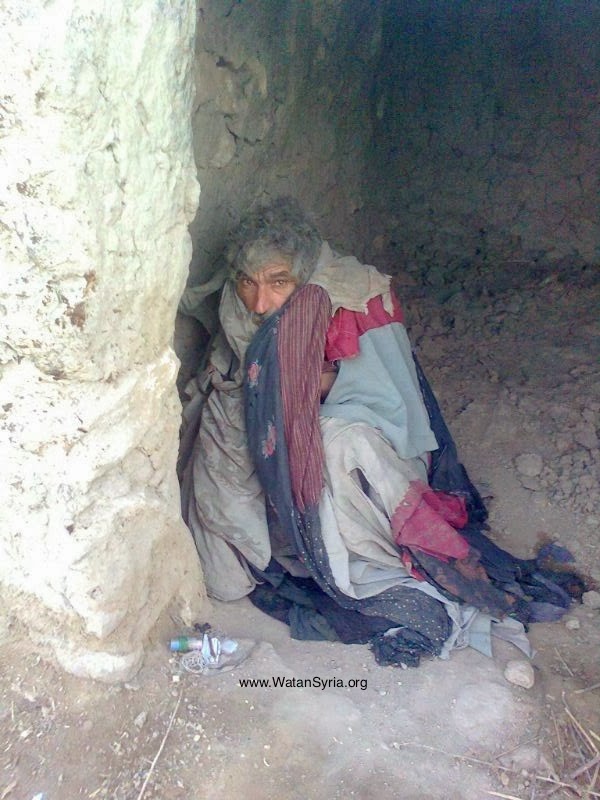
Take a good long look at this man photographed by the Watan Syria team as they distributed blankets to internally displaced people in Deir al Zor, Syria. This is what a broken man looks like. He has nothing except the time left before he dies. It doesn’t matter what his name is, or what his story is. He’s a man who was born in the wrong part of the world and with the wrong type of passport. Because that’s how it is. People like him are not allowed to change their own condition, to ask for freedom or dignity. They have to crouch down beneath military boots and the “big picture”, or freeze and starve to death quietly in bare hovels.
Posted by Maysaloon at 6:35 am


