Search

band annie's Weblog

I have a parallel blog in French at http://anniebannie.net

Category

Syria

Raging with the Machine: Robert Fisk, Seymour Hersh and Syria

April 25, 2014 § 5 Comments

Yassin al-Haj Saleh is a Syrian writer who spent 16 years in the regime’s prisons. In this exclusive for PULSE, Saleh, who has been described as the “conscience of Syria“, discusses the distorted lens through which most people are viewing the conflict.

In the West, Robert Fisk and Seymour Hersh are considered critical journalists. They occupy dissident positions in the English-speaking press. Among Syrians, however, they are viewed very differently.

The problem with their writings on Syria is that it is deeply centered on the West. The purported focus of their analysis – Syria, its people and the current conflict – serves only as backdrop to their commentary where ordinary Syrians are often invisible. For Fisk and Hersh the struggle in Syria is about ancient sects engaged in primordial battle. What really matters for them are the geopolitics of the conflict, specifically where the US fits into this picture.

On the topic of chemical weapons, Fisk and Hersh, completely ignore the antecedents of last summer’s attack on Ghouta .

A reader who relies exclusively on Fisk/Hersh for their understanding of Syria would never know that the Assad regime had used chemical weapons several times before the August 21, 2013 massacre in Ghouta. I was there at the time. I saw victims of sarin gas on two occasions in Eastern Ghouta and I met doctors treating them. The victims were from Jobar, which was hit with chemical weapons in April 2013 and from Harasta, which was hit in May 2013.

It is shocking that investigative journalists such as Fisk and Hersh know nothing about these attacks. They write as if Ghouta was the first time chemical weapons were used in Syria. Their credibility and objectivity is compromised by these omissions.

For these renowned commentators, the entire Middle East is reducible to geopolitical intrigue. There are no people; there is only the White House, the CIA, the British Government, Recep Tayyib Erdogan, the Emir of Qatar, the Iranian regime and of course Bashar Assad and the jihadis.

In Fisk’s myriad articles, one rarely reads about ordinary Syrians (the observation also applies to the late Patrick Seale).

Robert Fisk was once a scourge of American reporters embedding with US forces during the 2003 invasion of Iraq. But he saw no irony in himself embedding with Syria regime forces as they entered Daraya in August 2012.

More than 500 people were killed in a massacre at that time (245 according to Fisk). Who killed them? The rebels, determined Fisk based solely on interviews with regime detainees. Why should local fighters kill hundreds from their own community? Robert Fisk does not provide an answer. Had he spoken to a single citizen without his minders present, he would have learned that they had no doubts about the regime’s responsibility. Indeed, it was an American journalist, Janine di Giovanni, who established that fact shortly thereafter by visiting Daraya on her own.

At the same time when this was happening Human Rights Watch documented ten attacks on bread queues around Aleppo. Fisk did not mention a single one.

During this time Fisk visited a security center in Damascus where he was welcomed by a security official. He was given access to four jihadi fighters, two Syrians and two foreigners. Fisk made a point of mentioning that the prisoners were allowed family visits. As someone who spent 16 years in Assad’s jails and who has firsthand knowledge of these factories of death, I find this claim highly improbable. Fisk’s credulity is risible; he is assisting a shameful attempt to beautify the ugly polices of the House of Assad.

Why has Robert Fisk never attempted to contact people of Eastern Ghouta to ask them what happened there last August? It would have been easy for a person as well-connected as he to convince his friends in the regime, such as Assad’s media adviser Buthaina Shaaban, to facilitate his entrance to the besieged town. He could have met ordinary people for a change without the intimidating presence of regime minders and found out for himself who used the chemical weapons that killed 1466 people, including more than 400 children.

Ignoring local sources of information on the conflict in Syria seems to be a standard practice among many in the West, especially among left wing and liberal commentators. This speaks volumes about their ideological bias. Their dogmatic self-assurance with its veneer of professionalism is not substantively different than the obscurantist self-righteousness of the jihadis.

The Hersh/Fisk narrative unfolds in a historical vacuum: it tells you nothing about the history and character of the regime. You will not learn that the regime has used collective punishment as a policy since the very beginning of the Syrian revolt. That it has used fighter jets, barrel bombs and scud missiles against civilians to cow them; that it has invited foreigners from Lebanon, Iran, Iraq, and other countries to assist in the slaughter.

Nor will you learn about a flourishing death industry in the very places to which Fisk is a welcome visitor. Three months ago he penned an article about Assad’s systematic killing of the detainees in his dungeons, but Fisk reported on this topic in a way that gives us a biopsy of his professional conscience.

Fisk prefaces his report on the regime’s atrocities by warning readers about the horrors that may soon exist “if the insurrection against Bashar al-Assad succeeds.” For most, the significant fact about the photos was the industrial scale killings inside Assad’s jails that they evidenced. But Fisk appeared more obsessed with the timing of the photos, as they appeared a day before the Geneva 2 Conference. Fisk may have been reminded of Nazi Germany by the horrific fate of the 11,000 prisoners, but he still found occasion to expatiate at length about Qatar, whose “royal family viscerally hates Bashar al-Assad”, for funding the investigation. For Fisk, the atrocities were a mere detail in a larger conspiracy whose real victim was Assad’s regime.

To the uninitiated, Fisk’s article might convey the impression that those 11,000 were all that were killed by Assad’s regime and the 20,000 killed in Hama in 1982 were all that that were killed by his father’s. The actual number of victims is eleven times as many for Assad and twice as many for his father. Moreover, these figures ignore the tens of thousands arrested, tortured, and jailed, and the millions who have been humiliated by this regime

By methodically ignoring the Syrian people and by focusing on Al Qaeda, Robert Fisk and Seymour Hersh have done us all a huge disservice. The perspective on Syria portrayed by these writers is exactly the view of Syria that Bashaar Assad wants the rest of the world to see.

–  Yassin al-Haj Saleh (born in Raqqa in 1961) is one of Syria’s most prominent political dissidents. In 1980, when he was studying medicine in Aleppo, he was imprisoned for his membership in a pro-democracy group and remained behind bars until 1996. He writes on political, social and cultural subjects relating to Syria and the Arab world for several Arab newspapers and journals outside of Syria, and regularly contributes to the London-based Al-Hayat newspaper, the Egyptian leftist magazine Al-Bosla, and the Syrian online periodical The Republic. Among Saleh’s books (all in Arabic) are Syria in the Shadow: Glimpses Inside the Black Box (2009), Walking on One Foot (2011), a collection of 52 essays written between 2006 and 2010, Salvation O Boys: 16 Years in Syrian Prisons (2012), The Myths of the Others: A Critique of Contemporary Islam and a Critique of the Critique (2012), and Deliverance or Destruction? Syria at a Crossroads (2014). In 2012 he was granted the Prince Claus Award as “a tribute to the Syrian people and the Syrian revolution”. He was not able to collect the award, as he was living in hiding in the underground in Damascus.

source

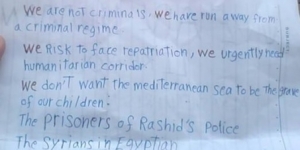
Syria, 144 refugees stopped in Egypt locked in two rooms with 63 children.


a letter written by the detained Syrians in Egypt

Stopped in the middle of the sea by the Egyptian Coast Guard, aboard a boat that was sinking shortly after the start of its journey to Europe. Locked within the premises of a police station in Alexandria, where the police prevent the arrival of relief supplies of Caritas

WRITTEN by STEFANO PASTA, translated by Mary Rizzo

MILAN- Through WhatsApp, we interviewed Syrian refugees held since 14 April in Al Rashid police station in Alexandria, Egypt. Having failed to reach Europe with a barge, they were handed over to the Egyptian authorities, but now risk transfer to the prison of Al Burj , or – even worse – repatriation to Syria.

What is your situation like today?

Disastrous hygienic conditions are dangerous due to a broken sewer. We are 144 persons living in two rooms measuring only a few meters, one room for women and one for men. We sleep on the ground and we cannot wash. We try to keep calm, but when it happened a few days ago there were moments of tension between us, the police prevented the visits for that day and suspended the coffee and the food brought from outside by Caritas Alexandria. The boys and men are still able to resist in some way, but the women and children are really at the limit; there are two women with heart problems who finished their medicine and they need to get out immediately.

What is the situation of children?

There are 44 children under the age of 12, while the total number of children is 63. There are a few who are trying to play with water bottles and they are the only ones who can get distracted for a moment. At night, however, they find it difficult to sleep. As of yesterday, almost all of them have developed a sort of skin disease that no one can identify. Two children of one and two and a half years, alone with his mother because his father was killed in Syria, were suffering particularly yesterday , they were taken to the hospital five times because they suffer from asthma and staying in this place of detention is equivalent to sleeping in a garbage dump. We are also concerned about another 4 year old girl, suffering from cardiac difficulties, who had begun to complain about the chest pain already in the midst of the sea.

Why did you flee from Syria?

Many of us have fled to avoid conscription in the army of Assad, others are activists against the regime who are risking their lives. Then there are families who have fled their homes because they could not survive in some cities, people are dying of hunger because of the siege of the regular army (regime army), which does not allow the entry of food. There is no bread and milk for the children, while the rice when one can find it, costs almost twenty dollars a kilo. Life like that is simply impossible, that’s why we escaped.

Have you talked with a lawyer or with international authorities?

No, none of us was able to speak with a lawyer or has received a sheet with the written reasons for why we are being detained. We met a lawyer named Ahmad, who initially presented himself as belonging to UNHCR, but then he began to terrorise us by threatening to have us repatriated and he revealed that he works for Egyptian National Security.  This is our greatest fear, because it would be tantamount to a death sentence; also return to Lebanon would be very dangerous, since it has already happened that Hezbollah has handed over some refuges to Assad. After a week from the meeting with Ahmad, presented to us is a UN official, at least this is what he is telling us, along with an interpreter, in which we explained how we ended up in the police station.

How did it happen?

What happened before our arrest was a nightmare. We were ready to face the Mediterranean to reach Europe and we had entrusted ourselves to smugglers, who treated us badly, screaming profanities and threatening to beat us with bars, even children. With small boats, we were taken in groups on a larger boat, where we were parked at sea for seven days waiting for it to fill up to 250 people. When we were ready to leave, the same smugglers noticed that the boat was about to sink. It was the worst time since we left Syria: we could die and nobody would know. Then, after a fight broke out between the smugglers on the boat and the organisers were on the ground, we were able to convince them to bring us back; we passed the Coast Guard, but no one saw us. Once on the beach, we ourselves went to the Egyptian authorities, asking for help, but since that day, April 14, we were all arrested, including children.

Have you heard of other refugees detained in Egypt?

Of course, we have detailed information because they are members of our own families. The wife of a man who is here at Al Rashid is held in another place, then we know where the traveling companions arrested with us are. In the police station in Al Montazah there are 22 people, 55 in Chabrakhit and an unknown number – but with so many children – in Miami.

What are you asking for?

We call for the respect of Article 33 of the Geneva Convention, which prohibits any member country the repatriation (refoulement ) of persons to countries where their lives or freedom would be threatened . We ask UNHCR and the European embassies (we initiated contact with the Austrian one) to be able to apply for asylum. We ask the Europeans: would you like your children to have the Mediterranean as their graves? Open a humanitarian corridor, let us save our lives legally.

thank you to Nawal 

source

Syria : retort from Rime Allaf to The Telegraph

On April 17, The Telegraph published a terrible piece on Syria in its News section. I immediately wrote the following letter to the editor; he refused it because it attacked the writer and was too long. The Telegraph published a shorter version today (photo) but here is my full original text.

Sir,

That Peter Oborne has been a fan of Syria’s genocidal dictator for some time is clear; that he presents distortions and fables as facts in a quality publication like The Telegraph, however, goes beyond his right to have an opinion, as morally objectionable as that opinion may be.

Oborne suspects that some of the accounts of the government’s dreadful atrocities “have been exaggerated”; would that include the evidence of the Assad regime’s systematic mass torture and starvation until death of over 11,000 Syrian men, women and children, presented to the Security Council on Tuesday? Would that include the Secretary General’s report on UNSCR 2139, blaming the Assad regime for flouting the legal obligation to lift its numerous sieges on desperate civilian populations? Would that include the irrefutable proofs, documented by international and British media and NGOs, of the Assad regime’s barbaric missile and barrel bomb campaign in every corner of Syria? Would that include the United Nations High Commissioner for Human Rights’ plea to bring the regime to the International Criminal Court and hold it accountable for massive crimes against humanity, now that at least 150,000 Syrians have been killed (including hundreds who were gassed to death in a chemical weapons attack) and nearly 10 million have become refugees, fleeing Assad’s bombs?

The Assad regime’s atrocities are far from exaggerated; on the contrary, we are merely skimming the surface of what the Syrian people have been subjected to for not only three years of uprising, but for over 40 years of brutal dictatorship by the same clan.

It is outright dishonest of Oborne to claim that “jihadist groups make up the opposition” when the Free Syrian Army, formed initially by brave defecting soldiers who refused to carry out Assad’s orders to kill their compatriots, is the only force actually fighting the very jihadists of ISIS who the Assad regime never attacks. When barrel bombs and missiles continue to rain on schools, breadlines, hospitals and homes, the headquarters of these Al Qaeda terrorists have remained miraculously untouched by Assad’s bombs, which he reserves for civilians and the moderate nationalists of the Free Syrian Army.

It behooves honest journalists to give facts, and The Telegraph’s readers should have been told there is no such thing as an independent MP in Assad’s Syria, nor can there be a “free and fair election” when over two thirds of the population have been turned into refugees, are starving, maimed, ill and in no condition to vote – even if they had wanted to take position on this farce which Mr Oborne seems to be the only journalist to describe as “election.”

It is a pity that Mr Oborne fears leaving the comfort of his central Damascene surroundings under the supervision of the Assad regime; we would be happy to put him in touch via phone or Skype with hundreds of Syrians all over the country, or to take him on an actual fact-finding mission to the camps housing millions of Syrian refugees in the region, so that they can tell him, and readers of The Telegraph, why they had to flee the hell which Assad has unleashed on them.

Sincerely,

Rime Allaf
Presidential Advisor
National Coalition of Syrian Revolution and Opposition Forces

On April 17, The Telegraph published a terrible piece on Syria in its News section. I immediately wrote the following letter to the editor; he refused it because it attacked the writer and was too long. The Telegraph published a shorter version today (photo) but here is my full original text.</p>
<p>Sir,</p>
<p>That Peter Oborne has been a fan of Syria’s genocidal dictator for some time is clear; that he presents distortions and fables as facts in a quality publication like The Telegraph, however, goes beyond his right to have an opinion, as morally objectionable as that opinion may be.</p>
<p>Oborne suspects that some of the accounts of the government’s dreadful atrocities “have been exaggerated”; would that include the evidence of the Assad regime’s systematic mass torture and starvation until death of over 11,000 Syrian men, women and children, presented to the Security Council on Tuesday?  Would that include the Secretary General’s report on UNSCR 2139, blaming the Assad regime for flouting the legal obligation to lift its numerous sieges on desperate civilian populations?  Would that include the irrefutable proofs, documented by international and British media and NGOs, of the Assad regime’s barbaric missile and barrel bomb campaign in every corner of Syria?  Would that include the United Nations High Commissioner for Human Rights’ plea to bring the regime to the International Criminal Court and hold it accountable for massive crimes against humanity, now that at least 150,000 Syrians have been killed (including hundreds who were gassed to death in a chemical weapons attack) and nearly 10 million have become refugees, fleeing Assad’s bombs?</p>
<p>The Assad regime’s atrocities are far from exaggerated; on the contrary, we are merely skimming the surface of what the Syrian people have been subjected to for not only three years of uprising, but for over 40 years of brutal dictatorship by the same clan.</p>
<p>It is outright dishonest of Oborne to claim that “jihadist groups make up the opposition” when the Free Syrian Army, formed initially by brave defecting soldiers who refused to carry out Assad’s orders to kill their compatriots, is the only force actually fighting the very jihadists of ISIS who the Assad regime never attacks.  When barrel bombs and missiles continue to rain on schools, breadlines, hospitals and homes, the headquarters of these Al Qaeda terrorists have remained miraculously untouched by Assad’s bombs, which he reserves for civilians and the moderate nationalists of the Free Syrian Army.</p>
<p>It behooves honest journalists to give facts, and The Telegraph’s readers should have been told there is no such thing as an independent MP in Assad’s Syria, nor can there be a “free and fair election” when over two thirds of the population have been turned into refugees, are starving, maimed, ill and in no condition to vote - even if they had wanted to take position on this farce which Mr Oborne seems to be the only journalist to describe as “election.”</p>
<p>It is a pity that Mr Oborne fears leaving the comfort of his central Damascene surroundings under the supervision of the Assad regime; we would be happy to put him in touch via phone or Skype with hundreds of Syrians all over the country, or to take him on an actual fact-finding mission to the camps housing millions of Syrian refugees in the region, so that they can tell him, and readers of The Telegraph, why they had to flee the hell which Assad has unleashed on them.</p>
<p>Sincerely,</p>
<p>Rime Allaf<br />
Presidential Advisor<br />
National Coalition of Syrian Revolution and Opposition Forces

On the Myth that is “Assad is here to stay”

WEDNESDAY, APRIL 16, 2014


Jim Muir recently wrote that “Bashar al Assad and his leadership are there to stay” and explained why. Hassan Nasrallah also declared triumphantly that the danger facing Assad’s regime in Syria has now passed, and Assad himself said that the war has reached a “turning point“. What most people forget as they get carried away by headlines like this is that the number of “turning points” we have had since the start of the revolution leave us all exactly where we started.

A little bit of perspective would not go amiss here. What kind of turning point is it for Assad when he had said exactly the same thing as he “toured” the Baba Amr district in Homs two years ago. That was supposed to be a big deal. And remember that three months into the conflict the popular regime slogan was “it’s over” and yet here we are three years later. The world lampooned President Bush for his “Mission Accomplished” slogan on an aircraft carrier and yet they still take Bashar al Assad seriously. With hindsight we know now that the Syrian revolution was always going to be a near impossible task. It should not have succeeded, and by all rights Assad’s fearsome intelligence services and the cast-iron support of his international allies should have stamped out the Syrian people from the very first days of protest. And they tried, very hard.

The fact is, and I agree with Muir on this, the war of attrition is the only reality we have in Syria. But we shouldn’t confuse the ebbs and flows of the war with turning points, the reality is far more fluid, and it shows us that the water has been creeping closer and closer to Assad’s power base with each successive new tide. He pushes back constantly, and sometimes he pushes back harder when an influx of arms and troops from his allies helps him, but where his soldiers patrol during the day, the rebels come back at night. The old adage, “the situation is critical but not serious” sums up everything about the “Assad is here to stay” mantra.

The Syria rebels continue to consolidate their positions in the north of the country, his stronghold in Western Aleppo came under serious attack only recently, and in spite of their war against the Assad regime the Syrian rebels have also managed to push back the much hated extremist group “The Islamic State of Iraq and Syria” ISIS. They spent the first months of the year fighting ISIS, then a few weeks ago they took over Kassab and the last stretch of Syrian territory under Assad’s control that borders with Turkey. They are constantly assassinating and killing his commanders. A few days ago they assassinated Major General Salim al Sheikh, and earlier they had killed yet another of his cousins, Hilal al Assad, as they pushed closer into his hinterland.

Assad’s posturing and the buttressing of his image abroad as “here to stay” is really all a matter of timing. As is the case with his Iranian tutors, Assad pays very close attention to the political calendar. Whether it was his forces shelling Hama on the eve of Ramadan in 2011 or today as he “campaigns” in Damascus by visiting Syrians displaced because of the fighting, what Assad is doing is trying to shape perceptions. He wants the world to believe he is there to stay. But if that were true he wouldn’t have to do that. He would simply just crush his opponents and take a walk down the streets of his capital, something that he cannot do. After all the strongest kid on the block does not need to keep telling people what he is. He simply does what he needs to do.

Then there is the matter of the help he’s been getting. It’s true that he has maintained his grip mainly with Hezbullah and Iran’s aid, but to say he is here to stay misses a crucial fact. He is there only as long as there are Iranian and Hezbullah fighters propping him up. When they leave, he leaves. Machiavelli once said that only an invader who has come to live in a country can ever maintain his grip on it. I don’t see the families of Shiite fighters from Hezbullah, Iraq or Iran bringing their families to live in Syria any time soon. In fact recent tensions over coverage by the Hezbullah propaganda channel (Al Manar) and the pro-Assad channel al Mayadeen have highlighted what could be cracks in the alliance with Assad. He is still under immense pressure, domestically and abroad, and he is haemorrhaging soldiers and equipment while his economy is losing billions of dollars a year. He also has to pay at some point for all the support that Iran and Russia are giving him. There comes a time when the tab gets too big for you to get another drink and you must pay the bartender.

What is really holding back real change in Syria hasn’t been Assad’s tenacity or the resolve of his allies, but the weakness and division in the opposition against him. This too has changed in leaps and bounds. People noticed the professionalism of the Syrian National Coalition in Geneva 2 in contrast to the demagoguery and hysteria of the Syrian regime’s entourage. The current head of the coalition, Mr Ahmad al Jarba, has been constantly engaged in quiet diplomacy since then and the Syrian opposition today is certainly not the same confused, disjointed opposition that blinked its eyes into the light three years ago. It is a completely different beast and it has formed, stormed and normed itself into something that is proving far more agile at playing the diplomatic game whilst also strengthening connections with units on the ground. Only recently Jarba toured the front in Lattakia – always a big publicity boost for the Syrian revolution and a matter of hysterics for regime apparatchiks. This is because such visits by heads of the opposition inside Syria, and in areas that Assad only recently controlled, are direct snubs to his power and authority and the Stalin-esque nature of his regime is pathologically incapable of accepting such new realities. So really the slogan “Assad is here to stay” should be read “Assad is here for now” and he’s only keeping the seat warm in Damascus

Forced confessions in Syrian state Tv

The Heinrich Böll foundation has published this article on the forced confessions in Syrian state Tv.

Forced confessions on TV: A Syrian Drama
by Haid Haid

“The Syrian state television began several years before the Revolution to broadcast “confessions” convicted criminal on television.

Most Syrians can still remember “The police in the service of the people,” a television program that turned out the performance of the police in the arrest of criminals and thieves. Once aired the week, the show gave the audience the Syrian public, ​​is merely not to go into difficulties since the Syrian security forces would come to them on the ropes anyway.

Not to mention how the multi-talented moderator, Alaa al-Din al-Ayoubi, would be drawn on national television. In general, the program began with the moderator a brief overview of the case provided, according to which, or the criminals went into the details of the committed act. The day ended with a short interview with the chief of police or prosecutor, to thank him for his work and the opportunity to offer him to advise viewers how they could protect themselves. The show served as a rich source for Syrians scorn: The mustache of the moderator and his demeanor showed clearly to his unfulfilled career aspirations as a police officer.

Spectators mocked the fact that criminals formally appealed to him as “sir,” as if he were really one. In addition, all confessions followed the same script: What did you spend your loot? For my own pleasure, sir. And did you have to steal? Not at all, sir. Why so you’ve done it? The Devil and bad friends, good sir. Do you regret it now? In any case, my dear sir, I am very sorry. What do you want to say to the audience? I would advise them to stay away from the path that I have chosen, my dear sir. It was so predictable that parts of the interview were quoted in everyday conversations, to provide laughter or amusement.”

http://translate.google.de/translate?sl=de&tl=en&js=y&prev=_t&hl=de&ie=UTF-8&u=https%3A%2F%2Fwww.boell.de%2Fde%2F2014%2F04%2F11%2Ferzwungene-gestaendnisse-fernsehen-ein-syrisches-drama&edit-text=


April 14th, 2014, 5:38 am from Syria Comment

fr

Syria : Suspects into Collaborators


Peter Neumann argues that Assad has himself to blame

You are invited to read this free essay from the London Review of BooksRegister for free and enjoy 24 hours of access to the entire LRB archive of over 12,500 essays and reviews.

Three years ago, it was hard to find anything significant about Syria in books about al-Qaida. Lawrence Wright’s The Looming Tower, which many consider the definitive history of al-Qaida, contains only five references, while Fawaz Gerges’s The Rise and Fall of al-Qaida mentions Syria just once, as the home of Osama bin Laden’s mother. Today, by contrast, Syria is widely – and correctly – seen as the cradle of a resurgent al-Qaida: a magnet for jihadist recruits, which offers the networks, skills and motivation needed to produce a new generation of terrorists. How did this happen? And why did it happen so quickly?

For Bashar al-Assad, the blame lies with outsiders – especially Turkey and the Gulf monarchies – who have used their money and influence to sponsor the uprising, arm the rebels and supply foreign recruits. This is certainly the case, but it’s only part of the story. In the years that preceded the uprising, Assad and his intelligence services took the view that jihad could be nurtured and manipulated to serve the Syrian government’s aims. It was then that foreign jihadists first entered the country and helped to build the structures and supply lines that are now being used to fight the government. To that extent Assad is fighting an enemy he helped to create.

To make sense of his policy, it is important to understand the long history of confrontation between Islamists and the Baath Party governments of Bashar and his father Hafez. Violent clashes between the government and the Syrian Muslim Brotherhood broke out in 1964 – less than a year after the Baath Party seized power. From the Islamists’ perspective, the country had been taken over by people who were diametrically opposed to everything they stood for: the Baath Party’s stringent secularism ruled out the creation of an Islamic state; its socialism threatened the interests of the small traders and businessmen who were the Brotherhood’s main constituency; and its strong support among minorities – especially Christians and Alawites – meant that the Sunni majority was going to be ruled by ‘unbelievers’ and ‘apostates’.

It was not until 1976, however, that a sustained uprising took shape. Initiated by the so-called Fighting Vanguard (an aggressively sectarian group on the Brotherhood’s fringes) it eventually gained support from all factions of the Brotherhood, parts of the secular opposition and Saddam Hussein’s Iraq. The confrontation culminated in a three-week battle in the city of Hama in February 1982 during which government forces killed thousands of people and caused virtually every known supporter of the Brotherhood to flee the country. This marked the end of the Muslim Brotherhood inside Syria and explains why its voice and presence during the current conflict has been so marginal: the Syrian Brothers, unlike their Egyptian counterparts, have had no organisation, no structure, and most of their (surviving) leaders haven’t set foot inside the country for decades.

The ruthless elimination of the Brotherhood didn’t mean that the country was exempt from the ‘religious turn’ which many Arab societies experienced during the 1990s. Fuelled by economic and political grievances, widespread corruption and a sense that Syrian society in its existing state offered no hope, direction or opportunity, many Sunnis embraced Islam and adopted more religious lifestyles. Conscious of what was happening, Bashar, who succeeded his father in 2000, sought to co-opt and control this revival. In the first years of his presidency, he spent much of his time grooming religious leaders, controlling mosques, and making sure that the burgeoning Islamic sector was playing by the regime’s rules. He also funded religious institutions, created Islamic banks and loosened government regulations on public displays of piety, such as the wearing of headscarves in public buildings and prayer in the armed forces. InIslamic Revivalism in Syria (2011), the academic Line Khatib noted that Bashar’s conciliatory attitude towards Islam stood in marked contrast to the Baath Party’s original doctrine, which regarded any mention of religion as politically deviant and denounced Islam as a ‘reactionary ideology’.


Bashar’s more accommodating approach towards Islam did not, at the time, extend to the jihadists, who had quietly gained a following among Salafist communities in Syria’s deprived suburbs and the countryside: places like Dara in the south, Idlib in the north, and the outskirts of Aleppo. In late 1999 a jihadist ambush resulted in four days of clashes and prompted a nationwide crackdown, resulting in the arrest of 1200 suspected militants and their supporters. Following the 11 September attacks, Bashar offered his government’s assistance in the war on terror. Though wary of his motives, the Bush administration agreed to co-operate, rendering ‘high-value’ jihadist suspects to Syria until at least 2005.

The Syrian government’s ‘secret weapon’ against jihadists was to infiltrate their networks and turn suspects into government collaborators – a technique that had been used with great success against the Muslim Brotherhood in the 1970s and 1980s. The director of one of Syria’s intelligence services told visiting US officials, according to a WikiLeaked US State Department cable, that ‘we have a lot of experience and know these groups.’ He went on: ‘We don’t attack or kill them … We embed ourselves … and only at the opportune moment do we move.’ This approach, he said, had resulted in ‘the detention of scores of terrorists, stamping out terror cells’.

The American invasion of Iraq in March 2003 caused outrage among Syrian Salafists, who considered the occupation of ‘Muslim lands’ a legitimate reason to take up arms. The regime’s well-honed strategy for dealing with such events – organising staged demonstrations, allowing people to vent their anger on state television – was no longer an option: the Salafists were unappeasable, they wanted to go to Iraq and kill Americans. For Assad and his intelligence chiefs, this presented a serious challenge; after weeks of hesitation, they decided to embrace a bold new strategy: rather than suppressing the Salafists’ rage, they would encourage it.

Allowing the Salafists to go to Iraq was thought to be a good idea for two reasons: first, it got rid of thousands of the most aggressive Salafists with a taste for jihad, packing them off to a foreign war from which many would never return to pose a threat to Assad’s secular, minority-dominated government; second, it destabilised the occupation of Iraq and thwarted Bush’s quest to topple authoritarian regimes (everyone in Assad’s inner circle feared that Syria would be next). According to Assad’s biographer David Lesch, ‘Damascus wanted the Bush doctrine to fail, and it hoped that Iraq would be the first and last time it was applied. Anything it could do to ensure this outcome, short of incurring the direct military wrath of the United States, was considered fair game.’

Practically overnight, Syria became the principal point of entry for foreign jihadists hoping to join the Iraqi insurgency. Inside the country, Assad’s intelligence services activated their jihadist collaborators. The most prominent among them was Abu al-Qaqaa, a Salafi cleric from Aleppo who had studied in Saudi Arabia and whose sermons attracted hundreds – sometimes thousands – of people. Before the invasion of Iraq, Abu al-Qaqaa’s followers acted as religious vigilantes, meting out punishments for ‘indecent behaviour’ and stirring up hatred against the infidel governments of Israel and America. After the invasion, his group turned into a hub which provided Abu Musab al-Zarqawi’s al-Qaida in Iraq with Syrian recruits. Qaqaa’s efforts were so successful that for most of 2003 Syrians constituted the largest foreign fighting contingent of the (emerging) insurgency. Four years later, when the political calculus had changed and the Syrian government wanted to slow down the traffic, Qaqaa was shot dead in mysterious circumstances. His funeral was attended by members of the Syrian parliament along with thousands of Islamists. According to a Lebanese media report, ‘his coffin was draped in a Syrian flag and the affair had all the trappings of a state occasion.’

Qaqaa was important, but he was not the only person involved in sending foreign fighters to Iraq. According to records captured by the US military in the Iraqi border town of Sinjar, the logistics were handled by an elaborate network of at least a hundred facilitators, who were spread throughout the country and maintained weapons caches and safehouses in Damascus, Latakia, Deir al-Zour and other major Syrian cities. They, in turn, worked closely with tribes along the Iraqi border whose smuggling business had suffered as a result of the war and for whom facilitating the flow of jihadists was a welcome substitute.


Less than a year after it had been set up, the Syrian pipeline was so well established that it started attracting jihadists from countries like Libya, Saudi Arabia and Algeria, who flew into Damascus or travelled via one of the Palestinian camps in Lebanon. In 2007, the US government estimated that 90 per cent of suicide bombers in Iraq were foreigners, and that 85-90 per cent of the foreign fighters had entered Iraq through Syria. The jihadist networks in Syria had, in essence, become an extension of those in Iraq and operated without the Assad government’s active support, though almost certainly with its knowledge.

By 2005, it was already obvious that Operation Iraqi Freedom was in trouble and that the Syrians wouldn’t have to worry about being next on the list. The constant flow of refugees from Iraq put a heavy burden on the Syrian economy (by 2008 it was clear that Syria wanted to see stability, not turmoil, in Iraq). Moreover, al-Qaida in Iraq – the group with which Abu al-Qaqaa had collaborated so closely – was turning its attention away from fighting the US towards the possibility of a civil war with the Shiites, a prospect the Syrian government, dominated by Alawites, viewed with horror. There was, however, no chance of simply turning off the tap. The jihadist networks had expanded so quickly, even Abu al-Qaqaa, who was told to call for ‘moderation’ when the insurgency started turning into a sectarian war, had lost much of his influence; and the smuggling of fighters had become so lucrative and deeply ingrained that it would have taken a full-scale conflict with the tribes to stop it. The regime had created a phenomenon it could no longer control.

*

For some of the jihadists who started returning to Syria after 2005, Assad’s intelligence services came up with what seemed like an ingenious plan. Once again, they sought to externalise the jihadist threat while turning its protagonists into the (unwitting) tools of Syrian foreign policy. This time the target was Lebanon, where Syria had recently been forced to end a 30-year military occupation and was held responsible for the assassination of the prime minister, Rafik Hariri. As a result, many of the foreign jihadists who had entered Iraq through Syria were now told to return to the Palestinian camps near Sidon and Tripoli where they had started their journey into Iraq. Neither Fatah al-Islam nor Usbat al-Ansar, the local jihadist groups, were fully controlled by Syrian intelligence, but both were corrupt enough to serve its purposes in Lebanon, where they hoped to destabilise the political order, stir up sectarian conflict and derail the investigations of the special tribunal set up to investigate Hariri’s assassination.

It soon transpired that sending jihadists to Lebanon didn’t solve the problem. A good many jihadist returnees decided to stay in Syria, where they embarked on a terrorist campaign. This included high-profile attacks against government buildings, state television, the US Embassy and a Shiite shrine, all reported by the international press. But there were hundreds of smaller incidents and failed attacks which the government kept secret, and outsiders had little way of knowing about. Representatives of European intelligence services stationed in Syria at the time say that they received reports about terrorist incidents ‘on a monthly basis’. The leaked State Department cables mention bombings and numerous shoot-outs in the years 2004 and 2005; a suicide bombing and several armed clashes and attempted bombings in 2006; more gun battles, several attempted car bombings in Damascus and the seizure of ‘suicide belts, vehicles and 1200 kg of explosives’ in 2008; as well as the bombing of a bus carrying Shiite pilgrims in March 2009.

The first wave of these attacks, from 2004 to 2006, was claimed by Jund al-Sham, an obscure group which experts believe had been started by Zarqawi, while the second, from 2008 to 2009, was the work of ‘rogue members’ of Fatah al-Islam. Whatever the label, the people responsible were, without exception, former foreign fighters who had been part of the Iraqi insurgency and fetched up in Syria, where they used their fighting experience and combat skills to attack the government and, increasingly, the Shiite population.

One of the most dramatic illustrations of the way in which Assad’s policy backfired were the Sednaya prison riots. After the Iraq invasion, Syrian intelligence officials offered Islamist inmates at this notorious facility just outside Damascus the chance to receive military training and fight against Coalition forces in Iraq. According to a leaked State Department cable, of those who accepted the offer and subsequently managed to return to Syria, ‘some remained at large … others were sent to Lebanon, and a third group were re-arrested and remanded to Sednaya.’ The ones who went back to prison felt ‘cheated’: they ‘had expected better treatment, perhaps even freedom, and were upset over prison conditions’. In July 2008 they rioted, taking a number of prison staff and military cadets hostage. Despite the deployment of special forces, the prisoners maintained control over part of the prison for several months. In January 2009 the long stand-off was resolved in a ferocious battle, which cost the lives of a hundred prisoners and dozens of soldiers. For the military, the episode was a ‘black mark’. The Syrian media never mentioned it.


The transfer of former fighters to Lebanon also caused problems for Assad. The leader of Fatah al-Islam, Syria’s main jihadist ‘partner’ in Lebanon, was widely believed to be a Syrian intelligence asset, and the original idea was for Damascus to turn the group into its own jihadist faction in Lebanon, rivalling efforts by the prime minister, Saad Hariri (the son of Rafik Hariri) and his Saudi allies. According to the French academic Bernard Rougier, an expert on Lebanon’s refugee camps, the Syrians succeeded beyond their wildest expectations. In addition to foreign fighters, the group attracted aspiring jihadists from across Lebanon. Based in the Palestinian camp Nahr al-Bared, Fatah al-Islam quickly grew to more than five hundred men, with money coming not just from Syria but from the Gulf and even from Hariri’s supporters (whose influence it was originally meant to counter). In Rougier’s words, ‘it took on its own life. It had a magnetic effect on Islamists in the country.’

By early 2007 the group had declared its intention to establish an Islamic emirate in the north of Lebanon and sparked a confrontation with the Lebanese army, culminating in a three-month stand-off and the group’s eventual defeat. The surviving members found refuge in the tightly knit Salafi communities of northern Lebanon or went straight back to Syria, where they launched attacks against Shiites and the Syrian government. During the current conflict, Fatah al-Islam emerged as one of the first rebel groups to adopt a jihadist agenda, and its supply routes and recruitment networks in Lebanon continue to be used by other jihadists.

The most significant, long-term consequence of Assad’s policy arose from the opening up of Syria to international jihadist networks. Before he turned his country into a transit point for foreign fighters, Syrian jihadists had been largely homegrown. If international links existed, they were to neighbouring countries. Al-Qaida had always had prominent Syrians as members – the strategist Abu Musab al-Suri, for example, or Abu Dahdah, who was sentenced to a lengthy prison term in Spain – but they had fled the country in the early 1980s, and there is no evidence that they directed jihadist activities inside Syria, sought to organise them, or even showed any interest in doing so. The terrorism experts were not entirely wrong, therefore, in believing that – for some time at least – Syria was outside al-Qaida’s orbit.

This changed in 2003 when Assad allowed the jihadists in his country to link up with Zarqawi and become part of a foreign fighter pipeline stretching from Lebanon to Iraq, with way points, safehouses and facilitators dotted across the country. With the active help of Assad’s intelligence services, Syria was opened to the influx – and influence – of experienced and well-connected jihadists from Libya, Saudi Arabia, Algeria, Tunisia, Yemen and Morocco, who brought with them their contact books, money and skills. Within a few years, the country ceased to be a black spot on the global jihadist map: by the late 2000s it was familiar terrain to foreign jihadists, while jihadists from Syria had become valued members of al-Qaida in Iraq, where they gained combat experience and acquired the international contacts and expertise needed to turn Syria into the next battlefront.

When the current conflict broke out, it was hardly surprising that jihadist structures first emerged in the eastern parts of the country, where the entry points into Iraq were located, and in places like Homs and Idlib, which were close to Lebanon; or that it was jihadists – not the Muslim Brothers – who could offer the most dedicated and experienced fighters with the skills, resources, discipline and organisation to hit back at the government. They were also the ones who found it easiest to prevail on international networks of wealthy sympathisers, especially in the Gulf, to supply weapons and funding. The clearest example is the Islamic State of Iraq and Greater Syria (ISIS), a viciously sectarian player in the current conflict, descended from Zarqawi’s al-Qaida in Iraq, which draws on the same networks and supply lines that enabled the transfer of fighters from Syria to Iraq – except that now, of course, the traffic flows in both directions.

Given the history and genesis of groups like ISIS, many Syrian opposition figures now claim that the jihadist groups in Syria are puppets of Assad, and that they continue to be used and manipulated by Syrian intelligence in its efforts to discredit the revolution, divide the opposition and deter the West from intervening on their behalf. Indeed, there can be little doubt that many of the older and more senior figures in groups like ISIS will have records with Syrian intelligence, and that some are likely to be collaborating with the regime. Nor is there any question that the Syrian government, which is fighting large numbers of secular defectors from its own forces, has an interest in portraying the opposition as crazy fanatics, or that some of its actions – such as releasing more Islamists from Sednaya prison, or sparing ISIS-controlled areas from attack – have been designed to strengthen the jihadists vis-à-vis their rivals. There still is no solid evidence, however, that the jihadists as a whole are controlled by the regime, despite repeated announcements by opposition figures that such evidence would be forthcoming. No one doubts that jihadist groups in Syria draw on external support and international networks, including foreign fighters from across the Middle East and even Europe. But the reason they were able to mobilise them – and mobilise them quickly – is that Assad’s government had helped to set them up.

28 March

source


Rape and ransoms: Hilal al-Assad’s ‘thug’ legacy


Some accuse the regime of orchestrating the death of Assad’s cousin, Hilal al-Assad (L), to diffuse the Alawite sect’s growing resentment. (Photos courtesy: Facebook and Reuters)

Tuesday, 25 March 2014
“The lout and lowlife‪,‬ Suleiman al-Assad‪,‬ the son of Hilal‪,‬ the head of Military Housing in Latakia‪,‬ was arrested on Monday from the Meridian of Latakia after receiving a beating from the good boys ‪….‬ they said he cried and screamed‪. Among his entourage, was an official’s son called Amjad Aslan, also a friend of the Latakia Military Security Chief…‬ they are all a group of louts and low lives who have wreaked havoc and infested corruption in the city‪ …”‬‬‬‬‬‬‬‬‬‬‬‬‬‬‬

Such statements, critical of the practices of Syrian President Bashar al-Assad’s clan, appeared on regime loyalist Facebook pages to the surprise of many Syrians. With loyalist calls for their arrest, Suleiman and his father Hilal al-Assad were perceived as a liability in the coastal region.


Hilal al-Assad. (Photo courtesy: Facebook)

SANA, Syria’s official news agency, announced the death of Hilal, the 47-year-old second cousin of Syria’s president on Monday, with some already accusing the regime of orchestrating his death to diffuse the Alawite sect’s growing resentment.

Certain reports claimed his death in the newly launched Alanfal campaign, a joint Islamist military operation against Syria’s coastal region. An Islamist group declared that Hilal, among other Allawite figures, died in a rocket attack on the city of Latakia.

Hilal is the grandchild of Ahmad al-Assad, the older half-brother of Hafez al-Assad, the late Syrian president. Following the revolution, he and his son were known for their thuggish practices, namely ransom kidnapping and rape, surpassing the reputation of his two notorious brothers, Haroun and Hail.


Suleiman with Shabiha at a Latakia, according to loyalist Facebook pages.

“Suleiman was dubbed ‘the President of the Syrian Coast’s republic; he acts in that capacity, a thug since his teenage years,’” according to an Alawite Latakia resident, who asked to remain anonymous for fear of reprisals. “They are notorious for rape and ransom kidnappings, and their headquarters at sports city is a Bermuda Triangle for their detainees.”

The rise of Shabiha

The Shabiha is a term originally used to describe the Assad clan’s smugglers and racketeers and their Allawite henchmen in the late 1970s. They exploited the high demand for foreign goods, especially cars and cigarettes, following newly imposed government restrictions on imports. Malek al-Assad, the son of Ibrahim, Hafez’s half-brother, was a pioneer in smuggling; he became a liability for his involvement in weapons’ smuggling, according to this detailed account of the rise of Shabiha by Syria Comment. Hafez imprisoned his nephew for days. Years after losing his lucrative business, he ended up a taxi driver on the Latakia–Damascus route, dying in car accident.


Suleiman sometimes drove Syrian army tanks to ‘show off’. (Photo courtesy: Facebook)

Fawwaz al-Assad, being Hafez’s full nephew, enjoyed better immunity than Malek. He led a successful career in smuggling cars and cigarettes, gaining increasing notoriety for rape, driving in a multi-car convoy, and ransom kidnappings.

Hafez reportedly intervened occasionally to curtail his excesses. As the other nephews and cousins grew older, they competed for power and wealth, often parading their brand new cars, with tinted windows and bodyguards brandishing their Kalashnikovs. The Shabiha were notorious for their gangster looks, tattoos, funky haircuts, massive biceps and beards.

Orwa Nyrabia, a Syrian filmmaker and former Latakia resident, believes that Hafez, a cunning leader often praised for his Machiavellian tactics, intentionally left his extended family uneducated, paving the way for their thuggish behavior.

“There was an interest in repressing the coastal region through the clan. Hafez’s eldest son, Bassel Assad, periodically curtailed and unleashed their activities in a semi-organized manner,” said Nyrabia.

The Assads, originally peasants from the Latakia Mountains, mostly took the easy illicit road to fortune and power, the Tashbeeh. They moved to the city of Latakia, a mostly Sunni coastal city with a few hundred thousand residents. Sectarian tensions hid some class hatred, according to residents from both communities, as Allawites often cited their history as discriminated against peasants and servants of urban Sunnis.

The Shabiha instilled fear among the population, while amassing fortunes from smuggling; the regime kept them at bay to fulfill the regime’s two pillars of control: demoralization and fear. After the revolution, and as the regime’s dependency on local militias grew, their power was unleashed. They repressed demonstrators in the coastal region, tortured and humiliated them, like in this infamous video from Bayada, a town in the Banyas province.

After Hilal’s death

Syrian activists recently reported that Suleiman, Hilal’s son, harassed a girl at a DVD store in Latakia; when the owner confronted him, he was forced to lick his shoes, then get naked, and dash around the many squared meters of his shop.

Following news of his father’s death, Suleiman and his Shabiha indiscriminately shot at Sunni neighborhoods. “Young Sunni men were left with little choices in Latakia,” according to a half Alawite, half Sunni city resident.

“Either they stay in the city and risk arrest, conscription and harassment, or join the rebels in the mountains”, he said. “Most chose the latter.”
source

Last Update: Tuesday, 25 March 2014 KSA 12:24 – GMT 09:24

Blood ties: the shadowy member of the Assad clan who ignited the Syrian conflict

March 20, 2014 Updated: March 20, 2014 13:03:00

BEIRUT and AMMAN//On a summer evening five months into the Syrian uprising, a well-dressed man, a little heavy-set but younger looking than his 50 years, sat quietly at the bar of the Four Seasons Hotel in Damascus, having a drink and smoking a cigar.

He was appropriately turned out for the only authentically five-star venue in the city. Handmade Italian shoes, an expensive suit and shirt, no tie, a gold chain around his neck. There was a Rolex watch on his wrist and lying alongside the ashtray on the tabletop were the de rigueur prayer beads, smartphone and sunglasses.

An unremarkable looking figure, similar to any other member of the narrow elite grown rich in Syria’s vigorous, family-run kleptocracy. But this man was set apart by a particular hardness on his face, framed by dark, neatly trimmed stubble along the jawline, and an intense hostility in his eyes.

Most Syrians wouldn’t have known him by sight but they all know his name: Atef Najib, the man who ignited the revolution.

And they would not have been surprised to find him lounging in the dimly lit opulence of the Four Seasons that summer. He was supposedly under investigation by a special committee, headed by an independent judge, over involvement in torture and several killings. But, as a cousin of President Bashar Al Assad, he could enjoy his night out with complete impunity.

Even if the investigating committee was more than a hollow fiction and even if there was such a thing as an independent judge in Syria, neither would dare touch him.

===

Despite his pivotal role in sparking the Syrian revolt, the public record on Najib is threadbare. He is a first cousin of Assad and was the head of political security in Deraa, a low-rise city of industrious farmers and traders on the border with Jordan, where simmering disaffection burst into the open on March 18, 2011.

There were small protests elsewhere in Syria that Friday, and there had been isolated outbreaks of public dissent over the previous week, but they were handled with a certain deft, constrained ruthlessness. Beatings, arrests and threats but not murder. In Deraa under Najib, it was different – and it exploded.

He had, with characteristic arrogance, already laid the groundwork to set Syria aflame, most notably by insulting a group of local men who had gone to ask that he set free 18 boys, detained for writing “Doctor, your turn next” on a school wall.

The teenagers were tortured for daring to suggest that Assad – an ophthalmologist – was heading the way of other, recently deposed regional dictators.

Najib told the boys’ worried fathers to “forget about them”. There are two versions of what he said after that. One, told by regime sympathisers willing to discuss the incident, grudgingly admits that “two or three” of the young prisoners were physically abused, but holds that Najib told the men their failure to teach their children manners meant the job had fallen to him.

The other account, the one that has entered into Deraa lore, is that Najib told the men go home and have new children and, if they lacked the virility to do so, that they should send their wives to his office and he would ensure they left pregnant. It was all too much for a proud people to take.

In response came the fateful March 18 protests demanding Najib be sacked and punished. His security forces answered by shooting into the crowd of unarmed civilians, killing three people. That day was the start of a grassroots revolution and a bloodletting that, now entering its fourth year and with more than 140,000 dead, shows no sign of abating.

“When it started, you could say it was a revolution against Atef Najib. There were lots of other issues, but he was the reason people went out, he pushed them past the point of no return,” said a member of an influential Deraa family with close ties to the regime. “It became a revolution against Bashar but right at the beginning they just wanted Najib gone. Everyone hated him”.

For his role in those opening acts of violence, Najib was placed on the economic sanctions lists by the EU and US, documents that are notable for their dearth of information. The brief US entry is the most detailed: NAJIB, Atif (aka NAJEEB, Atef; aka NAJIB, Atef); Place of Birth, Jablah, Syria; Brigadier General; Position: Former head of the Syrian Political Security Directorate for Deraa Province.

Some of the most infamous members of the Assad cabal have more or less well-known biographies, their pictures posted online, without their consent perhaps, but they are there, exposed: Rami Makhlouf, Maher Al Assad, Rostom Ghazali, Asef Shawkat, Ali Mamluk.

Najib, like other powerful officers in the secret police fraternity, preferred the shadows. Away from the facade of Syria’s government ministries, courtrooms and state-run television, he was part of the opaque world of the mukhabarat (secret police), Assad family members and ultra-loyalists who really run the country but who, for the sake of a certain decorum, pretend not to. He didn’t like to have his photo taken.

===

By 1965, Hafez Al Assad, the son of a peasant from Syria’s impoverished Alawite community in the mountain region on the Mediterranean coast, had already moved far beyond his humble origins to lead the country’s air force and hold a place in the Baath party’s ruling National Command.

That year, his second son, Bashar Al Assad, was born. Around the same time – most likely in 1964 or 1965 – Hafez and his wife Anisa, another Alawite from similarly inauspicious origins, had also gained a nephew, Atef Najib.

Anisa’s sister, Fatima Makhlouf, had married Najib Ala’a, a small-time businessman from Jablah, a coastal town 14km from Qurdaha, the Assad family’s ancestral home. He sold petrol by the side of the road, less a garage than a couple of fuel storage drums to serve the few passing motorists.

Najib Ala’a was a Sunni; intermarriage between the sects was common, although not always viewed kindly (“We don’t like our women marrying Sunnis because they bring up the children according to the father’s religion and they’re all extremists in the end,” as an Alawite mukhabarat officer would later put it). Fatima Makhlouf and Najib Ala’a would go on to have five children, two daughters, three sons. All would benefit from the coup d’etat of 1970 that brought their uncle, Hafez Al Assad, “the eternal leader”, to power.

Fatima’s and Anisa’s brother, Mohammad Makhlouf, was the most successful at exploiting the link to his brother-in-law the president, becoming his personal financial adviser and building a vast business empire that would, under his son, Rami Makhlouf, blossom into monopolies worth billions of dollars.

Najib Ala’a, the former petrol seller, also a brother-in law to Hafez, cashed in on the connection as well but not to the same degree and, according to accounts from friends of the family and Syrians familiar with the workings of the regime, his clumsy moneymaking ventures became something of an annoyance and embarrassment to Hafez.

“He would use his family connections to make money in corrupt ways, but not cleverly, and he ended up making trouble for Hafez, there was some friction there, he fell out of favour and may have been put in prison for a month or so, just as a warning,” said a former friend of one of Najib Ala’a’s sons.

The path of Atef Najib, a volatile, aggressive man prone to outbursts of anger, had distinct echoes of that previously trodden by his father.

As a teenager, Atef Najib went to military college and was closer to Bacel Al Assad, Hafez’s eldest son and the man then being groomed to replace him as president, than he was to Bashar, a shy, gawky teenager. Bacel and Atef had similar characters: brash, fearless and feared – they both loved to drive recklessly in fast cars; a crash would kill Bacel in 1994.

Atef Najib joined the intelligence services but ended up at odds with his superiors, and, as his father had, annoying his powerful cousin and uncle. In the early 1990s, he was suspended from his duties.

“Bacel kicked him out of the intelligence services around 1992. He was insulting to people, using very bad words, kidnapping girls, firing off guns. He was so arrogant they couldn’t handle him. Hafez was also angry at Najib’s behaviour,” said a former friend of the Assad family.

For about six years, with his career in the mukhabarat apparently over, Najib languished, “sitting in the house”, according to the former friend, until, with Bashar on the brink of taking over the presidency from his ailing father, Fatima Makhlouf, Atef’s mother, managed to talk the Assads into taking him back. Her errant son, now 34 years old, had matured and was fit for duty, she said. He was reinstated at his old rank, and reassigned to political intelligence in Damascus, working out of their foreboding cement block office in Mezzeh.

The responsibilities of Syria’s myriad intelligence agencies are vague and overlapping, with officers spying on each other as well as the public. At political intelligence in the capital, Atef Najib specialised in monitoring the police and making sure that political parties – all were illegal except those supporting the regime – stayed in line.

Najib would drive around the capital in an invariably new car from his growing collection of BMWs and Jaguars, sometimes meeting the people he sought to control over lunch in expensive restaurants, if they were being cooperative, or summoning them to his office if they needed to be brought into line.

“Sometimes he’d be nice and the next minute terrible, he was up and down, just a very volatile man,” said a Syrian businessman who was questioned by Atef Najib more than once during the period. He also described him as “filthy rich”.

“There are some people in the regime it pays you to meet and have a close relationship with. There is a reasonableness to them, you can work with them. And then there are others who you don’t want to go near because nothing good will come of it – Atef Najib was one of those,” the businessman said.

Najib’s family connections ensured he had power and wealth but his reputation for violent instability meant some regime insiders saw him as more of a liability than an asset.

In 2002, Ghazi Kanaan, a distant relative of Atef Najib, was summoned back from his 20-year stint as Syria’s feared intelligence chief in Lebanon and put in charge of political security in Damascus. He had little time for Najib and sidelined him within the bureau, where his opponents had nicknamed him “the animal”.

“Atef was nothing special, he was conceited, he thought a great deal of himself, more than anyone else did. He was related to the Assads, that was his talent,” said a former mukhabarat officer who knew the Najib family.

“He wasn’t particularly violent or corrupt, just the normal levels for someone in his position.”

Only after Kanaan’s death in 2005 – a self-inflicted gunshot, according to the Syrian authorities – did Najib’s career regain momentum. Within three years he was sent to Deraa to head the governorate’s political security branch.

===

In Deraa, Najib quickly set about establishing his own fiefdom. “His reputation preceded him. We were told: ‘You’re getting a man there is no talking to, you’re getting a real criminal.’ But the big families in Deraa had good connections to the regime and plenty of money, so they thought they’d be able to bribe him as they bribed any other officer,” said a Deraa resident from one of those influential families.

But instead of simply taking those bribes and an easy living, Najib insisted on control. He muscled in on the territory of other security chiefs in the area, built his own network of spies and spread personnel loyal to him throughout the province.

“He had informants everywhere, there was an atmosphere that his soldiers were listening in on everything, even in the elementary schools. He insisted on being the first to know about any problem that might be developing. Teachers were sending weekly reports up to him about the political convictions of even their young students,” the well-connected Deraa resident said.

“There were security officers in Deraa who were afraid even in their homes,” explained another Deraa resident who was close to the city’s security apparatus and business elite. “One senior officer I was close to told me he was convinced Najib had put cameras in his house so he could spy on him even there. ‘Walls have ears, he’s listening,’ they’d say.”

In the guise of fighting corruption, Najib moved to block established networks for transporting goods, both legal and illegal, replacing them with his own monopoly on the movement of goods across the border, flows of money and information, and exploitation of water rights – crucial in a farming community – according to yet another Deraa resident involved in business in the province.

“It didn’t stop the corruption, it just concentrated it in his hands,” said the relative of a powerful smuggler operating in Deraa at the time. “Smuggling and money-laundering all still happened, it was just all through certain big merchants and that is where Atef Najib got his money from.”

Paranoia infected Najib himself. Even before the revolution, he was rarely seen in public and would move in a high-security motorcade, convinced his enemies wanted to assassinate him. His food was shipped from Damascus because he feared poisoning.

“Things hadn’t been as bad in Deraa since the 1980s, he reintroduced that mentality, we thought that was all in the past but he brought it back – he brought back the iron fist,” said the well-connected Deraa resident, who once met Najib. “He was considered the absolute power in the province, he was in charge of the fate of 1.2 million people,” he said. “Atef Najib used to tell us, ‘In Deraa, I am God’.”

Deraa had long had a reputation as being solidly pro-Assad, with many regime figures recruited from the area. Najib’s imperious reign was instrumental in turning it against the ruling family.

===

After the killings of March 18, Assad followed a double strategy of mild conciliation and brutal crackdown that would quickly ignite a full-blown rebellion in the country his family had ruled since 1970. He refused to travel to Deraa personally and instead sought to defuse anger there with delegations, which were invariably told that Najib must be punished for the torture of the schoolboys and held responsible for the shootings.

The regime also moved to crush the growing dissent before it could build momentum. On March 23, Faisal Kalthoum, the governor of Deraa, was sacked, supposedly a gesture at reform. The same day, soldiers raided the Omari Mosque in Deraa’s old city, killing nine people. They said it had become a den of plotters involved in a foreign conspiracy against the homeland.

Four days later in parliament, Yousef Abu Rumiah, a Syrian MP from Deraa, took the unprecedented step of demanding that Assad ensure Najib be punished, saying his security forces had “killed people indiscriminately”. Those remarks were edited out of parliamentary footage shown on state TV.

On April 9, with 170 people killed in just 23 days, an unnamed regime “security source” told the media that Najib and Kalthoum had been referred to court for investigation. In June, Judge Mohammed Deeb Al Muqatran, the head of a special judicial committee set up to investigate allegations against security officers, banned Najib from travelling abroad. “No one has immunity, whoever he is,” state media quoted the judge as saying.

In the months after those first Deraa shootings, Assad received visiting delegations, including a group of clerics who pleaded that he take action against Najib, telling the president that transparent justice against a member of his family would send a powerful message and restore confidence in the regime. According to accounts of that meeting, Assad told them he couldn’t arrest his cousin because no formal complaint had ever been made to the police and, therefore, no case had been opened. “I cannot just punish a person,” Assad told them.

“Atef was moved to a different position, but there was no punishment. He was in Deraa as Bashar’s envoy, he was doing exactly the work Bashar sent him there to do. Why would he be punished for that?” said a former senior mukhabarat officer.

Much of Deraa city has been destroyed. In April last year, the stone minaret of the Omari mosque, which dates to the 7th century, was felled in what appears to have been a deliberate act of demolition by regime forces. A video shows it collapsing into rubble as a tank passes. Large parts of the city and surrounding province are now in the hands of rebels but regime forces remain strong in the southern region. Neither side appears close to victory.

“The regime doesn’t regret what he did, regime people don’t think he made mistakes or anything of the sort. They look at him, many people in the regime, and believe he is a hero for what he did,” said a Syrian who knew Najib and who remains in touch with Assad loyalists.

He cited a “very high-level official in Damascus” as saying that they should erect a statue of Najib: “The man is a hero. He really was the first one to discover the conspiracy against Syria, he saw it before the rest of us,” the official said.

In the summer of 2011, supposedly under investigation, Najib was glimpsed in expensive restaurants and the Four Seasons in Damascus. He is believed to still work for the security services in some capacity.

A Syrian who met Najib numerous times may have been speaking of the whole regime when he said: “A mistake people make is to think people like Atef Najib are just ignorant, violent thugs but that underestimates them.

“Atef Najib was smart, he was clever like the devil is clever. When it comes to their business, they get right down to the hard edge of things, when it comes to survival they have amazing instincts. A big mistake people made is to think they are all stupid. They’re not.”

Phil Sands reported from Beirut, Suha Ma’ayeh from Amman and Justin Vela from the UAE.

psands@thenational.ae

Read more: http://www.thenational.ae/world/middle-east/blood-ties-the-shadowy-member-of-the-assad-clan-who-ignited-the-syrian-conflict#full#ixzz2wdN82ssr  Follow us: @TheNationalUAE on Twitter | thenational.ae on Facebook

#WithSyria

see also What happened in Syria when the world was not watching

With the eyes of the world on Ukraine, an escalated campaign of barrel
bombings by the regime of Bashar al-Assad has led to the indiscriminate
killing of men, women and children in Syria.

Blog at WordPress.com.

Up ↑