In this Feb. 26, 2012 file photo, People burn portraits of Syrian President Bashar Assad during a demonstration against his regime in the outskirts of Idlib, northern Syria. Assad has ordered the release of some 1,500 political prisoners, including horse rider Adnan Qassar, who was sent to prison 21 years ago on trumped-up charges, reportedly because he rivalled Assad’s older brother Bassel Assad in the sport. (AP)
BEIRUT: Syria has freed after 21 years in jail an ex-horse rider known to have been an equestrian rival of one of President Bashar Assad’s late brothers, reports said Sunday. The release of Adnan Qassar is part of a wide-reaching amnesty that Assad decreed last week, and has seen some 1,500 people freed from the war-ravaged country’s prisons, said the Syrian Observatory for Human Rights. “In 1993, Adnan Qassar was one of the top horse riders in Syria and the Arab world. He won a horse race against Bassel Assad,” who at the time was being groomed for the presidency, said Observatory director Rami Abdel Rahman. “Qassar was thrown in Saydnaya jail (near Damascus) for his ‘crime’,” said Abdel Rahman. Aks Alser, a Syrian opposition activist website, also reported Qassar’s release, and said he had been accused of “possessing explosives, and of trying to assassinate Bassel Assad.” Qassar was jailed “without trial,” it added. A year later when Bassel Assad died in a traffic accident, “Qassar was dragged out of his cell to a public square, beaten and then thrown back in jail. It took them 21 years to release him,” said Abdel Rahman. The Assad clan has ruled Syria with an iron fist for more than 40 years. “Qassar was not a political activist. But in Syria, no one is allowed to be better at anything than the Assads,” Abdel Rahman said.
Qassar was set free as part of a wide-reaching general amnesty that President Assad decreed last week. So far, some 1,500 people have been set free from jails across the country, most of them from Damascus, according to the Observatory. The amnesty is unprecedented because it pledges pardon and reduce sentences for people jailed under Syria’s controversial 2012 anti-terror law, which has seen tens of thousands of people jailed over political charges. The regime has systematically branded armed and unarmed dissidents, including journalists, of being “foreign-backed terrorists.” “Some of those released so far are prisoners of conscience, others were in jail over criminal charges,” Abdel Rahman said. The number of those released so far pales in comparison to the estimated total of 100,000 people imprisoned, including some 50,000 held in security buildings dotted across the country. Rights groups say torture and ill-treatment are systematic in Syria’s jails.
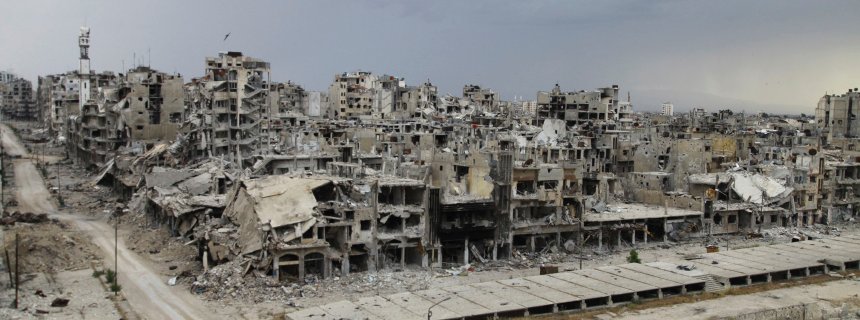
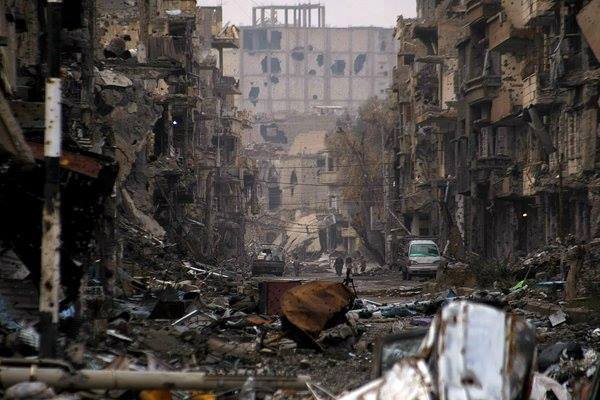
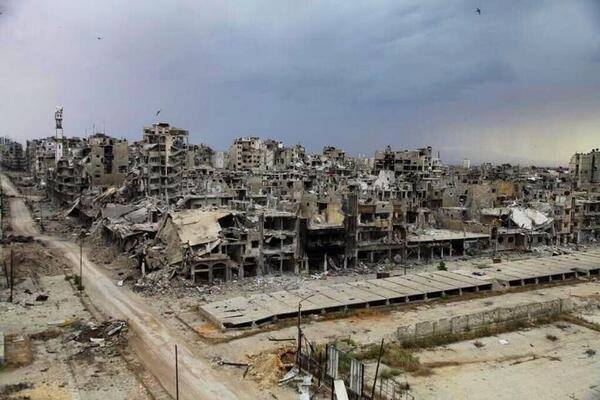
REUTERS Homs in May: “People are telling me that Homs looks like Berlin in 1945.”
Mr. Brahimi, in May, you stepped down as the United Nations special envoy to Syria. When you took the position in 2012, many considered the task of achieving peace in Syria to be a mission impossible. What did you hope to achieve?
Brahimi:The idea was, and still is, for Bashar al-Assad to agree to become the kingmaker instead of staying on as president, an orderly transition with his participation to go to the new Syria. This is what I was and still am dreaming of.SPIEGEL:Can you point to a particular incident that showed you that it was time to give up?
Brahimi:When I ended the second round of discussions at the so-called Geneva II conference at the beginning of this year, I realized that this process was not going to move forward any time soon.
SPIEGEL:What happened?
Brahimi:Neither Russia nor the US could convince their friends to participate in the negotiations with serious intent.
SPIEGEL:To what degree is the dispute about the person of President Bashar al Assad?
Brahimi:The issue of President Assad was a huge hurdle. The Syrian regime only came to Geneva to please the Russians, thinking that they were winning militarily. I told them “I’m sure that your instructions were: ‘Go to Geneva. But not only don’t make any concessions, don’t discuss anything seriously.'”
SPIEGEL:What about on the other side?
Brahimi:The majority among the opposition were against coming to Geneva. They preferred a military solution and they came completely unprepared. But at least they were willing to start talking with President Assad still there as long as it was clear that, somewhere along the line, he would go.
SPIEGEL:So, you didn’t have a chance at all?
Brahimi:I told the Americans and the Russians several times while we were preparing for Geneva that they were bringing these two delegations kicking and screaming, against their will.
SPIEGEL:For the sake of his country, why couldn’t President Bashar accept a replacement leader that everybody could live with?
Brahimi: It is his regime. He still has an appetite for power. The regime is built around his person and he still has enough authority over people that having him stay in power is a fundamental part of their vision of the future. The way he puts it is, “The people want me there and I cannot say no.” He said, “I am a Syrian national. If I have 50 percent plus one vote at the elections, I’ll stay. If I have 50 percent less one vote, I will go.” Yesterday he was just re-elected for another seven years! You have a situation where one side says there can be no solution unless Assad stays in power. While the other side says there can be no solution unless Assad goes. Do you know how to square a circle?
SPIEGEL:Is Assad aware of the way the war is being conducted by his army?
Brahimi:One-hundred percent.
SPIEGEL:The barrel bombs being thrown from helicopters on civilian populations? The targeted bombing of hospitals? The systematic torture and killing of thousands or tens-of-thousands?
Brahimi:He knows a hell of a lot. Maybe he doesn’t know every single detail of what is happening, but I’m sure he is aware that people are being tortured, that people are being killed, that bombs are being thrown, that cities are being destroyed. He cannot ignore the fact that there are 2.5 million refugees. That number is going to be 4 million next year, and there are 6 million people who are internally displaced. He knows that there are 50,000 to 100,000 people in his jails. And that some of them are tortured every day.
SPIEGEL:Did you confront him with those facts?
Brahimi:Sure! I spoke to him of a list of 29,000 people in his prisons and I gave a copy of the list to his office.
SPIEGEL:Is the regime the major culprit or are war crimes also committed by others?
Brahimi:War crimes are being committed every day, by both sides. Starvation is being used as a weapon. When you prevent water and food from reaching 250,000 people, what else can you call that? And at the same time, some of the armed groups are using civilians as human shields. But the regime has a state, has an army with 300,000 men, has airplanes, which the opposition doesn’t have.
SPIEGEL:Does anybody track those war crimes and hold people responsible?
Brahimi:There is an investigation commission, working under the umbrella of the High Commission of Human Rights, that has been trying to look at all these human rights abuses and they are systematically collecting facts. People will be held responsible one day.
SPIEGEL:Who is the dominating force in the armed opposition?
Brahimi:The opposition is very fragmented, even the Free Syrian Army. But everybody understands that the jihadi group ISIS (Eds. Note: The Islamic State of Iraq and the Levant) is not really interested in Syria. They seek to establish a new order in the region. As long as there are no negotiations, the armed groups as well as the political opposition will continue to be fragmented.
SPIEGEL:Are any of those groups capable of winning the fight against Assad and his regime?
Brahimi:The United Nations secretary general has been saying all along that there is no military solution. Neither the regime, nor the opposition can win a decisive military victory.
SPIEGEL:What is your prediction for the future of Syria and the region?
Brahimi:Unless there is a real, sustained effort to work out a political solution, there is a serious risk that the entire region will blow up. The conflict is not going to stay inside Syria. It will spill over into the region. It’s already destabilizing Lebanon, there are 1.5 million refugees in the country; that represents one third of the population. If it were Germany, it would be the equivalent of 20 million. It is destabilizing because ISIS …
SPIEGEL:… the most radical and brutal armed opposition group, which seeks to establish a militant Islamic state …
Brahimi:… is active in both Syria and Iraq already, and Jordan is really struggling to continue resisting. Even Turkey! According to a senior Iraqi official, ISIS has carried out 100 operations in Syria and 1,000 operations in Iraq in just three months.
SPIEGEL:How could these radical forces emerge so quickly? Sources say that the Syrian regime itself helped unleash this phenomenon deliberately — that they have released hundreds of extremists from their prisons, even encouraging them to create an enemy that they can legitimately fight against. Is this correct?
Brahimi:I have heard this several times. People will tell you that ISIS controls one province and the government never attacks them. It is probably the government’s way of saying: “This is the future you will have if we are not there anymore.”
SPIEGEL:Will the states of Jordan, Iraq, Lebanon and Syria be able to survive?
Brahimi:They will not completely disappear as states, but it reminds me a lot of 1999. Then, I resigned from my first assignment as UN special envoy to Afghanistan because the UN Security Council had no interest in Afghanistan, a small country, poor, far away. I said one day it’s going to blow up in your faces. It did.
SPIEGEL:What is the link to Syria?
Brahimi:Syria is so much worse! This ISIS, they don’t believe in just staying there. And they are training people. Your countries are terribly scared that the few Europeans that are there may come back and create all sorts of problems. So just imagine what the feelings are next door!
SPIEGEL:Did the West make significant mistakes when the conflict broke out?
Brahimi:Most people did, the product of a wrong reading of the situation inside Syria — just as events in Tunisia and even in Libya were misread by most people. People have got it wrong every time. Which is understandable. It is complicated and these events erupted on us when we weren’t looking. What is difficult to understand is that the early, mistaken assumptions have not been revised. On all sides, people still help the war effort instead of the peace effort, and it is making things worse.
SPIEGEL: If the international community had only supported the Free Syrian Army with the right weaponry in the early stages, Assad could have been ousted and a peaceful transition could have prevailed. Do you share this assessment?
Brahimi: No, because I think they did help the Free Syria Army. But the thing is they thought that the regime was going to fall easily — complete misconception. Syria has a state, it has an army, and it was assumed that it was going to fall just like Libya did.
SPIEGEL:Might the Assad regime fall at some point?
Brahimi:So far he is still President and Russia and Iran still support him.
SPIEGEL:Is there any plan you can think of that might put an end to this conflict?
Brahimi:Iraq tells us that military intervention is a very, very dangerous way of solving problems. UN intervention is something else. If you have a peace-keeping mission that comes as part of an agreed solution, that would be different.
SPIEGEL:What should such a mission look like?
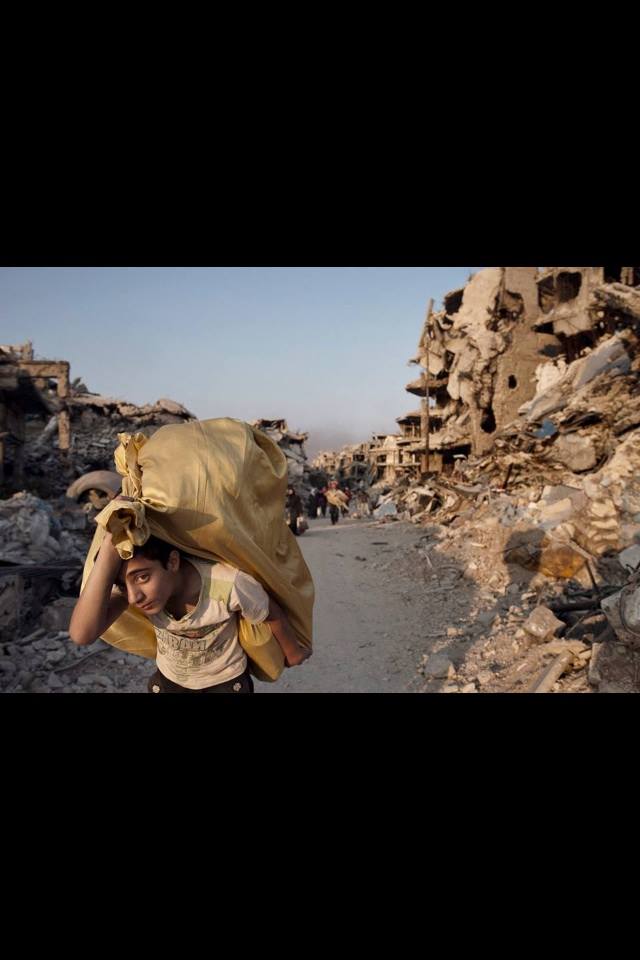
Brahimi: The UN has, I think, 20,000 or 30,000 soldiers that would be there to help the Syrians implement something they have agreed upon. And then you would need to face the ISIS, Jabhat al Nusra and (other radical groups). But first, the Syrians would have to agree for the UN to come in. It doesn’t look likely today or tomorrow, but this conflict has got to be resolved. And it will be at some point. The question is: How much killing and destruction are we going to have before that happens? People are telling me that Homs looks like Berlin in 1945.
SPIEGEL: Could the recent ceasefire in Homs be a model for other places like Aleppo?
Brahimi: The government starved the people there into surrender. The negotiation in Homs took place within the war project of the government, and it led to a victory by the government. But a lot of the things that have taken place during the last phase of negotiations over Homs could be part of a peace process. On previous occasions, many among the people who surrendered were arrested. It is alleged that some have been tortured or even killed.
SPIEGEL:What role do the countries backing each party play?
Brahimi:The Russians have consistently said it was not up to them to ask President Assad to leave office: “We do not have that much influence over him, even if we wanted,” they said. The Iranians said they accept that the crisis needs to be solved through negotiations, that at the end there must be free and fair elections and that this could be organized and observed by the United Nations. But then they said that, of course Assad would be allowed to stand if he wants. All three — Russia, Iran and Iraq — are supporting Damascus and delivering a lot of aid to them; probably money and definitely weapons.
SPIEGEL:How about the support for the armed opposition?
Brahimi:The Saudis, the Qataris and the Turks are supporting all kinds of political groups and armed groups. The foreign minister of Saudi Arabia said several times that the Syrian people are defending themselves against a brutal regime and it is legitimate to help them protect themselves.
SPIEGEL:We have been told that the Saudis even refused to meet with you.
Brahimi:That’s a fact. I think they didn’t like what I was saying about a peaceful and negotiated settlement with concessions from both sides. I am only guessing because I did not hear that from them. The irony is that hired pens for the regime are saying that I am Saudi Arabia’s man!
SPIEGEL:Could the Saudis and the Iranians come up with a solution if they were just to sit down together instead of letting their proxies fight about who will dominate the region?
Brahimi:Saudi Arabia is a very important country. King Abdullah is a very wise man and the Iranians, I think, with the new government that they have, also want to be constructive and responsible. Both countries have a responsibility. The region has to start discussing not how to help warring parties, but how to help the Syrian people, their neighbors. The other country that can help is Egypt.
SPIEGEL:To what degree does this conflict pose a threat to Israel?
Brahimi: Israel is very happy. Things are going very, very well for them. If Bashar goes it’s great; if Bashar stays it’s great. Syria is being weakened. Syria had some kind of strategic weapon with their chemical weapons and that’s gone. So Israel is doing very well, thank you very much. You don’t need to worry about them.
SPIEGEL:It sounds like you are saying that the Israelis are leaning back and saying: “Great, our enemies are killing each other.” Is the world that cynical?
Brahimi:I’m sure they are saying that. It’s a realistic point of view. Ask your Israeli friends; they will tell you it’s so.
SPIEGEL:What is the true story about the use of chemical weapons in this war?
Brahimi:They have been used, but there are conflicting views about who the culprits were. The UN was specifically requested by the Security Council to merely establish that chemical weapons were used. Not everyone agrees that it was the Syrian government who used these chemical weapons.
SPIEGEL:The West considers it fact that the Syrian government was responsible.
Brahimi:As I said, the UN investigating mission was strictly ordered NOT to try to determinate who the guilty party was. Now, from the little I know, it does seem that in Khan al-Assal, in the north, the first time chemical weapons were used, there is a likelihood that it was used by the opposition. Regarding the use of chemical weapons on Aug. 21, 2013 in the suburbs of Damascus, it is a fact that for the West and perhaps most people in the region, the responsibility lies with the regime. Moscow and Tehran say they are equally certain that the government DID NOT use chemical weapons anywhere. It is a great pity the UN was under strict instructions not to try to point the finger at anyone. More recently, there are again allegations that chemical substances have being used. I hope this time the UN will be asked to do its best to find out who the guilty party is.
SPIEGEL:What was the effect of US President Barack Obama not having done anything after poison gas was deployed in Syria; after the red line had clearly been crossed twice? Is America’s unwillingness, or inability, to intervene a dangerous portent?
Brahimi:I think that Obama — and the Russians — decided that, rather than take punishing action, they would solve the problem at its roots, and they may have done that. From their point of view, and from Israel’s, that is the better solution. But many Syrians on both sides are rather unhappy that the government is giving up the only strategic weapons they have; a weapon that was acquired at enormous cost to the people of Syria.
SPIEGEL:What do you think will ultimately become of Syria?
Brahimi:It will be become another Somalia. It will not be divided, as many have predicted. It’s going to be a failed state, with warlords all over the place.
SPIEGEL:What can the international community do, Europe in particular? What should Germany do?
Brahimi:The people in your governments know how dangerous this crisis is and how important it is to support a political solution.
SPIEGEL:Are you referring to the 320 Germans that have thus far joined ISIS?
Brahimi:And to the 500 or 600 French, the 500 or 600 British, and so on and so forth. There are several thousand non-Syrians. My goodness! These are your nationals that are training in Syria and that are part of ISIS, which believes that you have got to build an Islamic state all over the world, starting with Berlin. That’s a threat to you, isn’t it?
The Jobar Synagogue was one of the holiest Jewish sites in Syria and contained priceless historical artifacts. Now it’s destroyed—and the opposition says Assad is to blame.
Syrian Arab Army forces flattened the Eliyahu Hanabi Synagogue in the Jobar neighborhood of Damascus over the weekend. The attack not only wrecked a site that’s at least 400 years old. It may have destroyed thousands of irreplaceable Jewish artifacts contained inside the synagogue, according to opposition leaders and photos obtained at the site.
The area where the synagogue once stood has been under bombardment by the forces of Syrian President Bashar al-Assad for months. The Syrian regime is laying siege to the town, one of the few rebel strongholds in the area. It’s all part of what the opposition calls Assad’s “scorched earth” policy, which includes random and violent attacks on civilian populations.
“I am deeply saddened to learn of the destruction of Jobar Synagogue, which was a treasure of Jewish and Syrian cultural heritage,” said Shlomo Bolts, an official at the Syrian American Council, an American charity connected to the Syrian opposition.
The Jobar Synagogue in Damascus lay in ruins Monday after being shelled by Syrian government forces. All photos provided exclusively to The Daily Beast by witnesses on the ground. ()
Bolts, a Jew of Syrian ancestry, said that the Syrian Jewish community is only the latest victim of Assad’s strategy to target religious and cultural institutions.
“Yet this is hardly the only place of worship to be destroyed by the Assad regime. The Umm al-Zinar Church [a house of worship in Homs that locals say dates back to the first centuries of Christianity], the [1,400 year-old] Khalid Ibn Walid Mosque, and countless other irreplaceable cultural sites are now lost to history due to a dictator’s manic desire to keep power at all costs,” he said.
The Syrian American Council is part of the Coalition for a Democratic Syria, an umbrella organization that says it represents over 100,000 Syrian-Americans. The group’s contacts inside Syria shot photos of the rubble where the Jobar Synagogue stood until days ago. Those photos were provided to The Daily Beast.
This week’s attack, though the final blow, was not the first time the Syrian regime had bombarded the Jobar Synagogue. AnIsraeli news report from April 2013noted that the synagogue had been “looted and destroyed,” although later photos proved that the synagogue had taken only moderate damage from a mortar shell.
Activists estimate that at least 33 churches and hundreds of mosques have been destroyed by the Assad regime since the start of the Syrian civil war. Six UNESCO World Heritage Sites in Syria have been destroyed in Syria since the fighting began.
Last December, photos emerged inanother Israeli news reportshowing that many of the synagogue’s most precious artifacts were intact. The report stated that the bulk of the synagogue’s artifact collection was being held safely in the hands of local leaders.
Before the conflict, the synagogue held thousands of religious and cultural treasures, including hundreds-years-old Torah scrolls, historical texts, precious dining ware, and ancient Judaica of all sorts. Some of the items were reportedly looted in the early days of the war. Some were reportedly placed in safekeeping. Many remained in the building until its destruction.
Opposition sources told The Daily Beast that the damage assessment following this week’s devastating attack on the Jobar synagogue was ongoing but all of the Jewish heritage items that remained inside the synagogue are feared lost.
The Eliyahu Hanabi Synagogue, built to honor the prophet Elijah, had existed at least since medieval times. The site has been a destination for Jewish pilgrimage for centuries. It was said to have been built atop the cave where Elijah hid from his persecutors. The Prophet Elisha, who allegedly built the synagogue, was said to have anointed King Hazael on its steps, now gone.
The town of Jobar was home to a significant Jewish population throughout the medieval period, although the community was eventually driven out of Syria and the synagogue was taken over in the 19th century by local Arab leaders. Following the establishment of the State of Israel, the synagogue was used as a school for displaced Palestinians.
Activists estimate that at least 33 churches and hundreds of mosques have been destroyed by the Assad regime since the start of the Syrian civil war. Six UNESCO World Heritage Sites in Syria have been destroyed in Syria since the fighting began.
As early as March 2012, UNESCO Director General Irina Bokova waspublicly warningabout damage to precious sites and calling on both sides to protect Syria’s cultural legacy.
“Damage to the heritage of the country is damage to the soul of its people and its identity,” she said.
Please, tell me more about your “Resistance” project, and how you are fighting the good fight against imperialism and occupation and cultural hegemony. About how you think the necktie is a remnant of the uniform worn by the old Knights Templar (it’s not but I like to see you keep bringing that up). Tell me more about how the freedom of the individual, this so-called negative and positive freedom you keep liking to invoke, is so, so, very important to the historic struggles of the brown man as he shakes off the yoke of his oppressor. Tell me about your amazing plan to liberate Jerusalem, for the dignity of all Palestinians, Arabs, and Muslims (no dignity to any of them until then, of course). Tell me about your glorious leaders and martyrs, about “keeping your word” with a brutal dictator who has butchered the Syrian people just so that he can be a president like his Daddy.
You’ll only be happy to, I am sure. But right now there is something you’re not telling me. Right now the so-called “Zionist Enemy” has, through their courts and laws, imprisoned a former president on charges of rape, and that there is a former prime minister who will now serve six years in prison on charges of bribery. Maybe they’re not as good at picking their leaders as you are. And you definitely don’t want to tell me about how your torture chambers make anything the villainous “Empire” can think of, including Guantanamo and Abu Ghraib – yes, especially them – look like Disney land in comparison. You don’t want to tell me that your pet dictator and the militias you send to support him have killed more Syrians than everybody killed by US drone strikes since 2001. That they have displaced in three years more Syrians than the “Zionist enemy” ever did when it took part of Palestine in 1948, and then the rest of it in 1967. I guess these are things you don’t want to tell me about…
Volunteers distribute free meals to residents at the Palestinian refugee camp of Yarmouk. Photograph: Reuters
Lugging a plastic bag carrying the clothes and food scraps she could salvage, Umm Samir set out from her ruined home and crawled through the pre-dawn gloom on her second journey into exile in 68 years.
In the difficult days since, she has made her way from the YarmoukPalestinian refugee camp in Damascus to Beirut, where she now confronts the bitter reality of again becoming a refugee, the lifelong dream of returning to her birthplace now further away than ever.
“I always thought that the only time I would move from Yarmouk would be back to Palestine,” she said from a tiny, airless basement in the Sabra-Shatila Palestinian camp in the heart of the Lebanese capital, where the family sought sanctuary three days ago. “Now I find myself here.”
Across the room, Umm Samir’s daughter, son-in-law, and five of their 10 children, were squatting silently on the floor. The children’s father, Abu Sameer, had a hunched and defeated air, while their mother, Umm Sameer, shifted quickly between anger and sorrow.
“I didn’t expect this at all,” said Umm Sameer of the unrelenting siege of the Yarmouk camp that had seen many of those who remain starved to the point of death. “I didn’t think the [Syrian] regime would do this to our people. The veil has dropped. We can see clearly how we were used.”
Over the past fortnight, the siege of Yarmouk, the camp held up by Syriaover four decades as a symbol of its commitment to the Palestinian cause, has reached a nadir. Many of those who remain have been unable to eat, or leave. Others, like Abu Sameer and his family, decided that a suicide run for the camp’s closely guarded borders was a better bet than fossicking for scraps in abandoned buildings and pillaged orchards.
“We made it in small groups, but five of our children were left behind,” said Abu Sameer. “It was just too dangerous to bring them. “We were going to die,” he said of his decision to leave. “We had no choice.”
The desperate plight of those who left behind was showcased last week through pleas by the United Nations Relief Works Agency (UNRWA) and stories in the Observer. Both revealed the scale of an unfolding catastrophe starkly at odds with a recent UN security council resolution demanding that humanitarian aid be delivered to all those caught up in Syria’s unrelenting war.
Last week, after a demand from UN secretary general Ban Ki-moon, things changed in Yarmouk, with food parcels reaching some of those who needed them for the first time in 15 days.
The UNRWA reported that Syrian officials had allowed close to 700 parcels, each capable of feeding between five and eight people, into the camp. The delivery eases an immediate crisis, but fails to address a profound stockpile deficit caused by months of delayed deliveries earlier in the year.
And the new supplies have not reached all those who need them. One Yarmouk resident, who asked not to be named, was almost too exhausted to make himself heard down the phone line on Friday. “It is a nightmare,” he said. “For four months we have been eating rice and grass, radishes and greens.”
Asked why he had not tried to leave, he said: “If we are caught, it is straight to the Palestine Branch (an intelligence division). Anyone who goes in there does not come out. If they do manage to, they have been reborn. So many people have been disappeared.”
Many of the Yarmouk exiles say the name of their former home will soon be etched into infamy in the same way that Sabra-Shatila was 32 years ago, when more than 1,000 Palestinians were massacred by Lebanese Christian militias who at the time were allied to the occupying Israeli army.
The ghosts of 1982 remain deeply synonymous with Palestinian suffering. But some of the new arrivals say the scale of the current horrors in Yarmouk and other Syrian camps may soon eclipse even such a painful episode.
Iran and Syria “pretend to be against Israel”, but that is just a ploy, according to Umm Ibrahim, the matriarch of a another Yarmouk family which had arrived in Sabra-Shatila in recent weeks. “The Golan Heights have been silent for how long?” she asked rhetorically. “The Palestinian resistance used to come through Lebanon to fight Israel. They weren’t allowed through Syrian land. Not even a bird was allowed to fly across the border fence.”
Resentment seethed among both families of new refugees. “The Arabs are bigger enemies than the Israelis,” said Umm Sameer. “They don’t behave like this to their worst enemies.”
Unwanted in Syria, those fleeing Yarmouk are hardly made to feel at home in Lebanon either. New arrivals are given a one-week visa, which requires them to report to authorities or face a $200 fine, which few among them can afford. While UNRWA and other aid organisations offer some food assistance and living space, conditions are far worse here than in pre-war Syria.
“They didn’t care about us at all,” said Umm Samir, who was too young to remember her first journey to exile in 1948 from the Palestinian town of Safed, in what is now Israel, and too anguished to want to recall her second journey last week. “I thought that if I ever leave my home again before I die, it would be to go back to Palestine.”
Outside Sabra-Shatila, in the Palestinian embassy nearby, senior official Qassem Abbas, who is responsible for Yarmouk arrivals, tried to play down the scale of the crisis. “Things have actually improved in recent weeks,” he said. “They haven’t worsened. The Palestinian leadership has decided to take a position of neutrality. This brought us closer to the Syrian regime, despite everything that has happened. It was a difficult decision, but it made us less biased.
“This is a chess game being played by all those in the region,” he said of the Syrian war. “But there is only one real mastermind, America. It serves their interests so they can stay in the region.”
Back in the camp, the new arrivals were having none of that. “Our so-called leaders have their own reasons for their closeness to the Syrian regime,” said Umm Sameer. “And it has nothing to do with us. “Shame on them and their silence.”