Search

band annie's Weblog

I have a parallel blog in French at http://anniebannie.net

Category

Syria

The Mystery of Abdul-Rahman, or Peter Kassig

NOVEMBER 17, 2014


BY AMY DAVIDSON
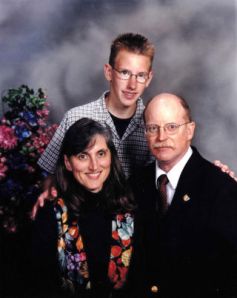
Davidson-Kassig-Family-320

CREDITCOURTESY THE KASSIG FAMILY

“They tell us you have abandoned us and/or don’t care but of course we know you are doing everything you can and more,” Abdul-Rahman Kassig, born Peter Kassig, wrote to his parents, Ed and Paula, when he had been held by the Islamic State in Iraq and al-Sham for several months. He knew that his captors might kill him—“it may very well be coming down to the wire here”—and in the end they did: over the weekend, ISIS released a video of a member of the group displaying Kassig’s severed head. He was twenty-six years old, and from Indiana. In the letter, he’d sought to prepare his parents for that end, and, perhaps, to forestall the visions they might have of his last moments: “Don’t worry Dad, if I do go down, I won’t go thinking anything but what I know to be true. That you and mom love me more than the moon & the stars.”

Kassig was kidnapped delivering medical aid to people affected by the civil war in Syria. He had been a soldier, a Ranger in Iraq, then a college student, and, very briefly, a husband. (The marriage ended in divorce.) Along the way, the Army trained him as a medic, and he took classes to learn to be an emergency medical technician. On a vacation to Lebanon, where he encountered Syrian refugees, he realized that his medical knowledge was an asset, a gift he could hand to desperate people. Just before he was supposed to go home, he had, as he wrote in an e-mail to family and friends, “the best conversation that I have ever had with my mom. From 4,000 miles away in a shelled out parking lot in Beirut I told her about what I had been involved in over the last week.” He had found his “calling”:

Yesterday my life was laid out on a table in front of me. With only hours left before my scheduled flight back to the United States, I watched people dying right in front of me. I had seen it before and I had walked away before.… I’m just not going to turn my back this time, it’s as simple as that.

“My whole life has led me to this point in time,” he wrote. He stayed, and bandaged wounds, cared for people in clinics, and, just generally, helped. He was drawn across the Syrian border into a zone of both war and jihadi kidnapping. Joshua Hersh, who encountered Kassig when he was working there, wrote that he “didn’t try to convince me that going back was safe, or even wise. But his commitment to the relief project he had embarked on was untempered, and it was clear to me that he would soon go back.” In a wrenching statement posted to Facebook on Sunday, his parents said, “We are incredibly proud of our son for living his life according to his humanitarian calling,” and asked that people donate to a Syrian relief group in lieu of flowers.

Altruism is a mystery, in the best sense of the word, in the same way that love is. It’s not one we always need to solve; often, it leaves us most puzzled about ourselves, about our own lives spread on a table. (Larissa MacFarquhar has written about this.) But there are also two other, more specific mysteries associated with Kassig’s death. One has to do with his conversion to Islam. The other is why this ISIS beheading video did not resemble others.

At some point in his captivity, Peter Kassig, who was raised Methodist, converted to Islam and took the name Abdul-Rahman.* That is what his parents called him publicly when, after a period in which they were trying to quietly work for his release, they began to speak out; they referred to him as Abdul-Rahman Peter Kassig in the statement after his death was confirmed, when it would no longer have been useful; President Obama also used the name Abdul-Rahman, in calling the murder “an act of pure evil.” Kidnappings often include forced conversions—the men who abducted more than two hundred girls from their school in Nigeria claimed that the girls had converted, but no one would hold those children (or adults in similar situations) to religious declarations made under duress. Kassig’s parents have said, through their family Twitter account and other statements, that they believed he was sincere—and he was, by nature, sincere and searching. They were also, as Kassig rightly said in his letter to them, doing everything they could think of to save him. His mother appeared in hijab in video appeals to his captors, and also at a prayer vigil at an Islamic center in Plainfield, Indiana, where the Muslim community rallied around him. Indeed, the Muslim voices advocating for his release were as many and varied as one could get. They included college students in America, refugees in Syria, and even members of the Islamist Al Qaeda affiliate Al Nusra Front, who remembered him as someone who treated wounded rebels, among others. (This may also hint at the mixture of rebel forces.) It didn’t work. Conversion was never protection. It was not ISIS’s goal to make Kassig a Muslim, nor was it in its interest to acknowledge him as one. They wanted to murder an American, and they did.

This is what Kassig wrote, obliquely, about the questions he must have known his parents had about his conversion, in that letter from captivity:

In terms of my faith, I pray everyday and I am not angry about my situation in that sense. I am in a dogmatically complicated situation here, but I am at peace with my belief.

Kassig’s parents knew him best, and what “dogmatically complicated” and “peace” might mean to him. In the same letter, he said, “I cried a lot in the first few months but a little less now.” The choice for the rest of us, going forward—when deciding, for example, what name to call him, or to entertain the idea that the conversion was part of where Kassig’s life was leading—seems clear: follow Ed and Paula Kassig’s lead, and give them room to think about what God meant to their son.

Then there is the mystery of the video. The others each involved a hostage kneeling in an almost art-directed outdoor setting, reciting a confession, and then having his head cut off with a knife. This one did not. Instead, the ISISmember who stands there with his head calls him Peter Edward Kassig and states that he “doesn’t have much to say. His previous cellmates have already spoken on his behalf.” Before that, as if to make the point that they do, still, film themselves in the act of decapitation, there is footage of ISIS members killing captured Syrian soldiers this way. Perhaps there is footage of Kassig that the group has in reserve. But its absence so far has led to speculation that, as the Times put it, “something may have gone wrong” from ISIS’s perspective during the filming of his murder.

What could that be? There are immediate romantic fantasies: a defiant speech, a brave silence. Maybe—but keep in mind that Kassig, who was dying, didn’t owe anyone a gesture like that. It might just have been that a bomb went off nearby, or that, as the Times suggested, drones drove the executioners inside, or crossed the sky in the middle of the shot, or something prosaic, like a cameraman’s fumble. Or there could have been something that particularly spoiled its propaganda value among Muslims: for example, a profession of faith. He didn’t owe that to anyone, of any faith, either.

When he wrote to his parents as a hostage, Kassig thanked them for raising him, and for the things and the scenes that they had shown him. “I wish this paper would go on forever and never run out and I could just keep talking to you. Just know I’m with you. Every stream, every lake, every field and river. In the woods and in the hills, in all the places you showed me. I love you.” That was the end of the letter.

Update: At a press conference Monday afternoon, Ed Kassig said, “Please pray for Abdul-Rahman, or Pete if that is how you knew him, at sunset this evening.… Lastly, please allow our family the time and privacy to mourn, cry—and yes, forgive—and begin to heal.”

*Correction: A previous version of this post said that Kassig was raised Catholic.

source


Asking Assad to stay is asking Syrians to be party to a charade

Article is one year old but still valid

&MaxW=640&imageVersion=default&AR-131129704


In Ambiguities of Domination, political science professor Lisa Wedeen examined the Syrian regime’s rule of domination under then-president Hafez Al Assad.

She noted a dual role for Syrians: both propping up the regime’s propaganda and at the same time subverting its power via the symbols and rhetoric of everyday life and popular culture. This seminal work, published in 1999, a year before Al Assad junior took power, explained to outsiders the inner mechanisms of an authoritative regime. Its relevance is significant today under the shadow of Hafez’s son Bashar and with the fate of a blood-soaked Syria, now in ruins.

In a particularly powerful chapter entitled Acting As If, Wedeen writes: “Power manifests itself in the regime’s ability to impose its fictions upon the world.” The complicity of the people within this imposition enforces the regime’s power of domination. In other words, the regime’s power is mainly constructed by the people’s enacted participation in that very construction.

According to Wedeen: “The politics of acting ‘as if’ carries important political consequences: it enforces obedience, induces complicity, identifies and ferrets out some disobedient citizens …”

Indeed, one of the fundamental ways the Syrian people functioned in the police state was by “acting as if”. Acting as if nothing was going on as Hama was pummeled in 1982. Acting as if they loved the leader even though they were terrified of him.

The tragedy of Bashar Al Assad’s rule is that his father’s construct of complicity has, over the past 32 months, bled far beyond Syria’s borders to encompass the entire region and international community.

As world leaders discuss the merits of the Syrian opposition attending Geneva 2 peace talks without preconditions, they flip the narrative of the revolution. A narrative in which Mr Al Assad is upgraded from a brutal dictator that deserves no more than a cell at The Hague to a potential “partner” in the transitional peace process.

The latest demeaning analysis offered to Syrians is to act “as if” Mr Al Assad maintaining power would end the brutal war that was unleashed by Mr Al Assad himself. Governments act as if dragging the Syrian opposition to the negotiation table without any preconditions will result in a political solution to a raging war. World leaders act as if Mr Al Assad’s cooperation in dismantling his chemical weapon stockpiles is reducing the amount of bloodshed, even as the cluster bombs and scud missiles continue to fall onto civilian populations.

As the slated 2014 Syrian presidential election approaches, “Syrians will have their voices heard at the ballot box” is the current refrain of Assad loyalists. As if presidential elections can even be a possibility in a country where over seven million people are displaced. And Mr Al Assad himself acts as if his nomination is not even problematic, to say the least.

For what purpose is all of this acting “as if”? To save Syria from the very regime that created this catastrophe in the first place?

The act of “acting as if”, like the fable about the emperor and his non-existent clothes, twists lies into elaborate truths to the point where even well-intentioned people, including Syrians themselves, are left to wonder: “Should Assad stay?”

Faisal Al Yafai, writing in these pages, approaches the “unthinkable question” of Mr Al Assad remaining in power to save Syria, arguing “all of that could be worthwhile if it ends the conflict”. True, but the most important word in that sentence is “if”.

While Al Yafai rightly points out that no one has any good ideas to end the protracted bloody war, the idea of Mr Al Assad staying in power may just be the worst one.

Most Syrians are worn out by the gruelling violence that has taken a toll on all aspects of life. Most Syrians want peace and stability. If faced with a sincere choice – Mr Al Assad remaining in power in exchange for a ceasefire, the release of all political prisoners, opening humanitarian and medical aid corridors into Syria, and beginning the long process of refugee return – most Syrians would swallow the bitter pill and choose Mr Al Assad. This choice is the result of being left alone to fight two enemies armed by foreign forces with virtually no support. It is a choice of despair.

It is also an unfairly framed choice for one simple reason: Mr Al Assad will never uphold his end of the bargain. Syrian history, old and new, is a reminder of how the Assad regime deals with the people’s dissent. Both father and son have displayed their relentless tactics of retribution. (See Hama, 1982. Or Syria, 2011-2013.)

Making a judgement call based on the grim Syrian present – well over 100,000 dead, thousands in torture cells, millions of displaced and refugees, foreign fighters and extremists battling for foreign ideologies and agendas, mass destruction of cities, towns and villages, an out-of-touch political opposition that is corrupt and impotent, and millions of exhausted Syrians who just want it all to end now – is simply a convenient and careless cop-out.

It’s easy to look at this list of tragedies and claim that saving what’s left of Syria should be the only priority and argue that preconditions to the negotiations will only ensure more stalemate and bloodshed.

Merely glancing at the present is not only naive, it’s immoral. History tells a different story. Stories of mass murder and destruction 31 years ago in Hama, stories of thousands of torture and rape cases, stories of boys whose fingernails where ripped out because they wrote “freedom” on their school walls, stories of enforced policies of “Assad or we scorch the country”, and more recently “Kneel or starve”. Those stories document the despicable and undeniable truth of this regime.

We live in dark times when tyrants are hailed as saviours and martyrs are called terrorists.

History repeats itself – as Hama did before Daraa, and Hafez before Bashar. History also bears witness to the simple fact that sooner or later, every tyrant’s rule ends. In fact, tyrants have fallen over the centuries of our collective civilisation, on this very land called Syria.

Perhaps we will not be able to rejoice soon (or not even for decades) that the Assad regime is finally finished. That will not change one fact: asking for him or his regime to stay will not save lives. Instead, this decision will take more Syrian lives. Thousands more lives.

Deceptive options and skewed choices can be framed as powerful persuasions, as the “last hope” and the “moral choice”. These “solutions for the Syrian conflict” mock the Syrian people’s heavy sacrifices, bloody history, and desire for a peaceful future of freedom and dignity.

If the world has now decided to act “as if”, this complicit world should know that the Syrian people ended that charade 30 months ago. That was their unambiguous choice.

Beyond the dead, tortured, and displaced people; beyond the destroyed cities and scorched landscapes; beyond all what we have lost; does the world really expect Syrians to go back to acting “as if”? As if they loved the illegitimate leader in Damascus? As if the tyrant’s clothes were not soaked with the people’s blood? As if the lies had become the truth? As if history had never unfolded in the terrible ways it did?

As if nothing had happened at all?

Amal Hanano is the pseudonym of a Syrian-American writer

On Twitter: @AmalHanano

Read more:http://www.thenational.ae/thenationalconversation/comment/asking-assad-to-stay-is-asking-syrians-to-be-party-to-a-charade#full#ixzz3I57fqX44 
Follow us: @TheNationalUAE on Twitter | thenational.ae on Facebook

Death at sea: Syrian migrants film their perilous voyage to Europe – video

This is the story of five friends – Moaaz, Majd, Rasha, Kinan and Khalid – who fled war-torn Syria to embark on a perilous trip to reach Europe. So far this year an estimated 3,000 migrants have died attempting this same journey. On 16 August 2014 they set off from Syria to Lebanon, where they caught a flight to Algeria, to begin their journey 

 All mobile phone footage in this film was filmed by Majd 
 ‘I feel for those who were with me. They got asylum in the sea’


see the video here

Macbeth in Syria- Act4 part I


CHORUS: Oppressed land of ours! You cannot have the sweet name of mother now that you have become a tomb for your sons.

From orphans, from those who mourn, some for husbands, some for children, at each new dawn a cry goes up to outrage heaven.

To that cry heaven replies as if moved to pity, oppressed land, it would proclaim your grief for ever.

The bell tolls constantly for death but no-one is so bold as to shed a vain tear for the suffering and dying.

Oppressed land of ours! My homeland, oh,my homeland!

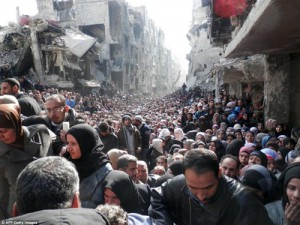
syria-hordes

New-photographs-from-Syria-show-devastation-of-civil-war_lg

pict69

Isil’s reign of terror rooted in the political culture of Iraq and Syria

Isil’s extreme cruelty and filmic savagery has shocked the world, but it is not very different from what leaders of Iraq and Syria – and to some extent their colonial predecessors – have been doing to local people for decades


Isil’s ‘Caliph’ Abu Bakr al-Baghdadi

By Richard Spencer, Dohuk, northern Iraq

7:00PM BST 04 Oct 2014

The beheading of Alan Henning was not Isil’s first, as we all know full well, nor will it be the last. But by ignoring pleas for mercy from across the Muslim world, the group set any doubt to rest as to the nature of its need for video horror violence.

That violence is in part religious – a public insistence that its own ultra-aggressive interpretation of Islam is more “authentic” than the wishy-washy versions of Muslim politicians, scholars and ordinary people who want to live peacefully and get on with the modern world.

It demands recognition that Islam can be spread by the sword in the 21st century, just as much as it was in the 7th.

The violence is also rooted in the political culture of Iraq and Syria, the countries from which Islamic State of Iraq and the Levant has sprung.

The extreme cruelty with which Isil’s “Caliph” Abu Bakr al-Baghdadi and his predecessors have avenged themselves on Westerners has revealed a culture of violence to an international public. But it is not very different from what these countries’ leaders – and to some extent their colonial predecessors – have been doing to local people for décades.

Most importantly and specifically, the violence reflects a need to show a continuous momentum. Success, however horrific, breeds success; if you depend on apparently psychopathic behaviour to press your advance, you need to recruit more psychopaths, and to show it works.

A United Nations report last week showed the importance of this sense of momentum. The headlines were full of the admirable words of Human Rights reportage: it talked of “gross abuses of human rights that have been perpetrated by Isil and associated armed groups, with an apparent systematic and widespread character”.

What that doesn’t capture is the constant movement and repetition of Isil’s actions, the reiteration of its overwhelming purpose. The greater the violence, the more the idea that this is a zero-sum game, a question put to Sunni Muslims of whether they want to be winners or losers, is rubbed home.

In June, The Sunday Telegraph reported how an Isil pickup truck killing party swept through Turkmen Shia villages in northern Iraq, killing scores of people at random – old men gunned down outside their homes, women shot dead as they fled. Any sign of trying to hide was doubly punished.

That is, by now, the well-recognised modus operandi of the group, showing their followers that they have the strength and ruthlessness to lead.

But as with everything Isil does, there was a twist.

Six weeks after the Telegraph interviewed survivors in a half-built mosque where they had taken refuge in a town nearby, Isil came back.

The jihadists set off a car bomb near the building site, killing 12 of those inside, including Abdulwahid Reza Kahir, the patriarch of one of the families.

An old man in a turban and farmer’s robe, already mourning the random killings of his son, cousins, nephews, including a 15-year-old: there was no precisely definable military or political purpose to his death, other than to show that, for jihadists, anything is possible.

There will be no end to the harrying of the enemy, an idea that is writ through the history of conquest.

It is easy to say that the national psychosis which gave rise to Isil was triggered by the American and British invasion of 2003. There is of course some truth in that: al-Baghdadi’s inspiration is Isil’s founder, Abu Musab al-Zarqawi, who also ordered the filming of decapitations of western hostages, sawing off the head of the American Nicholas Berg himself.

Abu Musab al-Zarqawi (Reuters)

Zarqawi was already a local al-Qaeda leader, but his particular brand of filmic savagery, mostly inflicted on Iraqi Shia, flourished in the lawlessness and increasing sectarianism of the country in the wake of the invasion. It is a platitude that the absence of order allows deranged men to prosper.

The defeat of Saddam Hussein also fed into the widespread Middle Eastern perception that Sunni Islam is under particular threat in the Arab world, is suffering an Arab equivalent of what the Chinese call “a century of humiliation”: colonial rule, the existence of the state of Israel and its repeated defeat of its (Sunni) Palestinian enemies, the economic catastrophes represented by Egypt and Yemen.

For those with ethnic or sectarian inferiority complexes – in this case both – there is a primal appeal in seeing your foe kneel before you and die.

However, the idea that politics is not just occasionally violent, but requires of its essence demonstrative violence, long predates 2003.

The modern Iraqi state is founded upon it. When the royal family, imposed by the British Empire in its dying days, was overthrown by a coup in 1958, the prime minister was not only shot dead with the king.

His corpse was dragged through the streets of Baghdad, publicly hanged and then burned.

The fate of the coup leader, Abdul Karim Qasem, when he was in turn overthrown five years later, is even more reminiscent of Isil’s approach to the media. He was shot on live television, and the state network’s camera rested on his bloodied corpse for the rest of the day, army officers occasionally intruding to insert a knife to prove his death for the viewer.

The lawlessness, in other words, is not just a product of the absence of a state, but written into the state. In Syria next door, ordinary people routinely tell stories of similarly pointless horrors, that served some political purpose while having little apparent rationality, from long before the civil war.

One Christian friend describes watching, as a child, her nine-year-old playmate next door being lined up against a wall and executed, after the Muslim Brotherhood uprising in 1982.

Another describes how a secret school truant smoking session in a Damascus cemetery was broken up by police who wrongly thought the teenagers were drug dealers. One boy disappeared, arriving home without his finger nails a few days later.

These are just stories plucked at random.

In war, everything escalates. The same regime that did these “small”, local crimes then began mutilating corpses of teenagers who opposed it. In 2011 one 13-year-old boy was sent home without his penis. From then on, anything was possible, impunity was written into the code of conduct. Impunity’s apotheosis was the attack by a regime militia on the town of Baniyas, where among the 400 victims, many of them children with their throats cut, was a pregnant woman whose body had been cut out so her foetus could be killed too.

Like Isil, the militia’s leader boasted publicly for the camera of what he was about to do.

These victims were, in the nature of the war, Sunni. The need to see your enemy kneel and die in a pool of blood is common to both extremes.

Can the West do anything to stop this? It should only try with humility. It is all too easy to find pictures on the Internet of Western soldiers – French, Italian, even British – posing for pictures with the heads of their colonial victims in the all-too-recent past.

There is no start point to the cycle of violence.

We do, however, have the experience of putting back together what is psychologically broken, as Syria and Iraq undoubtedly are. Whether that can be done from the air, or even in the halls of the United Nations, is another matter.

source


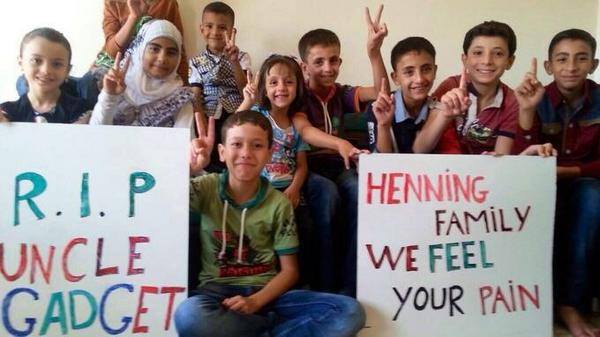
Syrian children thank Alan Henning

henning

Mr Henning was delivering aid to Syria when he was kidnapped, as Paul Wood reports
The Salford taxi driver was delivering aid to Syria in December when he was kidnapped and then held hostage by IS.

IS threatened to kill him in footage last month showing the death of Briton David Haines, and in this video they threaten US aid worker Peter Kassig.

David Cameron said Britain would do all it could “to hunt down these murderers and bring them to justice”.

The prime minister said the killing of father-of-two Mr Henning, 47, showed “how barbaric and repulsive” IS was.

“My thoughts and prayers tonight are with Alan’s wife Barbara, their children and all those who loved him,” he said.

“Alan had gone to Syria to help get aid to people of all faiths in their hour of need.”

Mr Henning’s wife Barbara had this week appealed for her husband’s release, saying: “He is innocent.”

Volunteer Mr Henning was on his fourth aid mission to Syria when he was captured within minutes of arriving in the country last December.

Alan Henning
Alan Henning

The prime minister will be briefed by intelligence and security chiefs on Saturday.

Downing Street said the “barbarity” of the act “underlines why it is right for Britain to join in the attacks against IS”, according to BBC assistant political editor Norman Smith.

“It is also pointed out that ministers have known for some time the risk to Western hostages and cannot allow that to determine British foreign policy,” our correspondent added.

Number Ten has declined to comment on the possible use of special forces in the fight against IS.

‘Generous character’

IS has previously released videos showing the apparent beheading of two US journalists, James Foley and Steven Sotloff, and British aid worker Mr Haines.

The video released on Friday is yet to be verified, but it appears to show Mr Henning kneeling beside a militant, who is dressed in black, in a desert setting.

The footage ends with an IS fighter threatening a man they identify as Mr Kassig.

In a statement, Mr Kassig’s family said he had converted to Islam and referred to him as Abdul Rahman Kassig.

The family asked people around the world to pray for his release and that of “all innocent people being held hostage in the Middle East and around the globe”.

They also asked people to pray for Mr Henning’s family, adding: “We have read about his work and his generous character with great respect and admiration.”

Mr Henning’s friend Majid Freeman described him as a “selfless, humble, courageous individual” who had simply wanted to help others.

Mr Freeman, who was with him on the convoy when he was captured, told BBC Radio 4’s Today programme: “He was helping the innocent people the rest of the world had abandoned.

“It doesn’t make sense to kill him.”

‘British accent’

BBC security correspondent Gordon Corera said the footage was similar to previous videos released by IS, though slightly shorter.

He said it included a reference to last week’s vote by UK Parliament to authorise air strikes against IS in Iraq.

Like previous videos it features a militant with an apparently British accent, he added.

Alan Henning

The UK Foreign Office said in a statement: “We are aware of the video and are working urgently to verify the contents.

“If true, this is a further disgusting murder.

“We are offering the family every support possible; they ask to be left alone at this time.”

The US said it was evaluating the video and if proved real, it was “another demonstration of the brutality” of the militant group.

Grey line

Analysis

Alan Henning with convoy members and ambulance

Frank Gardner, security correspondent, BBC News

David Cameron’s vow to catch the jihadist killers of Alan Henning and bring them to justice would seem to match the mood of the nation.

But judging by the track record of previous such cases of hostages being murdered overseas, this promise has little likelihood of being fulfilled.

Tony Blair made the same pledge after Ken Bigley from Liverpool was beheaded in 2004, Gordon Brown did the same when tourist Edwin Dwyer was kidnapped and killed in the Sahara, and Mr Cameron vowed to punish those who besieged the Algerian gas plant last year.

According to the Crown Prosecution Service, there has not been one single case of any murderers of British hostages ever being brought to justice in Britain.

Profile: Alan Henning

Henning’s home town ‘stunned’

8 reminders of how horrible Syrian President Bashar al-Assad has been to his people

(AFP/Getty Images)

In the shadow of the Islamic State, which has taken over large parts of Syria and Iraq — and has made beheading a thing it does — the world seems to have forgotten about the evil deeds of Syrian President Bashar al-Assad.

Many Syrians are upset that US President Barack Obama decided to intervene to stop the brutality of the Islamic State, but refrained from using its robust military force to stop the brutality of the Syrian government. Some US allies even believe that it is Assad who is actuallythe root of the problem. It is the terror of the Syrian leader that allowed room for the terror of the Islamic State, the story goes.

“Why now?” one Syrian told a writer for Buzzfeed reporting from Turkey, near the Syrian border. “Is it because of the crime of the beheading of two American journalists? Or is it because this is really a terrorist group that terrorizes people in Syria? If so, then the regime has committed more crimes than ISIS. With much cruelty. People are dead in the prisons by the thousands. What about this?”

There was a time — in 2011 — when Syrians were peacefully calling for simple democratic reforms. Then Assad’s security forces decided they would have none of it and violently cracked down on civilian demonstrators. An armed rebel alliance arose as a result, full-blown civil war erupted, foreign extremists entered the country, religious extremism took hold and all hell broke loose.

Through it all, Assad continued to massacre Syrians. The United Nations says nearly 200,000 have been killed since fighting began. But no matter what Assad did — mass murdering civilians, torturing children, killing American journalist Marie Colvin — the United States refrained from intervening.

read here

US Strikes In Syria

TUESDAY, SEPTEMBER 23, 2014

Since 2011 Assad has progressively escalated his war against the Syrian people. His regime set the daily killing quotas, they escalated from small arms fire to tanks, cannon, rockets and airplanes. As the days turned into weeks and the months turned into years we were subjected to the same diatribe demanding that innocent unarmed people die for the principles of those watching them from a thousand miles away. Anybody who thought otherwise was dismissed as a warmonger. The chemical attacks came, and still the world did nothing. Then ISIS emerged, it almost overran the north of Syria before the Free Syrian Army along with Jabhat al Nusra pushed it out, and it went on to overrun most of Iraq. Then the world took notice but that was only because ISIS were about to commit the mother of all massacres against the Azidis of Iraq. Nobody complained about the airstrikes against ISIS in Iraq. Today those airstrikes began in Syria, and like earthworms after the rain the people who were silent before have now appeared and are able to speak.

Now they wring their hands in anguish. They pray for Syria. They wish there was another way. They worry about the innocents whose lives would be lost if the US led strikes against Syria materialised. Maybe to them a death by a US made bomb is a far worse fate than being killed by a Russian made one. So they shake their heads, “No, this won’t do at all. It is one thing to watch a country bleed white over the course of three years, but to have the United States cauterise the cancer that is ISIS immediately, well that’s just outrageous”.

There’s only one reason why the United States is bombing ISIS in northern Syria, and that’s because the Assad regime gunned down innocent protesters in 2011. In his first speech after the protests in Deraa, and when his regime could no longer pretend like nothing was happening, he ranted and raved about a terrorism that didn’t exist in Syria yet. He warned, no he threatened, that Syria will turn into another Afghanistan. He abandoned the north east of Syria, he struck oil deals with ISIS, he deliberately avoided bombing their headquarters whilst raining his wrath on the parts of Syria in control by the Free Syrian Army. His army obliterated parts of Homs, and eviscerated Aleppo, in a scorched earth policy that his soldiers spray-paint christened as “Assad or this country burns”. If there is anybody who holds the moral blame for all that has befallen Syrians since then, it is this bankrupt regime and its Russian and Iranian backers.

Syrians have had three years of this murder. Three years of his apologists using smoke and mirrors and every trick in the book to paralyse the international community and prevent it from doing anything about the barrel bombs and the chlorine bombs dropping on the heads of civilians. Again and again the spectre of Iraq is raised, not so that anybody can learn anything, but to frighten anyone from action, however much needed, to help Syrians. The anti-imperialist camp must, at any cost, oppose intervention in Syria and they are pathologically incapable of comprehending its necessity. Others will get on to the moral high horse and say that strikes on Syria will lead to innocent lives being lost. Of course, they don’t seem to mind much that the very next day those lives could be lost either by an overzealous ISIS fanatic enforcing his apocalyptic vision of a utopian society, or that death could come by Assad’s barrel bombs or rocket attacks or air strikes. No, for that they can only offer the potential victims a lot of moral anguish, hand wringing and anxiety as they are crushed between Assad and ISIS. Heaven forbid that anybody interfere, that anybody try to do something.

Last year many of those same people cheered with joy that strikes against the Assad regime were averted after he used chemical weapons against the Syrian people. Since then the death toll in Syria has risen to over 200,000. But they have nothing to say about that. They’ve been too busy spending the last year basking in the warm glow of their own self righteousness. Since then Assad and his Shiite allies have managed to push back the Free Syrian Army (without ever challenging ISIS seriously) and ISIS has emerged from a fringe lunatic group to a lunatic messianic state controlling an area larger than the size of England. The non-interventionists are responsible for this turn of events, and they are responsible for the rise of ISIS. They offered no solutions, only obstacles. They don’t have a position you can criticise. They just insist that nobody have a position either, that Syrians die for the principles of somebody else; somebody who can rubber-stamp the revolution and say, “Yes, you’re a bonafide revolution and we approve of you”, and say to them, “We will sing your praises in post-graduate Middle East courses across the Western world for all time, and write books about your sacrifices”. 

The fact is non-interventionists have no right to talk about who may or may not get hurt in Syria, to pretend to be concerned for the innocent, and they have no right to hold the moral high ground after the debacle we’ve seen in Syria for the last twelve months. This is a disaster, step aside and let someone do something about it.  

Three Monsters

September 23, 2014 

threemonstersPart of me, of course, is happy to see bombs fall on the heads of the international jihad-fascists tormenting the Syrian people (I refer to ISIS, not the Shia jihad-fascists fighting for Assad, who I’d love to see bombed too). Mostly, I’m just disgusted. In the name of disengagement the West not only refused to arm and supply the democratic Syrian opposition – even as Assad launched a genocide against the people – the United States actually prevented other states from providing the heavy weapons and anti-aircraft weaponry the Free Army so desperately needed. It was obvious what would happen next. The Free Army – and the Syrian people – were increasingly squeezed between Assad and the ISIS monster. And now the Americans are bombing both Iraq and Syria. This is where ‘disengagement’  and ‘realism’ has brought us.

ISIS, like Assad, can be hurt from the air but defeated only on the ground. Obama and the Congress have just agreed to spend $500 million on training 5000 vetted members of the Free Syrian Army – the same people that Obama mocked as irrelevant “pharmacists, farmers and students” a few months ago. The training won’t be finished for eight months, and anyway will be of little use. The Free Army now houses some of the best, most battle-hardened fighters in the world. They don’t need training; they need weapons. In the present balance of forces, in any case, the wounds inflicted by America’s photogenic bombing run may not translate into any improvement on the ground. Only Syrians can improve things on the ground.

The West was not moved to act by 200,000 (at least) slaughtered, or nine million homeless, or by barrel bombs, rape campaigns, starvation sieges or sarin gas. It was only moved when an American was beheaded. The inconsistency is noted well by Syrians. In some quarters, an assault on ISIS which is not accompanied by strikes on Assad and aid to the Free Army will be perceived as a Western-Shia-Assadist alliance against persecuted Sunnis. This could increase the appeal of ISIS and successor Sunni extremist groups.

ISIS has many parents, but the first of these, in Syria at least, is Assad. He released extremists from prison while he was assassinating unarmed democrats. He sectarianised the conflict by setting up sectarian death squads and by bringing in Iran-backed Shia militias from Iraq and Lebanon. His scorched earth policy made normal life impossible in the liberated areas, creating the vacuum in which organisations like ISIS thrived. And until this June, he had an effective non-aggression pact with ISIS, not fighting it, buying oil from it. From January, on the other hand, all opposition militias – the Free Army groups and the Islamic Front groups – have been fighting ISIS (and losing thousands of men in the struggle). These fighters are not about to become an on-the-ground anti-ISIS militia, as the Americans seem to want. They know the truth – that both states, the Assadist and the psychotic-Islamist, are absolute enemies. There’s no destroying one without the other. And both must be destroyed by Syrian hands, not by foreign planes.

Worth reading Yassin al-Haj’s comment, from here:

I am ambivalent about a Western attack against ISIS.

On the one hand, I would like to see this thuggish gang wiped from the face of the earth. ISIS is a criminal organization that has killed thousands of Syrians and Iraqis while leaving intact another criminal organization—the Assad regime—that is responsible for the deaths of close to 200,000 people. ISIS has destroyed the cause of the Syrian revolution as much as the Assad regime has destroyed our country and society.

On the other hand, an attack against ISIS will send a message to many Syrians (and Iraqis and other Arabs) that this intervention isn’t about seeking justice for heinous crimes, but is rather an attack against those who challenged Western powers. This will lead to more resentment against and suspicion of the outside world, which is the very nihilist mood on which ISIS capitalizes and profits.

Western powers could have avoided this had they helped the Syrian resistance in its battle against the fascist Assad regime. The right thing to do, ethically and politically, is to build a coalition against both ISIS andthe Assad regime, and to help Syrians bring about significant changes in their country’s political environment.

Let me finally say that I am very skeptical of the plans and intentions of the American administration. ISIS is the terrible outcome of our monstrous regimes and the West’s role in the region for decades, as much as it is the result of grave illnesses within Islam. Three monsters are treading on Syria’s exhausted body.

—Yassin al-Haj Saleh, one of the leading writers and intellectual figures of the Syrian uprising, imprisoned from 1980 to 1996 for left-wing activities, now living in exile in Istanbul

source

Blog at WordPress.com.

Up ↑