Search

band annie's Weblog

I have a parallel blog in French at http://anniebannie.net

Category

Syria

Should We Oppose the Intervention Against ISIS?

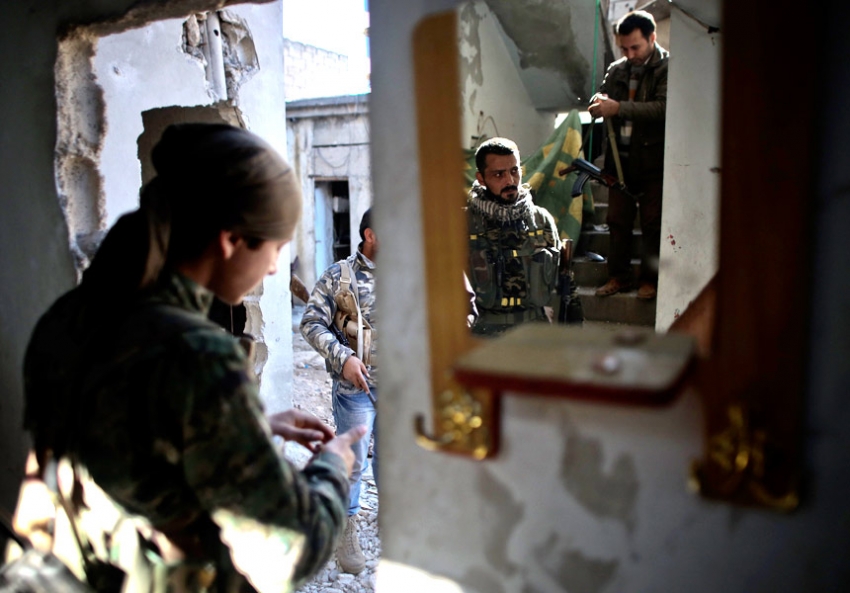
Kurdish fighters in the besieged Syrian city of Kobani prepare to fight against ISIS on November 7. The Kurds are receiving U.S. military aid. (Ahmed Deeb/AFP/Getty Images)

Most U.S. leftists say yes. But voices we rarely hear—Kurds and members of the Syrian opposition—have more ambiguous views.

BY DANNY POSTEL

To consider ending the war, which is what all of us want, without considering what’s at the root of this entire monstrosity—which is the Assad regime itself—is unacceptable.

ISIS (or ISIL, or the Islamic State) sent shock waves through the Middle East and beyond in June when it seized Mosul, Iraq’s second-largest city. The organization has now laid claim to a swath of territory “stretching from Baghdad to Aleppo and from Syria’s northern border to the deserts of Iraq in the south,” in the words of Patrick Cockburn, author of The Jihadis Return: ISIS and the New Sunni Uprising.

In August, the United States assembled an international coalition (eventually including more than a dozen countries) to conduct a campaign of air strikes on ISIS positions in Iraq, coordinating with Iraqi and Kurdish Peshmerga forces. Then, in October, the coalition expanded the intervention into Syria, coordinating with Kurdish fighters on the Syrian-Turkish border and Free Syrian army forces.

American progressives have been relatively uniform in opposing the intervention against ISIS. But to most Kurds and many Syrian activists, the intervention is more welcome. Turkish and Syrian Kurds along the border watch the battles against ISIS from hilltops, breaking out in cheers and chanting, “Obama, Obama.” Within the Syrian opposition, one finds a range of perspectives—some support intervention, others oppose it, and many, like the Syrian leftist intellectual Yassin al-Haj Saleh, are torn. In late September Saleh told me,

On the one hand, I would like to see this thuggish gang wiped from the face of the earth. ISIS is a criminal organization that has killed thousands of Syrians and Iraqis while leaving intact another criminal organization—the Assad regime—that is responsible for the deaths of close to 200,000 people. ISIS has destroyed the cause of the Syrian revolution as much as the Assad regime has destroyed our country and society. On the other hand, an attack against ISIS will send a message to many Syrians (and Iraqis and other Arabs) that this intervention isn’t about seeking justice for heinous crimes, but is rather an attack against those who challenged Western powers. This will lead to more resentment against and suspicion of the outside world, which is the very nihilist mood on which ISIS capitalizes and profits.

Some Syrian activists question how committed the Kurds are to toppling the Syrian dictator. The Kurds, for their part, distrust Turkey, which supports the Syrian opposition. These debates and dynamics are mostly unknown to American progressives.

Given that ISIS and the intervention against it directly impact the peoples of the region, it behooves us to know what they have to say about it. So when In These Times asked me to convene a roundtable discussion on the ISIS intervention, I saw it as an opportunity to bridge this gap—to explore some of these contending perspectives and stimulate a conversation between U.S. progressives and some of our Syrian and Kurdish counterparts.

Richard Falk has been one of the leading voices of peace and human rights over the last half century. He was the UN’s Special Rapporteur on Palestinian Human Rights and a member of the Independent International Commission on Kosovo. His blog, Global Justice in the 21st Century, is a constant source of thought-provoking and self-reflective analysis. His essay in The Syria Dilemma, the book I co-edited with Nader Hashemi, is among the most thoughtful and challenging arguments about the Syrian tragedy I have read.

The Kurdish region of Rojava in northern Syria has been likened to the Zapatista autonomous territories of Chiapas and has inspired  international solidarity efforts with its experiment in democratic autonomy . The anarchist writer and activist David Graeber has written a forceful plea to stand with the beleaguered Kurds as they fight for their lives. With Graeber’s help I reached out to Alan Semo, the UK representative of the Kurdish Democratic Union Party (PYD), to get his perspective on the ISIS intervention.

I also deemed it essential to include a Syrian opposition voice in the discussion. There has been and remains deep confusion about the Syrian conflict amongst many leftists. So I reached out to Rime Allaf, who serves on the board of directors of The Day After Project, an international working group of Syrians building toward a democratic transition in Syria. She is a former advisor to the president of the National Coalition of Syrian Revolution and Opposition Forces and former Associate Fellow at London’s Chatham House think tank.

There are few people I hold in higher regard than Rafia Zakaria, a lawyer, board member of Amnesty International USA, columnist for Al Jazeera America and the Pakistani newspaper Dawn, and the author of The Upstairs Wife: An Intimate History of Pakistan (forthcoming in February from Beacon Press). Rafia brings both an international human rights perspective and the painful knowledge of what U.S. military intervention, in the form of drone strikes, has wrought in her part of the world.

Richard, with only one or two exceptions (notably Kosovo), you have opposed U.S. military interventions for the past 50 years. As someone who has opposed those interventions as a champion of self-determination—especially self-determination for formerly colonized peopleswhat do you make of the current U.S. intervention against ISIS? And specifically, the siege of Kobani and the Kurdish resistance against ISIS along the Turkish-Syrian border?

Richard: It’s a tough question. We need to contextualize this a bit further. In my view, there is no basis for the United States to play a constructive role in this region. Its role in Iraq and Syria—much less, Israel, Palestine, Egypt and elsewhere in the region—figures into an overall strategy of dominating the region and supporting highly reactionary forces in the Gulf, particularly Saudi Arabia. The notion that the United States can be a liberating actor by narrowing the focus to one specific battle site isn’t convincing to me. The plight of the Kurds in Kobani and their courage in resisting ISIS poses a tragic predicament that does challenge the kind of anti-interventionism that I feel is justified overall, particularly in the Middle East. But to overcome the presumption against military intervention, especially from the air, one needs very powerful evidence. And one needs a full-fledged diplomatic initiative, which I see lacking so long as Iran continues to be excluded from any effort to resolve the Syrian conflict. Like the drone attacks, the ISIS intervention doesn’t seem designed to actually deal with the problem. Rather, it looks like a projection of U.S. power in the region.

Where do you stand on the intervention, Rafia?

Rafia: I oppose it. Look at what the U.S. has done in South Asia in the past ten years. As someone who has covereddrone attack after drone attack in Pakistan, I can tell you that the dynamics are very similar. When the U.S. began its drone campaign in north and south Waziristan, where the Taliban were headquartered, there was a lot of support from Pashtun tribal leaders, similar in a way to the current situation between the Kurds and ISIS. The narrative was that the drone attacks were empowering the indigenous people of area who were facing incursions from the Taliban. It’s been beyond a miserable failure. The drone attacks have led to the displacement of hundreds of thousands of people. Whenever you have communities that are displaced—and this is precisely what is happening in Syria and Iraq as a result of ISIS incursions and the airstrikes against ISIS—their social mechanisms, their political allegiances, their forms of governance all collapse. Once that happens, those populations are far, far more vulnerable to being recruited by groups like ISIS. Or they become disenchanted with any effort to rebuild or organize. The consequence of intervention is displacement. And the consequence of displacement is further civil war, which is what you have in Pakistan right now.

Syrian activists have expressed a range of views on the intervention against ISIS. Rime, how do you see it?

Rime: I very much share the ambivalence of Yassin al-Haj Saleh. Many of us in the Syrian opposition do. Everything that has happened in Syria was predictable—and indeed was predicted. The rise of these Islamist terror groups…before they became an organized entity calling itself ISIS, they were smaller groups fighting in various areas in Iraq but mostly in Syria, where they had free reign because the only forces fighting them during roughly their first year on the scene [2013] were the Free Syrian Army. The FSA—the bulk of the Syrian armed opposition to the Assad regime—thus found itselffighting two very brutal forces, the Assad regime on one side and these Islamist groups on the other—and those two forces were not fighting each other. This is an essential point. It was inevitable that this would weaken the opposition and strengthen the regime. Because the Assad regime was not attacking this Islamist plague, it was to be expected that these terror groups would gain ground. They had help from al-Qaeda type groups in Iraq. Plus they had the advantage of their enemies [the FSA] being bombed relentlessly by the Syrian regime. So they gained strength.

Let’s be very clear that for the longest time, the Syrian opposition was not asking for a “boots on the ground”-style intervention, or even for a bombing campaign led by the U.S. What was being requested early on was the establishment of humanitarian corridors with the help of a “no-fly-zone” and/or weapons for the FSA to defend liberated areas from the relentless barrel bombing campaign of the regime. Since none of this happened, it was to be expected that these Islamist groups have been able to gain so much ground and find themselves with a weakened opponent in the FSA. Now the Assad regime doesn’t even need to worry about ISIS because it’s got the U.S. fighting [ISIS].

Alan, where does the Kurdish Democratic Union Party (PYD), which you represent, stand on the U.S. intervention against ISIS? The PYD has opposed external military intervention in the Syrian conflict, but hasn’t the Kurdish struggle against ISIS benefited from the coalition airstrikes?

Alan: I think the American-led international intervention against ISIS has been efficient. The Americans realized that the expansion of ISIS is serious and threatens the region—it has to be stopped and eliminated. The U.S. has been relying on air strikes alone, and they know they need troops on the ground. The forces on the ground fighting ISIS in northern Iraq and now in Kobani, in northern Syria, are Kurdish troops. They have been defending themselves very efficiently against ISIS, which is a real threat to the region. So I think eliminating this threat is the right step, both for the Syrian people and for regional security and stability.

Rime: From January roughly until the summer, what happened is that ISIS was allowed to spread its terror throughout the Jazira region of Syria without any intervention of any kind from outside Syria—or within Syria. The only people fighting them were the Free Syrian Army—alone, without ammunition. So I agree with Alan that the intervention is proving useful, but only up to a point. It is proving useful in a very limited area, and—this is critical—it is not tackling the origin of this plague, which is the Assad regime.

Alan: Now, Kurdish forces are working together with some sections of the Free Syrian Army and other forces in northern Syria.

The Centre for Humanitarian Dialogue, a Geneva-based organization, has recently put forward a proposal to end the Syrian conflict that includes the creation of a Peace and Reconstruction Authority that would implement local ceasefire agreements and serve as an interim governing authority. The report also suggests that once a deal has been struck, the Assad regime and the Syrian opposition could focus their energies on fighting ISIS. What do you make of this idea?

Rime: It’s an absolutely obscene proposition because it takes the position that anything is better than ISIS, whereas most Syrians view ISIS and the Assad regime as being on an equal level of savagery. Many Syrians will tell you the Assad regime is actually worse than ISIS and has killed far more people.

To consider ending the war, which is what all of us want, without considering what’s at the root of this entire monstrosity—which is the Assad regime itself—is unacceptable. To propose that in order to end ISIS we have no choice but to work with Assad is not a solution at all.

Alan: At the end of the day, we have to end Syria’s war. To end the war requires a solution on three levels: the internal balance on the ground inside Syria; the regional circumstances; and the international level. I believe the will of the Syrian people has been hijacked by regional powers and by global powers—America and Russia. But the Syrian people have to determine their own destiny. The Syrian opposition has to be united. And they have to have a clear vision of how they can end this war. I do not agree with Rime’s statement that you have to fight the regime before fighting ISIS.

Rime: I did not say that. I said that you can’t just get rid of ISIS. You cannot just get rid of Assad. You have to get rid of both.

Alan: The Syrian people are defending themselves. They are fighting against ISIS. The people of Kobani have been protecting themselves for two months with their limited resources.

Rime: But the coalition’s airstrikes are helping them. For three years Assad has been dropping barrel bombs on civilians and yet no help has come from anybody. But now you have the coalition bombing ISIS, which helps the Kurds in Kobani to defend themselves.

Richard, what do you think of the idea of a Peace and Reconstruction Authority?

Richard: I think that a proposal of this sort is somewhat suspect given both how it originated and what it’s proposing, because it’s really a plea to, in effect, enlarge the anti-ISIS military coalition. I agree with what Rafia said earlier, that bombing only contributes to destabilizing the whole underlying reality. And we still have to address why Iran hasn’t been brought into the process as a major political actor that needs to participate in any kind of diplomacy to resolve the Syrian crisis.

I think there are desirable elements [in the Centre for Humanitarian Dialogue proposal], such as trying to respect the ceasefire, but it overlooks the complexities and contradictions that have emerged in the Syrian conflict. To try to solve the problems of the Middle East from above is very unlikely to have constructive effects.

Finally, there’s an absence of political imagination. The American approach has become so militarized over such a long period of time that it’s just about incapable of thinking outside of the military box. It therefore keeps reinventing a military solution to essentially political problems—and is undeterred by a record of failure because it’s the only way it knows how to project its power. The U.S. is so addicted to hard-power ways of behaving in the world. It has very little credibility in my view—even when you narrow the focus and it looks like it’s better to help those beleaguered in Kobani than to ignore them. That’s why I say it’s a tragic predicament: Every alternative is repugnant under these conditions. I’ve always felt that when all alternatives are repugnant the one point of moral clarity is, don’t add to the killing. And, echoing what Rafia said, don’t add to the displacement, which is subverting any possibility of benevolent political reconstruction.

Danny Postel is Associate Director of the Center for Middle East Studies at the University of Denver and co-hosts its series of video interviews with leading scholars. He is the author of Reading “Legitimation Crisis” in Tehran  and co-editor of The People Reloaded: The Green Movement and the Struggle for Iran’s Future and The Syria Dilemma, which was named one of the best books of 2013 in The Progressive. He is a co-editor of PULSE and blogs for Truthout, Critical Inquiry and the Huffington Post. He was a member of Chicago’s No War on Iran coalition, communications coordinator forInterfaith Worker Justice, and communications specialist for Stand Up! Chicago, a coalition of labor unions and grassroots community organizations.

source via PULSE

Syrian Bomb Plot Marked Deadly Turn in Civil War

New Revelations Suggest Killing of Bashar al-Assad’s Brother-in-Law Was Inside Job

A poster of Syrian President Bashar al-Assad in the city of Homs, where the early confrontations between protesters and regime authorities progressed into civil war.ENLARGE
A poster of Syrian President Bashar al-Assad in the city of Homs, where the early confrontations between protesters and regime authorities progressed into civil war. AGENCE FRANCE-PRESSE/GETTY IMAGES

AL-QARDAHA, Syria—On the fourth day of a rebel assault on President Bashar al-Assad ’s seat of power in Damascus, an explosion tore through offices of the National Security Bureau, killing the president’s brother-in-law and three other senior officials.

Rebel groups claimed credit for the audacious plot, and Syrian opposition groups declared it was the beginning of the end for the regime. In Washington, the Obama administration ordered a task force from the Pentagon, State and Treasury to draw up plans for a post-Assad Syria, said Robert Ford, the U.S. ambassador to Syria at the time.

The July 2012 bombing indeed marked a turning point in Syria’s conflict. But rather than the downfall of Mr. Assad, it ushered in a new, more deadly phase of Syria’s civil war that allowed him to cling to power. Any regime voices still open to accommodating the opposition went silent, and, within a year, pro-Assad forces deployed chemical weapons against rebels and civilians.

Now, new revelations point to a startling theory about the bombing that killed Assef Shawkat, an army general who was Mr. Assad’s brother-in-law and the deputy defense minister: It was an inside job.

Two dozen people, including past and current regime officials, opposition leaders, activists and rebels, and politicians in neighboring countries with ties to Mr. Assad told The Wall Street Journal the bombing grew out of a split between the Assad family and its hard-line allies on one side, and officials seeking negotiations with opposition groups on the other.

Acceptance of the theory by such a broad cross-section of Syrians highlights the ruthless reputation Mr. Assad has cemented since the conflict began more than three years ago. It also shows the dynamic of the president’s inner circle as it struggled to keep a grip on power.

Mr. Assad’s media office rejected requests for an interview with the president. Maj. Gen. Ali Mamlouk and Maj. Gen. Deeb Zeitoun, two of the regime’s top security officials, declined separate requests for comment.

Former Syrian army general Manaf Tlass believes the regime was connected with the bombing. Mr. Tlass defected two weeks before Mr. Shawkat was killed—after guards found six explosive devices planted outside Mr. Tlass’s office on a military base in Damascus. He accused the regime of wanting to kill him, too.

Mr. Tlass said he and Mr. Shawkat were among those calling for talks with both peaceful and armed regime opponents, a position contrary to Mr. Assad and his intelligence and security agency chiefs, who sought to crush the insurgency.

“Bashar never opted at any time for serious and credible reforms, but instead chose to destroy the country rather than lose power,” said Mr. Tlass, who is living in Paris. “He sold Syria to the Iranians.”

The attack opened the door for Iran, Mr. Assad’s principal regional ally, and Hezbollah, its proxy militia in Lebanon, to play a greater role in defending the regime, according to members of Syria’s security forces and pro-regime militias. Within weeks, foreign Shiite militiamen flocked to Syria. The fighters joined homegrown militias trained by Iran and Hezbollah to help prop up the overstretched Syrian army.

These fighters took the lead in the regime’s recapture of rebel territory, helping push the death toll from less than 20,000 at the time to more than 190,000 as of August, according to the United Nations. Millions more Syrians have fled their homes amid the destruction.

Iran’s embassy in Damascus and a spokesman for Hezbollah in Beirut refused interviews or comment.

Mr. Ford, who now works with the Middle East Institute, a nonpartisan think tank in Washington, said top members of the Syrian opposition told him rebels weren’t responsible for the bombing but believed the regime was. “I’ve never seen convincing evidence that it was an inside job,” he said, “but the allegations were widespread.”

A leading Syrian opposition activist, who had direct ties with rebel groups and was in Damascus the day of the bombing, said it would have been impossible for rebels at the time to carry out such an attack.

“If you asked me then, I would have lied to you and told you, ‘Our heroic rebels did it.’ But now I can tell you, ‘No, we were amateurs back then,’ ” said the activist, now based in Turkey. The bombing boosted opposition morale after government reports credited the rebels, he said. It also spurred more Alawites, members of Mr. Assad’s Shiite-linked minority sect who opposed the Sunni-led revolt, to rally around the regime.

Growing involvement by Shiite-dominated Iran and Hezbollah boosted support from Sunni Arab states and private donors to more militant rebel groups, including Islamic State, said Western officials and analysts.

Today, many Syrians—and the U.S. and its allies—face a choice between the Assad regime or the militants of Islamic State, which has turned large parts of Syria and neighboring Iraq into a magnet for foreign jihadists.

Long before Syria’s conflict began in the spring of 2011, Mr. Tlass and Mr. Assad—military academy classmates—were seen as a new breed of Syrian leaders: young, modern and open to reforms.

“Bashar started making reformist steps between 1998 and 2000, even before becoming president,” Mr. Tlass said. “I was close to him. People were hopeful and thought he was capable of changing things.”

Even the U.S. thought it could do business with Mr. Assad, reappointing an ambassador in Damascus in 2009.

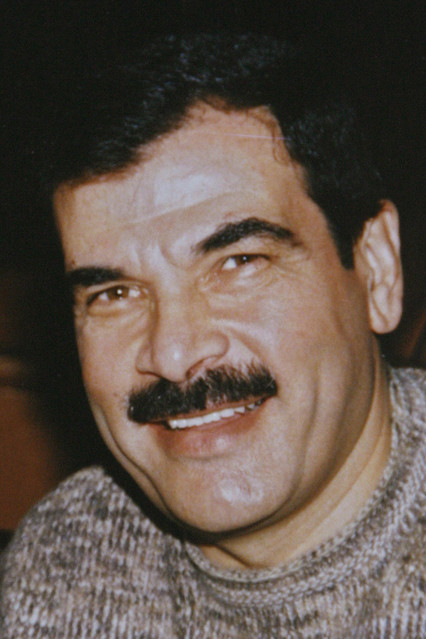
Assef Shawkat, an army general and the brother-in-law of Syrian President Bashar al-Assad, who was killed in a July 2012 explosion in offices of the National Security Bureau in Damascus.
Assef Shawkat, an army general and the brother-in-law of Syrian President Bashar al-Assad, who was killed in a July 2012 explosion in offices of the National Security Bureau in Damascus. REUTERS

The killing of two Syrian protesters by regime forces on March 18, 2011, in the city of Deraa, changed everything. It shattered a short period of peaceful marches by mostly Sunni crowds calling for Mr. Assad’s ouster.

Two days later, Mr. Tlass said, he got a call from Mr. Assad asking for advice. Mr. Tlass said he suggested Mr. Assad remove the governor of Deraa, release anyone detained in the demonstrations, arrest the local security chief and make amends for the killings with a visit to the city.

“I told him our society is tribal and will value your conciliatory gesture,” Mr. Tlass recalled. “He told me, ‘OK.’ ”

But as more protesters poured into the streets, more were killed. “It’s no secret that Syria is facing today a grand conspiracy whose threads extend from inside the homeland to far and near countries,” Mr. Assad said in a speech to parliament on March 30, 2011.

At the time, Mr. Tlass commanded a 3,500-strong unit within the Republican Guard that was charged with protecting the president and the capital. Mr. Tlass said about 300 of his men were sent to the city of Douma to help with crowd control as thousands of people took to the streets.

He said they were pushed aside by forces reporting to intelligence chief Hafez Makhlouf —a maternal cousin of Mr. Assad—who shot and killed about a dozen protesters in April 2011. Mr. Makhlouf couldn’t be reached for comment.

Mr. Tlass said some of his men were executed for refusing to shoot protesters. One of his best officers, he said, returned from Douma and pleaded to be relieved of the assignment.

“I told him, ‘Be patient, the president promised that things will be fixed within three weeks,’ ” Mr. Tlass said. “The next day, he committed suicide.”

Syria’s security and intelligence agencies believed they could rely on repressive measures that had worked for decades, according to former regime officials and Western diplomats.

Haytham Manaa, a Syrian opposition leader who has spent much of his life in exile in France, said the regime was surprised when people overcame fears and continued the street protests, which were inspired in part by the Arab Spring uprisings in Tunisia, Egypt and Libya.

Mr. Tlass said he retained his official position but was sidelined by the regime after he raised objections to shooting demonstrators and called for talks with community leaders involved in the protests. That view, he said, put him at odds with hard-liners close to Mr. Assad.

In May 2011, Mr. Tlass said, he had a last meeting with the president. “I told him, ‘I am your friend and I advised you not to choose the military solution,’ ” Mr. Tlass recalled. “ ‘Go for the political one, it’s more inclusive.’ He answered, ‘You are too soft.’ ”

Mr. Assad’s vice president at the time, Farouq al-Sharaa, one of the country’s most seasoned politicians, fell next. He was pushing for dialogue with opposition groups, his relatives said, and was put under house arrest shortly after he chaired a national dialogue conference in Damascus in early July.

Walid Jumblatt, a senior Lebanese political leader, said he last met with Mr. Assad in June 2011: “He told me at the end, ‘I don’t want people to love me, I want people to fear me.’ ”

Regime loyalists, meanwhile, took up the slogan: “Assad or nobody. Assad or we burn the country.”

In June 2011, some activists tried to keep their opposition movement peaceful amid the growing sectarian violence between the mostly Sunni rebels and regime forces, largely Alawite.

Mohammad-Mounir al-Faqir and fellow activists bought 5,000 ping pong balls that they covered with such slogans as, “Assad, we want freedom whether you like it or not,” Mr. Faqir said. They released the balls from a spot uphill from Mr. Assad’s residence and filmed guards scurrying to collect them.

By fall, rebels in Homs took control of neighborhoods by force. For the regime, the rebel advances threatened important roads connecting Damascus with Syria’s only seaports.

The casket bearing the remains of Hafez al-Assad, the founder of the modern Syrian regime and the father of the current president, inside a mausoleum in al-Qardaha, Syria.
The casket bearing the remains of Hafez al-Assad, the founder of the modern Syrian regime and the father of the current president, inside a mausoleum in al-Qardaha, Syria. SAM DAGHER/THE WALL STREET JOURNAL

In December 2011, Mr. Shawkat, the brother-in-law later slain in the bombing, and two security chiefs visited Homs, Syria’s third-largest city, to meet with opposition activists, businessmen and religious and community leaders.

Mr. Shawkat and the others offered a cease-fire plan that would have committed the regime to end opposition arrests and the shelling of neighborhoods in return for a pledge by rebels to halt attacks on regime checkpoints, said people who were there.

One opposition activist said Mr. Shawkat seemed to be the regime representative most interested in the discussion. One of the businessmen there agreed.

“I told them, ‘You are turning people into your enemies, what’s your interest in that?’ ” the businessman said. “I was interrupted by an angry official but Assef [Shawkat] snapped at him and told him, ‘Calm down. Let him finish.’ ”

No deal was reached. Conciliatory gestures approved by Mr. Shawkat, such as allowing ambulances to pick up the dead and wounded, were blocked by regime hard-liners, according to activists and community leaders.

Mr. Tlass, the defected general, said Mr. Shawkat’s power diminished shortly after his return from Homs, as security and intelligence chiefs asserted greater control. “He insisted on retaining his functions and powers,” Mr. Tlass said, “and here the real clash began.”

Mr. Tlass and several people with knowledge of the matter said Mr. Shawkat posed a threat to Mr. Assad’s rule. Mr. Shawkat, who was married to Mr. Assad’s sister, had previously headed Military Intelligence—one of Syria’s most feared institutions—and commanded a loyal group of officers.

Mr. Shawkat moved within the circles of power that surround Mr. Assad. The first circles include Mr. Assad’s wife and mother, his army commander brother, Maher, and maternal cousins, the Makhloufs, Mr. Tlass said. The next circle includes the chiefs of security and intelligence services.

“In my opinion, they got rid of him. They were scared of him,” Mr. Jumblatt, the Lebanese politician, said of Mr. Shawkat. Others, including Mr. Tlass and people who know members of the Assad family, said Mr. Shawkat was seen as a potential threat to Mr. Assad.

Two months before the July 18, 2012, bombing, Mr. Tlass said, there was an unsuccessful plot to kill Mr. Shawkat with a poisoned takeout lunch of kebabs and hummus in Damascus.

The bombing marked a shift by Hezbollah and Iran—when saving the Assad regime became their top priority, according to Iraqi and Lebanese officials close to both sides.

On the day Mr. Shawkat was killed, Maj. Gen. Qassim Suleimani, commander of Iran’s elite Qods Force, was in Damascus, Mr. Tlass said. The Qods Force is a unit of Iran’s Revolutionary Guards responsible for operations abroad, particularly in Lebanon, Iraq and Syria.

Also that day, Hassan Nasrallah, commander of Iran’s main regional proxy force Hezbollah, spoke to supporters in a Beirut suburb to mark the anniversary of the 2006 war with Israel.

Mr. Nasrallah said Mr. Assad and his regime were indispensable for the survival of Hezbollah and other Iran-backed movements, including Hamas. Mr. Nasrallah said rockets fired at Israel in the war were Syrian.

A Syrian militia leader said in an interview last year that Syria’s intelligence services worked with Hezbollah and Iran’s Qods Force to raise fears that Sunni militants planned to attack holy Shiite shrines in Syria—an effort to attract more Shiites across the region to fight alongside Assad regime forces.

With the help of foreign fighters, the regime “succeeded in giving the impression of a strong and cohesive army,” said Ezzat al-Shabandar, an Iraqi Shiite politician with close ties to Iranian and Syrian regime officials.

The regime also began using social media to shift popular views toward the idea that opposition groups and rebels had joined savage Islamic extremists. Mr. Assad in speeches and interviews embraced the idea that he was an indispensable leader who must use violence to rescue Syria, a message that has echoed down the chain of command.

“I always tell Sunnis, ‘Your only protector is Bashar al-Assad because he’s restraining us and not letting us do more,’ ” said Col. Jamal Younes, an Alawite army officer.

Militancy on the opposition side also rose dramatically. By the spring of 2013, such extremist groups as Islamic State and the al Qaeda-linked Nusra Front were displacing both secular and homegrown Islamist rebel groups in Syria.

Islamic militants in March seized the predominantly Armenian-Christian resort town of Kasab, located in the mountains of Mr. Assad’s home province near the border with Turkey in western Syria.

Regime forces drove them out three months later, leaving homes and churches ransacked.

“We are victims of both sides and this is why I want to leave,” said Armen Georgekian, an Armenian Christian and the town’s only shopkeeper. He recalled visits by Mr. Assad before the conflict and said he and his group bought ice cream cones from his shop.

“He can survive,” Mr. Georgekian said, “but he can’t win.”

Down the coast is Mr. Assad’s hometown of al-Qardaha, which has been largely untouched by the war. A domed mausoleum stands on a hill where a dozen workers in late summer trimmed hedges and pulled weeds in its garden.

Inside, two guards in suits stood motionless next to a casket, covered in a green velvet cloth, that holds the remains of Hafez al-Assad, the Syrian president’s father and the founder of the Assad regime.

Around the casket in the black-marble hall are the tombs of two of Bashar al-Assad’s brothers, Majd and Bassel, who had been groomed by his father to take over power. Bassel al-Assad ’s death in a 1994 car accident opened the way for his younger brother, Bashar.

In Qardaha’s central market, shops were fully stocked and farmers from nearby villages hawked fruits, vegetables and freshly picked tobacco leaves.

A statue of Hafez al-Assad, surrounded by four lions symbolizing his four sons, stands in the main square.

Posters of Bashar al-Assad were plastered on shop windows. One showed him next to his father, who had a halo above his head. “Rest in peace in the heavens above, our master,” the caption said. “You should be proud of Bashar.”

source   source

United Nations’ Food Program Halts Aid to Syrian Refugees

World Food Programme Cites Lack of Funding

A Syrian Kurdish woman walks in a refugee camp in the town of Suruc, Sanliurfa province in Turkey, in October.
A Syrian Kurdish woman walks in a refugee camp in the town of Suruc, Sanliurfa province in Turkey, in October. AGENCE FRANCE-PRESSE/GETTY IMAGES

The United Nations World Food Programme on Monday said it would halt its aid to 1.7 million Syrian refugees on the cusp of winter due to lack of funding.

In a statement on their website, the WFP said the consequences of the decision will be “devastating” for the refugees and their host countries.

“A suspension of WFP food assistance will endanger the health and safety of these refugees and will potentially cause further tensions, instability and insecurity in the neighboring host countries,” WFP Executive Director Ertharin Cousin said in the statement.

The decision will impact refugees in Jordan, Lebanon, Turkey, Iraq and Egypt, and comes at a time when temperatures have begun to drop in the region, raising concerns around how refugees will be able to endure the potentially harsh winter.

Many Syrian refugees, especially in Lebanon, where the majority of refugees reside, live in makeshift tents and camps and suffer from a lack of fuel, clean water, proper sanitation and warm clothing.

The U.N. agency warned in September it was running out of funds and that cutbacks were inevitable if additional support wasn’t received.

The inability to secure the $64 million needed for the program to continue also ends the WFP’s electronic voucher program. The e-vouchers allowed refugee families access to a prepaid credit card that could be used in participating local stores. The program had contributed $800 million to the economies of the host countries, the statement said.

If sufficient financial support is secured, the program will resume immediately, the statement said.

As the Syrian crisis nears the end of its fourth year, the WFP isn’t the only U.N. agency struggling to meet its funding appeals, said Lama Fakih, Syria and Lebanon researcher at Human Rights Watch.

Of the $3.7 billion request made in June 2014 by the U.N. High Commissioner for Refugees, Syria’s neighboring countries and other humanitarian agencies, only 51% of the funds have been received thus far.

“As the number of Syrian refugees increases, 3.2 million now, the needs increase, and despite international attention diverted to other crises, Syrians are still very much in need,” said Lama Fakih, Syria and Lebanon researcher at Human Rights Watch.

There are several reasons contributing to the lack of sufficient aid to Syrian refugees, most notably the various humanitarian emergencies happening simultaneously around the world that have diverted the world’s attention and wallets away from Syria.

According to Joelle Eid, the WFP’s communication officer stationed in Amman, Jordan, the need for humanitarian aid has skyrocketed this year. The WFP is currently dealing with five high priority emergencies around the world, including the Ebola crisis, Eid said.

“If we don’t urgently get this assistance, get the $64 million for December alone, people will simply go hungry,” she added.

source

Black Holes and Media Missionaries

A boy walking in a street in Bab Amr, Homs. Daniels and 3 other journalists were holed up for days is behind the building at rightA boy walking in a street in Bab Amr, Homs. Daniels and 3 other journalists were holed up for days is behind the building at right. Photo: Freedom House. This image is licensed under Creative Commons License.

The lights are going off in Syria. Peter Kassig is only the most recent witness that succumbed to the darkness. David Haines, Steve Satloff and James Foley went before him. They had all gone there to assist and bear witness. A measure of the Islamic State’s (IS) monstrosity is the nobility of the people it has killed. International media has rightly condemned these horrific murders.

For IS murder is a political act. But is also a performance–a spectacle as a means to amplify its message. The ritual act of murder, especially of a westerner, is certain to receive media coverage. IS uses this to rudely force attention.

The emergence of IS has been a godsend for the regime. IS is the monster that the regime always claimed it was fighting. Ideologues who echoed and amplified this regime line over the years have proclaimed IS the true face of the opposition.  Left unmentioned is the fact that until recently IS fought its biggest battles against the Syrian opposition. Indeed, earlier in the year, rebels had driven it out of Idlib, Deir Ezzor, much of Aleppo and areas around Damascus. It was only after its successes in Iraq and its newly acquired arsenal that it returned to Syria in triumph. But for many western ideologues, IS is part of an undifferentiated radical opposition to the secular regime of Bashar al Assad.

In fact, IS has a lot more in common with the regime. It is a totalitarian force that uses terror as a means of control. The regime kills but is loath to take responsibility; IS revels in murder. The regime kills more, but IS better amplifies its acts. The regime’s audience is domestic; IS has transnational ambitions. Significantly, where IS proudly rejects the international order, the regime presents itself as its indispensable, if ruthless guardian. For the media, IS is a more exciting story.

The media is selective elsewhere too. Foley and Satloff aren’t the only journalists IS has killed: there have been many more—Iraqis and Syrians—whose names remain unknown to the world. And IS isn’t the only force in Syria killing journalists and aid workers: Bashar al Assad’s regime has been doing it far longer.

The Syrian nightmare has unfolded with such pace and intensity that each day’s horror displaces the one preceding it. With IS dominating the news it might be hard for audiences to remember that the killing of western journalists in Syria is as old as the conflict itself. It began long before any jihadi had alighted on Syrian soil.

Years before anyone had heard the name IS, the regime killed Marie Colvin of theSunday Times along with the French photographer Rémi Ochlik when, in the first major escalation of the war, it used artillery on the Baba Amr district of Homs. A month before that it had killed Gilles Jacquier of France 2.

Since the beginning, Damascus has tried to control the narrative by making it too dangerous for journalists to report from Syria—unless they embedded with the regime. Some have embraced this arrangement; unwilling to compromise their objectivity, others have accepted the perils of independent reporting. But most have stayed clear, relying instead on stringers, activists, or citizen journalists.

Leaving aside the courage of the few who have risked much to report from outside regime-controlled Syria, reporting on the conflict has been gernally dismal. While some have used new technologies, including Skype, Youtube, Twitter, to gather material for reportage; others have forgone such exertions to deduce reality from pre-existing notions, ignoring the specificities of the situation in favour of ideological formulas that are impervious to time and place.

With multiplying dangers and fewer reporters willing to enter the killing fields of Syria, it is the ideological types that have come to dominate reporting. This type has also found it easier to embed with the regime. They visit Syria not in search of stories but bring stories to Syria in search of validation.

Beyond the ideological type, however, there is also the hack. If the ideological types are defined by their dogmas, the hacks are defined by procedures. All journalists aspire to be objective; and objectivity for most journalists is encoded in certain practices. To be objective is to be fair, impartial and balanced. But fairness and impartiality are harder to demonstrate; balance is measurable. For this reason, hack reporters use balance as an indicator of their objectivity. Balance is useful in many cases. But where there is a severe imbalance in the underlying situation, imposing balance distorts the picture.

In Syria, the hack reporter’s need for balance has created a misleading picture of the conflict. One often hears the bien pensant liberal lament how “both sides” in the conflict are just as bad as the other. But “both sides” in the conflict are not equal. One side is a state with its hierarchies, chains of command and coercive apparatus intact; the other side is a diffuse, uncoordinated and disorganized opposition. The crimes of the former reflect policy; those of the latter only reflect on the group or individual perpetrating them. The regime’s crimes have been sustained and wholesale; the crimes of the opposition are retail and sporadic.

That is not to excuse any crime. All criminals—rebel or regime—must face justice. But one must be wary of false notions of balance that undermine a sense of proportion.

On September 11, 2013, Paulo Sérgio Pinheiro, special investigator for the UN Human Rights Council, concluded that before the August 2013 chemical massacre, the Assad regime had perpetrated at least eight major massacres while the rebels had been responsible for one. The rise and extreme brutality of IS hasn’t changed this equation. In a report concluded a year later, Pineheiro noted that the despite IS’s extreme violence, the Assad regime “remains responsible for the majority of the civilian casualties, killing and maiming scores of civilians daily”.

This isn’t all that surprising if one considers that the Assad regime has a monopoly on airpower, armour, heavy artillery, ballistic missiles, and unconventional weapons—and it hasn’t hesitated to use them against civilians.

But monstrous as the regime’s actions are, it has always managed to find people willing to give it the benefit of doubts. Refracted through ideology, each of the regime’s ruthless acts of repression becomes a strike against western imperialism or Islamic fundamentalism (the contradictions between the two notwithstanding). This is achieved by zooming out from actual events to an imagined context: Assad is not at war with his own people, we are made to understand, but against the proxies of an imperial force trying to undermine the “axis of resistance” of which he is a part.

Only such creative reimagining could allow a veteran journalist like Charles Glass to present Assad as the underdog and his most heinous crime—last year’s chemical attack on Ghouta—as something positive. Consider these words:

“The introduction of chemical weapons, which have been alleged to have been used not only by the government but by the rebels as well, was only the most dramatic escalation by combatants who seek nothing short of the annihilation of the other side”

After using the benign “introduction” to describe a major escalation, Glass immediately retreats into the passive voice with “alleged to have been used” which doesn’t require him to identify the alleger. The UN and OPCW have alleged no such thing. The regime perhaps?

But things get worse: Glass next tells us that the attack “unexpectedly led to hope for a way out”, because the Russians compelled Assad to give up his chemical arsenal. Glass then goes on to laud Russian which “delivered President Assad” at Geneva, but condemns the US for being “slow to persuade the militias it funds” along with its allies.

By this reckoning when the Syrian regime uses chemical weapons against its people, it is delivering hope; the real aggressor, it turns out, is the US.

Glass is not even the worst of them. The Independent’s celebrated foreign correspondent Robert Fisk, who has also chosen to embed with the regime,reported shortly after the chemical attack, that “information is now circulating in the city”—furnished by the Russians and corroborated by “a former Special Forces officer” operating with the Syrian Army’s 4th Division, who is “considered a reliable source” (by whom?)—that Assad wasn’t responsible for the attack. Fisk’s reliable source—the regime—tells him that it was indeed the rebels that were responsible for the attack.

Fisk’s credulity is matched by his ethics. In August 2012, after a massacre in Daraya had left between 400-500 people, Fisk rode a Syrian Army armoured personnel carrier into the city to interview survivors and concluded that it was “armed insurgents rather than Syrian troops” that were responsible for the massacre. It somehow did not occur to this veteran journalist that people might not be very forthcoming being interviewed by a journalist “in the company of armed Syrian forces”. Indeed, Human Rights Watch came to very different conclusions after its investigation into the massacre. And when the veteran war correspondentJanine di Giovanni visited the town unaccompanied by regime troops, she received detailed testimony on how the Syrian military had carried out the massacre.

Patrick Cockburn, Fisk’s colleague at The Independent, is another veteran correspondent, a winner of many awards. His book, The Jihadi’s Return, is enjoying great success. For Cockburn, IS  has little to do with the Syrian regime; it is a by-product of the West and its Gulf allies’s decision to support an uprising against Assad. Cockburn finds it absurd that the West should try to strengthen the Iraqi government against IS while simultaneously trying to weaken the Syrian one. For Cockburn the Syrian regime is the only force capable of confronting IS. More controversially, he has portrayed the Free Syria Army as being in cahoots with IS, attributing this incendiary claim to an “intelligence officer from a Middle Eastern country neighbouring Syria”. (Note that this is the only instance in which Cockburn doesn’t reveal the name of the country. His most frequent source is the intelligence service of Iraq—Assad’s closest ally).

Cockburn’s problems go beyond sourcing. Like Fisk, he also takes liberties with facts.

On page 76 of his book, he writes: “I witnessed JAN forces storm a housing complex by advancing through a drainage pipe which came out behind government lines, where they proceeded to kill Alawites and Christians.”

If he witnessed this, then it would be major scoop. Since other than the regime, the only source to make this claim was the Russian state broadcaster RT. However, RT had used fake pictures to support its claim. Human Rights Watch and Amnesty International have found no evidence of this alleged massacre.

However, when one looks at Cockburn’s original report on the incident in his January 28, 2014 column for The Independent, he attributes the story about rebels arriving through drainage pipes to “a Syrian soldier, who gave his name as Abu Ali”. In that version, Cockburn wasn’t a witness.

By far the most egregious incident of journalistic malpractice comes from one of the most celebrated names in journalism: the Pulitzer Prize-winner . In two frontpage articles for the venerable London Review of Books, he claimed that it was the rebels rather than regime that carried out August 2013’s chemical massacre. Hersh attributed this claim to an unnamed “former intelligence official”. Hersh’s theory was contradicted by extant data collected by the UN and OPCW (as I have shown in an extended investigation for the Los Angeles Review of Books). But the story that Hersh was retailing had already been circulating on the internet. It’s authors were a group of former intelligence officials, some of whom are Hersh’s frequent sources. Their main claims were attributed thus:

There is a growing body of evidence from numerous sources in the Middle East — mostly affiliated with the Syrian opposition and its supporters — providing a strong circumstantial case that the August 21 chemical incident was a pre-planned provocation by the Syrian opposition and its Saudi and Turkish supporters.

The date was September 6. But on September 1, the Canadian conspiracy site Globalresearch.ca published an article by one Yossef Bodansky implicating the Obama administration in the chemical attack. It began thus:

There is a growing volume of new evidence from numerous sources in the Middle East — mostly affiliated with the Syrian opposition and its sponsors and supporters — which makes a very strong case, based on solid circumstantial evidence, that the August 21, 2013, chemical strike in the Damascus suburbs was indeed a pre-meditated provocation by the Syrian opposition.

The intelligence officials had plagiarized. Their claim was the figment of a conspiracist’s imagination.

Syria has been a deadly conflict for journalists – it has claimed the lives of 70 so far. Few journalists are willing to venture there any longer—except as guests of the regime.  Those who have made this compromise in turn have acquired influence despite the compromised nature of the journalism that they are producing.  In turn they are shaping public opinion and even policy. We have to be wary of those who see Syria as an opportunity to settle old ideological scores.

An abridged version was first published in “die tageszeitung” on November 25, 2014

source

ISIS is Deadly and Bashar even more

Human Rights Watch has been working on Syria for years. This video features two of Human Rights Watch’s investigations in 2013, including the al-Bayda massacre and the Ghouta attacks.

Bashar as helpless plumber

In Syria, Doctors Become the Victims


By LEONARD S. RUBENSTEIN and M. ZAHER SAHLOULNOV. 19, 2014

Aleppo, Syria, Nov. 6. CreditFadi Al-Halabi/Agence France-Presse — Getty Image


Continue reading the main story

“Working in a field hospital is like death,” a surgeon told us two weeks ago in Turkey, where more than two dozen Syrian doctors and other health workers had come for training. As if treating victims of the Syrian Army’s weapon of choice, the barrel bomb, wasn’t enough, they themselves were often victims of those same terrible devices.

International law is supposed to protect health workers treating anyone who is sick or wounded. Not in Syria: There, along with bakeries and schools, one of the most dangerous places to be is in a hospital or an ambulance. According to Physicians for Human Rights, more than 560 medical personnel have been killed and 155 medical facilities have been attacked since the conflict began, though based on our interviews these numbers are understated.

From the start of the war, the regime of Bashar al-Assad has attacked civilians and obstructed humanitarian relief, including vaccinations for children. It has cut off electricity and clean water to areas controlled by the opposition, punished health workers treating protesters and opposition fighters, and deployed chemical weapons against defenseless fellow Syrians.

But things have gotten worse over the past year. The Assad regime has descended to an unprecedented level of barbarism, escalating its use of air power against enormous numbers of civilians. The number of injured, according to the World Health Organization, has risen to 25,000 people per month.

The centerpiece of the new strategy has been the barrel bomb, an oil drum filled with explosives, bolts, hardware and scrap metal, usually dropped from a helicopter. The bombs explode with terrific force and breadth, amputating limbs and driving shrapnel throughout the body. One doctor we interviewed was still horrified by the indelible image of a mother and daughter whose bodies were blown apart while their hands remained clasped together.

In response to such barbarism, and in defiance of the new strategy, local doctors, supported by a few daring nongovernmental organizations, have set up field hospitals in factories, farms, houses, cultural centers, caves and even chicken coops to provide surgery and other care to the injured. Humanitarian organizations are providing supplies and supporting salaries.

The regime has in turn embarked on a brutal campaign to destroy the hospitals and kill their medical staffs. It is using those same barrel bombs and missiles against field hospitals and dozens of other medical outposts, as well as ambulances, in order to deter people from seeking care. On some occasions, when rescue crews arrive at the scene of an attack on a crowded location like a bakery or school, more barrel bombs are dropped to maximize the carnage.

When the conflict began, the regime decreed that medical care to any area controlled by the opposition, which included demonstrators as well as armed opponents, was a criminal offense — a position that violated the Geneva Conventions’ declaration that medical personnel and facilities are off-limits. Of the 25 medical staff members we interviewed, six had been arrested and jailed for allegedly providing such care. Now the regime is targeting anyone giving medical care in opposition-run areas.

The attacks have driven most physicians out of Syria. In Aleppo, the largest city in the country, only 13 surgeons remain. And despite efforts of humanitarian groups to supply them with essential supplies and equipment, medical personnel must cope with severe shortages.

Doctors and nurses also suffer profoundly, strained by long working days, the horror of the injuries, the impossibly difficult triage decisions forced by lack of resources, and constant danger. One doctor told us that if everyone survived a barrel bombing they did the Dabke, an Arabic dance, in celebration.

When we asked the doctors what kind of support they needed, though, they didn’t cite the need for more staff, equipment, rest or psychological support. They asked for one thing: Stop the bombs from raining down so they can treat their patients without fear of death.

The United States has the capacity to do that. It can impose a humanitarian buffer zone in northern and southern Syria to allow health care workers to save lives, children to get vaccinated and go to school, refugees to resettle, and relief organizations to do their work. A buffer zone would be enforced by a no-fly zone that would protect the hospitals and civilian areas from aerial attacks.

The Obama administration made a great moral and political case for saving the Yazidi people in Iraq and other minorities threatened by the Islamic State, and mobilized an international coalition to do so. How can it now ignore the carnage being inflicted on a far larger group of people in the same region, including caregivers who seek to attend to the complex injuries they have suffered?

The brutality of the Assad regime’s tactics at least equals that of the Islamic State. Aleppo itself may soon be under complete siege by regime forces. The Obama administration must affirm America’s leadership role and act to save people under such relentless attack. When work in a field hospital becomes like death, it is difficult to imagine how life has any chance at all.

Leonard S. Rubenstein is the director of the Program on Human Rights, Health and Conflict at the Center for Public Health and Human Rights at the Bloomberg School of Public Health, and member of the core faculty at the Berman Institute of Bioethics, both at Johns Hopkins University. M. Zaher Sahloul is a critical care specialist in Chicago and the president of the Syrian American Medical Society.

A version of this op-ed appears in print on November 20, 2014, on page A29 of the New York edition with the headline: In Syria, Doctors Are the Next Victims.

Subscribe

source


3 Million Reasons Why Your Heart Will Break In One Video

I’ve been plunged into despair but I’ve been healed by looking around and seeing what we do for each other to bring each other back up from the depths.” Neil Gaiman

“We watch the news about Syria and the situation is bleak. In May when I travelled to Jordan with the UN Refugee Agency (UNHCR) and visited Zaatari and Azraq refugee camps with fashion designer Georgina Chapman and her husband, film producer, Harvey Weinstein, the scale of the refugee situation was extraordinary to us. Conflict was forcing innocent people in love with their country to abandon their homes and bleed, in their thousands, across its borders. How are they able to cope with losing everything? How are the neighbouring countries expected to cope with the flood of human beings overwhelming their infrastructure and their already scarce resources?

6 months on and the numbers of refugees and internally displaced have climbed, not inch by inch, but in dizzying numbers: over 6.4 million people displaced inside Syria, over 3 million refugees outside Syria. Spirits have been broken, homes wrecked, lives destroyed, and a generation of children traumatized.

But somehow, still, in amongst the horror and the nightmares, there are still many small and glorious stories of survival and hope, resilience and dignity. I have already shared many of them with you, but there are more to tell. I’m sharing them in order to build a connection between the people I have met – Ayman, Ibrahim, Um Murad and the rest – and with you. Yes, you. I’m asking, on their behalf and UNHCR’s, for help, because if you could have the conversations that we had, if only you could sit and speak to the refugees, face to face, you would see that we really are the same, that we really are part of one family. And, at its best, a family does all it can to support each other.” – Neil Gaiman

Please visit http://rfg.ee/D98RY to help now. If you’re in the UK, you can also text NEED2510 to 70070 to donate £10 now.

Original piano music was composed & recorded for this film by Amanda Palmer.

Information for media:
If you would like to use this video to communicate refugee stories or require B-Roll, transcripts, stills or much more information, please contact us at drozditb@unhcr.org or tibaw@unhcr.org.

Keep up to date with our latest videos: https://www.youtube.com/user/unhcr?su…

SYRIA ON FILM


How to support the Syrian democrats in their daily resistance? What can cinema do to help people who try to make their voice heard at the risk of their own lives? The war in Syria has been raging since March 2011: bloody dictatorship on one side, jihadists and terrorists on the other. Despite the horror suffered by the civilian population, the word and artistic creation seem to have liberated themselves. Films and debates try to shed a light on one of the darkest pages in the Middle East’s recent history.

Programme:

BOZAR CINEMA
07.12.2014
14:30 PREMIERE Silvered Water, Syria Self-Portrait – Ossama Mohammed 
Preceded by the shortfilm: Under the Tank – Eyas Al Mokdad
17:00 > 17:15 –The Celebration – Ghayath Almadhoun (Reading & projection)
17:15 > 18:45 – Debate
19:00 – PREMIERE Our Terrible Country – Ali Atasi 
In the presence of Ali Altasi

FESTIVAL CINEMA MÉDITERANÉEN 
08.12.2014 
19:00 Io sto con la sposa –  Antonio Augugliaro, Gabriele Del Grande, Khaled Soliman Al Nassiry  
In the presence of the Directors
Followed by a debate with: Antonio Augugliaro, Gabriele Del Grande, Khaled Soliman & Caroline Intrand (CIRÉ – Coordination et initiatives pour réfugiés et étrangers)

10.12.2014
21:15 Return to Homs –  Talal Derki 

More info: http://www.cinemamed.be 

CINEMA AVENTURE
10.12.2014 
19:30 – The Immortal Sergeant – Ziad Kalthoum 

RELEASE @ AVENTURE > 11.12.2014 
Silvered Water, Syria Self-Portrait – Ossama Mohammed
Return to Holms – Talal Derki
Our Terrible Country – 
Ali Altasi

More info: http://www.cinemamed.be 

Dates
Sunday 07.12.2014 – 11:00 > 22:30
Place
Access
Rue Ravenstein

Note

:: PROGRAMME ::
UPCOMING

Blog at WordPress.com.

Up ↑