Search

band annie's Weblog

I have a parallel blog in French at http://anniebannie.net

Category

Syria

SYRIA: Who’s Afraid of Razan Zaitouneh?

FreeRazanBy Karam Nachar

There was a time, not too long ago, when a young woman headed one of the largest networks of Syrian activists working against the Assad regime. She had blue eyes and uncovered blond hair; she spoke English and held a degree in law; and she was a staunch secularist. But Razan Zaitouneh was utterly uninterested in showcasing any of these ‘qualities’, or in becoming an international icon. She believed in the universality of freedom and human rights, but it was only through very local battles that she thought such values could acquire life and meaning.

It was in 2005 that I first heard of Razan. She had taken part in a small demonstration in Damascus, and soon thereafter stories circulated of her exceptional bravery. Razan Zaitouneh had raised chants against the Assad family when, for most Syrians, the mere mention of the president or his father was reason enough to shudder with fear. She had spoken the radical truth when older activists and most international observers were content with their vague demands for ‘reform’ or ‘gradual change’ in Syria.

And so when the Syrian countryside rose up in rebellion in 2011, Razan did not hesitate to join the struggle. With her husband Wael Hamadeh and many old and new friends, she had soon built a formidable constellation of ‘Local Coordination Committees’, which covered around fifty different locations in the country. The LCCs organized and documented demonstrations on film; they tracked the rising numbers of the dead, the wounded, and the missing; and they started to provide and coordinate humanitarian assistance to the displaced families. They also elected a political committee that debated all matters related to the Syrian uprising, and offered a detailed vision for a truly democratic and pluralistic post-Assad Syria.

It was all the stuff of true revolutions, and for those of us who took part or helped from outside, the experience was often truly euphoric. But by the time the uprising had entered its second year, the inclinations of the mostly secular and pacifist members of the LCCs seemed at odds with the grand political realities and ideological forces that were now at work in their country. The savage repression of the Assad regime had made it impossible for the people to continue with their non-violent protests. They started to carry arms, and with that, their need for an ideology of confrontation and martyrdom started to eclipse their earlier enthusiasm for forgiveness and reconciliation.

For many civilian activists, the transformation of the Syrian uprising into what seemed like a full-blown civil war was unbearable. Of those who escaped death or detention, many decided to flee the country; and, from the bitterness of their exile, they began to tell a story of loss and disillusionment. But for Razan, Wael, and many of their close friends, these same developments called for more, not less, engagement. They argued that civilian activists had the responsibility now to monitor the actions of the armed rebels, to resist their excesses, and to set up the institutions for good governance in the liberated parts of the country. They also believed, much like their friend the renowned writer Yassin al-Haj Saleh, that their task as secularists was not to preach ‘enlightenment’ from a safe distance, but to join the more ordinary and devout folk in their struggle for a life lived with dignity. Only then could liberal secularism earn its ‘place’ in Syrian society and truly challenge its primordialist detractors.

It was these beliefs that set Razan Zaitouneh on her last journey in late April 2013. After two years of living underground in Damascus, she followed the example of Yassin al-Haj Saleh and moved to the liberated town of Douma. There, among a starving population that was constantly under shelling by the regime forces, Razan launched a project for women empowerment and a community development center, all while continuing her work in documenting and assisting the victims of the war. By August, al-Haj Saleh had already left for the north, but his wife Samira al-Khalil, Razan and her husband, and their friend, the poet and activist Nazem Hammadi were all settled in Douma, sharing two apartments in the same building. In the middle of the night of December 9, they were abducted from their new homes by a group of armed men that were later linked to Al-Nusra front and the Army of Islam. To this day, their fate and whereabouts remain unknown.

Razan Zaitouneh did not cover her hair in Douma, nor did Samira al-Khalil. They did not ‘go native’ in the conservative town, because they believed that to be a native of Syria should not require conforming to any one cultural or political mold. This alone seems to have terrified the new Islamo-fascist forces in the area in the same way mass protests had terrified the Assad regime. But beyond these local actors, the presence of people like Razan Zaitouneh also disturbed the narrative that the world had found most convenient to adopt about Syria, in which true democrats were seen as weak or entirely absent in what was now only a sectarian civil war. If this statement has a ring of truth now, it is only because for two years the true democrats have been left to fight a brutal dictatorship, Al-Qaeda extremists, and corrupt warlords all by themselves. Already in December 2011, when Amy Goodman asked her what she expected from the world, Razan replied “I do not expect anything anymore”. She was right. The world has done nothing for Syrians like Razan. At least not yet.

SOURCE: therepublicgs

We Can’t Destroy ISIS Without Destroying Bashar al Assad First


By Fred Hof

On Wednesday evening, President Obama took 14 minutes to articulate, in clear and persuasive language, a counter-terrorism strategy “to degrade and ultimately destroy the terrorist group known as ISIL.” Yet the problem presented by an ersatz caliph and an amalgam of criminals, terrorists, executioners, and foreign fighters goes far beyond one of counter-terrorism. The Islamic State—just like its parent, Al Qaeda in Iraq—cannot be killed unless the causes of state failure in Syria and Iraq are addressed and rectified. Although such a task cannot be the exclusive or even principal responsibility of the American taxpayer, the president’s strategy, its implementation, and its outcome will be incomplete if it remains solely one of counter-terrorism.

The essential problem that has permitted the Islamic State to roam freely in parts of Iraq and Syria amounting in size to New England is state failure in both places. Redressing this failure is far beyond the unilateral capacity of the United States, as occupation in Iraq and ongoing operations in Afghanistan demonstrate. Still the fact remains that until Syria and Iraq move from state failure to political legitimacy—to systems reflecting public consensus about the rules of the political game—the Islamic State will remain undead no matter how many of its kings, queens, bishops, rooks, and pawns are swept from the table. And yet a strategy that does not address how America and its partners can influence the endgame—keeping the Islamic State in its grave—is simply incomplete.

Iraq and Syria are extreme examples of the fundamental grievances embodied by the 2011 Arab Spring.  Since the 1920s, much of the Arab World has been struggling to answer one fundamental question: what is it that follows the Ottoman Sultan-Caliph as the source of political legitimacy? The answer suggested by protesters in Tunis, Cairo, Deraa, and elsewhere was compellingly correct: the consent of the governed. That autocrats should reject the answer and push back is hardly surprising. Today only Tunisia seems to be on a clear path to legitimacy. Other Arab Spring countries—notably Libya and Yemen—teeter on the brink of state failure. Syria has taken the plunge. Iraq, though not an Arab Spring country per se, is likewise in the pit.

The Obama administration’s strategy, though counter-terrorist in its essence, hints at the broader problem. In a fact sheet issued on September 10, the White House cites “Supporting effective governance in Iraq” as a key pillar of the president’s strategy. It argues, quite correctly, that “only a united Iraq—with a government in Baghdad that has support from all of Iraq’s communities can defeat ISIL.” An important obstacle to legitimate governance in Iraq will be Iran’s arming and financing of Shia militias, which see Iraqi Sunnis—all of them—as supporters of the Islamic State. Interestingly, however, the fact sheet makes no mention of promoting effective, legitimate governance in Syria.

Today’s crisis—that which obligated the President to speak on September 10—has its roots in the March 2011 decision of Syrian President Bashar al Assad to respond with lethal violence to peaceful demonstrators seeking his protection from police brutality. The Assad regime initially escorted Al Qaeda in Iraq operatives from Syria to Iraq between 2003 and 2011, but its violently sectarian response to peaceful protest drew much of what was left of the seemingly beaten Al Qaeda in Iraq back to Syria, where it was joined by foreign fighters and split into two groups: the Islamic State and the Nusra Front.  Both groups compete with the nationalist opposition to Assad—indeed, the Islamic State engages in de facto collaboration with the regime in western Syria to erase the nationalists, even as Assad and the caliph clash in eastern Syria over oil fields and air bases. And it was from secure bases in eastern Syria that the Islamic State launched its recent assault into Iraq, taking advantage of the depredations of yet another illegitimate, sectarian leader: Nouri al Maliki.

Indeed, if sidelining Maliki was the essential first step to getting to legitimate governance in Iraq, what about Assad in Syria? He is the face of Islamic State recruitment around the world. He is the author of war crimes and crimes against humanity that are breathtaking in scope and consequences.

President Obama decided, correctly if belatedly, to seek more robust assistance for beleaguered Syrian nationalists fighting in two directions: against the Islamic State and the regime. Will it work? It would have been easier two years ago, but now there is no choice. Airstrikes will not suffice in executing the counter-terrorism strategy. A ground element is essential, as it has been in Iraq. Indeed, airstrikes in Syria should focus first on Islamic State targets in western Syria, where nationalist forces are desperately trying to repulse the caliph and his forces.

Over three years ago, President Obama called on Bashar al Assad to step aside. Moving this murderous regime offstage will be neither easy nor quick. Yet unless it is a major facet of American strategy, the Islamic State will not be killed. It has been a gift to the Assad regime, one that will keep on giving so long as that regime exists. Legitimate governance in Syria will require much more than removing Assad. But regime removal is the first step, and without legitimate governance in Syria (as well as Iraq) the undead Islamic State will continue to march.

Fred Hof is a Resident Senior Fellow in the Atlantic Council’s Rafik Hariri Center for the Middle East. He worked on Syria-related issues in the State Department from 2009 through 2012.

source


ISIS’ Antiquities Sideline (bis)

SEPT. 2, 2014

The territorial gains made by the Islamic State in Iraq and Syria have provoked fears — as well as tentative news reports — that archaeological sites in those countries are being attacked and looted, much as sites in Iraq were at the outset of the second Iraq war.

We have recently returned from southern Turkey, where we were training Syrian activists and museum staff preservationists to document and protect their country’s cultural heritage. That heritage includes remains from the ancient Mesopotamian, Assyrian, Hellenistic, Roman, Byzantine and Islamic periods, along with some of the earliest examples of writing and some of the best examples of Hellenistic, Roman and Christian mosaics.

In extensive conversations with those working and living in areas currently under ISIS control, we learned that ISIS is indeed involved in the illicit antiquities trade, but in a way that is more complex and insidious than we expected. (Our contacts and sources, whom we cannot name out of concern for their safety, continue their work under the most dangerous of conditions.)

03azam-articleLarge

Photo

CreditNeil Webb

ISIS does not seem to have devoted the manpower of its army to the active work of looting archaeological sites. Rather, its involvement is financial. In general, ISIS permits local inhabitants to dig at these sites in exchange for a percentage of the monetary value of any finds.

The group’s rationale for this levy is the Islamic khums tax, according to which Muslims are required to pay the state treasury a percentage of the value of any goods or treasure recovered from the ground. ISIS claims to be the legitimate recipient of such proceeds.

The amount levied for the khums varies by region and the type of object recovered. In ISIS-controlled areas at the periphery of Aleppo Province in Syria, the khums is 20 percent. In the Raqqa region, the levy can reach up to 50 percent or even higher if the finds are from the Islamic period (beginning in the early-to-mid-seventh century) or made of precious metals like gold.

The scale of looting varies considerably under this system, and much is left to the discretion of local ISIS leaders. For a few areas, such as the ancient sites along the Euphrates River, ISIS leaders have encouraged digging by semiprofessional field crews. These teams are often from Iraq and are applying and profiting from their experience looting ancient sites there. They operate with a “license” from ISIS, and an ISIS representative is assigned to oversee their work to ensure the proper use of heavy machinery and to verify accurate payment of the khums.

In addition to the looting, ISIS seems to be encouraging the clandestine export of archaeological finds, which is primarily centered on the border crossing from Syria into Turkey near Tel Abyad, an ISIS stronghold. There is reason to suspect that ISIS has approved and encourages the transborder antiquities trade. In institutionalizing this system, which provides ISIS with one of its many diversified income streams, ISIS has caused irreparable damage to Syria’s cultural heritage.

Stopping this illicit trade is imperative not only because it is a source of income for a terrorist organization, but also because it jeopardizes the possibility of post-conflict stabilization and reconciliation. In Syria, cultural heritage is part of everyday life. Syrians live in ancient cities and neighborhoods, pray in historic mosques and churches and shop in centuries-old bazaars. If and when the fighting stops, this heritage will be critical in helping the people of Syria reconnect with the symbols that unite them across religious and political lines.

Numerous local and international organizations such as The Syria Campaign are advocating for the United Nations Security Council to ban the trade in undocumented and most likely recently looted antiquities. The success of such a resolution could become the most effective means available to save Syria’s past.

And saving Syria’s past is about saving Syria’s future.

Amr Al-Azm is an associate professor of anthropology and Middle Eastern history at Shawnee State University. Salam al-Kuntar is a lecturer of anthropology at the University of Pennsylvania. Brian I. Daniels is the director of research and programs of the Penn Cultural Heritage Center at the University of Pennsylvania Museum.
source

Syrian refugees trigger child labour boom in Turkey

Thousands of young refugees are missing out on school to support families left destitute after fleeing the fighting in Syria

child worker in Kilis on the Turkish-Syrian border

Hassan, a 13-year-old from the southern Syrian town of Deraa, at work in Kilis on the Turkish-Syrian border, where many refugee children have had to become breadwinners for their families. Photograph: Murad Sezer /REUTERS

Counting in Arabic, Hamza is carefully stacking freshly-baked flatbreads on the shop counter. It is a Saturday afternoon in the southern Turkish town of Antakya, blisteringly hot. The seven-year-old boy has been working in the small bakery ever since his family of five fled from Aleppo in Syria.

“I really want to go to school, I like school,” he says, now balancing a basket full of firewood. “But my mother won’t enrol me. She says we need the money to eat.”

The oldest of three siblings, Hamza works six days a week, often up to 12 hours a day, to support his family. His mother begs on the street. “My father is hurt and cannot find work here,” he says. “Life in Turkey is very expensive.”

His two child colleagues, brothers from Hama, are 12 and 13. Both have been working in the bakery ever since they came to Turkey more than six months ago. “I would rather go to school,” said 12-year-old Nasir.

The rent for the two rooms they share with 23 family members is 750 Turkish lira (£209) a month. “We need to contribute to the family income,” says Nasir.

According to the UN high commissioner for refugees (UNHCR), about half the million Syrian refugees currently living in Turkey are children. Whereas more than 60% of children in refugee camps are enrolled in school, 73% of those outside the camps – the overwhelming majority of refugees – do not go to school. A recent Unicef report estimates that one in 10 Syrian refugee children is working – in agriculture, restaurants and shops, as mobile vendors or begging on the street.

“There is a massive increase in child labour here. It didn’t used to be that way. The authorities try to fight against it, but in many cases families have little choice,” said a Turkish human rights activist who wished to remain anonymous.

Almost 900,000 children are estimated to be working in Turkey, around 300,000 of them between the ages of six and 14, according to official figures. The legal working age is 15. Hakan Acar, a children’s rights expert from Kocaeli University, underlined that the real numbers were probably much higher: “Children working on the streets are not included in these statistics, for example – children selling water, tissues or those who are begging.”

As refugees from Syria do not receive work permits in Turkey, underage Syrian workers are not being recorded at all. “It makes them extremely vulnerable to abuse,” warned Acar. “Syrian women and children are probably amongst the most vulnerable groups in Turkey right now.”

In Kilis, a town where there are now more Syrians than local residents, child labour has soared.

Samir, 12, from Aleppo, fled to Turkey two years ago with six siblings, his mother, father and his aunt, all of whom share one small flat. He has not attended school since. In order to support his family he worked at a butcher’s for a year, and he started a job in a shoe shop in the city centre in March. Samir works seven days a week, from 8am until nightfall, earning 35 TL a week – a small fraction of the legal minimum wage.

The employer, a Turk who has owned the shop for 29 years, says that business has been booming since the Syrians came, and that Samir is a diligent worker.

Acar criticises the authorities for failing to tackle child exploitation and punish offenders: “There are too few labour inspectors, no clear procedures for what to do about child labour. Workplaces that employ children are rarely penalised.”

Muhannad al-Nader, a Syrian political activist involved in child protection in Gaziantep, explains that desperation may make refugee families complicit: “Many families might hide the fact that their children are working, because they are afraid that humanitarian organisations might reduce the aid if they find out about it.”

The lack of schools outside of refugee camps in Turkey adds to the problem of increasing child labour among the Syrians, he adds: “Schools are overcrowded. Privately-funded schools are sometimes too expensive. Many children who should continue their education thus end up working.”

While the large majority of child workers from Syria are boys, a growing number of girls can also be found working in shops, private homes and in the fields.

Aisha, 12, from Azaz, and Hatice, 13, from Aleppo, have been in Turkey for two and a half years. Both work in a clothes shop in Kilis. Hatice, who works six days a week for 50 TL, says that she dropped out of school to help her family and because the Syrian school she attended in Turkey was bad.

“In Syria I liked going to school, but here the teachers were not good, it wasn’t nice. My favourite subject was geography, but here, I didn’t learn anything.” All of her three siblings work, including her younger brother, who is nine and works at a barber’s shop.

Ridwan, 12, from Aleppo, sells biscuits from a mobile tray together with his younger brother Mahmud, 8, on the streets of Kilis, earning around 12 TL a day. His feet are covered in bloody blisters caused by ill-fitting sandals. “In Syria, my favourite subject was maths. I would love to be a doctor for children when I grow up.”

Together with his mother, Muntaha, his seven siblings and another family of eight, Ridwan lives in a small depot without hot water. His father was killed in a bombing raid on Aleppo. One corner, separated from the rest of the small, unplastered space by an old blanket, serves as both the kitchen and the bathroom. They have to pay 200 TL in rent.

“Six of my children went to school in Syria,” Muntaha explains. “How is Ridwan ever going to become a doctor? All my children were so good in school in Syria. This situation makes me very sad as a mother.”

Ahmed, 10, whose family fled their Turkoman village six months ago after an Islamic State (Isis) attack, says that he misses going to school. He is the eldest of eight children, and now works at a Syrian restaurant in Gaziantep, often up to 14 hours a day, seven days a week, for 40 TL. In the three months he has been working, he had one free day, which he spent playing football with his cousins in a nearby park.

“I want to go to school again, and learn,” he says. “I don’t want Bashar [al-Assad], I don’t want Isis, and I don’t want the Free Syrian Army. I don’t care about them. All I want is peace, and my Syria back.”

*Some names have been changed

source

Anti-Assad Alawites Call for Brave and Fearless Commander

Mon 01 Sep 2014
By Zaman al-Wasl (Opposition website)  

Regime supporters have turned to social media to reflect their rage over the Islamic State’s humiliating defeats against the armed forces in eastern Syria

A decline in Bashar al-Assad’s popularity amid traditional supporters, reflected on social media, has gained momentum, with new calls for him to be replaced with one of his brutal commanders.


Online activists from Assad’s Alawite sect said that Colonel Suhail al-Hassan, who leads the military operations in Hama province is the most suitable man to replace Assad, saying Syria is in need of a strong leader who is brave and fearless.


Veteran British journalist Robert Fisk praised Hassan’s achievements in a report, calling him ‘Tiger’ and saying that he refused to take credit for a promotion to brigadier.


Regime supporters have turned to social media to reflect their rage and anger at Assad over the radical Islamic State’s (IS) humiliating defeats against the armed forces in eastern Syria.


The execution of scores of Syrian soldiers taken captive by IS at an airbase in Raqqa province has triggered unusually harsh social media criticism of the Damascus government by people who have taken its side in the civil war, Reuters reported.


Footage subsequently released on YouTube and broadcast by Arab news channels showed Islamic State fighters executing scores of Syrian soldiers after forcing them to march in the desert in nothing but their underwear.


Ahmed al-Ahmed, a Syrian writer from the Alawite sect, said on Facebook that “for who we should die, our sons are not puppets and they are not for sale or slaughter.”


Alawites are worried by both the Islamic State and recent attempts by Al-Qaeda’s Syrian arm, the Nusra Front, to advance closer to their areas, said an anti-Assad Alawite who lives near the coast, speaking via Skype to Reuters.


“The Alawite community is afraid. People here are angry. They’re upset that the government abandoned those soldiers. They are also worried now that the battles are coming so close,” Reuters quoted an activist, who spoke on condition of anonymity because of fears for his safety.


Translated and edited by The Syrian Observer

source

The Anti-Imperialism of Fools

معاً ضد الديكتاتورية Juntxs contra la dictadura Together against    Dictatorship (Kurdish woman fighter of PYD "Rpkan" in Aleppo)معاً ضد الديكتاتورية. Juntxs contra la dictadura. Together Against Dictatorship (Poster featuring Rokan a Kurdish PYD fighter from Aleppo)

As we all witnessed yesterday Syria’s foreign minister Walid Muallem said thatSyria will offer to help the US fight the Islamic State (IS) militant group. This of course has left the so called Anti-war camp and “Anti-Imperialist” left in the U.S/West and even Arab assadists that support Assad either confused or silent on the matter. It’s important to note these are the same leftists or as some call them ‘tankies’ that support Russian imperialism and Iranian mini-imperialism in the Middle East and don’t even care whether Russia is a capitalist oligarchy or if Iran has communist political prisoners in its jails or killed because of their ideas this shows you how unprincipled they can be by becoming reactionary by supporting bourgeois nationalism and fascism. This article will focus on the many ways to break the regime’s “resistance” and “rejection of U.S/Western Imperialism” narrative and a way for critically think about Syria and the peoples mobilization against the regime.

I. Understanding the Assad regime and Syria 

In order to understand what led to the masses in Syria rising up against the regime we must look into the social,economic and material conditions in Syria. I will provide a short introduction from comrade Yasmeen Mobayed:

the ba’ath party staged its first military coup in syria in 1963. in 1966, hafez al-assad participated in the second military coup, which brought salah jadid to power. from 1950-1970, hafez al-assad was a lieutenant in the syrian air force, the head commander of the syrian air force, and the minister of defense. then in 1970, hafez al-assad led the third military coup to topple salah jadid, finally forcing himself into power. hafez al-assad actively used sectarianism as a method of consolidating and maintaining his power – he greatly increased alawite dominance in the regime’s security and intelligence branches, though his elite class was of all sects. the core of the assad regime, however, consisted (and still consists) of assad family members/relatives who control everything from the army to the economy (ex. rami makhlouf, bashar al-assad’s cousin, controls 60% of syria’s economy).  an introduction to syria – its history and its present revolutionary struggles

Beginning in the 1980’s Hafez Al-Assad began implementing neoliberal policies and especially in 2005 where the “social-market economy” was introduced which was according to Professor Omar S. Dahi This “was more market than social”. This type of authoritarian neoliberalism caused a crisis and mass poverty and unemployment where the peasants in the country side and the proletariat in the city suburbs and working class neighbourhoods suffered and these include the rise of “informal housing” or slums where people were forced in because the rent and housing prices and gentrification rocketed in Syrian cities they people were left in despair and it’s not surprising that when the protests broke out in Tunisia, Egypt the Syrian people saw that they had nothing to lose and rose up against the regime.

II. The Assad regime has always been a servant of Imperialism and Zionism

According to syrian regime narrative it has always been a “resistance” and “Objector to Zionism and U.S Western Imperialism” now we know from it’s history that it is far from that. Beginning with the Golan Heights a Syrian territory occupied by Israel Hafez-Al Assad never bothered to fight to return it and left it under occupation and zionist settler-colonisation. During the Lebanese Civil War Hafez-Al Assad and the Syrian Army led a war on Palestinian refugee camps which resulted in the deaths of many Palestinian civilians and was condemned by Palestinian revolutionaries like George Habash the founder of the PFLP who was critical of the regime in this video he criticizes the syrian regime for being a tool of zionism and imperialism and the regime being a killer of the Palestinian people next to israel. Now recently his son Bashar Al-Assad launched his own war on the camps in Syria with siege and shelling of Yarmouk Refugee camp and other camps. like Ramel in Lattakia and Dar’aa camp in southern Syria, Homs Al’Aiddeen camp and Handarat Aleppo camp where many of the inhabitants were killed, starved and made refugees again. The Assad regime has always served U.S/Western Imperialism besides the recent offer to aid to U.S strikes on I.S it collaborated with the U.S in the gulf war and under Bashar looked to re-establish ties with Israel. Also we can’t forget that the Syrian regime and it’s mukhabarat (intelligence services) worked with the C.I.A to torture on people on “extraordinary rendition” like the case of the Syrian-Canadian citizen Maher Arar who was kidnapped, deported and sent to be tortured by the syrian mukhabarat.

III. The Assad regime is Anti-Communist

This has to be always repeated the Assad regime is a bourgeois nationalist, capitalist and social chauvinist state that has always repressed any dissent against it with the use of it’s Mukhabarat (intelligence services) and especially the air force intelligence, Army and Shabiha (Regime backed Death Squads). Yes the Assad regime is Anti-Communist which is not surprising since the 1970 coup by Hafez Al-Assad was a right-opportunist and reactionary takeover against the Marxist and leftist Salah Jadid. The Regime has cracked down on many communist groups especially the Syrian Communist Action Party it has a Maoist tendency and was heavily repressed in the 70’s and 80’s by the Syrian regime and many of its cadres were militants in the 70’s student radicalism especially in Aleppo University where it was centre of a revolutionary organization. Also the regime heavily repressed Palestinian groups like the Palestinian Popular committees which was established in the 80’s and supported the Syrian communist action party and other leftist and communist militants the group had many of its cadres killed,arrested and  tortured in Syrian regime prisons. And many of these militants were from all sects especially the Alawite, Sunni, Ismaili, Druze,Shia and Christian sects. Regarding the Kurdish people the syrian regime prisons have always been filled with  Kurdish political prisoners and the regime itself denied Kurds citizenship and cultural and linguistic rights. Syrian communists in jail include Abd al Aziz al KhatyyerJihad As’ad. Also the Palestinian filmaker from Yarmouk camp Hassan Hassan who was tortured to death by the regime. The Assad regime is no different from the Somoza, Pinochet, Suharto and Kuomintang regimes it should be condemned by every Marxist-Leninist, Anti-Imperialist, leftist and socialist.

IV. There are progressive forces in Syria 

The Syrian Communist Action Party is part of the National Coordination Committee for Democratic Change a front of left-wing parties and organizations who oppose the regime and seek to overthrow it. There is also the PYD (People’s Protection Unit the military wing of the Kurdish leftist Democratic Unity Party which has declared peoples war on the regime taken control of Kurdish neighbourhoods in Aleppo and northern Syria or Western Kurdistan (Rojava) and built an autonomous self-governed region and has been fighting both the Assad regime and (I.S). Regarding non-Kurdish leftist groups who gave taken up armed struggle the Syrian Revolutionary left Current established the People’s Liberation Faction to commemorate the third anniversary of the Syrian revolution. Also these include the L.C.C (Local coordination committees), Left-wing and communist organizations like the Syrian leftist coalition and Syrian Communists. All these parties and organizations are Anti-Imperialist opposing U.S/Western Imperialism and the Arab Gulf states are part of this and Iranian-Russian Imperialism in the country and are struggling against them. Usually an assadist “leftist” will tell you that there is a communist party in the Syrian parliament yet fails to understand that the syrian communist party-Bakdash is a reactionary tool of the regime and the ruling class in Syria.

V. An end of the Anti-Imperialism of Fools 

Comrades and friends, let’s put an end to this Anti-Imperialism of fools and be principled to our ideals and not fall into supporting those who blindly back the fascist,social chauvinist and bourgeois nationalist Assad regime that is oppressing the Syrian masses we have to unite and support the syrian people’s struggle and progressive forces of Syria against the Assad regime and Imperialism whether it is US/Western Imperialism, Russian imperialism or Iranian and Arab gulf countries interventions in Syria.

– Mahmoud E.

source

Syria : Life After Theory

I felt a sense of sorrow seeing the Syrian regime soldiers being herded into the desert by ISIS. They were stripped of their uniforms and weapons. In the video they looked naked and weak. It wasn’t without a sense of irony that I recalled similar videos of Syrian civilians being herded off a bus, naked, hands tied and blindfolded as they were rushed off to whatever horrors lay in store for them. But I can’t bring myself to mock. I can’t look at a human being getting degraded in that way and not feeling something. Isn’t that why this whole affair kicked off? Wasn’t our outrage and horror at the way protesters were being treated the reason why we all broke the fear barrier and spoke out?

I can feel empathy for the regime soldiers, though perhaps less for the hardcore of the regime itself, and I’m free to do so. There is nobody compelling me to, and I feel no worry about holding my opinion, which is something that a pro-regime Syrian could never do. They can feel outrage only for certain victims, certain injustices, and certain types of suffering. And now that this ISIS has reared its head, what? Do we abandon everything as a hopeless dilemma? As a choice between two barbarisms? Between bearded and non-bearded butchers and torturers? No, I choose instead to believe in our decency and kind heartedness. Since the start of the Syrian revolution I’ve felt a resurgent humanism in my thinking and understanding and it tugs away at my feelings constantly. I know I’m not alone. It’s there if you look for it within every Syrian person who took the difficult and frightening first steps to stand up for what they believe in and say no to injustice. We had to overcome obstacles at every level to do that and anybody who hasn’t gone through that wouldn’t understand. Instead they would hide behind lofty talk of geo-politics and “great games”. But the dusty narratives about colonialism, post-colonialism, occupation and liberation are no longer relevant, if they ever were. There is something stronger, more powerful than all of that, and it’s something I choose to believe in.

source

Defying the media lies about Syria – finding truth in the body of evidence

Most of us recognise this picture as being from Aleppo. Aftermath of one of the market bombings by the Syrian regime against a civilian population. It circulates also as Gaza, where those who are then corrected, instead of saying, "this is terrible and  a crime against humanity" say instead, "Well, it REPRESENTS the suffering of the Gazans". The point is lost and truth is not served.

WRITTEN BY MARY RIZZO
The question invariably arises when one loses faith in the narratives of the news media: If the mainstream media sets forth aspects of an issue in order to put forth a particular agenda of the dominant or powerful sector of society, and even the so-called alternative media presents its own narrative to push ahead its own ideologies or values and effect the situation with its own “solutions”, where is one to turn to if one seeks to know the truth?

The answer is simple and complicated at the same time. One has to find the truth oneself. The truth is indeed “out there”. The problem though is that it is an enormously cumbersome and time-consuming task to get to it, so difficult and depressing, in fact, that too many give up on it and fall back on whatever the media narrative is, even when we know and have the proof that it is full of lies, full of holes or full of propaganda. The truth can be found not in the various narratives of the news media, but in the vast and bottomless well of the body of evidence. To get to the truth, one has to do one’s own digging, sorting, one has to do one’s own thinking. One can only get to the truth on one’s own and only with great determination and persistency.

It is absolutely frustrating to look at the news on TV or read it in the paper and see things that not only “don’t look right” but “don’t feel right”. We claim (well, most of us who are interested in civil justice and world peace) that we are supporters of human rights. But do we realise that often what we feel as a violation of our own rights on our own soil we shrug off as just “the way they do things” when it is on a vast scale in another country. Mass arbitrary arrests, bombing of civilian areas, torture, policies of terror and starvation to subjugate a population are wrong in our own lands as they are wrong in other lands. However, for a very long time, the extent of these policies has been kept hidden from us, that is, our media only reported on institutionalised (policy-based) violations of human rights when at some level our own interests were involved or there has been what is perceived as a connection between “us” and “them”.  Somehow, the bigger the atrocity is, the more distant we feel from it and the easier it is to keep us away from this reality. We accept as well the media narrative, which sometimes is just the echo of the regime or dominant narrative because the truth, the reality is far, far worse than what even our wildest ideas of it could be.
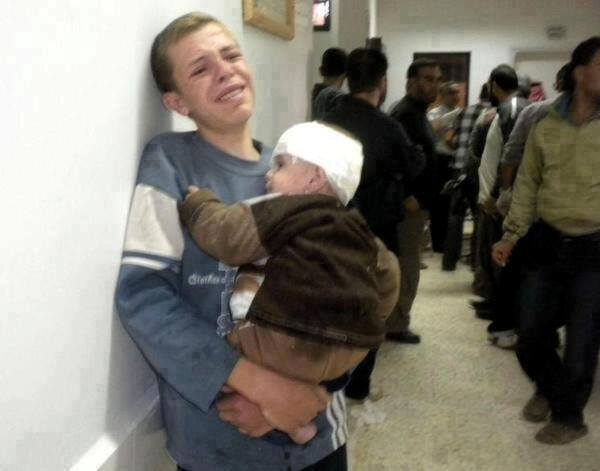
Orphans in Ras al-Ain, survivors of a Syrian regime aerial raid; the winter clothes alone should tell observers to look beneath the "insta-pundit labelling" of the sufferers as Gazans.

There is a reason  why reality is not presented fully to us and why so many populations have been presented as “other”. The people are depicted as deserving of the oppression because they are primitive, not ready for rights and still needed to be controlled by a powerful figure that would take care of their interests, though at times he might be a little rough, he’s probably some kind of oriental despot that we have to learn to live with out of some perverted idea of “relativism”.

We extend our disgust in various ways towards the population and their ignorance. If they voted, they never did it “right”. If they didn’t vote, that was because they didn’t view democracy as a value and therefore if internal movements towards democracy arose, they would be depicted as being driven from reactionary forces abroad who would then throw the rulers out of power and establish their own protectorate. In essence, the individuals and the geographical/ethnic/linguistic/religious groups they belonged to did not have their own agency to affect their own change, and if they are not “willing” to help themselves, it’s very easy to promote the idea that they are impermeable to change or that it has to be imposed from outside if there is going to be any. Otherwise, they get what they deserve.
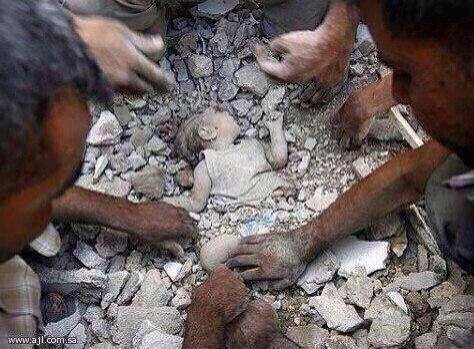
One of the innocent victims of the bombing of Azaz. The Assad regime kills them an the world lets them dig the dead infants out with their bare hands.  This picture has also circulated with great success as having happened in Gaza.

Only those who  have forgotten (or who haven’t realised) that personal freedom is a right for every human on the planet and that there is a series of rights that belong to every human being in order to truly be considered as being a free individual, regardless of the geopolitical situation in which he or she was born or currently is living will be interested in finding the truth and rejecting the “story”, “spin” or “narrative” that any news providers is giving. News providers don’t appear out of nothing, they obtain their information and disseminate their information according to their own interests. If they support a particular ideology, they will have a bias towards only giving information that supports the tenets of their ideology. If they claim to be media providers that are free of ideological bias and hidden agendas, however, they are going to have to have an ethical code of some sort, they are going to have to follow some kind of criteria for the selection of the material they present.

This is the reason that the only way towards knowing and obtaining the truth is to sort through the body of evidence. We can’t pretend to know everything about everything or even something about everything, but if we are interested in international affairs, if we are interested in civil and human rights, we can’t afford the luxury of laziness. We can’t accept everything that is handed to us as “news” and what IS handed to us under that guise has to be scrutinised very carefully. We have been presented with a multitude of “instant pundits” and experts under various titles who assure us that they have a very consistent response to all the issues they speak about and yet, the only thing they are consistently doing is neglecting the bulk of material that comprises the body of evidence. Their arrangement and analysis of information is sometimes even based on no evidence at all, but mere speculation and repetition of what anyone could recognise as propaganda if they actually look at their sources of information or the repetition of specific images over the course of time.

A body of evidence, on the other hand is not sorted, is not usually accompanied by “analysis” of experts and it has a scientific criteria that we can apply, it has a rationale that we can use to judge and verify its strength. First of all, we have to have access to information that is as close as possible to those affected by events. We unfortunately know that witnesses to events, particularly in the worst and most inhuman situations, are too busy trying to survive or escape than they are in trying to inform the outside world about what is happening to them. Outsiders who make it in often themselves become victims of the same situation, so the number of outsiders must be dramatically reduced in order to prevent complications. But, in situations such as war in Syria, the body of evidence is overwhelming in its immensity. There are literally millions of photographs and videos available to anyone at any time. There are millions of witnesses who are able to tell what is happening instead of just posing for a photograph in their miserable setting of an overcrowded and disease-infested refugee camp. There is actually SO MUCH information that we are numbed by the overwhelming quantity of it… but mostly, it is surprising to find that despite the fact that the consistency and veracity of it (given strength by its size, range, content, precision, directness) is overwhelmingly constant: and almost always pointing in the same direction and the news media still seems to ignore it in favour of its own bias which is that of ignoring the voice and evidence of the oppressed in favour of a different narrative with its own appeal and history.
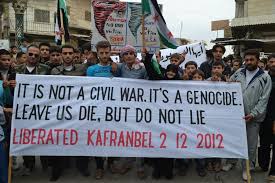
One of the hundreds of banners by the Kafranbel Media Centre... direct, to the point, and with no need for interpretation.

Since the onset of the uprising, protesters were determined to document the events in every way possible and to disseminate what they gathered outside of Syria. They did not own media providers, they were not part of an information “system”, they simply were providing evidence, most of it videos documenting the events and photographs of places during a protest or march or immediately following a sniper attack, a bombing, and later, a massacre. What has developed in Syria is a multitude of independent media aggregators, the Sham News Network, the Aleppo Media Centre, the phenomenon of the Young Lens photographers, the Kafranbel Media Centre and hundreds of others in every province and town, no matter how small. They collect, subtitle, disseminate and identify the evidence of the hundreds of thousands of witnesses to the war in Syria. They open YouTube channels, Facebook pages and blogs where anyone and everyone, INCLUDING mainstream and alternative media providers can tap into their evidence, and luckily, some outside news aggregators have picked up on their evidence and helped spread it far and wide. The problem is, the media providers that have a long history and prestige or are financed by advertising or political interest groups don’t tell a “sexy” story if it’s just about the (now four-year-long) struggle for survival of a besieged and oppressed people who have the misfortune of neither being of interest to the “imperialists” or the “anti-imperialists”, which are by the way, simply code words to express two variations of reactionary ideological thinking, where individuals don’t have rights, collective rights are also selective and all people can be fit into the prism of the narrative or spin of their administrations, regimes or leaders.

There is no shortage of evidence, the evidence provided meets all the criteria to be accepted as valid, even if it contradicts the story of the mass media, which often just serves as an amplifier of those who have the most power, preserving their interests. There is a clear causal chain that is evident to anyone who decides to access the body of evidence. The causal chain’s importance is heightened by the sheer magnitude of the evidence available. Literally, there are thousands of photographs and videos available that document the enormous quantity of atrocities committed against the people. It is not difficult to corroborate the evidence of the perpetrators of a massacre, and while the “pundits” will take the word of one “anonymous insider” whose words seem to mimic the regime narrative regarding who is responsible for the nerve gas attacks against the populations of the “free” towns that were resisting Assad and often victim to the regime’s violent attacks with more “orthodox” means, they refuse to study the evidence of experts who state that the only possible perpetrator is the regime and produce convincing argument that stands up to scrutiny, likewise corroborated by third party investigators who see more than the films, but have access to the sites or can scientifically test the tissue of survivors.

Infant victims suffocated in their sleep by Sarin in Al Ghouta (at the Arbeen field hospital). The fate of these innocent vicitms was "too horrifying" to be shown, but that all changed when they were recycled as victims of Israel and not of Assad and our indifference.

Yet, how could anyone in their right mind continue to even question or doubt such an obvious massacre as that of Ghouta? How could the proof of the culpability of the regime be in doubt for even one minute when their sponsors and patrons in the UN Security Council vetoed decisions made in Human Rights Commission following a detailed war crimes report to support the effort to bring the matter to the International Criminal Court which would judge the body of evidence in a legal seat and then exercise Justice, which then the world powers would have a leg to stand on when they took positions for or against Assad? By closing their eyes to the evidence, despite how great, consistent, direct, precise and applicable (i.e., bearing all the qualities that give what is known as “strength” to a body of evidence) they are able to hide the truth, but not to stop it being true.

Not only the massacre of approximately 1500 men, women and children by suffocation from exposure to nerve gas, but hidden or distorted are the numerous and well-documented “white weapons massacres” by knives and bayonets that are the signature of the Shabbiha thugs who operate for Assad, terrorising villages and leaving hundreds murdered despite their age, condition or innocence. The massacres of Houla, Banyas, Deir Ezzor and countless others have left in their wake hundreds and hundreds of photographs, videos and eyewitness testimony. If one looks at most of the news media though, you are going to find very little reference made to these events and they are simply not providing information on them, often with the ill-disguised goal of exclusion of the videos or pictures due to “the excessive cruelty of the images”, where they fall into the vacuum of oblivion, where our consciences can’t be reached and therefore our outrage can’t be aroused.

Instead they promote “massacres that weren’t” or at least that have no consistent body of evidence such as the “Adra Massacre” or the “Kessab massacre”. The “Hatla Massacre”, depicted as a sectarian attack against Shi’a Muslims by the agencies of the regime, bears a great deal of evidence that it was an armed conflict between anti-regime and pro-regime fighters with civilians caught in the crossfire and not a premeditated massacre to terrorise the population, though as a result, for a time the civilian population fled, as is the case in the entirety of Syria given the amount of urban warfare involved.

What are the images that people remember from the news? They see a “rebel” (not even a member of the Free Syrian Army) eating a heart, they see a “Christian” crucified by Islamists, and to them, the vision of these two images, out of context and factually incorrect (at least in the case of the crucifixion, the victims were Free Syrian Army soldiers, who by their identification are Sunni Muslims) become “the icons” and the real atrocities that matter. The tens of thousands of photographs of the torture of starved prisoners in regime jails was just a blip on the radar. The atrocities committed against Syrians who are tortured to death for crimes they did not commit are too vast to even contemplate. So, see the pictures, then forget them, that is how it works. It is much easier to bear one image and give it any meaning you want or you have been told. It’s not worth it to differentiate between types of atrocities and their intensity of occurrence.

a composite photo of some of the thousands of Syrian infants slaughtered in every way possible, one of them even wrapped in a Syrian Independence Flag... they finally got some interest when they ceased to be victims of Assad.

But the opposition to Assad, the suffering population has its own iconic images. Millions of them, some of them so familiar to those who have been seeking truth and evidence from Syria for these four years that it comes as a painful shock to see them “recycled” as being Palestinian victims of Israel’s brutal attacks in Gaza. To see the photos cropped to cut out watermarks, Syrian flags or anything that identifies the identity of the victim and the circumstances of his or her death has been a genuine shock and additional accumulation of suffering when one considers that these photos and videos have been shared for years, in the vain effort to inform the world of the situation and the extent of this crime against humanity that is the genocide of the Syrian people, first by Assad’s regime and its infiltrate forces and since the past two years also by the rogue “Islamist” forces that are conducting their proxy wars for the domination of either Iran or Saudi Arabia in the name of their stated objective of the creation of a Caliphate in the Levant.

ISIS, as well as Hezbollah, makes the claim that their enemy is the West, but they are only good at slaughtering and oppressing other Arabs, including Muslims or those who have come to witness and share the information of the besieged and oppressed people, including journalists and human rights workers and volunteers. To the distracted observer, the war is a sectarian war that is now in the face-off stages of secularism vs obscurantism and there is no interest in investigating the facts, but to act “better late than never” against the enemy that is perceived as dangerous to the West, forgetting in essence the actions and objectives of the tyrant whose policies were at the genesis of the entire uprising and who has only consolidated his power in farcical elections that would never be accepted by anyone if they were to happen in their own countries under such condition and lack of democracy or legitimacy. His “election” has given him the perceived license to kill as much and as brutally as possible, and it is a license that he has taken full advantage of.
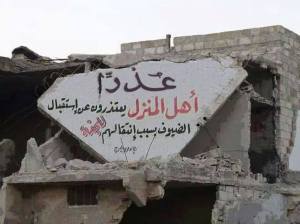
A roof in Aleppo, again, not surprisinging attracting interest only when it is mislabelled as being the destroyed home of a Gazan.

It is indeed frustrating to realise that the body of evidence proving the total destruction of Syria, its people and its infrastructure, including those who are living in the Palestinian refugee camps who have been subjected to siege, torture, arrest and death no less than their brothers and sisters in Gaza and in the rest of Syria, has been ignored for years, only to be carted out and presented as a different war, a different enemy, a different sponsor. Sometimes the Syrian independence flags that are used by every faction against Assad with the exception of the “black flag Jihadis” are not even cropped out or the subtitles changed. It is with a sickening Orientalism that these victims are passed off as someone more worthy of support, and at least for them, some support has been forthcoming. It is as if Arabs are interchangeable and a defiant Aleppo survivor who painted his ultimate resistance on the ruins of his bombed out roof has become a Gazan. The situation is not identical, though similar, but only one defiant resistant soul is honoured at the expense of another, whose suffering again is buried under rubble and debris. Nothing to see here, move along!
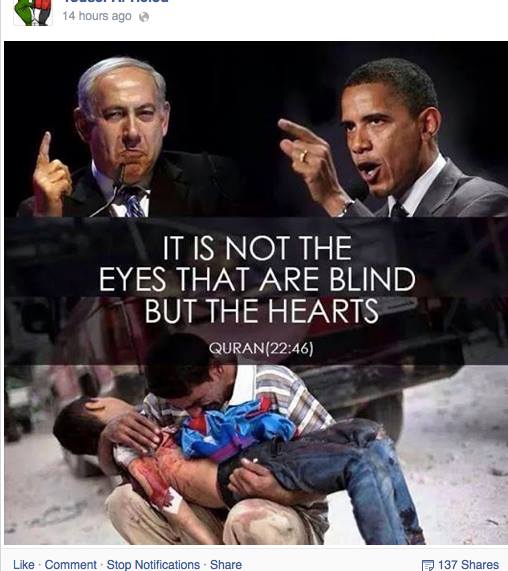
Another iconic image of Syrian grief and suffering,  mislabelled and blamed on anyone but Assad!

There are shameless people who spread pictures and videos that depict persons in a state of shock after their loved ones are carried off dead in blankets among the buildings that were made to explode and collapse on top of them after air raids in civilian areas. The viewer should use a bit of healthy scepticism to realise that in July winter coats are not worn in Gaza and this event is someplace else, the victims are someone else. The perpetrator of such heinous crimes is not Netanyahu but instead it is Assad.

All of this evidence, the weight of which presents a picture that again and again shows the reality of the situation, the true story of what is happening, stripped from agendas and narratives, all of it is there for us to view. It is a deliberate choice we can make to ignore it and take the easy way out of accepting the stories told by the media that are deliberately hiding or altering this information in such a way so that the struggle to know the truth is stifled, and it is out of our hands to effect change in a positive way to those who are suffering (those whose side we have to be on, no matter what other considerations might influence us such as proximity or religious/ethnic affiliation).

If those who survived a massacre decided to document it, and took all the risks linked to that, they did this so that the truth would not be hidden. They did it in the hopes that those who had the power, influence or ability could help and protect them. They did it not because they want to shock us or draw us into a world that has nothing to do with us, but because this is our world already, it is only a short flight away from many of us or even has touched our shores with its outpouring of survivors of unspeakable atrocities. If we refuse to be lazy, we can look for the truth and we can find it. We are no longer bound to being complicit in genocides and then claiming in the same breath, “we didn’t know” and “never again”. It will be never again ONLY if we make it so NOW. Our task is to be an amplifier of the voices of the people, not a substitute or interpreter of them.  We have the enormous possibility of affecting change simply by not keeping information buried or tearing it out of context. If we choose to, we can save lives and make a better world. It’s up to us. Can we be up to the task? Isn’t it a noble goal to seek the truth and serve the truth?
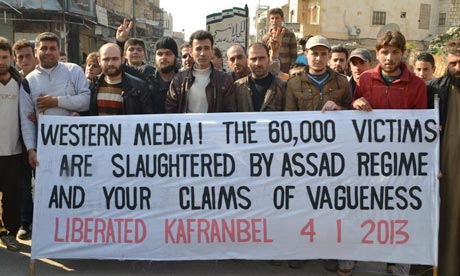
The Syrians know the Media isn't divided into Mainstream or Alternative. Until evidence is all that matters, they will hold the high moral ground.

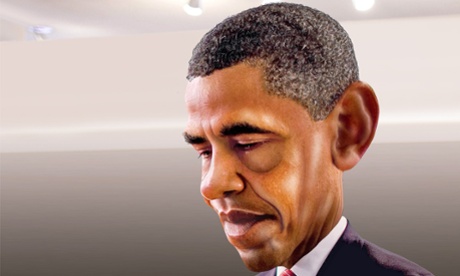
Obama has ignored Syria for too long: it’s the rise of Isis, stupid – now help

ob

Obama has ignored Syria for too long: it’s the rise of Isis, stupid – now help

It’s time for him to do the right thing by arming moderate rebels, imposing a no-fly zone and expanding military action beyond Iraq

ob

Blanket, cold-hearted realism doesn’t work when networked, cold-hearted terrorism does. Photo illustration: DonkeyHotey / Flickr via Creative Commons


Barack Obama is embarking on a global course correction, if not an outright reversal: the policy of “don’t do stupid stuff” – the non-interventionism so praised by the Farid Zakarias and Tom Friedmans of the world – is getting forced out, albeit in the typical Obama fashion of admitting nothing and never going fast or far enough.

And to hear the Chuck Hagels and John Kerrys of the administration tell the story for him, it’s all the fault of the Islamic State (Isis), which is “beyond just a terrorist group”, “an organization that has an apocalyptic, end-of-days strategic vision and which will eventually have to be defeated” – a feat which, realistically, will require some intervention not just in Iraq … but in Syria.

It’s difficult to do the right thing when you’ve already fucked up so badly. When the Obama administration refused to enforce a no-fly zone over Syria in 2011, the indifference gave rise to despair and forced people to abandon their nonviolent ways to defend themselves, effectively transforming the nonviolent protest movement into an armed resistance. Obama’s refusal to then support the rebels following the advice of his then-secretary of state, among other officials, created a vacuum that was gradually filled by extremist elements emerging out of the woodwork and jihadists pouring across the borders, a combination that paved the way for the emergence of the newly troubling and feared Isis.

Now, Isis has a vision being carried out – effectively, if with pure evil – by technocratic leaders with succession plans, flexible but enduing structures, and major funding, with major operations based out of its hub in Syria. Soon, some of its acolytes might make like Hezbollah and run legitimate businesses across multiple countries that secretly fund terror; some already appear to be attracted to the radicalized appeal of Isis leader Abu Bakr Al-Baghdadi declaring a new Caliphate.

No wonder Obama is finding it so difficult to justify a policy of minimal engagement anymore – perhaps even to himself. Blanket, cold-hearted realism doesn’t work when networked, cold-hearted terrorism does. The line between realism and cynicism has always been too thin, and has long been crossed by the Administration. While realism is laudable, cynicism ends up producing the very outcomes that realism intends to avoid. Letting a region take care of itself is impossible to allow when your spies are telling you about the rise of a terror group across the world, including the West – of terrorists that are effectively becoming a global movement of disaffected Muslims everywhere.

Some “realists” are advocating cooperation with Bashar al-Assad. But that wouldn’t just being doing “stupid stuff” – it would be downright delusional, since cooperating with dictators who abuse their own people is exactly what gives rise to extremist anti-Western movements.

The only way for Obama to stop doing stupid stuff with his foreign policy is to arm moderate rebels in Syria, to bomb Isis bases in both Syria and Iraq and to finally impose a no-fly zone on the Assad regime. This combination of tactics could allow the Syrian opposition – which has thus far been unable to govern the liberated areas due to Assad’s use of aerial strikes, including barrel bombs, scud missiles, and, on occasion, chemical weapons and poison gas – to move in and work with the local councils to begin returning the basic services to the local communities, bringing a measure of relief to the local civilian population. Imposing a no-fly zone also avoids having to supply advanced weapons to rebels, including TOW missiles and MANPADs, thus minimizing the risk of having them end up in the wrong hands. Still, the opposition will have its work cut out for it in terms of ensuring effective governance of the areas under their control, especially when it comes to reaching agreements between Islamist and secularist currents. But by controlling the flow of humanitarian aid and the funds required for the reconstruction processes, the administration and other members of international community could exercise leverage to allow for compromises to be reached.

Obama already plans to take a leading role at next month’s UN General Assembly, where strategies for holding back Isis will be a top priority. But Western and Middle Eastern leaders need to begin preparing for a peace conference following such strikes, because a real transition plan for a post-conflict and post-Assad Syria needs to be developed. Talks will not be easy (and could drag out for months if not longer), but if the regime’s ability to wreak havoc on rebel communities is curbed by strikes and the economic blockade against it is strengthened, time will not be on its side – rendering hopes for an eventual breakthrough more realistic.

It’s about time for the Obama administration to do the right thing. It’s about time, after doing so much stupid stuff and aiding in the rise of Isis, to begin resolving a conflict that has killed close to 200,000 people in less than four years, and produced millions of refugees, becoming the worst humanitarian disaster since the Cold War.

Yes, American strikes may make disaffected Muslims more eager to join Isis. Yes, we may be witnessing the birth of a new Islamic sect. But Barack Obama needs to stop fighting the symptoms while embracing the disease – to become a true realist and not a cynical one. Sectarian violence was not inevitable in Syria, as some analysts argued at the beginning of the revolution, but indifference and cynicism made it so. Obama needs to engage in the region with a positive mindset, knowing that he can actually make a positive difference.

source


Blog at WordPress.com.

Up ↑