Search

band annie's Weblog

I have a parallel blog in French at http://anniebannie.net

Category

Syria

New Syrian Novel Expresses Distrust of Storytelling


Syrian novelist Maha Hassan was longlisted for the International Prize for Arabic Fiction for the second time this year, for her Al-Rawiyat. The book didn’t make the shortlist, but reviewer al-Mustafa Najjar makes a compelling case for why you should read it nonetheless:

By Al-Mustafa Najjar

Female-VoicesIn her most recent novel, Al-Rawiyat (Female Narrators), published last year, Syrian novelist Maha Hassan explores the realms of oral and written storytelling through a set of female characters, who are not necessarily connected, but are all obsessed with the art of narration.

From the book’s dedication to the unpublished “female raconteurs [who] . . . lived and died in darkness” to the last sentence highlighting the “emancipatory” powers of writing, a celebratory, almost naive tone dominates the novel.

The first narrator, Abbadon, says she lives two lives: A superficial, “typical” one concerned with the satisfaction of mundane day-to-day needs, and a “rich and dense” one centering on fiction writing. “[I was] born to tell tales,” she says, echoing the title of Gabriel Garcia Marquez’s memoir.

“Telling tales is the only entertainment and pastime she has to pass the days in peace,” the narrator says. Even when someone steals the manuscript of the character’s debut novel and publishes it under their name, she does not seem too bothered.

“What’s the harm? What is important is that my characters have a chance to come out to the world, that tales come out for people to read. What is important is the novel, not the novelist.”

When she grows up, her relationship with her husband reaches a dead-end when she confesses to him that “the only moment I feel the ecstasy that resembles orgasm is when I tell tales.”

Rama, the last of the narrators, lives in a parallel, imaginary world, overflowing with fictional characters. Concerned about Rama’s sanity, her mother tries to “suppress” her imagination by exhausting her with all sorts of physical activities. Rama, who was born in India, inherited from her grandmother “the magical ability to tell stories.” Compared to her peers who find in bedtime stories a passageway to sleep, Rama waits for her grandmother to end the story so that she can deconstruct and reconstruct it from scratch. When she grows up, her relationship with her husband reaches a dead-end when she confesses to him that “the only moment I feel the ecstasy that resembles orgasm is when I tell tales.”

small-Maha-HassanThere are many similarities between these two narrators: both derive sexual pleasure out of storytelling. Abbadon says: “A sexual energy is generated inside me when I write.” But it would be a mistake to think that this is what Al-Rawiyat is all about, that the female protagonists are the 21st century version of Scheherazade, who tamed Shahryar after a thousand and one nights of storytelling. Al-Rawiyat is deeper than just a cry against patriarchy, or a manifesto calling for a feminist revolution. Beneath the bluntly “revolutionary” surface of the novel, there is a complex narrative structure threatening to subvert it.

Each of the book’s stories culminates with a twist in the plot that contradicts the narrator’s expectations and thus raises questions about their credibility and familiarity with the stories they tell. While Abbadon finds in Sabato the man of her dreams who does everything in his power to help her write her first novel, we discover at the end of their story that he has been using her for purely utilitarian purposes.

The same is also true of Rama, who realises — albeit too late — that Aravind, the musician whom she thought would liberate her repressed soul, is nothing but “an idiot who lacks imagination.”

“To tell a story is to claim a certain authority, which listeners grant,” writes American critic Jonathan D. Culler in his Literary Theory. Faced with the narrators’ celebratory tone about the ability of storytelling to undermine patriarchy, readers have no choice but to take what they say at face value, and thus submit to their narrative authority.

Unlike One Thousand and One Nights, which highlights Scheherazade’s mastery of the art of storytelling, Al-Rawiyat sheds light on the narrators’ failure to have control over the stories they tell.

However, following the disappointments the characters/narrators face, we start to doubt that they are worthy of our trust. The dramatic twists in the novel implicitly raise questions about the credibility of the narration and whether or not the narrator deserves the authority that the reader grants. Unlike One Thousand and One Nights, which highlights Scheherazade’s mastery of the art of storytelling, Al-Rawiyat sheds light on the narrators’ failure to have control over the stories they tell. The novel does exactly the opposite of what it preaches. Hassan’s female narrators give a fake impression of Scheherazade.

In what seems to be a diversion from the plot, Alice — a PhD candidate in “philosophy and its relation to art” — visits Cairo, having been “possessed with the spirit of Pharaohs.” The chapter overflows with references to the success of the Arab Spring in Egypt. Alice says she “has trust in the Egyptian people. Those who toppled Mubarak are capable of toppling the Muslim Brotherhood, and will not accept a new dictatorship.”

For all the failure that the Arab Spring has proved to be, such remarks — which we now find as either cynical or naïve — are said by Alice with the utmost seriousness. Based on what has been written about Al-Rawiyat in the Arab press, there seems to be a consensus about the chapter’s irrelevance to the rest of the novel. In fact, the chapter is highly significant in that it underlines the discrepancy between reality and narration.

Alice, the narrator, is merely offering her “narrative” of the Arab Spring, which stands in stark contrast to reality.

We all heard about the events in Tahrir Square on television, or in newspapers and magazines. In other words, what we know about the Egyptian Spring is nothing more than “narratives” that express the views of their authors. We are surrounded by narratives. Take newspapers, magazines, TV channels, YouTube and social media; they are all platforms for multiple voices and narratives. But do all of them reflect reality? Al-Rawiyat answers in the negative.

The structure of the novel is confusingly divergent, with the frame narrative resembling a Matryoshka doll that encases four stories. The multiple and overlapping narrative voices mean readers never stop asking: “Who is speaking?” and “What are they talking about?”

Added to this confusion is Hassan’s tendency to give several names to each of her characters. Abbadon is both Miriam and Maha, while Sabato can be Ernesto or Franco. “Our names have no significance  . . . We are mere virtual creatures.”

A similar uncertainty surrounds the place in which the novel is set. It is “that big city which resembles Cairo, New York, Tokyo, Paris, London or Beirut.”

Al-Rawiyat is a well-crafted work whose turbulent form gives it the uncertainty and ambiguity of great works, such as Season of Migration to the North by Tayeb Salih and Ulysses by James Joyce, novels that raised more questions than they offered answers.

Al-Mustafa Najjar is a Syrian journalist/translator at Asharq Al-Awsat. He holds a master’s degree in Post-1900 Literatures, Theories and Cultures from the the University of Manchester. He is based in London and we still hold out hope that some day he will take over the ArabLit franchise. 

source

A Critical Exchange with Reese Erlich on Syria, ISIS & the Left

March 8, 2015

Reese Erlich is a foreign correspondent with GlobalPost and reports regularly for National Public Radio (NPR), the Canadian Broadcast Corporation (CBC), and Radio Deutsche Welle. His reporting has earned him multiple awards over the years. The San Francisco Board of Supervisors declared September 14, 2010, “Reese Erlich Day” in honor of his investigative work. “Mr. Erlich,” the resolution read, “exhibits the finest qualities of…reporters willing to comfort the afflicted and afflict the comfortable.”

He is also a friend of mine. We met in the home of our mutual friend Stephen Kinzer in 2009. Kinzer wrote the Foreword to Erlich’s book Dateline Havana: The Real Story of US Policy and the Future of Cuba and hosted a gathering in his home in Oak Park (just outside of Chicago) in Erlich’s honor. It was a fabulous evening, and Erlich and I stayed in touch. A few months later he was in Iran, reporting on the historic protests that convulsed the Islamic Republic following its June presidential election. He wrote some of the very smartest stuff about those dramatic events. Erlich is a dyed–in–the–wool New Leftist who cut his teeth at Ramparts, the iconic magazine of1960s radicalism, took many of his fellow leftists to task for the utter myopia they displayed amidst the events in Iran that summer. His essay “Iran and Leftist Confusion” was bang-on and desperately-needed. He also provided a healthy corrective to the pervasive narcissistic blather about Iran’s Green movement being a Twitter revolution.

A couple years on, when his book Conversations with Terrorists: Middle East Leaders on Politics, Violence and Empire came out, I set up an event for Erlich at Chicago’s No Exit Cafe. And in 2013, when Erlich and Norman Solomon (his co-author on the 2003 book Target Iraq: What the News Media Didn’t Tell You) did a speaking tour to mark the 10th anniversary of the US invasion of Iraq, I set up an them for them in Denver.

In Erlich’s latest book, Inside Syria: The Backstory of Their Civil War and What the World Can Expect​, he is critical of me and my colleague Nader Hashemi for advocating humanitarian intervention to end the criminal starvation sieges in Syria. He reached out to me before the book went to print, asking me to read this section and send him feedback. We had sharp disagreements about Syria, but I appreciated his spirit of generosity and friendship. In this same spirit, I was happy to host him once again in Denver for a talk on his new book. But I was also keen to sit him down for a critical exchange about his book for the video series that our Center for Middle East Studies produces.

Our conversation reflects both my deep respect for Reese’s work and also my serious disagreements with him. It is a spirited and critical (in the best sense) exchange between two leftists with different perspectives on one of key issues of our time.

Are you Progressive Except for Syria? Take the handy test here!

Posted: 02/26/2015 by editor

pes 3We have all already heard of the phenomenon of PEP (Progressive Except on Palestine), in which those who consider themselves progressives (liberals in the USA) or leftists are pretty liberal on every single issue except the Israeli-Palestinian conflict. But, their syndrome has been pointed out and diagnosed fully. A lot of them justify this position by saying that supporting the government of Israel is a liberal position. Their problems are not our problem… they need help that we surely can’t provide.

However, there is another phenomenon far more worrisome because it involves those who are Progressive ALSO for Palestine, and that is the case of PES (Progressive Except on Syria). Those who are afflicted by this malady feel safety in numbers, because they are in fact the majority of non-Palestinian supporters of Palestine. They will actually USE the argument of Palestine as justification of their support of Assad, even though his regime has a terrible record regarding Palestinians, (as did that of his father).  They will argue that support of Assad is a progressive (liberal) leftist value. Whether it’s called “selective humanitarianism” “double standards” or “hypocrisy”, it is a dangerous and insidious disease and should be cured. Here is a little test to discover if perhaps YOU are afflicted with this mental illness.

pes 2Do you perhaps suffer from PES without being aware of it? Fear no more! We’re happy to provide you a self-diagnosis test with simple YES / NO replies so that you can discover your own hypocritical stance, and hopefully, be on the path to the cure.

  1. Did you protest or complain about the unfairness of the USAelections for any reason but believe that Assad won a landslide victory in free and fair elections?
  2. Do you think that Assad is fighting terrorism?
  3. Do you think that the Palestinian cause is being defended by Assad?
  4. Do you believe that the war in Syria is all about foreign aggression due to their national and pan-Arab stances” and is not a people’s uprising? In fact, you think the whole Arab Spring has got to be “exposed” as an imperialist, western plot.
  5. Do you think that the Intifada in Palestine is legitimate and that the uprising in Syria is manufactured (while of course saying so having been paid guest to Assad’s presidential palace)?
  6. Do you think that the Palestinian cause is being defended by Hezbollah even when they target and kill Palestinian refugees and ignore the growing tensions between Palestinian refugees in Lebanon and Hezbollah?
  7. Do you condemn religiously-inspired militias such as ISIS and Al Nusra when they commit murder and use violence against civilians but have not condemned Hezbollah when it commits murder and uses violence against civilians?
  8. Do you think that it was a good idea for the Popular Front for the Liberation of Palestine – General Command (PFLP-GC) to shoot on the Palestinians who mourned those killed on Naksa Day 2011?
  9. Have you called Gaza “the world’s largest open-air prison” but don’t agree with the UNHCR claim that Syria’s war “is more brutal and destructive than the wars in Afghanistan and Iraq, and has turned into the worst humanitarian disaster since the end of the cold war.”?
  10. Have you endorsed or thought a No Fly Zone was a good idea for Gaza but reject it as Imperialist meddling or abid to save Al Qaeda if it’s done in Syria?
  11. Do you condemn the Palestinians tortured to death in Israeli prisons (since 1967, a total of 72 Palestinianshave been tortured to death) but have not condemned the 200 Palestinians tortured to death in Syrian prisons since 2011? You naturally probably don’t know about the at least 2100 Syrians who were tortured to deathinside these prisons.
  12. Do the at least 10,000 bodies of prisoners in Syrian regime prisons that were ordered to be catalogued by the regime mean nothing to you since you don’t have details on what the reasons for their deaths could be?
  13. Do you call for release of political prisoners from Israeli jails but do not call for the release of the tens of thousands of political prisoners in Syrian jails?
  14. Have you actually asked for money to bring Gazan children to make a protest for the NFZ but think that asking for a NFZ in Syria is a bid to help Al Qaeda?
  15. Do you think Al Qaeda and ISIS are Mossad / CIA inventions?
  16. Do you protest against the death penalty in the USA: Executions in 2014, 35, but don’t do the same for Iran: executions in 2014, Between 721 and 801 at least.
  17. Do you think it is wrong for the US to provide Israel with armaments because it engages in war crimes but at the same time, think it is justified for Russia to provide the Syrian regime with armaments and military expertsbecause “it’s war against NATO”?
  18. Do you condemn Israel’s “extra judicial killing” but claim that Assad must do everything he needs to maintain power because blocking his actions in any way, even by condemning them “… could end up ousting Assad. It would mean replacing him with pro-Western stooge governance. It would eliminate another Israeli rival. It would isolate Iran. It would be disastrous for ordinary Syrians.”
  19. Have you ever praised Assad’s government because it is secular, or “fighting the enemy of the West”: because after all, you only see the alternatives being Assad or the “Islamic Fundamentalists”?
  20. Did you support Haniyeh and Meshaal until they started waving the Syrian revolution flag?
  21. Do you erroneously refer to the Syrian revolution flag as the “French Mandate Flag” ignoring that even the Assad regime celebrated it as the Independence flag each “Evacuation (Independence) Day on 17 April to celebrate the resistance against the French colonialists?
  22. Do you know the names of at least one Palestinian dissident/political writer but don’t know any Syrian ones?
  23. Do you call the opposition to Assad “Western-backed rebels” either from a Pro-Israel or Pro-Iran standpoint?
  24. Did you protest for Palestinian detainees and even know their names but not do the same for Palestinian detainees in Syrian’s prisons?
  25. Do you know the name of at least one minor arrested or killed by Israel but don’t know the name of at least one minor arrested or killed by the Assad regime?
  26. You have protested against the racist and discriminatory Apartheid Wall and checkpoints in Israel/Palestine but you have nothing much to say about Syrian military checkpoints and sniper-lined checkpoints?
  27. Did you get angry when a US newspaper used a photo of Iraqi deaths, claiming they were Syrian, but when Palestinian supporters use Syrian ones, it’s “illustrating the suffering in Gaza”?
  28. You have protested against Israeli use of phosphorus bombs but you have nothing much to say about the unconventional weapons use by Assad against both opposition fighters and civilians such as barrel bombs andchemical weapons?
  29. Are you critical of the US for intervening in affairs of other countries but think it’s normal for Iran and Russia to be sending troops into Syria to help the regime?
  30. You would never consider Palestine compromising with Israel but you believe that the opposition must compromise with the regime in Syria.
  31. Do you condemn the Saudi monarchy and refer to them as Wahhabis, Salafis, etc., but refuse to recognise that Iran is a theocracy?
  32. Do you think that Assad is simply doing everything he can to protect the minorities in his country?
  33. Do you call the Israeli occupation of Palestine ethnic cleansing but do not speak out against the regime-driven massacres in Syria that are ethnically based?
  34. Do you refer to the Assad regime, Hezbollah and Iran as the “Axis of Resistance” even when they don’t react to Israeli attacks on them?
  35. Do you think the following two statements are both true?
    a. Dissent in the United States is patriotic.
    b. Protesting in Syria is an assault on the State and needs to be quelled.
  36. Do you think the following two statements are true?
    a. Pepper spraying protesters in the USA is a violation of human rights.
    b. The Syrian regime has to use whatever force it deems necessary against protesters, because they protesters have violent intentions.
  37. Do you think that Israel must be brought to the ICC for crimes against humanity but think that the Syrian regime should not?
  38. Do you condemn the USA vetoes on the UN Security Council in favour of Israel but praise the Russian and Chinese ones in favour of Assad both to stop sanctions and to prohibit ICC investigation including three Chinese vetoes on Syria alone out of eight total vetoes in their history?
  39. Do you think the following statements are both true?
    a.Calling a U.S. citizen anti-American or un-American for being critical of the US government is ridiculous, knee-jerk, unintelligent and actually incorrect.
    b.People who are critical of Assad are closet or overt imperialists and want US control over the region.
  40. You do not believe that Russia is an imperialist state while you are certain that Syria is an anti-imperialist state defending itself against imperialist onslaught.
  41. Do you think that Erdogan is seeking to dominate politics in the region in an attempt to restore what was once the Ottoman Empire or even think the US is trying to establish an Islamic State but support Iranian domination and the Shi’a Crescent?
  42. Have you signed petitions against companies such as Soda Stream and Coca-cola but not against weapons provider, the Russian monopoly Rosoboronexport or even the western companies providing the Syrian and Iranian regimes with surveillance equipment that they use against dissidents and opposition?
  43. Do you call innocent victims killed by American drones or victims of war crimes but consider the Syrians and Palestinians killed by Syrian bombs and chemical weapons collateral damage?
  44. Do you reject the USA/UK “War on Terror” but believe that Assad has a right to use whatever means possible tokill whoever he considers as a terrorist in Syria and that Syria is a sovereign nation fighting Al Qaeda?
  45. Have you mentioned the Blockade on Gaza in conversations and know it is illegal and a crime against humanity but don’t feel the same about the Blockade on Yarmouk?
  46. Do you respond to criticism of Assad by pointing out USA human rights violations?
  47. You know the name of USA civilians killed by cops or vigilantes, but you don’t know the name of a single Syrian victim of torture in the Assad prisons.
  48. You have protested for the closure of Gitmo, but you don’t raise your voice or even one eyebrow over theSyrian Torture Archipelago in which “The systematic patterns of ill-treatment and torture [in the 27 detention facilities run by Syrian Intelligence] that Human Rights Watch documented clearly point to a state policy of torture and ill-treatment and therefore constitute a crime against humanity.” Moreover, you don’t want to notice that Syria’s government has been cooperating with the CIA extensively in renditions and the torture programme.
  49. You think that Israel should not have nuclear capacity but that Iran should have nuclear capacity. Extra pointsif you support Non-Proliferation. Super extra points if you participated in any No Nukes events in the West or signed any such petitions, super extra and mega extra points if you are against nuclear power.
  50. You believe that the Palestinian struggle is about human rights but the Syrian protests were sectarian and religious-oriented, driven by people who wanted to overthrow and overtake power illegitimately if not in factmanufactured by the West?
  51. Do you believe it’s normal for the Syrian constitution to be amended every time that it serves the Assad familybut the US Constitution is sacred and especially no amendments should be made to limit gun possessionwhether you detest the US government or think it should basically call all the shots around the world?
  52. Do you think that Jews protesting the Israel government are noble people who are fighting for human rights and justice while any Syrian protesting the Assad regime are in cahoots with the Israeli government.
  53. Do you believe that, “We must not in any way call for the removal of President Assad unless he commits acts of terror against us. Assad’s government has committed no such act, thus rendering it criminal for foreign governments to undermine the Syrian regime. You either stand for national sovereignty, or against it. The choice is yours.” While at the same time have supported efforts from the liberals or conservatives to have Obama impeached?
  54. Do you believe that foreign countries helping the Palestinians militarily to win against Israel is legitimate but helping Syrians win against Assad is meddling and think that “any further intervention in Syria would be for U.S. interests, like weakening an ally of Iran, and would encourage Assad’s allies to step up their armament shipments. The carnage would continue, and perhaps increase.”?
  55. Do you reject claims that the involvement of Iran and Russia in favour of Assad is meddling?
  56. Do you think that the entire Syrian war is for the purpose of the US weakening Syria so that it can pursue its own interests in the region but ignore the fact that Russia has enormous interests in Syria that are far more evident?
  57. Have you ever found yourself denying Assad had chemical weapons but also applauding the Syrian regime’s decision to hand them over to Russia as a strong gesture towards peace?

pes 1

How many questions did you answer YES to?

Between 1 and 5? You are headed towards selective humanitarianism, or even are afflicted with Western Privilege Syndrome!

Between 6 and 10? You are dangerously using double standards and believe that human rights aren’t something universal, but allow your ideological or dogmatic prejudices to influence your ethical judgement!

Over 10? You are a dyed in the wool Hypocrite! Maybe you should avoid “current events” altogether, you have no understanding of what human rights and justice mean, you should wash your mouth out before you ever speak about human rights for Palestinians or anyone.

A Leftist Syrian Point of View

“I am afraid that it is too late for the leftists in the West to express any solidarity with the Syrians in their extremely hard struggle. What I always found astonishing in this regard is that mainstream Western leftists know almost nothing about Syria, its society, its regime, its people, its political economy, its contemporary history. Rarely have I found a useful piece of information or a genuinely creative idea in their analyses. My impression about this curious situation is that they simply do not see us; it is not about us at all. Syria is only an additional occasion for their old anti-imperialist tirades, never the living subject of the debate … We, rank-and-file Syrians, refugees, women, students, intellectuals, human rights activists, political prisoners … do not exist … But honestly I’ve failed to discern who is right and who is left in the West from a leftist Syrian point of view … Before helping Syrians or showing solidarity with Syrians, the mainstream Western left needs to help themselves. Their views are totally misguided, and the Syrian cause was only a litmus test of their reactionary and decadent perspectives.”  – Yassin al-Haj Saleh

Read the full interview here.

source

Khaled al Khani – The Beginning

SEE the artist’s website with full presentation

The Schleswig-Holsteinischer Kunstverein is showing a temporary installation by the Syrian artist Khaled al Khani (b. 1975) which was especially made for the space in the Kunsthalle zu Kiel.


Khaled al Khani studied painting in Hama and Damascus. In 2011 he fled from Syria and is now living in exile in Paris. The artwork he has created for the Kunstverein with the title The Beginning is Khaled al Khani’s first museum presentation in Europe. It draws on the existential experiences of the artist in his homeland, the Syrian civil war and his hopes for a future of peace.

Like many of the paintings of the artist, the mural in the Kunsthalle zu Kiel depicts the adumbrations of groups of people against a light background. The faces of the figures are only vaguely defined. Al Khani’s expressive and figurative painting style encompasses the entire walls of the room as well as most of the ceiling. At many points it oscillates between figuration and abstraction. Painting with acrylics directly on the wall, the artist has created a space that allows beholders to individually experience and interpret what is depicted in the installation: in their perception inside and outside, the past and the future merge. Only an oval in the middle of the ceiling has been left unpainted. This compositional device opens up the pictorial space into a realm above, and alludes once again to the title of the installation.

At work in the Kunsthalle (Photo Gallery)


 full catalogue here

The Abdication of Moral Responsibility

ARGUMENT

Somebody Interviewed Assad. Chill out.

Many people I know were quick to jump on Jonathan Tepperman’s throat because he interviewed Assad. The interview itself was remarked upon widely for the insane comments that Assad made, completely divorced from reality and quite clearly an attempt to portray himself as a reasonable, sensible man that the West can do business with against ISIS. The result of this interview, however, was very different; Assad simply came across as deluded or a pathological liar, something that was confirmed by Tepperman himself when asked about his impressions of that man. So the crisis is averted and we can all stop beating ourselves into a social media frenzy.

There’s a strong tendency amongst Syrians supporting the revolution for group think, and we need to stop that. It doesn’t help our case, it doesn’t help Syrians, and it just alienates people who might be trying to help us in their own way. Not everybody needs to have exactly the same view. We don’t all need to have the same friends, talk the same way, and use the same language. I myself find plenty of pro-revolution Syrians who use ridiculous terminology and say the stupidest things when referring to the Syrian conflict and I bite my tongue and shut up because it’s negative and counter-productive. That’s the price I’ve agreed to pay for supporting freedom of speech in Syria, I’m learning to deal with the fact that stupid people will say things and other people will agree with them sometimes. We all just have to have believe in each other a bit more. I want Assad’s regime to be dismantled, and while I do worry that the world is forgetting us and that it might even forget about the horrible things that his dictatorship has done to Syria, I also know it is enough that I won’t forget.


source


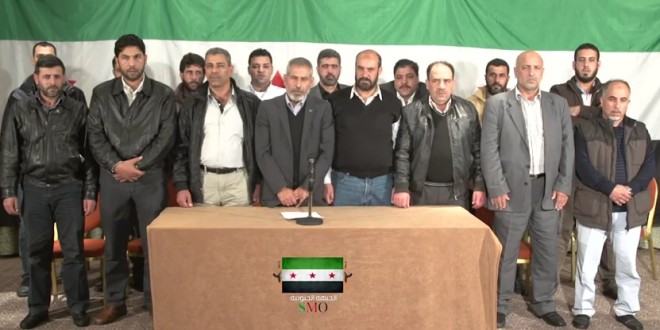
The Free Syrian Army – Southern Front

 Untitled6753423324546-660x330

Transitional Phase
10.12.2014

STATEMENT NO. 4

THE TRANSITIONAL PHASE

The collapse of the current Assad led regime will not be the end of the Syrian people’s revolution. The end of the regime will be only the start of a new and, hopefully, final phase of the people’s struggle for freedom. In order to ensure that the final phase succeeds the establishment of a new national model of governance based on respect for human dignity and a rebirth of Syria’s tremendous potential will be initiated.  It is imperative that all nationalist forces commit to a course of action during the period of transition from authoritarianism that will fulfil the popular will.

Therefore,

The Southern Front announces that it will dedicate its efforts during the period of transition following the collapse of the regime to supporting:

First: the protection of all Syrian citizens, their property and their rights without any distinction of religion, culture, ethnicity, or political affiliation in accordance with International Humanitarian Law and the international standards of Human Rights.

Second: the maintenance of Syrian state institutions, including all ministries and military institutions.

Third: the integrity of the economic and service infrastructure of the state, including telecommunications, energy, water, and public and private transportation networks.

Fourth: the establishment of a process of inclusive, national, political reconstruction.


GENERAL FRAMEWORK


1- The Civil Defence Force:

Once the Assad regime collapses, the Southern Front of the Free Syrian Army intends to transition from a military organization into a civilian defence force to contribute to establishing the appropriate conditions to enable a successful political transition in Syria. Among the primary objectives of a civilian defence force will be: protecting all citizens, maintaining all state institutions, and securing the infrastructure for the economic prosperity of the country.

The Joint Command of the Southern Front is currently preparing itself for the moment of transition and is committed to implementing a detailed day-after plan to protect Damascus (the seat of government), prevent looting, protect citizens and state employees, and ensure that governmental institutions remain fully operational.

2- The Transitional Administration:

To guide the period of transition, the Southern Front will support efforts to establish a Transitional Administration. The Southern Front believes that no current state employees, identified for their competence and loyal service to the state, should be excluded from continuing to serve. In addition, the Transitional Administration should be open to senior defected government officials who return to the country to help in its reconstruction. The Southern Front, which by this time will have transformed into the the Civil Defence Forces, will support such an interim governing arrangement granted that it is non-political, and led by technocrats whose terms will end upon the completion of the interim or transitional phase. .

The first task of the Transitional Administration will be announcing the cessation of all military operations and demanding foreign fighters to leave the country within a specified period of time. The Transitional Administration will also take steps to ensure that state institutions continue their routine work. It will announce to government officials including the judicial authority that their work will be guaranteed within the framework of the General Law. The civilian police will be requested to continue their work. The armed forces will be requested to remain temporarily in their barracks until security and order restored.

The current constitution will be immediately suspended and replaced by the original constitution of 1950 as an interim constitution until the drafting of a permanent constitution for the country that shall be approved by a popular referendum.

To ensure neutrality with respect to key decisions that need to be made during the critical transitional period, the Transitional Administration should issue an immediate appeal to the United Nations to form a “Syrian Transitional Phase Office” in Damascus as soon as possible with a special envoy of the UN Secretary General. This Office will be necessary to advise the Transitional Administration, coordinate foreign aid, and identify key requirements for the transition. It is also needed to recommend and supply experts and advisers to help rebuild the institutions of the state.

To ease the pressure on the Transitional Administration, and to benefit from the best Syrian minds and intellects in guiding the transition, the “Syrian Transitional Phase Office” will be requested to appoint a Syrian Advisory Committee composed of qualified professionals to draft a framework and plans for the transitional period, according to a specific timetable. The Office will also request the presence of a UN observer missions and specialist teams.

The key tasks for UN and the Syrian Advisory Committee will be:

First: to establish the High Electoral Commission.

Second: to oversee general elections to choose an “interim” legislative authority within six months, paving the way for the formation of a constituent committee for the drafting of the constitution.

Third: to form a constituent committee to draft the permanent constitution for the country within one year.

Fourth: to hold a public referendum on the constitution after the completion of the work of the constituent committee.

Fifth: to implement national elections for a new parliament and government.

All bodies formed by the “Syrian Transitional Phase Office” or by the Advisory Committee should be independent bodies. They should advise the Transitional Administration, but they should not be subject to it or overlap with it. The mandate of the Transitional Administration should be considered officially over after the holding of elections for a new parliament and government.

Long Live Free Syria

The Southern Front

source

10.12.2014

On Nir Rosen’s Definitions of ‘Sectarian’ and ‘Secular’

December 23, 2014 § Leave a comment

by Thomas Pierret

AFP photo. burying victims of the Houla massacre

Foreign Policy just published an article by David Kenner about a report on the Syrian conflict written for the US government by Nir Rosen, an ex-journalist currently working as a special adviser for conflict-resolution NGO Humanitarian Dialogue.

For several months, Rosen has been promoting an approach to the resolution of the Syrian conflict that shifts away from political transition in favour of local truces, a stance that is not dissimilar to UN Special Envoy Staffan de Mistura’s suggestion to “freeze” the conflict.

For many reasons, I do not think that this approach is in any way promising, but my concern here is different: it is rather the distinctly pro-Asad flavour of Rosen’s assessment of the conflict, which makes his piece look like an attempt at whitewashing the regime’s crimes, or to put it like Kenneth Roth from Human Rights Watch did it on Twitter, at sugarcoating deliberate mass-murder.

Rosen likes to remind his interlocutors that he has spent most of the last three years in Syria, speaking to people from all sides. This might be part of the problem: he seems to have spent so much time with regime officials that he is now speaking exactly like them.

Rosen’s report includes an old Stalinist trope about the Asads’ achievements in terms of health, education and infrastructure, an argument even the most obtuse defenders of the regime have started handling with care after the regime started to deliberately destroy much of its own infrastructures to make life impossible in rebel-held areas. In the same vein, Rosen claims that the Syrian regime was not the worst in the region before 2011. This is seriously debatable: by 2010, an aggregate index combining state repression and human development would certainly have placed Syria at the bottom of the regional ranking.

Then comes the breaking news: the Syrian regime is not sectarian, it is even staunchly secular! According to Rosen, the regime’s brutality towards the Sunni opposition “was done more out of a fear of Sunni sectarianism than as a result of the regime’s own sectarianism (sic)”. If Rosen is trying to tell us that the ruling clique in Damascus is not composed of sectarian ideologues, thanks, we knew that: Mafiosi are interested in power and money, not ideology. But that does not mean that their strategy cannot be deeply sectarian at the same time. The Syrian regime manipulated sectarian divides from day one. Does Rosen remember the first days of April 2011, when the Minister of Interior was branding the peaceful sit-in in Homs as a “Salafi Emirate”? Wasn’t that a not-so-subtle way to raise sectarian fears among minorities? Or was the Minister speaking so “out of fear of Sunni sectarianism”? Does Rosen remember that a couple of days later, Alawite auxiliaries were sent to kill protesters on Homs’ Clock Square? Did that also happen “out of fear of Sunni sectarianism”? Later that month, other Alawite militiamen were sent into the coastal village of al-Bayda, and filmed themselves tramping over the bodies of Sunni prisoners. An admirably non-sectarian move, once again! I had thought that faced with the same situation, a genuinely secular government would have sent uniformed security forces from other provinces rather than civilian auxiliaries from the rival local sect, but thanks to his three-year fieldwork expertise, Rosen redefined the whole concept of non-sectarianism: it means acting in a deeply sectarian manner while remaining staunchly secular in one’s heart.

My favourite display of regime “secularism” is this June 2013 speech by Asad’s head of security in Aleppo Muhammad Khaddur, who was trying to recruit Shia militiamen in the villages of Zahra and Nubbul by promising them he would “raise the flag of (Imam) Hussein over Munnagh airport”. That was staggeringly non-sectarian, wasn’t it? And of course, why would one think that a regime that is busy full-time recruiting sectarian militias from as far as Afghanistan is anything else than “non-sectarian in nature”?

I suppose that many of Rosen’s skeptical readers will wonder about sectarian massacres such as al-Hula in 2012, and al-Bayda/Banyas the following year, in which hundreds of Sunni civilians were killed by Alawite shabbiha. Were they also carried out “out of fear of Sunni sectarianism”?

Rosen’s report also includes the baffling claim that most rebels did not take up arms to defend themselves, but “out of religious zeal and political extremism”. So, from 2011 on, tens of thousands of ordinary Syrians picked up arms in a context of bloody repression of demonstrations, mass round up and torture, followed by shelling and air bombing of civilians. By 2012, Rosen was writing, on the basis of his own observations, that by cordoning off their neighbourhoods, the rebels had allowed people to demonstrate without being shot at by security forces, which strikingly looks like a defensive move to me. But after two more years of meticulous research (was it in SANA’s archives?), Rosen eventually managed to isolate the one main independent variable behind the militarisation of the uprising: it was “religious zeal and political extremism”. It is that simple: why care about the context when you can make sweeping essentialist assumptions about Sunni extremism?

Thomas Pierret is a Lecturer in Contemporary Islam at the University of Edinburgh. He is the author of Religion and State in Syria (Cambridge University Press, 2013).

source

Blog at WordPress.com.

Up ↑