Search

band annie's Weblog

I have a parallel blog in French at http://anniebannie.net

Category

USA

Once the card up its sleave, the Bush/Sharon letter is now being used against Israel

On Monday George Mitchell met with Israeli Defense Minister Ehud Barak in New York to continue the ongoing US-Israeli discussion on settlements. Ha’aretz reported on an interesting moment from the meeting in their article “Obama: U.S. will be ‘honest’ with Israel on settlements”:

The disagreement over the understandings concerning the settlements produced an embarrassing encounter in London last week during a meeting between Mitchell, Deputy Prime Minister Dan Meridor and a number of Netanyahu’s advisers.

At the meeting, the Israelis claimed there was a letter between former president George W. Bush and former prime minister Ariel Sharon stating that the settlement blocs would remain in Israeli hands, so construction is permitted there. Mitchell showed the Israelis that one of the letter’s sections discusses the principle of two states for two peoples. “That is also written in the letter – do you agree to that?” he asked.

READ ON

It was only a matter of time – Israeli govt minister compares Obama to Pharaoh

Israeli anxiety over the Obama administration actually being serious about settlement growth seems to getting worked into a full blown lather. Ha’aretz is following the frenzy closely and reports on a meeting between George Mitchell and Israeli officials in London to follow up on the Obama-Netanyahu meeting two weeks ago. The article has the unintentionally funny headline “Israel to U.S.: ‘Stop favoring Palestinians’:

The Israeli delegates were stunned by the uncompromising U.S. stance, and by statements from Mitchell and his staff that agreements reached with the Bush administration were unacceptable. An Israeli official privy to the talks said that “the Americans took something that had been agreed on for many years and just stopped everything.”

“What about the Tenet Report, which demanded that the Palestinians dismantle the terror infrastructure?” said the official, referring to former CIA director George Tenet. “It’s unfair, and there is no reciprocity shown toward the Palestinians.”

The Israeli envoys said the demand for a total settlement freeze was not only unworkable, but would not receive High Court sanction. Tensions reportedly reached a peak when, speaking of the Gaza disengagement, the Israelis told their interlocutors, “We evacuated 8,000 settlers on our own initiative,” to which Mitchell responded simply, “We’ve noted that here.”

Ha’aretz also points out the Israeli delegates’ disappointment that the Obama administration will not honor the deals the Bush administration struck with Ariel Sharon.

As can be expected, Israeli politicians are turning this disagreement over policy into an existential crisis. Noam Sheizaf points to this quote on his Promised Land blog:

“The American demand to prevent natural growth is unreasonable, and brings to mind Pharaoh who said: Every son that is born ye shall cast into the river,” Science Minister and Habayit Hayehudi head Daniel Herschkowitz said Sunday.

Sheizaf ends with, “My guess is that it is only a matter of time before Obama will be compared to Hitler.”

With Amalek in Iran, and the Pharoah running things in DC, Israel will really have its work cut out for it. Unfortunately, for all the fireworks, the US has still not decided how it wants to hold Israel accountable to stopping settlement growth. Helene Cooper reports today in her Times article “U.S. Weighs Tactics on Israeli Settlement” that “placing conditions on loan guarantees to Israel, as the first President Bush did nearly 20 years ago, is not under discussion,” and that at this point the US is only considering symbolic actions such as “refraining from the instant Security Council veto of United Nations resolutions that Israel opposes.” Small steps.

source

Iran official blames U.S. in deadly mosque bombing

By Zahra Hosseinian and Fredrik Dahl

TEHRAN (Reuters) – An Iranian official accused the United States on Friday of involvement in a mosque bombing that killed more than 20 people in volatile southeastern Iran, two weeks before a presidential election.

Washington denied the allegation.

READ ON

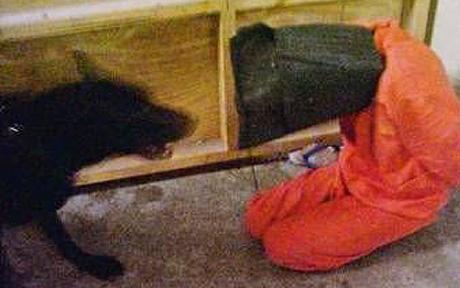
Abu Ghraib abuse photos ‘show rape’

A previous image of Iraq prison abuse

Photographs of alleged prisoner abuse which Barack Obama is attempting to censor include images of apparent rape and sexual abuse, it has emerged.

By Duncan Gardham, Security Correspondent and Paul Cruickshank
Last Updated: 8:21AM BST 28 May 2009

Iraq prison abuse: Abu Ghraib abuse photos ‘show rape’

At least one picture shows an American soldier apparently raping a female prisoner while another is said to show a male translator raping a male detainee.

Further photographs are said to depict sexual assaults on prisoners with objects including a truncheon, wire and a phosphorescent tube.

Barack Obama attempts to block alleged torture photos

Another apparently shows a female prisoner having her clothing forcibly removed to expose her breasts.

Detail of the content emerged from Major General Antonio Taguba, the former army officer who conducted an inquiry into the Abu Ghraib jail in Iraq.

Allegations of rape and abuse were included in his 2004 report but the fact there were photographs was never revealed. He has now confirmed their existence in an interview with the Daily Telegraph.

The graphic nature of some of the images may explain the US President’s attempts to block the release of an estimated 2,000 photographs from prisons in Iraq and Afghanistan despite an earlier promise to allow them to be published.

Maj Gen Taguba, who retired in January 2007, said he supported the President’s decision, adding: “These pictures show torture, abuse, rape and every indecency.

READ ON

Obama Tells Netanyahu He Has an Iran Timetable

The New York Times
Prime Minister Benjamin Netanyahu of Israel and President Obama had an extended meeting in the Oval Office on Monday.
SHERYL GAY STOLBERG

obanet

WASHINGTON — President Obama said Monday that he expected to know by the end of the year whether Iran was making “a good-faith effort to resolve differences” in talks aimed at ending its nuclear program, signaling to Israel as well as Iran that his willingness to engage in diplomacy over the issue has its limits.
CONTINUED

The NYT sums up Obama’s civil liberties record in one paragraph

Glenn Greenwald
Saturday May 16, 2009 07:26 EDT

(updated below – Update II)

Among progressives, Democrats, liberals, Obama supporters and the like, there seems to be some debate about the extent to which Obama deserves criticisms for what he has done thus far in the realm of civil liberties, restoration of Constitutional principles, and reversing the severe imbalance between “security” and liberties — major planks of his two-year-long campaign and among the most frequent weapons used to criticize the Bush presidency. On that topic, here is the first paragraph of this New York Times article this morning by David Sanger, summing everything up:

President Obama’s decisions this week to retain important elements of the Bush-era system for trying terrorism suspects and to block the release of pictures showing abuse of American-held prisoners abroad are the most graphic examples yet of how he has backtracked, in substantial if often nuanced ways, from the approach to national security that he preached as a candidate, and even from his first days in the Oval Office.

Here’s how the NYT describes the article on its front page:

The opening paragraph of this Washington Post article today says much the same thing:

As a candidate for president, Barack Obama offered himself as a clear alternative to Bush-era anti-terrorism policies. Governing has proven muddier.

Both articles quote the hardest-core Bush supporters as heaping praise on Obama for what he has done in the area of “national security,” terrorism and civil liberties (“Pete Wehner, a member of Karl Rove’s staff in the Bush White House [and a current National Review writer] applauded several of Mr. Obama’s decisions this week”).

Indeed, all week long, and even before that, the greatest enthusiasm for Obama’s decisions on so-called “terrorism policies” and civil liberties (with some important exceptions) has been found in the pages of The Weekly Standard and National Review.

Can anyone deny what the NYT and Post are pointing out today? This is what happened this week alone in the realm of Obama’s approach to “national security” and civil liberties:

Monday – Obama administration’s letter to Britian threatening to cut off intelligence-sharing if British courts reveal the details of how we tortured British resident Binyam Mohamed;

Tuesday – Promoted to military commander in Afghanistan Gen. Stanley McChyrstal, who was deeply involved in some of the worst abuses of the Bush era;

Wednesday – Announced he was reversing himself and would try to conceal photographic evidence showing widespread detainee abuse — despite the rulings from two separate courts (four federal judges unanimously) that the law compels their disclosure;

Friday – Unveiled his plan to preserve a modified system of military commissions for trying Guantanamo detainees, rather than using our extant-judicial processes for doing so.

It’s not the fault of civil libertarians that Obama did all of those things, just in this week alone. These are the very policies — along with things like the claimed power to abduct and imprison people indefinitely with no charges of any kind and the use of the “state secrets privilege” to deny torture and spying victims a day in court — that caused such extreme anger and criticisms toward the Bush presidency.

What would it say about a person who spent the last seven years vehemently criticizing those policies to suddenly decide that the same policies were perfectly fine or not particularly bothersome when Obama adopts them? How could that be justified? What should one say about a person who vehemently objected to X when Bush did it, but then suddenly found ways to defend or mitigate X when Obama does it? Just re-read that first paragraph from the NYT article today. What should a rational person say in response to what it describes?

It is absolutely true that there have been some important steps Obama has taken in the right direction that George Bush and John McCain would never have entertained, including banning interrogation techniques outside of the Army Field Manual, barring CIA secret prisons, guaranteeing International Red Cross access to all detainees, and releasing numerous Bush era OLC memos. He deserves praise for those decisions and has received it here.

But other than the OLC memos, those steps all came in the very first week of his presidency in largely symbolic form. At the time, in the first week, I wrote that Obama’s first-week executive orders “meet or actually exceed even the most optimistic expectations of civil libertarians for what he could or would do quickly,” but:

This is why the understandable enthusiasm (which I definitely share) over Obama’s pleasantly unexpected commitment in the first few hours of his presidency to take politically difficult steps in the civil liberties and accountability realms should be tempered somewhat.

There is going to be very concerted pressure exerted on him by establishment guardians such as Hiatt (and the Brookings Institution, Jack Goldsmith and friends), to say nothing of hard-line factions within the intelligence community and its various allies, for Obama to take subsequent steps that would eviscerate much of this progress, that render these initial rollbacks largely empty, symbolic gestures. Whether these steps, impressive as they are, will be symbolic measures designed to placate certain factions, or whether they represent a genuine commitment on Obama’s part, remains to be seen. Much of it will depend on how much political pressure is exerted and from what sides.

Obama deserves real praise for devoting the first few days of his presidency to these vital steps — and doing so without there being much of a political benefit and with some real political risk. That’s genuinely encouraging. But ongoing vigilance is necessary, to counter-balance the Fred Hiatts, Brookings Institutions and other national security state fanatics, to ensure that these initial steps aren’t undermined.

Since that first week, Obama has engaged in one action after the next to preserve many of the key prongs, and the essential architecture, of the Bush/Cheney abuses of executive power and civil liberties. That’s just factually true. What’s the point of closing Guantanamo if we’re going to continue to keep people indefinitely in cages with no trial in Bagram, or if we simply transport a modified version of Guantanamo justice to the U.S.? How can a President who repeatedly promised vast transparency embrace the most extremist Bush/Cheney secrecy powers?

How can a person who campaigned on the vow to end “Scooter Libby justice” and restore the rule of law take one extreme step after the next to shield from judicial scrutiny some of the most serious, brutal and highest-level crimes of the last eight years?

It’s certainly true that there are other issues besides civil liberties and national security policies that are important. The fact that he’s been horrible in these areas doesn’t mean he hasn’t been good in others.

One can argue, if one likes, that these civil liberties issues don’t really matter (a representative of Center for American Progress joined with two conservatives to claim exactly that yesterday on CNN), or one can argue that all that matters is that we fix the banking crisis and implement a new health care policy. But I never heard any Bush critics — not one — say anything like that when these issues were front and center in the case against the Bush presidency.

Nobody who spent the last many years devoting themselves to opposing Bush/Cheney abuses of executive power and civil liberties wanted to have to do the same in an Obama presidency. If you doubt that, just look at how intense was the celebratory praise directed at Obama from those factions in the first week.

But unless the opposition of the last eight years was really just a cynical means for opportunistically weakening and demonizing Republican opponents rather than opposing policies that one genuinely found dangerous and wrong, then the actions of Obama are leaving no other choice but to object and object strenuously. As the first paragraph of today’s NYT article put it, this week alone provided “the most graphic examples yet of how [Obama] has backtracked, in substantial if often nuanced ways, from the approach to national security that he preached as a candidate, and even from his first days in the Oval Office.” If nothing else, refraining from objecting will ensure that this continues further and further.

* * * * *

Yesterday morning, I was on WNYC’s The Takeway discussing (briefly) the issue of Obama’s military commissions and, more extensively, drug policy and decriminalization in Portugal. That can be heard here.

UPDATE: The Wall St. Journal Editorial Page today:

President Obama’s endorsements of Bush-Cheney antiterror policies are by now routine . . . . Mr. Obama deserves credit for accepting that the civilian courts are largely unsuited for the realities of the war on terror. He has now decided to preserve a tribunal process that will be identical in every material way to the one favored by Dick Cheney . . . Meanwhile, friends should keep certain newspaper editors away from sharp objects. Their champion has repudiated them once again.

Meanwhile, Law Professor Julian Ku notes that Obama Deputy Solicitor General Neal Katyal spent years arguing that military commissions generally (not merely Bush’s specific version) were oppressive and un-American (h/t). But now, thanks to Obama’s embrace of them, Katyal is going to have to defend Obama’s military commissions in court from challenge by the ACLU and other groups. At least Katyal has the excuse that defending exactly that which he spent years excoriating is his job. Obama supporters who are doing the same don’t have that excuse.

UPDATE II: Illustrating the irrationality that is used, Obama defenders are making the following two arguments to justify what he did on military commissions:

(1) Obama had no choice because he can’t obtain convictions of accused terrorists in civilian courts because so much of the evidence was obtained by Bush’s torture and thus can’t be used;

(2) Obama’s military commissions are better than Bush’s because Obama’s commissions won’t allow evidence obtained by torture.

Aren’t those two propositions completely contradictory? If Obama’s military commissions (like civilian courts and courts-martial) won’t allow evidence obtained via torture, then why can’t he use our normal court system to try accused terrorists?

— Glenn Greenwald

source
The 13 people who made torture possible

The Bush administration’s Torture 13. They authorized it, they decided how to implement it, and they crafted the legal fig leaf to justify it.

cover
By Marcy Wheeler

On April 16, the Obama administration released four memos that were used to authorize torture in interrogations during the Bush administration. When President Obama released the memos, he said, “It is our intention to assure those who carried out their duties relying in good faith upon legal advice from the Department of Justice that they will not be subject to prosecution.”

Yet 13 key people in the Bush administration cannot claim they relied on the memos from the DOJ’s Office of Legal Counsel. Some of the 13 manipulated the federal bureaucracy and the legal process to “preauthorize” torture in the days after 9/11. Others helped implement torture, and still others helped write the memos that provided the Bush administration with a legal fig leaf after torture had already begun.

The Torture 13 exploited the federal bureaucracy to establish a torture regime in two ways. First, they based the enhanced interrogation techniques on techniques used in the U.S. military’s Survival, Evasion, Resistance and Escape (SERE) program. The program — which subjects volunteers from the armed services to simulated hostile capture situations — trains servicemen and -women to withstand coercion well enough to avoid making false confessions if captured. Two retired SERE psychologists contracted with the government to “reverse-engineer” these techniques to use in detainee interrogations.

The torture 13 also abused the legal review process in the Department of Justice in order to provide permission for torture. The DOJ’s Office of Legal Counsel (OLC) played a crucial role. OLC provides interpretations on how laws apply to the executive branch. On issues where the law is unclear, like national security, OLC opinions can set the boundary for “legal” activity for executive branch employees.

As Jack Goldsmith, OLC head from 2003 to 2004, explains it, “One consequence of [OLC’s] power to interpret the law is the power to bestow on government officials what is effectively an advance pardon for actions taken at the edges of vague criminal statutes.”

OLC has the power, Goldsmith continues, to dispense “get-out-of-jail-free cards.” The Torture 13 exploited this power by collaborating on a series of OLC opinions that repeatedly gave U.S. officials such a “get-out-of-jail-free card” for torturing.

Between 9/11 and the end of 2002, the Torture 13 decided to torture, then reverse-engineered the techniques, and then crafted the legal cover. Here’s who they are and what they did:

1. Dick Cheney, vice president (2001-2009)

Dick Cheney

On the morning of 9/11, after the evacuation of the White House, Dick Cheney summoned his legal counsel, David Addington, to return to work. The two had worked together for years. In the 1980s, when Cheney was a congressman from Wyoming and Addington a staff attorney to another congressman, Cheney and Addington argued that in Iran-Contra, the president could ignore congressional guidance on foreign policy matters. Between 1989 and 1992, when Dick Cheney was the elder George Bush’s secretary of defense, Addington served as his counsel. He and Cheney saved the only known copies of abusive interrogation technique manuals taught at the School of the Americas. Now, on the morning of 9/11, they worked together to plot an expansive grab of executive power that they claimed was the correct response to the terrorist threat.

Within two weeks, they had gotten a memo asserting almost unlimited power for the president as “the sole organ of the Nation in its foreign relations,” to respond to the terrorist attacks. As part of that expansive view of executive power, Cheney and Addington would argue that domestic and international laws prohibiting torture and abuse could not prevent the president from authorizing harsh treatment of detainees in the war against terror.

READ ON

Obama bombs

EXCLUSIVE – List of 140 Afghan dead includes 93 children Reuters – Villagers look at the destruction caused after air strikes in Ganj Abad of Bala Buluk district, Farah …
By Hamid Shalizi Hamid Shalizi – Wed May 13, 5:35 am ET

KABUL (Reuters) – Ninety-three children and 25 adult women are among a list of 140 names of Afghans who villagers say were killed in a battle and U.S. air strikes last week, causing a crisis between Washington and its Afghan allies.

The list, obtained by Reuters, bears the endorsement of seven senior provincial and central government officials, including an Afghan two-star general who headed a task force dispatched by the government to investigate the incident.

Titled “list of the martyrs of the bombardment of Bala Boluk district of Farah Province”, it includes the name, age and father’s name of each alleged victim.

The youngest was listed as 8-day-old baby Sayed Musa, son of Sayed Adam. Fifty-three victims were girls under the age of 18, and 40 were boys. Only 22 were men 18 or older.

The U.S. military continues to dispute the toll and a military spokesman said some of the names could be fake.

The dispute over the number of dead has worsened tension between Washington and Kabul, despite apologies President Barack Obama and Secretary of State Hillary Clinton made during a visit to Washington by President Hamid Karzai last week.

The Afghan government has endorsed the list, and Karzai went on U.S. television to call for an end to all U.S. air strikes, only to be rebuffed by Washington. Afghan officials say the issue helps insurgents by turning the public against foreign forces.

Since last year, U.S. officials adopted new procedures for investigations of civilian casualties designed to ensure their statements agree with those of the Afghan government.

Nevertheless, Washington has continued to dispute the death toll. U.S. military spokesman Colonel Greg Julian said villagers had an incentive to invent names of dead relatives in the hope of collecting compensation

READ ON

Full Cheney Panic

CHENEYChipSomodevilla:Getty
10 May 2009 08:05 pm

I don’t know how else to interpret his obviously self-destructive grandstanding this weekend. But think of the long view for a moment. Here is a former vice-president, who enjoyed unprecedented power for eight long, long years. No veep ever wielded power like he did in the long history of American government. In the months after 9/11, he swept all Congressional resistance away, exerted total executive power, wielded a military and paramilitary apparatus far mightier than all its rivals combined and mightier than any power in history, tapped any phone he wanted, claimed the right to torture any suspect he wanted (and followed through with thousands, from Bagram to Abu Ghraib) and was able to print and borrow money with impunity to finance all of it without a worry in the world. But even after all that, he cannot tolerate a few months of someone else, duly elected, having a chance to govern the country with a decent interval of grace.


READ ON

Blog at WordPress.com.

Up ↑