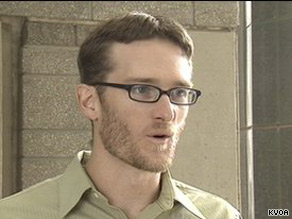
Walt Staton was convicted in June of littering by leaving jugs of water in a wildlife refuge.By Taylor Gandossy
CNN
(CNN) — An Arizona man caught leaving water bottles in the desert for illegal immigrants has been sentenced to 300 hours of community service and a year of probation, an aid group said.
Walt Staton was convicted in June of littering by leaving jugs of water in a wildlife refuge.
Walt Staton was convicted in June of littering by leaving jugs of water in a wildlife refuge.
Walt Staton, a member of the group No More Deaths, left full water bottles in December in Buenos Aires National Wildlife Refuge for the illegal immigrants who routinely pass through the 18,000-acre refuge, according to court documents.
A judge sentenced him Tuesday to 300 hours of picking up trash on public property and a year of probation, No More Deaths said in a written statement. He is also banned from the refuge during that time, the group said.
Kelley Vlahos has a great piece today on the Henry Gates affair and the larger problems of which it’s a symptom. One such problem is the ever increasing number of pretexts on which the authorities can interrogate, search, assault, and arrest citizens. The authority figure, equipped with endless excuses to initiate an interaction with the citizen, from an expired tag to a false burglar alarm to an alleged whiff of what might be a controlled substance, uses his or her superior knowledge of legal arcana to find some way to put the citizen behind bars. For instance, what struck me when reading the policeman’s account of the Gates incident was a small detail: the repeated use of the term “tumultuous.” It appears three times in the brief report in descriptions of Gates’ behavior. Why was the cop fixated on this SAT word?
Turns out, it appears in the Massachusetts statute defining disorderly conduct. The cop goaded the agitated Gates into stepping outside of his house (he made sure to give a reason for this in the report – poor acoustics in Gates’ kitchen!) to create the grounds for an arrest. The cop already knew the specific – though vague and debatable – adjective he should use in his report to make the charge sound incontestable to the lawnorder crowd.
The proliferation of new laws in the wake of 9/11, all full of vague and debatable terms, has given the authorities infinite points of entry into all of our lives. They truly can arrest first and read the statutes later; you’re sure to have done something wrong. Even if they eventually drop the charges or fail to convict you, don’t count on getting any compensation for your anxiety, lost time, injuries, or legal fees.
An analogous situation prevails in international affairs, where the global police churn out endless legal pretexts for subjecting whole countries to full body-cavity searches, house arrest, assault, and capital punishment, and we’re watching it play out yet again in the case of Iran. But that’s a post for another day.
A rally was held this evening protesting the arrival of the US envoys in Israel. Members of National Union, Likud and Israel Beiteinu led the crowd, which included Kahanists wearing t-shirts saying “Kahane was right,” referring to Meir Kahane’s ideology of violence against all who stand in the way of the constant expansion of Jewish territory.
Walter Cronkite: ‘We Are Mired in Stalemate,’ Feb. 27, 1968
When I watched Walter Cronkite’s heroic commentary in early 1968, I thought the country might finally have turned around on the Vietnam War. But Cronkite was ahead of the curve on Vietnam, and the US remained there for another seven years, costing the lives of tens of thousands more Americans and millions more Southeast Asians.
After Cronkite’s broadcast, President Lyndon Johnson is reported to have said, “If I’ve lost Cronkite, I’ve lost Middle America.” Several weeks later, Johnson announced he would not seek reelection.
Walter Cronkite died today at the age of 92. His 1968 words should be read again:
Tonight, back in more familiar surroundings in New York, we’d like to sum up our findings in Vietnam, an analysis that must be speculative, personal, subjective. Who won and who lost in the great Tet offensive against the cities? I’m not sure. The Vietcong did not win by a knockout, but neither did we. The referees of history may make it a draw. Another standoff may be coming in the big battles expected south of the Demilitarized Zone. Khesanh could well fall, with a terrible loss in American lives, prestige and morale, and this is a tragedy of our stubbornness there; but the bastion no longer is a key to the rest of the northern regions, and it is doubtful that the American forces can be defeated across the breadth of the DMZ with any substantial loss of ground. Another standoff. On the political front, past performance gives no confidence that the Vietnamese government can cope with its problems, now compounded by the attack on the cities. It may not fall, it may hold on, but it probably won’t show the dynamic qualities demanded of this young nation. Another standoff.
We have been too often disappointed by the optimism of the American leaders, both in Vietnam and Washington, to have faith any longer in the silver linings they find in the darkest clouds. They may be right, that Hanoi’s winter-spring offensive has been forced by the Communist realization that they could not win the longer war of attrition, and that the Communists hope that any success in the offensive will improve their position for eventual negotiations. It would improve their position, and it would also require our realization, that we should have had all along, that any negotiations must be that — negotiations, not the dictation of peace terms. For it seems now more certain than ever that the bloody experience of Vietnam is to end in a stalemate. This summer’s almost certain standoff will either end in real give-and-take negotiations or terrible escalation; and for every means we have to escalate, the enemy can match us, and that applies to invasion of the North, the use of nuclear weapons, or the mere commitment of one hundred, or two hundred, or three hundred thousand more American troops to the battle. And with each escalation, the world comes closer to the brink of cosmic disaster.
To say that we are closer to victory today is to believe, in the face of the evidence, the optimists who have been wrong in the past. To suggest we are on the edge of defeat is to yield to unreasonable pessimism. To say that we are mired in stalemate seems the only realistic, yet unsatisfactory, conclusion. On the off chance that military and political analysts are right, in the next few months we must test the enemy’s intentions, in case this is indeed his last big gasp before negotiations. But it is increasingly clear to this reporter that the only rational way out then will be to negotiate, not as victors, but as an honorable people who lived up to their pledge to defend democracy, and did the best they could.
Meet Wendell Potter. Bill Moyers interviews former health insurance industry executive Wendell Potter, who left the field after almost 20 years to become a health reform advocate. Check out Potters personal story here and tune in to Bill Moyers Journal, Friday, July 10, 2009 at 9PM on PBS (check local listings http://www.pbs.org/moyers/journal/abo… ) for his experiences inside the health insurance industry, their work fighting a public option, and the insurance companies close ties to Washington. The entire interview will be available after broadcast at www.pbs.org/moyers .
McKinney released from Israeli Prison, returning to United States
Print
Heart
Rhonda Cook and Larry Hartstein
The Atlantic Journal-Constitution
Cynthia McKinney’s mom said she’s learned that her daughter is on the way home.
Leola McKinney said a friend who contacted the U.S. Embassy in Israel reported that the former congresswoman was released from Israeli custody and taken to Ben Gurion International Airport.
“We finally got word that she was released,” Leola McKinney said late Sunday afternoon. “We don’t know what time she is supposed to fly out. All we know is that they took her to the airport.
“I would be more relieved when I know she’s on the flight,” Leola McKinney added. “But I am relieved that she’s away from there.”
McKinney had been in custody since Tuesday, when she and 20 others were swept up by the Israeli Navy while allegedly trying to sail through a navy blockade. The group says it was attempting to deliver humanitarian supplies to Gaza.
We’ve asked Prof. Joel Beinin, Donald J. McLachlan Professor of History and Middle East History at Stanford University, to give us his impression on President Obama’s speech in Cairo today. We’re sharing his response with you.
An articulate and charismatic President of the United States named Barack Hussein Obama giving a speech at Cairo University co-sponsored by al-Azhar, the most eminent institution of Muslim learning – now that’s a new picture. Its enormous symbolic value is President Obama’s biggest asset as he implements policy on the entire range of difficult issues he mentioned.
The President stated, “Given our interdependence, any world order that elevates one nation or group of people over another will inevitably fail.” This is an excellent basis for resolving the Palestinian-Israeli conflict.
The President did not provide details on how the conflict should be resolved beyond general support for “two states, where Israelis and Palestinians each live in peace and security.” But the meaning of this formulation is now contested due to its empty repetition by presidents and prime ministers whose actions and inactions have undermined it. Instead President Obama emphasized U.S. rejection of “the legitimacy of continued Israeli settlements,” saying nothing about the future of those settlements already existing and their nearly 500,000 inhabitants. By limiting himself to an apparently pragmatic “first step,” President Obama may have made his task harder. If he does not produce concrete results very soon on this limited, albeit it absolutely necessary, measure, then the potential value of his fine words in Cairo will soon diminish.
By JEFF ZELENY and HELENE COOPER
Published: June 4, 2009
CAIRO — President Obama pledged on Thursday to “seek a new beginning between the United States and Muslims around the world,” imploring America and the Islamic world to drop their suspicions of one another and forge new alliances to confront violent extremism and heal religious divides.