Tonight’s (Monday) Panorama programme was truly appalling
even by the BBC’s dire standards.
Willem happened to spot it just before it started – to the
best of our knowledge it had not been advertised in advance.
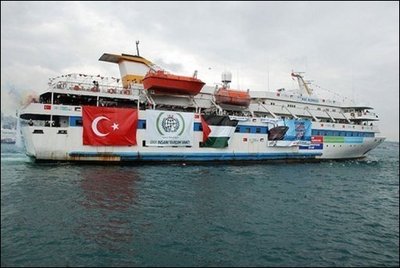
It claimed to be looking into “what really happened” when
the Israeli navy attacked the Mavi Marmara. No chance.
It’s hard to know where to start, but here are just some of the
aspects of bias that struck us:
– copious interviews with Israeli military spokespeople including
one who took part in the assault, whose anonymity was
preserved by blurring his face and anonymising him as “Lieutenant A”;
– use of film footage either shot by the Israelis or stolen
by them from those on the boat;
– use of some film footage by “Cultures of Resistance”, but always
with the implication that this was a group which encouraged
violence;
– portrayal of the IHH as a terrorist group which took control of
the ship;
– NO interviews with any Palestinian person, to the best of my knowledge,
apart from a Hamas spokesman;
– interviews with only ONE non-Turkish person on the boat, so that
most of the testimony from those on the boat was mediated by
translation;
– no interviews with representatives of any organisation participating
in the flotilla apart from IHH;
– no interviews with anyone on any of the other boats, indeed hardly
any mention that the Mavi Marmara was part of a large flotilla
organised by international humanitarian groups;
– no indication whatsoever that Israel’s attack might have been illegal
under international law – the emphasis was only on whether the force
used was “proportionate”;
– scheduling the broadcast during the evening in the first week of
Ramadan when many Muslim viewers were unlikely to be watching because
they would be breaking their fast;
– worst of all, playing the tape provided by the Israelis which has a
voice supposedly saying to them, from the Mavi Marmara, “go back to
Auschwitz”.
This tape has been SHOWN to be a fake. Any pretence at investigative
journalism has gone right out of the window.
As some of you know, Tony Greenstein has been collecting signatures for an
advertisement to be placed in the Independent (and also the Guardian if funds
permit) raising the issue of the BBC’s consistent pro-Israel bias. Now is
the time for that advert to be published! But Tony still needs funds. Send
your pledges to him at tonygreenstein@yahoo.com and he will tell you where to
send the cheques. You can add your signature too if you have not yet done so.
Tony can let you have the full text of the proposed advertisement.
Here are the BBC web pages covering this abysmal piece of broadcasting – the
tone of the web pages are exactly the tone of the programme itself:
I work crazy hours, get screamed at by unruly passengers, and have often fantasized about popping that escape slide and gliding to freedom. Will I actually snap one day?
The recent news about Steven Slater, the JetBlue flight attendant who cursed out his passengers, grabbed a couple beers, and rode the escape slide to freedom, had me thinking. Have I ever come close to my breaking point on the plane?
I remember working a flight from New York to Los Angeles when a man boarded wearing black sunglasses and a suit coat. He took off his coat, threw it onto my shoulder, and simply said, “Take care of it.” I thought, he can’t be serious. But serious he was. I smiled, folded it up nicely, and placed it in the overhead bin. The man slowly turned around, glaring, and said, “I told you to take care of it.” I smiled again, and responded, “I did.” We didn’t have closets on board that aircraft, and the moment was filled with tension. Later in the flight, this same passenger pushed his entire meal onto the floor of the plane because he “didn’t like the way it looked.”
Later in the flight, this same passenger pushed his entire meal onto the floor of the plane because he “didn’t like the way it looked.”
Still, I kept my cool. I talked it out with the other flight attendants on the flight, took their suggestions for dealing with the problem, and dealt with it. Don’t get me wrong, many times I have thought, How great would it be to pop the slide just to get out of here? But I would never do it.
In November of 2005, I filed an application with a regional airline to become a flight attendant. I did it because I was living in Los Angeles without a job and a friend of mine had described it as “awesome.” I had seen movies like View from the Top, which made the job look glamorous and exclusive, but I was skeptical that it was always that way.
I couldn’t have been more right.
Soon after you graduate flight attendant training, reality hits you. You find out that you’re only paid from the moment the aircraft door closes until the time that it opens again, which means transportation to and from a hotel is considered “rest” or “sleeping.” And you discover that, as a new hire, you are an “on-call reserve flight attendant,” meaning you can be called up and told to rush to a plane at any time. Even for more senior flight attendants, the schedules can be grueling—even as I write this, at midnight, my 4:45 a.m. wake-up call for my flight to San Francisco is looming.
When I first started flying I was based in Washington D.C. and I worked on an aircraft that had two flight attendants. The Federal Aviation Administration believes that every 50 seats warrants one flight attendant (personally, I think that ratio needs to be smaller). Having the extra crewmember means having someone to talk to on long flights. It also means you’re not the only target for passenger ire in the event that something goes wrong. And trust me, things go wrong.
I remember landing in Key West, Florida from Fort Lauderdale. We were supposed to turn around and go right back to Fort Lauderdale, on to Orlando, then up to Washington D.C. to end our trip. That didn’t happen. Instead, when we landed in Key West we deplaned, cleaned the cabin (that’s right, sometimes we’re the cleaners, too) and started to re-board the aircraft. I was working in the front, and the captain called me into the flight deck. Apparently there was a problem with our brakes and it wasn’t safe for us to fly the aircraft until it was fixed. I got to break the news to the full flight. People began screaming at me instantly. One passenger yelled at me that he had a meeting to get to. I would have liked to snap back, “Would you like to get there alive?” But I just smiled and said sweetly, “I’m so sorry. Hopefully they can fix this fast.”
Why was I having to apologize for an airplane breaking and my pilots deciding not to fly it? Getting yelled at for being the bearer of bad news—or even non-news—is not uncommon. Passengers take the things we tell them personally. Let’s say you’re sitting in your seat sending a text message. The main cabin door has been closed, and the safety demonstration has been completed.
By now, you’ve heard at least three times that all electronic devices have to be turned off. So why isn’t yours? The flight attendant comes over and asks you to turn it off, in front of everyone. It’s situations like this, where the passenger feels singled out, that start most of the confrontations on board. But we’re just doing our job. Asking people to push bags under their seats, put bags in bins, fasten seatbelts, shut off electronics, bring seats fully upright—we’re not picking on you or singling you out. We’re working.
I admire Steven for doing what he did. On a daily basis, I experience the frustrations he faced, and I can understand why he may have finally just said, Enough. (Not to mention, he did the two most taboo things in the industry: popping the slide and stealing alcohol.) But when the day is over and I walk off the airplane I can undoubtedly say I’ve handled each situation as it came to the best of my ability, and usually, I look forward to what the next day brings because no two days are ever the same.
Bobby Laurie is a lead flight attendant for a low-cost airline based in California. He resides in Phoenix, Arizona and combines his passions for writing and travel by blogging about his travel experiences and flying the friendly (sometimes!) skies. Bobby writes a flight attendant blog called Up Up & A Gay and serves as co-host of The Crew Lounge podcast.
Writer Susan Abulhawa discusses Palestine and the power of the novel
22.7.2010
Words by Rebecca Louder
On the morning of May 31st, mere hours after the Israeli flotilla attack, the Grapevine met with Palestinian-American writer Susan Abulhawa at her hotel. Susan was in Reykjavík on her way back from the Lillehammer Literature Festival in Norway. She held a small event at The Culture House to promote her latest book, Mornings In Jenin, a newly edited version of her first publication The Scar of David. The book follows the story of several generations of Palestinian characters and their personal struggles with location, identity, family and human rights. In America, her book has caused a controversial response for its pro-Palestinian stance, but she has continued to be outspoken on the topic despite the backlash. The writer seemed distraught as the charged events of the morning loomed over our interview.
How do you think fictional works can impact the global discourse on Palestinian-Israeli relations?
I think that writers, artists, musicians, poets and filmmakers in any society of conflict have a unique role to play in bringing the issues in the headlines to a human level. That’s the power of art and literature, in general—to remind us of our common humanity and that there are human beings who live the headlines and experience them in ways that are not abstract, in ways that a reader would experience them. You can take an individual through history through the lives of characters that they can get to know, that they can love or hate or what have you. Regardless, they get to know them and they can see conflict and the politics or the history through their eyes. That’s the beauty of a novel, as opposed to non-fiction or history textbooks that have more of a sterile, distant prose.
What is your personal experience in all of this?
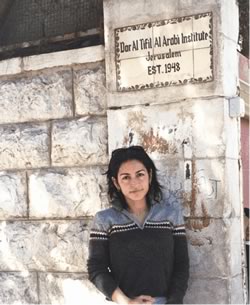
My parents were refugees of the 1967 Six Day War. Neither of them can really return to their place of birth nor live in the homes where they were born, or even visit their parents’ graves. I lived in Jerusalem when I was a little girl. Actually there’s a chapter in the book based on that, it’s called ‘The Orphanage.’ That’s really the only part of the book that is autobiographical. The entire historic background is non-fictional. It was real important to me that the historic background and the historic characters, the locations, the seasons, the fruits, etcetera, that all be real. The characters are fictionalised.
Your work has been quite controversial in the past. Why do you think that is?
I think anything that humanises Palestinians or criticises what Israel is doing creates a fury, basically. People try to shut you up. It’s not just me; it’s anybody, whether it’s academics, intellectuals, artists, what have you. That’s kind of a trend. There’s always a campaign of character assassination in trying to marginalise people.
Pro-Palestine sentiments are often deemed as being terrorist-sympathetic or anti-Semitic. Have you had these accusations launched at you?
Precisely. I think everybody who expresses this has. I don’t accept it. I’m neither a terrorist nor an anti-Semite. There’s nothing in anything I do or say that would indicate that. I think readers are smarter than that. I think they’ll see that when they read the book.
How has the book been received?
In Norway, and other European countries it’s gotten really good reviews. In America it has gotten limited reviews, but what it has gotten has been very good. Most journalists and reviewers in the United States just don’t want to touch it.
It’s not the first time. There was this wonderful play called My Name Is Rachel, it was based on the life of Rachel Corrie [American activist with the International Solidarity Movement who was crushed to death by an IDF bulldozer in 2003]. They managed to shut that down. There’s all this art by Palestinians, beautiful stuff that just reflects what’s inside of them, what they see, what their lives are about. It gets shut down. There have been several instances in the United States where that has happened. It’s because there are very powerful forces in the United States that don’t want Palestinians to appear human, because then it becomes harder to justify killing them. It becomes hard to justify raining death on this civilian population that really has nowhere to go and nowhere to run.
What is your hope for the region?
Of course there is hope. To me the solution is, and always has been, very clear. It’s the simple application of international law and the application of the universality of human rights. The declaration that Palestinians are human beings who are worthy of human rights. We are the native people of that land. We’ve been there for centuries, if not millennia, and everything has been taken from us. When the international community has the will to give more than just words and say that yes, we deserve the same rights that are accorded to the rest of humanity. That’s where the solution lies.
The West claims to value certain principles of human decency and equality, that they apply in their own countries yet support something entirely different in Israel. For example, nowhere in the West would any country allow the construction of neighbourhoods and settlements where only a certain group of people were allowed to live. No one would accept a housing unit for whites-only or having a road where only whites could travel, and yet that’s what Israel does. It’s a situation where human worth is measured on ones religion.
Palestine had always been a place where people of various religions lived. It had been a multi-cultural, multi-ethnic place and that’s the ideal, isn’t it? It should not be a place of exclusivity. It’s important that my words not be interpreted that Israelis should be kicked out or anything like that, because I don’t advocate that. That’s their country now. People were born there and live there. That’s where they’re from.
Why do you think the international community allows these human rights violations?
You’ll have to ask them. I don’t know. It’s hypocritical, it’s outrageous, actually. Luckily, the people of these nations are not necessarily on board and people of various countries are taking matters into their own hands. They are boycotting Israel and Israeli goods, and this flotilla, the Free Gaza movement, these boats have been travelling to Gaza from Cyprus carrying people from all over the world. These are ordinary citizens who have made history because they refuse to be silent in the face of what’s happening in Gaza.
People are literally and intentionally being starved to death in Gaza. Food is not allowed in or out, the economy has completely collapsed, the education system has completely collapsed. Eighty percent of Gazan children suffer from post-traumatic stress disorder, a crippling psychological disease and entire generations are being lost. The international community is doing nothing about it. Ordinary citizens are taking matters into their own hands and delivering boatloads of aid. Then today we find out that Israel in fact boarded that flotilla and killed a few people. So it remains to be seen whether the international community will yet again be silent.
Do you have any hope that they won’t be?
Well, they’re already condemning it, but they always do. They give lip service to it and then they do nothing. So I don’t place any hope or faith in any of these leaders or the so-called official international community, but I do place a lot of hope and faith in the international community that’s made up of world citizens and people of conscience to speak up and not to let this continue. People can’t really say “I didn’t know”. It’s everywhere. Israel has been held above the law. They have committed war crimes for over six decades and have done so with impunity.
This is where literature comes in, in my opinion. In the West when you say ‘Palestinian,’ people automatically conjure these really negative images and that is in large part due to this propaganda campaign over the years to paint Israel as this poor, vulnerable nation that’s just trying to defend itself when in fact it is the aggressor. Israel manages to paint Palestinians as these crazy, irrational aggressors, and that it’s just defending itself against this principally unarmed civilian population. Palestinians have nowhere to run. It has no navy, no army, no air force.
But when I think of Palestine, I think of a beautiful people. I think of a long suffering and enduring nation that despite everything gets up every morning and goes to those damn checkpoints, tries to get to work, tries to get to school and go about their daily lives. I think of a rich culture and good music and good food and stupid jokes and proverbs. I think of human beings, and that’s what I hope this book shows.
—
Michael Oren makes stuff up. But the NY Times doesn't have to publish it.
On 06.26.10, By Max Blumenthal
Nearly a month after publishing Israeli Ambassador the US Michael Oren’s apologia for the flotilla massacre, the NY Times has yet to correct two of the most glaring lies Oren made. The first of Oren’s deceptions was his assertion that “religious extremists embedded among those on board were paid and equipped to attack Israelis.”
The notion that al-Qaeda affiliated mercenaries were on board the Mavi Marmara was discredited as soon as the IDF Spokesman’s Office changed a headline on a press release about terrorist “mercenaries” to read, “Attackers of the IDF Found Without Identification Papers.” The headline was quietly altered on June 3, the same day the Times published Oren’s op-ed. Shouldn’t their fact checkers and editors been better informed?
The second of Oren’s lies was at least as ludicrous as his first. He wrote:
Also found on the boat were propaganda clips showing passengers “injured” by Israeli forces; these videos, however, were filmed during daylight, hours before the nighttime operation occurred.
If this was true, then where were the clips? Why hasn’t the IDF released any footage to support Oren’s claim? Probably because such clips do not exist anywhere. As far as I can tell, they were never on the website of the IDF Spokesman’s Office or the Israeli Foreign Ministry. The footage is not even available on YouTube. So where are they? Certainly the IDF would have wanted to publish anything that supported its version of events. But they could not conjure anything to bolster Oren’s bizarre claim (which seemed to suggest that the killing and maiming of flotilla passengers by Israeli commandos was simply “propaganda” and therefore never happened).
Unless Oren or the Israeli military can produce the “propaganda clips” Oren mentioned, the New York Times should be compelled to retract the falsehoods it published. The Times Public Editor Clark Hoyt can be reached at public@nytimes.com or (212) 556-7652
After Tuesday’s border clash, Israel will continue to ignore UNIFIL and the Lebanese army.
By Gideon Levy
Those bastards, the Lebanese, changed the rules. Scandalous. Word is, they have a brigade commander who’s determined to protect his country’s sovereignty. Scandalous.
The explanation here was that he’s “indoctrinating his troops” – only we’re allowed to do that, of course – and that this was “the spirit of the commander” and that he’s “close to Hezbollah.” The nerve.
And now that we’ve recited ad nauseum the explanations of Israel Defense Forces propaganda for what happened Tuesday at the northern border, the facts should also be looked at.
On Tuesday morning, Israel requested “coordination” with UNIFIL to carry out another “exposing” operation on the border fence. UNIFIL asked the IDF to postpone the operation, because its commander is abroad. The IDF didn’t care. UNIFIL won’t stop us.
At noon the tree-cutters set out. The Lebanese and UNIFIL soldiers shouted at them to stop. In Lebanon they say their soldiers also fired warning shots in the air. If they did, it didn’t stop the IDF.
The tree branches were cut and blood was shed on both sides of the border. Shed in vain.
True, Israel maintains that the area across the fence is its territory, and UNIFIL officially confirmed that yesterday. But a fence is a fence: In Gaza it’s enough to get near the fence for us to shoot to kill. In the West Bank the fence’s route bears no resemblance to the Green Line, and still Palestinians are forbidden from crossing it.
In Lebanon we made different rules: the fence is just a fence, we’re allowed to cross it and do whatever we like on the other side, sometimes in sovereign Lebanese territory. We can routinely fly in Lebanese airspace and sometimes invade as well.
This area was under Israeli occupation for 18 years, without us ever acknowledging it. It was an occupation no less brutal than the one in the territories, but whitewashed well. “The security zone,” we called it. So now, as well, we can do what we like.
But suddenly there was a change. How did our analysts put it? Recently there’s been “abnormal firing” at Israeli aircraft. After all, order must be maintained: We’re allowed to fly in Lebanese airspace, they are not permitted to shoot.
But Tuesday’s incident, which was blown out of proportion here as if it were cause for a war that only the famed Israeli “restraint” prevented, should be seen in its wider context. For months now the drums of war have been beating here again. Rat-a-tat, danger, Scuds from Syria, war in the north.
No one asks why and wherefore, it’s just that summer’s here, and with it our usual threats of war. But a UN report published this week held Israel fully responsible for creating this dangerous tension.
In this overheated atmosphere the IDF should have been careful when lighting its matches. UNIFIL requests a delay of an operation? The area is explosive? The work should have been postponed. Maybe the Lebanese Army is more determined now to protect its country’s sovereignty – that is not only its right, but its duty – and a Lebanese commander who sees the IDF operating across the fence might give an order to shoot, even unjustifiably.
Who better than the IDF knows the pattern of shooting at any real or imagined violation? Just ask the soldiers at the separation fence or guarding Gaza. But Israel arrogantly dismissed UNIFIL’s request for a delay.
It’s the same arrogance behind the demand that the U.S. and France stop arming the Lebanese military. Only our military is allowed to build up arms. After years in which Israel demanded that the Lebanese Army take responsibility for what is happening in southern Lebanon, it is now doing so and we’ve changed our tune. Why? Because it stopped behaving like Israel’s subcontractor and is starting to act like the army of a sovereign state.
And that’s forbidden, of course. After the guns fall silent, the cry goes up again here to strike another “heavy blow” against Lebanon to “deter” it – maybe some more of the destruction that was inflicted on Beirut’s Dahiya neighborhood.
Three Lebanese killed, including a journalist, are not enough of a response to the killing of our battalion commander. We want more. Lebanon must learn a lesson, and we will teach it.
And what about us? We don’t have any lessons to learn. We’ll continue to ignore UNIFIL, ignore the Lebanese Army and its new brigade commander, who has the nerve to think that his job is to protect his country’s sovereignty.
1. THE CALL FOR BOYCOTT, DIVESTMENT & SANCTIONS AGAINST ISRAELI OCCUAPATION AND APARTHEID
1.1 What is the Call for Boycott, Divestment & Sanctions against Israeli Occupation and Apartheid?
1.2 What are the objectives of the Call for Boycott, Divestment & Sanctions?
1.3 How are the calls for boycott, divestment, and sanctions against Israeli Occupation and Apartheid linked?
1.4 Are we strong enough to make the Call for Boycott, Divestment & Sanctions effective?
1.5 Don’t boycott, divestment, and sanctions campaigns also hurt Palestinians?
1.6 Why do you not call for boycott and divestment only from companies directly involved in the construction of the Apartheid Wall?
1.7 With boycott, divestment, and sanctions, aren’t you targeting the citizens of Israel instead of the politicians who make Israeli Apartheid politics?
2. THE CALL FOR BOYCOTT AGAINST ISRAELI OCCUPATION AND APARTHEID
2.1 What is a boycott?
2.2 Are boycotts effective?
2.3 How can I recognize Israeli products? Are there lists of goods to be boycotted?
2.4 What is the academic boycott?
2.5 Doesn’t the academic boycott limit the growth of opposition within Israel and target scholars who oppose the politics of Israeli Apartheid?
2.6 Are academic boycotts effective?
2.7 What would an academic boycott look like?
2.8 What is the cultural boycott?
2.9 What is the sports boycott?
3. THE CALL FOR DIVESTMENT FROM ISRAELI OCCUPATION AND APARTHEID
3.1 What is divestment and disinvestment?
3.2 How did divestment campaigns work for the movement against apartheid in South Africa?
3.3 How can I know which companies are Israeli or support Israeli Apartheid?
4. THE CALL FOR SANCTIONS AGAINST ISRAELI OCCUPATION AND APARTHEID
4.1 What are sanctions?
4.2 Haven’t sanctions often proved to be counterproductive, simply strengthening the existing politics in the countries subject to sanctions? And aren’t they often also inhumane, since they punish the poor?
4.3 Who can implement sanctions?
4.4 Since sanctions are a measure to be taken by governments and international bodies, how can the people create effective pressure for sanctions against Israeli Apartheid?
This book traces the history of the ancient Khazar Empire, a major but almost forgotten power in Eastern Europe, which in A.D. 740 converted to Judaism. Khazaria, a conglomerate of Aryan Turkic tribes, was finally wiped out by the forces of Genghis Han, but evidence indicates that the Khazars themselves migrated to Poland and formed the craddle of Western (Ashkenazim) Jewry…
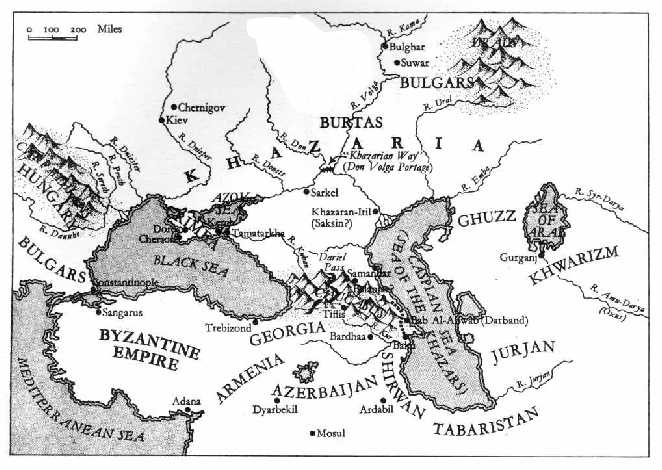
The Khazars’ sway extended from the Black sea to the Caspian, from the Caucasus to the Volga, and they were instrumental in stopping the Muslim onslaught against Byzantium, the eastern jaw of the gigantic pincer movement that in the West swept across northern Africa and into Spain.
Thereafter the Khazars found themselves in a precarious position between the two major world powers: the Eastern Roman Empire in Byzantium and the triumphant followers of Mohammed. As Arthur Koestler points out, the Khazars were the Third World of their day, and they chose a surprising method of resisting both the Western pressure to become Christian and the Eastern to adopt Islam. Rejecting both, they converted to Judaism.
The second part of Mr. Koestler’s book deals with the Khazar migration to Polish and Lithuanian territories, caused by the Mongol onslaught, and their impact on the racial composition and social heritage of modern Jewry. He produces a large body of meticulously detailed research in support of a theory that sounds all the more convincing for the restraint with which it is advanced.
Mr. Koestler concludes: “The evidence presented in the previous chapters adds up to a strong case in favour of those modern historians – whether Austrian, Israeli or Polish – who, independently from each other, have argued that the bulk of modern Jewry is not of Palestinian, but of Caucasian origin. The mainstream of Jewish migrations did not flow from the Mediterranean across France and Germany to the east and then back again. The stream moved in a consistently westerly direction, from the Caucasus through the Ukraine into Poland and thence into Central Europe. When that unprecedented mass settlement in Poland came into being, there were simply not enough Jews around in the west to account for it, while in the east a whole nation was on the move to new frontiers” ( page 179, page 180).
“The Jews of our times fall into two main divisions: Sephardim and Ashkenazim.
The Sephardim are descendants of the Jews who since antiquity had lived in Spain (in Hebrew Sepharad) until they were expelled at the end of the fifteenth century and settled in the countries bordering the Mediterranean, the Balkans, and to a lesser extent in Western Europe. They spoke a Spanish-Hebrew dialect, Ladino, and preserved their own traditions and religious rites. In the 1960s, the number of Sephardim was estimated at 500,000.
The Ashkenazim, at the same period, numbered about eleven million. Thus, in common parlance, Jew is practically synonymous with Ashkenazi Jew.” ( page 181).
In Mr. Koestler’s own words, “The story of the Khazar Empire, as it slowly emerges from the past, begins to look like the most cruel hoax which history has ever perpetrated.”
The history of the Ashkenazi Jews was widely known and appreciated in the former Soviet Union. Ashkenazi militants traced the area where the Turkic Khazars originated before their migration to Southern Russia to Birobidjan, an Eastern Siberian area as big as Switzerland bordered by the Amur river, by China and Mongolia. Around 1928 they started building settlements with the Soviet government’s help and in 1934 the Autonomous Republic (Okrug) of Birobidjan Yevrei came into being with official languages of Yiddish and Russian. It is still there as an Autonomous Republic to this day, offering the only historically legitimate settlement area for Ashkenazi Jews willing to exercise their “right to return”…
Mr. Koestler was an Ashkenazi Jew and took pride in his Khazar ancestry. He was also a very talented and successful writer who published over 25 novels and essays. His most successful book, Darkness at Noon, was translated in thirty-three languages.
As expected, The Thirteenth Tribe caused a stir when published in 1976, since it demolishes ancient racial and ethnic dogmas…At the height of the controversy in 1983, the lifeless bodies of Arthur Koestler and his wife were found in their London home. Despite significant inconsistencies, the police ruled their death a suicide…Another Mossad “suicide”!
AL-ARAKIB, ISRAEL — On July 26, Israeli police demolished 45 buildings in the unrecognized Bedouin village of al-Arakib, razing the entire village to the ground to make way for a Jewish National Fund forest. The destruction was part of a larger project to force the Bedouin community of the Negev away from their ancestral lands and into seven Indian reservation-style communities the Israeli government has constructed for them. The land will then be open for Jewish settlers, including young couples in the army and those who may someday be evacuated from the West Bank after a peace treaty is signed. For now, the Israeli government intends to uproot as many villages as possible and erase them from the map by establishing “facts on the ground” in the form of JNF forests. (See video of of al-Arakib’s demolition here).
“]Israeli high school age police volunteers lounge on furniture taken from an al-Arakib family’s home. All photos by Ata Abu Madyam of Arab Negev News.
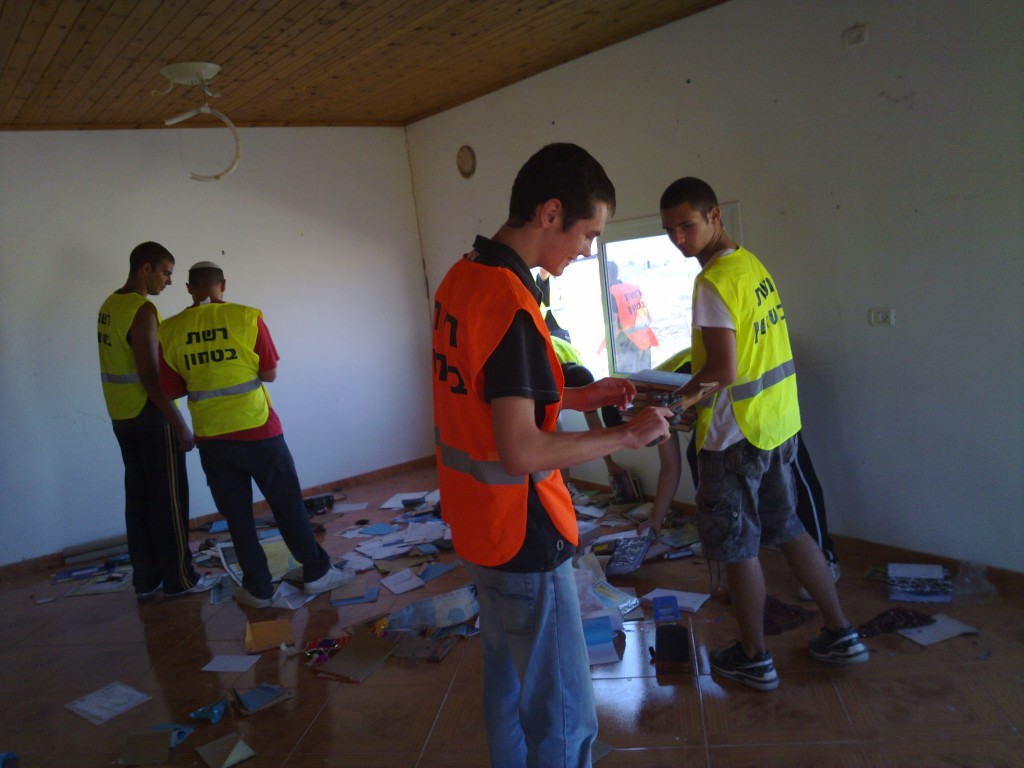
Moments before the destruction of the Bedouin village of al-Arakib, Israeli high school age police volunteers lounge on furniture taken from a family’s home. [The following four photos are by Ata Abu Madyam of Arab Negev News.
One of the most troubling aspects of the destruction of al-Arakib was a report by CNN that the hundreds of Israeli riot police who stormed the village were accompanied by “busloads of cheering civilians.” Who were these civilians and why didn’t CNN or any outlet investigate further?
I traveled to al-Arakib yesterday with a delegation from Ta’ayush, an Israeli group that promotes a joint Arab-Jewish struggle against the occupation. The activists spent the day preparing games and activities for the village’s traumatized children, helping the villagers replace their uprooted olive groves, and assisting in the reconstruction of their demolished homes. In a massive makeshift tent where many of al-Arakib’s residents now sleep, I interviewed village leaders about the identity of the cheering civilians.
Each one confirmed the presence of the civilians, describing how they celebrated the demolitions. As I compiled details, the story grew increasingly horrific. After interviewing more than a half dozen elders of the village, I was able to finally identify the civilians in question. What I discovered was more disturbing than I had imagined.
According to residents of al-Arakib, the youth volunteers vandalized homes throughout the village
Israeli police youth volunteers pick through the belongings an al-Arakib family
Arab Negev News publisher Ata Abu Madyam supplied me with a series of photos he took of the civilians in action. They depicted Israeli high school students who appeared to have volunteered as members of the Israeli police civilian guard (I am working on identifying some participants by name). Prior to the demolitions, the student volunteers were sent into the villagers’ homes to extract their furniture and belongings. A number of villagers including Madyam told me the volunteers smashed windows and mirrors in their homes and defaced family photographs with crude drawings. Then they lounged around on the furniture of al-Arakib residents in plain site of the owners. Finally, according to Matyam, the volunteers celebrated while bulldozers destroyed the homes.
“What we learned from the summer camp of destruction,” Madyam remarked, “is that Israeli youth are not being educated on democracy, they are being raised on racism.” (The cover of the latest issue of Madyam’s Arab Negev News features a photo of Palestinians being expelled to Jordan in 1948 juxtaposed with a photo of a family fleeing al-Arakib last week. The headline reads, “Nakba 2010.”)
Israeli police volunteers go through the belongings an al-Arakib family
According to residents of al-Arakib, the youth volunteers vandalized village homes
The Israeli civilian guard, which incorporates 70,000 citizens including youth as young as 15 (about 15% of Israeli police volunteers are teenagers), is one of many programs designed to incorporate Israeli children into the state’s military apparatus. It is not hard to imagine what lessons the high school students who participated in the leveling of al-Arakib took from their experience, nor is it especially difficult to predict what sort of citizens they will become once they reach adulthood. Not only are they being indoctrinated to swear blind allegiance to the military, they are being instructed to treat the Arab outclass as less than human. The volunteers’ behavior toward Bedouins, who are citizens of Israel and serve loyally in Israeli army combat units despite widespread racism, was strikingly reminiscent of the behavior of settler youth in Hebron who pelt Palestinian shopkeepers in the old city with eggs, rocks and human waste. If there is a distinction between the two cases, it is that the Hebron settlers act as vigilantes while the teenagers of Israeli civilian guard vandalize Arab property as agents of the state.
The youth volunteers extract belongings from al-Arakib homes prior to the demolitions
The youth volunteers extract belongings from al-Arakib homes prior to the demolitions
The spectacle of Israeli youth helping destroy al-Arakib helps explain why 56% of Jewish Israeli high school students do not believe Arabs should be allowed to serve in the Knesset – why the next generation wants apartheid. Indeed, the widespread indoctrination of Israeli youth by the military apparatus is a central factor in Israel’s authoritarian trend. It would be difficult for any adolescent boy to escape from an experience like al-Arakib, where adults in heroic warrior garb encourage him to participate in and gloat over acts of massive destruction, with any semblance of democratic values.
As for the present condition of Israeli democracy, it is essential to consider the way in which the state pits its own citizens against one another, enlisting the Jewish majority as conquerers while targeting the Arab others as, in the words of Zionist founding father Chaim Weizmann, “obstacles that had to be cleared on a difficult path.” Historically, only failing states have allowed such a corrosive dynamic to take hold. Thus the scenes from al-Arakib, from the demolished homes to the uprooted gardens to the grinning teens who joined the mayhem, can be viewed as much more than the destruction of a village. They are snapshots of the phenomenon that is laying Israeli society as a whole to waste.
“]”After the youth clear out the homes, the police move in…
…and the destruction begins
…and the destruction begins
:: Article nr. 68462 sent on 01-aug-2010 01:27 ECT