Search

band annie's Weblog

I have a parallel blog in French at http://anniebannie.net

Category

Syria

In Memory of A Hero (a repost)

Posted by

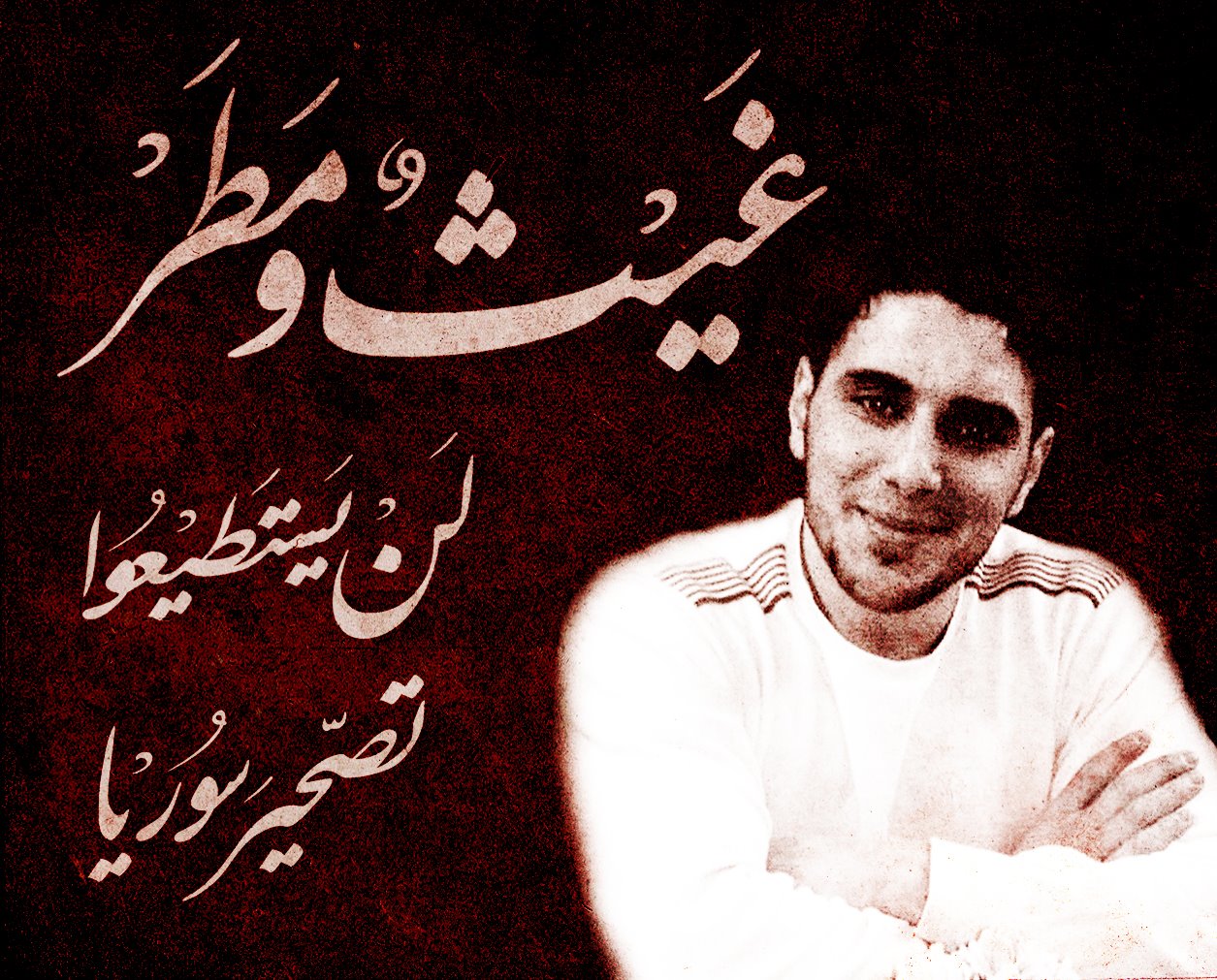
Ghiath Matar, the 26 years old activist was murdered after three days of torture at the hands of Assad’s goons. Orders for such inhumane murderous treatments could only come from the highest levels

Yesterday, and as the Secretary General of the Arab League was meeting with Syria’s chief tormentor, regime thugs visited the Matar family in Damascus Suburb with the body of their twenty six (26) year old son Ghiath. Along with the body, it was reported; the thugs handed the family their son’s larynx telling them, amidst their cries to make shawarma out of it.

I am a grown man, and I don’t believe that men should not cry, for I do cry, sometimes even in sad or romantic movie. But since yesterday, my tears are bitter. And as I write these words, heavy rain falls where I live, and while I wonder if nature is crying for the brave youths of Syria, my tears race with the drops of rain and Ghiath’s beautiful smile seemingly wanting to re-assure me, I hear a voice I never heard before … “common old man, don’t  cry….. I am but one of thousands and you will be free”.

Ghiath was a leader in the Syrian youth peaceful movement. He was among those who demonstrated unparalleled creativity in non-violent resistance as he and his friends tried to greet those charged with suppressing them with flowers and bottles of water in the heat of Syrian summer. He was waiting for his first daughter when the hyenas kidnapped him after luring him with a trap turning his generosity and chivalry against him as he answered an apparent SOS call from a friend.  Within three days of his arrest, this strong young man was dead because of torture inflicted by the Assad mafia hyenas.

Have words been invented to describe the level of atrocious hate this regime has for its own people? Is their mutilation of the young bodies a manifestation of the rot that eats them? Is it fear that moves them? Is hatred? is it revenge?  Or is it simply a death wish in need of an answer?

Some may want to believe that martyrs will be happy in heaven, I think more of the living, the mother awaiting her son, the young wife longing for the strong arms of her handsome husband, the daughter who they want to have grow knowing the name and face for the man responsible for her not enjoying the cuddling of her father, his guiding words, and not holding his finger with her entire hand as she walks next to him in the market place. Curse the murderers, curse them for eternity.

I leave you with what is being passed as to Ghiath’s last will and testament to his friends, while I was translating his words, my warm tears of cold rage raced along with my heart, my arms became week and my fingers felt inept to write appropriate words. I am now dreaming that my words would turn into winds that blows the face of Syria and that cleans, once and for all, the rubbish called the Assad regime, and all those whose moral compass is pointing into a direction of inhumanity, savagery, and hate.

Translation of Ghiath Matar’s Last Will

Praise Be to Allah, prayers, and peace to our Prophet Muhammad, his family and his companions

My free and young brothers of the revolution, you who have shared with me the path to freedom during days that were the most beautiful days of my life

If words of my martyrdom pain you, be comforted in the knowledge that I have now simultaneously attained both happiness and freedom. I wish if I can come back to life so that I can once more carry the banner of justice, dignity, and freedom and to be martyred once again…. Don’t think they have finished me off with the bullet they fired.

By God, I have triumphed and I have aided my cause every moment I came out to the streets to say no to injustice and tyranny, Yes to freedom, justice and dignity

And my will to you to remain true to the principle we went out for, and to work toward achieving all the slogans we raised until they become a living reality, to persevere in your courage no matter how they tried to  get you of to throw your ranks into disarray, don’t allow them to change you, don’t cheapen my blood, and the blood of the martyrs who gave their souls for a free Syria, don’t sell our sacrifices for any price. Don’t dialog with your executioners but wrest your rights from them with your determination to achieve victory.

I have seen freedom right at the gates, I’ve seen it very close to me and to you

Every time we went out, when our chants shook the earth, and instill terror in the hearts of cowards, I sow freedom approaching and victory being achieved … From my world, I now see it approaching nearer to you. Do persevere for victory is but one extra hour of perseverance.

Do not despair even if the whole world fought you and denied you.  Do not stop even if the repelled you and erected barriers and obstacles in your ranks, do not you turn back or they will get you, destroy you, and with you destroy the dream. Do not surrender for by that you sell our precious blood, and all of the efforts we made for a free dignified homeland.

Remember me when the shouts tower, when the women ululate at the wedding ceremony of martyrdom, and whenever a demand of ours is achieved along the way to freedom. Remember me when you celebrate the fall of the regime and the liberation of our homeland from the abusers. Remember me every time you plant a Jasmine sapling in Syrian soil, every time you lay a brick in a building, and when you see the future in the eyes of children, and remember that I gave my soul and my blood for that moment.

May God countenance you and bless you with steadfastness, victory will be ours at your hands, O heroes

Syrian Citizen Ghiath Matar

We are with you, Syria

[youtube http://youtu.be/Y9mu-fvH8K4?]

Yassin Haj Saleh – Regarding militarism and violence and revolution

At  Walls حيطان

OTW : Yassin Al-Haj Saleh just published this article in Al-Hayat about militarism, violence, and the revolution . Given that it falls right in our discussion, I have spent sometime to translate it to English using machine translation as a start and then performing very heavy editing. I think it is a good article coming from an intellectual who is not only on the inside, but also on the run.


Yassin Haj Saleh – Regarding militarism and violence and revolution

Little can be gained from discussing the growing military dimension of the Syrian revolution without placing it in the context of the 320 days of unconstrained and rampant violence practiced by the regime in its attempt to quell the revolt from the outset. Not much can be gained either by discussing intellectual, political, and psychological shifts that have occurred and are occurring in the society and within the revolution’s own environment throughout these bloody months. The outlines are known. The regime threw the army in to confront the foci of the Revolution and It killed many in the field who who refused to fire on their fellow citizens (Human Rights Watch report in December), leading some officers and soldiers to defect and out of these defections a loose umbrella was formed under the name «the Free Syrian Army FSA». The regime directed punitive and vengeful disciplinary campaigns akin to colonialist campaigns at cities and towns in and around Damascus, Homs, Hama, Idlib, and Deir Al-Zour , which resulted in civilians picking up arms here and there to face regime’s forces, albeit the regime has already pushed civilians in the conflict since the beginning and on a large scale: the Shabbeeha.

These circumstances, which are known to all, imply an authentic military component of the revolution that can’t be overlooked in the context of its intellectual or political planning considerations. This dimension is neither brought from the outside nor does it possess an ideological underpinning that may have preceded its emergence.

The emergence of this armed component does not undercut, today or since its beginning, the overarching peaceful character of the revolution. The peaceful nature of the revolution is rooted in its social composition, in the type of its demands, and in its primary protest tools (i.e., demonstrations), and not in any ideological preference or political tactics. It is now known that the juxtaposition of peaceful demonstrations flying banners and shouting chants and armed groups firing bullets does not say anything about what is happening in reality, but only covers the ignorance of those making such argument of the reality of what is happening with only figurative approximations.

In fact, it would not have been possible for the peaceful demonstrations to continue in most of their sites had it not been for the protection provided by the Free Syrian Army with both of its military and civilian component and had it not been for its relative deterrence of the striking arms of the regime.

Refusal to see this reality does not change it and hinders its understanding and more so the ability to influence it. And perseverance in reiterating argument against the arming of the revolution and against militarization without the slightest indication of a cessation of violence from the regime is akin to blaming the victims for their resistance to the aggressors. There are no nationalistic or humanitarian justifications for such an attitude.

There is no doubt that at abstract values level, peaceful resistance is preferable to armed resistance. However, we are not in a store shopping for this or that, but in macro-scale reality, which imposed on a substantial number of Syrians the need to defend themselves as they faced a regime whose precise composition is what breeds hatred and violence and not emergent exigencies, nor popular demands, as a massive Syrian minister had recently uttered.

What requires understanding and caution is that resorting to militarism can be associated, and today is actually becoming associated with anarchist and undisciplined practices. We can not deal with this reality with puritanical logic that refuses any armed resistance, or objects to the revolution itself under the pretext of the anarchist practices that may occur under its banners. This will not work as long as the regime persists in its own militarization. What could be useful is to work at the level of the revolution, not from outside or above, towards the direction of uniting the militant and civilians in a single concerted body and that the military component of the revolution be disciplined and directed by its general interest. This is not easy, and there is nothing that guarantees its accomplishment at the required level, but to continue singing about peaceful actions is a recipe that ensures it does not happen at all.

Notwithstanding the prospects for chaos, violence is formatively elitist and un-democratic, and expansively spread of its exercise, even if it is disciplined, may raise the threshold of identification with the revolution and weaken the participation of women and children and the elderly. Our choices, however, are not between militarization and the non-militarization, but between unchecked and undisciplined militarism, and that of a checked, and perhaps more disciplined militarization.

Furthermore, political change achieved by armed force may result in many social, political and security complexities, which is less favorable to democratic development than a peaceful transformation. But, again, our choices are not free, and the military component of the revolution is a byproduct of the intrinsic violence of the regime, not because of someone’s will or decision.

The key point in all this debate is that there remains no room to restore the original innocence that predated blood, or to leisurely talk about facing the regime’s violence with bare chests, especially when expressed by those who do not participate in the revolution, neither with their chests nor with their backs. What is needed instead of illusionary innocence are initiatives and work toward military, political, and moral discipline of force. We have a chaotic unchecked reality, and the intellectuals and politicians perform their duty when they work to make it rational and organized and not when they purify and distance themselves from it. This is weakness.

In fact, some of what is being said regarding militarism is driven by objection to the revolution itself and not by objection to the legitimacy of some of the practices under its banner. Revolution means the removal of the legitimacy of the regime and the denial of its national and public character, and, consequently, considering its violence a factional and unpatriotic, and the denial of any legitimacy and generality of any of its organs, which establishes the foundations for the new legitimate and popular, which is he revolution itself. While this does not confer an automatic legitimacy on all violence that may be exercised in its name or shadow, the only position that provides consistent objection to the uncontrolled violence is a position from within the revolution and with it, and not outside it or against it. Certainly, revolutionary violence is more legitimate than the violence of a regime murdering the people. It is a multiplier of legitimacy in that it is essentially forced and defensive even when it is offensive at the tactical level.

There is already a genuinely peaceful mood in the revolution that dislikes violence, even in self-defense. But the best defense of peaceful action is to participate in the revolution including on the ground, and to work hard to strengthen its civil nature. The worst defense is to sit on the sidelines and singing praise of the beauty of peaceful actions.

From the viewpoint of action, there is a need for legitimate public entity, that transcend the external embrace of the revolution’s cause and the standing beside it towards engagement in the revolution and the intellectual, political, and organizational morphing in manners responsive to its evolution and growing complexity. Such a public body would have coordinated between the components of the revolution and led it to achieving its national objective. Alas, this is not available. But one of the causes of optimism in Syrian Revolution is the multiplicity of the centers of thought and initiative, which proceed without the guidance of anyone, and never stop working in order to discipline the militarization and to develop the civil and popular character of the revolution.

————
Yassin Haj Saleh
Syrian dissident writer and
Dar Al Hayat
Sunday, 29/01/2012

Jonathan Miller I encountered the vicious reality of life under Gaddafi but nothing prepared me

[youtube http://youtu.be/Up2pqcjtkGE?]

Syria, where everything is normal according to Johnson

Tuesday 24 January 2012 7:06 pm

On 25th November last year, a British foreign correspondent called Johnson Miller was taken, under armed secret police escort, to the southern Syrian city of Dera’a.  He was accompanied by four Syrian government minders – and a driver (who was a secret policeman too).

“Johnson” turned out to be me.

johnsonmiller1 300x201 Syria, where everything is normal, according to Johnson.“Johnson Miller” in Syria, credit: SANA

It was the name by which the Syrian Arab News Agency (SANA) quoted me as saying that everything in Dera’a was “quite normal.”   (That’s one of my  minders, Monzer, by the way, sitting on my left in the photograph.)

Johnson’s “situation normal” quotation confused me as it was very clear to his alter ego, the foreign correspondent Jonathan Miller, that things in Dera’a were far from normal (as, I hope, was clear from the TV report we filed).

So surprising was my “situation normal” pronouncement that it prompted the Foreign Editor of Britain’s own state broadcaster, to tweet:  “Oh dear. Suspect C4N can do without official Syrian endorsement.”

Oh dear, indeed.  But since my visit, I’ve realised that the Syrian regime is so keen to convey to the world that “life is normal” in Dera’a that every hapless correspondent who bowls up there is asked by the local SANA reporter whether, in their opinion, um, life is normal.

Have a look:  It’s unbelievable!

(And, by the way, I would just like to state to the minders and their masters in the Syrian regime:  THIS BEHAVIOUR IS DEFINITELY NOT NORMAL!)

“Normal life in Daraa belies reports of misleading media” – SANA, 14 Dec 2011

“Life in Dara Normal, Reports of Biased Channels Contradict Reality” – SANA, 01 Jan 2012

“Spanish, Japanese and Italien Media Delegain Stress Normal Life in Daraa”– SANA, 11 Jan 2012

The reason they’re so keen to report that life is normal is that Dera’a has been chronically unstable ever since it emerged as the cradle of the Syrian revolution in March last year.

For weeks on end, its people were besieged by government tanks. Many of those who dared to openly defy the regime were shot dead in the streets by snipers.  Hundreds are thought to have been killed; thousands have been imprisoned.

source

From France, interview with a dissident Syrian historian

I came across this interesting interview in Le Figaro, in which Michel Kilo, a dissident historian, says that it is up to civil society (and implicitly, not foreigners) to oust Assad.

http://www.lefigaro.fr/international/2012/01/17/01003-20120117ARTFIG00640-kiloc-est-a-la-societe-civile-de-renverser-assad.php

via Le Figaro
The article is in French but here is my translation in case you don’t read French well:LE FIGARO: The Syrian opposition seems divided. How to fix it?
MICHEL KILO: There is the popular movement, which is close to the intellectuals, and the opposition by organized parties, such as the National Syrian Council on foreign shores or the National Committee of Coordination (CNC) within. But these organizations are always late arrivals on the scene of popular movements, historically speaking.
What do you think about the announcement that a military Council has been created, directed by the deserter general Moustapha al-Cheihk?
With several thousand soldiers, who do not comprise an army, he wants to attack an army of 400,000 troops! It will throw the country into endless chaos. It’s insanity. Protect the civilians, of course. But one cannot create the illusion of a war against the regime. And then we do not want, after victory, to be once again ruled by military men. The military must obey politicians.
So what is the solution?
One cannot rest content saying that we want to knock down the regime. We must explain how. At the beginning, we the intellectuals, we proposed national dialogue.
The dialogue with who?
With everyone, even the regime. The goal was to win for our cause new sectors of the population. Certainly, the regime would have refused to budge. But that was exactly the goal: show to those undecided that there was a political situation which the regime itself was refusing. At that moment, amassing on the streets was legitimate.
Are we now at an impasse?
Yes. The regime cannot force the protesters to clear out from the streets, and the latter cannot bring down the government. The recent talks show that Bachar el-Assad is desperate. Everything he promises is just a “war against terrorism” with which he thinks he can gain the support of the West, or at least scare the West. But it’s a phony concept. In Homs, the heart of the rebellion, there is no Islamist on the committee directing the revolution. Now, I think el-Assad wants to regionalize the conflict: referring to Iran, Hezbollah, the Iraqis, and threaten the Gulf states with a long war.
What do you propose?
The revolutionaries are in the process of organizing better the populist forces, and of convincing those who are still neutral to join their movement. They push now for the formation of base committees all around the country. These are the ones that shall form the future government of Syria, with the CNS or the parties of the interior. In Europe, in the Eastern countries, the intellectuals, the civil society, were the ones who overthrew dictatorships. We fought for 50 years against the regime. Most people of the CNS live abroad, and have for a long time. They are almost strangers to the people at home.
Can the Syrian people hold out for much longer?
Until the end of history. I posed such a question to some people in Deraa. They answered: ‘We do not have the courage to stop.’ If they stop, the repression will be comparable to that which was waged on Hamas in 1982, when there were 46,000 dead.
Is the exile of Bachar el-Assad inevitable?
It is necessary to find a solution.
You are going to return to Syria. Isn’t that dangerous?
In Syria, people are dying each day for freedom. It is shameful to be afraid.

Syrian dissidents start to call Cairo home

Posted By Nate Wright Friday, January 20, 2012 – 1:27 PM Share

On the top floor of a towering apartment block in Cairo, half a dozen Syrian activists are hunched over their laptops. Each man organized demonstrations in his home town before escaping the Assad regime’s intelligence agents in the last few months. Now, armed with a list of trusted contacts that stretches across the borders from southwest Syria to Lebanon and Jordan, they have become a key link in the supply chain of an opposition movement that is struggling to outmaneuver a brutal crackdown. Donations collected from Syrians and well-wishers in Cairo are used to purchase cell phones, satellite communications equipment, medicine, and money, which is smuggled to friends and family members on the inside. In turn, protesters send out video evidence of attacks, which the men in Cairo catalogue, upload to YouTube, and forward to media outlets.

The men work with close contacts in their own villages and neighborhoods, independently of organizing committees or opposition bodies. Abdel Youssef fled from Ad Dumayr, a city northeast of Damascus. Syrian authorities went door to door there searching for military defectors on Wednesday night and he spent the day following their movements through eyewitness accounts. As he tells the story of how he fled, a Skype window flashes up on his screen. A woman he knows tells him that security forces attempting to arrest a man have captured his daughter instead. “Now I’m looking out the window,” the message reads. “She is being beaten up by the security forces because she is saying ‘Allahu Akhbar’.” Abdel Youssef passes on information like this to a contact in the Free Syrian Army, who he says use this information to block roads and set up ambushes in an attempt to protect demonstrations.

“In our area, the Free Syrian Army is very well organized,” says Abdel Youssef, who acts as a communications hub for demonstrators in his city. He knows the location of the seven government roadblocks in Ad Dumayr. In one video, a friend holds up a pad of paper with the names and birth dates of those killed so that family members can claim the bodies.

He forwards his information to Omar Idlibi, a spokesman for the Syrian National Council, as well as international media outlets. But he works independently. Like the other activists in this safe house, six men in their 20s and 30s when I visited, Abdel Youssef only coordinates with his city. Abdel Rahman, from Damascus, works with his neighborhood and Omar, from Yabroodi, is in touch with his friends. All three gave only their first names to protect family members still in the country. Wary of people they don’t know and unimpressed with the politicians talking shop in Turkey, they work around the clock on the regional logistics of localized resistance. “I know about Damascus. Others know about other places,” said Abdel Rahman. “When we come together we know about everywhere in Syria.”

Turkey remains the political center for the opposition in exile, but Cairo is emerging as a vital logistical hub for the supply of dissidents within Syria and the dissemination of videos emerging from the country. They have come to Cairo for many reasons. As Foreign Policy reported in November, Assad’s allies are hunting Syrians in Lebanon. In Istanbul, activists say the Turkish intelligence wants to sign off on any political activities. “Because I am Syrian, the Turkish government wanted to know everything I did,” said Abdel Rahman, who flew to Istanbul before coming to Cairo. He pointed to the men with him in the safe house: “We couldn’t do this in Turkey.”

Syrian intelligence operatives are keeping a low profile here, but activists are not taking any chances. In November, the wife of Syrian television presenter, Thaer al-Nashef, was kidnapped in Cairo. He received text messages threatening to slit her throat and throw her in the Nile. She was later dumped, bruised but alive, in the street. When Syrian MP Emad Ghalioun arrived in Cairo, Akram Abdel Dayam took four cars to pick him up and drove through back streets to see if he was being followed. “Syrian intelligence is here, but it’s not as extreme,” said Rami Jarrah, a Syrian activist who spoke to journalists under the pseudonym Alexander Page before he fled to Cairo.

The promise of safety, cheap prices, and a supportive local population that cheered on Syria’s revolution after ousting their own president in February, make Cairo an attractive destination for opposition members able to reach the country. With no land borders, activists are flying in and getting visas at the airport. Those who escaped without passports, like military defectors, are forced to go to elsewhere and most head to Turkey, according to Jarrah.

The Syrian National Council has noticed. Lina Tibi, a press officer working with the Council in Cairo, hopes to have a media center up and running in the city next week. Burhan Ghalioun, who heads the Council, flew in on Friday to meet with Secretary General of the Arab League, Nabil al-Araby, a day before the League meets to discuss the results of its monitoring mission in Syria. “We are here in Cairo because the Arab League is here,” said Walid al-Bunni, the Syrian National Council’s director of foreign affairs.

While Syria’s opposition struggles to form a united front, most of the coordination with activists inside the country is happening through small, ad-hoc command and control centers like the safe house where Abdel Rahman, Abdel Youssef, and Omar live and work. Toby Cadman, a British lawyer engaged by the Syrian Emergency Task Force, has been working with activists to document crimes committed in Syria. He hopes to build a case to bring to the International Criminal Court. “The activists in Cairo have been extremely influential in this process,”he said. “A lot of what I obtain comes directly or indirectly from Cairo.”

Jarrah, who is not connected to the activists in the safe house, says weapon smuggling into Syria has already begun. But Omar insists his group is holding off on supplying arms, for now. “As soon as the Free Syrian Army was created, it began communicating with the local coordinating communities,” he said. “The Syrian National Council does nothing. It is all the local councils.” Abdel Youssef, Abdel Rahman, and Omar agreed that their patience was wearing thin. “If no one from the outside helps, if the Arab League keeps giving [Assad] time, then we will arm ourselves,” said Abdel Rahman. They say that March 15th, a year from the first major demonstrations in Daraa, is their deadline. “There will be a war if he has not stepped down by the anniversary of the revolution.”

Nate Wright is a journalist in Cairo. He writes for the Times of London and Middle East Report. Read his blog at www.themelian.com and follow him on Twitter at @nwjourno.

Keeping fingers crossed for Assad

We must admit, this is the Syrian people’s finest hour. It is not our finest hour.
By Aner Shalev

What is the final number? 4,000? 5,000? How many people have to die? Is 6,000 not enough? Are 6,000 people in a country that doesn’t have a lot of oil equivalent to just 600 dead in an oil superpower? What is the determining event? Is it indiscriminate sniper fire, even at funerals? Is it the killing of children? Is it systematic tank fire on city centers? Or is it gruesome torturing to death of protestors in front of a large crowd? Or is it perhaps terror attacks staged by the regime itself in its own capital, in the grand tradition of the burning of the Reichstag?

What is the red line that if crossed will make the world say, Enough? If Syrian blood is so cheap, perhaps the injuring of Arab League observers is a red line? Or mortar fired directly at a group of foreign correspondents and the death of a French journalist? What is the exchange rate for the blood of different nationalities?

Syrian protesters - Reuters - 19012012 Syrian protesters marching in Homs in late December. A heroic uprising that Israel hopes will fail.
Photo by: Reuters

Of all the revolutions in the Arab world, the Syrian uprising is depicted as being the most impressive and heroic. In Tunisia and Egypt, the army sided with the protestors within a relatively short time and forced almost immediate regime changes that gained American support. In Libya, the struggle took longer but even from its early stages seemed like a civil war with protestors using a range of weapons and later on receiving military assistance from NATO.

In no Arab country except for Syria has such restrained protest encountered such violent suppression, so determined and so cruel. In no other Arab country have protestors been abandoned by the enlightened world like they have been in Syria. And despite the tremendous risk, the many casualties and the uncertain chance of success, these protestors go out to the streets every day, without weapons, without support, armed only with faith. Yes, it is permissible to be moved by a heroic struggle for freedom and impressive displays of courage even in an enemy country.

Less impressive is the Israeli response to events in Syria. Defense Minister Ehud Barak posed as usual as a fortune teller and predicted that Bashar Assad would fall within a few weeks. Since then many weeks have gone by and Assad is still in power and still slaughtering. In the Israeli defense establishment, however, the prevailing sentiment seems to be panic over the possibility that the struggle to obtain freedom will succeed and the Syrian regime will fall.

Chief of Staff Benny Gantz spoke of a stream of Alawite refugees potentially flooding into Israel in such a scenario, and of Israel Defense Forces preparations for such an eventuality. Gloomy predictions of the transfer of dangerous Syrian weapons to Hezbollah are being made around the clock.

It is possible to read between the lines – Israel is not interested in Assad’s downfall. Israel is secretly rooting for Assad. Israel is silently praying that the murderous Syrian dictatorship hangs on, a dictatorship that means quiet on the Golan Heights without any threat of peace. As always, Israel prefers the status quo, the world of yesterday.

The world of tomorrow does not interest us, even if it may contain possibilities and dramatic change. Perhaps the fall of Assad will actually lead to the weakening of Hezbollah and Iran in Lebanon and in the entire region? Who cares? We’ll take the threats. The Syrian uprising has already prompted Hamas to move from Damascus to other Arab capitals and made it more moderate. But it seems that we prefer an extremist Hamas.

The present Israeli leadership consists of the people of yesterday, who look forward to the past, swim against the tide of history and hastily flee from any change. The familiar is preferable to what is good and right. Who knows, perhaps the stream of Alawite refugees they are predicting for us here will also include Assad and his family. If we are already rooting for Assad, why don’t we give him political asylum?

We must admit, this is the Syrian people’s finest hour. It is not our finest hour.

Hama ’82 : memories and testimonies


Thank you for this beautiful but painful entry. This February is the month to finally face up to the crimes that happened to Hama, while we were sleeping, while we were young, while we were silent. It is time to read the words of the survivors and listen after we ignored them for decades. It’s time to weep for Hama, to weep for our past and present. It is time as a nation, to collectively mourn Hama openly, without fear, for the first time since 1982. Maybe by the end of the month, we will be able to let go of some of the guilt and move forward, knowing while Assad repeats the sins of his father, we are not repeating the sins of our silent fathers.

A very harrowing account. It can’t have been easy to recall such painful memories.

Such evil can never be permitted to exist. How can anyone in their right mind even contemplate compromising or having a dialog with the entity that created such barbarity.

Two elderly members of my family in their sixties were gunned down in their home in Hama in 1982. Their children recognized the father from his wedding ring, this how bad his body was.
The level of hatred is manifest in the extreme brutality that followed that is also accounted by the book from Tadmur to Harvard. In this book the account is very similar to one of my relations who was imprisoned for more than a decade and once released had to walk in his slippers the 20 km to Damascus and when he showed up his family did not recognize him for so emaciated he was and they thought that this was a vagrant coming in for begging.
Once a person was taken into custody the sentence was death and the trial was to either confirm or commute the sentence.

Dear Amal
Thank you for your thoughtful comment. Your words do reflect what I was thinking as I was trying to finalize the translation of this installment. I had originally intended to have all of Khaled’s memories translated into a single post, but as I proceeded the feeling of guilt you so eloquently identified became overwhelming, and the only way to cope with it for me was to finish this segment and get it out, for I wanted the world to read Khaled’s words as soon as possible.

Yes, it is time to weep for Hama, as well as for the more than 6000 murdered by orders of the person who insisted on inheriting his father’s legacy as a butcher of Syria. And as we weep, and work, each within our best towards freeing ourselves and Syria, we forge a new country. A country that has finally learned to grief and to move positively.

The most distinguishing difference between those who support this revolution and those who have for months now only found reasons to stand against it is rather simple. We trust Syria and Syrians, they don’t. Poet Hala Mohammad now ends every post she writes by saying: Syria, I trust you. I think she is not being poetic only, but prophetic.

Words cannot describe the emotions I felt and feel from reading this post. I hope we Syrians can really learn our history no matter how dark it is, and insure that it never repeats its ugly face, and only enforce the great values that we all know and love.

And by the way OTW, the sentence “Syria, I trust you” is one of the most beautiful sentence I have ever read, and I believe in it with more conviction than anything else.

Thank you for this blog, I am learning so much about my Country, things that either I wanted to forget about, or was not aware of.

I still maintain that RIFAAT AL ASSAD was the main person responsible for Hama. Hafez may have ordered it, but Rifaat planned it and executed it. He was there in Hama throughout the Operation. He cannot be allowed to go scot-free, he is a killer, a killer in the same way the Mukahabarat Chief of Homs was a killer during the Clock Square Massacre. Anybody agrees with me ? It is criminal, no worse than criminal to trivialize the crimes of Rifaat just because he has distanced himself from the regime.

And what about Tadmur massacre ? that was done purely on the initiative of Rifaat, Hafez was recuperating in hospital at that time ( if u did’nt know the MB had tried to assassinate him at the Airport, the Tadmur Massacre was in retaliation for that).

I know u guys will label me a mukhabarati intent on obfuscating Bashar’s crimes. But I prefer calling a spade a spade, and Hama 82 was much worse than what has happened in the last 10 months ; and I prefer Rifaat to be in the dock along with his nephew(s).

Dear Observer
I hear your grief for your relatives. I have few of my close relatives who spent a lifetime in Tadmur, and when I finally had the chance to talk to one of them, he told me, there were times when we envied those who perished.

I believe there is not a single person in Syria in the 80s who did not have a distant relative or kinsman killed or imprisoned ( inclduing many regime bigwigs).

OTW,many thanks for this testimony.
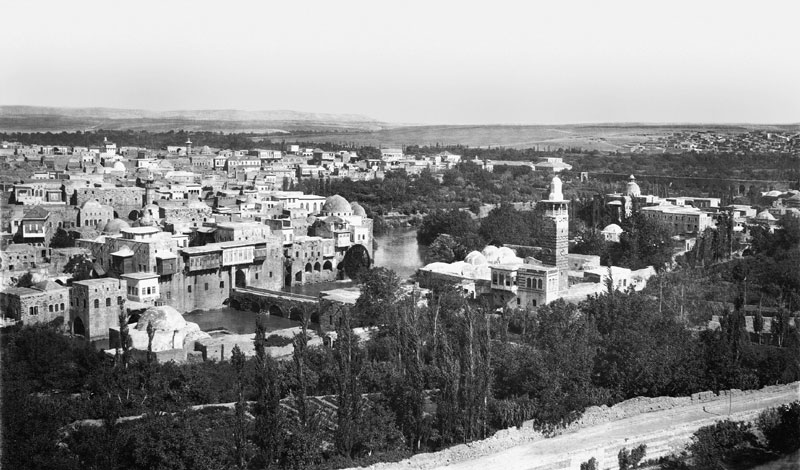
In order to illustrate it ,here are photos from the past of the rased neighborhoods by assad’s militia which are on the left bank on the pictures .Can be seen the Sufi lodge of the Kilani and the Kilani neighborhood and al Hader further.

http://www.usj.edu.lb/delore/imag/gphotos/hama.jpg

http://lcweb2.loc.gov/service/pnp/matpc/07100/07192v.jpg

As I read this horrific description of what happened in Hama, all these images came back to me. It was the fall of 1980. My eldest brother had finished his high school and left to Europe with my mother to enroll in university there. We were left with my father. We went to private school in Aleppo. It was a Friday. My older brother was in eleventh grade and his school was only half day on Fridays. I was in tenth grade and my little brother was in third grade. We also had a shorter school day on Fridays. When the school day was over and all the girls were boarding the buses to go home, the principal showed up with a very tense look on her face and ordered all the girls on our bus down. We could not understand why we were asked to stay in school and why only us. We heard that a parent had called the school, talked to the principal and down right ordered her to keep our bus from leaving. I later found out that the parent was actually no other than my own father.
Our old apartment was in a nice neighborhood in Aleppo. Unfortunately, the back of our building shared a wall with the intelligence service branch of “Amn al Dawleh”, the state security. All you had to do was walk a few meters to the end of our street, turn right and walk a few more meters to find yourself in front of their entrance. We did not even dare walk down that street. We were told by our parents to avoid it at all cost. It was completely blocked off for cars, but theoretically, a pedestrian could use that street. In reality, only those who were unfortunate enough to live on that street walked it and they were constantly harassed.
My brother had returned from school right before the call for Friday prayers. Considering he was sixteen at the time and with two distant cousins already in prison, my parents had forbidden him from even thinking about attending the Friday prayer. It simply was not allowed and God knows he tried. Right after Friday prayer, there was the sermon and then the congregation decided to walk from the mosque to the intelligence service branch behind our apartment. Apparently, there were detainees in that branch and the people were demanding their release. The men walked the 15 minute distance to the branch in a peaceful demonstration. From what my father was told later by members of the intelligence service, the men approached the branch entrance demanding the release of the prisoners. The branch chief came out and asked them to leave, but they were not backing down. He warned them that if they kept getting closer to the gate, they will be shot. They did not heed his threats. As the men started marching closer and closer to the gate, all hell broke loose. The unarmed men were faced with what amounted to a firing squad aiming directly at them. My father and brother were inside our apartment, but too close for comfort. They ended up on the floor in the middle of an interior corridor feeling like there was war outside our doors. All my father could think about was my bus and my little brother’s bus coming back to drop us off and getting hit by stray bullets. He crawled to the phone, called the principal and told her to halt the buses. She argued, he yelled: “Can’t you hear the war through the phone. This is not a joke. You will get the kids killed. Stop the buses.” She wondered what to do with the kids. He assured her that the parents would much rather pick their kids up when it was safe. Please just keep them at school until we could come. She did. My father called again and asked to talk to me. He told me to walk to my little brother’s school and keep him with me until he could pick us up. My brother’s school was in the same campus as my school. I walked there with my best friend, who also had a sister there. We picked both up and walked them back to our school. We were all so very scared and had no idea what was going on. My father finally came. He was in the car with two young men wearing camouflage vests. When I got into the car, I stepped on something. I looked down to see two machine guns on the floor of the car. They acted as a foot rest for all four kids until we approached our area. We had to go through three check points. Without the two men in the car, we could have never been allowed to go through. The area was simply off limits to anyone. We dropped my friend and her sister off at their house and proceeded to ours, where my brother was left home alone and near hysterical. It was a mixture of fright and excitement. He recounted the events for me without stopping to take a breath. A few minutes later, we went to our balcony and collected a big bucked full of shells. There were a few bullet holes on the walls of our apartment, luckily, no glass shattered.
The next morning, our cook arrived to our house shaking. I opened the door for her. She rushed in and told my father that across from the branch in one of the gardens there was a big pile covered with tarp. As she got closer, she could see human legs covered with blood peeking through the sides of the tarp. She told my father that there were too many and started sobbing.

And in very high definition as high that we can perceive interesting architectural details ,such as the monumental iwan in a house near the zawiya.
http://lcweb2.loc.gov/master/pnp/matpc/07100/07192u.tif

Dear Sheila
Thanks for sharing .This is the first time I hear this incident with such details. There will be  trials, and people know the names of the chiefs of these dungeons of horror. Even if they are retired, and living with their sons and daughters in some nice western country, cases will be filed. We have to do it.

Dear Shami
Old timer and the always reliable walking heritage encyclopedia, that high-res image made my day. Never knew how superb was the architectural heritage of Hama. The destruction of such wonderful neighborhood should also be counted as a crime against humanity. DO you have more photos, please either post the link or email it to me at modotwblog@yahoo.com.

OTW:

“….and when I finally had the chance to talk to one of them, he told me, there were times when we envied those who perished.”

Your lucky to have been able to converse with your relatives. My cousin was not able to talk for years. Even when he spoke his brain was fried. He still thinks the mukhabarat are watching him from across the street through the 4th floor window of his room.

His crime: His name and phone # was found in one of the his friends / student pocket phone book (who later turned out to be a brother of MB). Pathetic! No trial, just a conviction of 16 year old teenager and 20 year prison sentence.

Dear 7ee6anis
As Husam, observer, Sheila, and I did, please do tell your stories, even if it is a single paragraph. Part of our cross-generational grief is telling stories, sharing photos (as Shami just did).

The next segment will be longer, and i am afraid, even more horrific.

OTW,

I am not sure I will be able to read your next post, too troubling and depressing to read. I mean, I find the more I read and follow the news the more I can’t function. What am I to do, drop my life and children and join the revolution on the ground in Syria? Anything short of that is cowardice. I feel helpless.

the hama massacre happened before i was born, though my mother does tell me stories about how hamwis fleeing hama ,reached homs bare foot. i cringe at the thought of how they were isolated back then, no youtube,aljazeera,bbc, twitter, facebook to document their crimes. how did they live?!?!? : they didnt. They were brutally murdered and forgotten until now…………..

Dear SGID
Thanks for sharing, part of what I am trying to do is to help the world understand what really happened. I now realize many people, thanks to Husam that many people will not be able to read everything, but it is my generation’s duty to make sure that your generation is informed of our mistakes. When you depose the fool dictator, if possible, make sure that you never ever trust a “leader”, never ever place a fuzzy concept, no matter how sublime it sounds, above the value of individual life.

Dear OTW,they are from the library of congress digital collection, you will find many photos ,many available in high res ,not only of Hama ,but also from the other syrian cities ,taken during the Ottoman late era and the french mandate time.

http://www.loc.gov/pictures/

OTW, I will continue reading, for now I must stop.

I heard the horrors of Hama a year later, from a lady, who lived through it. I could not sleep for days.. cannot recount what I heard, could not read Khaled’s account of that horrific February, 1982…..We met outside Syria.

But I will always remember her voice, her affirmation. The children will grow, you will see, she said with a nod. We never talked about Hama after. No one did.

I will never forget the savagery. I lived it, through her words.

For two decades Syria looked like a dungeon from the middle ages. The walls had ears, your closest relatives and friends might be informants, they were not. It was the “shock and owe” of Hama. The nation was subdued. The youth imprisoned or exiled, tortured or dead. Discussions were muted.

… his son Bassel died in a car accident. We all felt like perpetrators, what is awaiting Syrians now? The verdict was issued. It was God’s will. Later, the father died, till this day I did not wish mercy upon his soul. Never will.

At the same time, I will never forget my ignorance, my naivety and immaturity for quickly forgiving and forgetting that the butcher’s son, is from the same poisonous milieu. He is surrounded by the same old guard that committed Hama, that humiliated Syrians, physically and emotionally.

This murderous family and their guards has written their last chapter, solely.

OTW:

Thank you for doing your part. Our generation knows fully well what took place. That is why I am for equal representation and I don’t trust any “leader” but God. Syrians of all people know that in order to get anywhere in politics (in almost every country) you have to be scum.

SGID:

The Hamwis and the Homasneh were never forgotten. I don’t have any in my family, but they are always in our conversation as brave people. Facebook, twitter, etc…was not around, but God was. Hafez continues to be tormented in his grave to this day.

His brother Rifaat, pencilneck, and the clan…their day is coming.

My step mother had two brothers who were arrested in 1981. Their crime was that they prayed at the same mosque as an imam whom the regime didn’t like. She never heard from them again. It was heart breaking to see how hopeful she and her family would be everytime the regime announced an “amnesty”, hoping for any scrap of news about her brothers.

I was very, very young in 1982, and living in Homs. My memories of those times are hazy, but what I remember the most was the memory of so many women wearing black. No body needed to tell me that something terrible had happened, something no one dared speak about.

Ya Hafiz fiq wa shoof,serna ensibak 3al makshof

Sheila,

Can you provide us with an acount of the Artillery School massacre in Aleppo ? That event has always mystified me, as to how 3 to 4 untrained people armed with AKs could masdsacre 70 military cadets after storming the compound.

I have read this account in Arabic before and this is an excellent translation. It did not lose any of its strength. Well done. I was too young during the events of 80′s but I remember the fear and the tank parked in front of our home and the marks it left on the asphalt for months later. I remember hearing the gun shots. I remember growing up knowing about missing relatives and the hardships their families encountered. I remember relatives dismissed from government jobs merely for having the wrong family name. The fear was suffocating.

Dear Nusayyif,
I was a teenager at the time and my information is based on what I have heard from my parents and their friends. Remember that there was never an independent investigation of what exactly happened there. All we got was the official story. My recollection of the incident is that a Sunni officer from the Artillery School in Aleppo gathered the young cadets in the school gym and with the help of a few other officers, locked the doors, trapped them in and opened fire. They specifically targeted Alawii cadets. The death toll was at 32 or 34 cadets. Ibrahim Yousef was the main perpetrator. He managed to escape, but was later captured by the end of the MB uprising and hanged.
The perpetrators did not storm the compound. It was an inside job.
The reaction to the massacre was mixed. On one hand people were happy that somebody was finally standing up to this tyrannical government, on the other hand, people were horrified at the killing of these young men just because they belonged to the president’s sect.
By the way, I do not think that Zabadani is 3 hours from Damascus as you claim. If you drive fast, you can reach Aleppo in 3 hours.

Ibrahim Al-youssef was the duty officer for that night. Duty officers have absolute control of the cadets and no one would have had any reason to suspect his orders to gather the cadets. He managed to also sneak in external collaborators. As you said, what he did was a crime that was used by the regime later on to aggravate sectarian hatred.
Blog at WordPress.com.

Up ↑