
This is the final of five exclusive extracts relating the story of Mezyan Al Barazi, a Syrian expatriate living and working in the United Arab Emirates, and his efforts to support the revolution in his home country. At turns informative, tragic, and edge-of-your-seat suspenseful, Godfathers and Thieves reminds us that the next revolution, like the last, will likely be crowdfunded. By ELIZABETH DICKINSON.
As violence spread across Syria in 2013, it seeped into humanitarian aid work. That fall, the Syrian government put the Palestine refugee camp of Yarmouk, a thriving suburb just miles from central Damascus, under siege. Syrian rebels had started using the neighborhood as a base to slip into the capital. With more than 150,000 people packed into a single square mile, it was easy to disappear – especially since a growing number of the residents were becoming sympathetic to their cause.
The Syrian army sent in soldiers. Government fighter jets bombed a school. The army set up a ring around the camp, preventing tens of thousands of remaining residents from leaving and stopping others from going in. Soon, Yarmouk began to starve.
Thousands of miles away in Abu Dhabi, Syrian businessman Mezyan Al Barazi — the unofficial head of a diaspora aid group — was scrambling to break the siege. At first, he thought the blockade would last just a few days. But it soon became clear that the troops were there to stay. Local clerics issued fatwas so that cats and dogs could be cooked to eat. Families chewed on grass or boiled it in water. By January 2014, at least 50 people had died from a lack of food and medicine.
Al Barazi reached out to a member of a charity run by Syrian doctors living abroad. Hospitals and medical personnel had been targeted by the Syrian government, and Al Siraj tried to fill the gap, smuggling in some 50 health workers to field hospitals, garages, and basements. Several of the doctors working with the charity had attended events hosted by Al Barazi’s diaspora organizing committee, or Tansiqiya, sharing harrowing stories from their mission.
Beyond their bravery and access, Al Siraj had resources. In December 2013, the group posted a photo of its monthly spending showing a total of $263,400. Indeed, the group had found donor support among some of Syria’s most prominent exiles, including two of the richest men in Doha: brothers Moataz and Ramez Khayyat, whose construction firm Urbacon International had won contracts to build facilities for the 2022 soccer World Cup. Their company’s Syrian offices, equipment, and land had been seized by the regime in 2011, and they claimed their loss to have been at least $200 million. Having relocated permanently to Doha, the brothers said they spent hundreds of thousands on relief work since the revolution had started. In 2014, when several businessmen provided a total of $5 million worth of flour and wheat to Syria, the Khayyats had paid $600,000 of it.
Al Barazi’s contact in Al Siraj said the group could smuggle supplies through the blockade, with payments to guards to look the other way. At first, the operation seemed to have been a success. Al Barazi confirmed that small amounts of supplies had reached their destination. But soon, friends and family members began to complain, claiming that Al Barazi’s intermediary in Yarmouk was mishandling the aid. He had made a list of beneficiaries and was delivering help only to them.
It was not easy to work out what was happening, and Al Siraj said it was unaware of the alleged favoritism. Yet Al Barazi knew that sorting through the tensions was vital. When aid made its way through the blockade, distribution points were at risk of being swarmed by desperate residents, scrambling for supplies.
In the meantime, word got around of Al Barazi’s success at running the blockade. Others in the diaspora began to harass him, asking him to put them in touch with his intermediary. The inquiries grew strangely aggressive. Once, he would have simply assumed that his fellow exiles wanted to send aid through the intermediary as well. Now, though, he was sure something else was going on. Did rivals wish to steal the aid? Or the money?
A few days later, Al Barazi’s phone buzzed with a message. It was a photo of the intermediary in Yarmouk, dead. There was nothing else – no explanation, no context. Since the beginning of the conflict, Al Barazi had seen plenty of pictures of the dead. But this was the first time that death had struck someone because of the work he was doing for Al Barazi.
For weeks, Al Barazi struggled with the implications. His contact’s death forced him to confront the growing ambiguities of the Syrian conflict. Had the murder been a warning from the regime to those trying to break the siege? Had it been carried out by corrupt aid groups or businessmen seeking a monopoly on supplies going into Yarmouk? Or, was it an accident? Al Barazi assumed it was all of these things and none of them. In the end, it didn’t matter because it was a reminder that every possible adversary could equally have pounced.
One day, several weeks later, Al Barazi pulled out his phone and flipped through his pictures until he found a picture of the dead man from happier times. When it was taken, the man was just 43 years old. He wore his brown hair artfully disheveled. Al Barazi kept the picture on his phone as a reminder that death could strike from any direction.
An effort that had started as humanitarian aid had become entangled in the war economy. Those struggling in Syria were no longer battling only for the future of their country; millions of dollars were at play, and the opportunities for greed, envy, and violence were endless. Reaching out to the wrong person at the wrong time with the wrong information could get someone killed.
But not reaching out seemed worse. On January 17 2014, Al Barazi posted an account from inside the blockade on his Facebook wall. “I asked my [friend] in the besieged camp Al Yarmouk yesterday: ‘Did you get any assistance?’ He said, ‘We got a barrel [bomb] that resulted in eight martyrs and 20 wounded,’” he replied.” Al Barazi’s next message was directed at Bashar al-Assad: “Damn your soul,” he wrote.
Yarmouk would prove only the beginning of how the violence tore apart the diaspora’s humanitarian operations. Each time they put together a shipment of food or medicine or clothes the Tansiquiya had to check and double check who, if anyone, was left to receive it inside Syria.
One recent container had been ready to go when Syrian government planes bombed its destination, the small town of Morek. The residents fled down the road, joining other displaced Syrians in a squalid makeshift camp, but as Al Barazi was preparing to redirect the shipment, the planes struck again. Having spotted the tents and roadside fires, they attacked, killing fifty-two women and children who had survived the destruction of their village. The aid intended for the village sat in a warehouse in Dubai, in need of a new recipient.
Getting cash to family and friends, meanwhile, had become nearly impossible. In order to limit the risks of terror financing, the UAE had shut down most money wiring services to Syria. One exchange house still conducted transactions, but sending money was risky. The Syrian government monitored the banking system for transactions that might indicate the recipient was an opposition liaison. In order to avoid detection, donations had to be split into dozens of smaller transfers and sent indirectly via people in cities and towns surrounding the final destination.
Businessmen could serve as unofficial brokers, but that was costly and difficult to arrange. “There are people fleeing the country, and they want to get their money out [of Syria],” explained Rani, an expat involved in a Tansiqiya in Dubai. “We say, ‘we’ll give you money here [in the UAE]’, and they release the [equivalent amount of] money inside.” By late 2014, the war had cost the Syrian currency, the pound, three-quarters of its value, and people outside Syria could disguise money for the rebellion as an opportunistic currency play.
Yet even as sending aid became harder, Al Barazi’s family in Syria grew more dependent on him, not just for help, but survival. Since the beginning of the conflict, 24 members of his extended family have died fighting the regime – and their sons, daughters, wives, and mothers turn to Al Barazi as a lifeline, fleeing to housing he arranges in planes or buses he pays for. A sister-in-law lives in an apartment he owns in central Damascus, a vestige from better days. Armed men recently came knocking on the door demanding she leave. Through a lawyer in Damascus, Al Barazi was able to forestay her eviction – for how long he can never be sure. “At any moment, they are waiting to take her,” he says, as if adding, that’s just how it is.
Meanwhile, in Abu Dhabi, the tension was beginning to rip through the diaspora. After watching four years of endless atrocities, some expats’ views about the war had radicalized or grown deeply religious. Others fell to more venal temptations. A member of the Abu Dhabi Tansiqiya was caught skimming. In order to preserve unity, the group expelled him – but quietly. “The man was a thief in Syria,” says Al Barazi. “And he is a thief now.”
Amidst it all, Abu Dhabi’s Tansiqiya is expanding as the existing diaspora absorbs hundreds of thousands more Syrians, fleeing to the Gulf and Europe, as well as millions in neighboring countries like Turkey, Jordan, and Lebanon. In the UAE alone, expats estimate that some 100,000 Syrians have recently arrived. In countries like Jordan, the pre-existing Syrian diaspora has been outnumbered ten times.
Unlike the middle class businessmen who fled decades ago, the new arrivals are often destitute – and increasingly dependent on their more established relatives and friends. “Each one of us here is sustaining 50 people,” Abu Akhram of the Abu Dhabi group said. “The diaspora has been able to help the people and the revolution to survive.”
***
Every Friday afternoon, Abu Dhabi’s seaside corniche bustles with families picnicking in the sun. A few times a year, the Tansiqiya posts a call on Facebook for its ranks to gather on a shady patch of grass, where they dine on mezze and grilled meat and sip cool yoghurt drinks. Al Barazi shows up early; he pitches his chair toward the front of the lawn to watch the crowds arrive.
After everyone has accepted a glass of juice and eaten at least a handful of dates, the wallets snap open. A doctor from Dubai counts bills, pausing to tell his son not to ride his kid-bike across the picnic blanket. A mother of three hands over several hundred dirhams. Tansiqiya members collect the donations in unlabeled envelopes without ever saying a word about the bills changing hands.
The Syrian diaspora is fast running out of money. Fundraisers that once would have pulled in more than $10,000 now barely top a couple thousand. By some estimates the fighting in Syria has destroyed nearly half of the country’s economy, and attending to the accompanying suffering has cost the diaspora most of its accumulated wealth. Four years of neglect has driven Al Barazi’s company into the ground. Consumed with Skype calls to Syria and requests for assistance, Al Barazi failed to seek out new contracts, and one by one the old ones expired. Once again, Syria has claimed his life savings and destroyed the business he built. Where he once contributed $1,000 a month to the cause, he now struggles to send even $300. “This conflict is getting long,” he says.
Even if the fighting were to end today, the depleted savings of thousands of Syrian expatriates will slow down the country’s recovery. Four years ago, Al Barazi would have been well placed to expand his business back into a stable Syria; he could have invested in a showroom, re-cultivated abandoned farms, and helped resuscitate the country’s agricultural industry. Instead, he and fellow exiles spend their money shipping seeds to besieged areas of Syria, where subsistence farming is the latest survival strategy.
Al Barazi may have been bankrupted once again, but this time he got something for his money. The conflict in Syria has destroyed the country he came from, but in doing so, it created a community where there was none, built a nation – of exiles, yes, but a nation – that did not exist before.
These days for the Syrians gathered at the seaside, the funds being raised are of only secondary importance, says Al Barazi. In exile, the Tansiqiya can build an ideal of Syria that no longer exists back home. In the memories of the diaspora, the country takes on an a luminescence tinged with nostalgia: the recollection of a land foreign to war and violent death. That idea of Syria long existed in their imaginations, but only now, abroad, does it have ground to sit on.
For a few Friday mornings a year, Al Barazi lives in the country he always dreamed of. Sunnis, Druze, Christians – there’s even a family of Allawites – sit and eat together. They leave their bags unwatched and entrust their children to friends they have just met. Here on the corniche crowded with picnickers, there’s no trace of the conflict tearing apart their homeland. They are simply friends, enjoying lunch on a lazy afternoon. DM
Read Part One here. [link does not work, sorry]
Read Part Two here.
Read Part Three here.
Read Part Four here.
Godfathers and Thieves is published by Deca. Download the full story here.
Elizabeth Dickinson is a Gulf-based American journalist whose writing has appeared in The New Yorker, Foreign Policy, The Economist, The Christian Science Monitor, and The National, among other publications. She is the author of the Kindle SingleWho Shot Ahmed, an account of a young videographer shot in cold blood at the height of Bahrain’s Arab Spring. She is also co-editor of the recent book The Southern Tiger, a narrative memoir by Chilean President Ricardo Lagos. She has reported from five continents and speaks French, Spanish, and Krio (Sierra Leone), as well as basic Yoruba and Arabic.
ABOUT DECA
Launched in June 2014, Deca is a journalism cooperative that creates long-form stories about the world to read on mobile devices. The group’s members have authored acclaimed books and published magazine articles in such outlets as Harper’s, The Atlantic, The New Yorker, GQ, National Geographic, and The New York Times Magazine. Deca’s writers include Pulitzer Prize, National Magazine Award, Livingston Award, Kurt Schork Award, George Polk Award, Michael Kelly Award, and Frontline Club winners and finalists. Learn more atwww.decastories.com.
Photo: Syrian troops on patrol in the town of al-Mleiha, ten kilometres south east of Damascus 15 2014 during a government-organized trip for journalists. Syrian troops captured the town a day earlier from armed groups following five months of heavy fighting. EPA/YOUSSEF BADAWI.

Having spent the greater part of the last couple of days at Westbahnhof, and at the border at Nickelsdorf on Sunday, I hesitate when I claim emotional tiredness after having heard Syrian refugees’ stories about their long road to Vienna and seen the state they were in. What they have lived is incredible, and painful to hear. Every person and every family stays with you, and you find yourself wondering how much more they will endure, and how many more will follow in their path.
This week was better organized overall, and the many Austrian volunteers, donors and helpers who continue to show such solidarity and compassion are truly a shining example of the power of civil society, especially when coordinated with and facilitated by authorities. Metal barriers have been brought in to organize arrivals and departures, and Platform 1 has become the transit area. In the midst of the main arrival hall, a new makeshift area for children to rest, snack and play amid a pile of plush toys has been set up and the scenes are heartwarming.
The Caritas operation nerve center has begun to issue badges for volunteers, listing spoken languages. This enables paramedics and police to call for help easily, especially when the inevitable rush happens as long awaited trains to Munich are about to leave, and volunteers are asked to explain the process – and to calm rising tensions amongst exhausted people. There have been slight scuffles and complaints about people cutting the long lines and positioning themselves in front; police and volunteers always try to bring families with young children to the front, but young men travelling alone are faster and less patient, especially when their journey has begun way beyond Syria.
Arrivals to the station can also be chaotic; most refugees are now mostly being brought in by buses from the border (yesterday alone there were 50 buses and 2,500 refugees, and many had not arrived by the time I left), and they are often unsure about what will happen next to them. Cordons of police officers line the platform, and volunteers guide them to the area where food and drinks – and another long waiting period – await them. Yesterday, a lovely choir of some 20 adults moved along the platform singing inspirational songs to bemused refugees. And when Austrian President Heinz Fischer made an unannounced visit as well, thanking officials and volunteers and chatting with some refugees, I can say with great confidence that at least 99% of them had no idea who he was.
The badges also encouraged incoming refugees to ask for help. While most Syrians I met were hoping to start a new life in Germany, many are desperate to know the rules and logistics of asylum requests in different countries, asking a myriad of questions which we simply could not answer, to their frustration. It would be so helpful if relevant NGOs could establish a reliable information base, allowing refugees to understand legal positions across the EU. Refugees arriving here are welcomed with huge posters from the City of Vienna telling them “You are safe” in English and in Arabic, and volunteers continue to explain that they will be taken by train to Munich for free, should they wish to continue beyond Austria.
I happened to spend quite some time taking newly arrived people to the Ambulatorium and translating for the paramedics, whose professionalism and kindness with refugees is to be saluted. At Nickelsdorf on Sunday, we were lucky to have an extended conversation with the official spokesperson of the Austrian police force, who told us of many cases of exhaustion, of extended walking and falling (and worse) related bruising and aches, but also of dehydration and lack of nutrition (that day alone, for instance, 7 small children had to be hospitalized because of severe dehydration), and Austrian medics at the border have been taking care of the most urgent cases.
Vienna doctors were busy too. The situation in Macedonia and especially Hungary has gotten much worse over the last week, the effect evident on the faces of many. On Thursday, l was led to a small Syrian boy who had headaches and had been feverish for several days. I touched his forehead and went straight into the anxiety mode most mothers feel when a child is that hot. After l accompanied little Ahmad and his mother Nour to a doctor, she wept on my shoulder as she recounted their ordeal from Bab Al Hawa to Vienna – from Assad’s bombs to a camp in Turkey, to a terrifying sea crossing, to the long journey through Greece, Macedonia, Serbia and finally through Hungary. And that is when Nour cried.
If there is one common denominator to the conversations I have had with Syrians refugees this week, and I am sure this is the case with most volunteers, it is their shock at the surreal violent and degrading treatment they received in Hungary. Most thought we didn’t know, that this was not being reported in the media, and they were shaken to their core and bursting to tell those who would listen. I took a young woman limping on one crutch to the paramedics; she had been pushed to the ground in Hungary and seemed to be in great pain. Dima, however, categorically refused to let the Viennese doctor touch her swollen leg (to his shock), traumatized by the Hungarian nurses and doctors who handled roughly and rudely. After she shared some shocking details with me (including bruises on her arms after they woke her up by pinching her), I asked her father to convince her that she was in good hands here and that I would be by her side the whole time; he was in his late sixties and trembled with indignation as he gave me details of “what they did to us in Hungary” – a sentence I heard repeatedly. Dima looked for me half an hour later, still in pain and still traumatized, and told me her father was now crying. After holding back for so long, he was finally able to break down, in the safety of Vienna.
He was not the only grown man crying. On one side of the platform, a Syrian man tried unsuccessfully to control his tears as he told us how he was separated from his wife and children as they were led into buses. This refugee had no phone and could only wait, and save for a few comforting words, I could only think of our own impotence in the face of a catastrophe of this magnitude. How many Syrians will be looking for family members across the world in the years to come, just as people, Jews in particular, did for years after WWII?
While despair was palpable in many refugees, so was a definite sense of determination in most. Two young couples (from Aleppo and from Hama) chatted with me about their plans in Germany. One man was a mechanical engineer, the other a graphic designer, and as their pregnant wives sat by a pillar resting their aching backs, both told me they couldn’t wait to settle down, learn German and start anew. In a world where there are inevitably haves and have-nots, they were clearly of the former, turned into the latter when barrel bombs pushed them into exile with a only small bag to their name. Likewise, a grandmother from Deraa tearfully explained her family had no choice but to flee the barrel bombs (“al barameel”), worried that one of her disappeared sons would not be able to find them. Her young grandson listened to us chatting as he munched on some peanuts handed out by volunteers; I told him that he looked like a very bright boy who would learn German quickly and do very well in school; he nodded smilingly and, as any Syrian would, offered me some of his peanuts.
Each refugee is a story of hardship, of tragedy, of a desperate attempt for safety and dignity and of hope that the next generation would at least have a chance for a normal life. The one who will stay with me forever is Loujeyn, a little 8-year old Syrian girl from Damascus whose little bag sank into the sea during a storm, taking with it the few possessions she had chosen. She had been in the same clothes for weeks, and was given some old sneakers when her wet ones finally gave out. She was sneezing, was clearly exhausted, and incredibly sweet as she patiently waited to go on to Germany while her mother Salwa recounted their journey to me; still outraged about what was done to them Hungary, she told me it had been the first time since they left Damascus that she had nearly regretted leaving.
I felt an immediate attachment to them, perhaps because Loujeyn was nearly my own daughter’s age, and perhaps because Salwa was a fellow Damascene with a shared environment and roots, and I arranged to have some clean clothes and a Barbie doll brought to her later that day and to Loujeyn’s priceless smile. As I prepared to leave them, Salwa reached into her handbag and tried to give me the one “luxury” item still with her: a small bag of Arabic coffee, carefully wrapped in plastic. She was pained when I refused, insisting “please, it’s from Syria.” I told her it would make me much happier to know she will drink it when she has a roof over her head, safe from the Air Force Intelligence unit which had taken her older son and prompted the family to flee when they got him out, and that one day I would accept her hospitality in Germany.
As I left the station, my badge already removed, I suddenly noticed many more people than usual begging. A young woman who appeared to be Gypsy approached me; out of habit after talking to so many refugees in the last week, I asked her where she was from as I reached into my purse. She replied: Syria. I was stunned for a second and furiously told her: No you’re not! Ask for money but do not pretend to be a Syrian refugee.
I make no apology for being protective of the people who have shown so much dignity throughout their ordeal, and who have endured every calamity as most of the world watched in silence. That others should exploit their plight adds insult to injury and distorts the reality, and we have gone from having to explain where Syria is, to having our mostly useless passports stolen, our identities borrowed and our tragedy abused. And yet, even in their time of need, Syrians’ generosity – and generosity of spirit – remained legendary.
It took a flood of refugees and dozens of encounters with my Syrian compatriots in the most unexpected of circumstances, here where they saw real solidarity and compassion for the first time in weeks, but I am beginning to think that the cliche just may be right: Vienna really is the heart of Europe.

Ari Kiro, center, leads his family through the border into Roszke, Hungary. Kiro was elected to lead a group of 42 family members, friends and neighbors from Alepo that included boat, bus, train and walking. (Robert Samuels/TWP)
By Robert Samuels September 9
ROSZKE, HUNGARY — Down the rusty train tracks littered with crushed water bottles and candy bar wrappers, a mass of red and orange hats emerged from the distance. Ari Kiro, dressed in a sleeveless green T-shirt and white sweatpants, marched in the shallow grass beside them, a whistle in his mouth. He blew. They all stopped.
Kiro counted the children: 11. He counted the adults: 34. Forty-five in all — extended family and some new friends — marching together to seek asylum from the war in Syria.
Their past was another land, but they had no idea where their future would be. What they had known, back in Syria — in Aleppo, where most of them were from — was that colder weather and choppier waters were coming, and that the Hungarian prime minister was seeking to seal off this border with Serbia as early as Sept. 15. Not quite two weeks ago, they made a decision thousands in the Middle East are making, to run for the border, while it is still possible.
The family elected Kiro, a masseur, to lead the way. They picked up their new friends in Turkey.
“We thought it would be easier if we all worked together,” said Mohamed Ismael, 30, a pharmacist. “Macedonia was the hardest. Two days without food and water. We had to walk in the dark.”
Migrants’ desperate quest to cross into Europe
View Photos More than 332,000 people have reached Europe this year. see full article here
(Budapest) – Migrants and asylum seekers are being held in abysmal conditions in the two Roszke migrant detention centers on the Serbian border, Human Rights Watch said today after obtaining footage from inside the camp and interviewing persons currently and formerly detained there. Hungarian police intercept asylum seekers and migrants entering via Serbia and detain them for days for registration and processing in conditions that fall short of Hungary’s international obligations.

Asylum seekers behind a metal fence in the ‘Hangar 1’ detention center, in Röszke, Hungary.
© 2015 Private/Courtesy of Human Rights Watch
“The detainees at Roszke are held in filthy, overcrowded conditions, hungry, and lacking medical care,” said Peter Bouckaert, Emergencies Director at Human Rights Watch. “The Hungarian authorities have an obligation to ensure that migrants and asylum seekers are held in humane conditions and that their rights are respected.”
Hungarian authorities should take urgent action to improve conditions in and around the Roszke detention centers and make sure that people have access to adequate food and water, shelter and medical care, Human Rights Watch said.
Although, UNHCR, the United Nations refugee agency, was recently granted access to Roszke, Hungarian authorities have not given permission to journalists or human rights organizations to visit the two police-run detention centers at the Roszke border between Serbia and Hungary, known as Hangar 1 and Hangar 2. The Hungarian Helsinki Committee (HHC) has access under a long-standing tripartite border monitoring agreement between HHC, UNHCR and the Hungarian police. The agreement, however, only allows HHC access maximum once a month to police run centers on the border and limits what the organization can publicly say.
The detainees at Roszke are held in filthy, overcrowded conditions, hungry, and lacking medical care. The Hungarian authorities have an obligation to ensure that migrants and asylum seekers are held in humane conditions and that their rights are respected.
Peter Bouckaert
Emergencies Director
Human Rights Watch had made a formal request to visit Roszke collection center on August 31, which was rejected by the National Police in Hungary on September 2, citing “interference with police procedures.” Public access is allowed to the “collection ground” – an outdoor area approximately 500 meters from the border where police gather asylum seekers and migrants before transporting them to the Roszke centers. Human Rights Watch was able to obtain footage from Hangar 1 and interviewed 24 asylum seekers from various countries of origin including Syria and Afghanistan currently or formerly detained at the centers.
Inside Hangar 1 and Hangar 2, detainees are kept in small clusters of tents in open air pens created by metal fences, often in overcrowded conditions with insufficient bedding and space for the numbers of persons detained in the pens. Interviews with people held there established that they are given little or no information about the legal rules and safeguards governing their detention and administrative procedures followed by the Hungarian authorities. No interpreters are on permanent stand-by at the facilities, which contributes to the serious communication problems and resulting anxiety and frustration among the migrants and asylum seekers held there.
Many of those interviewed appear to have been held beyond the 36 hour limit allowed by Hungarian law for detention for police registration purposes at the border, and said they had virtually no access to medical care in detention. All of those interviewed said they received barely any edible food, and were not informed whether the food was halal – that is, suitable for Muslims to eat. Drinking water in the camps is in short supply, and many said they had resorted to drinking the unclean water provided for washing.
People described instances in which detainees experienced heart attacks, insulin shock or seizures, and that newborns with serious fevers and vomiting received no medical assistance.

Interactive Photo Feature: Thousands of asylum-seekers, including many from war-torn Syria, arrive daily in Hungary, seeking a path to Germany and other Western European countries. Hungary has detained and at times refused to allow people to continue onwards to Western Europe, citing an EU regulation. As a result, thousands have been stranded at Budapest’s Keleti train station. Human Rights Watch researchers interviewed scores. Here are their stories. >>
“I begged them for milk for the baby and they just told me to leave,” said a man held with his wife and baby in Roszke. “We needed clean water for the baby and the other children [of other families] but police said to use the dirty water.”
When we crossed into Hungary the police sent us to a camp that was very dirty, like a place for animals. It was a closed camp and the conditions were horrible. When people tried to escape they were brought back. We slept for two days outside on towels. Nobody made special arrangements for the baby, they gave us no milk and they treated us very badly. They talked to us rudely, and they treated us very inhumanely, like we were slaves.
I begged them for milk for the baby and they just told me to leave [leave the police officer alone] in a very rude way. I tried to reason with them, saying I have a family that needs help and the policeman that he too has a family so what is the problem. We felt like prisoners and the food was so bad that we couldn’t eat it. The water was dirty and barely drinkable. We needed clean water for the baby and the other children [of other families] but police said to use the dirty water.
The family spent one night locked inside a police detainee transfer vehicle with a large group:
They told us to go to sleep at midnight and at 2 a.m. they would wake us up and move us to another camp with buses. Those five days we were not allowed to wash. Luckily we had some diapers left for the baby that we brought from Turkey. When we were taken to be fingerprinted, they locked us into a police transfer vehicle for prisoners with bars on the windows and they kept us there all night. There were about 100 people inside. Finally one woman got angry and demanded water. They gave us only one bottle of water. We spent the whole night locked into vehicle with our baby. It smelled terrible and we were all very dirty. There were about 10 children among us.
Another Syrian, Remis Shekal, 30, travelling with six children to reach her husband in Norway, said they were detained at two centers, including Roszke, for a total of four days. She described similarly bad conditions in Roszke saying that the place is “only fit for animals” and that no one explained what would happen to them or whether the food was halal. When the family refused to be fingerprinted out of fear that they would have to remain in Hungary under the Dublin regulation, which requires most asylum seekers to remain in the first EU country they entered, the police would wake them up during the night as a punishment, demanding that they go for fingerprinting.

In a second camp, which she couldn’t name, she said they were locked in a room with about 70 people and only five beds. They tried to accommodate the children among them by putting camping mattresses on the floor. After two days of detention, they were told that following fingerprinting and photographing they were free to go and were put on a train to Budapest. After agreeing to be fingerprinted and photographed they were released and went on their own accord to Budapest.On three separate visits to the Serbian side of the Serbian-Hungary border, Human Rights Watch found dozens, and at times hundreds, of persons too afraid to cross into Hungary because of the detention conditions and fingerprinting practices of the Hungarian government, fearing that they would be forced to remain in a hostile Hungary. Two families of 15, including a total of six children, told Human Rights Watch that they were sheltering on the Serbian side of the border because they were too afraid to cross the border from Serbia because of camp conditions and concerns about being forcibly fingerprinted in Hungary. They had spent three days camping out in a fruit orchard at the border. Almost all the Syrian families interviewed described their time in Roszke camp as their worst experience since arriving in Europe, and second only to the dangers of crossing by boat from Turkey to Greece.
Meanwhile, thousands of asylum seekers and migrants remain stuck at two train stations in Budapest, sleeping out in the open on the pavement without any visible humanitarian assistance from the Hungarian government. Asylum seekers and migrants normally arrive in one station, Nyugati, and subsequently make their way to Keleti train station, which has destinations to Western Europe. The Hungarian government in the first week of September prevented asylum seekers and migrants from boarding trains to Western Europe, the preferred destination for most, citing its obligations under EU regulations. It has since stopped this practice.
Rime Allaf added 3 new photos.
Today was an emotionally charged day for many Syrians and friends of Syrians in Vienna. When we heard that trains were running from Nickelsdorf (on the border with Hungary) to Vienna, those of us who could went straight to Westbahnhof to help welcome mostly Syrian refugees and to assist them in this stage of their epic journey. It was crowded, it was chaotic at times and it was overwhelming.
As they came off the trains, exhausted refugees would be met by dozens of volunteers offering drinks, food, medical help, and general assistance. We wore signs on our chest listing the languages we spoke, and we directed them as best as we could. For all the goodwill of all involved, it was difficult to know which trains would be the next to leave, and where to direct those continuing to Germany (the vast majority).
Platform 1 was entirely occupied by trolleys overflowing with food, drinks and hygiene items, with blankets, with clothes. Medical staff was on standby in a dedicated area clearly marked for all to see, in Arabic as well. On another side, some volunteers offered sim cards while others gathered cash donations for those who were continuing their journey beyond Munich. All travellers to Munich travelled for free, courtesy of the Austrian National Railways. Inside the arrival hall, multiple outlets were available for people to charge their phones, and signs in Arabic explained that free WiFi was available.
Amidst all the chaos was great dignity. The dignity of the refugees, who smiled when we said “alhamdella alsalameh” and who often politely refused to accept offered food, merely asking to be directed to the trains to Munich. The dignity of the children, who when handed chocolate bars and urged to take another would say no thank you, one is enough. The dignity of the volunteers, who seemed to instinctively know when to circulate, when to initiate contact, and when to stand on the side with trays of warm drinks, small things to eat and even cigarettes.
The generosity of the Austrian people and of the Austrian authorities was incredible; Caritas couldn’t accept more donations of clothes, shoes and toys for today. The kindness and calm shown by the police force was stunning; at one point, as a departure to Munich was announced, the platform became so crowded that a couple of employees were pushed and fell (on their feet) on the tracks. Yet, police remained calm and managed to restore order without force or roughness.
It was cold, windy and rainy in Vienna today, but to those fleeing war, misery and genocide, and especially after the stupefyingly harsh treatment they received from Hungarian authorities, Mother Nature was no match for the warmth of Austria’s welcome.
Tomorrow, Nickelsdorf.


Middle East Report N°163 2 Sep 2015
REUTERS/Bassam Khabieh
EXECUTIVE SUMMARY
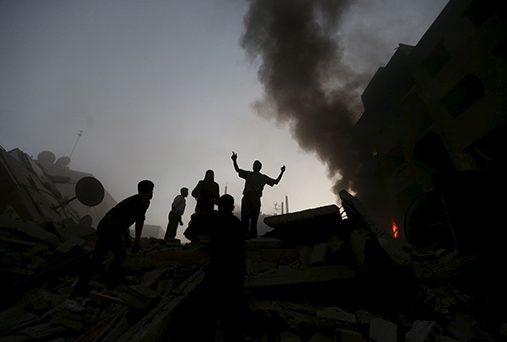
The Syrian war rages on, its devastating civilian toll rising with no viable political solution in sight. Diplomacy is stymied by the warring parties’ uncompromising positions, reinforced by political deadlock between their external backers. The U.S. is best placed to transform the status quo. A significant but realistic policy shift focused on dissuading, deterring or otherwise preventing the regime from conducting aerial attacks within opposition-held areas could improve the odds of a political settlement. This would be important, because today they are virtually nil. Such a policy shift could begin in southern Syria, where conditions are currently most favourable.
While the White House has declared its desire for an end of President Bashar Assad’s rule, it has shied from concrete steps toward this goal, pursuing instead a strategy to “degrade and ultimately destroy” the Islamic State (IS), which it deems a more serious threat to its interests. Yet, a year into that strategy, the overall power of Salafi-jihadi groups in Syria (as in Iraq) has risen. This is no surprise: the Assad regime’s sectarian strategy, collective punishment tactics and reliance on Iran-backed militias, among other factors, help perpetuate ideal recruitment conditions for these groups. By attacking IS while ignoring the regime’s ongoing bombardment of civilians, the U.S. inadvertently strengthens important aspects of the Salafi-jihadi narrative depicting the West as colluding with Tehran and Damascus to subjugate Sunnis.
Salafi-jihadi groups, including IS and Jabhat al-Nusra, al-Qaeda’s Syrian affiliate which fights both IS and the regime, are strongest in the north and east, where they have exploited disarray and conflicting priorities among the opposition’s external sponsors. While the U.S. has attached greatest importance to the battle against IS, for example, Turkey has pressed for a more concerted effort to topple the Assad regime, while pushing back against Kurdish groups allied with Iran. Continuing disagreement has prevented establishment of a northern no-fly zone, a key Turkish demand.
Southern Syria currently provides the best environment for a new approach. Beginning in early 2014, increased assistance from Western and Arab states and improved coordination among the southern armed opposition factions they support sparked a string of victories against regime forces, enabling these factions to gain strength relative to Salafi-jihadi groups. With these factions in the lead, by late January 2015 opposition forces had gained control over contiguous territory encompassing most of Quneitra province and the western third of Deraa province. A major regime counter-offensive the next month south of Damascus, with unprecedented Iranian and Hizbollah support, recaptured only a small share of territory and failed to halt the momentum of opposition forces that extended their territory through much of eastern Deraa between March and June. An opposition offensive is ongoing in late summer to capture the portion of Deraa’s provincial capital still under regime control.
Some of this success can be attributed to the steady erosion of regime military capacity, which manpower constraints suggest will continue. This may force Assad to deepen reliance on Iran-backed militias in areas he fears losing, or concede these to the opposition and resort to aerial attacks (including barrel bombs) to keep them ungovernable. In either scenario, Salafi-jihadi groups would gain further traction, lowering prospects for resolving the conflict politically. Avoiding this requires a joint strategy among the opposition’s backers to empower credible opposition elements to fill the military and civil voids on the ground by establishing effective civil administrations. The south, where Salafi-jihadi groups are weakest, is the most favourable starting ground.
As has become clear throughout Syria, however, opposition elements cannot build effective governance amid the death and destruction caused by aerial bombardment, particularly given the regime’s tendency to target precisely those facilities necessary for capacity to emerge. Diplomatic admonitions which are not backed by concrete action carry little weight with the regime’s backers, and are unlikely to halt Assad’s use of air attacks as part of a scorched-earth strategy and a way to mete out collective punishment. The U.S. needs to be ready to pursue other means at its disposal, and to signal that readiness.
The Obama administration has sought to avoid that deeper involvement in the conflict, due to scepticism about what a more robust policy could achieve and concern that the regime’s allies might retaliate against U.S. personnel and interests elsewhere. But this conflict will not end without a shift in U.S. policy. In addition to improving living conditions in the south, it could also significantly help in degrading Salafi-jihadi power and otherwise improve prospects for an eventual negotiated end of the war.
It would do so, first, by enabling opposition groups to consolidate military control and establish governance capacity in the south. This would improve their strength and credibility vis-à-vis Salafi-jihadi groups and could incentivise their development as political actors capable of governing their areas.
Secondly, achieving a zone free of aerial attacks in the south could provide a model for a different approach by the rebels’ state backers in the north, where poor coordination and divergent priorities with Ankara, Doha and Riyadh have contributed to a situation not conducive to an escalated U.S. role. A move by Washington to halt regime aerial attacks in the south could signal it would consider doing so in the north as well, if those allies would assist in bringing about a similar shift in the northern balance of power away from Salafi-jihadi groups.
Thirdly, a U.S. push to halt regime air attacks in the south would signal resolve to the regime’s most important backers, Iran and Hizbollah, and demonstrate that the returns on their investments in the status quo will further diminish. Iranian and Hizbollah officials play down the long-term costs of their involvement, believing they can outlast their opponents in a proxy war of attrition, and viewing the price of doing so as preferable to negotiating a resolution that includes an end to Assad’s rule. Their view appears based, in part, on the assumption that Washington’s narrow focus on IS and reluctance to confront the regime are pushing its policy toward accepting Assad’s political survival and thus, ultimately, a resolution of the conflict more favourable to them.
The U.S. initiative described here could help refute that assumption and put weight behind the White House’s assertions that the nuclear deal will not pave the way for Iranian hegemony in the region. This message of resolve should be paired with a parallel one indicating U.S. willingness to take the core interests of the regime’s backers into account in any political deal to end the war.
Beirut/Brussels, 2 September 2015

