Search

band annie's Weblog

I have a parallel blog in French at http://anniebannie.net

Category

Syria

Syrians Are War Correspondents, Too

A response to Terry Anderson’s “Running Toward Danger.”

BY AMAL HANANO | OCTOBER 30, 2012

Dear Mr. Anderson,

I read “Running Toward Danger” yesterday and I had to tell you how much it moved me. Syria is being ripped to shreds, the people are suffering, and the cities are being destroyed. We didn’t expect this degree of ruthlessness as a response to the people’s demands for freedom after 40 years of Assad tyranny, but as we know well, freedom is not free.

Your thoughts on war correspondents sacrificing everything for the truth applies not only to the brave journalists like Austin and Marie and Anthony and the dozens of journalists inside Syria now, but also to the Syrian men and women who stood behind the cameras, documenting the truth. We have lost dozens of citizen journalists in this revolution. Young men who were students, employees, fathers one day and became threatening targets the next day because of their cell phones, cameras, and laptops. They knew Syrians have been silent too long. Last year, they decided to never cover up Assad’s crimes with silence again. And they are paying a heavy price for it.

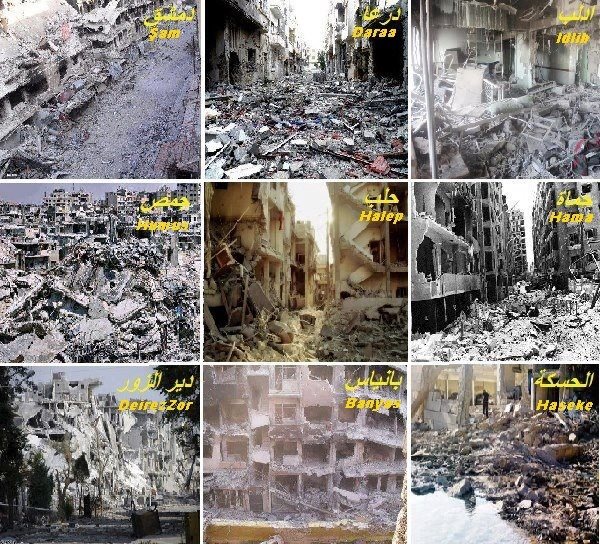
I don’t know what my dead friends would have answered your question, “Was it worth it?” But I do know what the ones who are alive and still film and photograph in Homs, Aleppo, Hama, Idleb, Daraa, and across Syria would say to the question, “Is it worth it to die for your camera?” They would say, “Yes.” Because they know for the first time in their lives, their voice matters and they are doing the most important job, to tell the truth while so many are telling lies. Telling the truth, in a way, has become even more important than freedom. It’s the road to freedom.

I’ve been writing about the revolution since the beginning. I didn’t expect to take on the role I now have when I began; telling my stories evolved into telling Syria’s stories. I only cared about one thing: telling the truth. Sometimes it seems like an impossible task. And many times the truth hurts. But we have to keep going and hope that what’s good in the people prevails over the evil.

When I read your piece, I remembered Anthony Shadid, a journalist who changed my life, and how much I miss his voice of truth. And I thought of Austin too. I pray he is safe and will return to his family soon.

Most of all, I wanted to tell you that your words made a difference to me. God bless you.

With much respect,
Amal

Syrian rebels ‘buying arms from the regime’

Last Updated: Tue Oct 30, 2012 10:30 am (KSA) 07:30 am (GMT)

Tuesday, 30 October 2012

A rebel fighter looks through the site of his rifle towards a positiong held by pro-Syrian government troops in the Bustan al-Bashar district of the northern Syrian city of Aleppo. (AFP)

A rebel fighter looks through the site of his rifle towards a positiong held by pro-Syrian government troops in the Bustan al-Bashar district of the northern Syrian city of Aleppo. (AFP)

By AFP
ALEPPO Syria

The Syrian regime may be their sworn enemy, but rebels fighting to bring down President Bashar al-Assad say they pay hard cash to government agents for guns and bullets.

For Syria’s plethora of armed opposition groups, obtaining weapons is a constant struggle. Furious with the West for failing to provide heavy weaponry, they say they have little choice but to line Assad’s coffers.

In a country where national service is compulsory, and a conflict where brothers fight on opposing sides and rebels defect from the armed forces, they say it is not difficult to find a “middleman” or an “old friend” to help.

“We buy from Assad spies and on the market,” said Major Abu Mahar, puffing on a French cigarette over coffee at a gym requisitioned by his network of fighters as a base in the northern city of Aleppo.

He claims to lead 200 men who conduct “special missions” against Assad’s forces. But like other units, they are poorly armed with machineguns, rocket-propelled grenades, sniper rifles and home-made rockets and bombs.

Seven Kalashnikovs hang upside down from hooks and a bucket of bullets sits in the corner of Abu Mahar’s office, which overlooks the mirror-lined workout room where bodybuilders used to flex their pecks.

Quietly spoken and hunched over in a leather jacket, he defected this summer from the air force. And like other rebels, he still has associates in various branches of the government military and security.

Abu Mahar says a bullet costs 110 Syrian pounds ($1.60) to buy from the regime, compared with $2 on the market, declining to specify where that market might be.

He claims that most of his group’s ammunition supplies come from the shabiha, the term used to refer to state-sponsored militia hired by the government.

“We buy them from double agents, they need the money. The shabiha’s God is money. They don’t care about anything else. If you give them money they’ll even sell you their own mother,” he said.

“They have open access to army, police and intelligence bullet stores. They’re saving up for when the regime falls,” he smiled into his salt-and-pepper beard.

But Abu Mahar is evasive about where and how often the exchanges take place. He says his network uses a “pointman” or an “old friend,” and they do not meet face to face.

Rebels seem unperturbed about bankrolling their enemy, particularly when the West has declined to provide heavy weaponry and there is no prospect of a NATO-enforced no-fly zone that was so vital in toppling Libya’s Muammar Qaddafi.

“They’ve already taken our money for the last 40 years, our gold, our minds, what difference does it make?” shrugged one member of the main rebel group, the Free Syrian Army (FSA), in northern Syria near the Turkish border.

For Yussef Abud, a commander in the FSA’s Tawhid Brigade, it’s a matter of survival although he claims to have bought regime bullets only “once or twice.”

“What can I do? Sometimes I don’t have enough weapons or bullets. I don’t like it, but without these bullets and weapons, many FSA will be killed,” he told AFP.

Rebels also take guns from soldiers they kill on the battlefield, while others who defect from the regime often manage to smuggle their weapons out with them.

Sitting guard in an old sports complex on the Aleppo front line, Mohammed Abu Issam al-Halabi, 49, claims to have bought his Kalashnikov “from bad guys in the regime” for $1,000 when he decided to become a “mujahid” eight months ago.

“You can’t buy these on the market and I need a weapon. What can I do?”

The former factory boss, with a bushy beard and black Islamic bandana round his head, told AFP that before the uprising the gun would have cost only $200-$300.

Across the road, Lieutenant Ahmed Saadeen, 24, agrees that buying armaments from the regime is right.

Like many rebels, he angrily criticizes the apparent refusal of the West and the Gulf to provide Syria’s rebels with anti-tank and anti-aircraft weapons.

“Where else can we buy them?” he snapped, before sprinting away to dodge sniper fire.

The Fall of the House of Asad, a rerun with interesting comments added

Qunfuz

Robin Yassin-Kassab

with 5 comments

steve bell’s asad

This review of David Lesch’s book was written for the Scotsman.

Until his elder brother Basil died in a car crash, Bashaar al-Assad, Syria’s tyrant, was planning a quiet life as an opthalmologist in England. Recalled to Damascus, he was rapidly promoted through the military ranks, and after his father’s death was was confirmed in the presidency in a referendum in which he supposedly achieved 97.29% of the vote. Official discourse titled him ‘the Hope.’

Propaganda aside, the mild-mannered young heir enjoyed genuine popularity and therefore a long grace period, now entirely squandered. He seemed to promise a continuation of his father’s “Faustian bargain of less freedom for more stability” – not a bad bargain for a country wracked by endless coups before the Assadist state, and surrounded by states at war – while at the same time gradually reforming. Selective liberalisation allowed for a stock market and private banks but protected the public sector patronage system which ensured regime survival. There was even a measure of glasnost, a Damascus Spring permitting private newspapers and political discussion groups. It lasted eight months, and then the regime critics who had been encouraged to speak were exiled or imprisoned. Most people, Lesch included, blamed the Old Guard rather than Bashaar.

“I got to know Assad probably better than anyone in the West,” Lesch writes, and this is probably true. Between 2004 and 2008 he met the dictator frequently. His 2005 book “The New Lion of Damascus” seems in retrospect naively sympathetic. He can be forgiven for this. Most analysts (me included), and most Syrians, continued to give Bashaar the benefit of the doubt until March 2011.

The most visible result of the early reforms was the rise of a new crony capitalist class. There was economic growth, but not enough to keep pace with population growth, or to withstand the shocks of recurrent drought and the 2008 financial crisis. The regime’s socialist pretensions collapsed, and by 2011 Syria’s working classes were as discontented as Egypt’s or Tunisia’s. Still, almost every observer predicted that Syria would weather the revolutionary storm. The Assadist state was expected to survive because of its (false) image as a ‘resistance regime’ amid a sea of cowering Arab puppets, because of the crushed and divided opposition, the unity of the government with military and security agencies, the threat of sectarian splintering, and a deeply-rooted popular fear of repression.

There was a great deal of truth to this perception. Calls for protests in January and February failed to mobilise the people. It was regime stupidity and barbarism, its failure to recognise the historical moment, which finally brought crowds to the streets. (“Bashaar is the real leader of the revolution,” a Syrian recently told me.) In March children scrawled subversive graffiti on the walls of the drought-struck city of Deraa, and were arrested and tortured. A few hundred relatives demonstrated for their release. Soldiers opened fire, killing four. The next day 20,000 protested. Soldiers killed still more and water and electricity were switched off. Protests then spread around the country.

Lesch blames the miscalculation on inertia and instinctive violence as well as Bashaar’s increasing hubris since 2005, by which time he’d survived Syria’s forced withdrawal from Lebanon and the threat of Bush-doctrine regime change. A man who was “unpretentious, even self-deprecating” betrayed by 2007 “self-satisfaction, even smugness.”

At first the protests were uncoordinated, and local grievances were as important as national. Nobody called for the downfall of the regime, only for reform. Yet, crucially, the fear barrier was falling. Lesch quotes an activist on the catharsis felt by many: “It was better than joy, it was better than love. What was amazing was that suddenly everyone felt like family.”

Bashaar still had time, but it was rapidly running out. He waited a week after the first bloodshed before addressing the rubber stamp parliament. Lesch calls the speech “pathetic”, and so it was. Not wanting to appear weak, or to concede to pressure as Mubarak and Ben Ali had done in vain, he blamed the upheaval on foreign conspiracies. In fact, the West, the Gulf and Turkey were willing to wait for Assad to offer real reforms and stabilise the situation. He did mumble about reforms, but stressed he’d been planning them since 2005. Disastrously, he giggled throughout the speech. In the new context his “childlike laugh” no longer provided a charismatic touch.

The vicious circle set in – demonstrations, killings, larger demonstrations, worse repression – until the current crescendo of over 20,000 dead, thousands (including children) tortured and raped, and the major cities bombed by tanks and planes. State violence brought unstoppable momentum to the uprising. Lesch quotes another activist: “If we had known it would reach this point, we probably wouldn’t have dared oppose the regime. But we did it, and now we can’t stop, because if we do they will kill us all.”

Lesch gives a good overview of the various opposition organisations, the grassroots Local Coordination Committees, and the burgeoning Free Syrian Army. He describes the international forces supporting and (ineffectually) opposing Assad, and the ultimately irrelevant international diplomacy.

Lesch finished writing before the FSA became more effective, before the high-level defections and assassinations of top figures. His book inevitably suffers slightly from the gaps and editorial lapses of a book rushed out in haste. It is also difficult to read that Lesch still holds Assad’s spokeswoman Bouthaina Shaaban “in high regard” (“Do you think this system would accept torture?” she asked Channel 4 in outraged tones).

Stephen Starr’s excellent “Revolt in Syria: Eyewitness to the Uprising” offers a more street-level account, but the strengths of Lesch’s book are his solid analysis and his previous access to the top which, while not providing any particularly new insights, does add an interesting layer of personal observation. Lesch’s disillusion echoes that of ordinary Syrians, and he is therefore ideally placed to chart how the dictator’s smugness has pulled Syria, this ancient country, into the abyss.

Written by Robin Yassin-Kassab

October 11, 2012 at 10:12 am

Posted in book review, Syria

Tagged with

5 Responses

Subscribe to comments with RSS.

  1. […] Read more of this post Robin Yassin-Kassab | October 11, 2012 at 10:12 am | Tags: David Lesch | Categories: book review, Syria | URL: http://wp.me/pytsp-ww Share this:FacebookTwitterLike this:LikeBe the first to like this. […]

  2. An excellent piece. Accurate and beautifully written.

    So why am I clutching my head in exasperation while reading it?

    It’s because you wrote: ” Most analysts (me included), and most Syrians, continued to give Bashaar the benefit of the doubt until March 2011.”

    Then comment: ” It was regime stupidity and barbarism … which finally brought crowds to the streets.“

    Exactly! But why is the the true nature of the regime treated as a discovery?

    It has confounded and appalled me since 2000 that anyone could accept, at any level, that Bashar Assad should be automatically elevated to lead Syria and then taken seriously. And that the situation was likely to be sustainable.

    A hereditary dictatorship in the 21st century? End of story. And one as inept and sinister as they come.

    The bleak inevitability of today’s nightmare from the day Hafez Assad seized power was summed up with crystal clarity by Burhan Ghalioun in a speech at the LSE last month:

    “…the Syrian regime is not a political regime. It’s not even a nationalistic patriotic regime. It’s actually acting only through blood and authority of occupation. The Syrian regime came to power through violence. It never sought to integrate or actually have any sort of participatory approach towards its own people, even in a partial way. It never answered to any political standard.

    …“It’s only through violence or sometimes they resorted to manipulation. The way they always played and exploited any contradictions that are there in Syria, any fractions that are already there. They always manipulated it to rule. “

    (I recommend in full the speech in London at the LSE on 20 September by Dr Burhan Ghalioun, Université Sorbonne Nouvelle and Former Chairman of the Syrian National Council –

    http://www2.lse.ac.uk/middleEastCentre/Events/Event%20Transcripts/Ghalioun.Keynote.Transcript.pdf)

    What were Lesch and others thinking? That Planet Assad was ‘normal’? That Assad was the Syrian people? That the Syrian people weren’t human beings like everyone else?

    Calling it naivety is being kind. I think a sharp recalibration of his moral compass is required if Lesch wants to be regarded as a grown up.

    SL

    October 12, 2012 at 9:20 pm

    • I remember when hafez died there was an atmosphere of barely suppressed panic amongst many syrians. people were terrified of a return to the coups. i think many, perjaps most, syrians welcomed bashaar not wholeheartedly, certainly not beuase they liked the hereditary president idea, but as the least worst option. aand the late 90s, early 2000s looked a hell of a lot better than the 80s in syria. so many people hoped. I too (and obviously i was completely wrong) hoped. i think hafez, though undoubtedly a ruthless tyrant and a domestic mismanager, had a strategic intelligence. for instance, he immediately understood the ramifications for syria of the collapse of the soviet union. i thought perhaps some of that strategic intelligence might survive in the regime and that the family would recognise the new historical moment – 2011, the arab uprisings, etc – and respond more intelligently so that syria could have had a staged route to democracy with guarantees for all etc. i was wrong, i was wrong. (i would say that your characterisation of the baath is too simplistic, although it’s cetainly true that the regime was always based in violence and never in a genuine mass movement. it did however represent a movement of rural sunnis and minorities to the urban centres and a share in power, whatever we think of how it was done and what happened to other social groups. i mean, it had some kind of social base at first, some kind of natural constituency. since bashaar and the crony capitalism (and really since the late 70s when the gloves came off) it hasn’t had that.

      Robin Yassin-Kassab

      October 12, 2012 at 10:50 pm

  3. Qunfuz,

    Usually leaders are given 100 days in office as a grace period. Assad was given 11 years.

    Don’t be too hard on yourself regarding this. Would it had made much difference if you had wanted Assad gone years ago? Was there any credible alternative after the Damascus Spring was beaten down? Not really. The Assads did not allow any alternative except the mosque to raise its head in Syria. So the only real alternatives for someone what cared about Syria were either to go into a pessimistic funk or optimistically hope that Assad will change. If you want to fault yourself for anything it should be for being too optimistic despite the evidence. But that is not more than an epistemology misdemeanor.

    If I may ask, at what point did you reach the conclusion that the Assad regime was not really a resistance regime? How would you define a resistance regime?

    AIG

    October 16, 2012 at 2:14 pm

    • I would define a resistance regime as one which resists zionist occupation and aids the palestinians to resist apartheid. if that’s the AIG i think it is, you won’t agree, especially with the apartheid bit – but let’s not fight about it now. Theoretically a resistance regime could resist in any of a variety of ways – diplomatically, politically, militarily, even culturally. I’ve never liked the term and I never thought the asad regime was really interested in resistance, but it did seem to me at one point to nearly fit as a result of its help to hizbullah – which it seems i was also wrong about. But I still respect the past version of hizbullah for its work for the lebanese shia and for its military resistance to israel. asadist help to hizbullah is outweighed by its slaughter of palestinians in lebanon and its useless attempts over the decades to coopt and divide palestinian political and military organisations.

      Robin Yassin-Kassab

      October 16, 2012 at 6:55 pm

Assad’s reforms in the field

Rime Allaf : Assad reform: mortar shells, missiles, barrel and cluster bombs all over Syria and equal rights to destruction.

Rightists and Leftists Against the Revolution

Ziad Majed

12 September 2012

Why do racist European right-wingers and some factions belonging to the far left find a common ground in their hostility towards the Syrian revolution?

For a while now, that same question has been posing itself on many friends shocked by the positions and comments of writers and reporters united in viciously criticizing the revolution, not out of concern nor “neutrality”, nor even as a result of their rejection of the revolution’s errors and impurities, which certainly exist and are plentiful.

Let us push the question even further. Why is the Syrian revolution unable to mobilize the activist segments of global or “Western” civil society, even though the media and public opinion generally empathize with it?

The answer seems compound, and is based on a combination of factors which control aspects of the political and cultural viewpoint of the Arab region, as well as political and moral criteria governing many of the attitudes and writings concerned with the region. As a result of these factors, sympathy or solidarity with the revolution seems minute compared to the brazen attacks, skepticism and perseverance of those holding hostile views.

One of those factors is the fear which prevents many political players from taking a stand towards “conflicts” in the “complicated” Middle East, where wars and crises accumulate and religious tendencies intensify, spreading their effects across the Mediterranean, inevitably reaching it northern shores.

There is also the prevalence of the “culturalistic doctrines” when comparing world issues and conflicts, particularly those associated with Arabs and their countries. Arabs appear to those “culturalistic” folks as people who habitually resort to violence in solving their conflicts, while drawing from a well of religious extremism, making it difficult to bet on their readiness to evolve towards democracy or to break free of the burdens of ‘Eastern despotism’. The severe violence associated with the Syrian conflict is therefore no exception in the context of the persistent ‘civil wars’ of the region, nor does it command surprise or urgent action.

Another factor is ‘Islamophobia’, shared by the extreme right (for racist reasons) and certain leftwing factions (who hide behind the excuse of defending freedoms and secularism). That is how writers from the far right meet with some of those on the far left in supporting Assad’s tyranny under the pretext of his hostility to the Islamists (the former) and his ‘secularism’ (the latter). In addition of both sides, there are those who are obsessed with the issue of ‘minorities’, perpetuating miserable tales of the threats and resentment posed by the majority.

This makes it easy for many political activists, especially students amongst them, to surrender to conspiracy theories and what they offer in terms of suspense, as well as pride garnered by understanding the “secrets” behind things, always stressing the malevolence of international relations. It used to be that leftist groups were more susceptible to becoming addicted to such theories. Now, however, the extreme right has also embraced them, especially those pertaining to ‘jihadist Islamic’ conspiracies, as well as international organizations being dens for plots which target the national makeup of countries, breaching their borders and sovereignty.

Another factor lies in the disdain of certain progressive ‘prominent’ writers, who hold influence over public opinion, from dealing in the issues of people, and their dignities and freedoms. What they are concerned with are borders, oil and geo-strategies, as well as the influential roles of regional countries and the ‘West’s’ decisions concerning them. Some of them surely look at Russia and China contemplating the return of the Cold War. In this they border on being racist even if they are looking at things from the perspective of ‘fighting for the best interests of Arab countries’. This is because they deal with these countries as entities that lack real people with flesh and blood and rights, or as if their citizens were deaf and dumb masses driven and misled by ‘Western’ plans and lies, and all that is required of those citizens is to rally around those who can protect them (or claim to protect them) from the Imperialist attack, even if they are to be crushed in order to thwart the success of these foreign conspiracies!

Another reason is the refrain of those intellectuals who championed the Palestinian cause with audacity and relentlessness from expressing advocacy of the Syrian revolution under the pretext of fear from Syria being torn apart or the spread of chaos in a way which would benefit Israel and America.

Finally, these factors also include the readiness of writers who have built fame and credibility over decades by residing in the region and opposing their countries’ policies towards it, to lie and be hypocrites in return for continued spotlight, battling and contradicting what they deem prevalent in their countries’ media, even if it, along with their governments, this time do not go against the ‘humane’ standpoints which those writers have had always called for to be taken into account.

We can also add to the aforementioned factors others which are linked to the boredom that has hit Western public opinion towards the Arab Spring phenomena, especially after the Muslim Brotherhood won elections in Egypt and Tunisia, and after the war in Libya, as well as the long time the Syrian revolution is taking. We can also note the geographical distance of the Middle East (in comparison to the geography and demography of North Africa). We can also talk of the skepticism held by many towards the Qatari and Saudi role in Syria and their worry that the situation will lead to the lack of stability in the entire region, as well as in Israel at its core. We must also not forget the efforts of the Syrian regime and its Lebanese and Arab allies, as well as some paid European experts, in peddling fabricated articles and information regarding the revolution and its plans as well as the horrors that threaten Christians and warnings of a repeat of the Iraqi scenario.

The bottom line is that the Syrian revolution today is not only facing Assad’s brutal regime, but also its supporters, Russia, China and Iran, and is on top of those up against a considerable amount of rotten concepts that alternate between racism, indifference and moral disease striking the hearts of certain leftists and ‘anti-imperialists’.

Even more, the Syrian revolution until now does not have a sound political leadership or a media apparatus with which it can deal with all the aforementioned factors. In return, however, the revolution does have legendary courage, as well as intellectuals, artists and activists with exceptional creativity, wisdom and nobility. It also has a reservoir of patience and hope which makes its ability to endure difficult to deplete, no thanks to any of its (ungenerous) allies.

Visit Ziad Majed’s blog for the original article in Arabic

source

Syria : genocide or civil war ?

[youtube http://youtu.be/MNw_4IUX35o?]

The debate and Syria


..

Bashar as God

This video explains to what level Syria has arrived. Syrian soldiers threaten to beat a young man as they make him chant that he loves Bashar and accepts him as God. They smile among themselves in self affirmation and mirth, as they terrify the teenager. He is cowering blindfolded against a wall. Bashar al-Assad claims his soldiers are fighting “fundamentalists” even as they impose their religion of al-Assad on terrified Syrians. The Salafis cannot be worse. This sort of video has become a trope. They have popped up with terrifying regularity since the first months of the revolution and express the ideological endgame of the regime. Assad is God

[youtube http://youtu.be/1zeI8JyYADg?]

source

We condemn Israel. So why the silence on Syria? |

Jonathan Freedland

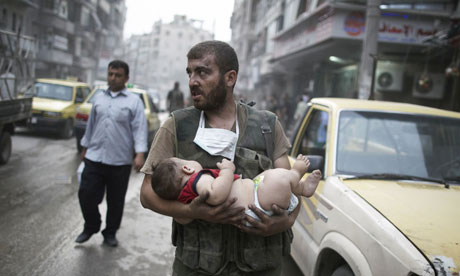
A Free Syrian Army fighter carries a baby, the only survivor in his family after an artillery round destroyed his home in Aleppo this month. Photograph: Sipa USA/Rex Features

Read by 243 people

Friday 19 October 2012

When Israelis kill Arabs there is outrage. But Assad’s brutal campaign has cost 30,000 lives and there’ve been no protests

We know the government hopes to do nothing, but what about the rest of us? Exactly one year after the death of Muammar Gaddafi, the chances of another round of Libya-style western military intervention, this time for Syria, hover close to zero. Even the hawkish Mitt Romney promises no such thing. Few politicians speak even of non-military options – of which there are many – let alone taking up arms.

They say nothing because there is no pressure on them to say anything. Here and abroad, there is virtual silence, save for the desperate pleas of a few Syrian expats and yesterday’s cry for humanitarian help from the Turkish foreign minister. We know the facts, and we know what Bashar al-Assad has done since demonstrators took to the streets to protest against his rule 19 months ago. He and his forces have pursued a campaign of the most chilling brutality, using fighter planes to bomb civilian neighbourhoods, capturing, starving and torturing children as young as six, according to Save the Children, and racking up an estimated death toll of 30,000 victims.

People know all this but stay mute. Not that they should be demanding immediate military action. After Afghanistan, Iraq and Libya, people are justifiably both weary and wary, with many regarding action in Syria as a practical impossibility. I understand that. But what I can’t comprehend is the lack of public pressure on those doing the actual killing – starting with the Assad regime. Instead, public opinion seems utterly disengaged, unbothered by the slaughter under way in Aleppo, Homs and Damascus.

There are no mass demonstrations outside the Syrian embassy in London. The story is rarely on the front page or on the TV bulletins. Even when there is a shocking atrocity, such as the Daraya massacre of up to 400 people in August, it makes only a fleeting impact. There is no Disaster Emergency Committee appeal. At the Labour party conference, there were fringe meetings on every possible subject, from teenage spending habits to domestic pets. But there was not a single session focused solely on Syria – and this in the party that calls itself internationalist.

It’s not as if this is par for the course, that we never get exercised by the loss of innocent life in the Middle East. We do. Nearly four years ago Israel launched Operation Cast Lead, designed to halt Hamas rocket fire from Gaza. It resulted in some 1,400 Palestinian deaths. For nearly a month that story was never off the front page, and it often led the TV news, here and around the world. There were large and loud public demonstrations. The DEC set up a fund and sought to air a televised appeal, famously refused by the BBC.

There is no such clamour now. The Stop the War Coalition is not summoning thousands to central London to demand an end to the fighting, as it did then. On the contrary, its statements are content simply to oppose western intervention – of which there is next to no prospect – while politely refusing to condemn Assad’s war on his own people. Caryl Churchill has not written a new play, Seven Syrian Children, exploring the curious mindset of the Alawite people that makes them capable of such horrors, the way she rushed to the stage to probe the Jewish psyche in 2009. The slaughter in Syria has similarly failed to move the poet Tom Paulin to pick up his pen. Apparently, these Syrian deaths are not worthy of artistic note. The contrast has struck Robert Fisk, no defender of Israel. He puts it baldly: “[T]he message that goes out is simple: we demand justice and the right to life for Arabs if they are butchered by the west and its Israeli allies, but not when they are being butchered by their fellow Arabs.”

Plenty resist that explanation. Some say the lethargy of both the public and anti-war left is due to the fact that Syria is now locked in a civil conflict, making it hard to tell good guys from bad guys. Yet NGOs were swamped with cash donations during the Kosovo crisis: the public did not write that off as a mere internal Balkan problem. Besides, though it’s a civil war now, with both sides armed, for several months it was much more straightforward: peaceful demonstrators killed in cold blood. Yet few rallied to the Syrian people’s cause then either.

Others wonder if Gaza in 2008-9 stirred greater outrage because it was such an intense episode, unfolding in a matter of weeks, while Syria has been a drip-drip horror story played out over nearly two years. But this hardly stacks up. Awful to speak in such terms, but the killing rate has been more, not less, intense in Syria: witness that massacre of 400 in a single day.

Anxious for answers, I called Lindsey German of Stop the War, who told me the organisation was not active on Syria because that “isn’t Stop the War’s job”. Its focus is on what “Britain and the US are doing”. Why, then, was it so vocal on Gaza? Because the west “was very much in support of the Israelis, so it was very different”. (In fact, Britain did not support Operation Cast Lead but called for a ceasefire.) She adds that the Palestinian question “has its own dynamic, which isn’t true of any other country”.

The trouble is, such thinking surely leads to a very parochial form of internationalism – turning a blind eye to all those areas of the globe where one’s own government is not involved. And that’s if such a rule were applied consistently – which it is not.

The last argument is a variation on the civil war one: Syria is now mired in a viciously sectarian conflict, Alawites and their allies against Sunnis and the rest, which makes it impossible for outsiders to take sides. But such logic rapidly falls into the moral hole identified by Fisk, in which a Muslim death matters less when the killer is a fellow Muslim.

Of course we reserve a special kind of outrage for the targeting of one ethnic group by another. Yet there is a risk here. It’s not simply a bias against Jews that regards an Arab or Muslim death as only deserving condemnation when Israel is responsible. It is demeaning of Arabs and Muslims themselves – implying that when members of those groups kill each other it somehow carries little moral weight. Such a view is not defensible, especially among those who would consider themselves to be enlightened or progressive. Every life has equal worth, no matter who’s doing the dying – or who’s doing the killing.

• Comments on this article will be launched on Saturday morning

source

Blog at WordPress.com.

Up ↑