Search

band annie's Weblog

I have a parallel blog in French at http://anniebannie.net

Category

Syria

Al Azm on “Anti-Imperialists”

Sunday, April 28, 2013

Dr Sadiq Jalal al Azm is somebody I’ve been wanting to read more of and never had the chance to. I just stumbled upon a recent translation of his interview and I’m impressed by his razor sharp analysis. Of particular interest to me was his classification of the so-called anti-imperialist camp that has made it their mission to obfuscate and confuse the discourse surrounding Syria since the start of the revolution.

Whereas the smaller bloc of the left has hardened its old positions, as if nothing happened after the end of the Cold War, and with time its attitudes and methods became of the same nature as that of the Taliban-Jihadis or dogmatic closed-minded sectarians, or even that of terrorist “Bin Ladenites,” in its blind defiance of the West, global capitalism (a global capitalism that Russia and China are now a part of) and imperialism. This bloc from the left, in the Arab world and internationally, is today the most hostile to the Syrian revolution and the closest to defending the tyrannical military-security-familial regime using several arguments, not least of which is that the entire world plotted, apparently, against this regime that is peace-loving and stable.

This type of leftist emphasizes “the game of nations” and “geopolitical analysis,” with stories of collision of interests and plans of the great powers and their dominance in our region, and does not want to view the revolution in Syria through anything other than through this lens, and neglects all that happens inside Syria and to Syria’s revolutionaries today, as well as ignoring all the reasons that led its people to a peaceful revolution, and later to taking up arms in the face of a “nationalist” tyranny that is allied with this kind of leftist.

In other words, this leftist has no problem with sacrificing Syria if it leads to a victory being handed to their international camp and “geopolitics” that wants a global victory in the “game of nations.” Their first priority is not Syria or its people in revolt to restore the republic, their freedom, and their dignity, but the game of nations at the global level of analysis and the side that they want to win.

The English translation of the interview is well worth a read here.

Posted by Maysaloon at 6:21 pm

source

The Two-faced Propaganda of the Damascus Regime

  • [An edited translation from the Azmi Bishara Arabic facebook page]

    The Syrian regime has been hosting American journalists as part of its propaganda campaign targeted at the West. It explains to its guests that Damascus’ is the only government capable of combatting global Islamic terrorism, and invites them to view the pictures of the “foreign fighters” who have come to Syria. Of course, they neglect to mention here how the Syrian regime is committed to the resistance, nor do they deign to mention the occupation of the Golan Heights. In its propaganda targeted at the Arab public, meanwhile, the same regime has deafened all of our ears with claims that it stands up for the resistance, and that this is what motivated the American-Arab conspiracy that is the Syrian revolution.

    In the regime’s propaganda directed to the Arab public, the foreign jihadists who have arrived in Syria are depicted as products of US intelligence and American-allied Arab governments. There’s no mention of that in what is said to the West, however. In the image the Syrian regime projects to the West, the emphasis is always on “terrorism” and “Islam”. Here, the Syrian regime presents itself as a victim of “Islamic terrorism”, in the same boat as the US in the wake of the Boston Bombings.

    The sordidness needed to carry out such a feat of duplicity is boundless. A separate fact is that, regardless of their motives, the presence of foreign fighters in Syria has harmed the Syrian people’s national revolution.

Lessons from the Minaret


Amal Hanano is a well-known Syrian writer and blogger, as well as an associate editor of Syria Deeply. Here she explores this week’s destruction of the Umayyad Mosque, the architectural pride of her hometown of Aleppo.

View of Umayyad from the street / Amal Hanano

I still remember how it smells, musty and old. It smelled like the air has never changed for centuries. The 1,000-year-old stone, worn rugs and stacked holy books were timeless. I remember how it was peaceful inside. No matter how hot it was outside, it was cool inside the vaulted rooms. A calm world tucked within a world filled with noise, dust and now chaos.

I remember how we would go sometimes to pray and other times with visitors. We would drape the long black abayas over our street clothes and cover our hair. We would laugh and take pictures of each other in the courtyard while old men recited verses in a corner and pigeons flew under the arches. It was a place to connect to your history, to your identity and to tell others, who were not from Aleppo: “This is where we are from. This is who we are.” This is where you come to face your roots. It was a place that existed forever, a place we thought would exist long after we were gone. But we were wrong.

They say that people make their cities. But if you are from Aleppo, one of the oldest cities in the world, the city has made you much more than you have made it. So when pieces of our history are destroyed one by one, pieces of us are lost, fragment by fragment.

*

“We really don’t know [whether Umayyad was targeted on purpose]. The story of the regime is that the jihadists blew it up on purpose, and the story of the Free Syrian Army is that it was under regime control and the regime had planted explosives within the mosque, and then the regime blew it up. It’s highly unlikely that the rebels or Jabhat al-Nusra would explode the minaret. Jabhat would not do that to a mosque. It was probably either targeted by the regime or fell as a result of crossfire.

It’s so sad and it’s so old. It’s 960 years old. And the mosque itself was built in the 8th century. The site, the ground, went back to Hellenistic times, then in Christianity it was a church. All of the Old City of Aleppo is like that, layers of history built on top of each other.

Mosque minarets were really used as urban planning devices.

Many from Aleppo have changed their Twitter and Facebook photos to this image of a broken minaret.

They planned the streets around that mosque to center around the minaret, so that the minaret would be in center of your [vantage point].

It’s very symbolic. People are really devastated. A lot of people changed their picture on social media to show the minaret. Or rather, a broken minaret. It’s part of our identity [in Aleppo.] The BBC got backlash for heavily covering it, because people said, ‘Why are you covering the destruction of a minaret when so many people are dying?’ But there is that sense that it’s part of our identity, and people are mourning it.

People in Aleppo are extremely proud of their architecture, especially our minaret. It’s a big sense of pride for people from Aleppo. And this is the most important site in the city, after the citadel. “

*

‘The minarets, like trees, have souls.’ – Nizar Qabbani

The lesson of the minaret: every tyrant will fall and the city remains. History has taught us that the people find a way to pick up the pieces of their city and rebuild. One thousand years from now, these years will be a chapter in history books. The future people of Aleppo will visit this sacred site and will feel the calm and peace once more. The stone will be old again. They will point to the square tower and whisper to their children the tale of this minaret that falls every few centuries when the lesson of tyranny must be taught to a people who had forgotten. Those people of the future are lucky. They will be unaware of the pain of living those years, unaware of the shame of writing this chapter. History is abstract and seamless to them, like it once was for us. It is merely a story they can recite while they trace their fingers over the stone and remember without consequence. I envy them. 

We were once like those people, telling tales of barbaric Mongols or tragic fires that had destroyed the Umayyad Mosque, the Great Mosque of Aleppo. Instead we will have to be the ones to pick the pieces this time and find a way to rebuild, to heal and to restore what was erased. Even when the rebuilding is done and the blood has stopped flowing, we will never be able to enter these sites without remembering what was lost. It will never smell timeless again for us. History will never be seamless with our memory again.We know that what we will rebuild is a replacement for something that was once perfect. Something that can never come back and will never be the same. We will be destined to whisper to our children and grandchildren: “Once upon a time, there was a minaret that was 1,000 years old. We loved it and we loved our city. But we had forgotten our history. We had forgotten that the hatred of men destroys all that we love, all that is sacred. And one day we woke up and the minaret was gone.

Umayyad Mosque in evening / Amal Hanano

Until then, people from Aleppo, who are now scattered around the world, go to sleep knowing that tonight Aleppo’s skyline is missing yet another sparkling green light that once was the jewel of our city, missing yet another voice that once joined a symphony of voices calling to prayer. Another beloved soul joins the thousands of murdered souls of our city. The city grows darker and quieter, but we also know, from our history, it will never die.

*

“The architecture in Aleppo is different from anywhere else in Syria. The buildings are made of stone, a limestone that’s very famous. And the history, the preservation of the Old City, is very unique. The core is a UNESCO world heritage site. What’s really sad is that before this destruction, Aleppo, and Fez in Morocco, were the two best-preserved Islamic city cores in the whole world. All the other cities were destroyed and rebuilt and modernized except Aleppo and Fez. And the Assad regime itself spent so much money rehabilitating the Old City. They even brought in a German organization that does restoration, and they did massive projects with it. That was their ‘thing.’ And now they’re destroying the Old City they helped preserve without thinking. Nothing is sacred to the regime anymore. Nothing means anything.” (As told to Karen Leigh.)

source

Acting President of SOC George Sabra – Press Conference

[youtube http://youtu.be/0WIcjHaMfSU?]

Syria : please sign petition for Pierre Piccinin da Prata

Pierre Piccinin da Prata is a Belgian political science teacher who has been missing for two weeks in West Syria. He is a journalist and expert of the Arab world; his online blog: http://www.pierrepiccinin.eu/ contains his thoughts and opinions on his journeys throughout the Middle East. After a painful trip to Syria in the spring of 2012, Pierre Piccinin became a supporter of the rebel Syrian cause, being highly critical of Bashar al-Assad’s regime.

He is the author of the book La Bataille d’Alep : Chroniques de la Révolution Syrienne, published by Harmattan in 2012. He is an important actor of the international arena facing the civil war in Syria.

Help us find him! Every signature shows the urgency to find him to the Belgian state.

http://www.activism.com/fr_FR/petition/retrouver-pierre-piccinin-disparu-en-syrie/43622

Bashar’s War

For the Syrian regime’s faithful mouthpieces, victory is always around the corner.

BY SAM HELLER | APRIL 23, 2013

In the Damascus suburb of Jdeidet al-Fadl, according to the Syrian regime media, all is well.

This is the sort of victory that defines the worldview of the Syrian regime media. Television, radio, and print outlets controlled by the regime of President Bashar al-Assad articulate a single vision of the war: that the Syrian Arab Army is waging an unrelenting campaign against terrorists led by Jabhat al-Nusra, an affiliate of al Qaeda, who are the vanguard of a “universal” conspiracy against the Syrian people. But Syria will prevail, state media contend, and its people will build a new, better country founded on dialogue and openness — an oasis of religious and ethnic tolerance.

This is the war Assad chooses to show, and more importantly, it is the war as the regime’s supporters understand it. This narrative has been broadcast to the Syrian public for over two years now by the core of Syrian regime media: SANA; the newspapers al-Baath, Tishreen, and al-Thawra; the official Radio Damascus; the state’s satellite television network and its sister news network, al-Ikhbariya; and the technically privately owned but staunchly loyalist al-Watan daily and Addounia satellite TV network. And in this narrative, the Syrian regime is winning.

The regime advances its understanding of the war most effectively through its daily battlefield reporting. These reports are nearly identical across all media, and they employ a set, limited vocabulary. The regime’s Syrian Arab Army is “our brave army” or “our brave armed forces.” The enemy consists of “terrorists” and “mercenaries,” and the Syrian military typically “destroys” their “nests,” “eliminates” them, and “leaves [them] dead and wounded.” Often, state media give names for the militants killed in combat, and in keeping with the media’s emphasis on foreign fighters among the rebels, their nationality is provided if they are not Syrian.

The regime’s narrative robs the anti-Assad forces of any agency. The Syrian military is always “pursuing” or “targeting” terrorists, but it is never ambushed or attacked. The armed forces sometimes “clash with” or “repel” terrorists, but there are never regime casualties. The regime’s enemies only have initiative when they murder and rob civilians due to those civilians’ “rejection of the terrorists’ crimes and refusal to harbor them.” Terrorists’ actions are “desperate” or “attempts to raise [their] morale” after significant losses.

The pro-regime media acknowledge no divisions among the opposition, painting the many factions as an undifferentiated bloc of militant fanatics. When coverage is more specific than simply “terrorists,” militants are most often identified as belonging to Jabhat al-Nusra, though “the terrorist gangs belonging to the so-called ‘Free Army'” make occasional appearances. When Jabhat al-Nusra publicly pledged loyalty to al Qaeda on April 10, regime coverage was not nonplussed: The announcement was “nothing new,” reported regime television; it was only something “the external opposition and their supporters had insisted on denying for appearances’ sake” while secretly arming the group.

The regime’s media outlets also supply a rationale for why these foreign terrorists have come to Syria. The West and its tame Arab allies, they say, have targeted Syria because it has championed the resistance against colonialist and Zionist plots to dominate the Middle East. In Prime Minister Wael al-Halqi’s words, the terrorists’ goal is to “break apart the countries of the Arab world, loot their resources, and destroy their social fabric.”

Who are the chief conspirators in this plot? State newspaper al-Thawra identifies them as “Zio-American circles and oil and gas sheikhdoms in the Gulf” — including Qatar, Saudi Arabia, Turkey, and the NATO countries. The United States and Israel ultimately steer events, the media report, and U.S. President Barack Obama is “the maestro of the war.”

The United States may publicly disavow terrorists like Jabhat al-Nusra, but according to al-Ikhbariya, Washington quietly pushes its minions in the region to fund and arm them. After all, America and its allies “created these terrorist organizations so that, like a mount, they might ride them into the region, divide its land, and tear apart its people.”

The rulers of Saudi Arabia and Qatar are regularly described as “a’arab” — uncultured Bedouins, it is implied — of whom Qatari Emir Hamad bin Khalifa Al Thani comes in for the most vitriolic criticism. Syrian television regularly cuts to stock footage of the Qatari ruler when it refers to those who conspire against the Arab people. Both Saudi Arabia and Qatar, the media report, “are blessed with peace and tranquility because they send death abroad and export terrorists.”

The international media aren’t spared the regime’s criticism. Foreign media engender a sort of free-floating hostility; the state media accuse them of “beat[ing] the drums of terrorism in Syria.” But Al Jazeera, which is financed by Qatar, is singled out for having “long played a role in spilling the blood of Arab peoples.”

Regime media also attack the Turkish government for openly supporting terrorists in Syria, implying that Ankara is motivated by imperial ambitions. The Turkish government is referred to as “neo-Ottomans,” while Prime Minister Recep Tayyip Erdogan reportedly “dreams of restoring the sultanate of the ‘sick man [of Europe].'” The Turks are also accused on occasion of selling Syrian refugees’ organs before burning their dismembered bodies.

The Syrian regime, which has long presented itself as “the beating heart of Arabism,” reacted to the Arab League’s recent decision to hand over its seat to the external opposition with contempt. The Baath daily called the Arab League’s March summit “the Summit of Shame.” The event, Minister of Information Omran al-Zoubi explained, was “convened in Qatar under the control [of Qatar] and its money, which allowed it to hijack the league and do as it pleased.”

The political opposition is covered as an afterthought in the regime media — as a front for the terrorist core of the insurgency. The aforementioned Baath report calls opposition leaders the “kumbars of global terror.” “Kumbars” means “film extras”; it doesn’t quite map onto English idiom, but the point should be clear.

Of course, this array of enemies doesn’t necessarily mean that the Syrian regime portrays itself as confronting “global terror” alone. State media are quick to emphasize anything that runs counter to a narrative of Syria’s international isolation. This ranges from any official support — including statements from Russian and Iranian officials — to popular support, like a “mass” solidarity march in São Paulo or reports that “dozens of Yemeni youths” are ready to head to Syria to support the military. Foreign experts and media reports are also given prominent placement when they reinforce the regime narrative. Some foreign journalism is faithfully reported, but sometimes the source material is made more palatable for the regime narrative. An article on a King’s College London report on Europeans joining the rebels, for example, referred to the Europeans as “mercenaries” — a charge absent in the original study.

The Syrian state also leans on support from religious leaders as a key source of legitimacy. It promotes calls by Pope Francis for a political solution to the crisis, for example, and highlights a mixed assemblage of Aleppo priests and imams who participated in the lead-up to the country’s national dialogue. While foreign media often emphasize the conflict’s sectarian dimension, the Syrian official media consistently stress what they portray as Syria’s relative religious harmony. Damascus is, in the words of Syria’s satellite station, “the Damascus of Arabism, the city of love, tolerance, and coexistence.” This ecumenical language reinforces the regular portrayal of the terrorist rebels as takfiri — extremists willing to murder the insufficiently pious.

In contrast to the rebels’ alleged nihilism, regime media consistently advance what they describe as “the only way out of this crisis” — a political solution. Syrian media report daily on meetings held by the “ministerial committee tasked with the implementation of the political program to solve the Syrian crisis” — meetings to which the external opposition is invited, it is emphasized. The process is meant to strengthen respect for a plurality of opinion and ultimately build a “strong, new, united Syria.”

But this regime-run process of dialogue seems, in practice, to amount to little more than a monologue. While the government and its interlocutors do reportedly engage on concrete issues — including security, housing, and municipal services — participants interviewed stress their total commitment to both Assad’s political program and the ongoing military campaign to purge the country of terrorists. This is a discussion in which participants may differ on the details, but the broad themes are fixed. As al-Ikhbariya puts it, its goal “is to bring everyone together for dialogue under the roof of the nation, with an emphasis on the need to combat alien takfiri thought and to root out the forces of terrorism.”

The challenges of the moment aren’t necessarily papered over. Regime media acknowledge the economic hardships facing average Syrians but frame such difficulties in terms of their determination to persevere. “The terror of militant groups in Syria hasn’t been able to prevent the student, the employee, the laborer, and the simple shopkeeper from going about their lives and performing their duty for their nation,” SANA reports.

Prime Minister Halqi, meanwhile, reassures the public: “The Syrian Arab Army is at its strongest and its best, and the Syrian people are behind the state. They believe in it, and their morale is high. If the feeling of concern is legitimate and natural, fear is not.”

Such sentiments are intended to communicate confidence, but the Syrian regime’s messaging is, at best, primitive. In a conflict where new media — both pro- and anti-regime — have helped shape events on the ground, the traditional Syrian state media feel robotic and derivative. The print media coverage consists largely of rewritten SANA news releases, while Radio Damascus’s call-in shows — and their suspiciously articulate participants — sound like playacting. The one bright spot is Syria’s official television: If you can detach from the content of the coverage, the reports are frequently so acid and sarcastic that they’re hilarious. ((For subtitled translations of Syrian television reports, see here and here.)

Average Syrians’ views, however, seem to get lost in the mix. State media produces man-on-the-street quotes and interviews, but only with proud citizens who express unflinching support for the regime. In a report about a school for martyrs’ children, for example, a war widow says, “I still have a girl and a boy, and I, all of us, would love to give our blood and our lives in the defense of our mother, Syria.” Now, this sentiment is real. A broad segment of Syrian opinion is committed to the regime’s vision for the country — or terrified enough by the opposition to side with the familiar. But when you see this in the Syrian media, are they showing that genuine commitment to Assad’s Syria — or a sort of facsimile thereof?

Still, you can be forgiven for occasionally thinking that the regime media’s accounts offer a glimpse of something real — something that taps into the suffering of Syrians, for and against the regime, who are seeing their lives fall away from them. Reporting from Damascus’s Sabaa Bahrat Square after an April 9 car bomb, Addounia narrates that the area “once more polishes its veneer and restores a luster that says, ‘Syria is for us.'”

As it shows people sweeping dust and debris from their storefronts, the television network assures its viewers: “Not one speck of Syria will ever fall under the control of monstrous takfiri terror or be at the command of bastards coming from the depths of ignorance and its garbage dumps, supported by the sellers of gas and slaves, traders in white flesh, and owners of red rooms.”

And then the report cuts to locals estimating the cost of rebuilding their livelihoods — figures in the hundreds of thousands or millions of Syrian lira, a lifetime’s savings. And the Syrians just look tired.

source

Assad Guided by Russian Lessons from Chechnya.

When asked how long the war would take, the soon-to-be assassinated independence leader of the Chechen people, Dzhokhar Dudayev famously responded, “it will be a war of 50 years”.

This week’s focus on Chechnya reminds me how Assad’s strategy to suppress the revolution is influenced and informed by his Russian allies. Some would go as far as suggesting that the similarities point to the Russians actually managing the operation – from SCUD launches to international “diplomacy”.

One can find many similarities with how Russia crushed the independence aspirations of Chechnya over past twenty years and Assad’s action today. Of course, it is not an identical situation by any means, but is insightful to dissect to further understand how Assad’s main advisors are guiding him to survive.

In 1994, in response to the Chechen Republic of Ichkeria secession a few years earlier, Russia, under the leadership of Boris Yeltsin launched a brutal war to recapture the breakaway republic. However, the Russian Federation was unprepared, relying on conscripts and machines to fight a popular Chechen resistance. The result was a bloody two-year war, marked by massive war crimes committed by the poorly organized & undisciplined Russian forces against the population of Chechnya (both Chechen and Russian civilians alike). Indiscriminate shelling, targeted assassinations, mass executions, massacres and rape.

Literally, the population was decimated.

A ceasefire was signed in 1996 followed by a treaty a year later. The unpopular war was a “loss” for the Russian Federation and resulted in the deaths of 100,000 dead civilians in Chechnya, over 300,000 displaced – out of prewar population of ~1.2 million. The Chechen capital, Grozny was practically razed to the ground, invoking memories of the World War 2 allied bombing campaign of Dresden…the cruelty was maddening.

Chechnya's Destroyed Presidential Palace in Grozny.

Is this Grozny 1995 or Aleppo 2013? (Chechnya’s Presidential Palace, a symbol of independence destroyed by the Russians)

But the Chechens won something close to independence, albeit temporarily.

Russian designs for the republic were temporarily halted and left behind a devastated Chechnya along with a shocked and impotent international community – actually, an interesting question to ponder is whether the “West”, with a loud bark and consistent lack of tangible action, is treating Syria as an internal Russian affair, just as they did with Chechnya.

The subsequent dialogue and treaty, allowed for Russia to regroup while the Chechen Republic fragmented under the burden of its devastation. A ravaged economy, displaced and homeless populace, international isolation and the pain and trauma of the war resulted in radicalization, fragmentation and the weakening of Chechnya’s government.

Russia reentered Chechnya again in 1999 with the goal of destroying the de facto independence and establishing a pro-Moscow government. This second war was as devastating as the first. The Russians revised their tactics, led with a “victory by bombardment” strategy, followed by overwhelming ground support. Within a year, they succeeded in establishing direct rule over Chechnya and drove all resistance to the mountains to launch a low-level guerilla campaign that has outlived Yeltsin, who bequeathed power (appointed) to the KGB man, Vladimir Putin, in 2000.

Chechen Refugee 1994

Is she from Chechnya 1994, or Homs 2012? Both victims of Russian strategy.

Two Russian wars on Chechnya cannot be adequately detailed in a few paragraphs. However, an approach to suppress uprising starts to emerge and illustrate how Russian lessons in Chechnya inform Assad response to revolution over the past 15 months and his anticipated action in the near future.

Specifically, similar to his Russian sponsors, Assad has responded through the use of overwhelming and sustained violence – led by aerial bombardment and shelling, resulting in the destruction of society and civilian infrastructure. This has had a four-fold effect of 1) destroying the “enemy”, 2) spreading collective fear across all liberated areas, and 3) annihilating key leaders of the revolution 4) limiting the ability of rebels to effectively rule (i.e. provide security, safety, health & economic opportunity). The Russian experience in Chechnya has also taught Assad how to best utilize time and dialogue to attempt to reassert control over the situation.

Over the past year, as we’ve seen Assad’s control over territory shrink the Russian advisor influence has become very apparent. Syria’s infrastructure has been effectively destroyed and the revolution continues to be starved, both politically and militarily. Collective punishment via the air and shelling has been the regime’s strategy, followed by “boots on the ground” of the regime’s army and sectarian militias (“shabeeha”/ National Defense Forces) to control and retake territory.

Assad also hides behind the “dialogue” card, part of the bigger game played by powerful allies and the so-called friends of the revolution. Even this past weekend, we heard of a “Geneva approach” consensus by “Friends of Syria” which calls for transition. It, however, excludes any mention of removing Assad. Immediately following this call for dialogue, Assad’s forces massacred over 550 Syrians, most of them slaughtered in Jdaidet Artouz, a Damascus suburb, as a stark message to all involved, both within and outside Syria.

With all this said, we can see how Assad’s survival strategy is influenced, maybe even directed by his Russian allies – the blueprint for his survival may just have been written with the blood of Chechens. All those supporting Syria’s revolution must take note, and strap in for the long haul.

source

Another Gruesome Massacre Near Damascus

21 Apr 2013

At least 450 people were summarily executed in Jdaidet Al Fadhl, near Damascus. Some of the victims, including women and children and a mosque imam, were reportedly slaughtered by knives. Local Coordination Committees (LCCs) activists say 100 of those had been arrested by the regime’s forces some days earlier. The numbers are expectedly on the increase, with the regime’s forces are still roaming the area and carrying out summary execution.
massacre
The regime’s forces reportedly entered the area after anti-regime fighters withdrew from the town. It is probably the first such gruesome massacre on this scale since the Daraya massacre on August 27 last year — often referred to as bloodiest single day of carnage in the Syrian uprising, in which about 1,000 people were killed.
It is not a coincidence that the two massacres, in Daraya and Jdaidet Al Fadhl, occurred in towns close to the capital. Also, another massacre, if only on a lot smaller scale, took place on August 1, when the army went into Jdaidet Artouz and from house by house, dragged more than 20 people to the streets and killed them in a similar manner. An eyewitness, a Christian friend whose family had to leave the town the following day, said the army entered their house and then left after they found out they were Christians. The eyewitness said the tanks demolished a long line of cars while the regime’s forces were handpicking town residents from Sunni neighbourhoods and summarily executing them.

There is a lot of speculation about how the butchery took place exactly. Considering that the town is close to the capital, it is likely the regime is trying to make a point. The same happened last year when rebels tried to enter Damascus in the beginning of the summer.

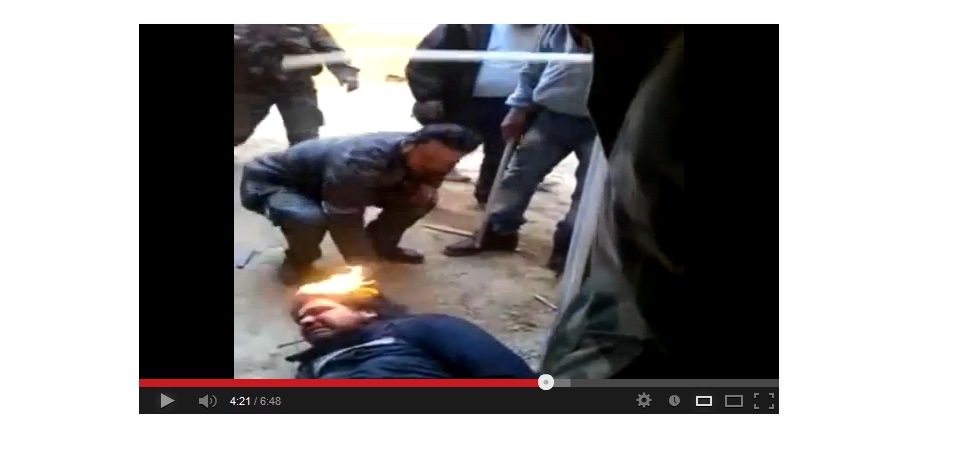
torture

torture fire

In a separate gruesome episode today, a video emerged showing a number of regime’s Shabbiha (pro-regime armed militias, mostly Alawites) torturing to death two young men in Al-Tal town. The video also shows the Shabbiha putting the young men to fire. In the video, the regime forces put the hair of a man who appears to be in his late thirties to fire, then put it out by kicking his head with their boots, then hit his head with a car tyre. The two young men finally apparently die from torture. Absolutely gruesome.

How will a permanent or even temporary partition of the country impact on the conflict?

A Syria divided

Last Modified: 21 Apr 2013 11:10
[youtube http://youtu.be/W7e756co2ZQ?]
Listen to this page using ReadSpeaker
On Wednesday, Syria’s president said his forces have no option but to win the war , or to lose the country

Given that I don’t see any dramatic shift in US policy or any kind of direct intervention … I think that this kind of conflict will grind on and therefore we will have a Syria that is in the de facto sense a divided Syria but in the du jour sense might still exist.– Andrew Tabler, the Washington Institute for Near East Policy

Speaking in an interview on local TV last week, Bashar al-Assad maintained that thousands of foreign fighters had crossed over from Jordan, and warned that the conflict was increasingly becoming a regional one.

He repeated the allegation that Western powers are directly and indirectly supporting elements of al-Qaeda in their desire to unseat him.

“I think that Syria, in these circumstances, is exposed to an attempted colonisation by all means. There’s an attempt to invade Syria by foreign forces. These forces are using new techniques, it is an attempt to invade Syria culturally,” he told interviewers on pro-regime Syrian television channel Al-Ikhbariya.

This week we focus on the possibility of a permanent or even temporary partition of Syria and whether this would lead to a drop in the level of the conflict.

There’s an objective to create de facto Balkanisation in Syria, there’s an external objective to divide this country. Their neighbours, the Israelis would benefit off this and it would be disastrous  for the entire region.-Mahdi Darius Nazemroaya, the Centre for Research on Globalisation

Last week al-Assad extended yet another amnesty to all those who laid down their arms but within hours of the offer, several reports indicated a massive mobilisation of government forces and a series of offensives in strategic areas of the country.

The possible consequence, whether intended or not, is the creation of defined enclaves in which opposition forces are contained.

To discuss this on Inside Syria, with presenter Mike Hanna, are guests: Andrew Tabler; a senior fellow in the Program on Arab Politics at The Washington Institute for Near East Policy; Ziad Majed, an assistant professor of Middle East Studies at the American University of Paris and co-ordinator of the Arab Network for the Study of Democracy; and Mahdi Darius Nazemroaya; a Canadian-based sociologist who is also a research associate at the Centre for Research on Globalisation in Montreal, specialising in geopolitical and strategic issues.

“It is not a viable situation, all will depend on how things will develop later – now we have areas where chaos is reigning, in others the opposition controls the ground but cannot always protect itself from air raids and scud missiles. So the situation is still unclear now, time will determine to which direction we will be heading. But I think the regime has a Plan B that is to try to defend Homs and the coast, if Damascus is to fall in the hands of the opposition, but we are not yet there.”Ziad Majed, American University of Paris

Blog at WordPress.com.

Up ↑