Search

band annie's Weblog

I have a parallel blog in French at http://anniebannie.net

Category

Syria

A Dream Of Powerful Monsters حلم الوحوش القوية

في فيلم “حلم الوحوش القوية” من انتاج “بدايات”، تقودنا المخرجة لينا العبد في رحلة قصيرة داخل منامات الأطفال السوريين اللاجئين برفقة أهاليهم الى مخيم شاتيلا في العاصمة اللبنانية بيروت.
تصور لينا العبد بعمق وحساسية أطفالاً صاروا كباراً على حين غرة، متأثرين بما شاهدوه وعاشوه من قتل وتهجير ورعب، فصارت أحلامهم أقرب الى الكوابيس.
حكايات بسيطة وعميقة، وأحلام تتقاطع وتتكامل في حلم (كابوس) واحد، يتصدى له الفيلم مستخدماً لغة بصرية وسمعية جريئة، يمتزج فيها جمال السرد بحساسية الصورة، وصولاً إلى نموذج تعبيري يتقارب مع عوالم الأحلام ذاتها.
وجوه الأطفال الصامتة تنظر في عيوننا مباشرة دون أن ترانا، أصواتهم تأتي من البعيد، وتمنحنا شعوراً وكأننا نمضي متلصصين في عوالمهم الداخلية الخاصة، نواجه في كل لحظة كوابيسنا ومخاوفنا الشخصية. تقول لينا العبد عن فيلمها القصير: “هي محاولة لمواجهة كوابيسي الشخصية التي تحّرض أرقي المستمر، لربما تصبح الحياة في المنام ـ على الأقل ـ أفضل من الواقع” .

From within the shelters that are home to Syrian children at the Chatila camp in Beirut, Lebanon; the director Lina Al Abed vividly portrays the haunting dreams of these forcefully migrated children, intersecting their deep stories and nightmares into one dream in the movie – The Dream of Strong Monsters – a short film by Bidayyat Productions. </p><p>Using daring audiovisual language that combines the beauty of the portrayal of the children, with the sensibility of the image, Lina Al Abed seeks an expressionistic pattern that resembles their dream worlds.

“It’s an attempt at facing my own nightmares that invokes my continues insomnia”, Al Abed says, “Maybe then, life spent dreaming will be better than reality”. The pale, silent faces of the little children staring us in the eyes without really seeing us, the echo of their voices coming from far away, makes us feel like we’re sneaking into their private world, facing with every moment our own fears and night-mares

Lina Alabed’s new film – The Dream of Strong Monsters – portrays the life and dreamworld of Syrian refugee children living in shelters in the Chatila camp in Beirut, Lebanon’s capital. She fuses their profound stories of loss and displacement having fled the violence in their neighbouring country, with their haunting dreams to create a fusion of reality and the subconscious. The result is an expressionistic film that resembles the children’s own dreamworld. “It’s an attempt at facing my own nightmares that invokes my constant insomnia”, Alabed says, “Perhaps a life spent dreaming will be preferable to reality”. The children’s pale, silent faces and their intense gazes, along with the echo of their voices that seem to come from far away, gives the impression of sneaking into their private world, and by trespassing on their dreams, confronting our own fears and nightmares. The Dream of Strong Monsters is produced by Bidayyat Productions.

First Lebanese Battalion in FSA After Hezbollah’s Call

15SaturdayJun 2013

Posted by  in

≈ 1 Comment

20130615-124120.jpg

Lebanese individuals might have been involved in Syria’s war from early days. Sheikh Ahmad Al-Aseer declared Jihad and went himself there couple of months ago with his fighters too for a show-off exercise, but permanent or independent Lebanese fighting battalion are not known to be present as of yet.

Hezbollah has institutionalised the Lebanese involvement in Syria with his recent public involvement in the battle of Qusair. Hassan Nasrallah has publicly called his Lebanese opponents “to meet them in Syria to fight”. Hezbollah is part of the Lebanese state and government and obviously has a regional weight – which means Iran.

The lebanese government, which is supposed to be adopting a dissociation policy, is in coma status with no comment whatsoever. Even more, “sovereign” Michel Aoun has defended Hezbollah’s intervention on the basis they are fighting the takfirees (beyond our borders.)

Sadly, some Lebanese will meet Hezbollah’s divisive call and go to Syria. This will expand Syria’s war into a sectarian regional one, and allow the war to spread to Lebanon too without a shadow of a doubt.

Below is the video of the 29 years old Lebanese Fadi AbdulKader declaring the formation of the Free Battalion of “Ikleem el Kharoub” under the Free Syrian Army command to fight Hezbollah. If you don’t know it, Ikleem el Kharoub is a Sunni area in the mostly mixed Druze and Christian Chouf district.

In what could be the first video of its kind for a Lebanese, Fadi AbdulKader shows a copy of his Lebanese passport (which expired last month) confirming his ID and date of birth. The video is done on the style of previous videos for defections from the Syrian army. He declares he wants to defend his religion and land in both Syria and Lebanon. Funnily enough, he gives The Lebanese Republic a new name by calling it the Arab Republic of Lebanon.

Hezbollah, which always prided itself not be part of the Lebanese civil war, is now creating a Lebanese civil war on Syrian land and contributing to the Syrian civil war. Hezbollah has officially turned into a militia, and seeking other Lebanese militias on the opposite side. This can only get worse for everyone.

20130615-124149.jpg

source

Should The U.S. Intervene in Syria?

780240302

A Leftist Response to Leftist Delusions on Syria

June 8, 2013 § Leave a Comment

This excellent piece was written by Shiar in response to Stop the War’s Lindsey German (who can’t even get the Syrian president’s first name right) and was first published at the Syria News Wire.

“Being anti-imperialist yet West-centric,” writes Shiar, “just does not work: it is still Orientalism. This Orientalist (and statist) world view is so dominant within the Western Left that even a mass, popular uprising is reduced to a Western-manufactured conspiracy (which is, incidentally, the same line as that the Syrian regime has been repeating). It not only ignores facts on the ground and the complex political dynamics at play in those countries, but also overlooks those people’s agency and reduces them to either some inferior and stupid stereotype (Islamist terrorists) or some romanticised mythical version that is compatible with the dominant Western values (pro-democracy, peaceful, etc.).”

I have no idea where you get your news about Syria from, but it strikes me that it’s probably mostly from the Guardian, BBC and other establishment mouthpieces (when it comes to foreign policy anyway). For how else can one explain your sudden realisation that Syria is only now “descending into hell”? Really?! All this death and destruction over the past 26 months has not been hellish enough for you? Only now, when your beloved mainstream media start to recycle some state propaganda nonsense about the conflict in Syria taking (yet another) dangerous turn or crossing some ‘red line’, do your alarm bells start to ring?

You see, information sources are not just about information; they also shape your perspective. As a Leftist activist, one would have thought you would mention – at least once, in passing – the popular uprising or the revolution, what Syrians think and want, or anything remotely related to people. Instead, all you obsess about is big politics from a statist perspective: regime change, foreign intervention, regional war, Israel, Iran, bla bla bla.

If you’d argued that, after Tunisia, the prospect of mass, popular uprisings bringing regimes down seemed too frightening for Western and regional powers, so they opted for pushing the revolutions into prolonged armed conflicts or wars (mainly by not intervening when they could), I might have paused and thought a bit about your argument. If you’d said that the prospects of progressive governments emerging from mass uprisings demanding freedom and social justice seemed too frightening for the conservative, neoliberal forces, both regionally and internationally, so they converged to divert the revolutions and paint them as something else, I might have listened to you. But dismissing everything people have been fighting for because of some archaic geo-strategic equations… that’s just too much to swallow.

The only time you seem to remotely allude to people’s agency is when you fall into the trap of Western media’s obsession with Middle Eastern sectarianism, reducing complex political dynamics to a savage ‘civil war’ between religious sects: “Syria, locked into a bitter civil war between the government of Bashir Assad and the various opposition forces…” Here is what a friend posted on Facebook a while ago:

“Dear friends everywhere, We, Syrians, or a vast majority of us, do not accept using the term ‘civil war’ when talking about our revolution. We hope that you can take serious note of that. It is a popular revolution against a mass-murdering dictatorship. Calling it a civil war is unacceptable to us. Thanks.”

Your misinformed, or disinformed, sources of information may also explain your simplistic analysis of the political games unravelling in Syria, such as your talk about the imaginary “alliance of Saudi Arabia, Qatar, Israel, Jordan and the Western powers.” Had you bothered to look a bit closer, check some more informed and reliable sources, or even talk to some Syrians, you would have realised that this ‘alliance’ is riddled with power struggles, with different regional and international powers supporting different factions fighting in Syria, with very different agendas and strategies. The only thing that seems to unite them is their opposition to the regime.

But even this does not mean that ‘the Syrian people’ are united in their position regarding these factions. Had you bothered to look or ask, you would have discovered that many Syrian Leftists are fighting alongside members of the Muslim Brothers, that there have been numerous protests inside Syria against Jabhat al-Nusra when its members have gone too far in their authoritarian or sectarian practices, and so on and so forth. Instead, you chose to quote Robert Fisk – who has long lost it, as far as I’m concerned – saying: “The rebels so beloved of NATO nations are losing their hold of Damascus… This war – beware – may last another two, three or more years. Nobody will win.”

The same can be said of your eye-opening revelation that the sole aim of the Syrian revolution, as a Western conspiracy, is “a transformation of the Middle East aimed at permanently weakening Iran and its allies.” I do not want to comment on this any further but you might want to commission one of your coalition members to investigate the complex and changing attitudes of Syrians towards Hizbullah and Iran. A cursory look at recent images posted on Facebook of Syrian banners and placards ridiculing Hasan Nasrallah and Hizbullah might be a good start.

My point is that your objections to a military intervention in Syria seem to stem from the same place as the intervention: that ‘we’ (Europeans, Westerners, whatever) know better than Syrians what should be done about Syria. Had you bothered to talk to some Syrians, they might have told you how complex and nuanced the issue of foreign intervention is for most Syrians (I’m obviously not talking about a few sell-outs or parasites who are capitalising on the events for their own advantage). Their angry responses to the Israeli air strike on Damascus last week are just one example.

Did it not cross your mind, for instance, that ‘those people’ have already experienced Western colonialism and have grown up with strong anti-imperialist discourses (Leftist, pan-Arab nationalist and Islamist)? That they too might have learnt something from the Iraq war like you? (even though I would object to equating the invasion of Iraq with the recent popular revolutions in the region, but that’s another discussion.)

I doubt any of this has ever crossed your mind. Because had it done so, you might have paused for a moment and thought: what is that pushes these people to resort to the support of antagonistic regional and Western powers, knowing full well that the conditions of this support or the price they would have to pay is very high? I can tell you what I think the main reason is.

If you and your comrades had shown the Syrians who started the revolution any sort of support from the beginning – I mean serious, material support, not conditional solidarity and empty, confused slogans – they might not have had to resort to the US, Turkey, Saudi Arabia and other powers, and to form coalitions with ‘backward’ forces. Instead, all you and your comrades have been obsessing about is an imaginary peaceful or civil society movement that would mysteriously succeed in bringing down a blood-thirsty regime just like that. Then you turn to slag off those who join the Islamists or whoever is actually fighting the regime. This is not only delusional, allow me to say, it also does not exactly strike a chord with the majority of Syrians at the moment, given the context of extreme violence.

Every time I hear people here talking about a peaceful uprising being hijacked by militant Islamists or great Western powers or whatever, I cannot help thinking that it is not just their ignorant arrogance that is making them so blind to what is actually happening on the ground; it is, rather, an ideologically driven habit of twisting facts so that they conveniently fit into a pre-constructed narrative about ‘those people’ and how they do things. It is, in other words, Orientalism.

Here is another example from your article: “The impact of Western intervention in Syria is becoming more destructive as time goes on. […] Syria… is continuing its descent into hell, aided and abetted by outside powers whose concern is not humanitarian nor democratic, but is about reshaping the region and especially destroying Syria’s ally in Iran.”

To me, the position of Western anti-war activists and politicians vis-a-vis the Arab revolutions can be best descried as ‘schizophrenic delusion’. On the one hand, they stand against ‘the war’; on the other, they find themselves not only supporting repressive regimes but also supporting the wars waged by these regimes against their peoples because they are stuck in an archaic anti-imperialist discourse.

Being anti-imperialist yet West-centric just does not work: it is still Orientalism. This Orientalist (and statist) world view is so dominant within the Western Left that even a mass, popular uprising is reduced to a Western-manufactured conspiracy (which is, incidentally, the same line as that the Syrian regime has been repeating). It not only ignores facts on the ground and the complex political dynamics at play in those countries, but also overlooks those people’s agency and reduces them to either some inferior and stupid stereotype (Islamist terrorists) or some romanticised mythical version that is compatible with the dominant Western values (pro-democracy, peaceful, etc.).

Regional and Western powers will, of course, try to capitalise on the Syrian revolution and attempt to hijack or utilise it for their own ends (they’ve always done so; that’s politics.). But by imposing your own values and political agendas on the revolution, instead of showing real, unconditional solidarity with the people living it, you do exactly the same, dear comrade: you use it to feel better about yourself; to feel you’re still relevant, superior and intelligent.

source

By predicting the fall of Syria, world helped it crumble

Amal Hanano and Yakzan Shishakly

Jun 4, 2013


A Syrian man from Homs used to run a tiny felafel stand in Reyhanli, Turkey, to support his family. He had fled the violence at home and lived in this Turkish town near the Syrian border.

Since twin car bombings hit the town on May 11, killing over 46 people – including Turkish citizens and Syrian refugees – and wounding over 100, the man has been nowhere to be found. His felafel stand was outside the smoking video frames and chaotic images frantically being shared across social media sites.

Responses to the attack varied. The media focused on the latest episode of violence and its regional repercussions. Ankara condemned the attacks and blamed the Syrian regime. The Assad regime then blamed Turkey for sheltering Syrian rebels. Meanwhile, many Syrians’ eyes were on the screens, looking for loved ones, like the man from Homs, horrified that this safe haven had become as dangerous as the land across the border.

Reyhanli has become a vital hub for aid organisations to funnel emergency humanitarian and medical supplies into Syria’s northern, liberated areas that still suffer from both constant bombardment and extreme shortages of basic necessities such as food, water and medicine. Reyhanli is also a main artery of aid for tens of thousands of displaced Syrians (IDPs) stranded in makeshift, under-served camps along the border. These IDPs settled into a life of misery, reasoning that at least this area was safe. Or so they thought.

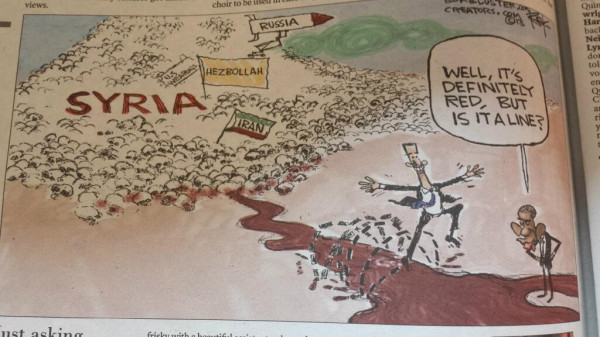
For Syrian Americans who provide aid while living abroad, there is a separation of realities between attempting to alleviate the devastating humanitarian crisis on the ground and watching the endless discussions of “red lines” in the media. Analysts and politicians ask: were these lines crossed already? And if they were, what’s next?

Outsiders deal with the question of chemical weapons or the flow of Russian advanced weapons to the regime in the abstract – through the prism of strategic interests. But while they crunch numbers and predict scenarios, we know that an influx of hundreds of thousands of people fleeing the threat of “small scale” chemical weapons attacks will be catastrophic.

Over 5 million Syrians are internally displaced or refugees – almost a quarter of the country’s population. According to Oxfam America’s president, Raymond Offenheiser, Syria’s humanitarian crisis numbers compare to historical crises like Darfur’s. To those who manage IDP camps, each number is an additional mouth to feed, another tent to erect, another child without a school. Each number is a red line to Syrians, a line that has been crossed over and over again.

For many months, experts have warned of the spillover of violence from Syria into neighbouring countries: Lebanon, Jordan, Iraq, Turkey and of course Israel. But Syrians have watched the reverse spillover of violence into their country from all of these countries.

Over the last two weeks, hundreds of Hizbollah militiamen along with Assad regime forces have launched a massive attack on the town of Qusayr, in Homs. These “resistance” fighters seem to have no problem slaughtering civilians and fighters alike. Families in Qusayr have been trapped for days with no access to humanitarian relief and no way to escape. Yet this escalation seems to cross no red line.

Syria has become the regional catastrophe that the president, Bashar Al Assad, promised it would become during the early days of the peaceful uprising. It is the catastrophe Mr Al Assad and his allies constructed out of brutality, a catastrophe exasperated by an impotent political opposition, regional meddling and international silence.

There’s a Syrian joke about a man walking down the street when he saw a banana peel on the pavement. He slapped his hand against his forehead and exclaims: “Wow, that’s a major fall!”

Too much time has been spent predicting the aftermath of Syria’s fall – the acts of revenge, sectarian genocide, religious extremism and warlordism. Predictions without preventions. Meanwhile, hundreds of Syrians perish every single day and the IDP camps swell by the thousands every single week.

Isn’t it time to pick up the peel and save what’s left of Syria instead of foreseeing its fall? Here’s a prediction: what the world is unwilling to pay for now, it will pay for in the future – many times over. Another one: what happened in Reyhanli on May 11 is a sneak preview of future terrorist blasts that will be exported across the region.

The worsening humanitarian crisis must be central to the “Geneva II” talks expected to take place between the regime and the opposition. Aid must flow easily into besieged areas and IDP camps on the borders. Regime air raids must end so these IDPs can return home and begin to repair their towns and communities. And yet, Russia’s veto to the UNSC’s draft resolution to stop the bloodshed in Qusayr and allow immediate relief delivery to the trapped civilians proves the exact opposite is happening.

Every minute that passes is the difference between death and life, torture and freedom, rape and safety, forced exile and home. This is the reality for millions of Syrians. The world has played the waiting game, but if it had acted instead of passively watching, Reyhanli would not have been the victim of the terrorist bombings and the man who makes felafel would not have been a missing refugee. He would have been safe, with his family, in Homs.


Yakzan Shishakly is the director of the largest IDP camp inside Syria, near the village of Atma. He lives in Reyhanli, Turkey. Amal Hanano is a pseudonym for a Syrian American writer

Syria’s Lost Generation


June 3, 2013

Syria's Lost Generation 1

Andrea Bruce, The New York Times

An outdoor cafe at Damascus U. was struck by mortar shells in March, killing at least 10 students.

By Keith David Watenpaugh

Within sight of the Syrian border, the Za’atari refugee camp spreads out in a sea of white-canvas tents across barren hills into the cerulean sky of the Jordanian desert. Home to some 140,000 people, it’s hard to call it a camp, having become one of Jordan’s largest cities. Most of the refugees are from the villages and towns of southern Syria, where the uprising against the authoritarian rule of Bashar al-Assad began two years ago.

In mid-April I traveled to the camp with colleagues to meet with Syrian university students as part of a joint research project of the University of California at Davis’s Human Rights Initiative and the Institute of International Education’s Scholar Rescue Fund. Before we went, U.N. officials and relief workers had told us that there were no university students there; we would find only poor and uneducated villagers. We were even cautioned against going at all, because the refugees might be openly hostile to Western visitors and had attacked employees of nongovernmental organizations in the past. Indeed, the day after our visit, a riot broke out between refugees and Jordanian guards.

And yet, sitting under a giant tent, around white-plastic picnic tables, and speaking entirely in Arabic, we met with 18 university students whose studies had been interrupted by the war. Most were women, though we also spoke with a handful of men. These were polite, though often intense, conversations, punctuated with laughter. We learned that they had been students at Damascus University, its branch campuses, or Al-Ba’ath University, near Homs. Some had been in the camp for months; others had just arrived. They had been studying law, history, biology, education, engineering, computer science, and pharmacy. And they were only a handful of the tens of thousands of Syrian students dispersed throughout the region.

I had lived in Syria—Damascus and Aleppo—for much of the 1990s and have returned every few years since then. It was where I did the research for my first book, Being Modern in the Middle East (Princeton University Press, 2006), about the emergence of the Syrian middle class. Higher education had been part of that process.

When the father of Syria’s current president seized power, in the early 1970s, the country embarked upon an ambitious expansion of higher education. The chance to send one’s children—especially young women—to college became a key element of the country’s development, but also of the ruling Ba’ath Party’s “authoritarian social contract,” by which political quiescence was exchanged for the approximation of a comfortable middle-class lifestyle and the chance for social advancement.

The misconception that there were no university students in Za’atari stems from the way aid workers often imagine refugees. Historically, whether it’s Armenian survivors of genocide, Palestinians displaced by the creation of Israel, or Iraqis fleeing foreign invasion and civil war, Middle Eastern refugees can appear to be an undifferentiated, opaque mass in the collective consciousness of international humanitarianism.

Not understanding the diversity of refugees and the societies from which they come is a problem in addressing their immediate suffering and helping them either to begin new lives elsewhere or to return and rebuild their societies. This is certainly the case for Syria’s ambitious and talented university students, who could be a modern and moderating force in a post-conflict Syria.

I went to Za’atari with Adrienne Fricke, a human-rights expert who wrote the Human Rights Initiative report with me. We wanted to know what future the students envision for themselves, and to document the obstacles they face as they seek to continue their studies. Those problems range from the practical—lacking transcripts—to the intractable: choosing between paying rent or tuition. Still, the students we spoke with expressed an intense desire to renew their studies, even if it meant leaving their families and traveling farther abroad. As one law student in the camp told us, “In our home, studying is holy”—and her home at the moment was a tent.

Our conversations also gave us a glimpse into the horror the young people had fled. They told us about demonstrations and growing political consciousness on campuses, followed by violent crackdowns by plainclothes militiamen, known as the Shabiha, or “ghosts,” working alongside secret police and soldiers. The students reported that their dorm rooms had been searched, computers taken, and colleagues arrested or “disappeared.” But it was the fear of having to fight in a war they wanted no part of, and unrelenting insecurity, that drove many of them and their families into exile.

Others fled because of their political activism. One of the urban refugees we met was a young man in his early 20s, whom we will call Majid. He had been at Damascus University when he became involved in organizing antiregime demonstrations using Facebook and Google Maps. After a secret-police raid on his family’s home, during which his laptop and books were seized, he was brought before a military court and accused of the Orwellian crime of “undermining nationalist sentiments in a time of war.”

Released after 25 days in the Damascus central jail, he was summarily suspended by the university’s ethics committee and so became eligible for induction into the army, where he would probably have been killed. His family paid thousands of dollars for a forged exit permit and bribed a border guard to get him to safety.

Of the stories I heard, this was the one that has most vividly stayed with me. The historian in me felt Majid’s attachment to his books, and with their confiscation his loss of identity and the assault on his dignity. But more important, he had claimed his human rights in the eloquent language of nonviolence and was continuing to pay a terrible price.

The challenge for us who will write the history of Syria and the broader Arab Spring is to remember that many Syrians bravely sought to change their society without guns. The sectarianism and Islamist radicalism that define the war now came only after the regime’s brutal suppression of that movement, the arrival of sanguinary jihadist fighters, and the West’s inaction. Majid is resilient, and I think he will be OK. His family outside Syria has money to help him to finish his studies in Jordan.

As we drove away from Za’atari, I recalled another time of war, in 2003, when I had directed a similar research project, in Baghdad. I had documented the looting of universities and the burning of libraries, and witnessed the incompetence and poisonous arrogance of the Americans sent to run Iraq. Yet the universities functioned, and students attended class. Even in the darkest days, Iraq’s universities remained places of possibility.

This is not true for Syria. There is no reason to believe that the war, which has taken more than 80,000 lives and made millions refugees, will end soon. Syrian society itself is collapsing and, along with it, its universities.

As I sat in the shade of that giant tent, I knew that I was looking across the table into the faces of Syria’s lost generation.

Keith David Watenpaugh, an associate professor, is director of the University of California at Davis’s Human Rights Initiative. His book Bread From Stone: The Middle East and the Making of Modern Humanitarianism is forthcoming from the University of California Press. 

source

The Day We Broke Fear

Posted: 03 Jun 2013 03:10 AM PDT

It was a clear blue day as I walked to the square where the protest was being held. I felt frightened and nervous having been warned not to do this sort of thing again, but I felt compelled to do something, anything. I couldn’t sit at home and pretend nothing was happening when I knew perfectly well that people were getting murdered in cold blood. It felt as if somebody was hitting me over the head with a hammer, telling me to get up and go, as if I would never be able to forgive myself if I didn’t seize that moment. As I got nearer and nearer I could hear the sounds of chants carried to me over the patches of silence in the square. One turn of the corner and I could see the flags, the familiar faces of friends, and my heart instantly felt at ease because I knew then that I wasn’t the only one.

In those early days I suffered from an intense feeling of isolation and loneliness. I used to seek out other Syrians so that we could talk about what was happening and about how we felt. Before that day the tone was always one of worry and fear – fear for our families, for ourselves, for lives which will be upturned. We were always worried of that “report” that might be written about us, that somebody would have our names on a file somewhere and then that would be it, that we would be out in the cold and exiled from our homes and loved ones. What a thing to tell a mother, that her son was marked as an agitator and troublemaker! And yet there was that hammer on the head again, that drive which pushed us on in spite of our nagging worries to speak up and keep speaking. Something was wrong and yet many people wanted to pretend as if nothing was happening. Then I went to that protest and everything changed. It was my second and up until that point I had still been undecided about what position to take. What was happening was clearly wrong, but I felt that change and reform could happen if we made clear how unhappy we were about the heavy handedness.

As we all stood together in front of the embassy the atmosphere was euphoric. I pumped my fist in the air and began to chant, no longer concerned if the embassy was filming us. I began to call for the overthrow of the regime! In the space of a few minutes a lifetime of inhibitions and taboos came crumbling down. There was no longer any fear. It might seem strange to bring this up today, but two years ago when this revolution started the word on everybody’s lips had been about the “fear barrier”. People marveled at the sensation of no longer being afraid to speak their mind, and we would exchange stories about our own individual moments. It was as if, by shattering this glass cage, we were becoming complete again, like fixing that tap which had always been dripping or changing a burnt out bulb after ignoring it for so long.

In those heady days we felt as if nothing was impossible and that we were going to change the world. I remember standing in the crowd on that sunny Saturday in Belgrave Square, wearing a bright blue t-shirt,  jeans and trainers and singing with everybody at the top of my voice. Nothing felt more right in my whole life.

But then things changed. Videos of tens of thousands of people demonstrating against tyranny gave way to the images of deserted streets in derelict towns. Of tanks driving up main streets and planes bombing villages. The cynics who didn’t bat an eyelid for the thousands of innocents who were shot like dogs now nod their heads knowingly and speak of a revolution “hijacked”. They can go to hell. This revolution was not about an ideology or a religion, and it wasn’t about grand political scheming, it was about normal people who stopped what they were doing to stand up for what they believed in, and they did that even though they were afraid and, in many cases, would lose their lives. Injustice can only sustain itself through fear, and on that day we broke fear forever. This is what the revolution was about I don’t ever want to forget that.

source

Azmi Bishara on Syria

The subtitled last few minutes of a Jazeera Arabic interview with the great Palestinian thinker, in which Azmi expresses his disgust with those who fail to recognise the incredible revolutionary spirit of the Syrian people.  “The Syrian people are the ones who turned out to be strong!” he exclaims. “An admirable, heroic, great people! In the face of planes and tanks and artillery. I salute the people of al-Qusair! … This is what we ought to be impressed by!”

[youtube http://youtu.be/A3lfLp7RbH0?]


from here

Blog at WordPress.com.

Up ↑