Search

band annie's Weblog

I have a parallel blog in French at http://anniebannie.net

Category

Syria

Michael Heart – What About Us (Song for Syria)

The Stream: Malek Jandali Playing for Peace in Syria

Starved Syria civilians flee besieged Damascus suburb

          29 October 2013 Last updated at 17:59 GMT

The BBC’s Lyse Doucet was there to witness thousands of Syrians fleeing their home after nine months under siege

Thousands of Syrian civilians have finally been allowed to leave the besieged Damascus suburb of Moadamiya.

The BBC’s Lyse Doucet, who was at the scene, describes a tide of desperate people leaving the area, which has been closed off since March.

Supplies in Moadamiya had been running desperately short, and residents had pleaded to be saved from starvation.

The exodus of civilians has been made possible by an apparent relaxation of a blockade by government forces.

The Syrian army had previously said that rebel-held areas of Damascus such as Moadamiya could surrender or starve.

At least three of Damascus’s suburbs – Yarmouk, Eastern Ghouta and Moadamiya – have been besieged by government forces for several months.

Continue reading the main story

image of Lyse Doucet Analysis Lyse Doucet Chief international correspondent

A tide of people fled Moadamiya today – some on stretchers, some crying, all showing the severe strain of a life under siege.

“We didn’t see a piece of bread for nine months,” one woman told me. “We were eating leaves and grass.”

A little girl in a pink dress showed me her trembling hands. “We are all sick,” she said, as she and her little sister clutched pieces of bread distributed by the Syrian Arab Red Crescent Society.

Some 20 buses were waiting at the entrance to Moadamiya to take residents to a government shelter.

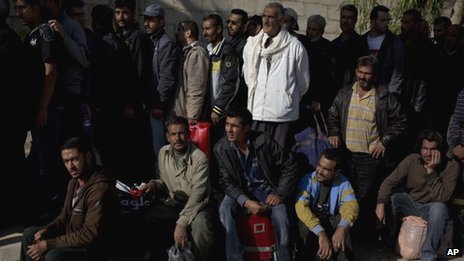
But men, young and old, were kept in a separate queue. They will now be questioned about what side they are on, and what was their involvement in the fight.

The situation has become so desperate that earlier this month Muslim clerics issued a religious ruling allowing people to eat cats, dogs and donkeys just to survive.

Those animals are usually considered unfit for human consumption in Islam.

Eating grassFor months, the UN and other aid agencies have been calling for urgent help, fearing the worst for the people of Moadamiya.

“We didn’t see a piece of bread for nine months,” one woman told the BBC. “We were eating leaves and grass.”

The Minister for Social Affairs, Kinda Al Shamamat, who was overseeing the evacuation, has accused rebel gunmen – whom she describes as terrorists – of infiltrating Moadamiya.

But rebel fighters – who have stayed behind in the suburb – accuse the government of trying to starve them into submission.

Now that most civilians have fled, the battle will intensify, our correspondent says.

People walk from the rebel-held suburb of Moadamiya to government-held territory, helped by aid workers
The people of Moadamiya were running short of food and water
A volunteer from the Syrian Arab Red Crescent helps a weeping man
Moadamiya has been under siege and heavy bombardment since March – with no one able to get in or out
Woman held by Red Crescent workers
Some were too ill to walk, and had to be assisted by Red Crescent workers
Syrian families leave their besieged town
Most of those trapped were women and children
Men wait to be searched by the Syrian military
The men were taken to a separate area, to be searched by the military
Men wait to be searched by the Syrian military
The army wants to check if any of these men were fighting on the rebels’ side

Polio outbreakThe World Health Organization has confirmed 10 cases of polio in Syria – the first outbreak in the country in 14 years.

Save the Children’s Brie O’Keefe: Syria polio is “a deterioration in global progress”

The UN body says a further 12 cases are still being investigated.

Before Syria’s civil war began in 2011, some 95% of children in the country were vaccinated against the disease, but now an estimated 500,000 children have not been immunised.

There has been speculation that foreign groups fighting in Syria may have imported polio into the country.

The disease has been largely eradicated in developed countries but remains endemic in Nigeria, Pakistan and Afghanistan.

Meanwhile Syria’s Deputy Prime Minister, Qadri Jamil, was dismissed on Tuesday for leaving the country and acting without government permission, state media said.

Mr Jamil met US officials in Geneva over the weekend to discuss peace negotiations, according to UN and Middle East officials.

But the state news agency Sana said Mr Jamil had been dismissed by President Bashar al-Assad “because he left his centre of work without prior permission and did not follow up on his duties”.

“Additionally, he undertook activities outside the nation without co-ordinating with the government,” Sana said.

source

Syrian Tears in Istanbul

Syrian Tears in Istanbul

On my way back from   applyinginformation but also the fact that the building was full of Syrians, a babble   of various Syrian dialects grumbling at the 200 Turkish Lira fee, a small   price it may seem for security but still a hefty sum nevertheless for most,   handing over my privileged claret passport cost another 175 TL on top of that,   I also grumbled in various dialects but mostly cockney, the air of   despondency followed me into a shopping mall just down the road, sitting   beside a water fountain performing to orchestral commands beyond my   comprehension, I logged onto Starbucks fading wifi signal while some tourists   from the far east snapped away at the aquatic display.
A more depressing globalized environment would be hard to imagine I thought   as I surveyed my surroundings, once again it’s the Syrians that grab my   attention, this time a young women pushing a child in a buggy, she looks   upset and as though she’s about to burst into tears, she’s followed by a   couple of young lads, aged about seven and eight they all sit down on the   step of the plaza and no sooner sitting she does burst into tears, the boys   are kicking their heals, soon they are joined by who clearly must be her   husband and another son, they are well dressed, not wealthy but typical   Syrian middle class, families like this I would see everyday shopping along   sharia Hamra, her tears could be nothing more serious that the usual marital   trauma brought on by a visit to overpriced shopping mall but I can’t help   feeling it’s another sad Syrian story, he paces around the plaza trying to   call on his phone, he seems agitated and looks as though he is just trying to   do something, anything, he knows it’s his job to solve the situation and he   is making the calls, the look in his eyes show a lack of confidence, the   women is sobbing non-stop and I just want him to go and comfort her, I want to   go and talk with them but I don’t, over the last almost three years I have   witnessed the tears of Syrians sobbing countless times, on occasion I have   tried to console but what you can you say or do, futile reassurance that   everything is going to be okay, they really do seem like a nice family, they   seem lost and out of their depth, I have listened to the conversations before   on what to do for the best, to leave Syria or stay, to go where and do what,   how much money do we have and how long will it last, what country accepts a   Syrian passport, who will give me a job, what about the car and the house,   what about the rest of the family, the decisions to leave are not easy, she   sits there alone tears running down her face, like the nation she has left   behind, alone and broken.

johnwreford

Freelance editorial photographer that has spent the last ten years living in the Syrian capital Damascus. Currently in Istanbul Turkey.

source

Maysaloon , Oh well…

Saturday, October 26, 2013


Should I really care if Abu Mohammad al Golani has been killed in a regime ambush? Probably not. The Syrian revolution isn’t about swapping an Alawite dictator for a Sunni one, it’s about fundamental rights for the citizen and for dignity. I’m not going to shed tears over somebody simply because he opposes Assad when his group openly calls for ethnic cleansing and has been accused of horrific human rights abuses. I’ve often heard Syrians telling me that they are “the only ones fighting Assad” and so we should turn a blind eye to their mistakes. I disagree.

Nobody asked for this war, Assad imposed it on the country in order to stay in power. The reason he did this was precisely for the kind of reaction that groups like JAN and ISIS are capable of. It is also to buttress his position internationally and domestically as some sort of champion for secularism. If we really think about it there are two things this regime has feared and avoided above all else, allowing peaceful demonstrations to take root in the country – coupled with a civil society movement – and foreign – specifically Western – intervention.

Both of these options seem a distant dream now, but if the killing is to stop, really stop, then we have to bring these back on the table. I don’t care who screeches to me about Iraq and imperialism, this is a matter of survival for an entire country. Assad and his allies are now presenting the world with two scenarios for Syria, and neither is acceptable. Either the country transforms into a version of North Korea, or it becomes Afghanistan. Both options would suit Iran, Hezbullah and Assad perfectly well for obvious reasons. But, and here is the important caveat, Iran, Hezbullah and Assad cannot impose their will on Syria. They’ve been trying to for almost three years and they can’t. That means a lot though it has come at a hell of a price.

Syrians can push for the third option, a country that respects the rights of its citizens and gives them the opportunity to try and make a better life for themselves. In order to do that they don’t have to feel compelled to clap and cheer for every madman who fires a Kalashnikov at the regime.

Posted by Maysaloon at 1:17 pm

Syrian family’s tortuous journey into the unknown

The BBC’s Matthew Price meets a family whose desperate flight from Syria has led them to Europe

Thousands of clandestine migrants have reached Europe in recent months, with increasing numbers arriving from war-torn Syria. The BBC’s Matthew Price has been following the progress of one Syrian family who sought asylum in Austria after arriving on the island of Lampedusa in Italy.

The little dark-haired boy is sitting bolt upright on a bench in a cafe just across the road from Vienna’s Meidling railway station. His puffer jacket is zipped right up to his neck. He is fast asleep.

His younger sister is also trying to sleep, face down with her head on her arms on a table by the window.

Their mother lights another cigarette, and draws on it nervously. Theirs has been the longest journey – and it is not over yet.

Continue reading the main story

Analysis

image of Matthew Price Matthew Price BBC News, Vienna

Amal’s story tells us as much about the lengths people are prepared to go to escape insecurity in their home country as it does about Europe’s immigration system.

The family entered Europe via the Italian island of Lampedusa. Under European Union law migrants should be processed in the country in which they first arrive. That is where any asylum claim should be considered.

According to Amal though, parts of the Italian system allowed them to leave, and indeed actively encouraged them to go.

The Austrian authorities have granted Amal and her family asylum but they are sending back many Syrians arriving through the Brenner Pass from Italy without the correct documents.

It is similar to what so angered the French government back in 2011 when Tunisian and Libyan migrants were being granted temporary permits that allowed them to skip across the border using the train from Ventimiglia in north-west Italy to Nice in France.

Italian officials say without more help from the EU they cannot cope with the number of migrants reaching their shores at the moment.

It is clear they are also trying to alleviate the pressure, by turning a blind eye to the rules that govern migration into the bloc.

“It’s a grey area,” an EU official says. “It may not actually break the law but it’s not within the spirit of it.”

Their train pulled in from Bologna, Italy, a few hours ago. The family huddled together in a carriage, as they had been all night –  not knowing what to expect when they arrived, not knowing whether they would arrive.

In Italy, “they gave us a choice – to stay or leave,” says the mother, who asked not to be identified for fear of reprisals for her relatives left behind in their native Syria. We shall call her Amal.

But “there is no way we could find work in Italy,” she adds. The economic situation there is just too tough. Like many migrants, they wanted to head north, to central and northern Europe.

Tears begin to wet her eyes. “I want a better life and stability for my children, I want them to go to school and live just like other kids.

“My children ask me: ‘Where is our house mum?’ My daughter asks me about her bed, she wants to sleep in her bed, and I don’t know what to say to her.”

The tears run down her cheeks. In the corner, her husband also starts to cry.

JailedTheir journey together had started many years earlier.

Amal married her husband, an architect, almost two decades ago. Their first child was born a few years later.

Amal is a Muslim, her husband a Christian. From the start, they say they were persecuted because of their mixed marriage. So in 2000, they decided to move to Libya.

They lived there for 11 years, until the revolution that overthrew Muammar Gaddafi started, and the country grew more and more unstable.

So they returned to Syria, where they still owned two properties. “I was arrested when we landed at the airport,” says Amal.

It was – she says – a post on a social media site, quoting an Arabic poet that drew her to the authorities’ attention.

Amal received a three-year prison sentence as punishment for “endangering the country’s security and humiliating the government”, she says.

Matthew Price first met the family on Lampedusa

Her husband sold their properties, and managed to bribe the judges on the case with $100,000 (£62,000). They reduced the sentence to eight months.

As soon as she was released, the family was on the move again, helped by the rest of the money from the sale of their houses.

‘Death trip’They flew to Egypt, and there contacted smugglers who got them back into Libya.

They hoped to stay, but after a few months they realised the country was too unstable, and they asked the smugglers to take them to Europe.

“There were 200 people in the smugglers’ house [in Libya]”. “We stayed there for eight days.”

Then they boarded the boat for Europe.

“It was like a death trip, a suicide trip.”

The children “were so scared and I regretted it. The boat was so bad. We were told the boat was big and that the trip would be comfortable. There was no way we could change our minds.”

They arrived in Lampedusa “thanks to God”, says Amal. There they were housed in the island’s small refugee centre, overflowing with new arrivals.

Bethany Bell explains how migrants try to make their way across Europe

Then, after a few days, when space became available at another centre in Foggia, southern Italy, they were transferred by plane by the Italian interior ministry.

In Foggia, “we were told: ‘You have three days to apply for asylum here or leave’.”

So they left, Amal said. “The Red Cross drove us to the train station. Someone from the refugee camp helped us book the tickets. We took the train to Bologna. Then another to Vienna.”

Under European Union law, migrants should be processed in the country in which they first arrive. That is where any asylum claim should be considered.

Boat Syrian family escaped on
Amal took photos of the her family’s journey. Here is the boat on which they escaped
Plane to southern Italy
The family was transferred by plane to another centre in southern Italy when space became available
Train journey
The family took the train north, to their final destination

According to Amal though, people in some parts of the Italian system allowed them to leave, and indeed actively encouraged them to go.

The Austrian authorities are sending back many Syrians arriving through the Brenner Pass from Italy without the correct documents.

It is similar to what so angered the French government back in 2011, when Tunisian and Libyan migrants were being granted temporary permits that allowed them to skip across the border using the train from Ventimiglia in north-west Italy to Nice in France.

Italian officials say that without more help from the EU they cannot cope with the number of migrants reaching their shores at the moment.

It is clear they are also trying to alleviate the pressure, by turning a blind eye to the rules that govern migration into the bloc.

“It’s a grey area,” an EU official says. “It may not actually break the law, but it’s not within the spirit of it.”

Seeking stabilityBefore all this, Amal says, “our life was stable.”

“We had everything. My husband’s job was very good. We lacked nothing. We could provide anything my children wanted.”

And now? “This is injustice. I don’t blame the European countries,” says Amal. “I blame the Arab countries who refuse to accept us.”

It is the Arab countries “who forced us to leave”, she continues. If they took in Syrian refugees, families like hers would not have to “follow illegal ways to get here”.

The coffee and cigarettes finished, they head outside once again, with one suitcase between them, containing all that they own now.

They take the tram out of the city, to the asylum centre.

The little boy kicks up golden autumn leaves on the pavement.

“It’s very cold,” says Amal. Her younger daughter pulls a towel tightly round her shoulders for warmth.

“I want my children to smile again,” Amal says.

The wind whips up the leaves, scattering them. The sun is low in a hazy sky.

That evening, Amal and her family formally request asylum in Austria.

Since our correspondent last met them, and less than three weeks since arriving in Italy, Amal and her family were granted asylum in Austria. They are to be housed in a hotel until proper accommodation is found for them in Vienna.

More on This Story

Amal Hanano on Kafranbel

October 19, 2013 § Leave a Comment

kafranbel1First published at Foreign Policy, the great Syrian journalist Amal Hanano describes her visit to Kafranbel last June (I was honoured to accompany her), and the revolutionary town’s changing strategy in the face of global indifference to (or orientalist misrepresentation of) the Syrian people’s struggle. “Many activists inside and outside Syria,” she writes, “realize that there is no longer a reason to convince the world to action. No one is coming to save Syria.”

KAFRANBEL, Syria — The Syrian revolution’s heart — not yet ravished by the regime or Islamist extremists — beats on in the northern town of Kafranbel, where a group of dedicated activists has captured the world’s attention through witty posters and banners that reflect the state of the revolt since spring 2011. And even as the Syrian narrative has increasingly focused on the extremists or an international plan to dismantle the Assad regime’s chemical stockpiles, the artists of Kafranbel have been engaged in their own struggle — to win back the support of residents of their own town.

The 40-year-old Raed Faris and his partner, 33-year-old Ahmad Jalal, are the creative duo behind the banners. Faris — a tall man with a booming laugh — writes the banners, while Jalal, quiet and shy, draws the cartoons. Together, they spend their time brainstorming, researching, and connecting with others on how to display Syria’s tragedy to the world.

The banners express sophisticated geopolitical analysis in the simplest of forms. They are often inspired by iconic pop culture references: Faris and Jalal have used a Pink Floyd album cover, the Titanic movie poster, and even The Lord of the Rings to describe what is happening in Syria. No side in the crisis was spared — not the Syrian regime and its allies, not the Western powers and the United Nations, not the exiled Syrian opposition, and not even the radical jihadists who eventually came to live among the activists.

Kafranbel’s messages traveled the world. A large collection of the posters and banners was smuggled out of Syria to protect them from being destroyed, and they were displayed as exhibitions across the United States and Europe. One poignant banner — carried in front of the White House last spring on the second anniversary of the revolution — adapted and adopted Martin Luther King Jr.’s timeless words: “I have a dream, let freedom ring from Kafranbel.”

Banners like this one — along with the famous response to the Boston Marathon bombing — drove home the universal and historic nature of the Syrian struggle. Kafranbel’s artists consistently made these connections to show that Syria’s war was not an event isolated by time or geography.

What made Kafranbel’s messages unique was their relentless insistence to reach out to the world. The banners expressed empathy and solidarity: “You are not alone; we suffer with you.” But another message was always embedded: “Do not leave us alone. Do not forget about us.”

But the world read the banners, and did nothing. Eventually, Kafranbel — and by extension, Syria — were disappointed by their global audience.

***

Recently, Kafranbel has gone beyond banners to something more sophisticated: “The Syrian Revolution in 3 Minutes” is the latest video produced by the town’s activists. It’s an elaborate production set on a rocky hill. The activists are dressed up as cavemen, complete with bushy wigs and brown sacks wrapped around their waists. Each group’s affiliation is marked by flags: the Syrian people, the regime, the international community, a fat Arab sheikh in a white robe, and an American in a bright red, curly wig.

A large group comes out of the cave to protest. They don’t use words, but gesture angrily and lift a single banner drawn on a dirt-brown, ripped parchment. The regime cavemen attack with rifles. They set off a bomb. The people fall to the ground in a heap of dead bodies.

The Arab, the American, and the United Nations stand to the side watching, doing nothing.

The people emerge from the cave to protest once more. The regime men spray them. They are gassed. They die. The American bystander “tsks” in disapproval and takes away the bright yellow canister of chemicals from the regime cavemen.

The people emerge from the cave to protest for a final time. They yell and gesture. They are bombed again. They die. The regime men look timidly toward the three figures, who give a thumbs-up in approval, overlooking the heap of bodies. The message is clear: It’s only the chemical attacks that the world cares about, not the dead Syrians.

And what exactly is on this threatening poster lifted by the protesters in Stone Age Kafranbel? It shows a drawing of a cave, its opening blocked with bars. But a single bird escapes, flying away to freedom.

*

Every Thursday evening in Kafranbel, the activists meet in the media center to create the banners for the Friday protest. The “ideas” headquarters is a wide balcony overlooking olive tree orchards, lined with potted plants, cushions, and a large red carpet draped across the wall like a curtain. It is a tranquil space, divorced from the war zone surrounding it. The sound of stray missiles in the distance is collectively pushed to the back of everyone’s minds.

One Thursday in June, I visited the town to witness the creative process and participate in the Friday protest. Faris picked up our group from the Bab al-Hawa crossing at the Turkish border. The two-and-a-half-hour drive went by quickly: My eyes were glued to the window, watching my homeland’s landscape pass by. The towns were dotted with destroyed buildings and children playing on the streets. Passing by the ghost towns along our journey, I thought about the dozens of Syrians I had met the week before in the Atmeh camp along the Syrian-Turkish border who had told me they were from these very places. Now they sleep in tents while their homes remain empty.

The main square in Kafranbel is a site of destruction, a grim and sad reminder of the regime’s brutality. But unlike some of the ghost towns in the north, Kafranbel is crowded with people — a mix of residents and displaced Syrians. A man rolled out dough for bread in a tiny space between two buildings, one of which was a hollowed-out shell filled with rubble. These scenes are the new “normal” in liberated Syria.

In the media center, small groups of people huddle together over laptops. There is a tangle of wires across the floor, as a central electrical outlet powered by a generator charges smartphones and computers. The town is disconnected from electricity for days at a time and land lines have been disconnected for months — but here, notifications from Facebook, Twitter, Skype, Viber, and WhatsApp constantly chime and ring on mobile devices. Some are Googling news events for inspiration, others are researching the Sopranos logo as an idea for a poster, and still others are discussing how to criticize the Syrian National Coalition’s recent elections in Istanbul.

As dusk falls, the carpet that had shielded the balcony from the sun is pulled back, the floors are cleared and cleaned, and wide reams of white fabric are rolled out. The groups outside begin to finalize the text for the Arabic and English banners. Jalal does not work with any particular group, but concentrates on listening to the discussions. He doesn’t draw his cartoons here — instead, he goes home well past midnight to draw alone. He returns on Friday mornings with his completed posters, ready to be unveiled at the protest.

Discussions revolve around frustration: frustration with the out-of-touch political opposition, frustration with local corruption, frustration that the revolution has taken so long. Activists who started with one big idea — toppling an entrenched regime through the sheer force of the people’s will — have slowly narrowed their scope of work. The grand scheme seems to have shrunk to delivering a single food basket for a displaced family, writing an article, or drawing a banner. As both regime and extremists chipped away at the revolution’s legitimacy, the activists are left alone to recapture the Syrian people’s wavering faith and support.

As the calligraphy artists begin to transfer Faris’s messages onto the banners, the atmosphere outside relaxes. Activists and visitors lounge on pillows on the balcony. An FSA general stops by for tea. Bowls of fruit are served. Faris plays a Fairuz song on the oud and a young Syrian-American woman sings along. A muted boom sounds in the distance. Here, despite the despair, hope still seems possible. The revolution still seems alive.

***

Kafranbel’s first banner, raised in April 2011, declared: “Freedom arrived from the fingernails of the children of Daraa.” It’s a reference to the schoolboys who wrote revolutionary slogans on their school walls, igniting the regime’s rage. The security forces’ torture of the boys — which included ripping their fingernails out — sparked protests in this southern Syrian city and marked the beginning of the revolution.

Kafranbel was still occupied by the regime then, and the banners placed the activists in grave danger from security forces. At the beginning, they used to burn the banners after the protests out of fear. Sometimes, they threw them in the river.

As the popularity of Kafranbel’s posters grew, so did the protests. The witty banners became the pride of the town. People emerged by the thousands to protest during the summer of 2011 and 2012. But then something changed: As the town was continuously shelled and targeted for its open dissent — and as the revolution continued, with no end in sight — many of the residents fled to refugee and internally displaced persons camps. The number of demonstrators dwindled as well, down to a few hundred and then a few dozen this summer.

On the Friday that I visited Kafranbel, we assembled in a narrow side street, in a few tight rows. The protest had not been announced to the town and was being held before the Friday prayers instead of afterward, which was the traditional time. We chanted for about 20 minutes. We posed for photographs with each banner. Faris documented the protest for Arabic satellite channels and social media, but the entire experience felt like an act on a stage. We were defiant and well-intentioned, but we were hiding — not just from the regime’s bombs or the extremists’ watchful eyes, but from the town itself.

What we didn’t know on that carefree day in June was that this would be one of the last protests in Kafranbel for some time. For six weeks this summer, Kafranbel went silent.

The people of the town had been coming to Faris for months. They begged him to stop creating the antagonistic banners and organizing the protests that had attracted international attention. They blamed the protests for the regime’s air raids that were devastating the town.

This is the twisted logic that plagues people in Syria. Facing continuously escalating violence, many civilians have directed blame toward the revolution. Obviously, you can’t blame the Syrian regime for being vicious and relentless — that’s just what it is, and always was. It was the revolution that should have known its limits: In many Syrians’ eyes, the revolution had brought death and destruction, invited unwanted extremists, and steered the country to the point of no return. Returning to silence, they reasoned, was the way to end the nightmare that had been unleashed on their country.

Faris tried to compromise. He moved the protests to an inconspicuous side street, away from the main square. He banned children from attending the Friday protests and changed the set time of the gathering. Nothing stopped the residents’ complaints. And so after a protest on July 15 that featured a banner dedicated to Trayvon Martin’s family, he stopped.

“Without popular support, we can’t do this anymore,” Faris said. At first he was angry — especially when the air raids did not stop. On July 27, during the holy month of Ramadan, the bombs fell at sunset while the town broke its fast. Several people were killed in the now-silent town. And still the people blamed the protests.

“While I search for your mistakes and you search for mine, while we search for someone to blame, we realize that we have lost because we no longer trust each other,” Faris wrote on his Facebook page on July 31. “Our revolution needs us all. Let us search for each other, for victory is nothing but grasping each others’ hands in solidarity.”

*

After a few weeks, Faris’s anger waned. The time off had given him time to reflect. He stopped focusing on what the world wanted to hear and see. Instead, he began to listen to the town, and worked on a plan to regain his lost legitimacy.

One August evening, activists set up screens, projectors, and sound systems in five different public spaces across Kafranbel. For two hours, news was broadcast on the screens — a report from Al Jazeera, a compilation of YouTube videos, and a special local news broadcast produced by the media team. Men stopped on the street to watch. They pulled up chairs and lined the sidewalks. Some had not watched the news for months. Others had not seen the YouTube videos at all.

After two years of projecting Kafranbel to the world, Faris had brought back the world into Kafranbel.

The media team started to put together the broadcasts every day. They compiled videos of the early protests, of the banners shared around the word, and stories about Kafranbel’s martyrs. Faris and his team ignored calls from journalists who asked for new banners and cartoons. They didn’t even create artwork or organize a protest after the horrific Aug. 21 chemical weapons attack on the eastern Damascus suburbs.

After a few weeks of these outdoor events, people requested that the protests and banners return. They regained their pride in their town’s defiance. And so on Aug. 30, Kafranbel reclaimed its revolutionary role.

Isolationism — which many Syrians view as President Barack Obama’s foreign policy with regards to their home country — works both ways. Many activists inside and outside Syria realize that there is no longer a reason to convince the world to action. No one is coming to save Syria.

The collective message of Kafranbel’s body of work is the opposite of isolationism. It’s an awakening to the world after decades of neglect and forced isolation by the Assad regime. Sadly, Syrians have realized their costly awakening has come to an unwelcoming world.

Over the last two and a half years, Kafranbel’s banners projected the same message over and over: “Listen to us. Watch us. Respond.”

The message is slightly different now. Children and men alike proudly walk the streets of Kafranbel. They chant for their brave town. They are no longer hiding on side streets or standing on a stage for the world. Instead, their message is: “We are here. We are not going anywhere. Watch us if you wish.”

The simple yet powerful “Stone Age Kafranbel” video is a case in point. The scene is timeless — beyond history, geography, and language. Whether scrawled on parchment or scribbled on poster board, whether viewed on YouTube or etched onto cave walls, the call for freedom is the heart of revolution. And it now pulses through a small, once unknown Syrian town that both found and was found by its voice — Kafranbel.

Cheating death in Syria

 Razan  Zeitoune

                                        September 16, 2013

                            Escaping hell: Lt. Col. Abu al-Mawt’s detention center


Out of all the stories and horrors documented within the course of my legal work, “Escape from hell” – with its five heroes and the monster figure of Lt. Col. Abu al-Mawt (literally, the father of death), who supervised the torture and execution of fellow detainees – is one I replay every day.

The five escapees delivered testimonies while we were preparing a report on what happened at the documentation center, and speaking about Abu al-Mawt gave them a sense of salvation. That they survived this ordeal can only be described as a miracle – Abu al-Mawt represented the brutality of the Assad regime for decades and throughout the two-and-a-half years of the Syrian revolution.

Out of all the torturers who ill-treated these five prisoners and hundreds of others at the air force intelligence prison in Harasta, Lieutenant Colonel Abu al-Mawt was a pure symbol of the hell that claimed more than 100,000 lives since the revolution first broke out.

Lieutenant Colonel Maan, known as “Abu al-Mawt,” represents Azrael, utter power, and the giver of death in the most horrendous of forms. He is the antithesis of anything that is human and has to do with life.

Abu al-Mawt used to call in those who had been detained for more than one year at the air force intelligence prison in Harasta, and tell them they would be sent to forced labor to dig trenches and build barricades for the regime’s army. When physical strength would fail them under the brunt of constant torture and hard labor, he would execute them after “entertaining” himself by torturing them a little more.

Yet, Abu al-Mawt only did this within a framework of special rituals. Detainees chosen to die next would be called in and forced to go down on their knees to kiss Abu al-Mawt’s hand before. But every time, he would close in his hand on the detainee’s throat and choke them for several minutes, exercising his authority over life that was granted to him by the Assad regime.

A survivor gives the following account of his first meeting with Abu al-Hawl: “A short, bearded officer called Maan came in. He was a lieutenant colonel known as Abu al-Mawt. He greeted us and we replied to his greeting before he said: ‘Allow me to introduce myself. I am Azrael, or, come to think of it, I am God and I am taking you to the other world. But since I am God, I shall extend your life for a few more days.’”

The five detainees managed to escape on Laylat Al-Qadr (literally the Night of Destiny, which commemorates the revelation of the Quran by Prophet Mohammad) this past Ramadan as they were doing forced labor near the prison. One former detainee said that no sane person would have tried this escape, as “guards were all around us and bullets rained down on us. But what we saw at the prison made us go mad, or else we would not have tried this.”

But aren’t all Syrian rebels like these five escapees who rebelled against Abu al-Mawt two-and-a-half years ago? No sane person would have thought to rebel against the most brutal of regimes and to go on with this rebellion even as the international community by-and-large abstained from supporting the rebels – and, therefore, disregarding the suffering of Syrian people.

Western media outlets have recently been airing images of Jihadist groups performing executions with edged weapons, the utmost expression of barbarism. However, no one provides any pictures of Lieutenant Colonel Abu al-Mawt tying a water-filled bag to one detainee’s penis while torturing him. No one has pictures of Lieutenant Colonel Abu al-Mawt emptying gunpowder from a bullet on the detainee’s chest and setting it on fire. No one has pictures of Lieutenant Colonel Abu al-Mawt setting a plastic bag on fire and allowing it to drip down on the detainee’s body. No one could ever have images capturing the stench of scorched skin as Lieutenant Colonel Abu al-Mawt emptied his Taser gun on the detainee’s body. Nor are there are pictures of the detainee begging for a sip of water shortly before his execution. All of them were executed while thirsty.

The world would rather deal with Syrian President Bashar al-Assad, Abu al-Mawt’s role model who gives him the authority to steal away or extend one’s life. This goes without mentioning the thousands of replicas of Lieutenant Colonel Abu al-Mawt who have been torturing and killing Syrians for two-and-a-half years. Yet, the West would then express surprise and focus most at the sight of al-Qaeda-linked groups
emboldened in some liberated areas and performing theatrical executions openly using edged weapons.

Ahmad Hamada, Louay Bellor, Fawwaz Badran, Hassane Nasrallah and Mowafaq al-Jandali managed to escape from Lieutenant Colonel Abu al-Mawt’s hell, avoiding a most certainly cruel form of death that would have eventually ensued.

And, every time I am gripped by despair, I recall the story of these five escapees and harbor the hope that we still have some time left for a miracle, which would see us collectively escaping Abu al-Mawt’s hell sometime soon.

This article is a translation from the original Arabic

source

Assad: Nobel Peace prize should have been mine

      bandannie : why not ? after all there was Obama and Begin and a few other deserving criminals….

Syrian President Bashar al-Assad said in remarks published on Monday by Al-Akhbar newspaper that the Nobel Peace Prize should have been attributed to him.

Commenting on the Organization for the Prohibition of Chemical Weapons’ winning the Nobel Peace Prize, Assad said “jokingly”: “This prize should have been [given] to me.”

Assad also reiterated that he did not regret handing over his country’s chemical weapons.

“Syria has stopped producing chemical weapons since 1997, and has replaced them with traditional weapons, which are the determining factor in the battlefield,” Assad said.

However, he said that handing over the chemical weapons was a “moral and political loss” for his regime.

Assad also tackled his regime’s alliance with Russia and said that the latter is not defending Syria, but it is rather defending itself.

“With what they are doing, the Russians are not defending Syria, its people, its regime or its president; they are defending themselves. Syria’s stability and security is protected by politics more than it is by a military arsenal,” he said.

The Syrian president also slammed Hamas and accused it of abandoning the resistance.

“Hamas decided to abandon the resistance and become a part of the Muslim Brotherhood. This is not the first time they betrayed us, they did it before in 2007 and 2009,” Assad said.

Asked about the possibility that he would receive Hamas leader Khaled Mashaal in his palace in Syria, Assad said jokingly: “Do not be surprised to see [Progressive Socialist Party leader MP] Walid Jumblatt here.”

source

Blog at WordPress.com.

Up ↑