Today, the Syrian revolution has spread far across the country, but one city stands out from amongst the rest. The besieged city of Homs is not only central to the Syrian uprising, but as one who calls Homs home, it is central to my life.
The Homs I knew was the safest place you could visit. A city I would spend my summers eating shawarmas late into the night, going from wedding to wedding, and walking up and down share’ al-mal’ab. Life was sweet but simple. The only fear we ever had growing up on our holidays in Syria was if we slipped up and spoke Assad’s name. We dared not speak of, or about him. It was simple. To live freely you had to play by the rules, conform and act as though you worshipped the president.
But is that really living in freedom? The fear of Assad’s regime is not something that came about eight months ago when the revolution began; rather it is something that has been instilled in every single Syrian since infancy. It is only now that the world is witnessing the brutality of Assad’s regime, as he massacres and tortures before our very eyes. We see brave men risking their lives, risking everything, to march through the streets; their voices and demands for freedom echoing and resonating through the city. Syrian men are shielded with an armour of bravery, forged by a trust in God. That is all they have. A faith in God, with hope and determination that this revolution will continue until it sees the only way out – a free Syria.
So what can we say about the thousands that claim to support Assad? I could fit any Assad supporter into one of four categories.
The first is personal benefit, because the success of many Syrians, if not all, is in some way or other tied down to the government. The rule in this sick game is that you cannot succeed without Assad and his cronies. These people support Assad because they believe that going against him means losing everything they own.
The second is fear and pressure. Having seen what Assad and his thugs have done, having heard of and witnessed the barbaric torture being implemented, it is only reasonable to expect that many will fear for themselves. For such reasons, many act as though they love Mr. President, to remain as far and safe as possible from any torment coming their way. Furthermore, many people are coerced and pressured by security forces to attend pro-government protests, threatened with torture, losing their jobs, or even their lives if they do not attend – they have little choice but to comply.
The third is ignorance. When I was in Damascus a few months ago, I met so many people who went on these marches, blinded by the propaganda. I recall a lady telling me not to believe the lies I saw in the news, that it was all a façade and that the blood we see dripping from people on-screen is actually ketchup. It was the most absurd thing I had ever heard but some Syrians, despite seeing such footage of torture, were adamant that this was all some kind of minority plot against Assad to cause trouble. Denial is what these people were so engrossed in, but I guarantee today, four months on, their views will have drastically changed.
And finally, the fourth reason is a lack of conscience. I include this because I would personally question the moral conscience of anyone that decides to side with a murderer; a cold-blooded murderer, responsible for the death of thousands and carrying the blood of every Syrian martyr. My cousin in Homs once said, “we are carving the word ‘freedom’ with our blood” – and as sickening and heart breaking as this is, it is so very true.
Today, my family and any Homsi will tell you that they are living in a prison. I was on the phone to one of my cousins recently and her entire family was huddled together in their parents’ bedroom. They took shelter away from their windows to avoid stray bullets. I wept as she reassured me that this had become the norm; the image of my relatives hiding in their own home haunts me to this day. I write this article for my family, for those abducted and tortured, for those who continue to fight and, most importantly, to remember the thousands that have lost their lives: Hakam Draak Al-Sibai, Hadee Al-Jendi, Rami Fakhouri, Hamza Al-Khateeb, to name but a few.
As I sit here, observing the brutality and destruction being wreaked upon the innocent citizens of Syria, I am positive and hopeful that these lives have not been lost in vain. I am a British Syrian woman, and I firmly stand against Assad and his regime. Anything corrupt is destined to crumble. It is only a matter of time before Syria joins Tunisia and Libya, in freedom.
The situation in Syria continues to deteriorate, while the brutality of the regime, which has killed well over 3,000 people and tortured even children, has escalated. Meanwhile, a group of Western commentators continues to carry water for President Bashar al-Assad. Their defense of a brutal dictatorship cannot go unchallenged or unexamined.
The Syrian regime’s blanket ban on journalist access has some carefully selected exceptions. Robert Fisk, for instance, who seems to be compensating for the naive anti-Syrian and pro-March 14th line in his reporting of Lebanon over the last years by treating the statements of Syrian regime figures – professional liar Boutheina Shaaban is one – with great naivety. At least he didn’t apply the ‘glorious’ epithet to her which he used to describe Walid Jumblatt’s wife. Fisk’s book on Lebanon “Pity the Nation” is a classic, his account of the massacres at Sabra and Shatila remain fresh in the mind (the blood-footed flies clambering over his notebook), and for many years he was one of the very few English-language journalists with some real knowledge of the Middle East. Sadly, his knowledge doesn’t extend to a working familiarity with Arabic. In several recent articles he has informed us that that the slogan of the Ba‘ath Party – umma arabiya wahda zat risala khalida – means ‘the mother of the Arab nation.’ In fact it means ‘one Arab nation with an eternal message’. Fisk is confusing ‘um’ – mother – with ‘umma’ – nation. It’s a rather disastrous mistake. Someone ought to tell him about it.
Nir Rosen is an excellent journalist who clearly does speak Arabic and who makes the effort to talk to ordinary people rather than just politicians and PR people. His book “Aftermath” is essential reading for anyone who wants to understand how the American occupation of Iraq catalysed an outbreak of Sunni-Shia sectarian hatred across the Arab world. His recent visit to Syria (see here and here and here and here) seems to have been both above and below regime radar. While he appears to have been smuggled in to certain locations he also interviews such regime figures as the state Mufti Hassoun – someone once known for his touchy-feely liberalism and his campaign against honour killing now making absurd threats about armies of pro-Asad suicide bombers lying low in Western countries. Unfortunately, Rosen sees Syria through the prism of Iraq’s sectarian war. He expects to find expressions of sectarian hatred, and he finds them aplenty. He can’t be blamed for making it up, because sectarian hatred certainly does exist in Syria, and because he honestly reports what people say to him. The danger of this method, however, is twofold. First, his selection of informants necessarily reinforces his bias. He does interview some pro-regime Sunni figures (like Hassoun) but chooses not to interview Alawi, Christian, Ismaili or secularist figures who support the revolution. He doesn’t consider such people to be representative of the revolution because he’s decided that the dynamic must be sectarian, even if the Ismaili town of Selemiyeh has been demonstrating for months and secularists like Suhair Atassi are very prominent in the revolution’s Coordination Committees. (Indeed, Burhan Ghalyoun, the head of the umbrella Syrian National Council, to which many demonstrations have proclaimed allegiance, is fiercely anti-clerical).
The second danger is the lack of context. To take a small example – an informant from an area of Homs where Beduin have settled tells Rosen that Beduin women wear only the hijab headscarf whereas non-Beduin Sunni women wear the niqab face veil. Anyone who knows Syria will know that this is untrue; only a small minority of Sunni women (Beduin or non-Beduin) wear the niqab. But Rosen simply reports what he is told, and a reader who does not know Syria will come to a false conclusion. In the near-civil war which the regime has brought the country to, after months of armed Alawi villagers terrorising Sunni cities, after non-stop sectarian propaganda from the regime, there do seem to be increasing incidents of sectarian killing. Rosen doesn’t give us a sense of how Syria arrived at this point. Neither does he attend to the countervailing revolutionary current which stresses national unity. His reporting does not explain the Alawi actress Fadwa Sulaiman leading the crowd in besieged and blood-soaked Homs in chants of ‘No Muslim Brotherhood, No Salafis, We All Want Freedom.’ If a journalist used Rosen’s method for a story on Israel-Palestine, interviewing some ordinary men in a cafe in Gaza and some other ordinary men in a cafe in Sderot, but ignoring secularist and Jewish anti-Zionists, and paying scant regard to historical events, he could easily bring his readership to the false conclusion that the conflict is an inevitable one between ‘the Jews’ and ‘the Arabs’.
Then there are the scribes of the counter-revolutionary Left, who fortunately have far less relevance than mainstream journalists like Fisk. Just as some retrospectively saw the Libyan revolutionaries as NATO plants and (at the very same time) al-Qaida operatives as soon as Britain and France began bombing, so they believe the Syrian revolution is managed by imperialist forces because Saudi Arabia, Qatar and the West have come to the end of their patience with the Asad regime. It took months and months of carnage for them to lose patience. The reason they have done so now is because they can see what is obvious: that with the army splitting and the demonstrations growing, the Asad regime cannot survive. Until the regime falls, Syria will slip further into a civil war which will torment the entire region. For this reason these powers are now working to bring about the regime’s fall. Of course they don’t want a democracy in Syria (although Turkey, the only outside power which may take military action at some point, would be pleased with a democratic conclusion), but they are not ‘managing’ the revolution – nobody is – and it’s hard to see how they could impose a solution on the country after Asad.
The worst example of counter-revolutionary leftism has been Joseph Massad’s Jazeera article, in which he advises Syrians to give up on their revolution for the greater anti-imperialist good. Not only is Massad’s analysis plain wrong, his advice is remarkably unrealistic. Syrian revolutionaries cannot afford to give up even if they wanted to. If they give up they will be living on borrowed time, until the regime locates them and tortures or kills them. Very usefully, Massad offers them his “condolences”. (Massad’s former contributions to Middle East progress have been to attack Walt and Mearsheimer’s excellent work on the Israel lobby and to paint Arab homosexuals as pawns of ‘the Gay international.’)
With nothing except the very welcome rhetorical support of the Turks and the Arab League to help them, against the opposition of imperialist Russia and sectarian Iran, and in the face of the tanks and gangs of a brutal torture state, Syrian revolutionaries are continuing their fight.
Amal Hanano’s excellent analysis of Rosen, Fisk and others on Syria is absolutely essential reading.
The Syrians have suffered a litany of horrors. Their resistance to Assad’s regime will stand as an exemplar of human courage
Rana Kabbani · 21/11/2011 · guardian.co.uk
Bashar Assad and Syrian generals at a ceremony to mark the 38th anniversary of the October 1973 Arab-Israeli war. Photograph: Ho/AP
‘Be careful what you wish for” will be scribbled on the totalitarian tombstone of the Assad regime. For eight months Bashar has squirmed to justify abominable crimes against peaceful protesters calling for long-overdue reform by obsessively rehashing that he is at war with “armed gangs”. These “bugs” were out to punish him for his “steadfast stance”, he announced to that zoo of appointees that goes by the brazen misnomer of parliament. His official media then went into overdrive as there was a lot to cover up, since mass graves were being uncovered with women and babies in them.
We Syrians have been witness to everything ghoulish in this year of our revolution, which is set to stand as one of history’s rousing exemplars of human courage. The castration of children, and the pulling out of their fingernails; hospitals, schools and football stadiums used to incarcerate more than 60,000 people, as the vast Hades of Assad’s prison system – always standing room only – quickly became packed beyond its own elastic limits; the profiteering of Assad’s shabiha (armed gangs) from a trail of thievery, torture and mayhem; trade in the organs of prisoners; the besieging and communal punishment of entire towns and cities; scorched-earth tactics in the countryside; bombardment of our coastline towns with naval gunships; the use of military planes to shell our inland cities; armoured tanks that are commanded to raze entire neighbourhoods; brutal house-to-house searches to harvest our young men and women; and the outrageous use of municipality rubbish trucks to collect their dear corpses.
As I watch the city of Homs (where many of my school friends have been bombed in their gracious homes or killed in a Syrian city renowned for its fabulous sense of humour and its delicious cheese kunafa) turned into a latter-day Grozny, I curse Vladimir Putin, the Russian leader, for helping in its wanton destruction, as he uses his veto to protect murderers, and supplies submarines and state-of-the-art weapons to kill yet more innocent Syrians. We Syrians recognise the type only too well. Vainglorious, brooking no dissent, buoyed up by financial mafias and laying on putrid cold war rhetoric, which leaves us even colder.
Even the affluent neighbourhoods of Damascus are trembling from the onset of winter, because heating fuel has become as scarce as freedom; the regime’s thugs have monopolised its use and are hoarding it, to give the soft, conservative capital a small taste of the discomforts and disasters for which it should brace itself if it joins the rest of the country in revolt – which it is already doing. Rebellious Mu’adamiyya on the outskirts of Damascus, where most of the city’s day labour comes from, has had no electricity or fuel for months, and has seen its impoverished houses emptied of their menfolk, as they are rounded up and taken away to join the 40,000 disappeared or 4,600 dead across the country.
I, for one, can remember a Syria where we bought lupins or myrrh incense or green almonds in our sublime ancient souks, unbothered by the big brother stare of endless Assads; a Syria where religion was still safely lodged in the house where it belonged, along with the wine-coloured prayer rug, the amber rosary and the manuscript Qur’an on its mussadaf stand. A Syria before Jamil Assad – Bashar’s uncle – allowed Iranian officials to enter our borders gleefully with their sackfuls of cash to recompense conversions.
In our recent misery, we have seen Revolutionary Guards aiding and abetting Assad’s torturers and snipers, and Iranian oil and money – needed far more in Iran by its long-suffering people who, like us, must bear the keen whip of totalitarianism and the innumerable privations of grave economic crisis – flowing in to succour Tehran’s political extension in Damascus. A military airport has sprung up on our Syrian coast, financed by Iran, to ease the flying in of those who would sow sectarian discord and hatred by such methods.
The consequences of 40 years of the policies of Hafez al-Assad and then his son Bashar – which turned our national army into a sectarian mafia family’s private militia, and our state’s coffers into that family’s piggy bank to be raided at whim – have been the tit-for-tat sectarian crime that has so revolted the vast majority of Syrians, who have seen post-occupation Iraq martyred by sectarian killing fields, and the government of Lebanon become hostage to an armed state within a state.
As rumours fly around that Bashar has been offered asylum by the UAE, and has allegedly bought property in Dubai for $60m to live in, we see the end in sight for the “banality of evil”. It’s been a long and painful time coming.
[Still image from the documentary, “Syria: Inside the Repression, Magneto Presse, 2011]
Over the last forty years, the Assad regime has mastered the method of burying our stories almost as well as burying our people. Our cities, like their residents, carry the scars of brutality, hiding decades of bloody secrets within their thick stone walls. One city in particular, Hama, lives with a twenty-nine-year-old secret, its 1982 massacre. It’s not really a secret, rather classified as a taboo subject never to be discussed in voices louder than whispers behind closed doors. Syrians didn’t even call it a massacre, they vaguely referred to it as al-ahdath, the events, as if there were an unspoken deal between the murderous regime and the people. We thought all these years if we never mentioned Hama again, the crimes would never be repeated, and the rest of us would be safe. We were wrong. The dark February month, when tens of thousands of Syrians were slaughtered (the real number will never be known) and thousands more were imprisoned, was destined to be swept under the regime’s dirty rug, and Hama, was destined to be forgotten forever. But after March 15th, the deal of silence was breached, as the crimes of the father were repeated by the son, and the blood of Hama’s past mixed with its present, its stories emerging from the repressed collective memory to join the new painful chapters written every day.
Twenty-nine years later, the tactics have changed but the intention is the same: bury the story with the people and cover the evidence in a fog of misinformation and confusion. The Syrian revolution’s media war has become almost as fierce as the battles on the streets. From satellite channels, social media platforms, and international newspapers, there is a PR war to be won by both sides. The regime’s strict ban on independent journalists entering the country has created two kinds of stories, undercover reports by journalists who dare to slip into the country for a few days through the Turkish or Lebanese borders, like Anthony Shadid, or reports by the privileged few who enter with the regime’s consent, like Hala Gorani, and are escorted by minders to “protect” them from mysterious “armed gangs,” and obviously, the truth.
These stories do not help strengthen the narrative that the regime wants to sell its supporters and the world. In the last few months, Bashar al-Assad seemed to realize that no news from his side is not necessarily good news. Perhaps in an effort to generate a more favorable narrative, a selective few have been granted access to Syria. These journalists, like Robert Fisk, Andrew Gilligan, and Nir Rosen, are vaguely not escorted, but not undercover. Their articles are branded as “exclusive,” “unique,” with unlimited access to “all sides,” commissioned to expose a radically different side of the revolution than what currently floods the regional and international media outlets which have been based on the steady stream of daily videos and eye-witness accounts.
Although these journalists vary in background and expertise, their accounts are similarly framed: focusing on the brewing, deadly sectarianism; proving the existence of an armed opposition; equalizing the regime’s force with the people’s dissent; while casting the protesters’ narrative in a cloud of doubt. Fisk’s recent reportage reads as if he were speaking directly from the presidential palace, or humble, unguarded, “largeish suburban bungalow,” if you are to believe Gilligan. And surprisingly, Nir Rosen’s recent series for Al Jazeera English seems to suffer from the same regime-tainted myopia.
Rosen spent seven weeks this summer in Syria, touring Daraa, Damascus, Homs, Latakia, Hama and Aleppo, speaking as he says, “to all sides.” But from the first article entitled, “The revolution will be weaponized,” it is clear how heavily one-sided this series was designed to be. His focus on the deep, historical grievances of the Alawite (but not Sunni) sect and his endless comparisons of Syria to Iraq casts a distinct air of doom and hopelessness over every piece.
Inspired by Rosen’s “A Tale of Two Villages,” in which he compares an Alawite village to a Sunni one, I would like to tell you two tales of al-Rastan. This small town, with a significant population of military families, located between Hama and Homs, has become the geographic and revolutionary heart of Syria. According to Rosen, al-Rastan is the headquarters of the “armed opposition.” But French journalist Sofia Amara, who visited the town around the same time as Rosen, witnessed another side to the same story.
Amara visited Syria undercover, for eleven days in early August, traveling to Zabadani, Damascus, Hama, Homs, and al-Rastan. When I met her, she spoke with guarded hesitation, even in the safety of her Paris apartment, although her fifty-two minute documentary film, Syria: Inside the Repression, exposes her name and face to the world. She is still afraid. For weeks after her safe return from Syria, Amara slept with hands formed into tight fists, thumbs protected, a habit she picked up from the locals. They sleep with their fingernails digging into their palms, because they fear of having their fingernails ripped out because of their dissent. Maybe the fear stems from the stories of the Daraa children, maybe from older prison stories, or maybe because it is the only form of torture that you imagine you can protect yourself from, even while you sleep.
With her sharp mannerisms, precise expressions in English, French, and Lebanese Arabic, and unruly, jet-black hair, Amara exudes an electric intensity. Although she is probably the toughest woman I have ever met, the hard, confident shell disappears when she speaks about al-Rastan, “Al-Rastan was amazing. I had the chance to be there when it was liberated. It was surrounded by tanks, but inside, it was free. The revolutionaries were in control of it, not with weapons, but with their strength.” Her affection and respect for the men who gave her complete access to tell their story is reflected in her voice and her eyes. One man was arrested and tortured for accompanying Amara. Her voice oscillates between excitement as she describes their courage, and sadness when she remembers, “But they have no one to support them.” Some of those same men are now dead.
Rosen similarly describes al-Rastan when he visited it on August 31st, “We drove north to Rastan, a city with a strong opposition presence. The last time I was there, several weeks earlier, I had counted 50 tanks along the perimeter of the town. As we drove toward the town, the scene was wholly different, not a single tank in sight. Rastan felt liberated.”
While in al-Rastan, both Amara and Rosen visited the Khaled bin al-Walid Brigade, a group of defected soldiers who were hidden in a safe house outside the town. Before Rosen meets the soldiers, he builds up the fear scenario with an over-dramatized, detailed description of a complicated set up that included a ski mask, switching vehicles, and a forced, sweaty, wardrobe change. “I felt claustrophobic and trapped. I could hear my own breathing louder than usual as we bounced around on a rough road. In eight years of working in conflict zones with armed groups I had never been told to put a mask on.” What he does not mention is that this extreme fear stems from knowing that the defected soldiers are probably the most wanted group by the regime because these soldiers had decided to stand with the people instead of shooting them.
At the safe house, Rosen meets first lieutenant Muhamad Abdelaziz Tlass who explains, “We are free officers rejecting the oppression of people and we are protecting the innocent people.” Rosen continues, “Tlass claimed their first operation occurred on June 20 when they defended a demonstration. Military security ordered an armored personnel vehicle belonging to the army to shoot at a demonstration. Four children were killed and he claimed security forces killed an army general for refusing to shoot. But it was more likely that the deserting soldiers had killed the general.” Rosen also admits, “The overwhelming majority of the opposition is peaceful and unarmed.” But the statement is followed by a suspicious, “For some it is a question of principal or strategy; for many it is simply because they do not have access to weapons that would be useful against the powerful Syrian security forces. There are various different armed opposition actors in Syria. Together they have killed around 700 hundred members of the Syrian security forces in various clashes and ambushes.”
This judgmental language is a continuous thread throughout Rosen’s accounts, which jump between dates and locations, and splice current events into the summer journal. He, like other journalists, does not differentiate between the peaceful protesters on the street and the defected soldiers who now form the Free Syrian Army, lumping them together into the “armed opposition” category. His statements are tainted with sectarianism that frames every piece in the series. He says, “Certainly violence tends to divide people, they watch different media, they go to different funerals, Alawites go to funerals for Alawite martyrs who may be in the police or in the army, Sunnis will go to funerals for martyrs who are demonstrators.” According to Rosen, the situation in Syria, “reminded me of Iraq,” or the way people spoke were “euphemisms I heard in Iraq.” Even when he witnesses protesters’ anti-sectarian chants he says, “although, in my opinion, whenever demonstrators condemn sectarianism in an all-Sunni demonstration, it is probably already too late, as I had witnessed in Iraq.” One especially divisive statement caught my attention, “Increasing communal violence, this is the scariest part of what’s happening in Syria, in the villages of Homs and Hama, you have local militias being developed in Alawite and Sunni areas, you have the beginning of sectarian cleansing, Alawite families being kicked out of Sunni villages, if you are a Sunni who goes into an Alawite village you will be killed sometimes, if you are an Alawite who goes into a Sunni village you will be killed.” Is communal violence really the “scariest part of what’s happening in Syria”? And if you are an Alawite you will be killed, but if you are a Sunni you will be killed “sometimes”? I wish someone, Rosen or others, would tell us, out of the over 4000 confirmed dead in Syria plus the over 700 soldiers, how many were Sunnis and how many were Alawites? But then that would be very sectarian of me to ask, wouldn’t it?
When Amara visits the defected soldiers, she gets there riding on a motorcycle in the dark, on the main highway that connects Damascus to Aleppo. On the motorcycle, the driver explains, “The entire road is monitored with night vision goggles, so we turn the headlight off and go through dirt roads between the trees.” When I ask her if she was scared, she acts cool and says, “It’s my job.” She arrives to the safe house and proceeds to interview the soldiers, their faces exposed, their IDs in hand. She plainly films their weapons lined on the wall. No drama. One of the defected soldiers tells Amara, “It’s only a few hours or days before I will die, so let me do a good deed in my life before I die and make you coffee, so you can drink coffee made by the hands of a martyr!”
First lieutenant Tlass, one of the first defectors, an al-Rastan native and relative of former Minister of Defense to both Hafez and Bashar, Moustafa Tlass, is also interviewed by Amara. He has traveled with the army from the beginning of the uprising from Daraa to the central Homs/al-Rastan area. He clearly states, “I was a witness to the massacres that the regime has inflicted on the people. There are no armed gangs. There is no one but us, the Free Syrian Army, to protect the people. We have the right to protect the people, and the use of weapons, and the use of force, against any security forces or any force that wants to hurt our people.” These men have witnessed the regime’s crimes of murder, torture and rape; some of them were imprisoned on the accusation of “showing leniency towards the people.” The Khaled bin al-Walid Brigade recently entered Homs during the government crackdown on the city during the Eid celebrations. This video shows Tlass speaking about their mission.
The only historical analysis Rosen was willing or allowed (I’m not clear which) to enrich his pieces with was atwo-part detailed account on the history of the oppressed Alawite sect in Syria. It reads like a Syrian version of the American “Why do they hate us?” argument. He pays special attention to the history of the Alawite sect that apparently has also suffered greatly under the Assad rule. “The regime denied any public space for Alawites to practice their religion. They did not recognize any Alawite council that could provide religious rulings. This could have been a tool to clarify the Alawite religion to other sects and religions and to reduce suspicions over what many Syrians perceive as a mysterious faith. Alawites struck a bargain; they lost their independence and had to accept the myth that they were ‘good Muslims’ so as to win Sunni acceptance. Assadism then filled the gap left by the negation of traditional Alawite identity.”
While this history is significant, where was the missing piece of the Syrian sectarian puzzle? Where was the historical account of the non-Alawite majority being trodden upon for forty years by an oppressive regime? And where were “the events” of Hama? In Rosen’s accounts to date, although Hama the city is mentioned several times, and the 1979-82 assassinations by the Muslim Brotherhood is repeated multiple times, the massacre of Hama is mentioned only once. Rosen describes it as a “violent crackdown” that left at least 10,000 men, women, and children dead. If 10,000 murdered people (which is the most conservative number used for Hama’s victims) is a crackdown, then what is a massacre?
While Rosen focuses on growing “sectarian hate,” we are inspired by the incredible courage of prominent Alawite figures such as writer Samar Yazbek and actress Fadwa Suleiman who stand clearly with the opposition and against the regime. He reluctantly admits, in the piece titled “Ghosts in the mosques,” “There have even been cases of Christians, Alawites or secular Sunnis standing outside mosques waiting for prayers to finish so they could join demonstrations.” Rosen should be clear about his narrow perspective. Did he spend more time with Alawites because of preconceived notions, the urge to report the “other” story that wasn’t being covered, or simply because that is what he had easiest access to? It seems all of these reasons aligned; this is the story he knew, this is the story he wanted to tell. In fact, if you read only Rosen’s articles on Syria, you would assume it is already the site of a raging civil war that erupted out of nowhere, complete with “sectarian cleansing,” just like in Iraq. Propagating the common western narrative of a people, who are ruled for decades under an oppressive dictatorship, waking up after centuries of social and religious cohabitation, and deciding: today, we will kill each other.
Amara traveled to Syria to tell a different story. During her short trip, she remembers a couple of moments that affected her the most, “I was in a house in Hama, poor people, they sat on the floor, on cushions. They were laughing, making coffee, saying they accuse us of being Salifis and Islamists, but look at us wearing shorts and drinking coffee in Ramadan. A man who had been tortured told me, ‘We now dream to die in a civilized way, with a beautiful bullet that would end our lives quickly, a bullet made for humans, not birds like the ones they fire at us, that we would die in way our families would be able to recognize our corpses.’” This is what the desperation in Syria looks like, our men dreaming of “beautiful bullets.”
The second instance was in Hama, Amara continues, “There was a man who was sitting near a grave in a public garden, the man was buried in the garden because there was no way to reach the cemetery. I followed him, asking questions. Then I asked, ‘Can you give us your name?’ He replied, ‘No, I can’t.’ He took out a cardboard sign with a name written on it and said, ‘This is the name of the martyr Milad Gimmosh.’ I asked him, ‘In this country, only the dead can give their names?’ He replied, ‘Of course, only the dead, the living cannot.’ You have to be dead to give your name.”
In Syria, martyrs’ funerals begin with one coffin and end with more dead bodies to bury, an unbreakable cycle. As a recent tweet explained, “Only in Syria, a man goes to a funeral of a man who was killed at a funeral of a man who was killed at a funeral of a man who was a protester.”
But not all the dead are buried in parks and marked by a piece of cardboard. At least not in the funeral Fisk chooses, or is escorted, to attend. He describes the official funeral of two soldiers as “the send-off their families would have wished for; coffins draped with the Syrian flag, trumpets and drums and wreaths held by their comrades, and the presence of their commanding officer.”
Maybe Rosen is right, our funerals are different from theirs.
Fisk continues, “They were shot dead in Deraa – by snipers, according to their commanding officer, Major Walid Hatim. ‘By terrorists,’ he said several times. Assad’s opponents might have no sympathy with these dead soldiers – nor Amnesty, nor Human Rights Watch, nor the United Nations, who say 3,000 civilians have been killed by Syrian security forces, nor the Americans, nor the British et al – but those two coffins suggested that there is more than one story to the Syrian Revolution. Syrian officers told me yesterday that 1,150 soldiers have been killed in Syria in the past seven months, an extraordinary death toll for regular Syrian troops if correct.”
Fisk is urged by the dead soldier’s uncle to tell the world about the atrocities facing the regime, “I hope you will be honest and tell the truth,’ he said. ‘Tell the truth about the killing of Syrian people. The hand of terrorists took my nephew. We are all ready to be martyred for Syria and for our President Assad.’ It sounded too pat, this little speech from a grieving man, and a reporter must ask if this was a set-up. Yet the military had only four minutes before I arrived for the funeral, and I doubt if they could have coaxed this poor man to say these words.” Actually, any reporter who has spent a fraction of the time Fisk has in the region, would know that no Syrian needs coaxing to say those words, they were bred to say them.
Amara makes an important point about the opposition being nameless in Syria. Rosen’s and Fisk’s accounts are filled with real names, people who are not afraid of telling their version of the story. I wonder why they would not be afraid, if there were so many “armed gangs” or Rosen’s “weaponized opposition” out to get them? I wonder why the pro-regime demonstrations openly occupy our city squares, with no snipers or scary, fundamentalist Sunnis to fear? I wonder why the balance of fear is so skewed, if the two sides were equal as these journalists would like their readers to believe? Or worse, as in this hysterical announcement by Syria Comment’s Joshua Landis, the Syrian “expert,” that “the death toll among the security forces is now starting to surpass that of the protesters.” The source of this gem? None other then The Telegraph’s Andrew Gilligan, who was also granted the latest exclusive interview with the president, in which we learned that the Syrian dictator is relaxed in his jeans, not worried, and acting pleasantly “like a nerd.” (We also learned that the president leads a normal life, that’s why he is popular.) The interview was conducted on the same Friday when the protesters demanded a “No Fly Zone” and over twenty protesters were killed in Homs. Perhaps in Assad’s delusional world, it truly was a care-free Friday.
These media games are designed to portray Syria as a land of confusion, where the truth is elusive, undefined, impossible to verify, and impossible to know. But even a subject as ugly and divisive as sectarianism can be treated in a sensitive and honest way, like in two of Anthony Shadid’s recent articles, released back-to-back. The first examines the current sectarian rifts in Homs, and the second is a historical account of the Arab Christian experience, bleakly offering a warning and a lesson. Shadid serves grim reality alongside hope grounded in history. He, is not afraid to “speak truth to the people” as Rosen says. But this truth (and proof) of rising sectarianism comes after months well-rounded reporting, thus legitimizes the source and the the story. So here is the truth: it should not be disputed that the Alawites have suffered a brutal history of abuse and atrocities in pre-Assad Syria; that there are sectarian rifts in the society (although heavily propagated by the regime); that there is an armed element to the uprisings; that supporters of the regime do exist and not every pro-regime demonstrator was threatened, bussed in, or paid to wave the flag. It is wrong (and not smart) for the opposition to deny any of these facts. It is also true that both sides are afraid, but there is a significant difference: one side is afraid of an uncertain future, and the other is afraid it will not survive another day in the present.
While the media speculates the “inevitable” civil war, and Assad’s thugs move from attacks on the streets to attacks on university campuses, and the Free Syrian Army adds more names to its roster of defected soldiers and boldly escalates the scale of their attacks on regime buildings, the opposition marches on, nameless and faceless. Amara’s film zooms in close to show the heart of this revolution: the people. She understands the importance Rosen’s concept of “hanging out” with the people. She visits their kitchens; eats iftar with them on the floor; she walks in protests; and even descends into a grave in al-Rastan where defected soldier, Fadi al-Kassem was being buried after security forces killed him. She invents creative ways of filming her subjects while concealing their identities, exposing only torsos, hands, knees, backs of legs. She artfully frames her shots through mesh, closed windows, and holes in doors. Heads are filmed from the back or covered, and faces are blurred.
Except the mothers. The mothers face the camera. Because they have nothing more to lose. Amara followed one mother whose son had been buried in the same park-turned-graveyard in Hama. Shrouded in black with her face exposed, she sat on the ground caressing the dirt, and she told Amara, “I’ve been sleeping for ten days over his grave. What shall I say? Where is my voice going to reach?” Amara asked her, “Would you like me to cover your face?” She replied in anger, “Don’t cover it. Because I’m not afraid. I’m not afraid of him, even if he wants to come and cut me to pieces, him and his party. They’ve slaughtered us for forty-two years and silenced our tongues. My children’s father was taken in the ‘80s, hung in Tadmor by the dog Hafez al-Assad.” She moved her hand over the ground again, “I wish they were here and we were eating this beautiful dirt; instead of being under it. Instead of being dead.” This mother refuses to live with the secret any longer. Is this what is takes to completely break the barrier of fear?
This year, our new “events” began in Daraa, circulated around the edges of our map from Deir al-Zor and Latakia, and moved to the heart of our country, pulsing from Hama, al-Rastan, Idleb, Jisr al-Shughour, and Jabal al-Zawiyeh. And today, Homs is our future city of secrets. We have yet to know how many are buried in the rubble of Baba Amr. We have yet to know how many people will die this winter from the government-enforced fuel, gas, and electricity shortages. Until Syria’s borders are open for all journalists to report freely without minders and handlers, to verify videos or record them themselves, those of us who know Syria will read every story with care. No amount of over-dramatized fear, like the comical account of Richard Engel, will convince us. And Rosen’s description of the too-tight polyester tracksuit and side of extra sweaty details adds color but not courage to his reporting, though it may qualify him for a TMI award.
In the end, despite the quest for objectivity, we write what we know and we search for what we wish to see. Every story, imagined or real, is nothing but a reflection of its writer’s frame of reference, and thus, their bias. Sometimes biases merely mirror another side, other times biases become lethal. It is up to the reader to sift through the information, and to believe, or not.
When it comes to Syria, I’ll take my stories faceless and nameless. Except of course, when the stories are of the dead. Then, the faces are uncovered, the tortured bodies are exposed. We learn their histories after they are buried in graves marked by pieces of cardboard. Those are the faces we see, the names we memorize, the ones we will never forget, because Syrians are no longer in the business of keeping bloody secrets.
Al-Rastan has lost dozens of people in this uprising, and hundreds more have vanished into the prisons. One day, people will be able to visit al-Rastan to decide for themselves what really happened in this small, but infinitely brave town. Those who have escaped bullets, beautiful and ugly, will live to tell their stories and their truth.
This interview was aired yesterday on AlJazeera
It served to introduce Colonel Riad AlAsaad,
Commander of the FSA
President of the Transitional Military Council
He appeared in civilian suit.
He spoke with clear language and clarity of purpose.
He projected civility, assertiveness and good nature.
He spoke about the revolution and revolutionists with affection and pride.
The following is an English summary of the Q/A
On the identity of the members of the FSA.
– All are professionals of the armed forces.
On the types and sources of arms of FSA?
– Light and intermediate.
– Source is strictly within Syria: brought along with defectors, acquired from ambushing Asad units, or bought from black market; interestingly, such sources have included Alawis arms businessmen and smugglers, who are currently part of the regime!
– None of FSA arms come from any non-Syrian sources.
On the strategy of FSA: the protection of civilians
– Ambushing convoys of Shabbeeha and security forces on their way to crackdown.
– Attacking security checkpoints.
– Engaging armoured units enforcing blockade on cities.
On the number of the FSA and rate of defection from Asad army;
– Number of FSA members is >15,000
– Defection is taking place daily.
– Rate and size of defection are on the rise.
– The more and bolder FSA operations the more defections.
– Asad army officers and soldiers wait for the right time to defect, such as attacks on their units by FSA who provide them with fire cover for their protection.
– Defections have been seriously hampered by Asad air force which serves to track and capture many defectors, like happened in Rastan and Baba Amr.
On the Militarization of the Revolution
– WFSA rejects such concept.
– FSA members are professional army members who have the right to defend Syrians as per Oath.
– Our number and armament do not enable us to fight army to an army.
– However, we are able, through our targeted operations cum defections to dismantle the Syrian army from within.
– Our experience from ground operations and from own reconnaissance from Asad security forces have shown us that Asad army is crumbling and their members are utterly demoralised. One clear example is the use of Air force, Artillery and tanks to merely subdue a small unit of the FSA. To us, Baba Amr operation spells the beginning of the end of the Regime.
On the future of FSA operations in the wake of the failure of the AL initiative
– We spontaneously suspended all our operations against Asad forces once the AL initiative was signed, although we knew the regime will not honour the agreement.
– Asad forces instead attacked and shelled Homs city with tanks and shells.
– Asad released 550 prisoners, only to arrest 4000 just in the Reef Dimashq area (Countryside of Damascus).
– Asad forces have managed to repaint Army armoured vehicles in blue to claim that it belonged to police.
– There is a plan for Asad armed forces and security agents armed with light concealable machine guns, to dress in civilian cloths and infiltrate demonstrators and fire at the crowd to create a scene of chaos and perpetuate their claim of armed gangs.
On future plans for acquiring heavy arms.
– None!
– We incite terror in Asad forces with the light weapons we have.
– We draw strength from the bravery of our revolution and from our faith.
– We salute the Syrian people who give us the greatest of inspirations to defeat this regime.
On the way FSA is regarded by Revolutionists
– Their saviour and the future army of Free Syria.
– We are a national, non-ideological army
On the presence of Officers from minorities in FSA
– None so far.
– I have made an overture to Alawi officer friends and I hope they join us. We hope the honourables of the officers from Kurdish, Alawis, Christian and Druze communities join us in the future.
On FSA ties with Turkey
– We thank Turkey and its PM for hosting Syrian refugees.
– Turkey’s contribution to us has been limited to humanitarian aid.
– Unlike in Lebanon refugees feel safe and do not fear getting arrested.
– Turkey has not provided us with a single bullet.
– None of our arms came from Turkey, Lebanon or Jordan; we buy much of it from local market in Syria, including regime merchants in Aalwis Mountains.
On relationship with SNC
– We support the SNC as long as they stick to serving the goals of the revolution.
– We do not need foreign military forces to fight for us
– We call the international community to provide us with political cover, a no fly zone, and arms in order to expediate our operation in ousting Asad and his regime.
– I have met with a delegation from SNC and the meeting was fruitful.
– We have decided to form a coordination assembly mandated with drawing the strategy for future Syria.
After sustained efforts by the Syrian opposition, the Syrian National Council (SNC) was founded in response to the urgent need for a political framework that represents revolutionary work being done on the ground since March 15, 2011 to overthrow the regime and its operatives. Seven months after the beginning of the revolution, a consensus was reached on establishing the Council, which was officially announced in Istanbul on October 2, 2011.
The SNC is a political institution that represents most political opposition forces, blocs, and groups, as well as revolutionary movement committees. The SNC works as a national, general, and temporary umbrella organization that reflects the will of the people for revolution and change. The goal of the SNC is to build a democratic, pluralistic, and civil state by the following means:
Breaking down the existing regime, including all of its operatives and symbols.
Preserving, protecting, and enhancing the peaceful nature of the popular revolution.
Uniting the efforts by the revolutionary movement and the political opposition.
Garnering Arab and international support at the individual, public opinion, and official levels.
Focusing efforts to support the peaceful revolution; continuing and increasing acts of civil disobedience.
Mobilizing both the Arab and international societies to increase pressure on the regime by all possible means.
Diversifying the means and methods of the revolutionary movement to include demonstrations, general strikes, and civil disobedience.
Working to secure international protection for civilians and supporting joint Arab and international means to secure its implementation within international agencies in the shortest amount of time possible.
Communicating with committees and action groups participating in the revolution to further mobilize the population and extend the reach of the SNC.
Enhancing communication and encouraging initiatives and activities among professional groups, business community, intellectuals, and others.
Maintaining a positive and flexible outlook towards all political opposition forces that are not part of the SNC, and working with them towards joining the SNC – if they approve the founding declaration documents – or, at minimum, coordinating efforts and establishing protocols for collaboration.
Giving the diversity of Syrian society the appropriate focus by providing clear programs, thoughtful analysis, and political activism, while intensifying efforts to communicate among committees, groups, and members and emphasizing the concept that their participation is the best guarantee for their concerns to be addressed.
Pursuing the official recognition of the SNC by Arab and foreign states.
Transitional Period
The SNC will take responsibility, with the military apparatus, to manage the transitional period and guarantee the security and unity of the country once the regime falls.
The SNC will form a transitional government to manage the affairs of the state.
The SNC will call for a national and all-inclusive convention with the theme of “democratic change” to implement a program and outline for the transitional period with representatives from all segments of Syrian society whose hands have not been stained with blood or theft of national wealth from among the regime’s officials.
The transitional government is responsible for creating the appropriate conditions for organizing political life in the country as well as providing conditions to promote the flourishing of civil society through various institutions, including trade unions.
Within one year at most, the interim government will organize free elections with Arab and international observers to elect a Constitutional Assembly tasked with drafting a new constitution for the country that is then voted on by the people in a referendum.
Free parliamentary elections shall be held within six months, in accordance with the new constitution.
The SNC will continue to implement its founding declaration concerning the preservation of state institutions, especially the military institution, throughout the transitional period. These institutions belonged to the people long before the authoritarian regime encroached upon them and stole them from the people. This does not contradict the need to end all expressions and symbols of totalitarianism.
Releasing detainees and prisoners; investigating the fate of those who are missing; ensuring the safe return of refugees and those in exile; and compensating the families of fallen heroes, the injured, and all those who were victimized.
The formation of an independent judicial commission whose task is to receive citizens’ grievances and investigate crimes committed against the people, and punishing those found guilty.
The formation of a national reconciliation commission in collaboration with civil society organizations, human rights groups, and volunteers to cleanse all residue from the era of corruption and tyranny.
Criminalizing all forms of oppression, exclusionary policies, and discrimination on the basis of ethnic or religious background, or gender.
The New Syria – General Principles
The new Syria is a democratic, pluralistic, and civil state; a parliamentary republic with sovereignty of the people based on the principles of equal citizenship with separation of powers, smooth transfer of power, the rule of law, and the protection and guarantee of the rights of minorities.
The new Syria guarantees for all its citizens what is declared by international laws in terms of human rights and basic freedom of belief, opinion, expression, assembly, the press, and other rights. In addition, all of its inhabitants will enjoy equal rights and duties without any discrimination on the basis of ethnicity, religion, or gender.
The government is committed to ambitious plans for economic and human development.
The new Syria is committed to combating poverty and focusing on developing disadvantaged areas. It regards achieving justice and equal opportunity among all citizens to be a national duty.
To achieve equity in the distribution of national wealth, since national resources belong to all Syrians in the context of good governance, and directing benefits from development to raising the capabilities and standard of living of all sectors of society and all regions, particularly the most disadvantaged.
The new Syria is committed to eradicating illiteracy and providing factual information to the general population.
The new Syria, with its civil and democratic system and constitution, provides the best assurance to all Syrians from all ethnic, religious, and sectarian backgrounds.
The constitution guarantees national rights for the Kurdish people and a resolution to the Kurdish question in a democratic and fair manner within the framework of the unity of Syrian territory and people, as well as the exercise of rights and responsibilities of equal citizenship among all citizens.
The constitution guarantees national rights for the Assyrian people and a resolution to the Assyrian Syriac question in a democratic and fair manner within the framework of the unity of Syrian territory and people, as well as the exercise of rights and responsibilities of equal citizenship among all citizens.
The new Syria guarantees full rights of women, including ensuring their effective participation in political life and all other sectors.
The new Syrian state will have a positive role and impact on the stability of the Arab and regional system as well as on the international level.
The new Syria will work to restore its sovereignty in the occupied Golan Heights on the basis of relevant and legitimate international laws and resolutions.
The new Syria will support the full and legitimate rights of the Palestinian people.
The new Syria will promote Arab and regional solidarity and cooperation, and will build relations with other states on the basis of mutual respect and national interests.
******************************
For more information or commentary, please contact Ausama Monajed, member of the Syrian National Council. Email: amonajed@gmail.com


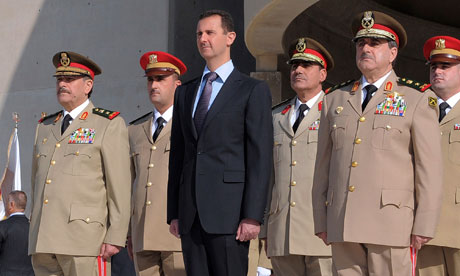 Bashar Assad and Syrian generals at a ceremony to mark the 38th anniversary of the October 1973 Arab-Israeli war. Photograph: Ho/AP
 [Still image from the documentary, “Syria: Inside the Repression, Magneto Presse, 2011]