| Posted: 06 Dec 2011 11:12 AM PST
There is no state on earth that will not use the misfortune of its neighbour for its own benefit. It’s a fundamental tenet of international relations (at least in realism) that states are self-maximising agents that constantly scheme against each other. In the Middle East, Syria took advantage of the turmoil in both Lebanon and Iraq for its own advantage, as did Iran. So why is it such a surprise that the Gulf states would seek to capitalise on the turmoil in Syria? And what on earth does that have to do with forcing the Syrian regime to stop killing its citizens?There are some intellectuals, activists and writers who, blinded with their hatred for the West, are incapable of uttering a single word of condemnation against the Assad regime in Syria, that has killed over 4,000 of its own citizens, all because they fear this would weaken the “resistance” project against the Israeli state. I simply don’t understand what could be more important than stopping this senseless bloodshed, taking place solely to maintain a police state that has treated its own people far more ruthlessly than the “Zionist enemy”, which has bombed the country freely and without retaliation over the past number of years. It is this hypocrisy which is far more blatant than the obvious Gulf Arab bias towards the Syrian revolution at the expense of the crushed Bahraini one.
|
| For After Prison, There is Only the Glory of a Rising DawnPosted: 05 Dec 2011 04:13 PM PST
Here is a beautiful poem written in 1922 by Najib al Rayess. I’ve never been able to find a rendition that does it justice, and so I will just put down the poem, and try to translate it in English as best as I can. When I hear that more and more people that I know are getting imprisoned, these are the first words that come to mind:
يا ظلام السجن
كلمات: نجيب الريس (1922)يا ظلامَ السّـجنِ خَيِّمْ إنّنا نَهْـوَى الظـلامَا
ليسَ بعدَ السّـجنِ إلا فجـرُ مجـدٍ يتَسَامى أيّها الحُرّاسُ رِفـقـاً و اسمَعوا مِنّا الكَلاما إيـهِ يا دارَ الفخـارِ يا مـقـرَّ المُخلِصينا و تَـعَاهدنا جَـميعاً يومَ أقسَـمْنا اليَـمِينا يا رنينَ القـيدِ زدني نغمةً تُشـجي فُؤادي لـسـتُ والله نَسـيّاً ما تقاسِـيه بِـلادِي فاشْـهَدَنْ يا نَجمُ إنّي ذو وفــاءٍ وَ وِدادِ
Oh the darkness of this prison, descend on us for we love the dark;
There is naught after imprisonment but the glory of a rising dawn
Oh guards, be gentle, and listen to our words;
Deny us not this air, for banning it is a sin
Oh land of pride and home of the loyal;
We the youth have arrived, and fear no death
And we had all promised, the day we gave our oaths;
To remain true to our word and took truth for our creed
Oh ringing chains, sing me a song to raise my spirits;
For your voice gives meaning to oppression and hardship
By God I have not forgotten what my country suffers;
So bear witness, oh stars, that I remain faithful and loyal
|
Jillian C York
A consummate activist, let’s hope my friend’s belief in the power of people is well placed and helps secure her freedom
Jillian C York · 05/12/2011 · guardian.co.uk
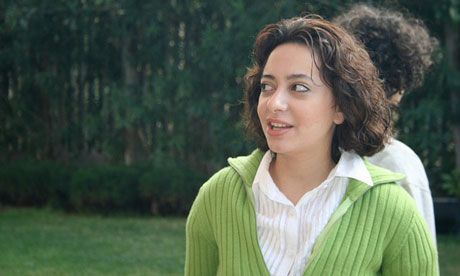
Razan Ghazzawi, a Syrian blogger, has been arrested. Photograph: Jillian C York
I got an urgent instant message from my good friend Razan Ghazzawi last Tuesday night. Having tweeted and blogged against the Syrian regime for the past several months under her real name, from inside Syria, Ghazzawi was concerned that she had become a target.
Always prepared, she sent me her contingency plan: close her online accounts. Syrians who have been arrested and detained over the past nine months have reported having their passwords demanded by authorities. Though closing her accounts wouldn’t help her, it could protect her friends – that’s the kind of person Ghazzawi is.
Those close to her say that she was on her way to a workshop in Jordan organised by her employer, the Syrian Centre for Media and Freedom of Expression, when she was arrested. Though it’s difficult these days to understand anything the Syrian regime does, her blog may have been the impetus for her arrest, or it may not have, but in either case her outspoken writing could very well make things worse for her.
By birth, Ghazzawi is an American citizen – though she would undoubtedly resent the idea of that being used to free her. In any case, it is unlikely that the US government could have any pull with the Syrian regime at this point.
I met Ghazzawi in 2008 at a conference in Europe. We only connected briefly – she was working on her master’s thesis – but we kept in touch and when I visited Syria the next year, reconnected. She is a consummate activist, never content to let something slide, always thinking, sometimes too much. She is passionate about LGBT and gender rights, Palestine and, of course, her beautiful Syria.
Though Ghazzawi had blogged under her own name for several years, at the start of the Syrian revolution she had a change of heart, changing her name on Twitter and locking down her Facebook account. I never asked, but I assumed she was scared. She left for a while for Lebanon, then Egypt, but ended up back in Syria soon after; I can only assume she felt compelled to return.
Eventually, she decided against anonymity, returning to her former outspoken nature and tweeting, her opposition to the regime coming across loud and clear.
What I appreciate and respect the most about Ghazzawi (and what I suspect is what irks a lot of other people about her), however, is her honesty and humanity. Though a staunch supporter of Palestinian rights, she has denounced the double standards of Palestinian resistance groups that have expressed support of the Syrian regime. She has not been afraid to speak up against those she disagrees with, even her friends. For that, she is among my heroes.
She has also been pragmatic, sceptical even, of the role of social media in Syria and throughout the region, consistently claiming that “online activists are overrated”. Bemused, annoyed even, at all of the invitations she’s received to represent Syrian digital activists at conferences, she has taken a pragmatic approach to the effect of digital tools in Syria, where access to the internet hovers at around 20% and DSL is mostly unavailable outside of Damascus.
Last time I saw her, at the Third Arab Bloggers Meeting in Tunis, she drove the point home: after learning that Palestinians had been denied visas to attend, she slapped a sign on her back that read: “OK, [Palestinians] denied entry. Let’s not just tweet about it!”
It is ironic then, that her own online outspokenness may be the cause of her arrest.
In respect to the Syrian opposition, Ghazzawi has been thoughtful, nuanced, writing about her love of Syria and her desire for a simultaneously free and peaceful Syria. On her blog, she recently wrote:
“Colonisation made us all a bunch of nationalists [fighting] for a label [rather] than for a value. I want to be living hand in hand with all of you, and this cannot be done if we see ourselves as ‘majorities’ and ‘minorities.’ The foundation of this logic lies in nationalism.”
But if there is one thing that represents Ghazzawi more than anything, it is her belief in the power of people – not politicians, not parties, but individuals. “It’s time for people’s self-determination to rule the region, you just wait and watch,” she wrote in October. Let’s hope that her prophecy is correct.
[youtube http://youtu.be/Jbnvxyd2jkw?]
I have only recently had the chance to watch the al Arabiyah interview with Rifaat al Assad, Bashar’s uncle. Rifaat is widely believed to be responsible for the Tadmur prison massacre, as well as with the Hama massacre during the regime’s battle with the Syrian Muslim Brotherhood in the eighties. Throughout the interview, an uncharismatic Rifaat is trying to portray himself as some sort of statesman. His solution to the current “crisis” is that a strongman from within the regime is needed, one who knows the threats to the regime, how to manage it, and who also knows “the people”. He rules himself and any of his children out, and he is clearly uncomfortable when asked how he amassed his enormous personal wealth.
Regarding the massacres, he points out that he was not responsible, and then says that there are “documents” on the internet that will prove who did so. He makes an interesting reference to an Islamic bourgeoisies – meaning the Muslim Brotherhood and their sympathisers.When he is challenged about the killings, he denies being involved with the Syrian presidency, and says that he was always against the law which sentenced members of the Syrian Muslim Brotherhood to death automatically. Surprisingly, he says that the killings were carried out under an article of the Syrian constitution, and as law they were to be carried out without question. Somehow I don’t think the International Criminal Court will find that a sufficient defence. Ludicrously, he says that he was never a leader of the notorious Defence Companies, and that such companies never existed! His excuse is that people mistakenly referred to some armed defence unit with that name and it stuck ever since.
What a silly man, and I am still amazed that he can live freely in Europe and that nobody has ever charged him with crimes against humanity. Watching this interview makes me realise just how delusional, secretive and out of touch this corrupt and brutal regime is with the Syrian people. To the world, they lie, lie and lie, through their teeth. What goes on within their inner circle, I’d love to find out one day. Remarkable
Saturday, November 26, 2011
It pains me to see people that I thought were principled in their commitment for justice and outspoken in their support for the Palestinians, ignore the plight of the Syrian people and dismiss what is happening there as some Western conspiracy. Those same people will accept “insights” from “sources” in Bahrain, publish Youtube videos of demonstrations in Saudi Arabia’s Qatif, and yet criticise al Jazeera for relying on anonymous sources, or Youtube videos in Syria, knowing well that all foreign media have been banned from operating there. They afford full respect to the Bahraini protesters, and relish the opportunity to use their plight as a way to highlight Western and Arab hypocrisy, and yet they waste no opportunity to ridicule coverage of Syria, and to argue about semantics or demonstrate their critical thinking and scepticism about any story that comes out of Syria. Yet at the same time they would never dream of applying such high standards of scrutiny for the same standard of stories, allegations or speculation if it came from Bahrain or, for that matter, Gaza. The opposite is true for those who conveniently ignore what is happening in Bahrain and cry crocodile tears for the Syrian people.
Shame on them all, completely and utterly. I support the people of Bahrain and all the Arab revolutions. I find no contradiction in this support, and I’m not waiting for somebody from the corrupt oppositions, the Muslim Brotherhood, or the stupid “resistance” demagogues and populists to remind me of my human duty.
“She complained to me that she was beaten and sexually assaulted by Central Security Forces,” Mr. Jaffar said. “But what did she expect would happen? She was in the middle of the streets, in the midst of clashes, with no press card or form of ID. The press center had not given her permission to be in the streets as a journalist. The country is in a sensitive situation. We are under threat. She could be a spy for all we know.”
Col. Islam Jaffar of the Egyptian Security Forces, acknowledging Egyptian-American journalist’s Mona Eltahawy accusation. (NYT November 25, 2011).
In his brief, maddeningly callous statement Col. Jaffar’s, epitomize all that is wrong and despicable in the Autocratic regimes of the Arab world. The overarching premise of all those regimes is that the average citizen is nothing more than a cog in a machine of the state serving strictly the interests of those in power. And when those cogs show signs of life and refuse to be simple inanimate objects, the leaders elevate them from inanimate objects to despicable subhuman creatures, rats (Gaddafi) or germs (Bashar), to be subjected to immediate extermination. Even when the citizens are occasionally allowed to assume human forms, they are, at the slightest hint of dissent, labeled as traitors and thus deserving the harshest of punishment. And so it is in Syria where the regime sends out it’s media “shabeeha” (thugs) to declare on the air that all who go against the eternal president of Syria are traitors who deserve to die.
It is the lowly policemen or security men who beat and groped Mona and have abused and killed hundreds of other unarmed protesters in Egypt. The same holds true of the killing and mistreatment of protesters in Syria, Yemen, Bahrain and Saudi Arabia. The real guilt, however, lies squarely on shoulders of the likes of Col. Jaffar and his superiors who in their words and actions encourage and excuse the behavior of their subordinates. Ultimately, General Tantawi is directly responsible for the recent deaths and abuse in Tahrir square as is Bashar Al Assad responsible for the thousands of deaths, disappearances, detentions and abuse of prisoners perpetrated by the forces he ultimately commands.
Before any of the niceties of democratic governance, the citizens of the Arab world urgently need and deserve a much more basic human right: the right to be treated with dignity and respect. It is the lack of this fundamental right that has ignited the Arab uprisings and it is the unrelenting daily toll of deaths and abuse that fans the flames of rebellion. In the United States, the pepper spraying of Occupy protesters sparked outrage and was relentlessly covered by the media for a week, the video of the incident replayed (in slo mo) ad nauseum. Meanwhile, after a week of mayhem and the killing of forty one protesters, all the Egyptian government can come up with is a lame apology, quickly negated by statements similar to that of Col. Jaffar. The Bahraini government, to its credit, and without excusing any of its past and ongoing transgressions, appointed an independent commission and actually allowed it to publicly present damning evidence of abuse and torture by government forces. This is the first step towards transparency and accountability.
We will not see such transparency any time soon in Syria under the leadership of a very myopic eye doctor in chief. Bashar and his propaganda machine, in complete denial, continue to lament the loss of life of the abusers never seeming to care about the abused, his own citizens. The heart wrenching lament of a middle aged Syrian protester who appears on one of the hundreds of Youtube videos sums it up best: His voice trembling and on the verge of tears he cries out “I am not an animal, I am not an animal! I am a human being!” and pointing to all the people around him he adds “we are all human beings and deserve to be treated like human beings”. It is a very simple and very basic request and it this demand for dignity and respect that is at the heart of all the popular uprising from Tunisia to Bahrain.
And so to president Bashar Al Assad I say: “It is the people, stupid!”. It is not about salafists, or terrorists or imperialist designs…. It is not about secterianism or the Hariri-KSA-Zionist plot… It is not about pan-Arabism or resistance or Baathist ideals. It is about about the people asking for their most basic rights.

The Syrian News Roundup – Lite
The big news this week has been about the Arab League’s imposing economic sanctions on Syria. In a nutshell, Syrian regime officials will no longer be able to travel to other Arab countries, and Syrian regime assets will be frozen wherever they are found. The League stressed that normal transfers from expatriate Syrians will still be allowed through, in the hope that the sanctions will have less of an effect on the average Syrian. Beirut and Baghdad have both rejected these sanctions, and it seems they will carry on business as usual with Assad’s regime:
Sheikh Hamad said Arab nations wanted to avoid a repeat of what happened in Libya, where aU.N. Security Council resolution led to NATO air strikes. He warned other Arab states that the West could intervene if it felt the league was not “serious.””All the work that we are doing is to avoid this interference,” he said.
There has been an alarming escalation in the language and condemnation of the gulf states by the regime’s supporters and its television and media. A derogatory term عربان (Arabians) is being used to refer to them, and I think it carries with it the historical derision that city folk الحضر viewed the Bedouin البدو. The regime and its supporters see themselves as better and more civilized than the Gulf Arabs.
If racist insults were the worst that this regime is capable of then I wouldn’t be worried, but there are worrying signs and much darker clouds appearing on the horizon. In other news, DP-News, a news site sympathetic to the Syrian regime has reported that the Japanese beat Syria in the London 2012 Olympic soccer qualifier.
[youtube http://youtu.be/_S_onOv6Has?]
[youtube http://youtu.be/GHA0EFDFCUQ?]
 band annie's Weblog
2 comments: