View the longer version of a TV ad about Israel’s actions in the Gaza Strip. A shorter version of this commercial was censored by DIRECTV. Take action to protest DIRECTV’s censorship here:
http://endtheoccupation.org/article.php?id=1817
Tony Blair was the speaker in the second lecture of University at Buffalo’s 23rd Distinguished Speaker Series on October 7th. Senior Political Science major, Nicolas Kabat, asks him about the Gaza War during the lecture’s question and answer session:
“UN investigation found that Israel and Hamas committed war crimes and crimes against humanity in the recent Gaza conflict. Yet the US and Israel insist that the report was biased, and proceeding with the Committees recommendations would be harmful to the peace process. Why is international law not applied in this case, when the evidence exists? And please explain, as Quartet Envoy, why the application of international law would be harmful to the overall peace process, and furthermore, why the siege on Gaza is not similarly deemed harmful to the peace process. Thank you.”
…838 Students Still Trying to Leave Gaza for Study Abroad
Wednesday, October 21, 2009 – Once again, following the start of the academic year at many institutions of higher education around the world, some 838 Palestinian students are still waiting to leave Gaza to study abroad. The students cannot leave due to the Israeli-imposed closure of the Gaza Strip and the rigid criteria for exit via the Erez and Rafah border crossings.
According to figures provided to Gisha – Legal Center for Freedom of Movement – by the Palestinian Interior Ministry in Gaza, 1,983 students who have been accepted into educational institutions abroad have registered for permits to exit via the Rafah crossing since the start of the year, but only 1,145 students have managed to pass through the crossing. 69 additional students have left via Erez crossing.
Overseas travel is no simple matter for Palestinian students because passage through Israel is extremely limited in accordance with a long list of criteria determined by Israel, which include the possession of a “recognized” academic scholarship and enrollment to study in a country which has a diplomatic presence in Israel. In addition, since June 2008 Israel has made the exit of students from Gaza to study abroad conditional on a physical diplomatic escort (see Gisha’s report: “Obstacle Course: Students Denied Exit From Gaza”). The students also have difficulty leaving through Egypt via Rafah crossing due to the fact that it is closed most of the time. The rare openings of Rafah Crossing permit travel for only about 12% of people wishing to pass (see Gisha’s report: “Rafah Crossing: Who Holds the Keys?”).
As a result, 838 students are still waiting in Gaza for permission to leave. An additional unknown number of students were not even eligible to register for a Rafah exit permit since they were unable to attend a visa interview in Jerusalem or the West Bank – a prerequisite for passing through the Rafah crossing. Below are three examples of students harmed by the infrequent opening of the Rafah crossing and the strict exit criteria set by Israel:
Mohammed AbuHajar, 29, was accepted into an MA program in Information Technology and Communications at the Center for Information Technologies in Athens in July 2009, and was even awarded a full scholarship by the Center. Since Israel does not consider this to be a “recognized university” or a “recognized scholarship,” and despite requests by Greek officials on his behalf, all of AbuHajar’s attempts to leave Gaza have so far led nowhere. He only just managed to register with the Palestinian Interior Ministry, but it is not known when the next opening of the Rafah crossing will take place or whether AbuHajar will be able to get through the crossing at all.
Ihab Naser, 38, who holds a graduate degree in Biochemistry, was accepted into doctoral studies in Community Nutrition at a Malaysian university in May 2009, but he has not yet managed to leave Gaza. Since Malaysia has no diplomatic ties with the State of Israel, so long as Israel continues to insist on the diplomatic escort requirement, Naser has no chance of getting out of Gaza via Israel to study abroad. Despite the fact that Naser has been on the list of students with a permit to exit via the Rafah crossing for a long time already, due to the huge crowd of hopeful travelers that converges on the crossing every time it opens, his exit has been delayed time and again.
Wesam Kuhail, 28, who holds a BA in Business Administration, was accepted into an MBA program in the USA, but has been forced this year – for the third time – to renew his application for the program. This is because Kuhail has not yet managed to get an exit permit from Gaza in order to attend a visa interview at the US Consulate in Jerusalem: “I don’t know if I’ll ever make it to the consulate under these circumstances. This wait has prevented me from making important life decisions… All I am doing is waiting for my entry permit to be approved by the Israelis.”
Source: Gisha
Munzer al-Dayyeh is a 40-year-old mechanic living in Gaza. And while the effects of war and ongoing siege may be good for his business, he can’t manage to secure medical treatment for his disabled children. An insight into an ordinary Gazan man struggling to make a living and to find a solution for his family in the difficulties of the Gaza Strip.
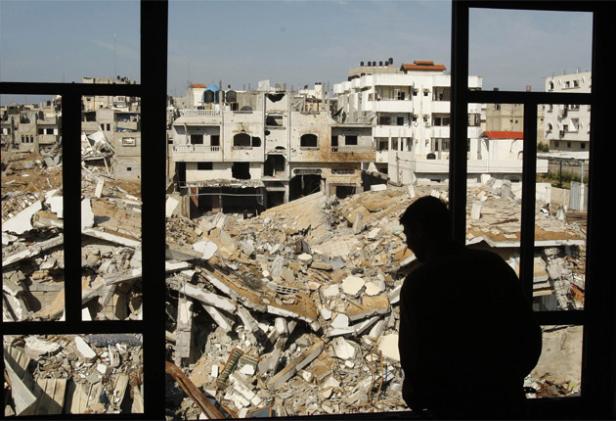
Under siege and grappling with joblessness, factional violence and the aftermath of war, Gazans are turning to pills as they seek to escape reality. Donald Macintyre speaks to a mental health group struggling to help addicts
Abu Ahmed lived through last winter’s Gaza war in a daze. Though the district where he lives was invaded by Israeli ground forces and came under heavy fire, including the use of white phosphorus shells, he felt little fear. For by then, the 45-year-old unemployed father of 10 was popping tablets of the painkiller Tramadol to feed an ever more dangerous habit.”Of course you care about the children but [with the drugs] you forget about yourself,” he explains. “You feel less frightened.”
Manufacturers warn the maximum daily dose of the synthetic opioid should be no more 300mg per day; Abu Ahmed was taking as much as 800mg – in the grip of an addiction which has rapidly spread throughout Gaza over the last two years. As the population struggles to cope with Israel closing their home to the outside world, the sometimes violent power struggles between Fatah and Hamas, and then the aftermath of Operation Cast Lead, the Tramadol pills – smuggled in through tunnels from Egypt – have provided a welcome escape from reality.

More than 1,400 Palestinians, a third of them women and children, died in the offensive [GALLO/GETTY]
A United Nations investigator has defended a report published earlier this month that accuses Israel and Palestinian fighters of war crimes following the Israeli offensive in Gaza earlier this year.

