Mondoweiss writes:
On Sunday, the last day of his 81st year, Noam Chomsky gave a speech on Gaza in Watertown, Mass., at the behest of Newton Dialogues on Peace and War. They raised alot of money for the Gaza Freedom March. I heard a rumor that the original venue for the speech, Eliot Church in Newton, had dropped the speech under pressure, saying that the speech was “controversial” and had not gone through the appropriate processes for church events. I emailed Newton Dialogues. Dave Ascher responded. If you read between the lines of his response below, it is clear that the Eliot Church came under pressure because of the political nature of the Chomsky speech.
Press Release, Gaza Freedom March
December 4, 2009
The Gaza Freedom March that will take place in Gaza on 31 December is an historic initiative to break the siege that has imprisoned the 1.5 million people who live there. Conceived in the spirit of Mahatma Gandhi, Nelson Mandela and nonviolent resistance to injustice worldwide, the march will gather people from all over the world to march — hand in hand — with the people of Gaza to demand that the Israelis open the borders.
Marking the one-year anniversary of the December 2008 Israeli invasion that left more than 1,400 dead, this is a grassroots global response to the inaction on the part of world leaders and institutions. More than 1,000 international delegates from 42 countries have already signed up and more are signing on every day.
Participants include Pulitzer Prize winning author Alice Walker, leading Syrian comedian Duraid Lahham, French Senator Alima Boumediene-Thiery, autthor and Filipino Parliament member Walden Bello, former European Parliamentarians Luisa Morgantini from Italy and Eva Quistorp from Germany, President of the US Center for Constitutional Rights Attorney Michael Ratner, Japanese former Ambassador to Lebanon Naoto Amaki, French hip-hop artists Ministere des Affaires Populaires, and 85-year-old Holocaust survivor Hedy Epstein.
We also have families of three generations, doctors, lawyers, diplomats, 70 students, an interfaith group that includes rabbis, priests and imams, a women’s delegation, a Jewish contingent, a veterans group and Palestinians born overseas who have never seen their families in Gaza.
The international delegates will enter Gaza via Egypt during the last week of December. In the morning 31 December, they will join Palestinians in a nonviolent march from northern Gaza to the Erez/Israeli border. On the Israeli side of the Erez border will be a gathering of Palestinians and Jews who are also calling on the Israeli government to open the border.
Inside Gaza, excitement is growing. Representatives of all aspects of civil society, including students, professors, refugee groups, unions, women’s organizations, nongovernmental organizations, have been busy organizing and estimate that at least 50,000 Palestinians will participate. People from the different sectors will march in their uniforms — fishermen, doctors, students, farmers, etc. Local Palestinian rappers, hip-hop bands and dabke dancers will perform on mobile stages.
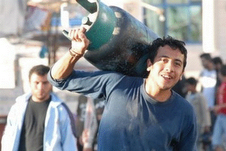 Gaza City, November 15, 2009, (Pal Telegraph) The ongoing Israeli siege has been gravely suffocating the life of people of the Gaza Strip. The fuel companies in the Gaza Strip have been warning of the imminent humanitarian crises that the cooking gas is about to get depletion after 25 days of cutting access to the Gaza fuel sanitation.
It is warily reported by Mahammed Al Shawwa, the head of the union of fuel companies in the Gaza Strip, that the gas sanitations in the Gaza Strip has stopped supplying people of their needs of the cooking gas.
It is worthily mentioning that the Israeli occupation authority has allowed limited amount of gas cooking in the last few months. Shawwa stated that for 25 days, the Israelis authorities haven’t allowed needed gas amount for the people of the Gaza Strip.
Shawwa clarified that the Israeli occupation authority has recently stopped using Al-Shajaia crossing to enter cooking gas and industrial diesel into Gaza and instead it allows in small quantities through Karam Abu Salem crossing which lacks infrastructure needed to supply Gaza with sufficient fuel shipments.
Shawwa appealed on the international community to put pressure on the Israeli side to allow the needed gas shipments entry in the Gaza Strip and to increase the shipments so as to alleviate part of the Gazans suffering and end the humanitarian crisis.
—
Most Grateful Regards From Gaza
=========================
Ayman T. Quader
Blogger Based on the Gaza Strip
Gaza Strip, Palestine
Mob: 00972599448628
E-mail: ayman.qauder@gmail.com
ayman.quader@yahoo.comSkype: peaceforgaza
Facebook: ayman.quader
Web: www.peaceforgaza.blogspot.com
www.paltelegraph.com
http:picasaweb.google.com/ayman.qauder
Efforts to prosecute those who may have committed war crimes in Israel’s war on Gaza have spread beyond the Middle East.
A lawyer in South Africa has identified 75 South African nationals who he says were fighting with the Israeli army in the war earlier this year.
Feroze Boda, based in Johannesburg and working on behalf of two local pro-Palestinian organisations, says the soldiers should face court action for their involvement.
Imran Garda reports from Johannesburg.
Faryal Leghari
29 October 2009
The Palestinians need humanitarian aid because of the situation created by Israel, but more than this, Israel needs to be confronted politically, argues Huwaida Arraf, leader of the Free Gaza Movement and co-founder of the International Solidarity Movement.
In an exclusive interview with Khaleej Times, Huwaida and Adam Shapiro, a human rights activist and documentary filmmaker, spoke at length about their mission, that is aimed at helping the besieged Palestinians and defying the Israeli siege of Gaza until it is lifted.
by mail
UN makes a drama out of Gaza crisis
Israel’s attack on an aid warehouse that was a lifeline for Palestinians has been powerfully reconstructed for the stage. But such controversial material is leaving audiences divided.
Donald Macintyre reports
The Independent
Sunday, 25 October 2009
Her face larger than life on the big screen at the back of the stage, Jodie Clarke explains just what was happening at her workplace on 15 January 2009, and how the military she was constantly in touch with were insisting it was not. “My dear, I am standing in my building,” she says she told the person at the other end of the phone. “It is collapsing around me. There is a huge fire. You are hitting the UN compound.”
The Australian warehouse manager goes on calmly to describe how she crawled under the wheels of a fuel truck to push away a burning a “softball-sized” chunk of white phosphorus that would have caused a devastatingly lethal explosion if it had ignited the vehicle.
Matter of fact as it is, Ms Clarke’s account is powerfully dramatic. Appropriately so, since it is now the centrepiece of what by any standards is one of the most unusual dramas to be staged in English in 2009. All the more so since the author, sole actor and director, is Chris Gunness, the chief spokesman for the UN Relief and Works Agency. And especially so given the unwieldily titled but highly watchable Building Understanding: Epitaph of a Dead Warehouse is intended for Israeli audiences, whose military was responsible for the artillery bombardment of UNRWA headquarters in central Gaza City during the last week of the invasion.
Provocative agitprop dramaturgy on the fringe-theatre circuit may seem rather beyond the remit of a UN press officer, however senior. But Mr Gunness decided last spring that this was the best medium with which to engage the Israeli public, among whom, as the body responsible for the welfare of almost a million of Gaza’s refugees, his employer UNRWA is, to put it mildly, far from universally popular, on the impact of Operation Cast Lead.
Mr Gunness, a Briton and one-time BBC correspondent turned diplomat, became internationally well-known during last winter’s war as he took to the airwaves and regularly protested about UN installations in Gaza, including the warehouse, coming under fire from the Israeli Defence Forces.
It was on the strength of one such appearance on a satellite channel that Tami Berger from Bezalel, Israel’s most venerable art school, invited him to take part in a one-day event on “storage-space” ranging from the human womb to a TV network’s archive. Mr Gunness thought of the UNRWA warehouse and with the backing of his bosses and the help of his Israeli assistant, Yael Azgad, sat down and wrote Epitaph.
On stage throughout the 40-minute performance, Mr Gunness plays – however improbably – the eponymous warehouse, announcing early on that he is “the victim of an excruciatingly painful fire that burned me down”. Most of the goods coming into Gaza, including food, medicine, basic health items and other humanitarian supplies “pass through me”, the warehouse explains, adding, “I am a lifeline to a society behind bars”.
Unsurprisingly, the play has generated controversy, especially since Jewish international judge Richard Goldstone’s UN-commissioned report on the Gaza operation, which excoriated the attack on the compound and triggered outrage through much of Israel; so much so that a planned performance at Tel Aviv’s Hasimta theatre last week, which was to have been followed by a panel discussion with a Israeli government representative, was cancelled. There is no sign that the theatre’s creative staff were responsible for the axing. The theatre director, Avi Gibson Bar El, referred enquiries this week to the Tel Aviv muncipality, which in turn refused two requests for comment.
Epitaph was similarly pulled – this time at the last minute – from Acre’s al Laz theatre, back in August. Mony Yousef, who runs the city’s arts festival who saw then recommended the play to the theatre, broke the news to Mr Gunness after he had arrived in the northern Israeli city to set up. Asked about the sudden U-turn, Mr Yousef suggested, somewhat bizzarely, that the problem was, in fact, that the play had not been provocative enough. “It was not theatre, it was not very radical,” he insisted. “There was no pressure.”
So far, therefore, Mr Gunness has been able to stage his play only twice for the Israeli audiences for whom it is intended. In Tel Aviv, 20 people (out of an audience of more than 100) walked out early on. One man rose to his feet halfway through the performance to denounce what he saw as the drama’s frontal onslaught on Israel’s military.
Mr Gunness defused the interruption by promising to discuss his concerns. At the end, he walked down to the man’s seat and pointed out that the show was not saying the bombardment was deliberate, or that it was a war crime. The man was apparently placated but Mr Gunness conceived the idea that performances should from then on feature a chair for audience members to come up on stage and engage in debate if they wanted.
The other performance was for a class at Sapir College in Sderot, the western Negev town which has borne the brunt of Hamas rocket attacks from Gaza. Although the students, including former soldiers, were on an elective course studying Palestinian refugees – and therefore more familiar with UNRWA’s work than the average Israeli – they were initially sceptical. “There was a lot of ‘Yes, but’,” said lecturer Maya Rosenfeld. “But in the end I think the whole idea of watching an UNRWA official doing this impressed them.”
For Mr Gunness, the show is partly about repairing the image of the UN, once famously dismissed as “Oom Schmoom” by Israel’s first Prime Minister David Ben Gurion. Israelis who dislike the UN may sometimes scrawl “Unwanted Nobodies” on its cars. Mr Gunness says the UN is “expected to stay put when there is danger and conflict and it does”. He believes that audiences who engage with Epitaph find that “our values are ones that a lot of Israelis identify with, including giving help to those who need it most”.
But was the highly sensitive subject of the Gaza War the best subject to begin this process of engagement and image building? “If I contact Israelis-journalists and others about other things we do, development and so on, they understandably glaze over; but if I say look, there’s a play with a pint-sized Australian woman from UNRWA who risked her life to stop an even worse conflagration in the middle of the war, they sit up and listen.”
Pointing out that Israel’s Foreign Ministry had encouraged UNRWA to engage more with the Israeli public, he adds: “Like Daniel in the biblical den, I’m ready to take this to the most leonine audiences anywhere in Israel.”

