Search

band annie's Weblog

I have a parallel blog in French at http://anniebannie.net

Author

bandannie

‘The Naked and the Dead’ documentary

[youtube http://www.youtube.com/watch?v=ATaZUUHVtgM&feature=colike?]

Set on an island in the South Pacific where the American Army under General Cummings is trying to drive out the Japanese, The Naked and the Dead focuses on a single reconnaissance platoon. The novel is split between alternating chapters depicting ongoing action on the island and retrospective chapters focusing on a particular character’s personality and past. The Naked and the Dead contains several combat scenes and a great deal of description of Army protocol, as well as detailed descriptions of the many trials and agonies of the enlisted man. The novel deals with the difficulties of the campaign, the danger posed by the Japanese, the conflict between officers and regulars, each man’s own internal conflicts and fears, and the aggression between squad members. Everyone, from the General down, has character flaws, and there are few depictions of lasting happy family life or of good male-female relations. Later in the book a former general’s aide, Hearn, becomes the Lieutenant of the squad, to the ire of Croft, the ambitious Sergeant previously in command, and to the detriment of the men of the platoon.

The novel questions the competence and motives of high-ranking officers, as well as the integrity of each of the many men depicted. The men suffer physical hardship and even casualties, but there is little mourning or kindness. There is no mercy shown to the Japanese. Occasionally, individual soldiers show sparks of sensitivity or thoughtfulness.

The Naked and the Dead was Mailer’s first published novel and is still his top ranked novel by sales; it established his reputation as a novelist and brought international recognition.
Download Address:
http://www.en8848.com.cn/d/file/soft/Fiction/General/201006/3ec7c8c37da7c6255b2982b6f00d271a.rar

Syria : Blanket Thinkers

Qunfuz

Robin Yassin-Kassab

with 2 comments

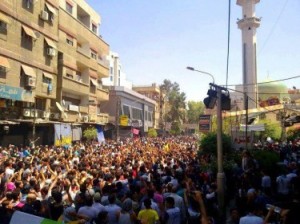
Yarmouk camp demonstrates

One of my infantile leftist ex-friends recently referred to the Free Syrian Army as a ‘sectarian gang’. The phrase may well come from Asa’ad Abu Khalil, who seems to have a depressingly large audience, but it could come from any of a large number of blanket thinkers in the ranks of the Western left. I admit that I sometimes indulged in such blanket thinking in the past. For instance, I used to refer to Qatar and Saudi Arabia as ‘US client states’, as if this was all to be said about them. I did so in angry response to the mainstream Western media which referred to pro-Western Arab tyrannies as ‘moderate’; but of course Qatar and Saudi Arabia have their own, competing agendas, and do not always behave as the Americans want them to. This is more true now, in a multipolar world and in the midst of a crippling economic crisis in the West, than it was ten years ago. Chinese workers undertaking oil and engineering projects in the Gulf are one visible sign of this shifting order.

(My talk of ‘infantile leftists’ does not include the entire left of course. Simon Assaf of the Socialist Workers, for instance, understands what’s happening. So does Max Blumenthal. And many others.)

The problem with blanket thinkers is that they are unable to adapt to a rapidly shifting reality. Instead of evidence, principles and analytical tools, they are armed only with ideological blinkers. Many of the current crop became politicised by Palestine and the invasion of Iraq, two cases in which the imperialist baddy is very obviously American. As a result, they read every other situation through the US-imperialist lens.

Qaddafi had opened up Libyan oilfields to Western exploitation, he bought Western weapons, and he tortured rendered suspects for the CIA. Inspired by uprisings in Egypt and Tunisia, the Libyans rose against the tyranny with incredible courage. When Britain and France, for their own reasons, helped to hasten the end by degrading Qaddafi’s mercenary forces (important but not decisive help – Qaddafi’s fall was effected by a rising in Tripoli and an influx of fighters from the Jebel Nafusa), blanket thinkers very insultingly painted the popular revolution as a foreign plot. Some even retrospectively raised Qaddafi to the rank of anti-imperialist hero. And since the fall of the old regime they’ve done everything they can to paint Libya as a failed state, a site of genocide, a new Iraq. It’s pretty insulting to Iraq as well as to Libya.

The fact that politics and civil society were effectively banned for decades, and the fact that Qaddafi imposed a civil war on his people, traumatising them and causing thousands of young men to take up arms, means that the new Libya faces imense problems. This is not news. Whenever a dictatorship ends violently, all the problems which have been repressed will burst forth. It’s like taking the lid off a steam cooker: all the good and evil in the society, all the intelligence and stupidity that was previously hidden, will spill out. This is not an argument for keeping the dictatorship. Several hundred have been killed in Libya since the fall of Qaddafi, mainly in battles between rival militias. Sometimes this has had a tribal or revenge aspect, but there has been no Iraq-style ethnic cleansing. There is a small separatist movement in the east. Fringe Islamist extremist groups have made a lot of noise. Many of the armed young men are reluctant to give up their arms. But there has been a very successful election. If the new government is able to absorb the militias into a national army and to resolve tribal, regional and other disputes within an accepted political process, Libya can look forward to a much better future. Opinion polls and conversations with Libyans show that an overwhelmingly large majority are happy that Qaddafi has gone and are optimistic about the future. But what does Libyan opinion matter to blanket thinkers?

After 17 months of slaughter in Syria, there is no no-fly zone. The extent of Western and ‘client’ intervention is this: Saudi Arabia and Qatar may be providing a small amount of light weaponry. The Turks may be helping to coordinate the weapons deliveries. The CIA appears to have a few men on the ground watching where the weapons are going and hoping (vainly) to ensure that they’ll never end up in the hands of anti-Zionist militants. On the other side stands a nakedly sectarian regime which considers its people slaves and murders them and destroys their cities with Russian weapons. Imperialist Russia, which has oppressed Muslims in the Caucuses and central Asia, and which bears half the blame for all the Cold War hot wars in Africa, is resupplying the regime with attack helicopters, tank parts and ammunition as the death toll surpasses seventeen thousand. Russia also protects the regime from condemnation at the UN security council. It plays the same role with regards to Syria that the United States plays with Israel. But how do the blanket thinkers see the situation? For them it’s yet another clear cut case of American imperialist aggression against a noble resistance regime, and once again the people are passive tools.

At best they are passive tools. They are also depicted as wild Muslims, bearded and hijabbed, who do not deserve democracy or rights because they are too backward to use them properly. Give them democracy and they’ll vote for the Muslim Brotherhood, and slaughter the Alawis and drive the Christians to Beirut. The blanket thinkers search for evidence of crimes committed by the popular resistance, and when they find them (usually on very flimsy evidence) they use them to smear the entire movement. They demand the resistance negotiate with a regime which has proved again and again that its only strategy is slaughter. They demand that the people remain peaceful as their children are tortured, their women raped, their neighbourhoods levelled. Leftist blanket thinkers do not apply the same criteria to the popular resistance of the Palestinians. It’s Zionists who do that.

To call the Free Syrian Army a sectarian gang is tantamount to calling the Syrian people a sectarian gang. It betrays a willed ignorance of reality. The FSA was formed in response to the sickening violence perpetrated by the Syrian regime, which at this stage is certainly a sectarian gang. Its Alawi military units work with armed Alawi civilians to slaughter Sunnis. This is a disaster for the Alawis and everyone else; it sows the seeds of a potential war which would destroy the country for generations, and it’s one of the first reasons why the regime must go as soon as possible. But the FSA is in reality hundreds of local militias which sometimes cooperate. It consists of defected soldiers (these people are heroes – they fled the army at huge personal risk because they were unable to stomach murdering their people; most soldiers who try to defect are killed before they leave base) and local men who have taken up arms to defend their neighbourhoods. Because the FSA is made of ordinary men, it covers an enormous range of political opinion. Some fighters are disillusioned Baathists, some are secularists, some leftists, some support the Muslim Brotherhood and some are attracted by extremist Wahhabi rhetoric. Some, I’m sure, are criminals, because some of the Syrian people are criminal. Some will be in it in the hopes of financial or sexual profit, because that’s the way people are.

Most are apolitical people, except for the fact that they want to bring down the tyranny. They fight because they have no choice. Of course, there is a huge danger that apolitical people will be easily manipulated by sectarian rhetoric, especially given that their enemy instrumentalises sectarianism. This is certainly a difficult period for revolutions in the Muslim world and internationally. The collapse of leftist thinking and reach, and the shrinking of public debate by dictatorships and consumerism, has left the way open to retrograde forms of religious or nationalist politics. Some of the battle videos labelled ‘Free Syrian Army’ look and sound depressingly similar to jihadist videos from Iraq. But for now it’s mainly a problem of style and ignorance, and it can easily be misinterpreted by an orientalist eye. Most Syrian people are religious, whether we like it or not. But most Syrian people are also aware that a sectarian war would produce no winners. The Allahu Akbar chant expresses a faith which is necessary to overcome the fear of being shot. It doesn’t autmomatically mean ‘Kill the Kuffar’. (But who am I talking to? The Palestinians use religious rhetoric and talk about ‘the Jews’ rather than ‘the Zionists’, and it doesn’t bother the blanket thinkers for a moment).

The longer the necessary fight goes on the more brutalised the people will become, and the more likely that vengeful sectarian voices will dominate. It is the duty of any right-thinking person, leftist or otherwise, to support the oppressed people in their struggle. Anyone who does so, and who respects the Syrians enough to base their comments on knowledge rather than assumption, will have earned the right to offer political advice to the Syrians.

The FSA is inevitably disorganised and outgunned. But it’s a lot more organised than it was a few months ago, and it is liberating territory. It fights with commitment and incredible resilience. Today the battle is in inner Damascus.

And a few days ago it was in the Yarmouk and Palestine refugee camps, which brings me finally to the strange fact that blanket thinkers persist in thinking of the Syrian regime as in some way a threat to Israel. It’s true that Syria helped Hizbullah stand firm, and this is not a small thing. It’s also true that the Syrian regime has massacred Palestinians in Tel Zaatar and other Lebanese camps, that since 1973 the border with the occupied Golan has been quieter than borders with states enjoying peace agreements with Israel, and that Syria has never even tried to shoot at the Israeli planes which have bombed its territory since Bashaar inherited power. But things have become clearer since the uprising began. Rami Makhlouf told the New York Times that Israeli security depended on the Syrian regime’s security.

Paul Woodward at War in Context quotes Reuters on the regime’s recent transportation of chemical weapons: An Israeli official said however the movements reflected an attempt by President Bashar al-Assad to make “arrangements to ensure the weapons do not fall into irresponsible hands”.

“That would support the thinking that this matter has been managed responsibly so far.”

Woodward then comments: So, while the word from Damascus is that “terrorists” armed with “Israeli-made machine guns” conducted the massacre in Tremseh yesterday, the word from Tel Aviv is that Syria’s chemical weapons are nothing to worry about so long as they remain in the responsible hands of the government.

There might be a certain amount of truth in that statement. Still, it’s not exactly the rhetoric one might expect from a representative of an alliance that is supposedly gunning for Assad’s downfall. On the contrary, it reflects the fact that Israel would be much happier to see Assad remain in power.

Here’s a simpler proposition for the blanket thinkers: Hizbullah won victories because it respects its people, because it is of its people. A regime which murders its people and destroys the national infrastructure, which plays with the dynamite of sectarian conflict and puts the whole people’s future in question, would be incapable of winning a victory even if it wanted to.

On Friday tens of thousands protested against regime barbarism in the Palestinian camps of Damascus. Regime forces opened fire, murdering eleven. Many more were dragged from their homes to be tortured in detention. Professional liar and regime spokesman Jihad Maqdisi then described Palestinians as ‘impolite guests,’ outraging Syrians and Palestinians, who are the same people, now more than ever.

Kafranbel does it again !

Yo Mama So Zionist

[youtube http://youtu.be/dAeOkdB2cl8?]

Chinese Workers Hail Romney’s Record as Job Creator

                                 July 14, 2012

Mass Pro-Romney Rally in Beijing

BEIJING (The Borowitz Report) – After a brutal week in which he was booed by the NAACP and grilled by the media, Republican presidential choice Mitt Romney got some support from an unlikely place today: Beijing.

Manufacturing workers from across China flooded downtown Beijing to show their gratitude for Mr. Romney’s robust record of job creation in China while at the helm of the private equity firm Bain Capital.

While Mr. Romney’s feats of outsourcing have taken a political toll at home, they have made him a national hero in China, according to workers like Qiu Huang, who attended the rally.

“I owe my job to Mitt Romney, and so do many of my friends and family members,” he said.  “His record as a job creator, in China at least, is second to none.”

Mr. Qiu said that if Mr. Romney ran for President of China, “he’d win in a landslide – he wouldn’t even need those billionaire brothers to buy ads for him.”

But the Chinese worker was surprised to learn that Mr. Romney had spent the better part of the week denying that he still worked at Bain during the company’s frenzy of outsourcing jobs to China.

“Why would you deny doing a great thing like that?” he asked. “That would be like denying you gave people healthcare.”  Get a free subscription to the Borowitz Report here.

In the Absence of Neutrality

Sunday, July 15,2012


by Amal Hanano

Medical Neutrality: a principle of noninterference with medical services in times of armed conflict and civil unrest: doctors must be allowed to care for the sick and wounded, and soldiers must receive care regardless of their political affiliations. . . . The principles of medical neutrality derive from international human rights law, medical ethics and humanitarian law. Violations of medical neutrality constitute crimes outlined in the Geneva Conventions.

Mohammed, an internal medicine physician, and his brother Omar, an orthopedic surgeon, are from Idleb. Since the Syrian uprising began sixteen months ago, they have worked in hospitals and make-shift field clinics in Hama, Idleb, Deir al-Zor, Raqqa, and al-Hasakeh. They joined the Free Syrian Doctors Union in May 2011. The union is a network of Syrian doctors who deliver medical care and emergency relief in field hospitals to scores of wounded protesters and opposition fighters. This is dangerous work, because as Dr. Mohammed says, “Any doctor who becomes known by name for working in a field hospital or taking care of the wounded who cannot be treated at a government hospital is wanted by the regime.”

Last month, two medical students and a first-aid medic had become known by their names. The three young men, Basel Aslan, Mus’ab Barad, and Hazem Batikh were wanted by the regime for treating protesters who had been shot by security forces. They were arrested at a checkpoint in Aleppo on June 17, 2012 and detained at an Air Force Intelligence branch. According to an Amnesty International report, the bodies were found in a burned car in the outskirts of Aleppo on June 24. Their charred corpses were marked with signs of torture. As the report indicates, Basel Aslan “had a gunshot wound to the head and his hands were tied behind his back. One leg and one arm were broken, several teeth missing and the flesh was missing from his lower legs, leaving the bone exposed. Some of his fingernails had been removed.” The report continues, “As casualties from the current unrest have mounted, so President Bashar al-Assad’s government has intensified its hunt for the wounded and for those who provide life-saving emergency treatment to them.”

Government hospitals in Syria have become centers of death and torture for Syrians who have been wounded by government bullets and shells. While some of the injured are armed defectors belonging to the Free Syrian Army, the majority of the people in need of emergency care are civilians, including thousands of women and children. There is no separation between attending to the severe humanitarian crisis and the regime’s brutality in quelling the uprising — in fact, the latter is the cause of the former.

In the absence of functional (and safe) medical institutions, under-equipped and underserved makeshift field hospitals — in homes, places of worship, or abandoned buildings — have become the main source of medical care in areas of conflict (the destroyed city of Homs being an extreme example). In other areas, doctors have been able to use private facilities, as Dr. Mohammed explains, “If an area is occupied by the revolutionaries, then the private hospitals can be used freely. For example, in Idleb, the Syrian Army only controlled the government hospital, so we were able to care for the wounded and conduct medical operations within the private hospitals.”

Even within these private hospitals, the medical teams found themselves struggling to meet the needs of the critically wounded. He says, “In Idleb we had an average of ten injured daily. Once, we received thirty wounded within half an hour. There was not enough space for us to walk between them. Most of the wounded had severe limb injuries. There was not enough medical staff to take care of them. We had five doctors; two of them were surgeons and the rest had non-surgical specialties. My brother Omar and I were able to work in the Red Crescent Hospital which was protected by the FSA for three months and until three days after the city of Idleb was under siege by Assad forces. We worked until the army was half an hour away from the hospital, then we left. We were wanted men.”

Dr. Mohammed left Idleb weeks ago and moved across the Turkish border where he works managing the trickle of medical aid delivered to the field hospitals in the northern region of Syria. He  risks his life to enter Syria once every two weeks or so and visit the field hospitals. He records the needs of the doctors and clinics, and delivers emergency kits.

He is well aware of the risks these Syrian doctors and medical personnel face every day for treating patients. Today, there are hundreds of physicians detained in intelligence centers. He explains, “We receive news of the detained doctors, and their condition is dire. There are four detained doctors in Damascus. One of them suffered congestive heart failure (CHF) while he was tortured. Security forces transferred him to the military hospital and when he was returned, they tortured him again. Some of these doctors were detained just for transporting medical equipment and aid in their personal cars to Idleb.”

He continues, “Dr. Mohammed Bashir Arab from Aleppo has been in prison for seven months. Some of the doctors who enter prison are not released at all. These doctors have done nothing but do their work: treating the wounded.” This is their unforgivable crime.

Arab is a 32-year-old pathologist. He was arrested on November 2, 2011 during an activists’ meeting. All the activists were detained, but later released. Except Arab, who has a long history of political dissent. In 2004, he was imprisoned for eleven months. Today, he is currently detained in the Air Force Intelligence branch where he was tortured under interrogation. He was not subjected to a trial or even an accusation. His detention has lasted for more than sixty days — which is the legal period for a citizen to be held without trial in Syria. Arab has become the face of the international campaign to release Syrian doctors from regime torture centers.

One Syrian American doctor has made a personal mission to fight for these imprisoned doctors. Dr. Hazem Hallak attends international human rights conferences to shed light on these cases. Even within the circle of countries known for their gross human rights violations, attendees and diplomats are always shocked to hear the extent of the abuse of physicians in Syria. In a recent conference in Taipei, Hallak was impressed with coordinated efforts of Bahraini doctors who arrived to the meetings prepared with detailed, documented cases of abuse. Then he found out that these doctors were sent by the Bahraini officials to represent their country. They asked him, “Can’t you go back to your country?” He replied, “No, I would be killed.”

As a practicing physician in the U.S., Hallak understands every physician’s ethical obligation to his patients. Unfortunately, he also has firsthand knowledge of the Assad regime’s torture tactics; his brother, Dr. Sakher Hallak, was tortured to death in Aleppo last May. He was a successful, practicing physician in Syria. Sakher did not treat wounded revolutionaries nor was he a protester; he was killed for the mere accusation of dissent.

Various human rights organizations have compiled a list of over five hundred doctors who have been detained since March 15, 2011. Hallak explains that when Syrian doctors are in jail, the community is deprived of desperately needed health services, while the doctors themselves suffer untreated injuries of their own from the torture. Some of them have suffered irreparable brain damage. He asks international ambassadors and diplomatic officials to demand the right to visit these physicians. He says, “Most of these doctors are not charged with a crime and all of them are non-violent. The only thing they have done is provide medical care for the injured. I know the government told the doctors not to treat protesters, but their actions cannot be considered criminal because as a physician you have an obligation to treat patients without discrimination.”

He requests that international human rights organizations appeal for the doctors’ immediate release and help them leave Syria. “We would like a United Nations or Red Cross delegation to put pressure on the Assad regime to visit these doctors in prison. It is imperative to expose what these doctors are enduring. Recently a doctor in Aleppo was detained. He was one of the most active doctors we had. These doctors are tortured regularly. Our goal is not political. Our goal is to release the doctors, or demand they are at least treated humanely in prison.”

In Syria, every mother dreams of her sons becoming doctors when they grow up. It is the most esteemed profession in the country and only the best students are able to attend medical school. These young, idealist doctors — some of the brightest minds of Syrian society — are now in dark cells being punished for doing their job: saving lives.

They are being tortured for practicing medical neutrality.

The Hippocratic Oath that states “Do no harm,” has ancient roots almost as old as Syria itself. But for the past sixteen months, the Assad regime has shown no respect, much less neutrality, for the basic rules of humanity. Hallak considers his pleas as a last resort, to possibly save a doctor like himself from torture, to perhaps save an innocent doctor from his brother’s devastating fate. “Bashar al-Assad himself is a physician, that is what’s ironic about this. He is killing his own profession.”

—Source—–

Public Appeal to: President Bashar al-Assad, President of Syria

June , 2012

From:  Members, Executive Committee, International Human Rights Network of Academies and Scholarly Societies

We are scientists and medical doctors who are members of prestigious national academies worldwide.  Our humanitarian work is grounded in the Universal Declaration of Human Rights, which guarantees the rights of all people.  Because we cannot defend all rights for all people, we focus on those of our colleagues—scientists, engineers, and health professionals—whose rights are violated.  Since the spring of 2011, we and many others involved in our network have made repeated private appeals to you for the release of our colleagues arrested since the Syrian uprising began—apparently to no avail. 

The Syrian Armed Forces, having already taken the lives of more than 9,000 of your citizens, relentlessly continue to inflict terror and brutality on the Syrian people.  They are also systematically singling out Syrian health professionals for arrest and often murder.  Today, some 500 names of such colleagues have been collected.

Given the gravity of this situation, we, an international group of prominent scientists—including medical doctors like you—now publicly appeal to you to urgently take the following steps:

  • Demonstrate respect for medical neutrality and the obligation of health professionals to provide medical care to all people who are ill or injured;
  • End immediately the arrests, torture, and sadistic killing of health professionals such as Dr. Sakher Hallak, who was detained and tortured to death in the most barbaric ways imaginable—his mutilated body dumped in the ditch.
  • Release now the several hundred health professionals detained in your prisons—including, among others, Syrian medical doctor Muhammad Bashir Arab, a pathologist held incommunicado since November 2, 2011—and facilitate their return to medical service.

Surely, President al-Assad, an ophthalmologist and fellow medical doctor such as you is aware of a patient’s right to nondiscriminatory treatment, a doctor’s obligation to treat the sick and injured, and the principle of non-interference with medical transport, facilities, and personnel.

We appeal to you to find within yourself the necessary compassion for your fellow medical colleagues to immediately order their release and facilitate their medical work with the thousands of sick and injured in your country.

Free Syrian army cleans Syria from al-Assad militia

[youtube http://youtu.be/Rg12qw65q6E?]

          Publiée le 14 juil. 2012 par

Free Syrian army kicks Assad’s ass every day in Syria ,, this video is a gift for assad’s alleys Russia and Iran, you can not stop the Syrian revolution

Abdulrahman AlQaryouti

Abdulrahman AlQaryouti song for the people of Syria

Blog at WordPress.com.

Up ↑