Search

band annie's Weblog

I have a parallel blog in French at http://anniebannie.net

Author

bandannie

Abbas widely slammed on social networking websites


[ 04/11/2012 – 10:55 AM ]


GAZA, (PIC)– The latest serious remarks made by de facto president Mahmoud Abbas have received widespread condemnation on popular social networking websites from different Arab and Palestinian noted writers and intellectuals.

Editor-in-chief of the London-based Al-Quds Al-Arabi newspaper Abdulbari Atwan described Abbas on his twitter page as “dangerous to the Palestinian constants.”

“Abbas is not able to defend the right of others from his people to return to Palestine when he gave up his own right to return to his hometown Safed…This man has become a threat to the Palestinian constants and must go,” Atwan said.

Saudi political writer Hasan Al-Ajmi commented on Atwan’s twitter remarks by saying, “he has been dangerous for a long time and he is definitely more evil than the occupier. He is the one who confers legitimacy on the existence of the occupier. May God be with you, Palestine.”

Specialist in Israeli affairs Saleh Al-Naami twitted: “the Palestinian left, which boycotted the visit of the Qatari emir to Gaza at the pretext he had ties with Israel, continues to sit with Abbas, although he waived the right of return.”

“All Fatah leaders are aware of the damage caused by Abbas’s outspoken concession on the right of return, but they embark on vulgarly inventing interpretations for it for fear they lose their financial privileges,” Naami added.

Director of the London-based Islamic political thought institute Azzam Al-Tamimi said on his page that “Abbas does not have anything in order to give up, and his statements are a kind of hallucination and of no value except that they confirm his deviance and bankruptcy.”

Journalist for Palestine newspaper Mohamed Yasin stated on his facebook page that “what many facebook activists said against Abbas following his remarks on the right of return was like a popular trial and a final irrevocable sentence against him releasing him from his posts.”

In a related incident, the Islamic student bloc at Birzeit university staged on Saturday afternoon a protest against Abbas’s remarks on the right of return and the popular intifada (uprising).

According to the reporter for the Palestinian information (PIC) in Ramallah city, dozens of Birzeit student rallied outside the student council carrying Palestinian flags and banners slamming Abbas’s antinational remarks.

source

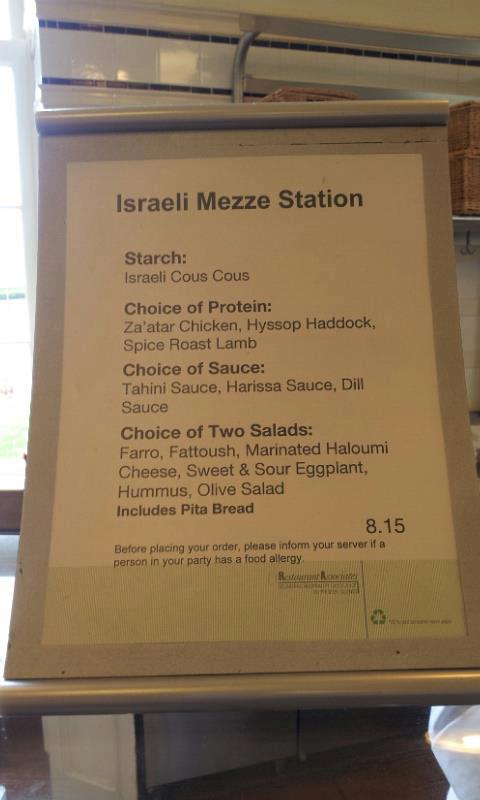
From the cafeteria of the Harvard Business School

Sara El-Yafi from her fb page

Alright Harvard Business School, let’s have a word or two.

I understand that you like to “change” things in your dining room every once in a while to tickle the palate of the HBS kids who have a tendency to grow blasé rather quickly of your stationary Italian, Asian, & Micronesian stations, so you feel the need to spice it up with an occasional exotic nationality… but this, THIS, is where we draw the line. Israeli food station? Hold your breath.

Let’s see:
1. Harissa (ه

ريسة) is a Tunisian and Libyan hot chili sauce whose main ingredient is piri piri. Piri piri grows in the wild in Africa. –> Since Israel is not in Africa, Harissa is not Israeli.

2. Couscous (كسكس) is a Maghrebian dish, a staple food throughout Algeria, Morocco, Tunisia, and Libya. Not Israeli. As for “Israeli couscous”, the real name is “Maftoul” (مفتول), which is a Palestinian dish of Couscous.

3. Fattūsh (فتوش) is a word made of Arabic fatt “crush” and the suffix of Turkic origin -ūsh. Coining words this way was common in Syrian Arabic as well as in other dialects of Arabic. –> Unless Israel’s main language is Arabic, this too is NOT Israeli.

4. Halloumi (χαλούμι) is a Cypriot semi-hard, unripened brined cheese made from a mixture of goats’ and sheep milk. It’s not even ARABIC. So seriously, your “fuck-you” is not even centered around Arabs, it’s going west. –> Until Cyprus becomes another conquered Israeli territory, Halloumi is considered NOT Israeli.

5. Hummus (حُمُّص): Let’s get to the bottom of this once and for all. Hummus is an Arabic word meaning “chickpeas.” Ok? It is an Arabic word. As far as “Israelis” are concerned, they don’t speak Arabic. So unless you change your primary language, you have no argument here. The earliest documented recipe for something similar to modern hummus dates to 13th Century (CE) Egypt. –> Since Israel was created in 1948, Israel is NOT 13th CENTURY EGYPT! And Hummus is therefore NOT ISRAELI.

6. Tahini (طحينه): ONE: Tahini is a loanword from Arabic: طحينة, or more accurately ṭaḥīnīa طحينية, and is derived from the root ط ح ن Ṭ-Ḥ-N which as a verb طحن ṭaḥan which means “to grind.” TWO: You can only make Hummus with Tahini, since it is the second main ingredient. –> As per the argument of Hummus, we conclude that Tahini is NOT Israeli.

7. Zaatar (زَعْتَر): Alright. Zaatar is THYME. It is a Middle-Eastern plant. It grows in Palestine and other land areas. Since Israel is modern-day Palestine, then I can see why you would like to make that plant Israeli. And you might be able to get away with it. But get this: Zaatar is an Arabic word. So, to make your argument more solid, why don’t you use a Hebrew word for it? Like “שקר”, which is hebrew for LIE.

8. Mezze (in the title): This word (which refers to a selection of small dishes) comes from the Turkish meze ‘taste, flavour, snack, relish’, borrowed from Persian مزه (maze ‘taste, snack’ < mazīdan ‘to taste’) and/or the Greek version mezés (μεζές). SO TURKISH, PERSIAN and GREEK –> NOT ISRAELI.

9. “Sweet & Sour”: This draws the f*ckin limit. Now this sure isn’t Arabic, but I would like to see Chinatown respond to this.

Dear HBS, that “Israeli Mezze Station” is the ultimate multicultural, multireligious fuck-you in the face of ALL Arabs at once from North Africa to the Levant… (while engaging a small spit on the Cypriots)… NINE counts.

If you insist on giving no honor to the Arabs (many of whom are Harvard students/alumni- “hi!”), and/or if you insist on never ever speaking of Arabs in culinary worth (since we’re only ever referred to as warmongers and terrorists), at least have the decency of calling it MEDITERRANEAN MEZZE STATION.

Israel already has a hard time keeping face in the Arab world for the way it has “appropriated” its lands since 1948, don’t make it worse for them by having them appropriate other peoples’ foods as well.

“Before placing your order, please inform your server if a person in your party is an Islamic fundamentalist and/or has ties to the Chinese government. We will rectify the nationality of your dish accordingly.
Sincerely, HBS”

Onwards.

(Picture taken by my dear friend/Harvard classmate “Mohamed El Dahshan” two days ago in the Harvard Business School Dining Room)

A marriage of convenience

Political Islam after the ‘Arab Spring’

Political Islam came to life after the Arab defeat of June 1967, with a new alliance between the Muslim Brotherhood and Egypt’s president Anwar Sadat.
by Eric Rouleau

In June 1967, after the Arab defeat in the Six Day war, many believed they were witnessing the death throes of the regime of Gamal Abdel Nasser (1). Yet Nasser opened the first meeting of the council of ministers on 19 June, declaring in a barely audible voice: “The old regime is dead; a new regime is born today.” The old regime had in fact died on 5 June, with the ignominious collapse of all the leftwing nationalist forces (Nasserist, Ba’athist, socialist, communist), held responsible for Egypt’s military defeat and the collapse of its political system. Political Islam soon filled the void created by the disappearance of these secular movements from the political scene.

At the time, my attention was caught by an unprecedented phenomenon: mosque attendance rose to the point that the faithful spilled into the surrounding streets, spreading their prayer mats in the road and blocking the traffic as far as the eye could see. All this was perfectly normal: religion is after all a refuge for those in distress and brings hope to those in despair. “Islam is the solution” (al-islamhouwa al-hal), the slogan later adopted by the Islamists, gained popularity. And many people I spoke to attributed Israel’s victory to the attachment of Jews to their religious traditions and their faith in their holy books, which for them legitimised their state in Palestine. They felt the Muslims had lost because they had abandoned their religion for secular ideologies — Nasserism, Ba’athism, socialism and communism.

Nasser was quick to notice the change that was taking place in Egyptian society. To general surprise, he ordered the release of a thousand members of the Muslim Brotherhood, who had been arrested two years earlier over a plot to avenge the state’s execution of their spiritual leader Sayyid Qutb, a theoretician of jihad. In parallel, he opened a dialogue with their leaders who had gone into exile, with a view to achieving “national unity”. With the Nasserist party (Egypt’s only legal political party) no longer in the ascendant, the Brotherhood was now the only political force with a structured, dynamic organisation. Egyptian radio and television were ordered to broadcast verses of the Qur’an on a regular basis and give conservative preachers airtime as often as possible. Saudi funds flowed into Egypt, financing mosques, Qur’anic schools and Islamic associations; these were to contribute, directly or indirectly, to the creation of a breeding ground for terrorism. Other countries in the region benefited from the same Wahhabi generosity. The face of the Arab world was changed forever.

Anwar Sadat (2) was conscious that the ideological void left behind by Nasser’s socialism was now being filled by Islam. So he harnessed the teachings of the Prophet to his own ends, progressively Islamising Egypt’s society and state. He was well placed to achieve this goal: he had learned to read and write at a Qur’anic school and could recite the holy book by heart. He made several pilgrimages to Mecca and assiduously attended mosques where, in front of the cameras, he prostrated himself alongside ordinary Egyptians. Photos of Sadat in the press showed off to best advantage his “prayer bump” (zebib), a callus the shape and colour of a raisin that had appeared on his forehead, a sign that his head made frequent contact with the ground during his daily prayers. The “father of the nation” also had himself referred to as “the pious president”. Religious ceremonies and sermons flooded the radio and television airwaves. Religious education became a core element of school curriculums. Egypt’s transformation was completed in 1980 with a new article in the constitution declaring that Islam was the state religion and sharia was the principle source of inspiration for legislation.

The establishment of a quasi-theocracy was without precedent in Egypt’s ancient or recent history: the secularism of Nasser’s era became just a memory. To secure his position, Sadat needed political alliances. Unable to find allies on the left, he naturally started courting the Muslim Brotherhood as soon as he came to power. He ordered the release of hundreds of their members who had been imprisoned by Nasser and began a dialogue with their leaders. He hoped to win the Brothers over by reminding them of his respect and profound admiration for their founder Hassan Al-Banna, whom he had met in 1940, and his gratitude for the regular financial support Al-Banna had given his family while he was in prison.

But the Brothers could not forget that Sadat had carefully failed to mention in his memoirs that he had ordered the execution of a number of their senior leaders, accused of plotting to assassinate Nasser in 1954. Nasser’s former protégé was a member of a “revolutionary” tribunal formed for the purpose of decapitating the Brotherhood.

In spite of their distrust, the Islamist leaders made a show of accepting an alliance with Sadat: they had everything to gain from the deal he was proposing. Sadat wanted their help in eliminating common adversaries — the Nasserists and the communists, who were still the dominant force in some sectors of Egyptian society, particularly factory workers and students. The Brothers were promised freedoms denied to other movements, which would allow them to extend their influence. This marriage of convenience only came to an end when Sadat’s determination to make peace with Israel took concrete form a few years later.

source

Eric Rouleau is a journalist with Le Monde and author of Dans les coulisses du Proche-Orient Fayard, Paris, 2012.

(1) Gamal Abdel Nasser and the “Free Officers” seized power on 23 July 1952. Nasser became the region’s most popular leader, combining pan-Arab nationalist rhetoric with a policy for Egypt’s development based on industrialisation. He also formed a solid alliance with the Soviet Union.

(2) Anwar Sadat was one of the “Free Officers” but a minor figure until Nasser’s death, on 28 September 1970, which propelled him into the presidency. He moved closer to the US and launched the process of economic opening-up. In 1977 he travelled to Jerusalem, paving the way for a peace treaty with Israel.

SYRIA : WORDS OF GOLD!!!

[youtube http://www.youtube.com/watch?v=5A-_7QVnWNM&feature=colike?]
WORDS OF GOLD!!! WORDS OF ABSOLUTE GOLD!!!!!!!!! BY ALLAH SWT THIS MAN SPEAKS HAQQ!!!

أقسم بالله كلامك ذهب يا بطل

TRANSLATION# THIS SYRIAN MAN FROM DEIR EZOUR ON THE BORDERS WITH IRAQ SENDS OUT A MESSAGE TO SAUDI ARABIA AND ALL THE MUSLIMS OF THE WORLD THE AHLUL SUNNAH , FROM THE HEART OF THE BATTLEFIELD YOU CAN EVEN HEAR THE SOUNDS OF THE GUNFIRE IN THE BACKGROUND..

HE SAYS ITS NOT JUST ASSAD SLAUGHTERING US AHLUL SUNNAH IN SYRIA ITS IRAN, HIZBULSHAYTAN, MALAKI OF IRAQ, THEY SEND ASSAD EVERYTHING IN ARMS AND TROOPS, AND WE HAVE NOTHING BUT ALLAH SWT AND OUR SELVES, WE ARE YOU NOT HELPING US, AREN’T WE YOUR BROTHERS AND SISTERS IN ISLAM??? ALL YOUR CHEAP PROMISES MEAN NOTHING TO US, WE ARE FIGHTING FOR ALLAH SWT CAUSE TO BE THE NUMBER ONE IN THIS LAND AND FOR THE ALL OF SUNNAH EVERYWHERE!! THE SHIAS ARE RAPING OUR WOMEN SLAUGHTERING OUR CHILDREN! FEAR ALLAH MUSLIMS!!! WHY DO YOU HAVE ALL THESE TANKS AND WARPLANES ???!! IS IT ONLY FOR PARADES??!! ..BASHAR HAS DONE FAR WORSE THAN HALACO OF THE MONGOLS AND HITLER!!! FEAR ALLAH FEAR ALLAH YA AHLUL SUNNAH WE ARE SUFFERING!!! DONT YOU FEAR ALLAH SWT??!! ARE WE NOT MUSLIMS??!! IVE SOLD EVERYTHING I HAVE EVEN MY WIFES GOLD AND MY DAUGHTERS GOLD JUST TO BUY ARMS AND DEFEND THEM AND THE SISTERS OF SYRIA!!!

When an Israeli soccer game looks like a Klan rally

By

|Published November 2, 2012

It’s hard to say which is worse – the behavior of racist fans, or the tacit approval they get from Israeli sports officials and media.

I like to think that if you discount for the century of fighting with Arabs, Israel is still plenty racist, but no more than most societies. I remind myself that even the absolute worst display of Israeli racism – the chanting of monkey noises (“hoo-hoo-hoo!! hoo-hoo-hoo!!”) and the throwing of bananas at black players during soccer games – has been going on in Europe, too, and probably elsewhere. But what happened this week to Nigerian-born Israeli player Toto Tamuz shows a level of callousness to blatant, raw racism that I wonder how many countries could match.

On Monday, Tamuz scored the go-ahead goal against Beitar Jerusalem in the capital’s Teddy Stadium, and right afterward looked out at the crowd and put his index finger up to his lips to shush them. Immediately the referee penalized him for unsportsmanlike conduct: “provoking the crowd.” Since this was Tamuz’s second penalty of the game, he was automatically disqualified. His team, Hapoel Tel Aviv, went on to lose, 3-2.

It was only after a day of sports reporters and commentators praising the Beitar crowd for firing up the atmosphere with their mad-dog spirit that it became known why Tamuz tried to shush the crowd in the first place. He told Yediot Aharonot:

I’ve never seen such racism in my whole life. … [two other black Hapoel players] and I were the last ones on the field. When we came out of the tunnel they started throwing bananas at us. We heard curses and racist chants. … [During the game] I heard their regular song, ‘Give Toto a banana,’ and a lot of other things I’m embarrassed to mention.

Another black Hapoel player, Eric Djemba Djemba from Cameroon, told the newspaper:

When they call you ‘kushi’ [‘nigger’] … and throw bananas at you, it’s not exactly pleasant. I like this country and I’m happy to be here, but this is impossible. I didn’t know things like this happened in Israel.

From the media coverage I saw (which was not by any means comprehensive), these remarks were treated as “their side of the story,” but the “objective” story was mainly about a hugely exciting soccer game in which there probably was a bad call by the ref, along the lines of:  you shouldn’t throw a player out of the game for “shushing” the crowd, but then those are the breaks …

What’s shocking about all this is that everyone in Israel knows that what Tamuz and Djemba Djemba described is what happens at any given game in which black players are on the field, especially if they score a goal. I witnessed it myself at a game in Tel Aviv’s Bloomfield Stadium in 2006, one of the very few Israeli soccer games I’ve been to. When an opposing black player would get the ball, a few Maccabi Tel Aviv fans several rows up from me would start chanting the monkey noises. (Neither I nor anyone else in the stands said a word to them. I was there with my two young sons, and I was afraid to confront them for fear of having to fight them all, which I imagine was in the minds of many other fans.) Later, when one of the black players on the visiting team scored a goal, the section reserved for several hundred hardcore Maccabi fans erupted with loud, furious, sustained chants of “hoo-hoo-hoo!! hoo-hoo-hoo!!”

This sort of thing has been going on at Israeli soccer games ever since the first black players arrived from overseas almost 20 years ago. The racist chanting against opposing Arab players has been going on ever since Arabs came into the league. Everybody knows this – and everybody knows that the worst, most psychotically racist fans in the country are those of Beitar Jerusalem, and that the atmosphere in Teddy Stadium when there are Arab or black opponents on the field is something out of a Klan rally. (I’ve sat in the stands with Beitar fans; they sing “I hate all the Arabs” with as much ease and familiarity as they sing Happy Birthday to You.)

Anybody who knows anything about Israeli soccer knows that Tamuz, who used to play for Beitar Jerusalem, was telling the truth – that he was trying to silence the racial mass hysteria going on in the stands. The same exact thing happened to him about two years ago in a game against Beitar – the monkey noises, the singing of “Give Toto a banana” – only that time the Israel Football Association had the decency to penalize Beitar, even rather severely, in soccer terms. But that was the exception; the rule is to accept what’s going on, to pretend it’s not happening, and the rule was in force this week.

The story wasn’t the Beitar crowd, but rather Tamuz. When the referee made him the villain and kicked him out of the game for his shushing gesture, the question in the media was whether the referee had been too harsh, not whether such a thing could have really happened, not whether we were all living in some Stephen King story.

And it didn’t end there. When the referee threw Tamuz out, the 24-year-old made some parting remarks. Tamuz says he told the ref that the crowd was the guilty one, not him. The ref says Tamuz called him “a shame and disgrace.” For that, Tamuz had to go before an Israel Football Association judge, attorney Yisrael Shimoni, who banned him from Hapoel’s next two games and put him on probation for two more.  ”There is no connection between, on the one hand, the atmosphere in the stands and whether racist expressions were made or not, and, on the other hand, the insulting remarks to the referee,” said the judge.

Beitar Jerusalem, the pride of the Israeli right, the only team in the league that has an unwritten but ironclad ban on hiring Arab players, said the claims by Tamuz and Djemba Djemba were an “orchestrated campaign of lies.”

Hapoel Tel Aviv, the pride of the Israeli left, the only predominantly Jewish team in the league to have an Israeli Arab captain, provided the only note of decency and honor in this episode. It announced: “The team will give full backing to its players who fall victim to racist attacks from rival fans. The next time the team’s players are victimized by racist, demeaning behavior from the fans of any team – all of [Hapoel’s] players and officials will leave the field immediately.”

source

Israelis vs. Africans (Goldstein Dawn)

[youtube http://youtu.be/XGzBwLd0OfY?]

October 28, 2012 Tel Aviv, Israel protest demanding the expulsion of all non-Jewish African asylum-seekers

Goldstein dawn, may be a  reference to the xenophobic fascist Greek political party Golden Dawn

The Revolution Becomes More Islamist

Robin Yassin-Kassab

with 11 comments

photo by reuters/ zain karam

Like ‘armed gangs’, armed Islamists are one of the Syrian regime’s self-fulfilling prophecies. Most grassroots organisers and fighters are secularists or moderate Islamists, but the numbers, organisational power and ideological fervor of more extreme and sectarian Islamists are steadily rising. So why is the revolution taking on an increasingly Islamist hue? Here are some points in order of importance.

First, the brute fact of extreme violence. As the saying goes, “there are no atheists in foxholes.” Not only is faith intensified by death and the threat of death, and by the pain and humiliation of torture, but tribal and sectarian identities are reinforced. We want to feel like we when in death’s presence, not like I, because I is small and easily erased. So in Syria at the moment many Sunnis are identifying more strongly as Sunnis, Alawis as Alawis, Kurds as Kurds, and so on. This is very sad and it immeasurably complicates the future task of building a civil state for all, but it is inevitable in the circumstances. The violence was started by the regime, and the regime is still by far the greatest perpetrator of violence, including aerial bombardment of villages and cities, and now the liberal use of child-killing cluster bombs.

Second, beyond patriotic feelings for Palestine and Iraq and an unarticulated sense that their government was corrupt, two years ago most men in the armed resistance were apolitical. Finding themselves having to fight, and suddenly entered onto the political stage, they search for an ideology within which to frame their exciting and terrifying new experience. At present, the most immediately available and simplest ideology on offer is Salafism. As well as for their stark message, Salafists are winning recruits because of their organisational and warfaring skills honed in Iraq and elsewhere, and because of their access to private funds from the Gulf. If this were the sixties, the revolutionaries growing beards would have had Che Guevara in mind (and if much of the ‘left’ in the world were not writing off the revolution as a NATO/Saudi/Zionist conspiracy, the left might have more traction). At present, Salafism is in the air. It’s unfortunate, but it’s the historical moment. And why were all these young men apolitical before the revolution? Why hadn’t they learned more of debate and compromise? Simply put: because politics was banned in Asad’s Syria.

Third, the perception that Alawis (and to varying extents other minorities too) are siding with the regime as it destroys the country and slaughters the masses has produced a Sunni backlash. To a large extent the perception is correct. The regime’s crucial officers, its most loyal troops, and most of the shabeeha in Homs, Hama and Latakkia are Alawis. It’s true that some prominent Alawis have joined the revolution, that Alawis were targetted by Asad’s sectarian propaganda from the start, and that Alawis have good historical reasons to fear the rule of the majority, but all this is academic to some of the men in the firing line. The situation has been made much worse by the lining up of supposedly ‘Shia’ forces in defence of the criminal regime. Iran, Iraq and Hizbullah each have their own (horribly mistaken) strategic reasons for opposing the revolution, but a fighter with no time for geostrategic analysis sees only a Shia alliance opposing his life and freedom. By their words and actions, Iran and its clients have confirmed the discourse of anti-Shia propagandists. Many Syrians who now chant threats against Hassan Nasrallah previously loved the man, and scorned those who muttered about his heresy or Iranian loyalties. Like racism, sectarian hatred is not something inherent in a society or in an individual’s heart. It is generated by propaganda and political reality. (Please someone tell this to Joshua Landis). So we have to worry about the Sunni backlash, but we also have to blame the propaganda and bad politics which catalysed the backlash.

Next, in the ears of many Syrians the phrase ‘Islamic government’ doesn’t signify ‘amputations’ or ‘women in burkas.’ Many Syrians hear the phrase as ‘just government’ or ‘clean government.’ Leftist and rightist Islamophobes made a fuss of the news that certain liberated areas of Syria have set up sharia courts, but this development isn’t necessarily as scary as it sounds. Family law was already run according to sharia in Asad’s Syria. In places where the state has collapsed, where corrupt officials have fled or been arrested, it is logical that local fighters and organisers would recruit respected clerics to practise a law which everyone understands. In rural Syria in particular sharia is more trusted than civil law, because the experience of civil law in Asad’s Syria has been an experience of grotesque corruption.

Then the regime went out of its way to kill or detain secularist or anti-sectarian activists. Secularist activists are in some ways the greatest threat to the regime, because their existence contradicts the regime’s sectarian propaganda. There are tens of thousands of disappeared, and amongst them many civil society organisers. We don’t know how many are still alive, but if and when these people leave prison their ideas will be reinjected into the revolutionary debate.

Finally, some units of the resistance that have recently grown beards and thrown a more Islamic twist on their videos are really only pretending. They are wearing Islamic clothing in the hope of attracting weapons and money from the Gulf. They are doing so out of necessity. This is what the regime’s violence has reduced the country to.

Is the increase in radical Islamism a problem? Of course it is. There is no reason to think that post-Asad Syria, once united and fed (for these will be the first tasks), will accept an undemocratic Islamism, but in the perhaps very long gap between here and there, radical Islamism poses a great threat. It makes it much more difficult to start building a civil state for all. It scares minority communities. It scares the West (which, anyway, is doing almost nothing to help). It means that at some point there will have to be a showdown between the majority of fighters who want a Syrian democracy and the small minority who want an emirate on the path to a global ‘caliphate’.

Should we refuse to support the resistance for fear of its Islamism? Absolutely not. The factors generating scary forms of Islamism are factors introduced by the criminal regime. The situation will continue to deteriorate until the regime is made inoperative.

 source Qunfuz here

Syrians choose war over Jordan Zaatari refugee camp

By Sakhr Al-Makhadhi BBC News, Mafraq, Jordan

A bus prepares to leave the Zaatari Refugee Camp
Families say goodbye to loved ones who are leaving the Zaatari refugee camp to return to Syria

The Zaatari camp in northern Jordan was meant to be a place of refuge for 30,000 Syrians. But every day, dozens are choosing to leave the safety of Jordan and make the perilous journey back into the war zone.

The sun is setting on Zaatari as a mother pleads with a soldier to be allowed on to a bus. Around her, dozens of Syrians say their farewells as the engine starts up. While an estimated 360,000 Syrians have fled their homeland, this busload is making the opposite journey.

“We face a slow death here, or a fast death over there,” says Hussain Ayish, pointing towards the border at the other end of the scrubland. As we talk, a low-flying Jordanian military jet and a fleet of helicopters circle overhead.

Truck after truck, most carrying drinking water, files past the Jordanian army tank and along the muddy road at the heart of the camp. Kids chase each vehicle and scrabble to ride up on the back of it.


Zaatari Refugee Camp

Zaatari is essentially an internment camp – built to house Syrians who have crossed the border illegally”

“Hide your car well,” says Bilal, a police officer. “They have no respect, they will throw stones at you,” he warns. “And make sure you are back before dark.”

This place of refuge has become the setting for an increasingly ugly battle between Syrian refugees and their Jordanian hosts. Demonstrations inside the camp have, on at least one occasion, turned violent, prompting an exodus back into Syria.

Like many of Zaatari’s inhabitants, the Howshan family comes from Deraa, the birthplace of the Syrian revolution, just over the border from here.

I am sitting at the entrance to their tent. The canvas is a dirty yellow, and they have scribbled their name on the outside in marker pen.

They have built a breezeblock barrier around the entrance in a futile attempt to keep the sand out. But it is no use. It gets everywhere – on the grey mattresses that line the edges of the tent, in the blankets, in the water, in the food.

This is my second visit to their temporary home. The mood is a lot more grim than last time.

“Remember my son?” asks Saeed Howshan. “He’s in hospital now, the food, this dirty food,” he says, as his cousin Ali opens one of the brown ration boxes to show me a rotten egg that he claims was this morning’s breakfast.

Saed Howshan and his nephews
Saed Howshan says his nephews (pictured) are treated “worse than animals” at Zaatari

“No matter what we do, the problems continue,” says Saeed as his nephews sit around him. He is getting animated, performing to an audience. “Even camels do not live on this land. They are treating us worse than animals.”

At this point, a Jordanian charity worker hears the commotion and ducks down, peering into the tent.

“I hope you are not saying anything against the Kingdom, are you?” he asks. The conversation turns into an argument, with the Jordanian accusing the Howshans of lying.

The Jordanian government insists the refugees’ basic needs are met, and claims that supporters of the Syrian regime have infiltrated the camp to cause trouble.

One high-placed official tells me pro-regime shabiha, Syrian paramilitary thugs, militiamen have been planted among the refugees to feed information back to the regime in Damascus.

“If we found one,” Ali says, referring to Syrian agents, “we would kick them out”. But he adamantly denies that the violence was a set up. “We have just had enough,” he says.The authorities have laid fresh gravel on the main track through the camp. And as we walk along here, dodging the trucks, Ali and his brother Mohsen show me a burnt out portacabin.

“This happened last week,” Ali tells me. “They closed the main road, sent in 300 police and tear-gassed us.”

Ali says it started out as a peaceful demonstration after two days of what he claims was inedible food and a lack of clean water. The United Nations Children’s Fund (Unicef) insists it checks the water twice a day.

There is open hostility on both sides. Police and soldiers patrol the perimeter to make sure no-one gets in and no-one leaves. “We are living in a prison,” Saeed Howshan tells me. “It is like we are prisoners of the Jordanians, it is as if they are working with the Syrian regime.”

Zaatari is essentially an internment camp – built to house Syrians who have crossed the border illegally.

Many of them fled the war zone with the help of the Free Syrian Army and were picked up by the Jordanian forces who have been co-ordinating with the rebels.

Burnt out portacabin
A portacabin was burnt out during a protest over a lack of clean water and edible food in the camp

When the conflict first broke out, Syrians – who can enter Jordan without a visa – were housed in the cities and cared for by the government. But as the trickle turned into a flood, the Zaatari tent city was erected in the desert and opened in July.

The Jordanian government estimates the country is now home to 200,000 refugees, 15% of them here in the camp.

As night falls over Zaatari, my phone rings, the authorities are telling me that I should have already left the camp. I am at risk, they insist. A small crowd has gathered near the blue toilet block plastered with Unicef logos. They are chanting against Bashar, rather than their Jordanian hosts, tonight.

Ali links arms with me and walks me to the gate where the soldiers are waiting for me. “I am surviving on juice and biscuits,” he says. “Take me out with you.” A soldier orders him back inside.

Like most other refugees I talk to, escape from Zaatari is the only thing on Ali’s mind.

source

Syrians Are War Correspondents, Too

A response to Terry Anderson’s “Running Toward Danger.”

BY AMAL HANANO | OCTOBER 30, 2012

Dear Mr. Anderson,

I read “Running Toward Danger” yesterday and I had to tell you how much it moved me. Syria is being ripped to shreds, the people are suffering, and the cities are being destroyed. We didn’t expect this degree of ruthlessness as a response to the people’s demands for freedom after 40 years of Assad tyranny, but as we know well, freedom is not free.

Your thoughts on war correspondents sacrificing everything for the truth applies not only to the brave journalists like Austin and Marie and Anthony and the dozens of journalists inside Syria now, but also to the Syrian men and women who stood behind the cameras, documenting the truth. We have lost dozens of citizen journalists in this revolution. Young men who were students, employees, fathers one day and became threatening targets the next day because of their cell phones, cameras, and laptops. They knew Syrians have been silent too long. Last year, they decided to never cover up Assad’s crimes with silence again. And they are paying a heavy price for it.

I don’t know what my dead friends would have answered your question, “Was it worth it?” But I do know what the ones who are alive and still film and photograph in Homs, Aleppo, Hama, Idleb, Daraa, and across Syria would say to the question, “Is it worth it to die for your camera?” They would say, “Yes.” Because they know for the first time in their lives, their voice matters and they are doing the most important job, to tell the truth while so many are telling lies. Telling the truth, in a way, has become even more important than freedom. It’s the road to freedom.

I’ve been writing about the revolution since the beginning. I didn’t expect to take on the role I now have when I began; telling my stories evolved into telling Syria’s stories. I only cared about one thing: telling the truth. Sometimes it seems like an impossible task. And many times the truth hurts. But we have to keep going and hope that what’s good in the people prevails over the evil.

When I read your piece, I remembered Anthony Shadid, a journalist who changed my life, and how much I miss his voice of truth. And I thought of Austin too. I pray he is safe and will return to his family soon.

Most of all, I wanted to tell you that your words made a difference to me. God bless you.

With much respect,
Amal

Blog at WordPress.com.

Up ↑