Search

band annie's Weblog

I have a parallel blog in French at http://anniebannie.net

Author

bandannie

Bashar’s War

For the Syrian regime’s faithful mouthpieces, victory is always around the corner.

BY SAM HELLER | APRIL 23, 2013

In the Damascus suburb of Jdeidet al-Fadl, according to the Syrian regime media, all is well.

This is the sort of victory that defines the worldview of the Syrian regime media. Television, radio, and print outlets controlled by the regime of President Bashar al-Assad articulate a single vision of the war: that the Syrian Arab Army is waging an unrelenting campaign against terrorists led by Jabhat al-Nusra, an affiliate of al Qaeda, who are the vanguard of a “universal” conspiracy against the Syrian people. But Syria will prevail, state media contend, and its people will build a new, better country founded on dialogue and openness — an oasis of religious and ethnic tolerance.

This is the war Assad chooses to show, and more importantly, it is the war as the regime’s supporters understand it. This narrative has been broadcast to the Syrian public for over two years now by the core of Syrian regime media: SANA; the newspapers al-Baath, Tishreen, and al-Thawra; the official Radio Damascus; the state’s satellite television network and its sister news network, al-Ikhbariya; and the technically privately owned but staunchly loyalist al-Watan daily and Addounia satellite TV network. And in this narrative, the Syrian regime is winning.

The regime advances its understanding of the war most effectively through its daily battlefield reporting. These reports are nearly identical across all media, and they employ a set, limited vocabulary. The regime’s Syrian Arab Army is “our brave army” or “our brave armed forces.” The enemy consists of “terrorists” and “mercenaries,” and the Syrian military typically “destroys” their “nests,” “eliminates” them, and “leaves [them] dead and wounded.” Often, state media give names for the militants killed in combat, and in keeping with the media’s emphasis on foreign fighters among the rebels, their nationality is provided if they are not Syrian.

The regime’s narrative robs the anti-Assad forces of any agency. The Syrian military is always “pursuing” or “targeting” terrorists, but it is never ambushed or attacked. The armed forces sometimes “clash with” or “repel” terrorists, but there are never regime casualties. The regime’s enemies only have initiative when they murder and rob civilians due to those civilians’ “rejection of the terrorists’ crimes and refusal to harbor them.” Terrorists’ actions are “desperate” or “attempts to raise [their] morale” after significant losses.

The pro-regime media acknowledge no divisions among the opposition, painting the many factions as an undifferentiated bloc of militant fanatics. When coverage is more specific than simply “terrorists,” militants are most often identified as belonging to Jabhat al-Nusra, though “the terrorist gangs belonging to the so-called ‘Free Army'” make occasional appearances. When Jabhat al-Nusra publicly pledged loyalty to al Qaeda on April 10, regime coverage was not nonplussed: The announcement was “nothing new,” reported regime television; it was only something “the external opposition and their supporters had insisted on denying for appearances’ sake” while secretly arming the group.

The regime’s media outlets also supply a rationale for why these foreign terrorists have come to Syria. The West and its tame Arab allies, they say, have targeted Syria because it has championed the resistance against colonialist and Zionist plots to dominate the Middle East. In Prime Minister Wael al-Halqi’s words, the terrorists’ goal is to “break apart the countries of the Arab world, loot their resources, and destroy their social fabric.”

Who are the chief conspirators in this plot? State newspaper al-Thawra identifies them as “Zio-American circles and oil and gas sheikhdoms in the Gulf” — including Qatar, Saudi Arabia, Turkey, and the NATO countries. The United States and Israel ultimately steer events, the media report, and U.S. President Barack Obama is “the maestro of the war.”

The United States may publicly disavow terrorists like Jabhat al-Nusra, but according to al-Ikhbariya, Washington quietly pushes its minions in the region to fund and arm them. After all, America and its allies “created these terrorist organizations so that, like a mount, they might ride them into the region, divide its land, and tear apart its people.”

The rulers of Saudi Arabia and Qatar are regularly described as “a’arab” — uncultured Bedouins, it is implied — of whom Qatari Emir Hamad bin Khalifa Al Thani comes in for the most vitriolic criticism. Syrian television regularly cuts to stock footage of the Qatari ruler when it refers to those who conspire against the Arab people. Both Saudi Arabia and Qatar, the media report, “are blessed with peace and tranquility because they send death abroad and export terrorists.”

The international media aren’t spared the regime’s criticism. Foreign media engender a sort of free-floating hostility; the state media accuse them of “beat[ing] the drums of terrorism in Syria.” But Al Jazeera, which is financed by Qatar, is singled out for having “long played a role in spilling the blood of Arab peoples.”

Regime media also attack the Turkish government for openly supporting terrorists in Syria, implying that Ankara is motivated by imperial ambitions. The Turkish government is referred to as “neo-Ottomans,” while Prime Minister Recep Tayyip Erdogan reportedly “dreams of restoring the sultanate of the ‘sick man [of Europe].'” The Turks are also accused on occasion of selling Syrian refugees’ organs before burning their dismembered bodies.

The Syrian regime, which has long presented itself as “the beating heart of Arabism,” reacted to the Arab League’s recent decision to hand over its seat to the external opposition with contempt. The Baath daily called the Arab League’s March summit “the Summit of Shame.” The event, Minister of Information Omran al-Zoubi explained, was “convened in Qatar under the control [of Qatar] and its money, which allowed it to hijack the league and do as it pleased.”

The political opposition is covered as an afterthought in the regime media — as a front for the terrorist core of the insurgency. The aforementioned Baath report calls opposition leaders the “kumbars of global terror.” “Kumbars” means “film extras”; it doesn’t quite map onto English idiom, but the point should be clear.

Of course, this array of enemies doesn’t necessarily mean that the Syrian regime portrays itself as confronting “global terror” alone. State media are quick to emphasize anything that runs counter to a narrative of Syria’s international isolation. This ranges from any official support — including statements from Russian and Iranian officials — to popular support, like a “mass” solidarity march in São Paulo or reports that “dozens of Yemeni youths” are ready to head to Syria to support the military. Foreign experts and media reports are also given prominent placement when they reinforce the regime narrative. Some foreign journalism is faithfully reported, but sometimes the source material is made more palatable for the regime narrative. An article on a King’s College London report on Europeans joining the rebels, for example, referred to the Europeans as “mercenaries” — a charge absent in the original study.

The Syrian state also leans on support from religious leaders as a key source of legitimacy. It promotes calls by Pope Francis for a political solution to the crisis, for example, and highlights a mixed assemblage of Aleppo priests and imams who participated in the lead-up to the country’s national dialogue. While foreign media often emphasize the conflict’s sectarian dimension, the Syrian official media consistently stress what they portray as Syria’s relative religious harmony. Damascus is, in the words of Syria’s satellite station, “the Damascus of Arabism, the city of love, tolerance, and coexistence.” This ecumenical language reinforces the regular portrayal of the terrorist rebels as takfiri — extremists willing to murder the insufficiently pious.

In contrast to the rebels’ alleged nihilism, regime media consistently advance what they describe as “the only way out of this crisis” — a political solution. Syrian media report daily on meetings held by the “ministerial committee tasked with the implementation of the political program to solve the Syrian crisis” — meetings to which the external opposition is invited, it is emphasized. The process is meant to strengthen respect for a plurality of opinion and ultimately build a “strong, new, united Syria.”

But this regime-run process of dialogue seems, in practice, to amount to little more than a monologue. While the government and its interlocutors do reportedly engage on concrete issues — including security, housing, and municipal services — participants interviewed stress their total commitment to both Assad’s political program and the ongoing military campaign to purge the country of terrorists. This is a discussion in which participants may differ on the details, but the broad themes are fixed. As al-Ikhbariya puts it, its goal “is to bring everyone together for dialogue under the roof of the nation, with an emphasis on the need to combat alien takfiri thought and to root out the forces of terrorism.”

The challenges of the moment aren’t necessarily papered over. Regime media acknowledge the economic hardships facing average Syrians but frame such difficulties in terms of their determination to persevere. “The terror of militant groups in Syria hasn’t been able to prevent the student, the employee, the laborer, and the simple shopkeeper from going about their lives and performing their duty for their nation,” SANA reports.

Prime Minister Halqi, meanwhile, reassures the public: “The Syrian Arab Army is at its strongest and its best, and the Syrian people are behind the state. They believe in it, and their morale is high. If the feeling of concern is legitimate and natural, fear is not.”

Such sentiments are intended to communicate confidence, but the Syrian regime’s messaging is, at best, primitive. In a conflict where new media — both pro- and anti-regime — have helped shape events on the ground, the traditional Syrian state media feel robotic and derivative. The print media coverage consists largely of rewritten SANA news releases, while Radio Damascus’s call-in shows — and their suspiciously articulate participants — sound like playacting. The one bright spot is Syria’s official television: If you can detach from the content of the coverage, the reports are frequently so acid and sarcastic that they’re hilarious. ((For subtitled translations of Syrian television reports, see here and here.)

Average Syrians’ views, however, seem to get lost in the mix. State media produces man-on-the-street quotes and interviews, but only with proud citizens who express unflinching support for the regime. In a report about a school for martyrs’ children, for example, a war widow says, “I still have a girl and a boy, and I, all of us, would love to give our blood and our lives in the defense of our mother, Syria.” Now, this sentiment is real. A broad segment of Syrian opinion is committed to the regime’s vision for the country — or terrified enough by the opposition to side with the familiar. But when you see this in the Syrian media, are they showing that genuine commitment to Assad’s Syria — or a sort of facsimile thereof?

Still, you can be forgiven for occasionally thinking that the regime media’s accounts offer a glimpse of something real — something that taps into the suffering of Syrians, for and against the regime, who are seeing their lives fall away from them. Reporting from Damascus’s Sabaa Bahrat Square after an April 9 car bomb, Addounia narrates that the area “once more polishes its veneer and restores a luster that says, ‘Syria is for us.'”

As it shows people sweeping dust and debris from their storefronts, the television network assures its viewers: “Not one speck of Syria will ever fall under the control of monstrous takfiri terror or be at the command of bastards coming from the depths of ignorance and its garbage dumps, supported by the sellers of gas and slaves, traders in white flesh, and owners of red rooms.”

And then the report cuts to locals estimating the cost of rebuilding their livelihoods — figures in the hundreds of thousands or millions of Syrian lira, a lifetime’s savings. And the Syrians just look tired.

source

Sarah Palin Calls for Invasion of Czech Republic

Apr. 22, 2013

0128-sarah-palin-political-career_full_600Sarah Palin called for the invasion of the Czech Republic today in response to the recent terrorist attacks in Boston.

In an interview with Fox News, the former governor of Alaska said that although federal investigators have yet to complete their work, the time for action is now.

“We don’t know everything about these suspects yet,” Palin told Fox and Friends this morning, referring to Tamerlan and Dzhokhar Tsarnaev, who allegedly carried out the Boston Marathon attacks. “But we know they were Muslims from the Czech Republic.

“I betcha I speak for a lot of Americans when I say I want to go over there right now and start teaching those folks a lesson. And let’s not stop at the Czech Republic, let’s go after all Arab countries.

“The Arabians need to learn that they can’t keep comin’ over here and blowing stuff up. Let’s set off a couple of nukes in Islamabad, burn down Prague, then bomb the heck out of Tehran. We need to show them that we mean business.”

Can’t See Russia…

Although hosts Steve Doocy and Gretchen Carlson applauded Palin’s jingoism, they immediately attempted to rectify her multiple geographic errors.

“Well Islamabad is the capital of Pakistan, which isn’t Arab,” Carlson corrected, “and Tehran is the capital of Iran, which is predominantly Persian. But I do see your point.”

“Also Czech Republic isn’t really an Arab or even Muslim country, I don’t think,” Doocy added, “but otherwise what you’re saying makes a lot of sense. I think most Americans wish Obama would step up and lead on this one.”

Palin, however, didn’t take kindly to being corrected and defended her analysis.

“Steve, that’s probably one of the most ignorant things I’ve ever heard. How is Czech Republic not a Muslim country? You saw those brothers, they were Islamic and they were Chechen!”

“Yes there were Muslim and they were ethnic Chechens,” Doocy started, “but they grew up mostly in Kyrgyzstan and the United States. And more importantly, Chechens don’t come from the Czech Republic, they come from Chechnya, which is part of Russia. ”

“What’s the difference?” Palin responded. “Isn’t Russia part of the Czech Republic?”

“No, the Czech Republic is a separate country. It’s part of the European Union and a strong NATO ally,” Doocy noted. “But heck, why not? Let’s invade. What could go wrong?”

“Yeah and while we’re at it,” Carlson added, “let’s call the Queen of England and see if the U.K. will join us.”

In a statement released after the interview, Palin attacked Fox News and its “pro-Islamic” and “pro-geography” bias.

“This is just another case of the politically correct liberal media refusing to tell the truth about radical Islam,” she said.

source

Assad Guided by Russian Lessons from Chechnya.

When asked how long the war would take, the soon-to-be assassinated independence leader of the Chechen people, Dzhokhar Dudayev famously responded, “it will be a war of 50 years”.

This week’s focus on Chechnya reminds me how Assad’s strategy to suppress the revolution is influenced and informed by his Russian allies. Some would go as far as suggesting that the similarities point to the Russians actually managing the operation – from SCUD launches to international “diplomacy”.

One can find many similarities with how Russia crushed the independence aspirations of Chechnya over past twenty years and Assad’s action today. Of course, it is not an identical situation by any means, but is insightful to dissect to further understand how Assad’s main advisors are guiding him to survive.

In 1994, in response to the Chechen Republic of Ichkeria secession a few years earlier, Russia, under the leadership of Boris Yeltsin launched a brutal war to recapture the breakaway republic. However, the Russian Federation was unprepared, relying on conscripts and machines to fight a popular Chechen resistance. The result was a bloody two-year war, marked by massive war crimes committed by the poorly organized & undisciplined Russian forces against the population of Chechnya (both Chechen and Russian civilians alike). Indiscriminate shelling, targeted assassinations, mass executions, massacres and rape.

Literally, the population was decimated.

A ceasefire was signed in 1996 followed by a treaty a year later. The unpopular war was a “loss” for the Russian Federation and resulted in the deaths of 100,000 dead civilians in Chechnya, over 300,000 displaced – out of prewar population of ~1.2 million. The Chechen capital, Grozny was practically razed to the ground, invoking memories of the World War 2 allied bombing campaign of Dresden…the cruelty was maddening.

Chechnya's Destroyed Presidential Palace in Grozny.

Is this Grozny 1995 or Aleppo 2013? (Chechnya’s Presidential Palace, a symbol of independence destroyed by the Russians)

But the Chechens won something close to independence, albeit temporarily.

Russian designs for the republic were temporarily halted and left behind a devastated Chechnya along with a shocked and impotent international community – actually, an interesting question to ponder is whether the “West”, with a loud bark and consistent lack of tangible action, is treating Syria as an internal Russian affair, just as they did with Chechnya.

The subsequent dialogue and treaty, allowed for Russia to regroup while the Chechen Republic fragmented under the burden of its devastation. A ravaged economy, displaced and homeless populace, international isolation and the pain and trauma of the war resulted in radicalization, fragmentation and the weakening of Chechnya’s government.

Russia reentered Chechnya again in 1999 with the goal of destroying the de facto independence and establishing a pro-Moscow government. This second war was as devastating as the first. The Russians revised their tactics, led with a “victory by bombardment” strategy, followed by overwhelming ground support. Within a year, they succeeded in establishing direct rule over Chechnya and drove all resistance to the mountains to launch a low-level guerilla campaign that has outlived Yeltsin, who bequeathed power (appointed) to the KGB man, Vladimir Putin, in 2000.

Chechen Refugee 1994

Is she from Chechnya 1994, or Homs 2012? Both victims of Russian strategy.

Two Russian wars on Chechnya cannot be adequately detailed in a few paragraphs. However, an approach to suppress uprising starts to emerge and illustrate how Russian lessons in Chechnya inform Assad response to revolution over the past 15 months and his anticipated action in the near future.

Specifically, similar to his Russian sponsors, Assad has responded through the use of overwhelming and sustained violence – led by aerial bombardment and shelling, resulting in the destruction of society and civilian infrastructure. This has had a four-fold effect of 1) destroying the “enemy”, 2) spreading collective fear across all liberated areas, and 3) annihilating key leaders of the revolution 4) limiting the ability of rebels to effectively rule (i.e. provide security, safety, health & economic opportunity). The Russian experience in Chechnya has also taught Assad how to best utilize time and dialogue to attempt to reassert control over the situation.

Over the past year, as we’ve seen Assad’s control over territory shrink the Russian advisor influence has become very apparent. Syria’s infrastructure has been effectively destroyed and the revolution continues to be starved, both politically and militarily. Collective punishment via the air and shelling has been the regime’s strategy, followed by “boots on the ground” of the regime’s army and sectarian militias (“shabeeha”/ National Defense Forces) to control and retake territory.

Assad also hides behind the “dialogue” card, part of the bigger game played by powerful allies and the so-called friends of the revolution. Even this past weekend, we heard of a “Geneva approach” consensus by “Friends of Syria” which calls for transition. It, however, excludes any mention of removing Assad. Immediately following this call for dialogue, Assad’s forces massacred over 550 Syrians, most of them slaughtered in Jdaidet Artouz, a Damascus suburb, as a stark message to all involved, both within and outside Syria.

With all this said, we can see how Assad’s survival strategy is influenced, maybe even directed by his Russian allies – the blueprint for his survival may just have been written with the blood of Chechens. All those supporting Syria’s revolution must take note, and strap in for the long haul.

source

Another Gruesome Massacre Near Damascus

21 Apr 2013

At least 450 people were summarily executed in Jdaidet Al Fadhl, near Damascus. Some of the victims, including women and children and a mosque imam, were reportedly slaughtered by knives. Local Coordination Committees (LCCs) activists say 100 of those had been arrested by the regime’s forces some days earlier. The numbers are expectedly on the increase, with the regime’s forces are still roaming the area and carrying out summary execution.
massacre
The regime’s forces reportedly entered the area after anti-regime fighters withdrew from the town. It is probably the first such gruesome massacre on this scale since the Daraya massacre on August 27 last year — often referred to as bloodiest single day of carnage in the Syrian uprising, in which about 1,000 people were killed.
It is not a coincidence that the two massacres, in Daraya and Jdaidet Al Fadhl, occurred in towns close to the capital. Also, another massacre, if only on a lot smaller scale, took place on August 1, when the army went into Jdaidet Artouz and from house by house, dragged more than 20 people to the streets and killed them in a similar manner. An eyewitness, a Christian friend whose family had to leave the town the following day, said the army entered their house and then left after they found out they were Christians. The eyewitness said the tanks demolished a long line of cars while the regime’s forces were handpicking town residents from Sunni neighbourhoods and summarily executing them.

There is a lot of speculation about how the butchery took place exactly. Considering that the town is close to the capital, it is likely the regime is trying to make a point. The same happened last year when rebels tried to enter Damascus in the beginning of the summer.

torture

torture fire

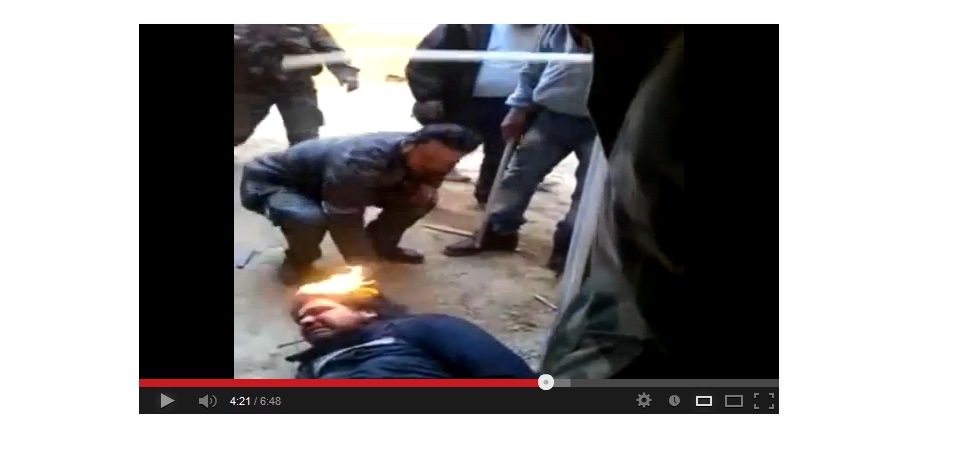
In a separate gruesome episode today, a video emerged showing a number of regime’s Shabbiha (pro-regime armed militias, mostly Alawites) torturing to death two young men in Al-Tal town. The video also shows the Shabbiha putting the young men to fire. In the video, the regime forces put the hair of a man who appears to be in his late thirties to fire, then put it out by kicking his head with their boots, then hit his head with a car tyre. The two young men finally apparently die from torture. Absolutely gruesome.

How will a permanent or even temporary partition of the country impact on the conflict?

A Syria divided

Last Modified: 21 Apr 2013 11:10
[youtube http://youtu.be/W7e756co2ZQ?]
Listen to this page using ReadSpeaker
On Wednesday, Syria’s president said his forces have no option but to win the war , or to lose the country

Given that I don’t see any dramatic shift in US policy or any kind of direct intervention … I think that this kind of conflict will grind on and therefore we will have a Syria that is in the de facto sense a divided Syria but in the du jour sense might still exist.– Andrew Tabler, the Washington Institute for Near East Policy

Speaking in an interview on local TV last week, Bashar al-Assad maintained that thousands of foreign fighters had crossed over from Jordan, and warned that the conflict was increasingly becoming a regional one.

He repeated the allegation that Western powers are directly and indirectly supporting elements of al-Qaeda in their desire to unseat him.

“I think that Syria, in these circumstances, is exposed to an attempted colonisation by all means. There’s an attempt to invade Syria by foreign forces. These forces are using new techniques, it is an attempt to invade Syria culturally,” he told interviewers on pro-regime Syrian television channel Al-Ikhbariya.

This week we focus on the possibility of a permanent or even temporary partition of Syria and whether this would lead to a drop in the level of the conflict.

There’s an objective to create de facto Balkanisation in Syria, there’s an external objective to divide this country. Their neighbours, the Israelis would benefit off this and it would be disastrous  for the entire region.-Mahdi Darius Nazemroaya, the Centre for Research on Globalisation

Last week al-Assad extended yet another amnesty to all those who laid down their arms but within hours of the offer, several reports indicated a massive mobilisation of government forces and a series of offensives in strategic areas of the country.

The possible consequence, whether intended or not, is the creation of defined enclaves in which opposition forces are contained.

To discuss this on Inside Syria, with presenter Mike Hanna, are guests: Andrew Tabler; a senior fellow in the Program on Arab Politics at The Washington Institute for Near East Policy; Ziad Majed, an assistant professor of Middle East Studies at the American University of Paris and co-ordinator of the Arab Network for the Study of Democracy; and Mahdi Darius Nazemroaya; a Canadian-based sociologist who is also a research associate at the Centre for Research on Globalisation in Montreal, specialising in geopolitical and strategic issues.

“It is not a viable situation, all will depend on how things will develop later – now we have areas where chaos is reigning, in others the opposition controls the ground but cannot always protect itself from air raids and scud missiles. So the situation is still unclear now, time will determine to which direction we will be heading. But I think the regime has a Plan B that is to try to defend Homs and the coast, if Damascus is to fall in the hands of the opposition, but we are not yet there.”Ziad Majed, American University of Paris

Maher Almounnes + Amal Hanano: Hallucinations of War

Amal Hanano (@amalhanano)  –  April 13, 2013
This post, called “Hallucinations of War,” was originally published in Arabic on the blog “Overdose”, which is written from Damascus by journalist Maher Almounnes. It is translated here by Syria Deeply associate culture editor Amal Hanano.Before this war, I used to be described as the smiling optimist. Maybe it was a blessing to be known to my friends as a good listener, because I would simplify situations and solve problems and so forth. However, I still, despite all the pain, continue to smile. And I still, despite all the weariness, find meaning within every tragedy.My first sorrows were losing loved ones, one after the other, as they left the country. But I would console myself with the belief that we would meet again and that our reunion will be sweeter after our separation.

Then we started losing loved ones who would never return. Their martyrdom was both a source of mourning and solace, as “the afterlife is better and everlasting.”

And when we left our home, I told myself that we were leaving one home for another, while there were thousands who had left their homes to live without shelter.

Then my father lost his job. I soothed my mother and told her there were others who had lost their eye or their leg or maybe even their life; thank God my father had not been harmed.

Then one of my best friends was abducted. The silver lining was that he returned with his head still attached to his body and that all that they had given him were a few bruises and slightly swollen soles.

Between these events are countless details, from having to postpone my sister’s wedding dozens of times to losing so many friends because of politics.

However, these details and others, like watching scenes of death in repetition, are details that every Syrian knows well. Death has come so close to each one of us that we no longer even see it.

All we see now is that we are political commodities or material for the media, or at best we are a number that scrolls on the red ticker on a television screen proceeded by the word: Breaking!

*

Two years. They seem like 20 years of wisdom and 50 years of sorrow. They made me change how I think about a lot of things. (By the way, I write now because I feel like it, not for any other reason.) But they did not stop me from taking advantage of this miserable reality and conspire with the girl I love.

The irony is, I forced this war to bend to my demands and serve my personal interests.

I claim to be the greatest lover in the dirtiest war. I claim to love her as much as the sorrow in Damascus, the number of the bullets in Aleppo, the destruction of the neighborhoods in the old city of Homs.

Every explosion is another reason to listen to her voice with the excuse to make sure she is alright. Would you believe that I now love the sound of explosions? Just so I can rush to call my love even though I know with certainty that she is safe at home.

Our new home that we fled to is located on the outskirts of Damascus, in a conflict zone. It’s wonderful for your home to be in a “hot” zone, because you have a daily appointment with death. And that’s another opportunity for her to worry about me and to call me every morning to make sure I woke up in my bed, still alive.

I work in a neighborhood where people are often detained. Amazing! A little bit of fear in exchange for more chances to be indulged and receive a few sweet words from here or a warm message from there.

And so what else is there in this war? Snipers? Suicide bombers? Mortars?

How beautiful they all are.

Because of them, I made a pact to never upset her no matter the reason. Because my fear is that death will come quickly, leaving a melancholy gaze between our eyes forever.

I owe our neighborhood sniper a rose. Because of him, I call my love every day, a few meters from my home, and each time it feels like our final phone call. I don’t know how I invent the words of endearment. I’m surprised by the beautiful words flowing out of my mouth that melt her and in turn melt me. Until I arrive safely to my doorstep.

I owe this war: 2,000 text messages; tens of handwritten letters; more than 4,000 “I love yous”; hundreds of kisses, embraces and tears of joy when we meet; and hours of pining and waiting.

Who said this war is all bad? I made the most beautiful love story out of this war.

Forgive me darling, our love story is written in steel and fire.

I swear by the blood of martyrs that spilled over my land that I love you until the last bullet, the last bomb and the last drop of martyr’s blood.

Not only because you are my angel, but because I believe: love is mightier than war.

You are mightier than war.

Kepler discovers two habitable planets

[youtube http://youtu.be/nkOZCK0txEo?]

New poll: 36% of Jewish Israelis back apartheid

Un­sur­pris­ing but im­por­tant new poll that re­veals the deep racism within Is­rael (so often ig­nored in West­ern media cov­er­age of the coun­try).

Mairav Zon­szein re­ports for 972:

Ac­cord­ing to a poll* re­leased Sun­day, a ma­jor­ity of Jew­ish Is­raelis (57 per­cent) be­lieve Is­rael should de­ter­mine its bor­ders uni­lat­er­ally ac­cord­ing to the cur­rent route of the sep­a­ra­tion wall, which cuts deep into the West Bank, wind­ing through Pales­tin­ian land well east of the 1949 Armistice Lines (Green Line).

This con­firms that 1) Is­raelis are ad­mit­ting the coun­try does not have de­fined and rec­og­nized bor­ders 2) Is­raelis are per­fectly happy (in­clud­ing 87 per­cent of Meretz vot­ers) push­ing for­ward uni­lat­er­ally de­spite re­peated claims by both the Is­raeli and U.S. gov­ern­ments that no uni­lat­eral steps should be taken by ei­ther side in the con­flict, and  3) Is­raelis don’t care that the ban­tus­tans cre­ated by the sep­a­ra­tion wall and the set­tle­ments are un­ac­cept­able to Pales­tini­ans or the in­ter­na­tional com­mu­nity, thus ig­nor­ing the im­prac­ti­cal­ity of this op­tion as a long-term so­lu­tion – not to men­tion an un­just one.

But what is even more telling and in­ter­est­ing about the poll is that while 61 per­cent sup­port a two-state so­lu­tion (39 per­cent op­pose), a sub­stan­tial 23 per­cent said they sup­port a bi-na­tional state “with­out giv­ing Pales­tini­ans full civil rights” (up sub­stan­tially from last year’s 13 per­cent). In other words, this can be un­der­stood to mean that 23 per­cent of Jew­ish Is­raelis want to live under an Is­raeli apartheid regime where Pales­tini­ans are in­sti­tu­tion­ally dis­en­fran­chised – though the poll does not men­tion the word apartheid any­where.

The poll also men­tions that 13 per­cent think the sit­u­a­tion should re­main as it is (“de facto Is­raeli con­trol of Pales­tini­ans with­out an­nex­a­tion of Judea and Samaria”), which means main­tain­ing the sta­tus quo. The sit­u­a­tion we live in right now is de facto a bi-na­tional state (or ‘one state’), in which every per­son be­tween the Jor­dan River and the Mediter­ranean lives under vary­ing de­grees of Is­raeli rule, so I think it is fair to add this 13 per­cent to the 23 per­cent  –which es­sen­tially means that a whop­ping 36 per­cent of Jew­ish Is­raelis sup­port Is­raeli con­trol of the West Bank with­out Pales­tin­ian civil rights – what I think can safely be called apartheid.

This may not come as such a sur­prise to some – as back in Oc­to­ber, we re­ported about a Haaretz poll that showed if Is­rael an­nexed the West Bank, a ma­jor­ity of Is­raelis would not want Pales­tini­ans to get the right to vote for Knes­set.

It should also be noted that the seven per­cent of the polled Jew­ish Is­raelis said they sup­port giv­ing Pales­tini­ans full civil rights within a bi-na­tional state – not so tiny con­sid­er­ing how mar­gin­al­ized the left-wing one-state vi­sion is in Is­rael.

The ques­tions in the poll about the bi-na­tional state are worded thusly (trans­lated from He­brew): “Which of the fol­low­ing sce­nar­ios would you pre­fer in order to main­tain Is­rael’s char­ac­ter as a Jew­ish and de­mo­c­ra­tic state 20 years from now?” I think this word­ing is quite telling since the very no­tion that we need to try very hard to “keep” Is­rael Jew­ish and de­mo­c­ra­tic in­her­ently re­flects that being both Jew­ish and de­mo­c­ra­tic isn’t re­ally work­ing out.

The poll was com­mis­sioned by an or­ga­ni­za­tion called Blue White Fu­ture, who pub­lished it in He­brew. The poll ques­tioned 500 Jew­ish Is­raelis, rep­re­sent­ing the adult Jew­ish pop­u­la­tion of Is­rael.

*The poll can­not be found on­line but here is a copy of it in He­brew.

source

Democracy Now Exclusive: Allan Nairn Exposes Role of U.S., New Guatemalan President in Indigenous Massacres

[youtube http://youtu.be/V9YieHwaP4M?]

………..

[youtube http://youtu.be/cXXOgbgVXmQ?]

……..

[youtube http://youtu.be/kKI2C0RzT0c?]

Blog at WordPress.com.

Up ↑