Search

band annie's Weblog

I have a parallel blog in French at http://anniebannie.net

Author

bandannie

Not the Jihadists but we are the problem

SYRIA-CONFLICT

A few days ago, a Belgian mother called me to ask if I could contact the Syrian Jihadists of Jabhat Al Nusra. Her son left his family to join them a month and a half ago and since then she hasn’t heard anything of him anymore. I had to disappoint her, as I have no contact with the Jihadists. In fact, when in Syria, I always try to avoid them.

She was of course very worried, but also embarrassed. Her son is fighting in a battle she does not at all support and even not understand. I kind of recognize this embarrassment as it made me recall the story of a relative whom my family barely ever talks about. He was killed in the Second World War when he decided to fight with the Nazis against the Communists. He believed he had to choose between Rome and Moscow; between God and the Devil and that this choice needed sacrifice even if it meant his own life.

Each time I travelled to Syria during the last months, I saw Jihadists taking the same plane and the same bus as I did and following the same illegal way to enter northern Syria. What drew my attention and worried me each time is the self-confidence in their eyes, the acceptance that they will die in Syria. Above all, they are proud of it. They know they are going to be at the front line of the battle and that some people will admire them for that. And for them, this is exactly what they missed in their lives; admiration, guidance and heroic acts.

What disturbed me most however, wasn’t seeing these Jihadists entering Syria. I can’t stop them anyway. No, what is worse is that I didn’t see any others entering Syria. No relief teams, no doctors and no trucks loaded with aid for the other Syrians, for the vast majority of the rebels who have nothing to do with the Jihadists’ ideologies. While Al Qaida’s friends possess weapons and money to distribute to their fighters, people are dying of hunger in refugee camps supervised by the FSA.

We in the West are so mesmerized by a small group of radicals that we lost the ability to see the reality. By fearing the ghost of Afghanistan, we decided to do nothing. Because if we do nothing, we can’t do anything wrong. And this is precisely the huge mistake we are committing today. Because by doing nothing we only make Assad and the Jihadists stronger. While we are leaving those who share our values on their own.

The main excuse I hear for not intervening is: we don’t know what the Free Syrian Army is and we don’t know what they want. It’s a silly excuse. Because if you don’t know, it’s simply because you haven’t done the effort. It’s not that difficult. Two weeks ago, I had a dinner in Turkey with the Chief of Staff of the FSA, Salim Idriss and four of the five Front Commanders. Anyone who does the effort to go to Antakya will be able to meet any officer of the FSA. You will hear that they want freedom and democracy, that they try everything in order to respect human rights, protect the minorities and help the refugees. But you will also hear that they don’t have the means to achieve these goals properly.

Anyone who makes an effort can reach the refugee camps in Syria very easily and will be able to see how disastrous and inhuman the situation is there, how children spend sometimes days without food or even weeks without milk, how they die because of injuries, caused by a shrapnel, due to lack of medical care. You will see how our aid to Syria is mainly distributed through Assad, which is the reason why almost no aid is reaching the liberated areas. Whoever makes an effort will see that it are the soldiers of Assad and no one else that are attacking and bombarding civilians.

But, apparently all this requires too much effort. We prefer to do nothing “as we don’t know what will happen after Assad falls”. Just imagine that the Americans and the British wouldn’t have entered in WWII because of fear of communists, and because, they too, didn’t know “what would happen after Hitler falls.

Should we be surprised then that those who fight for a better Syria are getting more and more angry and frustrated with the West? They have to witness how the only thing that comes from the West are Jihadist fighters – whatever small and insignificant their number is – while the secular forces and the Syrian people are being left on their own.

It is of course justified to feel uncomfortable and even fearful for “our boys” who go to this far away and unknown Syria to fight for the sake of forming an Islamic State. However, we will not solve this problem by trying to stop them. We will only solve them if we start to engage in Syria itself. It’s less difficult than we might think. We just need to do an effort.

(with thanks to Maha Alasil for helping with the translation from the Arabic version)

source

Al Azm on “Anti-Imperialists”

Sunday, April 28, 2013

Dr Sadiq Jalal al Azm is somebody I’ve been wanting to read more of and never had the chance to. I just stumbled upon a recent translation of his interview and I’m impressed by his razor sharp analysis. Of particular interest to me was his classification of the so-called anti-imperialist camp that has made it their mission to obfuscate and confuse the discourse surrounding Syria since the start of the revolution.

Whereas the smaller bloc of the left has hardened its old positions, as if nothing happened after the end of the Cold War, and with time its attitudes and methods became of the same nature as that of the Taliban-Jihadis or dogmatic closed-minded sectarians, or even that of terrorist “Bin Ladenites,” in its blind defiance of the West, global capitalism (a global capitalism that Russia and China are now a part of) and imperialism. This bloc from the left, in the Arab world and internationally, is today the most hostile to the Syrian revolution and the closest to defending the tyrannical military-security-familial regime using several arguments, not least of which is that the entire world plotted, apparently, against this regime that is peace-loving and stable.

This type of leftist emphasizes “the game of nations” and “geopolitical analysis,” with stories of collision of interests and plans of the great powers and their dominance in our region, and does not want to view the revolution in Syria through anything other than through this lens, and neglects all that happens inside Syria and to Syria’s revolutionaries today, as well as ignoring all the reasons that led its people to a peaceful revolution, and later to taking up arms in the face of a “nationalist” tyranny that is allied with this kind of leftist.

In other words, this leftist has no problem with sacrificing Syria if it leads to a victory being handed to their international camp and “geopolitics” that wants a global victory in the “game of nations.” Their first priority is not Syria or its people in revolt to restore the republic, their freedom, and their dignity, but the game of nations at the global level of analysis and the side that they want to win.

The English translation of the interview is well worth a read here.

Posted by Maysaloon at 6:21 pm

source

The Two-faced Propaganda of the Damascus Regime

  • [An edited translation from the Azmi Bishara Arabic facebook page]

    The Syrian regime has been hosting American journalists as part of its propaganda campaign targeted at the West. It explains to its guests that Damascus’ is the only government capable of combatting global Islamic terrorism, and invites them to view the pictures of the “foreign fighters” who have come to Syria. Of course, they neglect to mention here how the Syrian regime is committed to the resistance, nor do they deign to mention the occupation of the Golan Heights. In its propaganda targeted at the Arab public, meanwhile, the same regime has deafened all of our ears with claims that it stands up for the resistance, and that this is what motivated the American-Arab conspiracy that is the Syrian revolution.

    In the regime’s propaganda directed to the Arab public, the foreign jihadists who have arrived in Syria are depicted as products of US intelligence and American-allied Arab governments. There’s no mention of that in what is said to the West, however. In the image the Syrian regime projects to the West, the emphasis is always on “terrorism” and “Islam”. Here, the Syrian regime presents itself as a victim of “Islamic terrorism”, in the same boat as the US in the wake of the Boston Bombings.

    The sordidness needed to carry out such a feat of duplicity is boundless. A separate fact is that, regardless of their motives, the presence of foreign fighters in Syria has harmed the Syrian people’s national revolution.

Lessons from the Minaret


Amal Hanano is a well-known Syrian writer and blogger, as well as an associate editor of Syria Deeply. Here she explores this week’s destruction of the Umayyad Mosque, the architectural pride of her hometown of Aleppo.

View of Umayyad from the street / Amal Hanano

I still remember how it smells, musty and old. It smelled like the air has never changed for centuries. The 1,000-year-old stone, worn rugs and stacked holy books were timeless. I remember how it was peaceful inside. No matter how hot it was outside, it was cool inside the vaulted rooms. A calm world tucked within a world filled with noise, dust and now chaos.

I remember how we would go sometimes to pray and other times with visitors. We would drape the long black abayas over our street clothes and cover our hair. We would laugh and take pictures of each other in the courtyard while old men recited verses in a corner and pigeons flew under the arches. It was a place to connect to your history, to your identity and to tell others, who were not from Aleppo: “This is where we are from. This is who we are.” This is where you come to face your roots. It was a place that existed forever, a place we thought would exist long after we were gone. But we were wrong.

They say that people make their cities. But if you are from Aleppo, one of the oldest cities in the world, the city has made you much more than you have made it. So when pieces of our history are destroyed one by one, pieces of us are lost, fragment by fragment.

*

“We really don’t know [whether Umayyad was targeted on purpose]. The story of the regime is that the jihadists blew it up on purpose, and the story of the Free Syrian Army is that it was under regime control and the regime had planted explosives within the mosque, and then the regime blew it up. It’s highly unlikely that the rebels or Jabhat al-Nusra would explode the minaret. Jabhat would not do that to a mosque. It was probably either targeted by the regime or fell as a result of crossfire.

It’s so sad and it’s so old. It’s 960 years old. And the mosque itself was built in the 8th century. The site, the ground, went back to Hellenistic times, then in Christianity it was a church. All of the Old City of Aleppo is like that, layers of history built on top of each other.

Mosque minarets were really used as urban planning devices.

Many from Aleppo have changed their Twitter and Facebook photos to this image of a broken minaret.

They planned the streets around that mosque to center around the minaret, so that the minaret would be in center of your [vantage point].

It’s very symbolic. People are really devastated. A lot of people changed their picture on social media to show the minaret. Or rather, a broken minaret. It’s part of our identity [in Aleppo.] The BBC got backlash for heavily covering it, because people said, ‘Why are you covering the destruction of a minaret when so many people are dying?’ But there is that sense that it’s part of our identity, and people are mourning it.

People in Aleppo are extremely proud of their architecture, especially our minaret. It’s a big sense of pride for people from Aleppo. And this is the most important site in the city, after the citadel. “

*

‘The minarets, like trees, have souls.’ – Nizar Qabbani

The lesson of the minaret: every tyrant will fall and the city remains. History has taught us that the people find a way to pick up the pieces of their city and rebuild. One thousand years from now, these years will be a chapter in history books. The future people of Aleppo will visit this sacred site and will feel the calm and peace once more. The stone will be old again. They will point to the square tower and whisper to their children the tale of this minaret that falls every few centuries when the lesson of tyranny must be taught to a people who had forgotten. Those people of the future are lucky. They will be unaware of the pain of living those years, unaware of the shame of writing this chapter. History is abstract and seamless to them, like it once was for us. It is merely a story they can recite while they trace their fingers over the stone and remember without consequence. I envy them. 

We were once like those people, telling tales of barbaric Mongols or tragic fires that had destroyed the Umayyad Mosque, the Great Mosque of Aleppo. Instead we will have to be the ones to pick the pieces this time and find a way to rebuild, to heal and to restore what was erased. Even when the rebuilding is done and the blood has stopped flowing, we will never be able to enter these sites without remembering what was lost. It will never smell timeless again for us. History will never be seamless with our memory again.We know that what we will rebuild is a replacement for something that was once perfect. Something that can never come back and will never be the same. We will be destined to whisper to our children and grandchildren: “Once upon a time, there was a minaret that was 1,000 years old. We loved it and we loved our city. But we had forgotten our history. We had forgotten that the hatred of men destroys all that we love, all that is sacred. And one day we woke up and the minaret was gone.

Umayyad Mosque in evening / Amal Hanano

Until then, people from Aleppo, who are now scattered around the world, go to sleep knowing that tonight Aleppo’s skyline is missing yet another sparkling green light that once was the jewel of our city, missing yet another voice that once joined a symphony of voices calling to prayer. Another beloved soul joins the thousands of murdered souls of our city. The city grows darker and quieter, but we also know, from our history, it will never die.

*

“The architecture in Aleppo is different from anywhere else in Syria. The buildings are made of stone, a limestone that’s very famous. And the history, the preservation of the Old City, is very unique. The core is a UNESCO world heritage site. What’s really sad is that before this destruction, Aleppo, and Fez in Morocco, were the two best-preserved Islamic city cores in the whole world. All the other cities were destroyed and rebuilt and modernized except Aleppo and Fez. And the Assad regime itself spent so much money rehabilitating the Old City. They even brought in a German organization that does restoration, and they did massive projects with it. That was their ‘thing.’ And now they’re destroying the Old City they helped preserve without thinking. Nothing is sacred to the regime anymore. Nothing means anything.” (As told to Karen Leigh.)

source

Acting President of SOC George Sabra – Press Conference

[youtube http://youtu.be/0WIcjHaMfSU?]

Yemeni Activist Farea al-Muslimi Urges U.S. to Stop the Drone War on His Country

Over 200 Killed in Bangladesh Factory Collapse After Workers Forced to Ignore Building’s Dangers

[youtube http://youtu.be/7Ynjyu62tWk?]

BDS

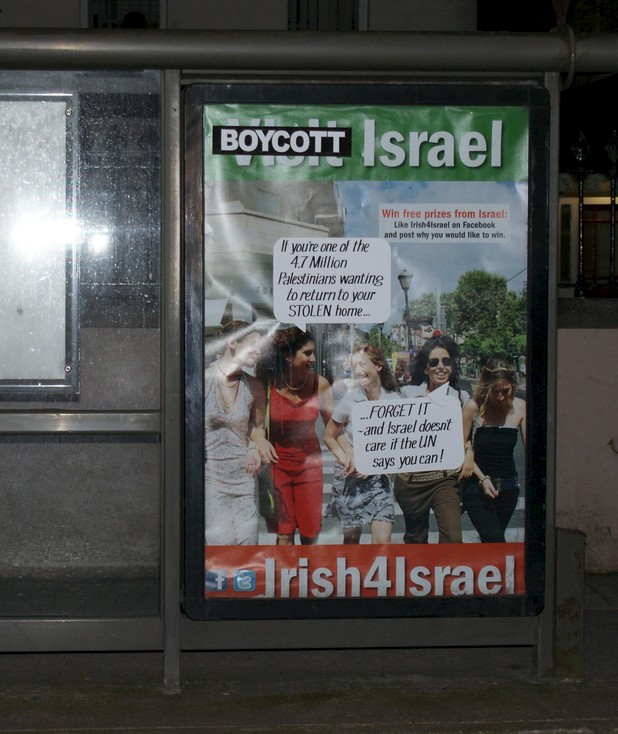
"revisited" ad for Israel
“revisited” ad for Israel

Syria : please sign petition for Pierre Piccinin da Prata

Pierre Piccinin da Prata is a Belgian political science teacher who has been missing for two weeks in West Syria. He is a journalist and expert of the Arab world; his online blog: http://www.pierrepiccinin.eu/ contains his thoughts and opinions on his journeys throughout the Middle East. After a painful trip to Syria in the spring of 2012, Pierre Piccinin became a supporter of the rebel Syrian cause, being highly critical of Bashar al-Assad’s regime.

He is the author of the book La Bataille d’Alep : Chroniques de la Révolution Syrienne, published by Harmattan in 2012. He is an important actor of the international arena facing the civil war in Syria.

Help us find him! Every signature shows the urgency to find him to the Belgian state.

http://www.activism.com/fr_FR/petition/retrouver-pierre-piccinin-disparu-en-syrie/43622

Blog at WordPress.com.

Up ↑