Search

band annie's Weblog

I have a parallel blog in French at http://anniebannie.net

Tag

War crimes

GOP Congressman calls for Gaza genocide: “It should be like Nagasaki and Hiroshima: Get it over Quick”

JUAN COLE 03/31/2024

Tweet

Ann Arbor (Informed Comment) – US Representative Tim Walberg (R-MI), a former pastor, called this week for a genocide, the Final Solution of the Palestinian Problem..

Michigan’s 5th congressional district stretches across the far bottom of the state, encompassing cities such as Albion and Jackson and abutting Ohio and Indiana. I don’t have any reason to think that the district is full of merciless psychopaths and mass murderers. Jackson has a famous ice cream shop, The Parlour, where the portions are to say the least generous, and which is pleasant to visit on a hot summer day. The district has a population of 768,000 and a median household income of $64,000 (for the US as a whole it is $74,580). It is about 85% white, with Hispanics, African Americans and mixed-race persons making up most of the other 15%. It has voted for a Democratic president in every election in this century and even favored Hilary Clinton over Trump. That Walberg represents this district demonstrates the axiom that Americans buy peanut butter more intelligently than they vote.

That is, the district is represented in Congress by a cruel would-be mass murderer. His soul lacks any hint of the milk of human kindness. Walberg, a fundamentalist former Christian pastor, once ran the homophobic, far right Moody Bible Institute in Chicago while supposedly representing a Michigan district, Walberg is against everything— a woman’s right to choose, the Affordable Care Act, gay marriage, and any attempt to counter the climate crisis. He went to Uganda to voice support for that country’s Anti-Homosexuality Act, which prescribes executions for gay people.

So genocidal tendencies were already apparent. Some 14 million American adults identify as LGBT in polling and apparently Rep. Walberg would happily see them all murdered. It should be remembered that some 90,000 gay men were rounded up in Nazi Germany, with as many as 15,000 sent to death camps, where perhaps 60% were killed. The only difference between Walberg and Heinrich Himmler, who created the Reich Central Office for Combating Homosexuality and Abortion, is that Walberg hasn’t yet found a way to implement his sadistic dreams.

At a meeting in Dundee with constituents on March 25, Walberg said that President Biden had spoken of our need to get aid into Gaza. He said, “I don’t think we should. I don’t think any of our aid that goes to Israel, to support our greatest ally, arguably maybe in the world, to the feet of Hamas, and Iran, and Russia. Probably North Korea is in there and China, too — with them, helping Hamas. We shouldn’t be spending a dime on humanitarian aid. It should be like Nagasaki and Hiroshima. Get it over quick.”


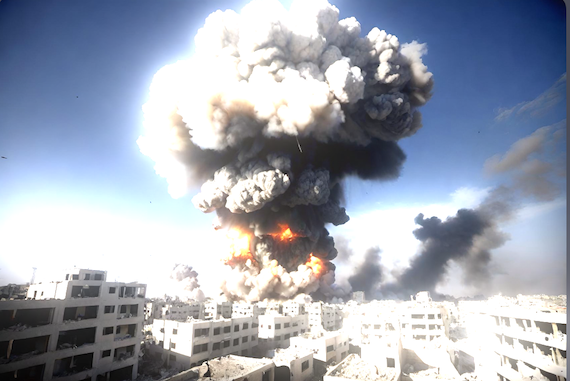
“Nuking Gaza,” by Juan Cole, Digital, Dream / Dreamland v. 3 / IbisPaint, 2024.

Unfortunately for Walberg, who likely talks like this all the time with his inner circle of fellow sociopaths, his remarks were recorded.

It is worth noting the bizarre conspiracy theory that any US aid money sent to Gaza would somehow benefit Russia, China and North Korea or that those three countries back Hamas. I might once have called such paranoid fever dreams abnormal, but I see them and their like normalized all around me these days.

The 2.2 million Gaza noncombatants cannot be blamed for the actions of a small Hamas guerrilla group. These civilians are in imminent danger of mass starvation and some are already dying of hunger. Half of them are children. Most of the rest are women and noncombatant men. Some 70% of them are in Gaza because Zionist gangs chased them out of their homes in 1948 in what became southern Israel, and made them stateless refugees. Now they are being killed on a scale unseen in any conflict in this century.

And, again, mass starvation was a key Nazi technique of war.

Voices from Damascus: ‘We Expect Nothing from the United Nations’

The photos and video circulating of yesterday’s alleged chemical gas attack in the east Damascus suburb of Ghouta are haunting. In some, dead bodies, including those of children, are lined up shoulder to shoulder on the floor. In others, volunteers go from victim to victim, pouring water onto the faces of those still alive.

The Syrian Observatory for Human Rights and other watchdog groups have claimed the attack was carried out by Bashar al-Assad’s regime; the Observatory put the number of dead at 1,400 and climbing. If so, it will be the largest recorded chemical attack since a 1988 hit on Iraq’s Kurds by ousted dictator Saddam Hussein. The missiles containing the gas are believed to have been launched from areas of Damascus controlled by the regime.

“A huge number of people in Ghouta are dead, doctors and witnesses are describing horrific details that look like a chemical weapons attack, and the government claims it didn’t do it,” Joe Stork, acting Middle East director at Human Rights Watch (HRW), said in a statement. “The only way to find out what really happened in Ghouta is to let United Nations inspectors in.”

At the time of the attack, United Nations inspectors were in central Damascus, but have not been allowed access to the attack site. HRW said that “whether or not chemical weapons were used, the attack left a large number of civilians dead, and those responsible for unlawful killings should be held to account. The government should give the United Nations chemical weapons inspection team currently in Damascus immediate access.”

Syria Deeply spoke with witnesses in Ghouta about what they saw, and their low hopes that the attack will trigger international intervention in the conflict.

Ghazwan, 28, doctor:

We have previous experience dealing with chemical attacks, but not on this scale. It was shocking to see such a large number of children and women. It was the first time we have seen a chemical attack like this. We couldn’t deal with all these numbers – about 800 injured arrived here in [neighboring] Douma, and we only have a few medical stations and doctors. We gave mechanical ventilation for some who couldn’t breathe, and it is important to give atropine shots, which is the antidote for sarin.

People can help in this situation by washing the injured. We had a lot of volunteers. The situation in Douma was good in in the end, thank God. Only 17 dead from 800.

The main mission was to rescue people. If you want to go there you have to wear masks to protect yourself from chemical weapons, and we only have a few. We get them from the Free Syrian Army.

Yesterday there were a lot of people coming to Douma for treatment. Most have been discharged. A few were suffocating and are getting medical ventilation. The acute state of chemical injuries only lasts 24 hours. That is the critical period. Now most of them are being taken care of back in their homes. A lot of them were scared to go home, but they have no place else to go.

One of the survivors told us that he fainted and then found himself in Douma. They took him to the field hospital. Some survivors told us that they were walking in the streets and seeing bodies everywhere, before they fainted. Some were dead, others were choking.

I’ll be frank with you: Most people I’ve seen today and yesterday don’t expect anything from the international community. They’ve expected too much in the past, so they don’t care too much about this.

Abu Adel, a member of the Information Office in Jobar, the eastern district of Damascus that borders Ghouta:

The atmosphere is incredibly tense. People are wary of a repeat scenario. Now there is heavy shelling with all kinds of weapons, mortar fire and warplanes, and surface-to-surface missiles hit the district in the morning. Now the neighborhood is surrounded by tanks from several directions, and there have been attempts to storm it.

The rebels are doing a major escalation and responding by shelling regime military locations.

We expect nothing from the United Nations.

Abu Ahmed, Moadamiyet al-Sham media center:

Four days ago, the regime [started] to shell Moadamiyet al-Sham with rockets and mortars [launched from] from the Mezzeh military airport. [There were also] tanks and artillery fire [at] the Fourth Division headquarters in the mountains of Moadamiyet.

There was no shelling the night before the attack. Yesterday, when people were leaving the mosque after dawn prayers, they heard seven strange sounds like whistles. The sounds of the explosions were unusually soft.

The rockets had come from the direction of Mezzeh and targeted the area of Zeitouna mosque. Nearby, [there] is a kindergarten.

The worshippers went to the scene to find their families [in a state that looked like] sleeping. People were wounded. Among the wounded were paramedics and doctors. All were passed out.

The ambulance took people to the field hospital. There were 103 people killed, including 17 children, and 305 wounded. Some are still unconscious. One child died today.

People have severed all of their hopes [that] the world [will intervene]. We have nothing but God. But if the inspectors are serious, then they must go to Moadamiyet immediately. They must make serious decisions and not just issue condemnations.

The regime has used every weapon, and now it is [using] chemicals. It is taking its revenge on the cities that have remained steadfast [opposition strongholds] despite all of the bombing and destruction. This is the last resort of Assad, after exhausting every means of suppression. This is vengeance.

source

Obama DOJ Wants Immunity For War Criminals

Bureau Investigation Finds Fresh Evidence of CIA Drone Strikes on Rescuers

Published on Thursday, August 1, 2013 by Bureau of Investigative Journalism

If proved, US targeting of rescuers who respond to scene of earlier explosions are clearly “war crimes”

  by Chris Woods with additional reporting by Mushtaq Yusufzai

The Bureau’s field researcher found five double-tap strikes took place in mid-2012, one of which also struck a mosqueA field investigation by the Bureau of Investigative Journalism in Pakistan’s tribal areas appears to confirm that the Central Intelligence Agency (CIA) last year briefly revived the controversial tactic of deliberately targeting rescuers at the scene of a previous drone strike. The tactic has previously been labelled a possible war crime by two UN investigators.

The Bureau’s new study focused mainly on strikes around a single village in North Waziristan – attacks that were aimed at one of al Qaeda’s few remaining senior figures, Yahya al-Libi. He was finally killed by a CIA drone strike on June 4 2012.

The Bureau’s field researcher found five double-tap strikes took place in mid-2012, one of which also struck a mosque

Congressional aides have previously been reported as describing to the Los Angeles Times reviewing a CIA video showing Yahya al-Libi alone being killed. But the Bureau’s field research appears to confirm what others reported at the time – that al-Libi’s death was part of a sequence of strikes on the same location that killed up to 16 people.

If correct, that would indicate that Congressional aides were not shown crucial additional video material.

The CIA has robustly rejected the charge. Spokesman Edward Price told the Bureau: ‘The CIA takes its commitment to Congressional oversight with the utmost seriousness. The Agency provides accurate and timely information consistent with our obligation to the oversight Committees. Any accusation alleging otherwise is baseless.’

Tactic revived

The Bureau first broke the story of the CIA’s deliberate targeting of rescuers in a February 2012 investigation for the Sunday Times. It found evidence of 11 attacks on rescuers – so-called ‘double-tap’ strikes – in Pakistan’s tribal areas between 2009 and 2011, along with a drone strike deliberately targeting a funeral, causing mass casualties.

Reports of these controversial tactics ended by July 2011. But credible news reports emerged a year later indicating that double-tap strikes had been revived.

International media including the BBC, CNN and news agency AFP variously reported that rescuers had been targeted on five occasions between May 24 and July 23 2012, with a mosque and prayers for the dead also reportedly bombed.

The Bureau commissioned a report into the alleged attacks from Mushtaq Yusufzai, a respected journalist based in Peshawar, who reports regularly for NBC and for local paper The News.

Over a period of months, Yusufzai – who has extensive government, Taliban and civilian contacts throughout Waziristan – built up a detailed understanding of the attacks through his sources.

His findings indicate that five double-tap strikes did indeed take place again in mid-2012, one of which also struck a mosque. In total 53 people were killed in these attacks with 57 injured, the report suggests.

Yusufzai could find no evidence to support media claims that rescuers had been targeted on two further occasions.

No confirmed civilian deaths were reported by local communities in any of the strikes. A woman and three children were reportedly injured in one of the attacks. Yusufzai says: ‘It is possible some civilians were killed, but we don’t know’.

However a parallel investigation by legal charity Reprieve reports that eight civilians died in a double-tap strike on July 6 2012 (see below), with the possibility of further civilian deaths in a July 23 attack.

Islamabad-based lawyer Shahzad Akbar says Reprieve’s findings are based on interviews with villagers from affected areas.

‘On both occasions [in July] our independent investigation showed a high number of civilians who were rescuers were killed in the strikes,’ says Akbar.

While some 2012 double-tap strikes appear to have been aimed at al Qaeda’s Yahya al-Libi, Reprieve believes both July attacks were focused on killing another senior militant, Sadiq Noor.

Noor is deputy to militant leader Hafiz Gul Bahadur. Both men are long-time targets for the CIA because of their support for the Taliban’s Afghan insurgency. Noor had falsely been reported killed on at least two previous occasions. It is not known whether he survived either of the strikes.

Summary of the Bureau’s new findings
The Bureau’s field research finds that – as widely reported at the time – on May 24 2012 a CIA-controlled armed drone hit a mosque in the village of Hasukhel in North Waziristan, killing some worshippers. Six further people were killed in a second drone strike shortly afterwards as they took part in rescue work, according to Yusufzai’s sources.

On June 3 2012, two Taliban commanders and their men were targeted as they visited the village of Gangi Khel in South Waziristan to attend funeral prayers for a relative killed in an earlier drone strike. Despite reports that the two commanders were killed, the Bureau’s research finds both men survived and there were no fatalities.

An attack on June 4 2012 ultimately killed al Qaeda second-in-command Yahya al-Libi. Despite US claims that al-Libi alone died, Bureau research appears to corroborate multiple accounts indicating that at least 16 people, all alleged militants, died in a series of missile strikes. This reportedly included the deliberate targeting of rescuers. Congressional oversight committee staffers reportedly told the LA Times they had seen video showing only al-Libi’s death. They may have been unaware of additional strikes. The CIA told the Bureau it ‘provides accurate and timely information consistent with our obligation to the oversight Committees. Any accusation alleging otherwise is baseless.’

On July 6 2012, a group of alleged militants were targeted and killed as they ate dinner with local tribesmen. Another nearby mixed group who were praying were not attacked. After waiting 30 minutes rescue work began. CIA drones then returned, killing 12 others including three brothers. Legal charity Reprieve reports eyewitnesses as identifying eight civilians killed in the attack, who it names as Salay Khan; Mir Jahan Gul; Allah Mir Khan; Noor Bhadshah Khan; Mir Gull Jan; Batkai Jan; Gallop Haji Jan and Gull Saeed Khan.

An initial attack on a house in Dre Nishtar in the Shawal valley on July 23 2012 killed five alleged militants. Local villagers refused to assist in aid work because they feared a fresh attack. Alleged militants involved in the rescue were then targeted in a second strike, with a further seven killed and eight injured. Reprieve believes civilians may also have died in this attack, and is continuing to investigate.

No evidence could be found for a claimed attack on rescuers on May 28 2012. Instead, Yusufzai’s sources said two separate linked strikes took place. An initial 4am attack failed to destroy a truck. The vehicle was pursued and destroyed 10 minutes later as it passed through Hasukhel village, killing seven alleged militants. Four civilians including three children were also injured when a nearby house was damaged.

Similarly, the Bureau can find no evidence to support a claimed double-tap attack on June 14 2012 in Miranshah. Instead, one individual died on the building’s roof, in what Yusufzai’s sources describe as a highly precise attack causing minimal structural damage.

Special rules?

The rescuer strikes examined by Yusufzai all appear to have been aimed at very senior militants – so-called High Value Targets. Under international humanitarian law, the greater the threat a target represents, and the more imminent that threat is deemed to be, the greater the leeway for targeting. The Bureau’s findings suggest that strikes on rescuers are still permitted in certain circumstances, such as in the pursuit of a high value target such as Yahya al-Libi.

The Bureau’s original investigation into the deliberate targeting of rescuers found that a significant number of civilians had been reported killed, alongside Taliban rescuers.

It was the presence of civilians amid groups of rescuers which meant the US may have committed war crimes, according to the UN’s special rapporteur on extrajudicial executions. Christof Heyns noted in June 2012:

If civilian ‘rescuers’ are indeed being intentionally targeted, there is no doubt about the law: those strikes are a war crime.

Heyns’ colleague Ben Emmerson QC, UN special rapporteur on torture, also told reporters in October 2012: ‘The Bureau has alleged that since President Obama took office at least 50 civilians were killed in follow-up strikes when they had gone to help victims and more than 20 civilians have also been attacked in deliberate strikes on funerals and mourners. Christof Heyns… has described such attacks, if they prove to have happened, as war crimes. I would endorse that view.’

The Bureau understands that Emmerson’s ongoing UN investigation into drone strikes is likely to engage with the issue of targeting first responders.

Bureau field researcher Mushtaq Yusufzai notes that civilians now rarely appear to take part in rescue operations, and are often prevented from doing so by militants. They also fear further CIA attacks, he says.

As Bureau field researcher Mushtaq Yusufzai notes, civilians now rarely appear to take part in rescue operations’

Sarah Knuckey is an international lawyer at the Center for Human Rights and Global Justice, based at New York University’s School of Law. An adviser to UN rapporteur Christof Heyns, Knuckey also co-authored the 2012 report Living Under Drones, which gathered substantial testimony in Pakistan about strikes on rescuers.

‘The threat of the “double tap” reportedly deters not only the spontaneous humanitarian instinct of neighbours and bystanders in the immediate vicinity of strikes, but also professional humanitarian workers providing emergency medical relief to the wounded,’ the report noted.

Commenting on the Bureau’s latest findings, Knuckey says civilians cannot be targeted under the laws of war.

But she adds: ‘Secondary strikes are not necessarily unlawful. If, for example, secondary strikes are carried out on additional military targets who come to the area of a first strike, the strikes might comply with the laws of war. And the Bureau’s findings of no evidence of civilian harm from the 2012 strikes they investigated suggest that proper precautions in attack may have been taken for those strikes.

‘The key question around the legality of secondary strikes is: On what basis is the US making the assessment that the ‘rescuers’ are legitimate military targets? Is the US assuming that anyone coming to a second strike is also a militant, or does it have – for each rescuer – intelligence on that person’s militant status? If secondary strikes take place within 10-20 minutes of a first strike, is that sufficient time to determine militancy?’

Stark contrast

The US has not generally responded to the issue of double-tap strikes. But three months after the 2012 attacks, a senior diplomat denied that civilian rescuers were ever ‘deliberately’ targeted by the CIA.

A group of US peace activists visiting Pakistan in October 2012 were told by acting US ambassador Richard E Hoagland: ’For at least the last several years that I have been here in Pakistan and more intimately associated with the knowledge of this [drone campaign], there was never any deliberate strikes against civilian rescuers.’

The US Senate and House intelligence committees are charged with overseeing the CIA’s drone targeted killing project. But there is an unexplained disparity between an account of what committee members were shown by the CIA on a particular strike, and what other sources report.

Is the US assuming that anyone coming to a second strike is also a militant, or does it have – for each rescuer – intelligence on that person’s militant status?’
Sarah Knuckey, New York University

Yahya al-Libi, al Qaeda’s second-in-command, was killed by the CIA on June 4 2012 in a strike on the village of Hassokhel in North Waziristan.

Almost all media reports at the time placed the death toll at 15-18. Sources including the Washington Post said rescuers were targeted and killed at the scene.

But the US has consistently denied this. ‘American officials said that Mr Libi was the only person who died in the attack, although others were present in the compound,’ the New York Times noted.

In July 2012, the Los Angeles Times published a detailed account of the workings of the Senate and House Intelligence Committees. According to reporter Ken Dilanian, staffers from both committees visit CIA headquarters once a month, where they watch video and review other evidence relating to drone strikes.

‘The BBC and other news organisations quoted local officials saying that 15 “suspected militants” were killed in the June 4 Pakistan strike that killed al Libi,’ Dilanian reports. ‘But the [CIA] video shows that he alone was killed, congressional aides say.’

The Bureau’s findings are in stark contrast, appearing to confirm original news reports that rescuers were indeed targeted at the time and that many more died.

According to Yusufzai’s sources, an initial 4am attack on a small house in the village of Hassokhel killed five. A dozen people ‘including Arabs, Turkmen and local tribesmen’ then started rescue work.

But as they were removing bodies, the CIA’s drones reportedly struck again – killing 10 more, including Yahya al-Libi, ‘who was observing the rescue operation when he too came under missile attack,’ the source said.

Neither the House nor Senate intelligence committees were prepared to comment on the disparity between these reports.

The Bureau approached the CIA for comment on the latest sequence of rescuer strikes. While declining to comment on most questions, spokesman Edward Price robustly denied the suggestion that the oversight committees may have been misled.

This work is licensed under a Creative Commons License
source

Bradley Manning Verdict @ Democracy Now

CLICK ON IMAGEbradley_manning_new_600

Tales in a Kabul Restaurant

May 21, 2013 § Leave a Comment

by Kathy Kelly

Afghan children

Twelve children killed in the Kunar province, April 2013 (Photo credit: Namatullah Karyab for The New York Times)

May 21, 2013 – Kabul–Since 2009, Voices for Creative Nonviolence has maintained a grim record we call the “The Afghan Atrocities Update” which gives the dates, locations, numbers and names of Afghan civilians killed by NATO forces.  Even with details culled from news reports, these data can’t help but merge into one large statistic, something about terrible pain that’s worth caring about but that is happening very far away.

It’s one thing to chronicle sparse details about these U.S. led NATO attacks. It’s quite another to sit across from Afghan men as they try, having broken down in tears, to regain sufficient composure to finish telling us their stories.  Last night, at a restaurant in Kabul, I and two friends from the Afghan Peace Volunteers met with five Pashtun men from Afghanistan’s northern and eastern provinces. The men had agreed to tell us about their experiences living in areas affected by regular drone attacks, aerial bombings and night raids.  Each of them noted that they also fear Taliban threats and attacks. “What can we do,” they asked, “when both sides are targeting us?”

THE FIRST RESPONDER’S TALE

Jamaludeen, an emergency medical responder from Jalalabad, is a large man, with a serious yet kindly demeanor. He began our conversation by saying that he simply doesn’t understand how one human being can inflict so much harm on another. Last winter, NATO forces fired on his cousin, Rafiqullah, age 30, who was studying to be a pediatrics specialist.

“A suicide bomber had apparently blown himself up near the airport.  My cousin and two other men were riding in a car on a road leading to the airport.  It was 6:15 AM.  When they’d realized that NATO helicopters and tanks were firing missiles, they had left their car and huddled on the roadside, but they were easily seen. A missile exploded near them, seriously wounding Rafiqullah and another passenger, while killing their driver, Hayatullah.”

Hayatullah, our friend told us, was an older man, about 45 years old, who left behind a wife, two boys and one daughter.

Although badly wounded, Rafiqullah and his fellow passenger could still speak. A U.S. tank arrived and they began pleading with the NATO soldiers to take them to the hospital.  “I am a doctor,” said Rafiqullah’s fellow passenger, a medical student named Siraj Ahmad.  “Please save me!”  But the soldiers handcuffed the two wounded young men and awaited a decision about what to do next.  Rafiqullah died there, by the side of the road. Still handcuffed, Siraj Ahmad was taken, not to a hospital, but to the airport, perhaps to await evacuation. That was where he died.   He was aged 35 and had four daughters. Rafiqullah, aged 30, leaves three small girls behind.

And Jamaludeen knows that those girls, in one sense are lucky.  Four years ago, he tried to bring first aid as an early responder to a wedding party attacked by NATO forces.  Only he couldn’t, because there were no survivors. 54 people were killed, all of them (except for the bridegroom) women and children.  “It was like hell,” said Dr. Jamaludeen.  “I saw little shoes, covered with blood, along with pieces of clothing and musical instruments.  It was very, very terrible to me. The NATO soldiers knew these people were not a threat.”

THE MANUAL LABORER’S TALE

Kocji, who makes a living doing manual laborer, is from a village of 400 families.  His story took place three weeks ago.  It started with a telephoned warning that Taliban forces had entered the Surkh Rod district of Jalalabad, which is where his village is located.  That day, at about 10:00 p.m., NATO forces entered his village en masse.  Some soldiers landed on rooftops and slid expertly to the ground on rope ladders.  When they entered homes, they would lock women and children in one room while they beat the men, shouting questions as the women and children screamed to be released.  On this raid, no one was killed, and no one was taken away.  It turned out that NATO troops had acted on a false report and discovered their error quickly.   False reports are a constant risk. – In any village some families will feud with each other, and NATO troops can be brought into those feuds, unwittingly and very easily, and sometimes with deadly consequences. Kocji objects to NATO forces ordering attacks without first asking more questions and trying to find out whether or not the report is valid.  He’d been warned of a threat from one direction, but the threats actually come from all sides.

THE STUDENT’S TALE

Rizwad, a student from the Pech district of the Kunar province, spoke next.

Twenty-five days ago, between 3 and 4 a.m., twelve children were collecting firewood in the mountains not far from his village.  The children were between 7 and 8 years old.  Rizwad actually saw the fighter plane flying overhead towards the mountains.  When it reached them, it fired on the twelve children, leaving no survivors.  Rizwad’s 8 year old cousin, Nasrullah, a schoolboy in the third grade, was among the dead that morning.

The twelve children belonged to eight families from the same village.  When the villagers found the bloodied and dismembered bodies of their children, they gathered together to demand from the provincial government some reason as to why NATO forces had killed them.  “It was a mistake,” they were told.

“It is impossible for the people to talk with the U.S. military,” says Rizwad.  “Our own government tries to calm us down by saying they will look into the matter.”

THE FARMER’S TALE

Riazullah from Chapria Marnu spoke next.   Fifteen days previously, three famers in Riazullah’s area had been working to irrigate their wheat field.  It was early afternoon, about 3:30 p.m.  One of the men was only eighteen – he had been married for five months.  The other two farmers were in their mid-forties.  Their names were Shams Ulrahman, Khadeem and Miragah, and Miragah’s two little daughters were with them.

Eleven NATO tanks arrived.  One tank fired missiles which killed the three men and the two little girls. “What can we do?” asked Riazullah.  “We are caught between the Taliban and the internationals. Our local government does not help us.”

THE STORY OF U.S./NATO OCCUPATION

The world doesn’t seem to ask many questions about Afghan civilians whose lives are cut short by NATO or Taliban forces. Genuinely concerned U.S. friends say they can’t really make sense of our list – news stories merge into one large abstraction, into statistics, into “collateral damage,” in a way that comparable (if much smaller and less frequent) attacks on U.S. civilians do not.   People here in Afghanistan naturally don’t see themselves as a statistic; they wonder why the NATO soldiers treat civilians as battlefield foes at the slightest hint of opposition or danger; why the U.S. soldiers and drones kill unarmed suspects on anonymous tips when people around the world know suspects deserve safety and a trial, innocent until proven guilty.

“All of us keep asking why the internationals kill us,” said Jamaludeen.  “One reason seems to be that they don’t differentiate between people.  The soldiers fear any bearded Afghan who wears a turban and traditional clothes. But why would they kill children?  It seems they have a mission.  They are told to go and get the Taliban.  When they go out in their planes and their tanks and their helicopters, they need to be killing, and then they can report that they have completed their mission.”

These are the stories being told here.  NATO and its constituent nations may have other accounts to give of themselves, but they aren’t telling them very convincingly, or well.  The stories told by bomb blasts or by shouting home-invading soldiers drown out other competing sentiments and seem to represent all that the U.S./NATO occupiers ever came here to say.  We who live in countries that support NATO, that tolerate this occupation, bear responsibility to hear the tales told by Afghans who are trapped by our war of choice.  These tales are part of our history now, and this history isn’t popular in Afghanistan. It doesn’t play well when the U.S. and NATO forces state that we came here because of terrorism, because of a toll in lost civilian lives already exceeded in Afghanistan during just the first three months of a decade-long war – that we came in pious concern over precious stories that should not be cut short.

– Kathy Kelly, (kathy@vcnv.org), co-coordinates Voices for Creative Nonviolence http://www.vcnv.org  She is living in Kabul for the month of May as a guest of the Afghan Peace Volunteers (http://ourjourneytosmile.com/blog/)

source : PULSE

Blog at WordPress.com.

Up ↑