Search

band annie's Weblog

I have a parallel blog in French at http://anniebannie.net

Tag

Syrian opposition

Should We Oppose the Intervention Against ISIS?

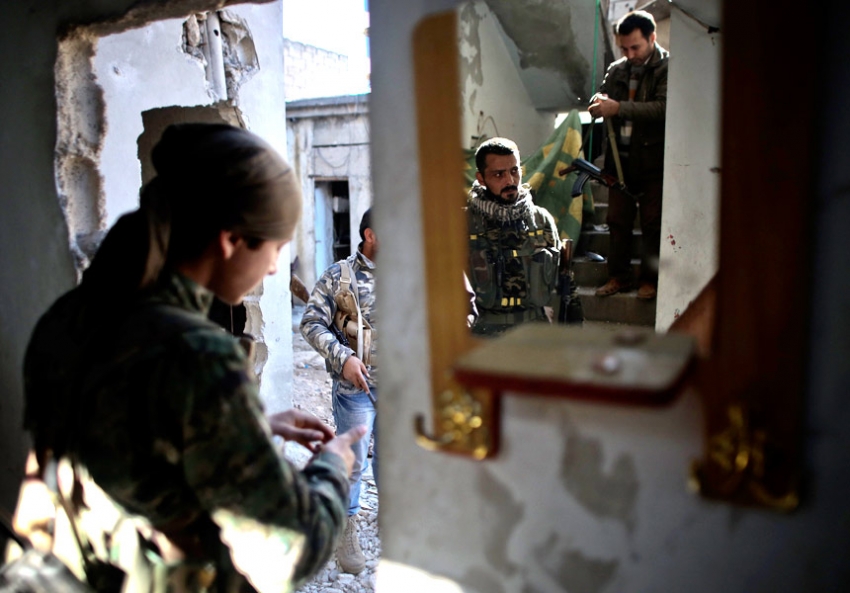
Kurdish fighters in the besieged Syrian city of Kobani prepare to fight against ISIS on November 7. The Kurds are receiving U.S. military aid. (Ahmed Deeb/AFP/Getty Images)

Most U.S. leftists say yes. But voices we rarely hear—Kurds and members of the Syrian opposition—have more ambiguous views.

BY DANNY POSTEL

To consider ending the war, which is what all of us want, without considering what’s at the root of this entire monstrosity—which is the Assad regime itself—is unacceptable.

ISIS (or ISIL, or the Islamic State) sent shock waves through the Middle East and beyond in June when it seized Mosul, Iraq’s second-largest city. The organization has now laid claim to a swath of territory “stretching from Baghdad to Aleppo and from Syria’s northern border to the deserts of Iraq in the south,” in the words of Patrick Cockburn, author of The Jihadis Return: ISIS and the New Sunni Uprising.

In August, the United States assembled an international coalition (eventually including more than a dozen countries) to conduct a campaign of air strikes on ISIS positions in Iraq, coordinating with Iraqi and Kurdish Peshmerga forces. Then, in October, the coalition expanded the intervention into Syria, coordinating with Kurdish fighters on the Syrian-Turkish border and Free Syrian army forces.

American progressives have been relatively uniform in opposing the intervention against ISIS. But to most Kurds and many Syrian activists, the intervention is more welcome. Turkish and Syrian Kurds along the border watch the battles against ISIS from hilltops, breaking out in cheers and chanting, “Obama, Obama.” Within the Syrian opposition, one finds a range of perspectives—some support intervention, others oppose it, and many, like the Syrian leftist intellectual Yassin al-Haj Saleh, are torn. In late September Saleh told me,

On the one hand, I would like to see this thuggish gang wiped from the face of the earth. ISIS is a criminal organization that has killed thousands of Syrians and Iraqis while leaving intact another criminal organization—the Assad regime—that is responsible for the deaths of close to 200,000 people. ISIS has destroyed the cause of the Syrian revolution as much as the Assad regime has destroyed our country and society. On the other hand, an attack against ISIS will send a message to many Syrians (and Iraqis and other Arabs) that this intervention isn’t about seeking justice for heinous crimes, but is rather an attack against those who challenged Western powers. This will lead to more resentment against and suspicion of the outside world, which is the very nihilist mood on which ISIS capitalizes and profits.

Some Syrian activists question how committed the Kurds are to toppling the Syrian dictator. The Kurds, for their part, distrust Turkey, which supports the Syrian opposition. These debates and dynamics are mostly unknown to American progressives.

Given that ISIS and the intervention against it directly impact the peoples of the region, it behooves us to know what they have to say about it. So when In These Times asked me to convene a roundtable discussion on the ISIS intervention, I saw it as an opportunity to bridge this gap—to explore some of these contending perspectives and stimulate a conversation between U.S. progressives and some of our Syrian and Kurdish counterparts.

Richard Falk has been one of the leading voices of peace and human rights over the last half century. He was the UN’s Special Rapporteur on Palestinian Human Rights and a member of the Independent International Commission on Kosovo. His blog, Global Justice in the 21st Century, is a constant source of thought-provoking and self-reflective analysis. His essay in The Syria Dilemma, the book I co-edited with Nader Hashemi, is among the most thoughtful and challenging arguments about the Syrian tragedy I have read.

The Kurdish region of Rojava in northern Syria has been likened to the Zapatista autonomous territories of Chiapas and has inspired  international solidarity efforts with its experiment in democratic autonomy . The anarchist writer and activist David Graeber has written a forceful plea to stand with the beleaguered Kurds as they fight for their lives. With Graeber’s help I reached out to Alan Semo, the UK representative of the Kurdish Democratic Union Party (PYD), to get his perspective on the ISIS intervention.

I also deemed it essential to include a Syrian opposition voice in the discussion. There has been and remains deep confusion about the Syrian conflict amongst many leftists. So I reached out to Rime Allaf, who serves on the board of directors of The Day After Project, an international working group of Syrians building toward a democratic transition in Syria. She is a former advisor to the president of the National Coalition of Syrian Revolution and Opposition Forces and former Associate Fellow at London’s Chatham House think tank.

There are few people I hold in higher regard than Rafia Zakaria, a lawyer, board member of Amnesty International USA, columnist for Al Jazeera America and the Pakistani newspaper Dawn, and the author of The Upstairs Wife: An Intimate History of Pakistan (forthcoming in February from Beacon Press). Rafia brings both an international human rights perspective and the painful knowledge of what U.S. military intervention, in the form of drone strikes, has wrought in her part of the world.

Richard, with only one or two exceptions (notably Kosovo), you have opposed U.S. military interventions for the past 50 years. As someone who has opposed those interventions as a champion of self-determination—especially self-determination for formerly colonized peopleswhat do you make of the current U.S. intervention against ISIS? And specifically, the siege of Kobani and the Kurdish resistance against ISIS along the Turkish-Syrian border?

Richard: It’s a tough question. We need to contextualize this a bit further. In my view, there is no basis for the United States to play a constructive role in this region. Its role in Iraq and Syria—much less, Israel, Palestine, Egypt and elsewhere in the region—figures into an overall strategy of dominating the region and supporting highly reactionary forces in the Gulf, particularly Saudi Arabia. The notion that the United States can be a liberating actor by narrowing the focus to one specific battle site isn’t convincing to me. The plight of the Kurds in Kobani and their courage in resisting ISIS poses a tragic predicament that does challenge the kind of anti-interventionism that I feel is justified overall, particularly in the Middle East. But to overcome the presumption against military intervention, especially from the air, one needs very powerful evidence. And one needs a full-fledged diplomatic initiative, which I see lacking so long as Iran continues to be excluded from any effort to resolve the Syrian conflict. Like the drone attacks, the ISIS intervention doesn’t seem designed to actually deal with the problem. Rather, it looks like a projection of U.S. power in the region.

Where do you stand on the intervention, Rafia?

Rafia: I oppose it. Look at what the U.S. has done in South Asia in the past ten years. As someone who has covereddrone attack after drone attack in Pakistan, I can tell you that the dynamics are very similar. When the U.S. began its drone campaign in north and south Waziristan, where the Taliban were headquartered, there was a lot of support from Pashtun tribal leaders, similar in a way to the current situation between the Kurds and ISIS. The narrative was that the drone attacks were empowering the indigenous people of area who were facing incursions from the Taliban. It’s been beyond a miserable failure. The drone attacks have led to the displacement of hundreds of thousands of people. Whenever you have communities that are displaced—and this is precisely what is happening in Syria and Iraq as a result of ISIS incursions and the airstrikes against ISIS—their social mechanisms, their political allegiances, their forms of governance all collapse. Once that happens, those populations are far, far more vulnerable to being recruited by groups like ISIS. Or they become disenchanted with any effort to rebuild or organize. The consequence of intervention is displacement. And the consequence of displacement is further civil war, which is what you have in Pakistan right now.

Syrian activists have expressed a range of views on the intervention against ISIS. Rime, how do you see it?

Rime: I very much share the ambivalence of Yassin al-Haj Saleh. Many of us in the Syrian opposition do. Everything that has happened in Syria was predictable—and indeed was predicted. The rise of these Islamist terror groups…before they became an organized entity calling itself ISIS, they were smaller groups fighting in various areas in Iraq but mostly in Syria, where they had free reign because the only forces fighting them during roughly their first year on the scene [2013] were the Free Syrian Army. The FSA—the bulk of the Syrian armed opposition to the Assad regime—thus found itselffighting two very brutal forces, the Assad regime on one side and these Islamist groups on the other—and those two forces were not fighting each other. This is an essential point. It was inevitable that this would weaken the opposition and strengthen the regime. Because the Assad regime was not attacking this Islamist plague, it was to be expected that these terror groups would gain ground. They had help from al-Qaeda type groups in Iraq. Plus they had the advantage of their enemies [the FSA] being bombed relentlessly by the Syrian regime. So they gained strength.

Let’s be very clear that for the longest time, the Syrian opposition was not asking for a “boots on the ground”-style intervention, or even for a bombing campaign led by the U.S. What was being requested early on was the establishment of humanitarian corridors with the help of a “no-fly-zone” and/or weapons for the FSA to defend liberated areas from the relentless barrel bombing campaign of the regime. Since none of this happened, it was to be expected that these Islamist groups have been able to gain so much ground and find themselves with a weakened opponent in the FSA. Now the Assad regime doesn’t even need to worry about ISIS because it’s got the U.S. fighting [ISIS].

Alan, where does the Kurdish Democratic Union Party (PYD), which you represent, stand on the U.S. intervention against ISIS? The PYD has opposed external military intervention in the Syrian conflict, but hasn’t the Kurdish struggle against ISIS benefited from the coalition airstrikes?

Alan: I think the American-led international intervention against ISIS has been efficient. The Americans realized that the expansion of ISIS is serious and threatens the region—it has to be stopped and eliminated. The U.S. has been relying on air strikes alone, and they know they need troops on the ground. The forces on the ground fighting ISIS in northern Iraq and now in Kobani, in northern Syria, are Kurdish troops. They have been defending themselves very efficiently against ISIS, which is a real threat to the region. So I think eliminating this threat is the right step, both for the Syrian people and for regional security and stability.

Rime: From January roughly until the summer, what happened is that ISIS was allowed to spread its terror throughout the Jazira region of Syria without any intervention of any kind from outside Syria—or within Syria. The only people fighting them were the Free Syrian Army—alone, without ammunition. So I agree with Alan that the intervention is proving useful, but only up to a point. It is proving useful in a very limited area, and—this is critical—it is not tackling the origin of this plague, which is the Assad regime.

Alan: Now, Kurdish forces are working together with some sections of the Free Syrian Army and other forces in northern Syria.

The Centre for Humanitarian Dialogue, a Geneva-based organization, has recently put forward a proposal to end the Syrian conflict that includes the creation of a Peace and Reconstruction Authority that would implement local ceasefire agreements and serve as an interim governing authority. The report also suggests that once a deal has been struck, the Assad regime and the Syrian opposition could focus their energies on fighting ISIS. What do you make of this idea?

Rime: It’s an absolutely obscene proposition because it takes the position that anything is better than ISIS, whereas most Syrians view ISIS and the Assad regime as being on an equal level of savagery. Many Syrians will tell you the Assad regime is actually worse than ISIS and has killed far more people.

To consider ending the war, which is what all of us want, without considering what’s at the root of this entire monstrosity—which is the Assad regime itself—is unacceptable. To propose that in order to end ISIS we have no choice but to work with Assad is not a solution at all.

Alan: At the end of the day, we have to end Syria’s war. To end the war requires a solution on three levels: the internal balance on the ground inside Syria; the regional circumstances; and the international level. I believe the will of the Syrian people has been hijacked by regional powers and by global powers—America and Russia. But the Syrian people have to determine their own destiny. The Syrian opposition has to be united. And they have to have a clear vision of how they can end this war. I do not agree with Rime’s statement that you have to fight the regime before fighting ISIS.

Rime: I did not say that. I said that you can’t just get rid of ISIS. You cannot just get rid of Assad. You have to get rid of both.

Alan: The Syrian people are defending themselves. They are fighting against ISIS. The people of Kobani have been protecting themselves for two months with their limited resources.

Rime: But the coalition’s airstrikes are helping them. For three years Assad has been dropping barrel bombs on civilians and yet no help has come from anybody. But now you have the coalition bombing ISIS, which helps the Kurds in Kobani to defend themselves.

Richard, what do you think of the idea of a Peace and Reconstruction Authority?

Richard: I think that a proposal of this sort is somewhat suspect given both how it originated and what it’s proposing, because it’s really a plea to, in effect, enlarge the anti-ISIS military coalition. I agree with what Rafia said earlier, that bombing only contributes to destabilizing the whole underlying reality. And we still have to address why Iran hasn’t been brought into the process as a major political actor that needs to participate in any kind of diplomacy to resolve the Syrian crisis.

I think there are desirable elements [in the Centre for Humanitarian Dialogue proposal], such as trying to respect the ceasefire, but it overlooks the complexities and contradictions that have emerged in the Syrian conflict. To try to solve the problems of the Middle East from above is very unlikely to have constructive effects.

Finally, there’s an absence of political imagination. The American approach has become so militarized over such a long period of time that it’s just about incapable of thinking outside of the military box. It therefore keeps reinventing a military solution to essentially political problems—and is undeterred by a record of failure because it’s the only way it knows how to project its power. The U.S. is so addicted to hard-power ways of behaving in the world. It has very little credibility in my view—even when you narrow the focus and it looks like it’s better to help those beleaguered in Kobani than to ignore them. That’s why I say it’s a tragic predicament: Every alternative is repugnant under these conditions. I’ve always felt that when all alternatives are repugnant the one point of moral clarity is, don’t add to the killing. And, echoing what Rafia said, don’t add to the displacement, which is subverting any possibility of benevolent political reconstruction.

Danny Postel is Associate Director of the Center for Middle East Studies at the University of Denver and co-hosts its series of video interviews with leading scholars. He is the author of Reading “Legitimation Crisis” in Tehran  and co-editor of The People Reloaded: The Green Movement and the Struggle for Iran’s Future and The Syria Dilemma, which was named one of the best books of 2013 in The Progressive. He is a co-editor of PULSE and blogs for Truthout, Critical Inquiry and the Huffington Post. He was a member of Chicago’s No War on Iran coalition, communications coordinator forInterfaith Worker Justice, and communications specialist for Stand Up! Chicago, a coalition of labor unions and grassroots community organizations.

source via PULSE

As If…

November 30, 2013 § Leave a Comment

the people of Kafranbel understand the game far better than most professional analysts

the people of Kafranbel understand the game far better than most professional analysts

In an article for the National, the wonderful Amal Hanano writes against the illusion that perpetuating the Assad regime can lead to anything other than continuing and expanding war.

In Ambiguities of Domination, political science professor Lisa Wedeen examined the Syrian regime’s rule of domination under then-president Hafez Al Assad.

She noted a dual role for Syrians: both propping up the regime’s propaganda and at the same time subverting its power via the symbols and rhetoric of everyday life and popular culture. This seminal work, published in 1999, a year before Al Assad junior took power, explained to outsiders the inner mechanisms of an authoritative regime. Its relevance is significant today under the shadow of Hafez’s son Bashar and with the fate of a blood-soaked Syria, now in ruins.

In a particularly powerful chapter entitled Acting As If, Wedeen writes: “Power manifests itself in the regime’s ability to impose its fictions upon the world.” The complicity of the people within this imposition enforces the regime’s power of domination. In other words, the regime’s power is mainly constructed by the people’s enacted participation in that very construction.

According to Wedeen: “The politics of acting ‘as if’ carries important political consequences: it enforces obedience, induces complicity, identifies and ferrets out some disobedient citizens …”

Indeed, one of the fundamental ways the Syrian people functioned in the police state was by “acting as if”. Acting as if nothing was going on as Hama was pummeled in 1982. Acting as if they loved the leader even though they were terrified of him.

The tragedy of Bashar Al Assad’s rule is that his father’s construct of complicity has, over the past 32 months, bled far beyond Syria’s borders to encompass the entire region and international community.

As world leaders discuss the merits of the Syrian opposition attending Geneva 2 peace talks without preconditions, they flip the narrative of the revolution. A narrative in which Mr Al Assad is upgraded from a brutal dictator that deserves no more than a cell at The Hague to a potential “partner” in the transitional peace process.

The latest demeaning analysis offered to Syrians is to act “as if” Mr Al Assad maintaining power would end the brutal war that was unleashed by Mr Al Assad himself. Governments act as if dragging the Syrian opposition to the negotiation table without any preconditions will result in a political solution to a raging war. World leaders act as if Mr Al Assad’s cooperation in dismantling his chemical weapon stockpiles is reducing the amount of bloodshed, even as the cluster bombs and scud missiles continue to fall onto civilian populations.


Kafranbel amplifies Amal Hanano's words

Kafranbel amplifies Amal Hanano’s words

As the slated 2014 Syrian presidential election approaches, “Syrians will have their voices heard at the ballot box” is the current refrain of Assad loyalists. As if presidential elections can even be a possibility in a country where over seven million people are displaced. And Mr Al Assad himself acts as if his nomination is not even problematic, to say the least.

For what purpose is all of this acting “as if”? To save Syria from the very regime that created this catastrophe in the first place?

The act of “acting as if”, like the fable about the emperor and his non-existent clothes, twists lies into elaborate truths to the point where even well-intentioned people, including Syrians themselves, are left to wonder: “Should Assad stay?”

Faisal Al Yafai, writing in these pages, approaches the “unthinkable question” of Mr Al Assad remaining in power to save Syria, arguing “all of that could be worthwhile if it ends the conflict”. True, but the most important word in that sentence is “if”.

While Al Yafai rightly points out that no one has any good ideas to end the protracted bloody war, the idea of Mr Al Assad staying in power may just be the worst one.

Most Syrians are worn out by the gruelling violence that has taken a toll on all aspects of life. Most Syrians want peace and stability. If faced with a sincere choice – Mr Al Assad remaining in power in exchange for a ceasefire, the release of all political prisoners, opening humanitarian and medical aid corridors into Syria, and beginning the long process of refugee return – most Syrians would swallow the bitter pill and choose Mr Al Assad. This choice is the result of being left alone to fight two enemies armed by foreign forces with virtually no support. It is a choice of despair.

It is also an unfairly framed choice for one simple reason: Mr Al Assad will never uphold his end of the bargain. Syrian history, old and new, is a reminder of how the Assad regime deals with the people’s dissent. Both father and son have displayed their relentless tactics of retribution. (See Hama, 1982. Or Syria, 2011-2013.)

Making a judgement call based on the grim Syrian present – well over 100,000 dead, thousands in torture cells, millions of displaced and refugees, foreign fighters and extremists battling for foreign ideologies and agendas, mass destruction of cities, towns and villages, an out-of-touch political opposition that is corrupt and impotent, and millions of exhausted Syrians who just want it all to end now – is simply a convenient and careless cop-out.

It’s easy to look at this list of tragedies and claim that saving what’s left of Syria should be the only priority and argue that preconditions to the negotiations will only ensure more stalemate and bloodshed.

Merely glancing at the present is not only naive, it’s immoral. History tells a different story. Stories of mass murder and destruction 31 years ago in Hama, stories of thousands of torture and rape cases, stories of boys whose fingernails where ripped out because they wrote “freedom” on their school walls, stories of enforced policies of “Assad or we scorch the country”, and more recently “Kneel or starve”. Those stories document the despicable and undeniable truth of this regime.

We live in dark times when tyrants are hailed as saviours and martyrs are called terrorists.

History repeats itself – as Hama did before Daraa, and Hafez before Bashar. History also bears witness to the simple fact that sooner or later, every tyrant’s rule ends. In fact, tyrants have fallen over the centuries of our collective civilisation, on this very land called Syria.

Perhaps we will not be able to rejoice soon (or not even for decades) that the Assad regime is finally finished. That will not change one fact: asking for him or his regime to stay will not save lives. Instead, this decision will take more Syrian lives. Thousands more lives.

Deceptive options and skewed choices can be framed as powerful persuasions, as the “last hope” and the “moral choice”. These “solutions for the Syrian conflict” mock the Syrian people’s heavy sacrifices, bloody history, and desire for a peaceful future of freedom and dignity.

If the world has now decided to act “as if”, this complicit world should know that the Syrian people ended that charade 30 months ago. That was their unambiguous choice.

Beyond the dead, tortured, and displaced people; beyond the destroyed cities and scorched landscapes; beyond all what we have lost; does the world really expect Syrians to go back to acting “as if”? As if they loved the illegitimate leader in Damascus? As if the tyrant’s clothes were not soaked with the people’s blood? As if the lies had become the truth? As if history had never unfolded in the terrible ways it did?

As if nothing had happened at all?

Amal Hanano is the pseudonym of a Syrian-American writer

On Twitter: @AmalHanano

source

Iran Shoots Itself in the Foot

By Robin Yassin-Kassab

In August 2012 Egyptian President Muhammad Morsi attended a meeting of the Non-Aligned Movement (NAM) in Tehran. His presence at the conference was something of a diplomatic victory for the Iranian leadership, whose relations with Egypt, the pivotal Arab state, had been at the lowest of ebbs since the 1979 revolution.

Egypt’s President Sadat laid on a state funeral for the exiled Iranian shah. A Tehran street was later named after Khalid Islambouli, one of Sadat’s assassins. Like every Arab country except Syria, Egypt backed Iraq against Iran in the First Gulf War. Later, Hosni Mubarak opposed Iranian influence in Iraq, Syria, Lebanon and Palestine, worked with the US and Saudi Arabia against Iran’s nuclear program, and was one of the Arab dictators (alongside the Abdullahs of Jordan and Saudi Arabia) to warn darkly of a rising “Shi’ite cresent”. Not surprisingly, Iran was so overjoyed by the 2011 revolution in Egypt that it portrayed it as a replay of its own Islamic Revolution.

Iran also rhetorically supported the revolutions in Tunisia and Libya, the uprising in Yemen, and, most fervently, the uprising in Shia-majority Bahrain.

In Syria, however, Iran supported the Assad tyranny against a popular revolution even as Assad escalated repression from gunfire and torture to aerial bombardment and missile strikes. Iran provided Assad with a propaganda smokescreen, injections of money to keep regime militias afloat, arms and ammunition, military training, and tactical advice, particularly on neutralising cyber opponents. Many Syrians believe Iranian officers are also fighting on the ground.

Iran’s backing for al-Assad is ironic because at a certain point the Syrian revolution was the one that most resembled 1979 in Iran – the violent repression of demonstrations leading to angry funerals leading to still more in a constantly expanding circle of anger and defiance; the people chanting allahu akbar from their balconies at night; women in hijabs joining women with bouffant hair to protest against regime brutality.

It was also a massive miscalculation, a lesser cousin to the miscalculations made by Bashaar al-Assad, and one which stripped the Islamic Republic of the last shreds of its revolutionary legitimacy. Like the Syrian president, Iran was popular among Syrians until twenty two months ago, even among many sectarian-minded Sunnis. (So too was Hizbullah, now widely reviled. In 2006, the Syrian people – not the regime – welcomed into their homes a million south Lebanese refugees from Israeli bombing.) It now seems very unlikely that any post-Assad dispensation in Syria will want to preserve Iranian influence. The Free Syrian Army, the anti-Assad Islamist militias, and the Syrian National Coalition all see Iran as an enemy of Syria, not as an honest broker that could help negotiate a transition.

Iranian popularity has also collapsed in the wider Arab world, where its pro-Assad policy has undercut its position more effectively than American or Israeli messaging could ever have done. (James Zogby’s poll was conducted in June 2011, too early for revulsion over Syria to have fully developed, but it nevertheless shows a dramatic decrease in favourable attitudes to Iran.)

Back in August, President Morsi (whose foreign policy has been much more intelligent than his domestic governance) chastised his hosts on the Syrian issue. “We should all express our full support to the struggle of those who are demanding freedom and justice in Syria,” he said, “and translate our sympathies into a clear political vision that supports peaceful transfer to a democratic system.” The Iranian leadership was embarrassed enough to censor this part of Morsi’s speech from its state TV broadcasts.

Morsi also offered the Iranians the following deal: Egypt would develop a warm economic and political relationship with Iran to the extent of championing Iran’s nuclear energy program and opposing sanctions in the international fora. In return, Iran would pull back from its support of the Assad regime.

By its continued support for Assad, Iran in effect rejected the deal. Nevertheless, Morsi set up a four nation contact group – Egypt, Turkey, Saudi Arabia and Iran – which has foundered not only on Iranian intransigence but also on Saudi absences from meetings. (Saudi Arabia has offered rhetorical support and some light weapons to the Syrian resistance; it also sent troops to Bahrain to help put down the democratic uprising there.) Egyptian-Iranian consultations on Syria continue.

Morsi was actually offering something substantial to the Iranians. It’s difficult to see how negotiations involving the Americans could produce better results so long as the US, bound up as it is with Israel’s self-perceived interests in the region, insists on sanctioning Iran’s nuclear program.

This is a great shame. Alongside Russia, Iran is the only power to exert any real influence on Bashaar al-Assad. It is to be hoped that, as the fall of the Assad regime becomes more apparent, wisdom will eventually prevail in Tehran. A volte face even at this late stage would strengthen Iran in its battles with the West and would temper rising anti-Shia sentiment in Syria and the wider Arab World.

– Robin Yassin-Kassab is the author of The Road From Damascus, a novel, co-editor of the Critical Muslim, a quarterly journal which looks like a book, and of www.pulsemedia.org. He blogs at www.qunfuz.com

source

Syria mourns man who might have been

Oct 7, 2012

Damascus // The gunmen walked in on a small political meeting in the northern town of Qamishli, asked for the opposition leader Meshaal Tammo by name and, when he answered, opened fire.

In this image taken from video obtained from Shaam News Network (SNN), which has been authenticated based on its contents and other AP reporting, a fire rages at a medieval souk in Aleppo, Syria. Syrian rebels and residents of Aleppo struggled Saturday to contain a huge fire that destroyed parts of the city's medieval souks, or markets, following raging battles between government troops and opposition fighters there, activists said. Some described the overnight blaze as the worst blow yet to a historic dist

His life, and his assassination a year ago today, encapsulate much about the Syrian uprising, and the frightening underworld of a country now mired in a gruesome conflict. The revolt has inspired revolutionary political vision, hope and generosity of spirit. But it has also unleashed obscene violence, ruthless political calculation, fear and a choking narrative of complexity and conspiracy.

Unlike many well known dissidents – for the most part elderly men seen as out of touch or, worse, as regime patsies by the mass of youthful demonstrators – Tammo, 53, was respected by those risking their lives protesting in the street.

“There are many remarkable activists and dissidents at street level but there’s a big shortage at national level. Meshaal Tammo was perhaps the only one with that kind of potential, to become a statesman,” said a Syrian political analyst who knew Tammo well.

“He is perhaps the only person in the Syrian opposition who you’d look at and think, ‘He could be president one day’, he had that about his character,” the analyst said.

Although himself a Kurd, Tammo wanted none of the special rights demanded by mafia-like Kurdish political groups, and insisted that the answer to the historic persecution of Syria’s ethnic minorities lay in democracy for all, not separatism for some.

He had paid his dues, serving a long jail sentence for political dissent and, having been released, he participated in demonstrations and organised them. Other opposition political leaders stood aloof, preferring to discuss policy in their offices or, better still, in the safety of luxurious hotels in foreign capitals.

Tammo refused to distance himself from the dangers faced by protesters, instead joining the rallies in which unarmed civilians were being shot by security forces.

While a split opposition – renowned for its multitude of preening egos and its dogmatic interpretation of politics – jockeyed amongst itself for position, Tammo worked to create a united platform of those seeking to usher in a new Syria after decades of authoritarianism.

In July last year, he was instrumental in organising a political forum in the Damascus neighbourhood of Qaboun, which, had it gone ahead, would have broken new ground by involving young demonstrators, seasoned political activists and exiled opposition leaders.

A hail of gunfire that killed 16 people outside the meeting hall led to its cancellation.

Tammo wanted to build a modern Syria, founded on a secular legal system, civil rights and citizenship. His solution for the various sectarian and ethnic divisions now tearing at Syria was simple; complete equality for all before the law.

Those qualities – his genuine leadership potential, his push for unity and his refusal to trade in the narrow sectarian and ethnic identity politics lurking so dangerously beneath Syria’s surface – made him a threat to the status quo.

And all of them, to a greater or lesser extent, gave his enemies a motive for killing him.

Openly calling for nothing short of Bashar Al Assad’s overthrow and for toppling the underlying structures of his regime, Tammo was anathema to the Syrian authorities.

By his own account, after the uprising began he had been called in by a particularly feared security chief and threatened in brutally stark terms to stop his activism, or face dire consequences. He had cheerfully answered that he was quite prepared to die for the cause of freedom in Syria if that is what was required of him.

At the same time, he was also anathema to powerful Kurdish political factions, rejecting their strategy of exploiting the uprising to carve out an independent enclave. Syria’s revolution was for all, Tammo said, and its Kurdish minority should stand alongside the Arab opposition and fight with them for nothing more and nothing less than complete equality.

He famously told Kurdish protesters not to fly Kurdish flags at demonstrations, asking them to fly the Syrian flag instead, and he openly sought a close working relationship with neighbouring Turkey, angering powerful Kurdish factions who view Ankara as a greater evil than the Damascus regime.

Old guard Arab nationalists – and they represent a strong sentiment in Syria – were also irritated by Tammo’s suggestion that the country should, in future, define itself as a democratic republic, not specifically an Arab country, for the simple reason that not all of its citizens were Arabs.

And he stood against Islamist militancy, opposing those who called for a state based on Sharia. Only a secular legal system would safeguard Syria’s mosaic of religious and ethnic groups, he said.

No one has ever been convicted of Tammo’s murder. Syrian officials said he had been killed by an “armed terrorist group” and, soon after he died, announced the arrests of 11 men in connection with the case. Nothing has been heard since.

He was one of the few genuinely charismatic opposition figures, a rare mixture of hard experience, energetic youth and political vision, and his story is one of Syria’s great might-have-beens.

If Tammo were alive today, there is a chance – a slim chance no doubt, but a chance nonetheless – that his country would not now be marching so quickly down the path of bloodshed and oblivion.

source

How to Advocate the Capitulation of a Revolution Without Actually Using the Word “Surrender”

September 8, 2012

A few days ago, the Open Democracy website published an article by “Rita from Syria”, a Damascus based Syrian activist. Titled “The FSA: how to lose support and alienate people in no time“, the writer bemoaned the growing trend towards the militarization of the initially peaceful Syrian Revolution. Civilian activists now feel increasingly insignificant and sidelined, unable to shape events. Syrian towns and villages that shelter the Free Syrian Army suffer under increasingly bloody reprisals and punitive assaults by the Assad regime. The FSA is accused of “miscalculations”, and challenged to “win back its credibility”.

The most telling sentence in the entire article is a quote from “Raghda”, a woman who recently lost her job at a publishing firm; “I just want to continue my life. I don’t see an end to this armed conflict. I agree with the rightful demands of the opposition, but if this means bringing a halt to my life then I will stand against them”

Which is as close one can get to advocating capitulation, without actually using the word “surrender”

Let us be clear on one thing; Assad cannot win this fight. He cannot defeat a guerrilla movement that has spread to nearly every single village, town and city in the county. The FSA, with little to no outside support, has managed the grind the region’s largest military into a stalemate. Whereas in Hama this time last year, twenty tanks were sufficient to bring the entire city to heel after the massive demonstrations in the Orontes Square, now those same twenty tanks are the regime’s loses on a good day.

So what’s a tin-pot dictator to do? What every tyrant on the ropes has done; go after the segment of ones opponents lest able to defend themselves. Just as Hitler desperately tried to knock the British out of World War 2 by indiscriminately pounding London with V-1 and V-2 rockets (thereby killing more civilians in England than his army managed to do on the field in the European theaters of war), the regime’s policy and actions has been to subject areas sympathetic to the FSA to the maximum amount of suffering and bloodshed as possible.

If Assad cannot beat the FSA’s soldiers in Aleppo, his airforce bombs their home towns from the air. Eventually, the logic goes, the misery of the civilian population will be so great, that they will discourage or actively deny the FSA shelter and space for movement. In the case of the recently unemployed Raghda, that seems to have worked. The only way the FSA can lose this fight is if enough of the Syrian population become convinced that the losses and suffering are too great, and the prospects for overthrowing the regime too remote.

In any war, the resilience of the societies engaged in war matters as much as the number and quality of arms those societies deploy. Long before Hitler got around to invading France in 1940, a defeatist mentality had already taken hold of much of French political society and its upper military echelons. The Battle of France had been lost long before the first German tanks broke through the Ardennes.

Rita is correct when she writes “FSA leaders should take heed that a guerrilla army can only attain success if it is mindful of its relationship to the people”. However, laying the blame at the feet of the FSA is misplaced, even if it is convenient from Rita’s point of view. No army in the world can protect every civilian center if its opponent engages in a deliberate policy of targeting those areas. It is the FSA’s job to wear down as much of the regime’s military machinery as possible, and it is the civilian opposition’s job to make sure that the regime pays, in terms of political and popular support, as a result of any disproportionate and indiscriminate retribution by the Assad army against the civilian population.

Or maybe scope of responsibilities isn’t so clear cut in the minds of the revolution’s civilian activists. To quote Rita’s article;

“Armed with a deep conviction in our revolution rather than any heavy weapons, the embryonic FSA used to keep watch in the alleys and alert us to the coming of regime forces and the shabiha.”

Alleys. Alleys and side-streets. Defectors, risking their lives by carrying arms to defend a 15 minute demonstration in some alleyway or side-street, the end result of which would be a few minutes uploaded to Youtube or some material for Al-Jazeera to stream. Amazing that the FSA waited so long and so patiently before concluding, correctly, that the regime was never going to fall through flash demonstrations in some darkened neighborhood corner. The civilian activists had plenty of time to make some tangible headway, to provide some accomplishments to justify the thousands of dead, thousands more wounded, and untold tens of thousands of disappeared and imprisoned.

A military aspect of a society only rises in prominence above that of the civilian, when the latter proves utterly incapable of meeting the challenges of the day. If the civilian activists feel sidelined, it is because in the 20 months of the revolution, they have in all honesty provided next to no tangible accomplishments on behalf of the revolution.

The Assad regime is one that has, as the most recent ICG report stated, mutated into little more than a militia. It doesn’t care for the loss of its border points with Turkey, or the loss of the areas in the north east of Syria to Kurdish control, as long as Assad’s core constituency retains power in the ever decreasing areas still under their control. Do the civilian “no arms lets turn the clock back to when we were demonstrating in the side streets” camp have ANY plan or solution to deal with such a regime? Not likely, if present perceptions of the SNC are anything to go by.

What exactly is required of the FSA? To lay down their arms? And will that turn to clock back to the days before the Dar’a protests? Anyone who thinks is is incredibly naive. A regime that triumphed through the use of terror and brute force will feel that the same formula is an acceptable one to apply to maintain power. Periodic mass arrests and show trials will be the norm. Towns and cities that were most prominent in the revolution will be neglected economically, its people cut off from government jobs. Every once in a while a staged car bomb will go off, to keep people on edge and remind them of the ever present danger of a return to the “bad old days” if the regime wasn’t around to “maintain stability”. And in thirty years’ time, little Hafiz will take the reins of power. But hey, at least Raghda got to “live her life”.

Which is the part of the article I personally find most disgusting and reprehensible. Saying that one is for the revolution as long as it doesn’t get in the way of one’s work, career, dates, love-life, TV-shows, is akin to saying that one would like to compete in the Olympics, if it wasn’t for all the hard training required.

Yep, I’d like to buy a house, if it wasn’t for the mortgage payments needed.

I’d like to go to Harvard to study medicine, but damn those SATs and entrance exams are a real roadblock.

I’d looooove to live in a democracy, as long as someone else is doing the heavy lifting and suffering, and a civil and free society is handed to me on a silver plater. Oh, and someone else can vote for me and keep the vigilance and sense of civic responsibility required to maintain any democracy.

One would have thought that the revolution would have at least freed us from the idea that we are entitled to the best the world has to offer without the need to put in any effort. Sadly, we are not all Al-Assads and get to inherit a country from our daddies. To say that one is against the revolution because it has gotten in the way of our lives, is tantamount to surrender. Our will has been broken, the price has become too high to pay. Brute force and tyranny have won, and just as long as the tyrants leave us to return to our miserable existence, we will soon forget the more than 20,000 Syrians whose lives were cut short, or the thousands of wounded and crippled, or the hundreds of thousands of refugees for whom returning will never be an option. People for whom carrying on with their “interrupted” lives is not an option.

If the civilian activists feel impotent, it is because for many months they acted like they were impotent, with only the FSA between them and annihilation at the hands of Assad’s shabihas. For how long was the FSA expected to carry and babysit an ineffectual civilian movement. No one wants to turn to arms as a first choice, but the Syrian Revolution found itself doing so as a result of the situation forced on it. For over a month, Baba Amr in Homs was subjected to massive artillery and tank assaults. The world community yawned a collective yawn and changed the channel. Were it not for the FSA, non of the 24,000 civilians who made it out, or the well known media personalities and foreign journalists trapped inside, would have come out of there.

If the civilian activists want to regain leadership of the revolution, then it is about time they did something to earn the mantle of leadership. The British did not whine and blame Churchill for the destruction wrought by Hitler’s bombers on their cities, and as a result their “finest hour” has become the stuff of legend.

The only way Assad can win this war is if we hand him victory. I myself spent ten days on the edges of Baba Amr while the army pounded the area. My close family has lost two homes, completely destroyed in the fighting. I have relatives who were and are imprisoned. Several distant family members were lost to us. I know full well the burden of taking on a vicious, unrestrained and barbaric regime. If the civilian activists have a better way than the one the FSA is pursuing, no one will be happier than me to hear it.

Otherwise, talk of the FSA laying down its arms is just a not-too-thinly-veiled plea by those whose will have been broken, for the revolution to surrender. I don’t judge people harshly if they feel they cannot carry the burden anymore, everyone has their own circumstances and pain-threshold. But I at least expect them to have the self-respect and decency to call what they are asking for by its proper name; capitulation and surrender to the Assad tyranny. 

SOURCE

Blog at WordPress.com.

Up ↑