Search

band annie's Weblog

I have a parallel blog in French at http://anniebannie.net

Tag

Qunfuz

QUNFUZ

The Background

Security prisons, and the terror they inspire in the Syrian population, have underpinned the Assad regime’s rule from the start.

The history of such prisons stretches back before Hafez al-Assad’s seizure of power in 1970, though his regime expanded and intensified the system. From 1946 on, Syria was racked by a series of military coups and counter-coups, interspersed with brief episodes of parliamentary democracy. Whenever a coup succeeded, the new rulers would round up the previous government and its supporters and detain them in prison.

The numbers of people held in security prisons increased during the United Arab Republic (UAR) of 1958 to 1961, and the conditions of detention worsened. The UAR brought the Syrian and Egyptian states together under the dictatorship of the Egyptian president, Gamal Abdul Nasser. Abd al-Hamid al-Sarraj, Nasser’s preferred Syrian secret policeman, is credited with introducing two particular torture methods to Syrian prisons during this period: the doulab, or tire, in which victims are stuffed, and then whipped; and the shabah, or ghost, by which victims are strung by their wrists from the ceiling for hours or days. Both methods are still applied in the Assad regime’s prisons today. ISIS inherited them from Assad, and also routinely applied such tortures in its own security prisons.

The UAR was widely seen as an economic as well as a political disaster, and was soon ended by a coup led by conservative army officers. When, in turn, a secret Military Committee of Baathist officers seized control in March 1963, it quickly set about rounding up and detaining those it considered a potential security threat. These included first the conservative officers who had seceded from Abdul Nasser’s UAR, then supporters of Abdul Nasser, then anyone who dissented from the ruling party’s line. As the Baathists had banned all media and all forms of civil organization beyond Baath Party control, this category covered many members of civil society.

READ ON HERE

Free Syria’s First Days: Good, Bad and Ugly

Qunfuz

Robin Yassin-Kassab

leave a comment »

This was published at the New Arab (link here)

We feared the regime’s end would be accompanied by a bloodbath. Thank God, that hasn’t happened. In the end the regime collapsed without a fight, even in its supposed heartland on the coast.

There has been some looting in Damascus, which has been somewhat more chaotic than the northern cities, perhaps because there has been a smaller rebel presence. Otherwise, the news coming from liberated Syria has been surprisingly good.

On the social level, Syrians are talking the language of reconciliation. One typical video shows a bearded rebel admonishing surrendered regime fighters for standing with the side that slaughtered women and children. Then he tells them, “Go! You are free!” The rebels have issued a general amnesty for military personnel. This does not extend to those guilty of war crimes and crimes against humanity. The intention is to hold those people to account.

Meanwhile, Muhammad al-Bashir, who was the prime minister in Idlib’s Salvation Government, has been appointed to form a Transitional Government in Damascus. The Salvation Government ruled in HTS territory, but was civilian, largely technocratic, and fairly independent. It looks as if a similar logic is going to apply to the Transitional Government.

Having shed his nom de guerre, Abu Muhammad al-Jolani is now known by his real name, Ahmad al-Sharaa. Instead of ‘leader of HTS’, he has been rebranded as ‘commander of military operations’. He wants to be seen as a national figure rather than a Sunni jihadist. Some fear that he will change direction as soon as western states stop branding him a terrorist, but for now at least his direction is tolerant and democratic. Rebels have been told not to interfere in women’s clothing choices, for instance. And prominent opposition figures say that UN Resolution 2254 will be implemented. This will involve drafting a new constitution and holding free and fair elections under UN supervision.

So far so good. All of it inspires confidence in Syrians at home as well as the millions who were driven from their homes. Huge streams of people are leaving the tented camps on the country’s borders, and returning from Turkey and Lebanon, where so often they were subjected to racist abuse and violence. The result is thousands of emotional reunions between siblings, or between parents and children, who in many cases haven’t seen each other in over a decade. This is a blessing that nobody expected a fortnight ago, and it culminates a drama that has lasted almost 14 years. In 2011, millions of Syrians screamed Irhal! – Get out! – at Assad. His response was to drive them out instead. But today, at last, the Assad family are the refugees.

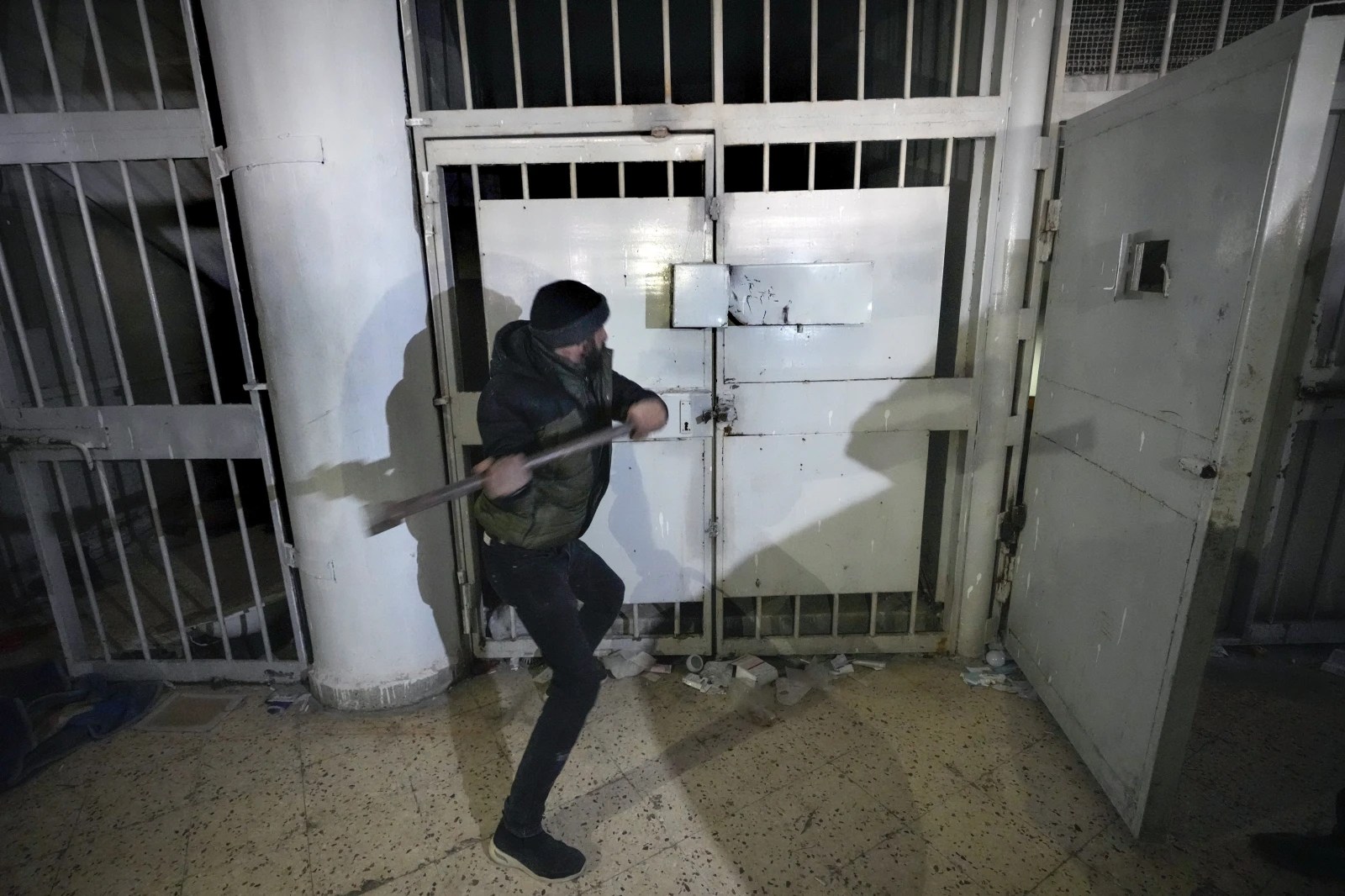
It’s also very good that tens of thousands of prisoners have been liberated from Assad’s dungeons. But it’s bad – profoundly depressing, in fact – that so many are in such a bad state. Lots of women and children have been found behind bars. The children were either arrested by the regime along with their parents, or were born in these dungeons to mothers who had been raped.

Some people have been found who were presumed to be dead. Many Lebanese have been liberated, and Jordanians and Palestinians, including Hamas members. Some of the prisoners had been “behind the sun”, as Syrians say, for over four decades. Some who were liberated thought Hafez al-Assad was still president (he died in 2000). Many of those coming blinking into the light are emaciated or disabled by torture. Some seem to have lost their memories or their sanity.

The worst images are coming from Sednaya Prison. Amnesty International called Sednaya ‘the human slaughterhouse’, and estimated that between 5,000 and 13,000 people were extra-judicially executed there between September 2011 and December 2015 alone. It now seems the total numbers of murdered are much higher than that.

At least 130,000 people were estimated lost in the Assadist gulag. Fadel Abdul Ghany, head of the Syrian Network for Human Rights, said yesterday (December 9) he believes that the vast majority of prisoners have been murdered.

The well-known activist Mazen Hamada has been found dead in Sednaya. Rooms full of discarded clothes and shoes, presumably belonging to the murdered, have been discovered. One room was filled with bags of noosed rope, for hangings. An ‘execution press’ for crushing bodies has been found, and a mass grave packed with bodies partially dissolved in acid. Piles of corpses have also been uncovered at Harasta Military Hospital. It is thought that these people were murdered at Sednaya, and then their bodies moved. It seems that very many were murdered very recently, even as the regime was collapsing.

After over half a century, Syrians are finally emerging from the horror of one of history’s worst torture states. The legacy of death camps like Sednaya is added – along with the cratered economy and the war-ravaged infrastructure – to the list of traumatizing challenges facing the country. Syrians need help, solidarity and understanding from the rest of the world.

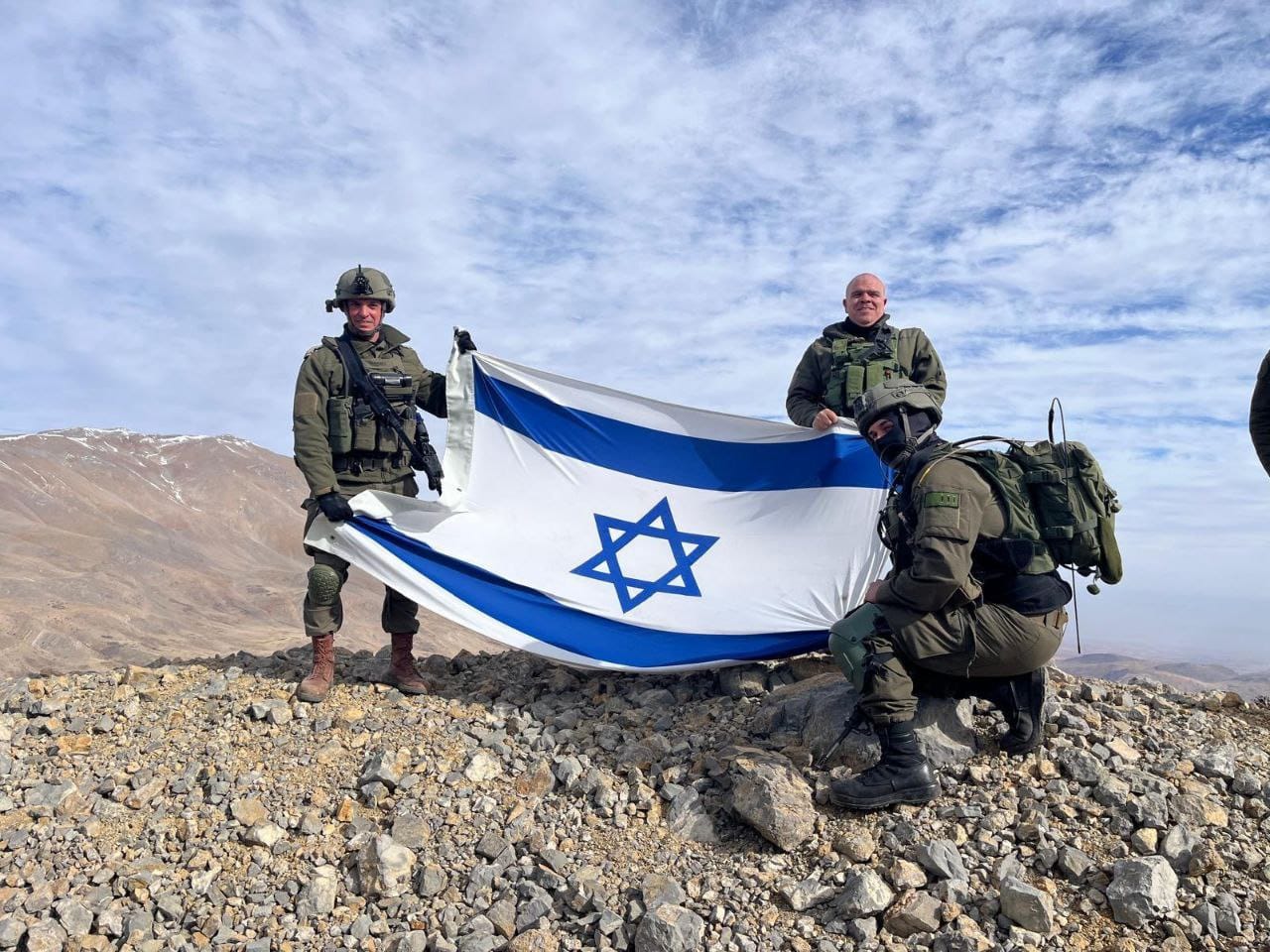
Zionists advancing into Syria.

But what is the ill-named ‘international community’ giving Syrians instead?

Israel – armed by the US, UK, Germany and others – is giving them crazy bombing. The Zionist state has struck hundreds of targets, not only weapons sites – so that a free and independent Syria will be defenceless – but also buildings containing documentation. It aims to destroy, one must presume, evidence of its collaborations with the regime, and perhaps its American ally’s collaborations too.

Israel is also advancing further into the Golan Heights, creating ‘a buffer zone’ to protect the illegally occupied territory which Bashar’s father Hafez al-Assad withdrew from without a fight in 1967 (he was defence minister at the time). The Assad regime under both father and son protected Israeli security on the border better than the states which had signed peace agreements with Israel. The regime also locked up any Syrian who organized against Zionism in any way at all. One of the prisoners freed yesterday was Tal al-Mallouhi. Tal was arrested in 2009, aged 19, merely for writing poems and blog posts which urged solidarity with Palestine. This is why the fall of Assad has enraged Israel.

No western power has condemned Israel’s unprovoked assault on free Syria. They have made their enmity to Syrians clear from the first minutes of the liberation. And this potentially makes all of our futures not just bad, but very ugly indeed. May the Syrian people prevail.

Share this:

Arabs Without God

Qunfuz

Robin Yassin-Kassab

Arabs Without God

with 2 comments

isis-flagThis was first published at NOW.

In the Arab world, the public declaration of religious disbelief is as taboo as the open profession of homosexuality. Publically-declared atheists and agnostics can wave goodbye to social respect, marriage prospects, even legal recognition. Yet a 2012 poll in Saudi Arabia – a state whose legal system equates atheism with terrorism, and which potentially applies the death penalty to apostates – found that 19% described themselves as ‘not religious’ and a further 5% as atheists.

In his new book “Arabs Without God: Atheism and Freedom of Belief in the Middle East” (soon to be translated into Arabic as ‘Arab bala Rab’) journalist Brian Whitaker interviews activist and quietist unbelievers from around the region, and investigates the pressures ranged against them. Most usefully, the book provokes a question – how can a revived Arab secularism (freed from the taint of the so-called ‘secular’ dictatorships) provide a future in which the rights of religious majorities as well as unbelieving or sectarian minorities will be respected and strengthened?

Demands to believe and submit go far beyond religion. Whitaker quotes sociologist Haleem Barakat, who noted that, like God, the Arab head of state and the Arab family patriarch require absolute respect and unquestioning compliance. “They are the shepherds, and the people are the sheep.” (This is why ‘rab’ – which means ‘Lord’ rather than only the monotheist God – is as apt a translation as ‘Allah’ for the book’s Arabic title). So intellectual atheism is perceived as an attack on family and state, and on community solidarity. The contemporary politicisation of religious identity makes unbelief akin to treason in some minds; for this reason minority sects, dissenters and atheists are frequently seen as fifth columnists, agents weakening state and nation on behalf of foreign powers.

Identity politics in the region took on its modern forms with the building of centralised nation states. Nationalism itself was an assertion of a politicised cultural identity, first against the Ottomans, then against the European empires. For the new rulers of post-independence states, a fear of disloyal communities turned to a generalised rage for homogeneity – ‘the good citizen’, depending on where they found themselves, was to be an Arab, or a Muslim, (or a Turk, or a Jew) as imagined by the state. Many states standardised dress, dialect and worship.

The state’s top-down approach to culture is infectious. Opposition groups too, whether nationalist, leftist or Islamist, have sought to emulate the rulers by seizing control of the state apparatus and imposing their vision from above.

Whitaker points to the failure of secular nationalism as demonstrated by the 1967 war as a turning point. Certainly the often-posed dichotomy between ‘secular’ dictatorships and activist Islamism is a false one – it was during the reign of the security states that Salafism came to dominate, for a variety of reasons. Some – like rapid urbanisation and population explosion – would have applied anyway; other factors were a direct result of oppression. Leftist and democratic alternatives were silenced or eliminated. Islamism was sometimes co-opted, usually repressed, and never combatted on the level of ideas. The European association of secularism with freedom of thought and expression never existed in the Arab states. Secularism didn’t mean the irrelevance of private belief to citizenship but the intrusion of the state into private life.

In Syria, a rhetorical secularism coexisted with a reality in which the regime’s security chiefs were overwhelmingly drawn from the Alawi sect. Public discussion of this fact was taboo, as was any public examination of the differences between the sects. As a result, the unlanced boil of sectarian resentment seethed in secret.

After the Muslim Brotherhood challenge of the 1980s had been put down in blood, concessions were sometimes made to reactionary Islamist demands – to ban certain books for example – and photogenic Islamist violence was sometimes allowed or encouraged as a message to threatening foreign powers. In the wake of the 2006 Danish cartoons affair, for instance, an angry crowd was permitted to attack the Norwegian and Danish embassies in Damascus. More significantly, Damascus facilitated the passage of jihadists to US-occupied Iraq, calculating that an Iraqi bloodbath would deter the Americans from Syrian regime change.

Today Iran and Assad on the one side and Sunni jihadists on the other exploit sectarian identity to rouse the cannon fodder they require to implement their respective authoritarian projects. The extremes on both sides feed off each other. Assad released hardline Salafists from prison in 2011 (simultaneously targetting non-violent, non-sectarian activists for assassination) because he knew their acts and rhetoric would terrify minority groups into loyalty to his regime. And the Sunni jihadists love the presence of Iranian, Iraqi and Lebanese Shia on the battlefield, because it reinforces their narrative – that Syria is not engaged in a revolutionary war for democracy and self-determination, but in a defensive war against an international Shia conspiracy.

No section of the people profits from this cruel game. In the Alawi community perhaps a third of fighting age men are dead, sacrificed to a dying dictatorship. An enormous proportion of the Sunni population has been killed, injured, imprisoned or displaced. And unless Syrians can surpass the identities fashioned for them by policemen and war lords, their country faces a future of sectarian dismemberment.

But the potential alternative can be found in Syria too, in the councils and committees in which local people cooperate on the practical business of living, to provide themselves with education, sanitation, and health care in the absence of the state. Most people involved are religious, but this self-organisation, where it works well, is a pure and natural form of secularism. Everyone is entitled to their personal, ethnic and sectarian identity, and of course to their spiritual beliefs. But these ties are largely irrelevant when neighbours organise on specific issues.

The Iraqi civil war, the regional counter-revolutions, the rise of Daesh and the failure to contain it – all these are examples of how the old identity politics have failed the Arabs in general, foiling specifically their desire to live free and dignified lives. True believers as much as atheists have been exploited, oppressed and murdered by political actors claiming religious or sectarian authority.

Disgusted by the political uses of religion, today a surprising number of Syrian activists admit privately to atheism, or at least mistrust of organised religion. And many more religious activists than before understand the importance of freedom of thought. When, for example, the Aleppo-based activist Basel al-Junaidi was briefly detained by militia for speaking out for secularism, Islamist as well as secular activists protested for his release.

In any case, it seems very unlikely that tormented Arab societies are about to lose their religious character. Brian Whitaker quotes Phil Zuckerman’s conclusions after studying UN Human Development Index data: “Societal health seems to cause widespread atheism, and societal insecurity seems to cause widespread belief in God.” This observation doesn’t of course disprove religion, but it does suggest why Arab societies are, outwardly at least, so much more religious than half a century ago.

p.s. https://youtu.be/5W1XXMPgG8M

A Trip to the Border

Qunfuz

Robin Yassin-Kassab

I’ve just returned from a brief visit to the Syrian/ Turkish border, to the Salaam School for refugee children in Reyhaniyeh on the Turkish side, where I was working with the Karam Foundation, and to Atmeh camp inside Syria, where almost 30,000 people are sheltering from the slaughter. Northern Syria is dotted with similar camps.

You can view pictures from the trip here.

1521519_10202631658611539_1315852872_n

Something that doesn’t come across in the pictures is how cold it is. Snow was lying on the ground in Atmeh the day before I arrived, and a child had frozen to death. I’ll be writing about my experiences and some of the stories of the people I met. In the meantime, here is the trip summed up by my Facebook status updates:

December 6th – the first stage of my trip to the turkish-syrian border involved being examined at edinburgh airport under schedule seven of the terrorism act (2000). To this the failed human beings of east and west have reduced the syrian people’s revolution.

drank tea and ate knafeh with the teachers of the Salaam School in Reyhaniyeh. very inspiring to see the organised hard work that’s gone into fitting new walls into a villa (and building an olive grove) to make a school which serves over a thousand refugee children. forget Assad, ISIS, and the Coalition – the future of Syria belongs to self-organised and committed Syrian women and men

December 7th – Assad forces backed by foreign Shia terrorists have executed dozens of civilians in Nabk. Watch the silence of the Western media, which seems to have no problem with terrorism and religious extremism when it seeks to preserve the status quo.

December 8th – there are the blue hills of syria, as ethereal as the future, so near and yet so far

December 9th – among the children’s chosen heroes in my storytelling workshop were Robin Hood, Batman, my brother the martyr, my father the martyr, and Sponge Bob. Among the problems to be solved were a dinosaur eating people, a car hitting a pedestrian, my house being shelled, and my cousin stuck in prison.

1000 days of the Syrian people’s revolution. 1000 days of Assad’s genocide. 1000 days of the world’s powers enabling the genocide directly or indirectly. A third of the population homeless. Thawra hatta an-nasr…

tonight the temperature’s at freezing point. a few miles away thousands of children are sleeping in plastic tents or under trees.

December 10th – Razan Zaitouneh

two men from Saraqeb, Idlib province are here with us. One of them lost his mother, grandmother, sister and brother to regime bombing on 15/09/2012 (he was also in the house at the time). these two are part of a team which publish various independent magazines, including Zeitoun wa Zeitounah, a children’s magazine. i saw a copy today. on the front it reads: ‘I have the right to express myself.’ of course the notion of free expression was forbidden by the regime for over four decades. the publication of such magazines is a sign the revolution has already succeeded, alongside the accumulating tragedy.

You sit abroad and read about the regime’s genocide, ISIS’s barbarism, the criminality of some of the free army militias, and you despair. You come near to the heart of the tragedy, a tragedy too enormous to comprehend, and you experience hope and love and inspiration. The struggling Syrian people, the women and men and children, are the most articulate, the warmest and brightest, the kindest and most sensitive, the bravest and most persistent people in the world. Borders and nationalities don’t mean much to me, but I’m enormously proud to be Syrian. I’ve never been prouder.

December 12th – there’s nothing wrong with dancing

I was talking to a teacher today. Her husband was an officer in the Syrian army. He defected because he didn’t want to murder his neighbours. He was captured. Seven months ago he died under torture. His body was thrown in a mass grave. Everybody has a story from this genocide.

December 14th – Atmeh camp, just inside Syria, and nothing has changed for the better since my last visit. More refugees now, less hope of imminent return, and instead of hot, dust-laden wind, melting snow and cold red mud. Despite it all, the people’s hospitality is extreme. People who own almost nothing serving glasses of tea and offering lunch.

spent the evening with a young doctor who worked in a field hospital in kafr batneh, the eastern ghouta, damascus suburbs. the regime has targetted bakeries, schools and hospitals in particular. after the plane fired its missile the doctor found himself swallowing dust, between life and death, trying to make sense and direction of the screams. that was a year and a month ago. he’s recovered, but has a hundred scars on his body and more on his mind. everybody has a story.

December 15th – spent the morning with a woman from Homs whose husband was tortured to death. his body was returned with bullets in the legs, chest and head, covered with burns, and missing chunks of flesh. the widow stayed in Homs until a missile hit her house. she showed me her broken arm and her son’s arm tatooed with burn scars. her little daughter sat listening to the story, which she witnessed, and which she must have heard recounted a thousand times.

something I won’t forget is the biting, burning, bone-deep cold, and the children in the camp in plastic sandals, no socks.

December 16th – I’m preparing to leave, inspired (by the persistence of the Syrian people) and depressed (by the slow death of Syria) in equal measure. I believe our team has made some difference to the children we worked with, and I will write the stories of some of the people I met, but all this is a blue drop in a red ocean of suffering which will continue to expand so long as the fascist regime and its backers are enabled to continue the genocide. The genocide is the prime story, not the Islamist extremism or sectarianism which have been deliberately engineered by the regime. The solution is ultimately not humanitarian, but political and military. In the coming decades we will all pay the price for ignoring this fact.

it doesn’t end. the cab driver who took me from Aziz’s place in Antakya to the airport is from Lattakia and happens to know my family. He and his 15-year-old son were arrested together. “They beat my son until he was nearly dead. They beat me until I wished I were dead.” In a cell with 50 others and a hole in the floor as a toilet, which they had to use in front of each other. Nobody was able to wash in the two months that he was inside. Two months of beatings, insults, humiliation, and near starvation. Then father and son were released, for which he thanks God profusely, because “so many die in their prisons.” Everybody has a story.

Dubious Wisdom

Qunfuz

Robin Yassin-Kassab

leave a comment »

monsterI wrote this review of Bente Scheller’s book for al-Jazeera.

Syrian poet Rasha Omran once told me that Bashaar al-Assad is “not a dictator, just a gangster boss.” But really he’s not even that. What he is, is what his father looked like in all those statues – one element in the managerial class, a (dysfunctional) functionary. Syria is a dictatorship which lacks an efficient dictator.

Hafez al-Assad – the father – was an entirely different matter. Born in a dirt-floor shack, he clawed his way to the top by brute cunning, deft flexibility, and strategic intelligence. The careful manipulation of sectarian tensions in order to divide and rule was one of his key strategies, yet he was also attentive to building alliances with rural Sunnis and the urban bourgeoisie – both constituencies now alienated by his son. Bashaar’s great innovation was supposedly economic reform. In practice this meant an unpleasant marriage of neoliberalism with crony capitalism. It succeeded in making his cousin Rami Makhlouf the richest man in the country. The poor, meanwhile, became much poorer, the social infrastructure crumbled, and unemployment continued to climb.

The thesis of former German diplomat Bente Scheller’s book “The Wisdom of the Waiting Game” is that the Syrian regime’s approach to its current existential crisis follows a “narrow path consistent with previous experience,” and she focuses on foreign policy to make this point. When the regime found itself isolated on Iraq after the 2003 invasion, for instance, or then on Lebanon in 2005 after the assassination of Rafiq Hariri and the Syrian army’s precipitous withdrawal, it waited, refusing to change its policy, until conditions changed, its opponents were humbled, and it was brought in from the cold. In his book “The Fall of the House of Assad”, David Lesch points out that Bashaar al-Assad felt personally vindicated by these perceived policy victories, and grew in arrogance as a result. Today, with the West handing the Syrian file over to Russia, and seemingly coming round to Bashaar’s argument that Islamism poses a greater threat than his genocidal dictatorship, it looks (for now at least) as if the refusal to budge is again paying off.

The most interesting parts of Scheller’s book are not actually dedicated to foreign policy, but describe – accurately and with balance – the causes of the revolution and the nature of the regime’s response. The most direct link she’s able to posit between domestic and foreign policy is that, in both, the regime’s only abiding interest has been self-preservation. In Scheller’s words, “regime survival … defines what is perceived as a security threat.” This chimes well with the shabeeha graffiti gracing Syrian walls – “Either Assad or we burn the country.” In regime priorities, Assad always stood far above the people, the economy, the infrastructure, and even the integrity of the national territory.

For both father and son, ‘Arabism’ was never anything other than a propaganda ploy. Notwithstanding its nationalist rhetoric, the regime stymied a Palestinian-leftist victory in Lebanon in 1976, before proceeding to slaughter Palestinians in the Lebanese camps. It supported Iran against Arab Iraq, and joined the US-led coalition to drive Saddam Hussain from Kuwait. All of these decisions were taken in the face of Syrian and Arab public opinion and ran counter to the regime’s own declared aims. In each case, regime-strengthening came first.

To drive home her point, Scheller provides a series of illuminating summaries of relations between Syria and its neighbours since 1990. These have been characterised by Machiavellianism and self-serving relations with non-state actors (such as on-off support for the PKK’s war against Turkey, supposedly to win Kurdish rights, while Syrian Kurds remained oppressed and in many cases stateless).

But despite Scheller’s argument of regime continuity from father to son, something which comes through very strongly is Bashaar al-Assad’s inability (unlike Hafez) to respond flexibly to emergent conditions. The Israeli withdrawal from Lebanon in 2000, shortly before Hafez’s death, undermined the legitimacy of Syria’s military presence there and called for a new policy. Bashaar was unable to deviate from his father’s old roadmap, however, despite its obvious irrelevance. As a result, Syria’s influence had shrunk dramatically in Lebanon and the region by 2005. Hizbullah, once a subservient client, grew to fill the vacuum (and now, according to reports from Qusair, Hizbullah even commands Syrian forces inside Syria).

Syrian control of Lebanon provided a safety valve for the regime. Cross-border smuggling boosted the sclerotic economy; Syrian workers found jobs in Lebanon, easing the unemployment crisis; the regime was able to wave the banner of resistance by association with Hizbullah’s struggle against Israeli occupation, while imprisoning teenage girls who dared to blog about Palestine, and without firing a shot across the occupied Golan; even Beirut’s nightclubs offered a release for the frustrated Damascus bourgeoisie.

The Lebanese case seems to prove Scheller’s contention that Syria’s foreign policy is indistinguishable from its domestic policy, that in effect there is no foreign policy, perhaps not even domestic policy, but simply, again, policies aimed at guarding the  throne.

But Scheller fails to highlight the profound discontinuity between Assad père and fils. In retrospect, the stupidest move of Hafez’s career was to hand power to his son, not the first son Basil who had been groomed for the post but then most unfortunately killed himself in a car crash, but the second son, Bashaar, who showed no interest in or aptitude for politics before his brother’s death, and who now, as Scheller herself points out, has “neither the power, nor the strategic mind, to exercise all of the options his father had at his disposal.”

Scheller’s  proclaimed focus on regime rather than personality is therefore very wise. Bashaar is too insubstantial to bear the weight of responsibility for the slaughter in Syria. His name represents the collective decision making of an elite whose relations are governed by mutual fear and distrust. The composition of this elite is obscure; analysts debate the relative influence of Bashaar’s mother, or his brother Maher, or the various heads of the security agencies. What is clear is that no individual is absolutely in charge, and that there is thus no possibility of imaginative thinking breaking a failed mould. As it did in Lebanon, the regime can only follow the dead father’s script. Hafez was able to contain a Muslim Brotherhood uprising in Hama in 1982, and by killing somewhere between ten and forty thousand people, to quickly crush it. 2011 was a very different historical moment. Protesters came from every political and religious background, were spread throughout the country, and had access to cameras and the internet. Yet Bashaar still applied the techniques of the eighties, and squandered the considerable reserves of goodwill felt for him personally (if not for the wider system) by the populace. His blundering violence provoked an armed revolution from a peaceful reform movement.

For Hafez al-Assad, the stubborn refusal to compromise was an occasional choice; for Bashaar’s inflexible circle, inertia became fate, a matter of inevitability. Because he was answerable to nobody, Hafez was capable of dramatic shifts. Scheller’s study starts in 1990 because this marks the collapse of the Soviet Union, a time when Assad Senior rapidly and effectively recalibrated his regional and international relationships.

For now, Bashaar may be winning, but not due to his own strength or popularity, and least of all to his wisdom. For his good fortune he should thank the hard work or failures of other actors: the solid support of Russia and Iran (the latter organising his military fight-back); the West’s silent complicity; the incompetence of opposition political elites; and the growth of Salafism and the consequent fears in minority communities. If and when he does finally conquer the revolution (still an unlikely prospect), it will be a pyrrhic victory for two reasons. First, the  monopoly of power and violence established by his father has been irretrievably lost. From now on the regime will be in hoc to the foreign powers and domestic sub-state militias which have rescued it. Second, with the economy, infrastructure and social cohesion of the country entirely destroyed, there will be nothing left to loot.

“The Wisdom of the Waiting Game: Foreign Policy Under the Assads” by Bente Scheller. Hurst & Co. London. 2013

Blog at WordPress.com.

Up ↑