Search

band annie's Weblog

I have a parallel blog in French at http://anniebannie.net

Tag

Obama

US and Israel divorce rumors over Iran

 on February 16, 2015 55 Comments

A lot has been going on on the diplomatic front over the U.S., Israel, and Iran over the weekend. Things are on a boil because of Israeli PM Benjamin Netanyahu’s upcoming speech to Congress in March, the Israeli elections that month, and the impending deadline at the end of the month on the P5+1 talks with Iran.

Here are some of the reports. First, David Ignatius in the Washington Post has published a widely-circulated story on a supposed breakdown in confidence between the U.S. and Israel because Netanyahu allegedly leaked details of the U.S. negotiating position that President Obama had conveyed him in confidence to Israeli journalists.

The decision [by the U.S.] to reduce the exchange of sensitive information about the Iran talks was prompted by concerns that Netanyahu’s office had given Israeli journalists sensitive details of the U.S. position, including a U.S. offer to allow Iran to enrich uranium with 6,500 or more centrifuges as part of a final deal….

An initial report Sunday by Israel’s Channel 2 news that the administration had cut all communications with Israel about the Iran talks was denied by White House spokesman Alistair Baskey. Sources here said that Philip Gordon, the Middle East director for President Obama’s National Security Council, would see Israeli national security adviser Yossi Cohen and other senior officials on Monday. The discussion would include Iran policy, but U.S. officials aren’t likely to share the latest information about U.S. strategy in the talks.

Ignatius’s tick-tock on the spat goes back before the invitation from the Republican leadership of Congress to Netanyahu to speak following Obama’s State of the Union speech.

This latest breach in the U.S.-Israeli relationship began around Jan. 12 with a phone call from Netanyahu. Obama asked the Israeli leader to hold fire diplomatically for several more months while U.S. negotiators explored whether Iran might agree to a deal that, through its technical limits on centrifuges and stockpiles, extended the breakout period that Iran would need to build a bomb to more than a year. But Netanyahu is said to have responded that a year wasn’t enough and to have reverted to Israel’s hard-line insistence that Iran shouldn’t be allowed any centrifuges or enrichment.

Obama was concerned because the United States had shared with Israel its goal of a one-year breakout period since the beginning of the talks. The White House saw Netanyahu’s comment as a change, one that could potentially scuttle the negotiations. The Israeli response is that Netanyahu has always argued for “zero enrichment.”

Relations began to unravel quickly after the phone call. On Jan. 21, House Speaker John Boehner (R-Ohio) invited Netanyahu to address Congress and share his concerns about the talks. The invitation hadn’t been pre-negotiated with the White House, as is usually the case when foreign leaders are invited to address Congress.

Then came the alleged leaks about the nuclear talks. On Jan. 31, the Times of Israel reported that an unnamed senior Israeli official had told Channel 10 TV news that the United States was ready to allow more than 7,000 centrifuges and had “agreed to 80 percent of Iran’s demands.” Channel 2 reported that the U.S. offer was 6,500 centrifuges. U.S. officials believed that Netanyahu’s office was the source of these reports and concluded that they couldn’t be as transparent as before with the Israel leader about the secret talks.

Ignatius sees it all coming to a head in March:

The Iran issue will come to a head next month. Netanyahu’s speech to Congress is scheduled for March 3. Israeli elections, in which Netanyahu is running against a coalition of more moderate Israeli politicians, will take place March 17. The deadline for reaching a framework deal in the Iran negotiations is March 24. It’s a month that could shape the future of the Middle East, not to mention the U.S.-Israeli relationship, for years to come.

At Vox, Max Fisher channels neoconservativism in deploring the apparent intelligence breakdown between the U.S. and Israel:

Some proponents of a nuclear deal with Iran may welcome this news as demonstrating that Netanyahu is a bad actor who should be sidelined from the negotiations process. But this would be misguided, and even proponents of a deal should worry about this development. One reason that Iran is willing to negotiate at all is that the US has succeeded in putting enormous pressure on the country and its nuclear program — often with crucial Israeli help. That has meant both gathering intelligence and, in cases such as the 2010 cyberattack on centrifuges via the Stuxnet virus, offensive operations.

Yes, what a great partnership. At Lobelog, Jim Lobe has rerun a post he first ran three years ago, detailing Netanyahu’s horrid advice to the U.S. on the urgent need to invade Iraq. Excerpt of Netanyahu’s counsel in 2002:

the question of time [for taking preemptive action], I think the sooner the better. But now the question is when you choose a target, I think Iraq brings two things, a confluence of two things. One, it is sufficiently important in this network to have a tremendous effect. If it collapses, it will have a beneficial seismic effect

Lobe’s piece is titled, “Lest We Forget: Bibi’s ‘Wisdom’ on Iraq.” Lobe writes:

Republican members of Congress say they are eagerly waiting to hear directly from Israeli Prime Minister Benjamin Netanyahu on why the nuclear deal being negotiated between the United States and its P5+1 partners (including its three closest NATO allies) and Iran is so dangerous…. Rep. Trent Franks (R-AZ) [wrote] in a letter signed by 47 of his House Republican colleagues in support of Speaker Boehner’s invitation to Bibi last week. “It is necessary now for Congress to hear from Prime Minister Netanyahu, and welcome his expertise on Iran’s regional designs.”

Which, of course, brings to mind once again Netanyahu’s demonstrated regional expertise in his enthusiastic promotion of the invasion of Iraq in testimony before the House Committee on Oversight and Government Reform on September 12, 2002. His appearance was transparently part of the Bush administration’s (and the neoconservatives’) campaign to persuade Congress to approve the Authorization to Use Military Force (AUMF) against Iraq—which it did one month later, on October 16, 2002.

Bibi’s timing was superb; he spoke on the day after the first anniversary of 9/11 and five days after Vice President Dick Cheney told “Meet the Press” that, “We do know, with absolute certainty, that he is using his procurement system to acquire the equipment he needs in order to enrich uranium to build a nuclear weapon.”

The excerpts of Netanyahu’s “wisdom” are to die for. Chris Matthews really owes it to his viewership to air this testimony in advance of Netanyahu’s visit.

Netanyahu greets Giuliani, Feb. 1, 2015

More in the unhinged department. Former NY Mayor Rudolph Giuliani met Netanyahu two weeks ago (above). Now he calls Obama a “moron” for dealing with Iran.

[Talking to Iran] is like playing poker with a guy who cheated you twice before. You know who does that? A moron. An agreement with Iran in to regard to nuclear power should be very simple. Iran should not be allowed to have any form of nuclear power…. The Ayatollah is insane. He’s like the guy walking around Bellevue Hospital thinking he’s George Washington. He’s a madman.. And we’re upset that Prime Minister Netanyahu wants to come here and defend his country?

The Netanyahu speech is doing great things for our country. It’s allowing Americans to talk about what’s in our interest and what’s in Israel’s, and distinguishing between the two categories. Thanks to Annie Robbins

– See more at: http://mondoweiss.net/2015/02/israel-divorce-rumors#sthash.bey2e5vG.dpuf
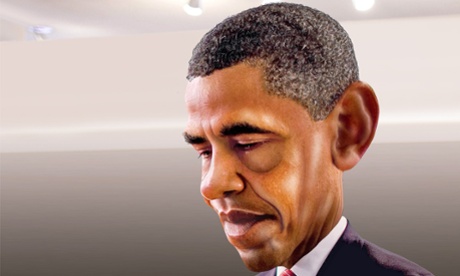
Obama has ignored Syria for too long: it’s the rise of Isis, stupid – now help

ob

Obama has ignored Syria for too long: it’s the rise of Isis, stupid – now help

It’s time for him to do the right thing by arming moderate rebels, imposing a no-fly zone and expanding military action beyond Iraq

ob

Blanket, cold-hearted realism doesn’t work when networked, cold-hearted terrorism does. Photo illustration: DonkeyHotey / Flickr via Creative Commons


Barack Obama is embarking on a global course correction, if not an outright reversal: the policy of “don’t do stupid stuff” – the non-interventionism so praised by the Farid Zakarias and Tom Friedmans of the world – is getting forced out, albeit in the typical Obama fashion of admitting nothing and never going fast or far enough.

And to hear the Chuck Hagels and John Kerrys of the administration tell the story for him, it’s all the fault of the Islamic State (Isis), which is “beyond just a terrorist group”, “an organization that has an apocalyptic, end-of-days strategic vision and which will eventually have to be defeated” – a feat which, realistically, will require some intervention not just in Iraq … but in Syria.

It’s difficult to do the right thing when you’ve already fucked up so badly. When the Obama administration refused to enforce a no-fly zone over Syria in 2011, the indifference gave rise to despair and forced people to abandon their nonviolent ways to defend themselves, effectively transforming the nonviolent protest movement into an armed resistance. Obama’s refusal to then support the rebels following the advice of his then-secretary of state, among other officials, created a vacuum that was gradually filled by extremist elements emerging out of the woodwork and jihadists pouring across the borders, a combination that paved the way for the emergence of the newly troubling and feared Isis.

Now, Isis has a vision being carried out – effectively, if with pure evil – by technocratic leaders with succession plans, flexible but enduing structures, and major funding, with major operations based out of its hub in Syria. Soon, some of its acolytes might make like Hezbollah and run legitimate businesses across multiple countries that secretly fund terror; some already appear to be attracted to the radicalized appeal of Isis leader Abu Bakr Al-Baghdadi declaring a new Caliphate.

No wonder Obama is finding it so difficult to justify a policy of minimal engagement anymore – perhaps even to himself. Blanket, cold-hearted realism doesn’t work when networked, cold-hearted terrorism does. The line between realism and cynicism has always been too thin, and has long been crossed by the Administration. While realism is laudable, cynicism ends up producing the very outcomes that realism intends to avoid. Letting a region take care of itself is impossible to allow when your spies are telling you about the rise of a terror group across the world, including the West – of terrorists that are effectively becoming a global movement of disaffected Muslims everywhere.

Some “realists” are advocating cooperation with Bashar al-Assad. But that wouldn’t just being doing “stupid stuff” – it would be downright delusional, since cooperating with dictators who abuse their own people is exactly what gives rise to extremist anti-Western movements.

The only way for Obama to stop doing stupid stuff with his foreign policy is to arm moderate rebels in Syria, to bomb Isis bases in both Syria and Iraq and to finally impose a no-fly zone on the Assad regime. This combination of tactics could allow the Syrian opposition – which has thus far been unable to govern the liberated areas due to Assad’s use of aerial strikes, including barrel bombs, scud missiles, and, on occasion, chemical weapons and poison gas – to move in and work with the local councils to begin returning the basic services to the local communities, bringing a measure of relief to the local civilian population. Imposing a no-fly zone also avoids having to supply advanced weapons to rebels, including TOW missiles and MANPADs, thus minimizing the risk of having them end up in the wrong hands. Still, the opposition will have its work cut out for it in terms of ensuring effective governance of the areas under their control, especially when it comes to reaching agreements between Islamist and secularist currents. But by controlling the flow of humanitarian aid and the funds required for the reconstruction processes, the administration and other members of international community could exercise leverage to allow for compromises to be reached.

Obama already plans to take a leading role at next month’s UN General Assembly, where strategies for holding back Isis will be a top priority. But Western and Middle Eastern leaders need to begin preparing for a peace conference following such strikes, because a real transition plan for a post-conflict and post-Assad Syria needs to be developed. Talks will not be easy (and could drag out for months if not longer), but if the regime’s ability to wreak havoc on rebel communities is curbed by strikes and the economic blockade against it is strengthened, time will not be on its side – rendering hopes for an eventual breakthrough more realistic.

It’s about time for the Obama administration to do the right thing. It’s about time, after doing so much stupid stuff and aiding in the rise of Isis, to begin resolving a conflict that has killed close to 200,000 people in less than four years, and produced millions of refugees, becoming the worst humanitarian disaster since the Cold War.

Yes, American strikes may make disaffected Muslims more eager to join Isis. Yes, we may be witnessing the birth of a new Islamic sect. But Barack Obama needs to stop fighting the symptoms while embracing the disease – to become a true realist and not a cynical one. Sectarian violence was not inevitable in Syria, as some analysts argued at the beginning of the revolution, but indifference and cynicism made it so. Obama needs to engage in the region with a positive mindset, knowing that he can actually make a positive difference.

source


Cold Open Presidential address SNL

Obama Promise To ‘Protect Whistleblowers’ Just Disappeared From Change.gov

July 30, 2013

(On the day Bradley Manning’s verdict is announced, Orwell’s Memory Hole is indeed alive in the United States. This excellent article was not written by me, and originally appeared on TechDirt)

The folks from the Sunlight Foundation have noticed that the Change.gov website, which was set up by the Obama transition team after the election in 2008 has suddenly been scrubbed of all of its original content. They noted that the front page had pointed to the White House website for a while, but you could still access a variety of old material and agendas. They were wondering why the administration would suddenly pull all that interesting archival information… and hit upon a clue.

A little bit from the “ethics agenda”:

Protect Whistleblowers: Often the best source of information about waste, fraud, and abuse in government is an existing government employee committed to public integrity and willing to speak out. Such acts of courage and patriotism, which can sometimes save lives and often save taxpayer dollars, should be encouraged rather than stifled. We need to empower federal employees as watchdogs of wrongdoing and partners in performance. Barack Obama will strengthen whistleblower laws to protect federal workers who expose waste, fraud, and abuse of authority in government. Obama will ensure that federal agencies expedite the process for reviewing whistleblower claims and whistleblowers have full access to courts and due process.

Yeah. That statement seems a bit embarrassing at the very same time Obama’s administration is threatening trade sanctions against anyone who grants asylum to Ed Snowden. Also… at the same time that we get to see how whistleblower Bradley Manning’s “full access to courts and due process” will turn out. So far, it’s been anything but reasonable, considering that the UN has already condemned Manning’s treatment as “cruel and inhuman.” And people wonder why Snowden left the country…

MY COMMENT: Yeah, Hope and Change my ass.

Bonus: Make you own Hope and Change poster here.

Related Articles:

– See more at here

Blog at WordPress.com.

Up ↑