Search

band annie's Weblog

I have a parallel blog in French at http://anniebannie.net

Tag

Lebanon

Black cats on holiday

Israel Spin – Mark Regrev

The November 2012 cease fire has been abandoned after 3 Israeli teenagers were killed and a revenge attack on a Palestinian teenager escalated into rocket attacks.
Abandoning the cease fire comes at a time as Israel seeks to continue its strangle hold control as the single energy producer for the region. Egypt, the wold’s largest Arab populace is almost completely reliant on Israel for energy. This may be seen by Hamas as a reason for not using an Egyptian intermediary in continued peace talks with Israel and as a method to stop further Israeli control in the energy sector of the Arab nations.

Mark Regrev is the Israeli Prime Ministers spokesperson…he is speaking here with Australian Television 14th July 2014.
His well practised spin is like a sing song prayer, hypnotising the watcher like some vaudeville character.


thedigitalfolklore | juillet 14, 2014 à 5:55   | Catégories: URL: http://wp.me/p1jpRz-69Y

source

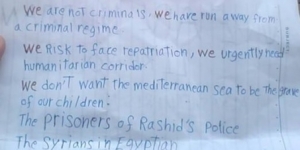
Syria, 144 refugees stopped in Egypt locked in two rooms with 63 children.


a letter written by the detained Syrians in Egypt

Stopped in the middle of the sea by the Egyptian Coast Guard, aboard a boat that was sinking shortly after the start of its journey to Europe. Locked within the premises of a police station in Alexandria, where the police prevent the arrival of relief supplies of Caritas

WRITTEN by STEFANO PASTA, translated by Mary Rizzo

MILAN- Through WhatsApp, we interviewed Syrian refugees held since 14 April in Al Rashid police station in Alexandria, Egypt. Having failed to reach Europe with a barge, they were handed over to the Egyptian authorities, but now risk transfer to the prison of Al Burj , or – even worse – repatriation to Syria.

What is your situation like today?

Disastrous hygienic conditions are dangerous due to a broken sewer. We are 144 persons living in two rooms measuring only a few meters, one room for women and one for men. We sleep on the ground and we cannot wash. We try to keep calm, but when it happened a few days ago there were moments of tension between us, the police prevented the visits for that day and suspended the coffee and the food brought from outside by Caritas Alexandria. The boys and men are still able to resist in some way, but the women and children are really at the limit; there are two women with heart problems who finished their medicine and they need to get out immediately.

What is the situation of children?

There are 44 children under the age of 12, while the total number of children is 63. There are a few who are trying to play with water bottles and they are the only ones who can get distracted for a moment. At night, however, they find it difficult to sleep. As of yesterday, almost all of them have developed a sort of skin disease that no one can identify. Two children of one and two and a half years, alone with his mother because his father was killed in Syria, were suffering particularly yesterday , they were taken to the hospital five times because they suffer from asthma and staying in this place of detention is equivalent to sleeping in a garbage dump. We are also concerned about another 4 year old girl, suffering from cardiac difficulties, who had begun to complain about the chest pain already in the midst of the sea.

Why did you flee from Syria?

Many of us have fled to avoid conscription in the army of Assad, others are activists against the regime who are risking their lives. Then there are families who have fled their homes because they could not survive in some cities, people are dying of hunger because of the siege of the regular army (regime army), which does not allow the entry of food. There is no bread and milk for the children, while the rice when one can find it, costs almost twenty dollars a kilo. Life like that is simply impossible, that’s why we escaped.

Have you talked with a lawyer or with international authorities?

No, none of us was able to speak with a lawyer or has received a sheet with the written reasons for why we are being detained. We met a lawyer named Ahmad, who initially presented himself as belonging to UNHCR, but then he began to terrorise us by threatening to have us repatriated and he revealed that he works for Egyptian National Security.  This is our greatest fear, because it would be tantamount to a death sentence; also return to Lebanon would be very dangerous, since it has already happened that Hezbollah has handed over some refuges to Assad. After a week from the meeting with Ahmad, presented to us is a UN official, at least this is what he is telling us, along with an interpreter, in which we explained how we ended up in the police station.

How did it happen?

What happened before our arrest was a nightmare. We were ready to face the Mediterranean to reach Europe and we had entrusted ourselves to smugglers, who treated us badly, screaming profanities and threatening to beat us with bars, even children. With small boats, we were taken in groups on a larger boat, where we were parked at sea for seven days waiting for it to fill up to 250 people. When we were ready to leave, the same smugglers noticed that the boat was about to sink. It was the worst time since we left Syria: we could die and nobody would know. Then, after a fight broke out between the smugglers on the boat and the organisers were on the ground, we were able to convince them to bring us back; we passed the Coast Guard, but no one saw us. Once on the beach, we ourselves went to the Egyptian authorities, asking for help, but since that day, April 14, we were all arrested, including children.

Have you heard of other refugees detained in Egypt?

Of course, we have detailed information because they are members of our own families. The wife of a man who is here at Al Rashid is held in another place, then we know where the traveling companions arrested with us are. In the police station in Al Montazah there are 22 people, 55 in Chabrakhit and an unknown number – but with so many children – in Miami.

What are you asking for?

We call for the respect of Article 33 of the Geneva Convention, which prohibits any member country the repatriation (refoulement ) of persons to countries where their lives or freedom would be threatened . We ask UNHCR and the European embassies (we initiated contact with the Austrian one) to be able to apply for asylum. We ask the Europeans: would you like your children to have the Mediterranean as their graves? Open a humanitarian corridor, let us save our lives legally.

thank you to Nawal 

source

First Lebanese Battalion in FSA After Hezbollah’s Call

15SaturdayJun 2013

Posted by  in

≈ 1 Comment

20130615-124120.jpg

Lebanese individuals might have been involved in Syria’s war from early days. Sheikh Ahmad Al-Aseer declared Jihad and went himself there couple of months ago with his fighters too for a show-off exercise, but permanent or independent Lebanese fighting battalion are not known to be present as of yet.

Hezbollah has institutionalised the Lebanese involvement in Syria with his recent public involvement in the battle of Qusair. Hassan Nasrallah has publicly called his Lebanese opponents “to meet them in Syria to fight”. Hezbollah is part of the Lebanese state and government and obviously has a regional weight – which means Iran.

The lebanese government, which is supposed to be adopting a dissociation policy, is in coma status with no comment whatsoever. Even more, “sovereign” Michel Aoun has defended Hezbollah’s intervention on the basis they are fighting the takfirees (beyond our borders.)

Sadly, some Lebanese will meet Hezbollah’s divisive call and go to Syria. This will expand Syria’s war into a sectarian regional one, and allow the war to spread to Lebanon too without a shadow of a doubt.

Below is the video of the 29 years old Lebanese Fadi AbdulKader declaring the formation of the Free Battalion of “Ikleem el Kharoub” under the Free Syrian Army command to fight Hezbollah. If you don’t know it, Ikleem el Kharoub is a Sunni area in the mostly mixed Druze and Christian Chouf district.

In what could be the first video of its kind for a Lebanese, Fadi AbdulKader shows a copy of his Lebanese passport (which expired last month) confirming his ID and date of birth. The video is done on the style of previous videos for defections from the Syrian army. He declares he wants to defend his religion and land in both Syria and Lebanon. Funnily enough, he gives The Lebanese Republic a new name by calling it the Arab Republic of Lebanon.

Hezbollah, which always prided itself not be part of the Lebanese civil war, is now creating a Lebanese civil war on Syrian land and contributing to the Syrian civil war. Hezbollah has officially turned into a militia, and seeking other Lebanese militias on the opposite side. This can only get worse for everyone.

20130615-124149.jpg

source

He Provided Them with Bananas

Karl Sharro  –  February 21, 2013

14

Karl Sharro is a Syria Deeply columnist,  London-based architect and Middle East commentator. He blogs at the wildly popular karlremarks.com and Tweets @KarlreMarks.

In the early 90s I was in a taxi heading from Lebanon to Damascus with several other passengers. The trips were always educational. This prime mode of transport between the two countries allowed one to meet people from various backgrounds and walks of life.

Listening to the coded way in which Syrians spoke was quite revealing. Nuggets of truth lay under layers of innuendo and seemingly apolitical language, decipherable only by the trained ear.

On that particular trip, we had an estaz on board, the generic description for an intellectual, usually a university professor or teacher. This particular estaz sported an audacious comb-over, which bestowed an added sense of respectability to his appearance.

In those days imports to Syria were still highly restricted and travellers took the opportunity of being in Lebanon to purchase products that were not available in Syria. Lebanese bread was particularly sought after, as well as fruits and other foods.

Before we were about to depart, the driver asked the estaz if he wanted to buy some bananas. The estaz declined.  Bananas weren’t in shortage in Syria any longer, he said.

Then he added, “God protect the president. [At the time, Hafez al-Assad, Bashar’s father.] He knows what the Syrian people want. He saw that the Syrian people wanted bananas, so he provided them with bananas.”

The pronouncement hung in the air for a while, before dissipating among the sea of mundane chatter that one was used to hearing in those days.

As it happened, that was the most profound political thought the estaz would make for the rest of the trip. To thank the ruler for his magnanimity in allowing the Syrian people access to bananas.

The words had come out un-selfconsciously, like the recitation of a familiar prayer. But for a learned man in particular, they must have been accompanied by a sense of shame at having to engage in this daily ritual of submission.

Those who don’t understand why Syria revolted two years ago are entirely oblivious to this deep sense of shame that its people lived with for decades.

It wasn’t the deprivation or lack of consumer goods. Rather, it was the incessant demand to submit to an all-knowing authority, one that cannot be questioned.

It was the lack of possibility, the closed doors of the future. It was the bureaucratic machine that reduced every citizen to a robot and then treated him or her accordingly.

In the 1980s, I remember going with a relative to an ice cream shop in one of Syria’s northeastern cities. I naively inquired about the flavors when the vendor was about to fill my scoop.

“Flavors? They’re all the same flavor, they’re just a different colour,” he said.

It was a perfect metaphor for the officially-sanctioned parties, available in various political shades but all subsumed by the ruling Ba’ath.

The illusion was elaborately constructed to remind you that you didn’t really have any choice.

Damascus in the 1960s was a thriving cultural center that had hundreds of media publications. By the ‘80s, just a handful was left. The two party-sponsored newspapers were completely interchangeable with little variation from day to day.

They provided sterile, mass-produced ‘opinions’ that were the journalistic equivalent of the estaz’s polyester suit. They belonged to a pacified intellectual class.

But they carried their shame with them. Everybody knew about the thousands in the regime’s prisons, those who refused to submit. Poets, writers, activists and workers who spent decades facing incarceration and torture but refused to sign a piece of paper denouncing their political aspirations.

Those on the outside felt that shame but thought they were helpless to do anything about it. They publicly sang the praises of the regime and the heroic role it played.

Syria’s rich and long history only increased the sense of shame. The feeling of being marginalized from the world’s consciousness was exacerbated by the ancient monuments that mocked your impotence.

What purpose does dwelling on past achievements serve other than to remind you of your helplessness and the squandered legacy you have not lived up to?

As Syria gradually opened to the Western world in the 1990s, the regime thought that it could pacify people by turning a blind eye to the satellite dishes that were sprouting like mushrooms on buildings, and later by allowing the internet.

But the feelings of inadequacy only increased. People could now compare between their lives and what was happening in the rest of the world. They had access to the internet, shopping malls and lots of bananas.

But they still had only one choice in presidential “elections.”

The sudden openness violently confronted Syrians with their helpless self-image. When the uprisings in Tunisia and Egypt succeeded in removing aging dictators, the response in Syria, more than any other Arab country, was visceral.

Organised attempts at staging demonstrations never materialized. When the eruption came, it was brought about by the regime’s heavy-handedness and the instinctive reaction to it. The time for living with the shame was over.

Syria’s was the least well-articulated or organised of all the Arab uprisings. It was raw and abrasive.

The people who had the responsibility to lead the uprising failed it. Perhaps this was unavoidable, the accumulation of anger and shame got in the way of cold thinking and the decades of oppression meant that Syrians were starting from scratch.

What we’re seeing today isn’t what Syrians wanted. The situation got out of control, but the regime bears the main responsibility for that. What is clear is that there will be no return to the old ways. After all the sacrifices, the people of Syria won’t go back to living with their shame.

About the Author

Karl Sharro
@KarlreMarks.Karl Sharro is a Syria Deeply columnist, London-based architect and Middle East commentator. He blogs at the wildly popular karlremarks.com and Tweets @KarlreMarks.

Blog at WordPress.com.

Up ↑