Search

band annie's Weblog

I have a parallel blog in French at http://anniebannie.net

Tag

Jonathan Cook

New BBC documentary ‘The Road to 7th October’ is an utter travesty

Pressured into removing a humanising portrait of Gaza’s children, the BBC offers instead a series on Israel-Palestine that frantically revives the very narrative that made the genocide possible

Jonathan Cook

Mar 09, 2025

Audio here

There has been a prolonged furore over the BBC’s craven decision to ban a documentary on life in Gaza under Israel’s bombs after it incensed Israel and its lobbyists by, uniquely, humanising the enclave’s children.

The English-speaking child narrator, 13-year-old Abdullah, who became the all-too-visible pretext for pulling the film Gaza: How to Survive a Warzone because his father is a technocrat in the enclave’s Hamas government, hit back last week.

He warned that the BBC had betrayed him and Gaza’s other children, and that the state broadcaster would be responsible were anything to happen to him.

His fears are well-founded, given that Israel has a long track record of executing those with the most tenuous of connections to Hamas – as well as the enclave’s children, often with small, armed drones that swarm through its airspace.

The noisy clamour over How to Survive a Warzone has dominated headlines, overshadowing another new BBC documentary on Gaza – this one a three-part, blockbuster series on the history of Israel and Palestine – that has received none of the controversy.

And for good reason.

Israel and the Palestinians: The Road to 7th October, whose final episode airs this Monday, is such a travesty, so discredited by the very historical events it promises to explain, that it earns a glowing, five-star review from the Guardian.

It “speaks to everyone that matters”, the liberal daily gushes. And that’s precisely the problem

What we get, as a result, is the very worst in BBC establishment TV: talking heads reading from the same implausibly simplistic script, edited and curated to present western officials and their allies in the most sympathetic light possible.

Which is no mean feat, given the subject matter: nearly eight decades of Israel’s ethnic cleansing, dispossession, military occupation and siege of the Palestinian people, supported by the United States.

But this documentary series on the region’s history should be far more controversial than the film about Gaza’s children. Because this one breathes life back into a racist western narrative – one that made the genocide in Gaza possible, and justifies Israel’s return this month to using mass starvation as a weapon of war against the Palestinian people.

‘Honest broker’ fiction

The Road to 7th October presents an all-too-familiar story.

The Palestinians are divided geographically and ideologically – how or why is never properly grappled with – between the incompetent, corrupt leadership of Fatah under Mahmoud Abbas in the West Bank, and the militant, terrorist leadership of Hamas in Gaza.

Israel tries various peace initiatives under leaders Ariel Sharon and Ehud Olmert. These failures propel the more hardline Benjamin Netanyahu to power.

The United States is the star of the show, of course. Its officials tell a story of Washington desperately trying to bring together the two parties, Israel and Fatah (the third party, Hamas, is intentionally sidelined), but finds itself constantly hamstrung by bad luck and the intransigence of those involved.

Yes, you read that right. This documentary really does resurrect the Washington as “honest broker” fiction – a myth that was supposed to have been laid to rest a quarter of a century ago, after the Oslo accords collapsed.

The film-makers are so lost to the reality in Israel and Palestine that they imagine they can credibly keep Washington perched on a pedestal even after we have all spent the past 16 months watching, first, President Biden arm Israel’s “plausible” genocide in Gaza, killing many tens of thousands of Palestinians, and then President Trump formulate an illegal plan to ethnically cleanse the enclave of its surviving Palestinian population to develop it as a luxury “waterfront property”.

A viewing of a short, Trump-endorsed, AI-generated promo video for a glitzy, Palestinian-free “Trump Gaza”, built on the crushed bodies of the enclave’s children, should be enough to dispel any remaining illusions about Washington’s neutrality on the matter.

Enduring mystery

This documentary, like its BBC predecessors – most notably on Russia and Ukraine, and the implosion of Yugoslavia – excels at offering a detailed examination of tree bark without ever stepping back far enough to see the shape of the forest.

The words “apartheid”, “siege” and “colonialism” – the main lenses through which one can explain what has been happening to the Palestinian people for a century or more – do not figure at all.

There is a single allusion to the events of 1948, when a self-declared Jewish state was violently founded as a colonial project on the ruins of the Palestinians’ homeland.

Or as the documentary delicately puts it: “Millions of their people [the Palestinians] had been made refugees by decades of conflict.”

As ever, when the plight of the Palestinians is discussed, the passive voice is put to sterling use. Millions of Palestinians were accidentally ethnically cleansed, it seems. Who was responsible is a mystery.

In fact, most of Gaza’s population are descended from Palestinian families expelled by the newly declared state of Israel from their homes in 1948. They were penned up in a tiny piece of land by European colonisers in the same manner as earlier generations of European colonisers confined the Native Americans to reservations.

Even when the term “occupation” appears, as it does on the odd occasion, it is presented as some vague, unexamined, security-related problem the US, Israel and the Fatah leadership are engaged in trying to fix.

The settlements are mentioned too, but only as the backdrop to land-for-peace calculations that never come to fruition as the basis for an elusive “peace”.

In other words, this is the reheating of a phoney tale that Israel and the US have been trying to sell to western publics for many decades.

It was holed well below the water line last year by the International Court of Justice (ICJ), the highest court in the world. It ruled that Israel’s occupation of the West Bank, Gaza and East Jerusalem was illegal, that Israeli rule over the Palestinians was a form of apartheid, and that its illegal settlements needed to be dismantled immediately.

That is the forest all the documentary’s furious bark-studying is designed to avoid.

Path to genocide

The makers of Israel and the Palestinians: The Road to 7th October choose to begin their time line on an obscure date: 19 August 2003, when a Palestinian suicide bomber blows up a bus in Jerusalem, killing 23 Israelis.

Why then?

The programme, despite its title, is not really about the “Palestinians”. Note that the BBC dares not refer to “Palestine”.

The true focus is on Hamas and its rise to power in Gaza, as viewed chiefly by the other parties: the US, Israel and Fatah.

Starting the story in 2003 with a bus bombing, the programme can navigate “The Road to 7thOctober” in ways that assist the self-serving narratives those other parties wish to tell.

On the Palestinian side, the story opens with a terror attack. On Israel’s side, it opens with Sharon deciding, in response, to dismantle the illegal settlements in Gaza and withdraw Israeli troops from the enclave.

This entirely arbitrary date allows the programme makers to create an entirely misleading narrative arc: of Israel supposedly ending the occupation and trying to make peace, while being met with ever greater terrorism from Hamas, culminating in the 7th October attack.

In short, it perpetuates the long-standing colonial narrative – contrary to all evidence – of Israel as the good guys, and the Palestinians as the bad guys.

In an alternate universe, the BBC might have offered us a far more informative, relevant documentary called Israel and Palestine: The Path to Genocide.

Don’t hold your breath waiting for that one to air.

Dystopian movie

In fact, Sharon’s so-called Disengagement Plan of 2005 had nothing to do with ending the occupation or peace-making. It was a trap laid for the Palestinians.

The disengagement did not end the occupation of Gaza, as the ICJ noted in its ruling last year. It simply reformulated it.

Israeli soldiers pulled back to the perimeter of the enclave – what Israeli and US officials like to falsely term its “borders” – where Israel had previously established a highly fortified wall with armed watchtowers.

Stationed along this perimeter, the Israeli army instituted an oppressive Medieval-style siege, blockading access to Gaza by land, sea and air. The enclave was monitored 24/7 with drones patrolling the skies.

Even before Hamas won legislative elections in 2006 and came to power in Gaza, the tiny coastal strip of land looked like it was the backdrop for a dystopian Hollywood movie.

But after Hamas’ victory, as the talking heads cheerily explain, the gloves really came off. What that meant in practice is not spelled out – and for good reason.

The Israeli army put Gaza on “rations”, carefully counting the calories entering the enclave to create widespread hunger and malnutrition, especially among Gaza’s children.

The Israeli official behind the scheme explained the reasoning at the time: “The idea is to put the Palestinians on a diet, but not to make them die of hunger.”

That official – Dov Weisglass, Olmert’s main adviser – is one of the central talking heads in episode one. And yet strangely, he is never asked about Gaza’s “diet”.

‘Die more quietly’

Stephen Hadley, George W Bush’s deputy national security adviser, claims – unchallenged – that Sharon’s disengagement was “a downpayment on a Palestinian state. … They [the Palestinians] would have an opportunity to build and show the world that they were ready to live side by side in peace with Israel”.

Israel’s real goal, all too evident then and impossible to ignore now, was something else entirely.

Yes, withdrawing from Gaza allowed Israel to falsely claim the occupation in Gaza had ended and focus instead on the colonisation of the West Bank, as the documentary briefly grants.

Yes, it split geographically the main territories forming the basis of a future Palestinian state and encouraged irreconciliable leaderships in each – divide and rule on steroids.

But even more importantly, by making Gaza effectively a giant concentration camp, blockaded on all sides, Israel ensured that the accommodationists of Fatah would lose credibility in the enclave and militant resistance movements led by Hamas would gain ascendancy.

That was the trap.

Hamas, and the people of Gaza, were denied any legitimacy so long as they insisted on a right – enshrined in international law – to resist their occupation and besiegement by Israel.

It was a message – a warning – directed at Fatah and the West Bank too. Resistance is futile. Keep your heads down or you’ll be next.
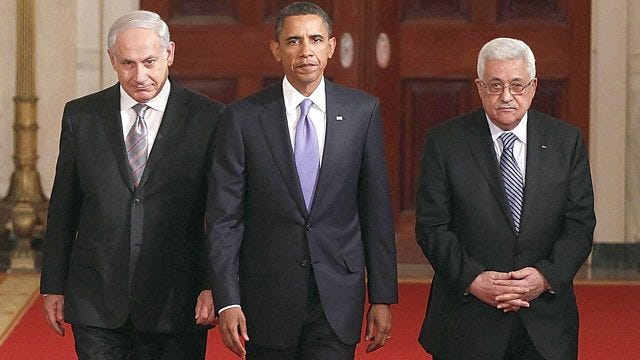
Which is exactly the lesson Abbas learnt, soon characterising his security forces’ collusion with the Israeli occupation as “sacred”.

For Gaza, the US notion of living in “peace alongside Israel” meant surviving just barely and quietly, inside their cage, accepting the diet Olmert and Weisglass had put them on.

Making any noise – such as by firing rockets out of the concentration camp, or massing at the heavily armed walls of their cage in protest – was terrorism. Die more quietly, Israel and the international community demanded.

Perversely, much of episiode one is dedicated to US officals spinning their conspiracy to foil the results of the 2006 Palestinian election, won by Hamas, as democracy promotion.

They demanded Hamas give up armed resistance or the 2 million people of Gaza, half of them children, would face a continuing blockade and starvation diet – that is, illegal collective punishment.

Or as Robert Danin, a US State Department official, puts it, the plan was “either Hamas would reform and become a legitimate political party or it would remain isolated”. Not just Hamas isolated, but all of Gaza. Die more quietly.

The hope, he adds, was that by immiserating the population “Gazans would throw off the yoke of Hamas” – that is, accept their fate to live as little more than “human animals” in an Israeli-run zoo.

‘Mowing the lawn’

Hamas, both its proto-army and its proto-government, learnt ways to adapt.

It built tunnels under the enclave’s one, short border with Egypt to resist Israel’s siege by trading with the neighbouring population in Sinai and keeping the local economy just barely afloat.

It fired primitive rockets, which rarely killed anyone in Israel, but achieved other goals.

The rocket fire created a sense of fear in Israeli communities near Gaza, which Hamas occasionally managed to leverage for minor concessions from Israel, such as an easing of the blockade – but only when Israel didn’t prefer, as it usually did, to respond with more violence.

The rockets also prevented Gaza and its suffering from disappearing completely from international news coverage – the “Die more quietly” agenda pursued by Israel – even if the price was that the western media could denounce Hamas even more noisily as terrorists.

And the rockets offered a strategic alternative – armed resistance, its nature shaped by Hamas’ confinement in the Gaza concentration camp – to Fatah’s quietist, behind-the-scenes diplomacy seeking negotiations that were never forthcoming.

Finally, confronted with the permanent illegitimacy trap set for it by Israel and the US, Hamas approved in 2018 mass, civil disobedience protests at the perimeter fence of the concentration camp it was supposedly “ruling”.Subscribe

Israel, backed by the US, responded with increased structural violence to all these forms of resistance.

In the last two programmes, Israeli and US officials set out the challenges and technical solutions they came up with to prevent their victims from breaking out of their “isolation” – the concentration camp that Gaza had been turned into.

Underground barriers were installed to make tunnelling more difficult.

Rocket fire was met with bouts of “mowing the lawn” – that is, carpet-bombing Gaza, indifferent to the Palestinian death toll.

And thousands of the ordinary Palestinians who massed for months on end at the perimeter fence in protest were either executed or shot in the knee by Israeli snipers.

Or as the documentary’s narrator characterises it: “At the border with Israel, protesters clashed with Israeli forces, and dozens of Palestinians were killed.”

Blink, and you might miss it.

Nothing learnt

Only by looking beneath the surface of this facile documentary can be found a meaningful answer to the question of what led to the attack on 7th October.

Israel’s strategy of “isolation” – the blockade and diet – compounded by intermittent episodes of “mowing the lawn” was always doomed to failure. Predictably, the Palestinians’ desire to end their imprisonment in a concentration camp could not be so easily subdued.

The human impulse for freedom and for the right to live with dignity kept surfacing.

Ultimately, it would culminate in the 7th October attack. Like most breakouts from barbaric systems of oppression, including slave revolts in the pre-civil rights US, Hamas’ operation ended up mirroring many of the crimes and atrocities inflicted by the oppressor.

Israel and the US, of course, learnt nothing. They have responded since with intensified, even more obscene levels of violence – so grave that the world’s highest court has put Israel on trial for genocide.

Obscured by The Road to 7th October is the reality that Israel has always viewed the Palestinians as “human animals”. It just needed the right moment to sell that script to western publics, so that genocide could be recast as self-defence.

The 7th October attack offered the cover story Israel needed. And the western media, most especially the BBC, played a vital part in amplifying that genocide-justifying narrative through its dehumanisation of the Palestinian people.

Its one break with that policy – its humanising portrait of Gaza’s children in How to Survive a Warzone – caused an uproar that has echoed for weeks and seen the BBC’s director general, Tim Davie, dragged before a parliamentary committee.

But in truth, we ought to be appalled that this is the only attempt the BBC has made, after 17 months of genocide, to present an intimate view of life for the people of Gaza, especially its children, under Israel’s bombs. The state broadcaster only dared doing so after stripping away the politics of Gaza’s story, reducing decades of the Palestinian people’s oppression by Israel to a largely author-less “humanitarian crisis”.

Not only is the programme never likely to see the light of day again on the BBC but, after all this commotion, the corporation is unlikely ever again to commission a similarly humanising programme about the Palestinian people.

There is a good reason why there has been no comparable clamour for the BBC to pull Israel and the Palestinians: The Road to 7th October.

The historical and political context offered by the documentary does nothing to challenge a decades-old, bogus narrative on Israel and Palestine – one that has long helped conceal Israel’s turning of Gaza into a concentration camp, one that made something like the 7thOctober breakout almost inevitable, and one that legitimised months of genocide.

The Road to 7th October seeks to rehabilitate a narrative that should be entirely discredited by now.

In doing so, the BBC is assisting Israel in reviving a political climate in which the genocide in Gaza can resume, with Netanyahu re-instituting mass starvation as a weapon of war and spreading Israel’s ethnic cleansing operations to the West Bank.

We don’t need more official narratives about the most misrepresented “conflict” in history. We need journalistic courage and integrity. Don’t look to the BBC for either.

[Many thanks to Matthew Alford for the audio reading of this article.]

Share

Leave a comment


All my posts are freely accessible, but my journalism is possible only because of the support of readers. If you liked this article or any of the others, please consider sharing it with friends and making a donation to support my work. You can do so by becoming a paid Substack subscriber, or donate via Paypal or my bank account, or alternatively set up a monthly direct debit mandate with GoCardless. A complete archive of my writings is available on my website. I’m on Twitter and Facebook.

How will US Jerusalem move affect Israel’s far right?

by Jonathan Cook

Trump’s seal of approval for Israel’s takeover of Jerusalem is likely to intensify the city’s religious symbolism for Jews – and the importance of Israeli sovereignty over al-Aqsa Mosque compound [Ronny Hartmann/Photothek via Getty Images]

Analysts fear Trump’s rubber-stamping of the right’s political goals will further radicalise both sides of the divide.

Jerusalem – Trump’s recognition this week of Jerusalem as Israel’s capital, overturning seven decades of US policy in the region and effectively ending hopes of a two-state solution, has provoked dire warnings.

But the focus by commentators on Palestinian reactions, rather than the effect on the Israeli public and leadership, might have underestimated the longer-term fallout from Trump’s move, analysts say.

Predictions have included the threat of renewed violence – even an uprising – from Palestinians; the possible collapse of the Palestinian Authority, the Palestinians’ government-in-waiting, and its diplomatic strategy for two states; and the demise of Washington’s claim to be serving as a credible peacemaker.

But according to analysts, more far-reaching – and disruptive – undercurrents will likely be set in motion by Trump’s decision.

Few have factored in the likely effect of Trump’s new Jerusalem policy on the Israeli public, which has been shifting steadily to the right for most of the past two decades. The city and its contested holy sites have gained an increasingly powerful religious and national symbolism for many Israeli Jews.

The fear is that Trump’s effective rubber-stamping of the right’s political goals in Jerusalem will further radicalise both sides of the divide – and accelerate processes that have been turning a long-standing national conflict into a more openly religious one.

‘Tipping point’

“We may remember this date as the tipping point, as the moment when a new consensus emerged in Israel behind the idea of total Jewish supremacy,” journalist David Sheen, an expert on Israel’s far-right movements, told Al Jazeera.

Similar concerns were expressed by Yousef Jabareen, a Palestinian member of Israel’s parliament.

“We can expect to see a move rightwards across Israeli society,” he told Al Jazeera. “The centre-left parties were already tacking much closer to the right. They will now want to align themselves with Trump’s position. Meanwhile, the right will be encouraged to move to the extreme right.”

Both noted that Avi Gabbay – the recently elected leader of the Zionist Union, the official opposition and the party that was once the backbone of the Israeli peace camp – had begun espousing positions little different from those of right-wing Israeli Prime Minister Benjamin Netanyahu.

Last week, Gabbay backed Trump’s announcement, saying that recognition of Jerusalem was more important than a peace deal with the Palestinians.

WATCH: ‘Dangerous and unacceptable’ – Arab League condemns US move

Sheen said that traditionally, the centre-left had been restrained in its political positions by concerns about alienating the United States: “Netanyahu has shown that he can bring the US round to his way of thinking by staying the course. In many Israelis’ eyes, he has now been proved right. The centrists may decide it is time to come onboard. Allying with the Republican right and the Christian evangelicals in the US may now look like a much safer bet.”

The possible effects of Trump’s announcement on Israelis have been largely overlooked, even though previous turning points in the conflict have consistently resulted in dramatic lurches rightwards by the Israeli public.

Given Israel’s power over the Palestinians, these changes have played a decisive role in leading to the current impasse between Israel and the Palestinians, analysts note.

Most obviously, Israel’s seemingly “miraculous” victory in the 1967 war, defeating the armies of neighbouring Arab states in six days, unleashed a wave of Messianic Judaism that spawned the settler movement.

A new religious nationalism swept parts of the Israeli public, driving them into the occupied Palestinian territories to claim a supposed Biblical birthright.

Other major events have had a decisive effect too. Unexpectedly, the Oslo peace process, launched in the mid-1990s, persuaded many non-religious Israeli Jews to move into settlements in the West Bank and occupied East Jerusalem, doubling the numbers there in a few years.

Into the arms of the far right

Alan Baker, a legal adviser to the Israeli foreign ministry in that period, explained Israelis’ peculiar reading of the Oslo Accords. In their view, Oslo meant Israel was “present in the territories with their [the Palestinians’] consent and subject to the outcome of negotiations”.

In other words, many Israelis believed that the Oslo process had conferred an international legitimacy on the settlements.

Later, in 2000, after the Camp David summit collapsed without the sides agreeing to a two-state solution, Ehud Barak, Israel’s then-prime minister, blamed Yasser Arafat and the Palestinians. He said they were “no partner” for peace.

As a result, Israelis deserted the peace camp and drifted into the arms of the right and far-right. Netanyahu has reaped the benefits, leading a series of ultra-nationalist governments since 2009.

Now Trump’s decision on Jerusalem effectively gives Washington’s blessing to Israel’s illegal annexation of East Jerusalem and five decades of creating facts on the ground there, said Jabareen.

“Trump has legitimised the far-right’s argument that Israel can control all of Jerusalem by sheer force, by denying Palestinians their rights and by creating facts on the ground,” he said.

With their policy of aggressive unilateralism now paying dividends in the US, the settlers and the ultra-nationalists were unlikely to be satisfied with that success alone, he added. “The danger is that the religious right’s narrative will now seem persuasive at other sites in the occupied territories they demand, such as Hebron and Nablus.”

Since Trump’s election a year ago, Naftali Bennett, the Israeli education minister and the leader of the main settler party, has begun calling for Israel to seize the opportunity to annex West Bank settlements.

Pressure is likely now to mount rapidly on Netanyahu to shift even further to the right.

On the 972 website, Noam Sheizaf, an Israeli analyst, observed that Trump’s declaration had boosted the settlers’ position that “in the long run ‘facts on the ground’ are more important than diplomacy and politics, and that Israel will eventually win legitimacy for its actions”

Effects in Jerusalem

The most immediate effects, according to Ir Amim, an IsraeIi human rights organisation, will be felt in Jerusalem itself. Government ministers have already drafted legislation to bring large West Bank settlements under Jerusalem’s municipal authority, as a way covertly to annex them.

There are also plans to strip large numbers of Palestinians of their Israeli-issued Jerusalem residency papers because they live outside the separation wall Israel built through the city more than a decade ago. That would cement a new, unassailable right-wing Jewish majority in Jerusalem.

Last week, Ir Amim warned in a statement that Trump’s move would be certain to “embolden” such actions by the Israeli right and provide a “tailwind” to those determined to pre-empt a two-state solution.

Assad Ghanem, a politics professor at Haifa University, told Al Jazeera: “Trump has given a legitimacy to the right’s Messianic agenda. He has adopted the language of the extreme right on Jerusalem – that it is Israel’s eternal, united capital. The far-right will declare this a victory.”

In parallel, Trump’s seal of approval for Israel’s takeover of Jerusalem is likely to intensify the city’s religious symbolism for Jews – and the importance of Israeli sovereignty over al-Aqsa Mosque compound, Ghanem noted.

In recent years, a growing number of rabbis have been overturning a centuries-old consensus that al-Aqsa compound is off-limits to Jews because it was not known where the ruins of an earlier Jewish temple lay. In Jewish tradition, it is forbidden to walk over an inner sanctum, known as the Holy of Holies.

Today, Jews regularly enter the compound and some even pray there. Settler rabbis and far-right government ministers have called for dividing the compound between Israelis and Palestinians, creating huge tensions with Palestinians.

Temple movements

Meanwhile, a once-fringe movement of Jewish supporters who wish to destroy the mosque to rebuild the ancient Jewish temple in its place, are gradually moving into the mainstream. Trump’s move will be a shot in the arm to their ambitions and their credibility, said Sheen, who has studied the temple movements.

He pointed out that immediately after Trump’s declaration, these groups had uploaded a cartoon of Trump standing in al-Aqsa compound, in front of the golden-topped Dome of the Rock, imagining the Jewish temple in its place. Trump is shown saying in Hebrew: “This is the perfect spot!”

Sheen said: “This will be treated as a call to arms by these groups.”

WATCH: Trump’s Jerusalem move roundly condemned at UN

Will the US recognition of Jerusalem as Israel’s capital have similarly dramatic long-term effect on Palestinians’ public opinion? Analysts believe it will. The lack of an outpouring of significant anger – even after Palestinian leaders called for three days of rage last week – could be deceptive.

Israeli analysts have suggested that there is often what they term an “incubation period” – a delay between a major change in Israel’s favour and a popular reaction from Palestinians. That was true of the second Intifada, which came months after the collapse of the Camp David summit.

An expectation of knee-jerk anger to Trump’s decision may be misplaced, say analysts. The decision may result in a slower and much deeper process of adjustment to the new reality.

“Palestinians will now have to abandon the old tools of national struggle, because they have been shown to be ineffective. We need new tools of resistance, and that will require a grassroots struggle. We need a return to mass protests,” Jabareen said.

Ghanem noted the danger that, with the likely growth of a Jewish religious extremism in Israel and among the settlers, some Palestinians might drift towards violence.

But he expected that a more significant trend would be Palestinians reassessing the end goal of their struggle and opting for mass civil disobedience.

“The two-state solution is obviously now finished, and that is likely to mobilise a new generation to struggle for a single state,” he said. “Activists and the leadership will need to rebuild Palestinian nationalism.”

Guardian: wounding kids ‘proof of mistrust’

24 APRIL 2014

You can understand a lot about journalists and journalism by examining our professional nervous tics. We all have them – and they tell you a lot about the hidden assumptions that drive the news agenda.

Peter Beaumont, the Guardian’s new Jerusalem bureau chief, and a veteran reporter, is a good liberal journalist with both a broad and deep understanding of the region. In the article below he tells us about the long-awaited reconciliation pact between Fatah and Hamas.

But what does the following little tic tell us, not so much about him but about the news agenda he serves?

After the agreement was announced, Israel cancelled a planned session of peace negotiations with the Palestinians. It also launched an air strike on a site in the north of the Gaza Strip, wounding 12 people including children, which underscored the deep mutual suspicion and hostility that persists.

Israel launched an unprovoked and, it seems, largely indiscriminate attack on Gaza that injured only civilians (as Haaretz reports) because two Palestinian factions signed a piece of paper. And that apparently “underscores the deep mutual suspicion” between Israel and the Palestinians.

Peter, here’s another thing the attack may underscore: Israel’s cynical and determined effort to break the agreement before it has time to take hold.

Talking of comments revealing a lack of self-awareness, how about this corker in the same article from Jen Psaki, a state department official, who called the unity pact “disappointing”?

It is hard to see how Israel can be expected to negotiate with a government that doesn’t believe in its right to exist.

And yet the US seems quite happy to have the Palestinians negotiate with a government, Israel, that has never shown any indication that it believes in the right of Palestine to exist.

www.theguardian.com/world/2014/apr/23/plo-hamas-agree-unity-pact-form-government

– See more at: http://www.jonathan-cook.net/blog/2014-04-24/guardian-wounding-children-proof-of-mistrust/#sthash.FbdGfXbi.dpuf

Gaza: Crushed between Israel and Egypt

                    on October 2, 2013 35

An empty smuggling tunnels in Rafah, Gaza. (Photo: Marius Arnesen)

An empty tunnel in Rafah, Gaza. (Photo: Marius Arnesen)

The furor over the recent chemical weapons attack in Syria has overshadowed disturbing events to the south, as Egypt’s generals wage a quiet war of attrition against the Hamas leadership in Gaza.

Hamas has found itself increasingly isolated, politically and geographically, since the Egyptian army ousted the country’s first democratically elected president, Mohammed Morsi, in early July.

Hamas is paying the price for its close ties to Egypt’s Muslim Brotherhood, the Islamic movement that briefly took power through the ballot box following the revolutionary protests that toppled dictator Hosni Mubarak in 2011.

Since the army launched its coup three months ago, jailing the Brotherhood’s leadership and last week outlawing the movement’s activities and freezing its assets, Hamas has become a convenient scapegoat for all signs of unrest.

Hamas is blamed for the rise of militant Islamic groups in the Sinai, many drawn from disgruntled local Bedouin tribes, which have been attacking soldiers, government institutions and shipping through the Suez canal. The army claims a third of the Islamists it has killed in recent operations originated from Gaza.

At an army press conference last month, several Palestinians “confessed”  to smuggling arms from Gaza into Sinai, while an Egyptian commander, Ahmed Mohammed Ali, accused Hamas of “targeting the Egyptian army through ambushes.”

The Egyptian media have even tied Hamas to a car bombing in Cairo last month which nearly claimed the life of the new interior minister, Mohammed Ibrahim.

Lurking in the shadows is the army’s fear that, should the suppressed Muslim Brotherhood choose the path of violence, it may find a useful ally in a strong Hamas.

A crackdown on the Palestinian Islamic movement has been all but inevitable, and on a scale even Mr Mubarak would have shrunk from. The Egyptian army has intensified the blockade along Egypt’s single short border with Gaza, replicating that imposed by Israel along the other three.

Over the past weeks, the army has destroyed hundreds of tunnels through which Palestinians smuggle fuel and other necessities in short supply because of Israel’s siege.

Egypt has bulldozed homes on its side to establish a “buffer zone”, as Israel did inside Gaza a decade ago when it still occupied the enclave directly, to prevent more tunnels being dug.

That has plunged Gaza’s population into hardship, and dealt a harsh blow to the tax revenues Hamas raises on the tunnel trade. Unemployment is rocketing and severe fuel shortages mean even longer power cuts.

Similarly, Gaza’s border crossing with Egypt at Rafah – the only access to the outside for most students, medical patients and business people – is now rarely opened, even to the Hamas leadership.

And the Egyptian navy has been hounding Palestinians trying to fish off Gaza’s coast, in a zone already tightly delimited by Israel. Egypt has been firing at boats and arresting crews close to its territorial waters, citing security.

Fittingly, a recent cartoon in a Hamas newspaper showed Gaza squeezed between pincers – one arm Israel, the other Egypt. Sami Abu Zuhri, a Hamas spokesperson, was recently quoted saying Egypt was “trying to outmatch the Israelis in tormenting and starving our people”.

Hamas is short of regional allies. Its leader Khaled Meshal fled his Syrian base early in the civil war, alienating Iran in the process. Other recent supporters, such as Turkey and Qatar, are also keeping their distance.

Hamas fears mounting discontent in Gaza, and particularly a demonstration planned for November modelled on this summer’s mass protests in Egypt that helped to bring down Morsi and the Muslim Brotherhood.

Hamas’ political rival, Fatah – and the Palestinian Authority, based in the West Bank – are reported to be behind the new protest movement.

The prolonged efforts by Fatah and Hamas to strike a unity deal are now a distant memory. In late August the PA annnounced it would soon be taking “painful decisions” about Hamas, assumed to be a reference to declaring it a “rogue entity” and thereby cutting off funding.

The PA sees in Hamas’ isolation and its own renewed ties to the Egyptian leadership a chance to take back Gaza.

As ever, Israel is far from an innocent bystander.

After the unsettling period of Muslim Brotherhood rule, the Egyptian and Israeli armies – their strategic interests always closely aligned – have restored security cooperation. According to media reports, Israel even lobbied Washington following the July coup to ensure Egypt continued to receive generous US aid handouts – as with Israel, mostly in the form of military assistance.

Israel has turned a blind eye to Egypt pouring troops, as well as tanks and helicopters, into Sinai in violation of the 1979 peace treaty. Israel would rather Egypt mop up the Islamist threat on their shared doorstep.

The destruction of the tunnels, meanwhile, has sealed off the main conduit by which Hamas armed itself against future Israeli attacks.

Israel is also delighted to see Fatah and Hamas sapping their energies in manoeuvring against each other. Political unity would have strengthened the Palestinians’ case with the international community; divided, they can be easily played off against the other.

That cynical game is in full swing. A week ago Israel agreed for the first time in six years to allow building materials into Gaza for private construction, and to let in more fuel. A newly approved pipe will double the water supply to Gaza.

These measures are designed to bolster the PA’s image in Gaza, as payback for returning to the current futile negotiations, and undermine support for Hamas.

With Egypt joining the blockade, Israel now has much firmer control over what goes in and out, allowing it to punish Hamas while improving its image abroad by being generous with “humanitarian” items for the wider population.

Gaza is dependent again on Israel’s good favor. But even Israeli analysts admit the situation is far from stable. Sooner or later, something must give. And Hamas may not be the only ones caught in the storm.

source

Blog at WordPress.com.

Up ↑