Search

band annie's Weblog

I have a parallel blog in French at http://anniebannie.net

Tag

Ilan Pappe

The only regional power that constantly and unconditionally supported the Palestinian cause is Iran. 

By Ilan Pappe – The Palestine Chronicle  

Ever since the death of Egyptian President Gamal Abdul Nasser, none of the regional powers in the Middle East had shown genuine solidarity with the Palestinian liberation movement. 

Jordan severed its ties with the Palestine Liberation Organization (PLO) in 1970; Lebanon ceased to be the geographical hinterland for the movement in 1982; Syria, which probably was more loyal than other states, did not allow Palestinian independent strategy and visions while Egypt altogether ceased to play a prominent role in regional politics. 

Other Arab countries were also quite absent from the Palestinian struggle. 

Türkiye, under Erdogan, at times showed greater solidarity, in particular with the besieged Gaza since 2005, but also pursued an ambivalent policy due to its strategic relationship with Israel. 

The only regional power that constantly and unconditionally supported the Palestinian cause was Iran. 

Erroneous Equation

The Western narrative equates erroneously, and probably intentionally, Iran with the Islamic State (ISIS), that very same organization that, in actuality, planted bombs in Iran, killing many people. 

It should also be remembered that the Western support of Sunni Jihadism as a counterforce to the secular and left anti-colonial movement planted the seeds from which both Al-Qaeda and ISIS grew and prospered. 

Their violence was also directed against Shia groups in Southeast Asia and the Arab world. Many of these groups are directly linked to Iran. 

Contrary to Western propaganda, the Iranian support to mainly Shia resistance groups is part of its perception of self-defense and not derived from a wish to impose a kind of Jihadist regime all over the world.

De-Zionized Palestine

Since the fall of the Soviet Union, over 30 years ago, Israel is the only state in the region that enjoyed unconditional support from an external superpower and its allies. 

And it is important, even at the risk of sounding trite, to mention once more what this unconditional support is for. 

Under this US-championed international immunity, Israel stretched over the whole of historical Palestine, ethnically cleansed more than half of its population over the years, and subjected the other half to a regime of apartheid, colonization and oppression.

Thus, direct support for the Palestinian cause from an important regional power such as Iran is meant to counteract the existential danger faced by the Palestinian people in the last 75 years. 

Iran is a complicated ally. It still has some way to go in terms of its own human rights record. 

The vocabulary and reservoir of images used by Iranian leaders and, at times, media does a disservice to the truly genuine Iranian solidarity.

Slogans such as “Small Satan” or “Death to Israel”, along with promises of total destruction, are all unnecessary tropes for galvanizing a nation that is already galvanized. Indeed, during the dictatorship of the Shah, the Iranian people supported Palestine and resented their regime for its close ties with Israel. 

Aside from rhetoric, however, the policy itself is highly valuable in terms of redressing the imbalance of power between apartheid Israel and the occupied Palestinians, who, again, are facing an existential threat.

It should also be noted that the language Israeli propaganda uses in referring to Iran, the Palestinians or Hamas is far worse – as was revealed in full in the material the government of South Africa handed over to the International Court of Justice last December.

In this respect, many of us share Iran’s vision of a de-Zionized and decolonized one-state solution in historical Palestine, which, at least I hope, will also be a democratic welfare state.

Iran’s policies towards Israel are portrayed in the West as motivated by antisemitism of the worst kind. 

Due to Israel’s intrinsic resentment of any pro-Palestine sentiments, in the Middle East or anywhere else in the world, Iran’s strong position in support of the Palestinians makes it the main target for Israel and its allies. In order for Israel to maintain Western-led pressure on Iran, it often, if not always, rewrites the history, the very chronology of the events, thus always presenting Iran as an aggressor and Israel as a country in a permanent state of self-defense.

Israel’s Aggressions and Iranian Counterattack

For a long time, Iran has tolerated sabotage acts on Iranian soil, including the assassination of scientists, the killing and wounding of its personnel in Syria and the Israeli pressure on the US to abolish the Iran nuclear deal in 2015.

Imagine if Iran would have destroyed an American embassy, killing some of the most senior officers of the US army, one would only imagine what the American reaction would have been.

In their last attack on Israel, on April 13, Iran did everything in its power to show that it is not seeking collateral damage or wishing to target civilians. In fact, they gave Israelis more than ten days to get ready for the strike. 

Yet, Israel and the West were very quick to declare that the Iranian attack was an utter failure that caused no damage at all. A few days later, however, they had to admit that two Israeli air bases were, indeed, directly hit in the Iranian strike. 

But this is hardly the point. Of course, both sides have the capability to inflict great damage and loss of life on each other. This balance of power, however, has implications that are far more important than the ones analyzed by military experts.

A Counterweight

If the Hamas operation on October 7 cast doubt on the invincibility of the Israeli army, the technological know-how Iran has introduced is another indicator that Israel is not the only military superpower in the region. 

It should also be noted that Israel needed direct support from Britain, France, the US, Jordan and some other Arab countries to protect itself from the Iranian attack.

So far, there is no sign Israelis internalized the important lessons they should have learned in the last seven months: about the limitations of power, the inability to exist as an alien state in the midst of the Arab and Muslim world, and the impossibility to permanently maintain a regime of racial apartheid and military oppression.

In this respect, the technological capacities of a powerful regional power such as Iran, by itself, is not a game changer. But it does constitute a counterweight to a strong and wide coalition that has always supported the Zionist project since the very beginning. A counterweight that was not there for many years.

It is obvious that the situation in historical Palestine will not change through the development or transformation of one single factor. Indeed, change will occur as a result of many factors. The combination of these processes will eventually merge into a transformative event, or a series of events, which will result in a new political reality that is situated within decolonization, equality and restorative justice in historical Palestine.

This matrix requires a strong Iranian presence, which can even be more effective if coupled with reforms inside Iran itself. It also requires the global south to prioritize Palestine; a similar change should also be registered in the global north. 

A united and younger Palestine liberation movement, alongside the de-Zionization of the global Jewish communities, are also two important factors. 

The social implosion inside Israel, the economic crisis and the inability of the government and the army to address the current needs, are also crucial developments. 

When fused, all of these factors will create a powerful transformation on the ground, which will lead to the creation of a new regime and a new political outfit.

It is too early to give the new outfit a name and it is premature to predict the outcome of the liberation process.

However, what is quite visible is the need to help this new reality to unfold as soon as possible. Without it, the genocide in Gaza would not be the last horrific chapter in Palestine’s history.
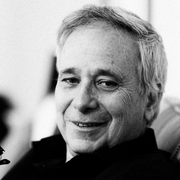
– Ilan Pappé is a professor at the University of Exeter. He was formerly a senior lecturer in political science at the University of Haifa. He is the author of The Ethnic Cleansing of Palestine, The Modern Middle East, A History of Modern Palestine: One Land, Two Peoples, and Ten Myths about Israel. He is the co-editor, with Ramzy Baroud of ‘Our Vision for Liberation.’ Pappé is described as one of Israel’s ‘New Historians’ who, since the release of pertinent British and Israeli government documents in the early 1980s, have been rewriting the history of Israel’s creation in 1948. He contributed this article to The Palestine Chronicle.
Ilan Pappe on one democratic state

On April 21 in the town of Shefamru we have begun the preparatory meeting for launching the one democratic state initiative.The idea is to bring together under one roof all the movements and individuals who believe in this solution in and outside Palestine and to try and create together a movement of change. The challenge is enormous. The representative bodies of the Palestinian national movement (in Israel and in the PLO) still adhere to the two states solution as do some genuine friends of the Palestinians such as Jeremy Corbyn. The early discussion revealed on the one hand significant questions that still have be discussed from secularism, the future of the West Bank settlements, and the right or the absence of it for collective rights. and more importantly how can such movement be representative and democratic in the present reality. Nothing resolved yet.

On the other hand there was a total agreement on the right of return, the abolition of Zionist institutions and equality (although i think we have to talk about the future economic system as well).

We hope to launch the initiative in September and would love to hear suggestions and responses. The two states solution is dead, even if we were not invited to the funeral, and who know the developments in the region are not all favourable to Israel and make it a great time to push forward this old new idea once more.

The meeting was in Arabic and mainly with Palestinians as we believe that this should be first and foremost a Palestinian project but we will have a separate meeting with anti-Zionist Jewish activists to get more feedback and listen to their suggestions and concerns. Meetings are planned for Gaza, the West Bank and the Naqab.

It is been a while that a meeting made feel optimistic, but i know the people who were there and i feel empowered and hopeful!

Shimon Peres from the perspective of his victims

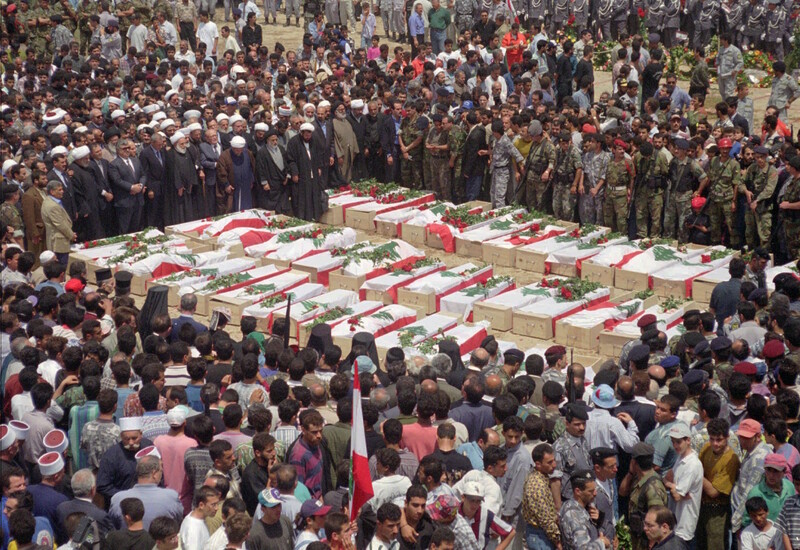
Officials and mourners surround coffins covered with Lebanese flags during a mass funeral in the southern Lebanese town of Tyre, 30 April 1996. The victims were killed in an Israeli artillery attack on a UN base in Qana, in southern Lebanon, on 18 April as part of an operation ordered by then Israeli Prime Minister Shimon Peres. Ahmed Azakir AP Photo

The obituaries for Shimon Peres have already appeared, no doubt prepared in advance as the news of his hospitalization reached the media.

The verdict on his life is very clear and was already pronounced by US President Barack Obama: Peres was a man who changed the course of human history in his relentless search for peace in the Middle East.

My guess is that very few of the obituaries will examine Peres’ life and activities from the perspective of the victims of Zionism and Israel.

He occupied many positions in politics that had immense impact on the Palestinians wherever they are. He was director general of the Israeli defense ministry, minister of defense, minister for development of the Galilee and the Negev (Naqab), prime minister and president.

In all these roles, the decisions he took and the policies he pursued contributed to the destruction of the Palestinian people and did nothing to advance the cause of peace and reconciliation between Palestinians and Israelis.

Born Szymon Perski in 1923, in a town that was then part of Poland, Peres immigrated to Palestine in 1934. As a teenager in an agricultural school, he became active in politics within the Labor Zionist movement that led Zionism and later the young State of Israel.

As a leading figure in the movement’s youth cadres, Peres attracted the attention of the high command of the Jewish paramilitary force in British-ruled Palestine, the Haganah.

Nuclear bomb

In 1947, Peres was fully recruited to the organization and sent abroad by its leader David Ben-Gurion to purchase arms which were later used in the 1948 Nakba, the ethnic cleansing of Palestinians, and against the Arab contingents that entered Palestine that year.

After a few years abroad, mainly in the United States, where he was busy purchasing arms and building the infrastructure for the Israeli military industry, he returned to become director general of the defense ministry.

Peres was active in forging Israel’s collusion with the UK and France to invade Egypt in 1956, for which Israel was rewarded by France with the needed capacity to build nuclear weapons.

Indeed it was Peres himself who largely oversaw Israel’s clandestine nuclear weapons program.

No less important was the zeal Peres showed under Ben-Gurion’s guidance and inspiration to Judaize the Galilee. Despite the 1948 ethnic cleansing, that part of Israel was still very much Palestinian countryside and landscape.

Peres was behind the idea of confiscating Palestinian land for the purpose of building exclusive Jewish towns such as Karmiel and Upper Nazareth and basing the military in the region so as to disrupt territorial contiguity between Palestinian villages and towns.

This ruination of the Palestinian countryside led to the disappearance of the traditional Palestinian villages and the transformation of the farmers into an underemployed and deprived urban working class. This dismal reality is still with us today.

Settlers’ champion

Peres disappeared for a while from the political scene when his master Ben-Gurion, Israel’s founding prime minister, was pushed aside in 1963 by a new generation of leaders.

He came back after the 1967 War and the first portfolio he held was as minister responsible for the occupied territories. In this role, he legitimized, quite often retroactively, the settlement drive in the West Bank and Gaza Strip.

As so many of us realize today, by the time the pro-settlement Likud party came to power in 1977, the Jewish settlement infrastructure, in particular in the West Bank, had already rendered a two-state solution an impossible vision.

In 1974, Peres’ political career became intimately connected to that of his nemesis, Yitzhak Rabin. The two politicians who could not stand each other, had to work in tandem for the sake of political survival.

However, on Israel’s strategy toward the Palestinians, they shared the Zionist settler-colonial perspective, coveting as much of Palestine’s land as possible with as few Palestinians on it as possible.

They worked well together in quelling brutally the Palestinian uprising that began in 1987.

Peres’ first role in this difficult partnership was as defense minister in the 1974 Rabin government. The first real crisis Peres faced was a major expansion of the messianic settler movement Gush Emunim’s colonization effort in and around the West Bank city of Nablus.

Rabin opposed the new settlements, but Peres stood with the settlers and those colonies that now strangulate Nablus are there thanks to his efforts.

In 1976, Peres led government policy on the occupied territories, convinced that a deal could be struck with Jordan, by which the West Bank would be within Jordanian jurisdiction but under effective Israeli rule.

He initiated municipal elections in the West Bank but to his great surprise and disappointment, the candidates identified with the Palestine Liberation Organization were elected and not the ones loyal to Jordan’s Hashemite monarchy.

But Peres remained faithful to what he named the “Jordanian option” as an opposition leader after 1977 and when he returned to power in coalition with the Likud in 1984-1988. He pushed forward the negotiations on the basis of this concept until King Hussein’s decision to cede any political connection between Jordan and the West Bank in 1988.

Israel’s international face

The 1990s exposed to the world to a more mature and coherent Peres. He was Israel’s international face, whether in government or outside it. He played this role even after the Likud ascended as the main political force in the land.

In power, in Rabin’s government in the early 1990s, as prime minister after Rabin’s 1995 assassination, and then as a minister in the cabinet of Ehud Barak from 1999 to 2001, Peres pushed a new concept for what he called “peace.”

Instead of sharing rule in the West Bank and Gaza Strip with Jordan or Egypt, he now wished to do it with the Palestine Liberation Organization. The idea was accepted by PLO leader Yasser Arafat, who may have hoped to build on this a new project for the liberation of Palestine.

As enshrined in the 1993 Oslo accords, this concept was enthusiastically endorsed by Israel’s international allies.

Peres was the leading ambassador of this peace process charade that provided an international umbrella for Israel to establish facts on the ground that would create a greater apartheid Israel with small Palestinian bantustans scattered within it.

The fact that he won a Nobel Peace Prize for a process that advanced the ruination of Palestine and its people is yet another testimony to world governments’ misunderstanding, cynicism and apathy toward their suffering.

We are fortunate to live in an era in which international civil society has exposed this charade and offers, through the boycott, divestment and sanctions movement and the growing support for the one-state solution, a more hopeful and genuine path forward.

Qana

As prime minister, Peres had one additional “contribution” to make to the history of Palestinian and Lebanese suffering.

In response to the endless skirmishes between Hizballah and the Israeli army in southern Lebanon, where Hizballah and other groups resisted the Israeli occupation that began in 1982 until they drove it out in 2000, Peres ordered the bombing of the whole area in April 1996.

During what Israel dubbed Operation Grapes of Wrath, Israeli shelling killed more than 100 people – civilians fleeing bombardment and UN peacekeepers from Fiji – near the village of Qana.

Despite a United Nations investigation that found Israel’s explanation that the shelling had been an accident to be “unlikely,” the massacre did nothing to dent Peres’ international reputation as a “peacemaker.”

In this century, Peres was more a symbolic figurehead than an active politician. He founded the Peres Center for Peace, built on confiscated Palestinian refugee property in Jaffa, which continues to sell the idea of a Palestinian “state” with little land, real independence or sovereignty as the best possible solution.

That will never work, but if the world continues to be committed to this Peres legacy, there will be no end to the suffering of the Palestinians.

Shimon Peres symbolized the beautification of Zionism, but the facts on the ground lay bare his role in perpetrating so much suffering and conflict. Knowing the truth, at least, helps us understand how to move forward and undo so much of the injustice Peres helped create.

The author of numerous books, Ilan Pappe is professor of history and director of the European Centre for Palestine Studies at the University of Exeter.

Hajo Meyer 2003 Interview – East Jerusalem

Ilan Pappe : My good friend Hajo Meyer died last week. He was an outstanding fighter for the freedom of Palestine. A Holocaust survivor who believed strongly the universal legacy of what he experienced was to struggle against human oppression, even if, and particularly if, the oppressors, are Jews.

1948 : Historical quote of the day

from Ilan Pappe
Yossef Vashitz was a senior advisor of Arab affairs to Mapam, whose major military force, the Palmach, were the commando units of the Zionist military effort in 1948. His private collection include this half page – undated  – translated here, which just give a short list of atrocities committed in 1948 (mostly in October to November that year during operation Hiram) in the upper Galilee. Here it is: Safsaf –caught 52 men, tied them one to the other, dug a hole and shot them.  While they were sill alive, women came and pleaded for their  lives. Found 6 bodies of old men, all and all 61 bodies.
Three rape cases. One by a Mizrachi Jew from Jaffa of a 14 years old girl. 4 men shot and killed. From The one they cut by knife his fingers to take his ring. Jish – 400 inhabitants. A women embracing a child  – both dead. 4 women and 11 soldiers dead. The Logistic Unit. They wipe everything. The Kibbutzim rob everything. Kefar Giladi [robbed] five flower lorries.
Ein Zitun, the logistic went wild…tore women earlobes to take the ear rings. In Birim – the same sight and one dead man for no reason. Sasa. Murders; especially of old men.
Ilabun – 1000 people, the army received surrender, slaughtered [animals], food, and then the expulsion from the village began by shooting. Thirty people died. The order was to expel the villages. Rumours of it across the border. Saliha – ninety two, men, old men women and children [died] when a house was blown on them. Mashhat – the village wanted to surrender already in the days of Qawqji, he revenged, now we.
Photo : Historical quote of the day</p><br />
<p>Yossef Vashitz was a senior advisor of Arab affairs to Mapam, whose major military force, the Palmach, were the commando units of the Zionist military effort in 1948. His private collection include this half page – undated  - translated here, which just give a short list of atrocities committed in 1948 (mostly in October to November that year during operation Hiram) in the upper Galilee.</p><br />
<p>Here it is:<br /><br />
Safsaf –caught 52 men, tied them one to the other, dug a hole and shot them.  While they were sill alive, women came and pleaded for their  lives. Found 6 bodies of old men, all and all 61 bodies. Three rape cases. One by a Mizrachi Jew from Jaffa of a 14 years old girl. 4 men shot and killed. From The one they cut by knife his fingers to take his ring.<br /><br />
Jish – 400 inhabitants. A women embracing a child  - both dead. 4 women and 11 soldiers dead.<br /><br />
The Logistic Unit.<br /><br />
They wipe everything. The Kibbutzim rob everything. Kefar Giladi [robbed] five flower lorries.</p><br />
<p>Ein Zitun, the logistic went wild…tore women earlobes to take the ear rings. In Birim – the same sight and one dead man for no reason.<br /><br />
Sasa. Murders; especially of old men.<br /><br />
Ilabun – 1000 people, the army received surrender, slaughtered [animals], food, and then the expulsion from the village began by shooting. Thirty people died. The order was to expel the villages. Rumours of it across the border.<br /><br />
Saliha – ninety two, men, old men women and children [died] when a house was blown on them.<br /><br />
Mashhat – the village wanted to surrender already in the days of Qawqji, he revenged, now we.

Blog at WordPress.com.

Up ↑