Define the Holocaust, explain why it happened.
Why focus on Jews?
The most important events of the Holocaust
The importance of the event and the reaction of the Arabs
What we learned from the Holocaust.
|
|
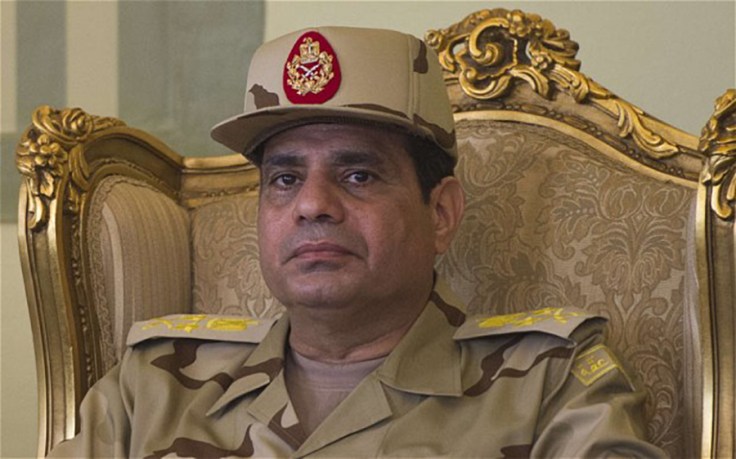
It turned out to be true. It was the most disgusting capricious report one could imagine, so much not only I but also so many other Syrian activists could not believe it, but it turned out to be true. Al-Sisi, the Wankertator of Egypt, and the jaundiced junta supporting him, did in fact hoist this attached banner in the streets of Cairo.
The banner shows smiling Al-Sisi sporting his military uniform standing next to a child waving at the dead body of Aylan, the Syrian Kurdish child who drowned off the cast of Turkey in September 2015, and whose death brought international attention to the plight of Syrian refugees, at least for a few weeks, before governments decided to ignore it again. The text accompanying the banner said: “A child who lost his army.”
For those who don’t get how macabre this gesture is, bear in mind that Aylan and his family were trying to escape the violent and bloody repression of the Assad regime’s army, the army that was to be protecting them, when their boat overturned and they drowned. Al-Sisi’s people are standing the truth on its head in order to justify their repression at home and their support of the maniacal regime of Bashar Al-Assad.
There is something so macabre and anathematic about dictators’ continued existence in this day and age, something that poisons the soul and militates against one’s own sense of humanity. No justification works anymore. They are neither father figures, nor modernizers, nor peacemakers, but maniacal ravishers and a deadly plague. Yes, they have some popular support, but some people are willing to make peace with cancer knowing that they would die of it, but, no matter what they think, they have no right to kill the rest of us. Because this particular cancer does not discriminate. This applies to Al-Sisi’s supporters as well as those of his earlier Islamist iteration: Mursi, the little horsy that couldn’t deceive enough people for a long enough time to sacralize his Islamist agenda in the form of a constitution.
Being critical of both sides of Egypt’s malaise wins me no admirers neither in Egyptian or Syrian circles. Some Syrians expect me to support Mursi and oppose Al-Sisi based on their positions towards the Syrian conflict, not their overall policies and worldview. But no can do.
When Al-Sisi mounted his coup, I was sad and wrote something like this on Facebook page: this is what the Muslim Brotherhood’s blind hubris managed to accomplish – it facilitate a return to military rule. I don’t support coup d’état’s but I cannot support religious autocracy, even if its wannabe founders came as a result of a popular vote. Indeed, the inability to understand that winning an election does not entitle one to rule as he and his party pleased, refashioning the state in their image and according to their particularistic vision, this inability does emanate from wishful stupidity but from willful blindness and Machiavellian machinations. Willingness to compromise is the only way out of this crisis, but many people cannot handle compromise it seems, and nuance is not something that they are used to. To them, I cannot be against Al-Sisi’s coup and not for MB. I am either for this side, or that side. And being with a side means treating its representatives as heroes. And our heroes are always saints, our villains perfectly villains, the ones inside and the ones outside. And our victimhood, for we are victims after all, we must be victims seeing how weak and insignificant we are, there is no denying this, not by any stretch of the imagination, our victimhood is always a perfect undeserved one, one to which we did absolutely nothing to contribute. It’s always the other’s fault: the others inside, and the others outside. That makes all of us guilty, therefore, none of us is.
So, here it is Egypt a victim of terrorism, but that infamous recent terrorist attack didn’t happen. This is probably why Egypt needs to maintain its position on the list of worst offenders against journalists.
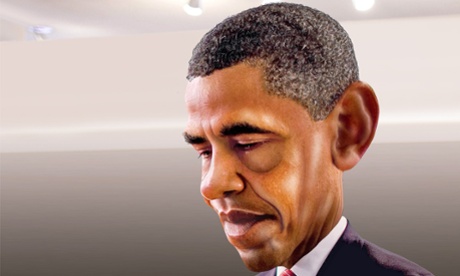
Obama has ignored Syria for too long: it’s the rise of Isis, stupid – now help
It’s time for him to do the right thing by arming moderate rebels, imposing a no-fly zone and expanding military action beyond Iraq
Blanket, cold-hearted realism doesn’t work when networked, cold-hearted terrorism does. Photo illustration: DonkeyHotey / Flickr via Creative Commons
- theguardian.com, Monday 25 August 2014 11.15 BST
- Jump to comments (282)
Barack Obama is embarking on a global course correction, if not an outright reversal: the policy of “don’t do stupid stuff” – the non-interventionism so praised by the Farid Zakarias and Tom Friedmans of the world – is getting forced out, albeit in the typical Obama fashion of admitting nothing and never going fast or far enough.
And to hear the Chuck Hagels and John Kerrys of the administration tell the story for him, it’s all the fault of the Islamic State (Isis), which is “beyond just a terrorist group”, “an organization that has an apocalyptic, end-of-days strategic vision and which will eventually have to be defeated” – a feat which, realistically, will require some intervention not just in Iraq … but in Syria.
It’s difficult to do the right thing when you’ve already fucked up so badly. When the Obama administration refused to enforce a no-fly zone over Syria in 2011, the indifference gave rise to despair and forced people to abandon their nonviolent ways to defend themselves, effectively transforming the nonviolent protest movement into an armed resistance. Obama’s refusal to then support the rebels following the advice of his then-secretary of state, among other officials, created a vacuum that was gradually filled by extremist elements emerging out of the woodwork and jihadists pouring across the borders, a combination that paved the way for the emergence of the newly troubling and feared Isis.
Now, Isis has a vision being carried out – effectively, if with pure evil – by technocratic leaders with succession plans, flexible but enduing structures, and major funding, with major operations based out of its hub in Syria. Soon, some of its acolytes might make like Hezbollah and run legitimate businesses across multiple countries that secretly fund terror; some already appear to be attracted to the radicalized appeal of Isis leader Abu Bakr Al-Baghdadi declaring a new Caliphate.
No wonder Obama is finding it so difficult to justify a policy of minimal engagement anymore – perhaps even to himself. Blanket, cold-hearted realism doesn’t work when networked, cold-hearted terrorism does. The line between realism and cynicism has always been too thin, and has long been crossed by the Administration. While realism is laudable, cynicism ends up producing the very outcomes that realism intends to avoid. Letting a region take care of itself is impossible to allow when your spies are telling you about the rise of a terror group across the world, including the West – of terrorists that are effectively becoming a global movement of disaffected Muslims everywhere.
Some “realists” are advocating cooperation with Bashar al-Assad. But that wouldn’t just being doing “stupid stuff” – it would be downright delusional, since cooperating with dictators who abuse their own people is exactly what gives rise to extremist anti-Western movements.
The only way for Obama to stop doing stupid stuff with his foreign policy is to arm moderate rebels in Syria, to bomb Isis bases in both Syria and Iraq and to finally impose a no-fly zone on the Assad regime. This combination of tactics could allow the Syrian opposition – which has thus far been unable to govern the liberated areas due to Assad’s use of aerial strikes, including barrel bombs, scud missiles, and, on occasion, chemical weapons and poison gas – to move in and work with the local councils to begin returning the basic services to the local communities, bringing a measure of relief to the local civilian population. Imposing a no-fly zone also avoids having to supply advanced weapons to rebels, including TOW missiles and MANPADs, thus minimizing the risk of having them end up in the wrong hands. Still, the opposition will have its work cut out for it in terms of ensuring effective governance of the areas under their control, especially when it comes to reaching agreements between Islamist and secularist currents. But by controlling the flow of humanitarian aid and the funds required for the reconstruction processes, the administration and other members of international community could exercise leverage to allow for compromises to be reached.
Obama already plans to take a leading role at next month’s UN General Assembly, where strategies for holding back Isis will be a top priority. But Western and Middle Eastern leaders need to begin preparing for a peace conference following such strikes, because a real transition plan for a post-conflict and post-Assad Syria needs to be developed. Talks will not be easy (and could drag out for months if not longer), but if the regime’s ability to wreak havoc on rebel communities is curbed by strikes and the economic blockade against it is strengthened, time will not be on its side – rendering hopes for an eventual breakthrough more realistic.
It’s about time for the Obama administration to do the right thing. It’s about time, after doing so much stupid stuff and aiding in the rise of Isis, to begin resolving a conflict that has killed close to 200,000 people in less than four years, and produced millions of refugees, becoming the worst humanitarian disaster since the Cold War.
Yes, American strikes may make disaffected Muslims more eager to join Isis. Yes, we may be witnessing the birth of a new Islamic sect. But Barack Obama needs to stop fighting the symptoms while embracing the disease – to become a true realist and not a cynical one. Sectarian violence was not inevitable in Syria, as some analysts argued at the beginning of the revolution, but indifference and cynicism made it so. Obama needs to engage in the region with a positive mindset, knowing that he can actually make a positive difference.
Whether it takes a week, a month, a year or a decade, it does not matter, Assad’s latest initiative is his final political act. By appearing so out-of-touch with reality, Assad has shown that he is not in control of his own regime. He, in fact, is the puppet, his bubble long burst. The question, therefore, is: who’s really running the show at this stage? And what do they want?
Sunday January 6, 2013
Today’s Death Toll: 101, including 2 children and 10 women: 28 martyrs were reported in Damascus and its Suburbs, 22 in Aleppo, 14 in Daraa, 13 in Homs (most of them in Tasneen), 10 in Hama, 10 in Deir Ezzor, 3 in Idlib and 1 in Lattakia (LCCs).
Points of Random Shelling: 294: 7 points were shelled with warplanes, 2 points with cluster bombs, 122 points with mortars, 111 points with artillery and 51 points with missile shelling (LCCs).
Clashes: The Free Syrian Army clashed with the regime’s army at 150 points where they managed to block the regime forces’ attempt to storm Bustan neighborhood in Aleppo (with the defection of several personnel from the Police Academy). They also gained control of the Soldier’s Hotel in Khan Al-Assal and shelled Jarah Military Airport in Maskana in Aleppo. In Deir Ezzor the FSA surround the Political Security branch and dismantled several military machines and in Damascus Suburbs they blocked an attempt by regime’s army to storm Eastern Ghota, through Hteitet Al-Turkman road, and destroyed more than 15 military vehicles and 4 tanks. In Hama, they seized a lot of ammunition and a food unit on the agricultural road connecting between Soqailbiya and Tal Burhan. Also, they destroyed several military vehicles and captured several regime army personnel throughout Syria (LCCs).
Reports from local activists confirm that the son of the newly appointed Minister of Defense, Rustom Ghazali, one of the few Syrian officials accused in plotting the assassination of former Lebanese PM, Rafic Al-Hariri, has been kidnapped by rebels from his hometown in Khirbet al-Ghazali. This development led to increase in the intensity of clashes in the area, and throughout the Daraa Province. Authorities used loudspeakers threatening local of dire consequences should the Minister’s not be returned unharmed. Ghazali had only days ago replaced Mohammad Al-Shaar as Minister of Defense. Minister Al-Shaar had been injured in a rebel attack, received treatment in Beirut then returned to Syria where he disappeared from public view amidst increasing reports that he passed away.
News
Syria’s Assad rejects dialogue with “puppet” opposition Syrian President Bashar al-Assad announced what he described as a peace plan on Sunday, calling for a reconciliation conference with “those who have not betrayed Syria”, to be followed by the formation of a new government and an amnesty. “The first stage of a political solution would require that regional powers stop funding and arming (the opposition), an end to terrorist operations and controlling the borders,” he said in a speech in central Damascus, his first public comments in months. “We will not have dialogue with a puppet made by the West,” he said.
Defiant Assad’s peace plan rejected by rebels In his first public speech in six months, Assad laid out terms for a peace plan that keeps himself in power, ignoring international demands to step down and pledging to continue the battle “as long as there is one terrorist left” in Syria.
Defiant Assad Says Syria ‘Accepts Advice but Not Orders’ he offered no new acknowledgment of the gains by the rebels fighting against him, the excesses of his government or the aspirations of the Syrian people. Mr. Assad also ruled out talks with the armed opposition and pointedly ignored its central demand that he step down, instead using much of a nearly hourlong speech to justify his harsh military crackdown… Mr. Assad’s speech was a disappointment for international mediators and many Syrians who say they believe that without a negotiated settlement, Syria’s conflict will descend into an even bloodier stage.
Syrian opposition dismiss Assad call for talks amid attack on ‘western puppets’ Rebels say Syrian president offered no meaningful concessions in his first public speech in seven months.
Morsy backs Syrian calls for al-Assad to face war crimes trial “The Syrian people through their revolution and through the movement will — when the bloodshed stops — move to a new stage where they will have an independent parliament and a government of their choosing,” Morsy, Egypt’s first freely elected leader, told CNN’s Wolf Blitzer in Cairo. “And then they will decide what they want to do to those who committed crimes against them. It is the Syrian people who decide.”
Israel warily watches shifts across its frontier with Syria Trenches lined with coils of razor wire have been dug along the Israeli side of the Golan frontier, and a new 15-foot-high steel fence is under construction, with plans to extend it the length of the boundary with Syria. Surveillance of the Syrian side, aided by cameras, also is being stepped up… Replacing a lower electronic warning fence, the imposing new barrier, encased in rolls of barbed wire, is intended to serve as a bulwark against infiltrators.
Special Reports
While there’s a common perception in Western capitals that the regime is on its last legs, there are plenty of signs on the ground that it remains very much intact—and very dangerous. Assad’s security forces have been forced to relinquish control of many rural areas and have even ceded the impoverished peripheries of a number of Syrian cities, but it has escalated its attacks on areas under rebel control in recent months, deliberately imposing a heavier toll in humanitarian suffering. And rebels in many areas appear desperately short of funds and military resources, despite promises of expanded support from outside powers.
He wants to negotiate, but with whom, and over what?
By appearing so out-of-touch with reality, Assad has shown that he is not in control of his own regime. He, in fact, is the puppet. The question, therefore, is: who’s really running the show at this stage? And what do they want?
Assad’s words provide few clues, but the subtext to his speech, the body language and apparent nervousness in delivery, his clear concern for how his speech will be viewed by his supporters as denoted by his repeated assertions that he is not giving up the fight against the “terrorists,” his dismissal of the external opposition coupled with his readiness to negotiate with their backers… all these things point to the presence of a radical camp inside the regime that seems to have taken charge of the day-to-day management of the crackdown, keeping Assad as a necessary window dressing.
What does this radical camp want? At this stage, and judging by developments on the ground, the only possible interpretation is that they want to buy enough time to draw the borders of their coveted enclave, while exacting revenge against the Sunni population all over the country through continued recourse to scorched earth policy.
In short, our descent into hell continues.
Video Highlights
Shortly after the speech delivered by Assad, clashes took place in several neighborhoods in Damascus City http://youtu.be/UvUNATTlasY , http://youtu.be/la_qMCdIlRM
Clashes in Deir Ezzor City intensified http://youtu.be/wyi8VPOugSY , http://youtu.be/mPr0xxS2N5Y , http://youtu.be/S_GNs-OMBh0 , http://youtu.be/O5AtC3IY2tA
Intense clashes took place in the town of Basr Al-Harir, Daraa as well http://youtu.be/f7jfaou4plI , http://youtu.be/hbGDSh9zhFs , http://youtu.be/dAxaNYkyVIc , http://youtu.be/JYFZpf0JhB0 , http://youtu.be/uAsLA2aWE58 Rebels take control of a BMP http://youtu.be/Bo4KM2HmHuk
Intense clashes took place in several neighborhoods in Homs City as well http://youtu.be/XAinJ2fUE1o
Clashes took place around the Police Academy in Aleppo City as well http://youtu.be/yMI1JAmefyk
Leaked video documents the use of missile launchers in the pounding of restive cities by pro-Assad militias http://youtu.be/O-djiFPf_qs
But Assad’s fighter jets kept dropping barrel bombs on Kuweirus Airport where rebels are positioned http://youtu.be/TPFkWEVVpa0
Posted by Ammar Abdulhamid at 1:05 AM
 band annie's Weblog