Search

band annie's Weblog

I have a parallel blog in French at http://anniebannie.net

Tag

Aleppo

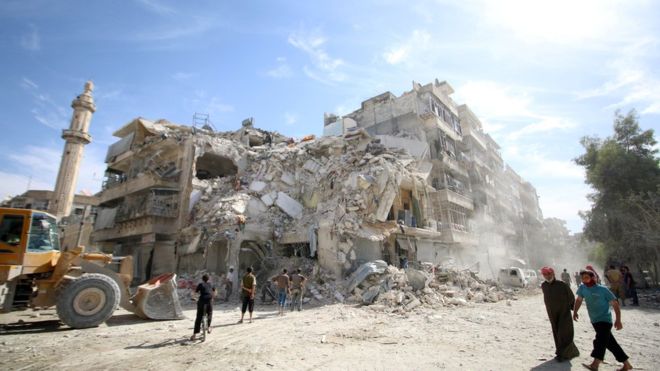
Aleppo Under Siege with No Hospital, Food

CLICK ON IMAGE
aleppo01

Aleppo in a Time of Monsters

“Alepponica” by Vasco Gargalo

During the Siege of Sarajevo in 1994, when a Bosnian Serb mortar shell landed in a marketplace, killing 68 and wounding 144, US president Bill Clinton, who had campaigned on a promise of “never again” to genocide, threw up his arms. “Until those folks get tired of killing each other over there, bad things will continue to happen,” he said.

Two decades later, confronted with indiscriminate bombings in Aleppo and a starvation siege in Madaya, Barack Obama waxed similarly fatalistic. “The Middle East is going through a transformation that will play out for a generation”; this, he said, was “rooted in conflicts that date back millennia.”

There are no conflicts in the Middle East that date back millennia. The conflict in Syria is just over five years old. Nothing about it is fixed. In its scope and its intensity, in its balance of forces and its cast of characters, the conflict has constantly evolved. The only thing that has remained static, however, is the international response.

In speaking of the horrors unfolding in Syria, it is hard not to get a sense of déjà vu. Everything that can be said about Aleppo has already been said about Homs, Houla, Daraya, Douma. But with each new execration comes a growing sense that, for all the obtrusive violence, for all the pleas and revelations, we are plunging into the deep, smothered by apathy, abandoned by hope.

Syria today is a free fire zone with no check on criminality. The red line that Barack Obama set was blithely crossed. It proved to be a Pavolvian exercise in reverse. In having his bluff called, the constitutionally weak president was himself zapped. Never eager for action in Syria, he has become fearful of setting new limits lest their violation further expose his pusillanimity.

Obama betrayed the people of Syria twice over. First by drawing a line on chemical weapons, at a time when most Syrians were being killed by conventional means; and then by failing to enforce it, giving Assad an unconditional license to kill by all means, including chemical weapons.

For the US, there is no categorical imperative against genocide. “Never again” is retrospective grandstanding. It is easy to take unequivocal positions when the political questions have been settled and there is no price to pay. The US has rarely acted to prevent atrocities in the present and, to the extent that it has, it has been guided entirely by political imperatives.

No one has ever suffered for denouncing the Nazi holocaust. But at the time of the holocaust, few acted to stop it. Leaders then were speaking about political interests, resource limits, and military priorities—same as today. “Never again” they said only afterwards.

Then came Rwanda. “Never again!” Then Srebrenica. “Never again!”

In 1995, when the US finally acted in Bosnia, the conflict was no worse than it had been a year before. But it was an election year and by flexing military muscle, Bill Clinton was able to erase the impression of weakness. Cynical motives notwithstanding, the action put an end to four years of “bad things” even though “those folks…over there” hadn’t yet “tired of killing each other”.

Barack Obama is on his way out. He has nothing to gain politically from confronting Assad. And morally—well, he is “proud of this moment” when he abandoned Syrians to Assad’s inexhaustible appetite for killing. Nearly three times as many people were killed in the two years after Obama’s embarrassing climb-down than had died in the two years before—by “ancient hatreds,” he might say.

Obama has meanwhile taken to encouraging “negotiations” and proclaiming that there is “no military solution” to the conflict. Assad, Putin, and Qassem Soleimani disagree. For them the negotiations are a temporising measures while proceeding with their conquest. But when the Syrian opposition protests against this farce, it is they who get painted as intransigents.

The US is no mere bystander. As in Bosnia, it has actively blocked the transfer of much needed anti-aircraft capacity to Syrian rebels, allowing the regime and Russia to bomb with impunity. And by accepting Russia’s “war on terror” rationale, it has made itself complicit in its crimes. Indeed, the US legitimized Russia and the regime’s ferocious aerial assault when its military spokesman alleged that “It’s primarily al-Nusra who holds Aleppo, and of course, al-Nusra is not part of the cessation of hostilities.” (Nusra has a small presence in the city but it certainly doesn’t “hold Aleppo”).

But if the US hasn’t fared well in Syria, neither has the UN.

In 2005, with much fanfare, the UN had introduced the doctrine of “right to protect” (R2P), codifying “never again” into a norm of international conduct. Its timely application in Syria might have saved hundreds of thousand lives. But even as the UN secretary general Ban Ki-Moon was acknowledging the “shame” of its failure in Rwanda and Srebrenica, the UN was giving cover to the regime’s starvation sieges across Syria, censoring its documents, and obfuscating responsibility with the anodyne language of “both sides”.

But as the Italian writer Primo Levi, a holocaust survivor, noted: “to confuse [perpetrators] with their victims is a moral disease or an aesthetic affectation or a sinister sign of complicity; above all, it is a precious service rendered (intentionally or not) to the negators of truth.”

The negators of truth are myriad. Not just governments, but also people—and above all media institutions (especially the London Review of Books and Democracy Now!, two institutions that have tried to systematically subvert truth).

Levi had observed in 1974 that “every age has its own fascism” and they are enforced “not just through the terror of police intimidation, but by denying and distorting information, by undermining systems of justice, by paralyzing the education system, and by spreading in a myriad subtle ways nostalgia for a world where order reigned.”

Where once “no justice, no peace” was considered a truism, demands for justice are now deemed a threat to “stability”. Peace without justice is the nostalgia the negators of truth hanker after. Preserving truth is therefore the first step toward confronting fascism. But truth alone will not change the imbalance of forces.

In international politics, the power of knowledge is trumped by the knowledge of power. Negotiations without leverage are doomed to fail.

It is by now clear that no power will intervene to aid the Syrian people. But regional powers, unlike the US, will not be shielded from the consequences of a regime victory. In the form of the “refugee crisis”, Europe is already feeling the repercussions. It is time for regional powers to step up and provide vetted rebel groups with MANPADS. Only by revoking the regime’s aerial capacity can it be induced to negotiate in good faith.

R2P and “never again” were false hopes. The new moral order that was struggling to come forth is now dead. But that is no reason to let the monsters reign. People have a right to defend themselves; let’s give them the means.

– A version of this article first appeared at The New Arab.

source


A Call to Stop the Bombing of Aleppo

Friends for a NonViolent WorldF N V W Calls for Stopping the Bombing of Aleppo

It is time for all peace organizations to speak out clearly.  We at FNVW since 2011 have supported both the Syrian nonviolent movement and nonviolent activists in their struggle for human rights and a democratic Syria for all Syrians without any group monopolizing power to impose its own agenda.

Throughout this struggle FNVW has opposed the United States as well as any other country or organization sending weapons and/or troops to any of the parties in the conflict. Friends for a NonViolent World affirmed that the United States must remain solely committed to diplomatic and humanitarian efforts to resolve this crisis.  And we have been outspoken in our opposition to the extreme Salafist groups in the armed opposition and any party in the conflict who have committed crimes against humanity.

Both the Guardian and the New York Times document what has been happening in Aleppo.

We at FNVW unequivocally condemn the crimes against the Syrian people and crimes against humanity, Russia and the Assad regime are perpetrating in Aleppo. The intentional killing of civilians is a war crime.  Putin’s and Assad’s brutal use of bunker busting bombs, thermobarbaric weapons, barrel bombs and phosphorus are resulting in devastating, unspeakable consequences for civilians. Government forces also have targeted the volunteer humanitarian group, the White Helmets, halting their rescue efforts.

The chart from the Violations Documentation Center in Syria answers the question of “Who kills civilians in Syria?”

These weapons do not distinguish between civilians and combatants.  Their goal is to terrorize into submission or displace people.  The use of this lethal weaponry is immoral and contravenes international law.

FNVW calls on both the Russian and Syrian governments to immediately halt their air strikes and war crimes in Aleppo.

Both the Guardian and the New York Times document what has been happening in Aleppo.

“‘Hell itself’: Aleppo reels from alleged use of bunker-buster bombs”, The Guardian

“Why So Many Children Are Being Killed in Aleppo”, New York Times

source

Al Jazeera World – Death of Aleppo

Al Jazeera World follows the everyday lives of Aleppo residents living amid the on-going conflict and destruction.

Hamam Khairy

Maher Almounnes + Amal Hanano: Hallucinations of War

Amal Hanano (@amalhanano)  –  April 13, 2013
This post, called “Hallucinations of War,” was originally published in Arabic on the blog “Overdose”, which is written from Damascus by journalist Maher Almounnes. It is translated here by Syria Deeply associate culture editor Amal Hanano.Before this war, I used to be described as the smiling optimist. Maybe it was a blessing to be known to my friends as a good listener, because I would simplify situations and solve problems and so forth. However, I still, despite all the pain, continue to smile. And I still, despite all the weariness, find meaning within every tragedy.My first sorrows were losing loved ones, one after the other, as they left the country. But I would console myself with the belief that we would meet again and that our reunion will be sweeter after our separation.

Then we started losing loved ones who would never return. Their martyrdom was both a source of mourning and solace, as “the afterlife is better and everlasting.”

And when we left our home, I told myself that we were leaving one home for another, while there were thousands who had left their homes to live without shelter.

Then my father lost his job. I soothed my mother and told her there were others who had lost their eye or their leg or maybe even their life; thank God my father had not been harmed.

Then one of my best friends was abducted. The silver lining was that he returned with his head still attached to his body and that all that they had given him were a few bruises and slightly swollen soles.

Between these events are countless details, from having to postpone my sister’s wedding dozens of times to losing so many friends because of politics.

However, these details and others, like watching scenes of death in repetition, are details that every Syrian knows well. Death has come so close to each one of us that we no longer even see it.

All we see now is that we are political commodities or material for the media, or at best we are a number that scrolls on the red ticker on a television screen proceeded by the word: Breaking!

*

Two years. They seem like 20 years of wisdom and 50 years of sorrow. They made me change how I think about a lot of things. (By the way, I write now because I feel like it, not for any other reason.) But they did not stop me from taking advantage of this miserable reality and conspire with the girl I love.

The irony is, I forced this war to bend to my demands and serve my personal interests.

I claim to be the greatest lover in the dirtiest war. I claim to love her as much as the sorrow in Damascus, the number of the bullets in Aleppo, the destruction of the neighborhoods in the old city of Homs.

Every explosion is another reason to listen to her voice with the excuse to make sure she is alright. Would you believe that I now love the sound of explosions? Just so I can rush to call my love even though I know with certainty that she is safe at home.

Our new home that we fled to is located on the outskirts of Damascus, in a conflict zone. It’s wonderful for your home to be in a “hot” zone, because you have a daily appointment with death. And that’s another opportunity for her to worry about me and to call me every morning to make sure I woke up in my bed, still alive.

I work in a neighborhood where people are often detained. Amazing! A little bit of fear in exchange for more chances to be indulged and receive a few sweet words from here or a warm message from there.

And so what else is there in this war? Snipers? Suicide bombers? Mortars?

How beautiful they all are.

Because of them, I made a pact to never upset her no matter the reason. Because my fear is that death will come quickly, leaving a melancholy gaze between our eyes forever.

I owe our neighborhood sniper a rose. Because of him, I call my love every day, a few meters from my home, and each time it feels like our final phone call. I don’t know how I invent the words of endearment. I’m surprised by the beautiful words flowing out of my mouth that melt her and in turn melt me. Until I arrive safely to my doorstep.

I owe this war: 2,000 text messages; tens of handwritten letters; more than 4,000 “I love yous”; hundreds of kisses, embraces and tears of joy when we meet; and hours of pining and waiting.

Who said this war is all bad? I made the most beautiful love story out of this war.

Forgive me darling, our love story is written in steel and fire.

I swear by the blood of martyrs that spilled over my land that I love you until the last bullet, the last bomb and the last drop of martyr’s blood.

Not only because you are my angel, but because I believe: love is mightier than war.

You are mightier than war.

Blog at WordPress.com.

Up ↑