Search

band annie's Weblog

I have a parallel blog in French at http://anniebannie.net

Anti-Zionism as Decolonisation

Leila Shomali and Lara Kilani

15-12-2023

As horrifying scenes from Gaza have been recorded, published, and replayed around the world, people have been jolted into action and have thrown themselves into solidarity work. This surge of activism is fuelled by visceral reactions to the harrowing realities of Israel’s ongoing genocide unfolding on the global stage. People are realising, by the thousands, that zionism is a political program of indigenous erasure and primitive resource accumulation. 

Many new activists and reactivated organisers seek to translate their emotional responses into tangible support. They are also searching for community hubs, often in the form of organisations, that confront zionism and colonialism – the root cause of this genocide. Whether activists know it or not, they are looking for an anti-zionist home for their organising efforts. It is exactly the moment, therefore, to provide an honest discussion on some of the essential characteristics of this organising, firmly rooted in the principles of Palestinian liberation and decolonisation, peeling away any remaining layers of confusion or mystery. This essay aims to open the overdue conversation with some suggestions for individuals to consider as they search for their anti-zionist organising home. 

If we accept, as those with even the most rudimentary understanding of history do, that zionism is an ongoing process of settler-colonialism, then the undoing of zionism requires anti-zionism, which should be understood as a process of decolonisation. Anti-zionism as a decolonial ideology then becomes rightly situated as an indigenous liberation movement. The resulting implication is two-fold. First, decolonial organising requires that we extract ourselves from the limitations of existing structures of power and knowledge and imagine a new, just world. Second, this understanding clarifies that the caretakers of anti-zionist thought are indigenous communities resisting colonial erasure, and it is from this analysis that the strategies, modes, and goals of decolonial praxis should flow. In simpler terms: Palestinians committed to decolonisation, not Western-based NGOs, are the primary authors of anti-zionist thought. We write this as a Palestinian and a Palestinian-American who live and work in Palestine, and have seen the impact of so-called ‘Western values’ and how the centring of the ‘human rights’ paradigm disrupts real decolonial efforts in Palestine and abroad. This is carried out in favour of maintaining the status quo and gaining proximity to power, using our slogans emptied of Palestinian historical analysis. 

Anti-zionist organising is not a new notion, but until now the use of the term in organising circles has been mired with misunderstandings, vague definitions, or minimised outright. Some have incorrectly described anti-zionism as amounting to activities or thought limited to critiques of the present Israeli government – this is a dangerous misrepresentation. Understanding anti-zionism as decolonisation requires the articulation of a political movement with material, articulated goals: the restitution of ancestral territories and upholding the inviolable principle of indigenous repatriation and through the right of return, coupled with the deconstruction of zionist structures and the reconstitution of governing frameworks that are conceived, directed, and implemented by Palestinians. 

Anti-zionism illuminates the necessity to return power to the indigenous community and the need for frameworks of justice and accountability for the settler communities that have waged a bloody, unrelenting hundred-year war on the people of Palestine. It means that anti-zionism is much more than a slogan. 

A liberation movement

Given the implications of defining anti-zionism, we must reorient ourselves around it within the framework of a liberation movement. This emphasises the strategic importance of control over the narrative and principles of anti-zionism in the context of global decolonial efforts. As Steven Salaita points out in ‘Hamas is a Figment of Your Imagination’, zionism and liberal zionism continue to influence the shape of Palestinian resistance: 

Zionists [have] a type of rhetorical control in the public sphere: they get to determine the culture of the native; they get to prescribe (and proscribe) the contours of resistance; they get to adjudicate the work of national liberation. Palestinians are entrapped by the crude and self-serving imagination of the oppressor.

We have to wrestle back our right to narration, and can use anti-zionist thought as a guide for liberation. We must reclaim anti-zionist praxis from those who would only use it as a headline in a fundraising email. 

While our collective imaginations have not fully articulated what a liberated and decolonised Palestine looks like, the rough contours have been laid out repeatedly. Ask any Palestinian refugee displaced from Haifa, the lands of Sheikh Muwannis, or Deir Yassin – they will tell that a decolonised Palestine is, at a minimum, the right of Palestinians’ return to an autonomous political unit from the river to the sea.

When self-proclaimed ‘anti-zionists’ use rhetoric like ‘Israel-Palestine’ – or worse, ‘Palestine-Israel’ – we wonder: where do you think ‘Israel’ exists? On which land does it lay, if not Palestine? This is nothing more than an attempt to legitimise a colonial state; the name you are looking for is Palestine – no hyphen required. At a minimum, anti-zionist formations should cut out language that forces upon Palestinians and non-Palestinian allies the violence of colonial theft. 

The settler/native relationship 

Understanding the settler/native relationship is essential in anti-zionist organising. It means confronting the ‘settler’ designation in zionist settler-colonialism – a class status indicating one’s place in the larger settler-colonial systems of power. Anti-zionist discourse should critically challenge the zionist (re)framing of history through colonial instruments, such as the Oslo Accords and an over-reliance on international law frameworks, through which they differentiate Israeli settlers in Tel Aviv and those in West Bank settlements.

Suggesting that some Israeli cities are settlements while others are not perpetuates zionist framing, granting legitimacy to colonial control according to arbitrary geographical divisions in Palestine, and further dividing the land into disparate zones. Anti-zionist analysis understands that ‘settlers’ are not only residents of ‘illegal’ West Bank settlements like Kiryat Arba and Efrat, but also those in Safad and Petah Tikvah. Ask any Palestinian who is living in exile from Haifa; they will tell you the Israelis living in their homes are also settlers.

The common choice to centre the Oslo Accords, international humanitarian law, and the human rights paradigm over socio-historical Palestinian realities not only limits our analysis and political interventions; it restricts our imagination of what kind of future Palestinians deserve, sidelining questions of decolonization to convince us that it is the new, bad settlers in the West Bank who are the source of violence. Legitimate settlers, who reside within the bounds of Palestinian geographies stolen in 1948 like Tel Aviv and West Jerusalem, are different within this narrative. Like Breaking the Silence, they can be enlightened by learning the error of colonial violence carried out in service of the bad settlers. They can supposedly even be our solidarity partners – all without having to sacrifice a crumb of colonial privilege or denounce pre-1967 zionist violence in any of its cruel manifestations.

As a result of this course of thought, solidarity organisations often showcase particular Israelis – those who renounce state violence in service of the bad settlers and their ongoing colonisation of the West Bank – in roles as professionals and peacemakers, positioning them on an equal intellectual, moral, or class footing with Palestinians. There is no recognition of the inherent imbalance of power between these Israelis and the Palestinians they purport to be in solidarity with – stripping away their settler status. The settler is taken out of the historical-political context which afforded them privileged status on stolen land, and is given the power to delineate the Palestinian experience. This is part of the historical occlusion of the zionist narrative, overlooking the context of settler-colonialism to read the settler as an individual, and omitting their class status as a settler. 

Misreading ‘decolonisation’

It is essential to note that Palestinians have never rejected Jewish indigeneity in Palestine. However, the liberation movement has differentiated between zionist settlers and Jewish natives. Palestinians have established a clear and rational framework for this distinction, like in the Thawabet, the National Charter of Palestine from 1968. Article 6 states, ‘The Jews who had normally resided in Palestine until the beginning of the Zionist invasion will be considered Palestinians.’

When individuals misread ‘decolonisation’ as ‘the mass killing or expulsion of Jews,’ it is often a reflection of their own entanglement in colonialism or a result of zionist propaganda. Perpetuating this rhetoric is a deliberate misinterpretation of Palestinian thought, which has maintained this position over a century of indigenous organising. 

Even after 100 years of enduring ethnic cleansing, whole communities bombed and entire family lines erased, Palestinians have never, as a collective, called for the mass killing of Jews or Israelis. Anti-zionism cannot shy away from employing the historical-political definitions of ‘settler’ and ‘indigenous’ in their discourse to confront ahistorical readings of Palestinian decolonial thought and zionist propaganda. 

The zionist version of ‘all lives matter’ 

As we see, settler-colonialism secures the position of the settler, imbuing them with rights, in this case, a divine right of conquest. As such, zionism ensures that settlers’ rights supersede those of indigenous people at the latter’s expense. Knowing this, the liberal slogan ‘equal rights for all people’ requires deeper consideration. Rather than placing the emphasis on the deconstruction of the settler state and the violence inherent to it, which eternally serves the settler to the direct detriment of indigenous communities, the slogan suggests that Palestinians simply need to secure more rights within the violent system. But ‘equal rights’, in the sense that those chanting this phrase mean them, will not come from attempts to rehabilitate a settler state. They can only be ensured through the decolonization of Palestine, through the material restitution of land and resources. Without further discussion, the slogan simply serves as another mechanism of zionism, one that maintains the rights of the settler rather than emphasising the need to restore rights to indigenous communities, who have long been the victims of settlers’ rights.

Anti-zionists cannot both denounce settler-colonialism and zionism, and centre advocacy on the claim that settlers should have equal, immutable rights. Zionists would have you believe that their state has always existed, that Israelis have always lived on the land. But a brief reference to recent history reminds us that anti-zionism must confront the ongoing mechanisms materially advancing the development of colonies in Palestine.  

In 2022 alone, zionist institutions invested almost $100 million, transferring some 60,000 new settlers from Russia, Eastern Europe, the United States, and France to help secure a demographic majority and ensure a physical presence on indigenous lands. This only happens by maintaining the forced displacement of Palestinians, and by violently displacing them anew as we see on a daily basis, particularly across the rural West Bank. 

There is no moral legitimacy in the suggestion that these settlers have a ‘right’ to live on stolen Palestinian land, the theft maintained by force, as long as there has been no restoration of Palestinians’ rights. No theories of justice exist in mainstream ethical or philosophical discourse that advocate for a person who has stolen something to rightfully keep what they have taken. The act of theft, by definition, violates the basic principles of theories of justice, which emphasise fairness, equitable distribution of resources, and respect for individual rights and property.

Reminding people that decolonisation is not a metaphor, some activists with Israeli citizenship, including Nadav Gazit and Yuula Benivolsky, have taken the initiative to tangibly support Palestinian liberation and renounced their claim to settler citizenship. When liberal NGOs champion ‘equal rights for all people’ with no further discussion of what this means, it is the zionist version of ‘all lives matter’, perpetuating – or at best, failing to question – the maintenance of systems of violence against Palestinians. 

Having laid out some of the foundational concepts and definitions pertaining to zionism and anti-zionism, we can explore some essential strategies and tactics of anti-zionist organising. 

Structural changes to support liberation

As anti-zionism necessitates the systematic dismantling of zionist structures, this process may include educational programs and protests, which serve as foundational activities. However, it is essential to be cautious of organising spaces and activities that become comfort zones for activists, lacking the necessary risk and meaningful challenges to existing structures of zionist violence. Anti-zionist organising must involve strategic policy and legal reform that support decolonisation from afar, such as targeting laws that enable international charities to fund Israeli settler militias and settlement expansion. After all, our aim from abroad should be to make structural changes to advance decolonisation, not simply shift public sentiment about Palestine.

Decolonial approaches abroad include changing the internal structures of institutions that support colonisation: charities, churches, synagogues, social clubs, and other donor institutions. This includes entities that many international activists are personally, professionally, and financially linked to, such as the nonprofits we coordinate with and large granting institutions like the Open Society Foundation and Carnegie Corporation of New York.

In the context of the United States, the most threatening zionist institutions are the entrenched political parties which function to maintain the status quo of the American empire, not Hillel groups on university campuses or even Christian zionist churches. While the Anti-Defamation League (ADL) and the American Israel Public Affairs Committee (AIPAC) engage in forms of violence that suppress Palestinian liberation and must not be minimised, it is crucial to recognise that the most consequential institutions in the context of settler-colonialism are not exclusively Jewish in their orientation or representation: the Republican and Democratic Party in the United States do arguably more to manufacture public consent for the slaughtering of Palestinians than the ADL and AIPAC combined. Even the Progressive Caucus and the majority of ‘The Squad’ are guilty of this. 

These internal challenges to the institutions and communities we belong to are, by definition, risky and sacrificial – but essential and liberatory. They require confrontation, and likely the withholding of support and material resources, in order to usher in change. As we have seen over the last months, merely organising protests to pressure politicians without the explicit intent to withdraw electoral and financial support from political parties and institutions is fundamentally flawed. It also does not secure the desired result: on November 28, 2023, in the midst of Israel’s genocide of the Palestinians in Gaza, members of the US House of Representatives voted 421 to 1 (with the 1 unaligned to any decolonisation movement) to support a bill that equates anti-zionism to antisemitism. Members of ‘The Squad’ who did not vote for the bill did not vote against it.

Politicians, organisational leaders, and funding institutions must see the real political consequences of their decisions to support genocide. Reluctance within the executive leadership of international solidarity organisations to hold elected officials accountable is a red flag, as we cannot balance our loyalties between liberation and temporary political convenience. Anti-zionism requires more than political organising that is targeted at those intentionally maintaining white supremacy through zionism; it requires that we wager our access to power to dismantle mechanisms of oppression. We must stop betting on the longevity of zionism.

When we properly decouple zionism from Judaism and understand it as a process of indigenous erasure and primitive resource accumulation, the dominant political formations, the armaments industry, and the high-tech security sector are easily understood as indispensable institutions in the broader zionist project. These bodies also materially benefit from the status quo of zionist colonisation, and therefore wield their power to maintain it. This is part of a larger function of these formations to uphold white supremacy, imperialism, and colonialism globally – systems that harm all communities, albeit unequally. This helps us recognise that zionism does not serve to benefit Jewish people, even if this is not the primary reason we should abolish it. Equating global Jewish communities’ safety and prosperity with the safeguarding of colonial violence is an antisemitic and fallacious argument. It contends that in order to thrive, Jewish communities must displace, dominate, incarcerate, oppress, and murder Palestinians.

This relates to the earlier discussion of understanding Palestinians as the authors and caretakers of anti-zionist decolonial thought. We must be cautious not to portray anti-zionism as belonging in any exclusive way to Jewish activists, or requiring Jewish organisations’ initiative. Characterising anti-zionism as a practice necessarily spearheaded by Jewish activists, rather than acknowledging it as a decolonial praxis aimed at deconstructing the institutions maintaining the colonisation of Palestine, displaces Palestinian decolonial leadership. By placing undue emphasis on the role of Jewish organisations, we de-centre Palestinian knowledge, experience, and decolonial efforts in favour of non-Palestinian agencies. This is a grave error. Such a conflation not only misrepresents the objectives of anti-zionism but also inadvertently contributes to the continuation of antisemitic sentiments by equating Judaism and colonialism. 

Bold solidarity 

In summary, anti-zionism is not a slogan, but a process of decolonisation and liberation. Palestinians committed to resisting zionism and erasure are the caretakers of this political movement. Cities such as Tel Aviv and Modi’in are settlements, just like Itamar or Tel Rumeida in the West Bank. Decolonisation does not imply the displacement of all Jewish communities in Palestine; however, it is crucial to recognise that not every individual identifying as Jewish is indigenous to Palestine. This basic framework must be unabashedly articulated by anti-zionist organisations and allies in their advocacy. Anti-zionist organising should move towards dismantling the colonial structures through the changing of laws and policies of the institutions and formations most essential to the Israeli state project. 

This essay is not an exhaustive manual; instead, it begins a much-needed conversation and presents central principles of anti-zionist praxis. These principles are non-negotiable and represent some of the markers of anti-zionist organising. These anti-zionist indicators should not be sprinkled about through emails or social media posts that one has to dig for, but should be glaringly evident in our work and analysis.

An organisation’s commitment to solidarity and conceptualisation of resistance should be transparent. Its ideals should be clear to potential newcomers as well as its donors. We have seen, too many times, organisations intentionally obfuscate what they stand for so they relate to a broad mass of people while at the same time being palatable to liberal donors. They use vague language about the future they envision, describing ‘equality, justice, and a thriving future for all Palestinians and Israelis’ without a thoughtful discussion of what Palestinians will need to reach this prosperity. The dual discourse phenomenon, where contradictory messages are conveyed to grassroots supporters and financial donors, is a manipulative tactic for institutional or personal gain. It should be clear from the onset that a group’s efforts have one ultimate goal: from the river to the sea, Palestine will be free. Anti-zionism and solidarity should be bold. Palestinians deserve nothing less. 

Acknowledgements: We would like to thank Em Cohen and Omar Zahzah for their meticulous editing and thoughtful suggestions.

Leila Shomali is a Palestinian PhD candidate in International Law at Maynooth University Ireland and a member of the Good Shepherd Collective.

Lara Kilani is a Palestinian-American researcher, PhD student, and member of the Good Shepherd Collective.
Misreading Palestine

Misreading Palestine

Max Ajl

‘An unyielding will to continue’: An Interview with Abdaljawad Omar on October 7th and the Palestinian Resistance

‘An unyielding will to continue’: An Interview with Abdaljawad Omar on October 7th and the Palestinian Resistance

Abdaljawad Omar and Louis Allday

Ebb Publishing |
Oxford, United Kingdom

Words without Action

The West’s Role in Israel’s Illegal Settlement Expansion
By: Ramzy Baroud    
The international uproar in response to Israel’s approval of a massive expansion of its illegal settlement enterprise in the occupied Palestinian West Bank may give the impression that such a reaction could, in theory, force Israel to abandon its plans.

Alas, it will not, because the statements of ‘concern,’ ‘regrets’, ‘disappointment’ and even outright condemnation are rarely followed by meaningful action.True, the international community has a political, and even legal, frame of reference regarding its position on the Israeli occupation of Palestine.

Unfortunately, however, it has no genuine political mandate, or the inclination to act individually or collectively, to bring this occupation to an end.This is precisely why the announcement on October 27 by Israel that it has given a ‘final approval’ for the building of 1,800 housing units and initial approval for another 1,344 will unlikely be reversed anytime soon.

One ought to keep in mind that this decision came only two days after an earlier announcement that the Israeli government had advanced construction tenders for 1,355 housing units in the occupied West Bank.Israel has rarely, if ever, reversed such decisions since its establishment on the ruins of historic Palestine.

Moreover, since Israel’s occupation of Palestinian East Jerusalem, the West Bank and Gaza in 1967, Israel’s colonial project has remained in constant and unhindered expansion. 54 years should have been enough for the international community to realize that Israel has no intentions whatsoever to end its military occupation on its own accord, to respect international law and to cease construction of its illegal settlements.

Yet, despite this obvious fact, the international community continues to issue statements, moderate in their language, at times, even angry at others, but without ever taking a single action to punish Israel.A quick examination of the US government’s reaction to the news of settlement expansion tells of the lack of seriousness from Washington towards Israel’s continued disregard of international law, peace and security in the Middle East.“We strongly oppose the expansion of settlements,” said US State Department spokesman, Ned Price, adding that the Israeli decision is “completely inconsistent with efforts to lower tension and ensure calm.”Since when was Israel concerned about ‘lowering tensions’ and ‘ensuring calm’?

If these were truly important US demands and expectations, why then, does the US keep funneling billions of dollars a year in military aid to Israel, knowing fully that such armaments will be used to sustain the illegal Israeli occupation of Palestine and other Arab lands?


If, for the sake of argument, we assume that Washington is finally shifting its policies on Israel and Palestine, how does it intend to pressure Israel to cease settlement construction? Mr. Price has the answer: The Biden Administration would “raise our views on this issue directly with senior Israeli officials in our private discussions”, he said on October 26. “Raise our views”, as opposed to demanding accountability, threatening retaliation, or, God forbid, withholding funds.While it is true that the US government is Israel’s main western benefactor, Washington is not the only hypocritical administration in this regard. The Europeans are not fundamentally different, despite the fact that their statements might be a tad stronger in terms of language.“Settlements are illegal under international law and constitute a major obstacle to the achievement of the two-state solution and a just, lasting and comprehensive peace between the parties,” read a statement issued by the office of EU foreign policy chief, Josep Borrell, on October 29.

The statement mirrors the exact sentiments and language of numerous statements issued in the past, ones that “strongly reject” the Israeli action, and “urge” the Israeli government to “revoke” its recent decisions for the sake of “sustainable peace”, and so on. One may even muse to claim that the task of preparing these statements must be the easiest of all clerical work at the EU offices, as it is largely a matter of a simple ‘cut and paste’.

Yet, again, when it comes to action, Brussels, like Washington, refrains from taking any. Worse, these entities often bankroll the very action they protest, while insisting that they are standing at the exact same distance between Israelis and Palestinians, assigning themselves such roles as “honest peace brokers”, “peace mediators” and the like.One should not be in the least surprised by Israel’s recent announcement.

In fact, we should expect more settlement expansion and even the construction of new settlements, because that is what colonial Israel does best.Within a matter of a few days, Israel has announced its intentions to build, or start bids for, nearly 4,500 settlement units. Compare this number with the settlement expansion during Donald Trump’s term in office. “Israel promoted plans for more than 30,000 settler homes in the West Bank during the four years (Trump) was in power,” the BBC reported, citing an Israeli group, Peace Now, as saying in its recent findings.

Those figures in mind, if the Israeli government under Naftali Bennett continues with this hurried pace of illegal housing construction, it could potentially match – and even overtake – the expansion that took place during the terrible years of the Trump era. With no accountability, this catastrophic political paradigm will remain in place, irrespective of who rules Israel and who resides in the White House.Israel is doing what any colonial power does.

It expands at the expense of the native population. The onus is not on colonial powers to behave themselves, but on the rest of the world to hold them accountable. This was true in the case of the South African Apartheid and numerous other examples throughout the Global South. It is equally true in the case of Israeli Apartheid in Palestine.The truth is that a thousand or a million more statements by western governments will not end the Israeli occupation, or even slow down the pace of Israeli military bulldozers as they uproot Palestinian trees, destroy homes and construct yet more illegal colonies. If words are not backed by action – which is very much possible, considering the massive military, political and economic leverage the West wields over Israel – then the West remains a party in this conflict, not as a ‘peace broker’, but as a direct supporter of the Israeli occupation and apartheid.
* Ramzy Baroud is an author and editor of Palestine Chronicle. His latest book is The Second Palestinian Intifada: A Chronicle of a People’s Struggle (Pluto Press, London). – ramzybaroud@gmail.com
source : http://www.amin.org/articles.php?t=ENews&id=5921

July in Damascus

July 2004

There, Damascus blossoms in a terrible heat and a no less important influx of people from the Gulf. At certain hours, it becomes difficult to find a free cab. Among these rich tourists, some are quite arrogant: in the old city, I saw one whose large frame, swollen with pride and wallet, occupied the width of the alley.

I continue to study

In the morning, the newspaper for an hour with R., and texts in the afternoon with my teacher. As it is the vacations I give up grammar until the beginning of the school year.

There are invitations given or received
A meal in the ghota with Magida and the children
 
Evening walks in the old Damascus
Meeting a beloved face
 
This beautiful French T-shirt worn by a Syrian
 
This young man on a terrace writing his diary or even a book
 
The foul (beans) eaten at Bouz El Djedi in Chalan
There is also the fresh fruit juice drunk at Abou Shaker’s in Salihya where people crowd in the evening.

I took this picture especially for you last nightand this made me be hailed by a suspicious young man:

why are you taking this picture? he asks me. I explain to him internet and so on. But why this juice stand? he insists.

I answer that I am trying to give an idea of what Damascus is like in July; besides, Abu Shaker is quite famous here.

And you don’t have that at home? No. And you wouldn’t photograph a frittekot? I should have retorted.

Let’s move on to a sinister encounter, probably a member of some jihad

Don’t worry, it’s my

In summer, it is difficult to get an appointment with him because he is overwhelmed with work. From all over the world people are flocking to have their pianos professionally restored for a price that will allow them to make up for the trip plus everything else (buying a car, he says, but I think he’s putting it off a bit; still… I remember the American prices and they were very expensive indeed).

I’m also trying to catch up on my “posts” as there are a plethora of photos in my archives. Expect to be overwhelmed with chapters.

I have started to lose a few pounds, because although I still wear galabyas at home or at our place, I don’t know anymore, I would like to put on my European clothes from time to time that I don’t fit into anymore.

I think of my return to Belgium, of the reunion with my dishwasher (a year of washing dishes by hand!), with my vast apartment, with the people I love and miss (more than my dishwasher), with Pascal and Dominique, my hosts.

However, in cha Allah, I’m coming back in September to join the Mahad (the school).

Maybe I’ll go to Yemen before school starts. Reading Travels with a Tangerine by Tim Mackintosh made me want to, as he seems to like it there. In this book, he follows in the footsteps of the great Arab traveler Ibn Battutah.

I am green with envy when he tells me that he picks up Ibn Battutah’s travels from a shelf in the bookstore and is immediately captivated by his story, but he reads in Arabic! I am still struggling to decipher – with a lot of help – stories for children! I calm down when I learn that he has been living in Yemen for 17 years (that was 2 or 3 years ago)! Something to look forward to.

June 2003 : last message before I return

I postponed my return several times under various pretexts. In fact, I didn’t really want to go back, but one has to fill in the tax form and go through nine months of mail. There is also the desire to see the friends who could not come to visit .

Marie told me I would miss the cherries and apricots and I could not give them up. There was no reason for me to come home so early. In addition to the fruit (the juicy, fragrant apricots, the amazing blackberries called “touts”), there are the fresh sweet garlic and onions whose consumption does not handicap social life. I didn’t mention the almonds that are eaten with their shell, sprinkled with lemon and seasoned with salt. But that was in April.

Another reason to stay is the sheer pleasure of spending hours reading under the iwan of the Danish cultural center, which is housed in a masterfully restored house in the old town. The iwan is the place to be in the summer and I have photographed it for you; it is a room open on one side. It’s not as hot because the sun doesn’t touch it. In the center of the courtyard, a fountain as in all the houses of the old city.

I was immersed in the study of the language, while being totally ignorant of the history of the country and of Islam in general. I began to remedy this deficiency with the books of the center’s library. 

I smoke my last arguilé on my balcony; I had totally stopped smoking when the only doctor I consulted here (it was before the exams; I was dying of fear and my blood pressure was having unpleasant surges), so when the doctor told me that water did not clean the smoke, that the tobacco contained molasses which increased its harmfulness, in short, that I’d better abstain, I complied. But smoking in the dark, in the evening heat… irresistible.

Arabic coffee and Turkish coffee

For nine months I ordered Arabic coffee without realizing that I was being given Turkish coffee. I finally have the recipe for the real Arabian coffee: a bitter coffee with a little bit of unroasted coffee sometimes mixed in and left to simmer for at least half an hour. This is the kind of coffee that is served to you in a small cup. In the street or in a restaurant, you will sometimes see a man with a large coffee pot with a curved spout offering you some. The beverage is strong.

I have already spoken about the Palestinians

To speak of a land without people for a people without land is really an aberration.

They show me the pictures of their schools, their houses, the class pictures; “we had a country. Our land was occupied by its inhabitants.

They are in a dark tunnel without a glimmer of hope.

And yet, and I didn’t know this until I came here, the Jews of the region are Arabs in the same way as Muslims and Christians. We tend to equate Muslims and Arabs; needless to say, the Turks, Iranians, and Kurds are not Arabs, although they are mostly Muslims.

Iraq

Although I don’t regret the week spent with the human shields it only served to give some courage to the Iraqis before the assault; I have no news of the family I met at the Daura refinery. I could not find the Indian medicine that the cab driver asked for his brother and the internet did not forward my messages..

Here, we think a lot about our neighbors with sadness and dismay. The danger of an American invasion of Syria seems to be over for the moment, but who knows… 

In the podcast I talk about the Kurdish marriage

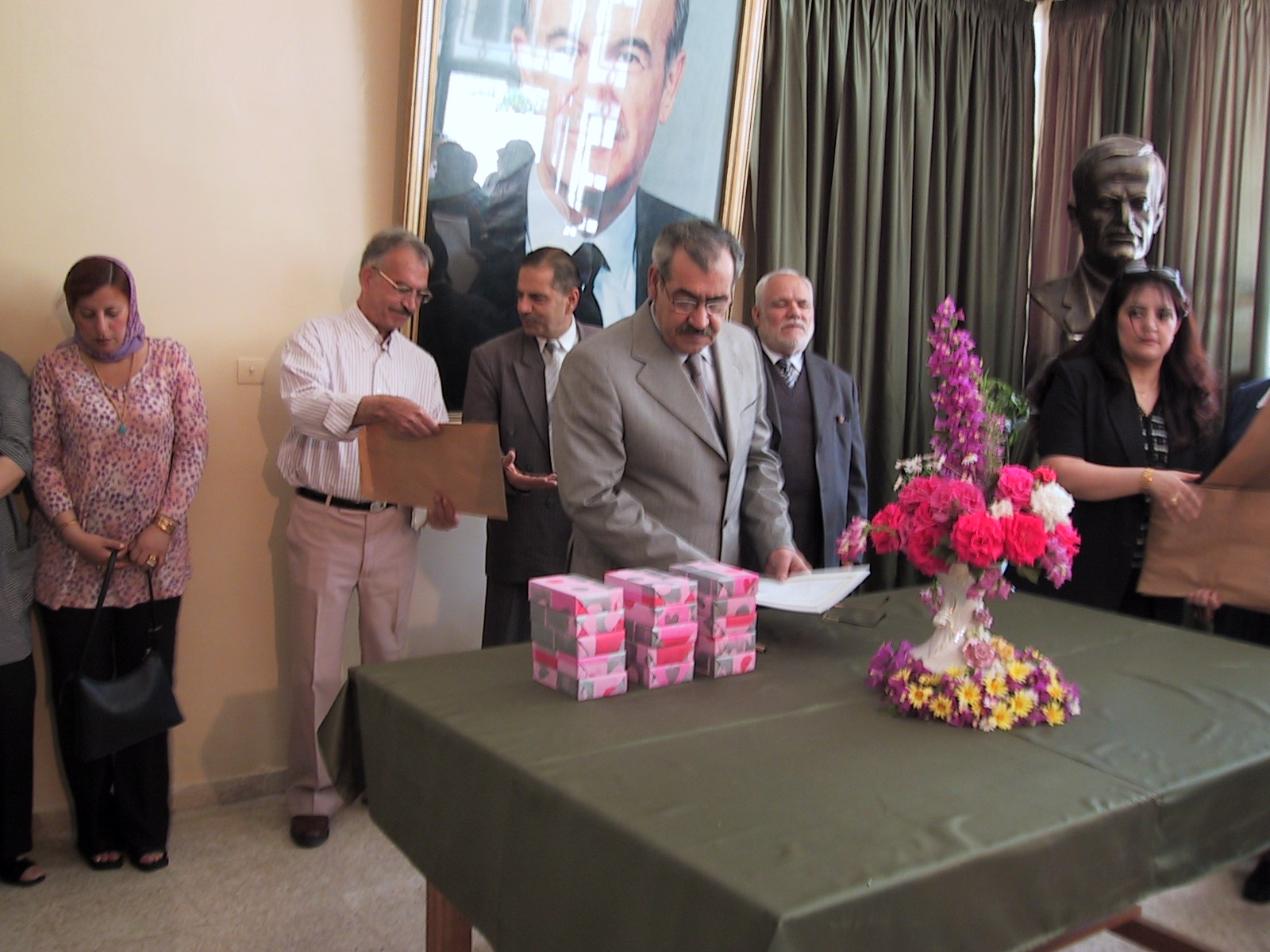
Proclamation of results at the Majad

Happy to have succeeded

Our diplomas

I will write to you next time from Belgium Tot ziens et illa liqa !

:)

Syria: The Bashar Years

Newlines Podcast

Newlines PodcastJuly 16, 202107:34 EST

Syria: The Bashar Years
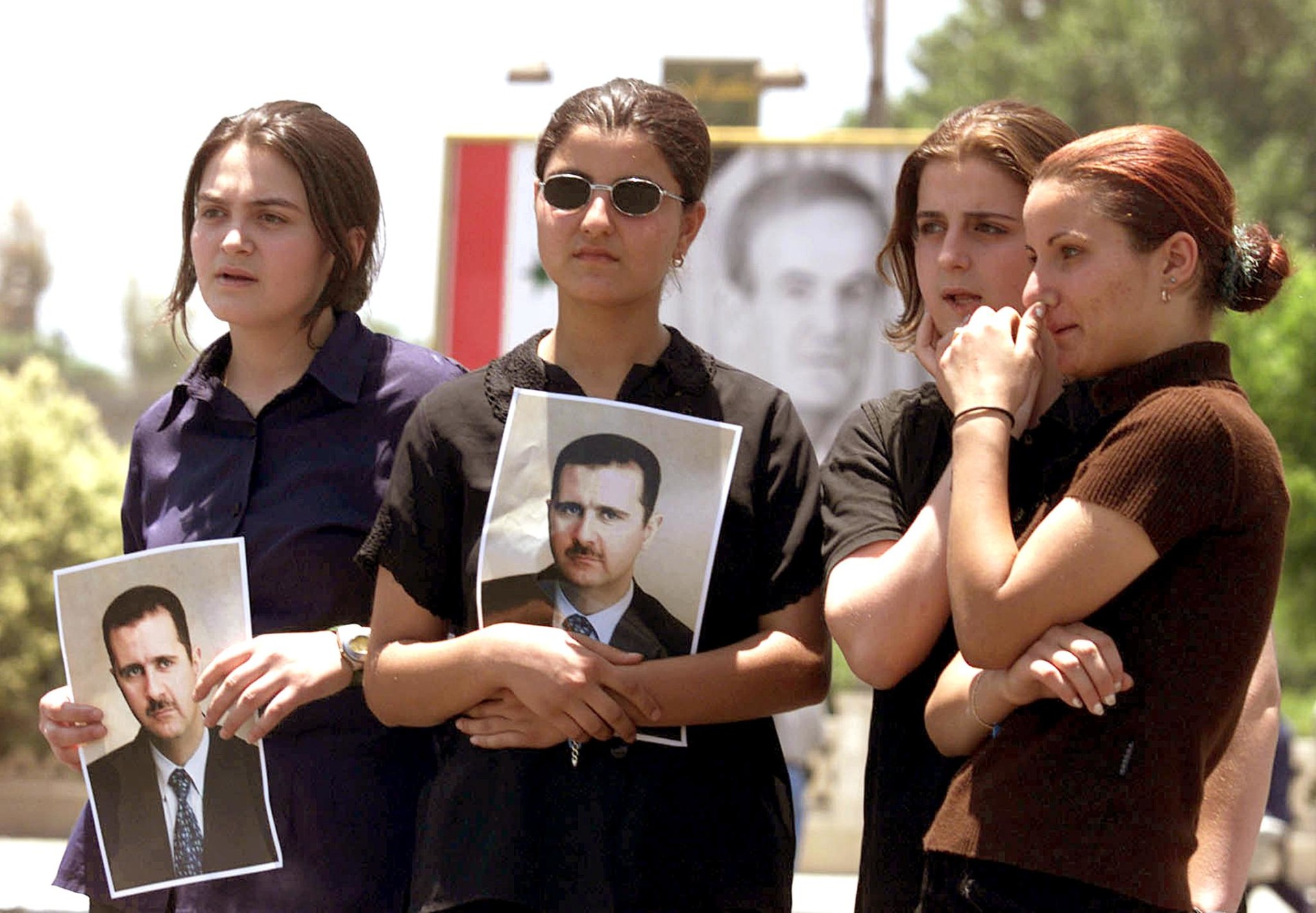
Syrian girls, holding pictures of Bashar al-Assad, mourn his father in downtown Damascus on June 12, 2000 / Patrick Baz / AFP via Getty Images

Everyone expected that the regime would find a way to make Bashar president after Hafez al-Assad’s death. I thought maybe they would remove the age requirement altogether. And all they did, in five minutes, in front of our very eyes, it was put down to 34, his exact age. They might as well have said, ‘The president must be 34 and his name must be Bashar al-Assad.’

Rime Allaf is a Syrian-born writer and political analyst. In a wide-ranging conversation with Newlines’ Faisal Al Yafai, she recalls living through the end of the Hafez al-Assad era and traces the Bashar years from the initial optimism of Syrians, through the end of the Lebanon occupation and the Iraq War, to the start of the Syrian revolution.

For the podcast go here

How Arabs Have Failed Their Language

The insistence on teaching Classical Arabic over modern dialects has hindered our linguistic and literary development

How Arabs Have Failed Their Language

Reading with children is, or should be, an enjoyable act of bonding and education. But, in the case of Arabic, I have often found reading in the language I inherited to be an experience of mutual misery. My son and I speak Lebanese Arabic, which he understands well enough — and better every day. But we can only find a handful of books available in that dialect — or in other accessible, useful dialects, be they Egyptian or Iraqi. Conversely, although we find many more books in Classical Arabic, my son understands very little of it. Accessible books are rare, while common books are inaccessible. Children do not seek out books written in an old Arabic, because they are full of unknown words and unfamiliar grammatical structures; parents struggle to instill a love of language and learning, or even to access these materials themselves.

Arabs have done this to themselves, doubly damning their communication in diglossia, or linguistic variety, and denying their role in this. Diglossia is a situation in which two or more varieties of a language are shoved together through social circumstances; for Arabic, there are numerous spoken dialects that exist side by side with the formal, standardized al-fuṣḥā, or fus-ha, also known as Modern Standard Arabic or Classical Arabic. Arabs have tried to elevate the only so-called true or pure Arabic, while working to discredit, disable, and even destroy dialects. They have thus made an official language out of a form that nobody considers a native tongue, while making everyone’s different native tongues seem subpar, uncouth, and useless.

This emphasis on preserving Classical Arabic — itself an acknowledgement that the language needs protection, without which it will die out — has made such reading an unlovable experience for most speakers, who struggle to properly speak the language. More importantly, the fixation with or sacred view of the old language has directly affected the dialects.

Speakers can’t pass on their dialects fully because they lack institutional support, have few available tools, and suffer from sociocultural snootiness toward the spoken tongue(s). And they can’t access Classical Arabic — which everyone glorifies but no one speaks as a native — easily enough.

As it is used today, Classical Arabic is not even a complete or living language. Most people do not use it much and only do so in formal settings (or, perhaps, for official purposes). It lacks expressive qualities needed for everyday speech. This discourages wider uptake and use, which in turn creates a scenario where Arabs cannot develop such phrases. If dialects were to disappear tomorrow, people would struggle to use Classical Arabic as an everyday language.

Dialects are limited, too. Often mutually unintelligible, dialects divide people who might otherwise be part of a realm connected culturally by the Arabic language, such as somewhat standardized Arabic in the press and certain sociocultural traditions and practices. Lacking legitimacy and acceptance, dialects are less useful — at least now — in different spheres like education, law, and administration (areas that also involve precedent, meaning that future changes are constrained by the past).

Perhaps nothing illustrates Arabs’ contradictory approach to their language than the messages they give their children. On the one hand, parents laugh at their children when they pick up Classical Arabic words (from, say, cartoons). They chide their children with comments like, “Nobody speaks like that.” But they also implore their children to learn the language they have just exposed as useless and worthy of derision. Recalling a time when her kids were fighting, one Arabic professor laughed with exasperation at the thought of one yelling at the other: “tabban lak!” — an archaic and awkward phrase meaning “damn you.”

On the other hand, people degrade dialects all the time. Children who ask why a certain phrase is used are told they are speaking a “grammarless” or even “fake” language. Even worse, that language might be branded as vulgar. Parents might call someone who uses even the simplest, easiest words of their lexicon a “farmer” or a “barbarian.” In doing so, they attach shame to the language of their daily lives. Unlike Classical Arabic, nonetheless, dialects are unregulated and so better allow users to create new words or absorb new phrases from foreign languages or the old language.

Reviewing global literacy rates against money spent on education, the language professor John Myhill concluded that the focus on Classical Arabic in formal education hurts literacy rates in Arabic-speaking countries. Across the board, even in richer Gulf Arab states, Arabic-speaking literacy rates are lower than expected given the amounts these governments spend on education. The problem is worse than the numbers suggest, although an illiteracy rate of 28% in Egypt should be alarming enough. Exam results, a widely used metric of educational success, fail to convey an accurate picture of language proficiency given reports that people pay bribes to pass literacy exams (according to an article in Al-Fanar, an academic assessment, and my interviews with non-governmental organizations working on literacy in Egypt).

Arabic speakers admit to holding negative views of Classical Arabic — and, relatedly, their own skills in it. Everyone from high school students to adults expressed a “dislike of reading in general, especially ‘longer pieces’ like books,” during a study in Egypt by Niloofar Haeri, a linguistics professor at Johns Hopkins University. Finding Classical Arabic to be “heavy” and “scary,” Haeri’s participants “simply did not enjoy the activity” of reading and found writing to be even more difficult and “intimidating.” Suggesting that the official literacy numbers are shaky at best, she notes that “the majority of people do not attain a level of literacy that allows for participation in various creative or civic communities when these require proficiency in the official language. … Even grammar teachers, copyeditors, and university-educated people speak routinely of their fear of making mistakes.”

They learn to speak one language at home and read or write another language at school.

While other researchers have made different arguments, they ultimately misdiagnose and understate the problem. Helen Abadzi, a faculty member at the University of Texas at Arlington College of Education, claimed in an article that Arabic is difficult for children because the script is complex. Echoing a complaint common among Arab scholars, she stated that reading tests in four Arab countries “have shown a widespread inability to understand written text.” Describing issues that children clearly face because they learn to speak one language at home and read or write another language at school, she concludes that the problem is the complexity of Arabic script. But the script, or the script alone, cannot be the problem. Other languages, such as Persian, use the same script as Arabic, but their users do not face the same reading and writing challenges.

Make no mistake. The problem is diglossia.

When I studied Arabic as a child, and when I restarted studying it as an adult, I didn’t know much about these issues. The more I learned, the angrier I became. Why did I, and millions of other children, have to go through a bad education system that left us frustrated and hating our own language, then go through it again while trying to relearn Arabic as adults, and then perhaps again while trying to teach our children?

If Arabs wanted to keep Classical Arabic and dialects, they could still develop an education system that took on the challenges of diglossia and even turned the presence of dialects and Classical Arabic into a strength.

Read on here

PALESTINIAN ACTORS BOYCOTT CANNES FESTIVAL AS THEIR FILM IS PRESENTED AS ISRAELI

July 10, 2021ACTUALITIES, BDS Campaign

The actors of the film ‘Let There Be Morning’, directed by Israeli Eran Kolirin, are boycotting the Cannes Film Festival, despite the fact that the film will premiere there this Saturday.

Palestinian actors boycott the Cannes Film Festival, as their film is presented as Israeli

The actors, who are Palestinian citizens of Israel, explained in a collective statement on social networks that this is a “political act of absence” to protest against the cultural erasure of Palestinians by Israel. “We cannot ignore the contradiction of the film’s entry at Cannes under the label of an “Israeli film” while Israel continues to carry out its decades-long colonial campaign of ethnic cleansing, expulsion and apartheid against us, the Palestinian people,” the casting team said in a statement. The production team further explained the prejudicial erasure that is done to Palestinians when their work is categorized as “Israeli” in the media.

“Every time the film industry assumes that we and our work fall under the ethno-national label of ‘Israeli,’ it further perpetuates an unacceptable reality that imposes on us, Palestinian artists with Israeli citizenship, an identity imposed by Zionist colonization to maintain the continued oppression of Palestinians within historic Palestine; the denial of our language, history and identity,” the actors wrote.

“[…] Waiting for us to stand idly by and accept the label of a state that has sanctioned this latest wave of violence and dispossession not only normalizes apartheid, but also continues to enable the denial and whitewashing of the violence and crimes inflicted on Palestinians.”

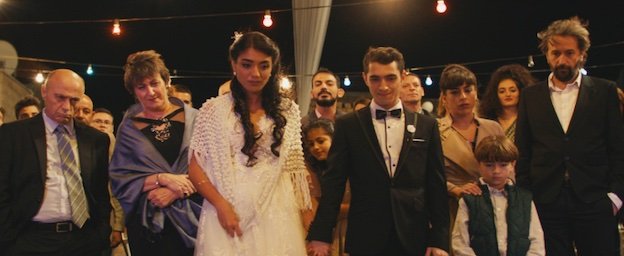
‘Let There Be Morning’ is a film based on a book by Palestinian journalist, screenwriter and author Sayed Kashua. It tells the story of Sami, a Palestinian citizen of Israel who returns to his hometown with his family to attend his brother’s wedding. After the wedding, Sami, his wife and son encounter Israeli soldiers who force them to stay in the village, and Sami is soon imprisoned and besieged in his hometown, not knowing why or for how long.

“The film, which is the result of our collective creative work, is about “The State of Siege,” a phrase coined by the revered Palestinian poet Mahmoud Darwich,” the release said. “The state of siege manifests itself in walls, checkpoints, physical and psychological barriers, and the subordination and violation of the Palestinians’ identity, culture, movement and basic human rights.

The film stars concluded their explanation by calling on international artistic and cultural institutions to amplify the voice of Palestinian artists and creators, as they “resist all forms of Israeli colonial oppression against the right of the Palestinian people to live, be and create. The statement was signed by actors Alex Bakri, Juna Suleiman, Ehab Elias Salameh, Salim Daw, Izabel Ramadan, Samer Bisharat, Yara Jarrar, Marwan Hamdan, Duraid Liddawi, Areen Saba, Adib Safadi and Sobhi Hosary.

Director Kolirin told Haaretz, “I understand [the reason for their action] and I support each of their decisions … It hurts me that they are not here to celebrate their amazing work, but I respect their position.”

Source: Middle East Monitor

Back from Deir Ez Zor

Februari 14 2003

Euphrates : Pont des Français

What are you going to do there, the somewhat incredulous Ami had asked me ?

It must be said that in general, Syrians do not like to be sent to this region very much. Deir is a bit like the Wild West and last night, I thought so in a cyber  crowded with kids, no one was surfing(way too expensive), but they use the computers to play. The people in charge give me their own pc to access the Internet. On my web page I intend to correct a title, when suddenly a cup flies above my head and comes crashing on the wall behind me. There ia a noise of broken dishes towards the entrance. A window is broken. A melee ensues that becomes more serious when knives come out and two boys (17 and 13 years old) try to cut the cyber managers. Their hands are slashed and when they call for help, they flood the phone with blood. I tell myself that my editing will have to wait and I hand out some Kleenex. Angry at their attackers, they scream in a language I no longer recognize. I don’t think the killers are aiming at me, but still, I’m afraid someone will die. The police arrive and the victims go to the hospital for treatment.

Abou Qamal

When I returned to the scene this morning, I didn’t see them anymore and I hope they didn’t lose their jobs because at first sight they had nothing to do with this mess. The little I understood of the situation made me think of Brussels and the Marolians’ raids at the Jambe de bois (a café near the Place Anneessens) that you are all too small to have known. At that time, the Marolians were underprivileged Belgians while the population of the Jambe was composed of students and it was regularly assaulted with a peak at the Saint V the big student feast.

Let’s go back to Deir. One reason for coming here is the Euphrates, whose name I much prefer in Arabic: el Fourati. There are also the remarkable ruins of some fortresses and especially of Dura Europos and Mari (already inhabited before the XXVth century B.C. and one of the strongholds of the Sumerians) towards the Iraqi border.

Europos

At the airport of Deir, no cab, no shuttle. With two other travelers we wait. One of them ends up going to a Rover and soon invites us to join him. An extremely kind gentleman is at the wheel and drives us to our respective destinations. Just like that. It was a good start and the rest is history.

I stay at a hotel that a friend told me was on the banks of the Euphrates. Not so, I am in fact at the edge of the canal. The river is 500 meters away towards the French bridge, a suspended footbridge.

Deir is close to Iraq not only geographically, but also by accent, music and affinity. Here, the war is felt even more painfully than elsewhere.

I have talked about them at length; some of them even make common cause with Saddam, even Ossama. Don’t rush to the conclusion that they are terrorists, but the Americans are pushing some Arabs towards these people because they need personalities who can rally them. They tease me about “old Europe” and I tell them that we have become the new Arabs.

The inhabitants speak a different Arabic than in Damascus; as for the music, I love it: harsh, it has desert accents.

HANI

I have to find transportation to visit the sites conveniently and as the hotel is very evasive, I take things in hand.When I boarded the cab of Hani, I knew at once that hewas the man of the situation. The symbiosis is total since he does everything I want which is not obvious in this country where the man often does not even listen to what the woman suggests. Except for MamnouA (verboten), nickname we gave to my sister during her visit; the driver not having lowered the radio after her repeated requests, she must have frightened him so much that we had peace during the rest of the trip. Same thing for the hotels that he suggested so insistently that it was hard to resist, except for MamnouA. It was convenient to have a sister who took the unpopular attitudes for me.

Hôtel à Deir Ez Zor

As for Hani, I spent three wonderful days with this very young man, dignified, classy, who was visibly interested in my visits himself. I even spent an evening at his home with his wife, his children and the mayor of Deir.

I even went as far as Qamishle to see the Tigris, but Ain Diwar is beyond what my back can handle and that will be for another time. Little did I know that I would soon see it in Baghdad.

Deir Ez-Zor

Used by the nomads of the Middle East, the Arabic word zor refers to the scrubby vegetation that covers the lower terraces of the desert river valleys, especially those of the Jordan and Euphrates, says Universalis.  

A look at the city

Qalat Rahba (on the road to Abou Kamal)

Doura Europos

Fourati

Mari

And above all, the people

Below is a crucial character: it is thanks to him that I am sending you these pictures. I had forgotten my camera in his car and he went looking for me to give it back.

I think the restaurant is called Sayag; the happy cooks

The famous tanour, makes the best bread ever

January 2003 My sister and her husband visit

Jablé
Tekyié Suleimani

Yamdi el waqt bi soura

Filed under: Blog — annie at 3:22 pm on Thursday, January 30, 2003 Edit This

January 2003

Translation: Time moves quickly; I’m almost halfway through my stay. I don’t realize I’m in Syria because I feel so at home. Everything is going smoothly; I feel transparent..

The weather

Springtime weather. Cat are in heat and you can hear them courting

The exams

They ended today (January 18). I did pretty well. I’ll be reunited with most of my classmates next semester.
In the meantime, I’m going to treat myself to a real vacation because the pace has been steady for four months. However, stamina quickly increased use, and I was doing just fine studying six hours every day.

The Iraq War

In my class at the Institute, we decide to stay if the Americans invade Iraq. However, if the Belgian embassy told me to pack up, I would be forced to leave.

The Dutch received a pre-warning and the Germans have recensed their nationals in Jordan.

Saddam, and for that matter Osama, have few supporters here, but that doesn’t mean the Syrians support Bush.

The New Year’s Eve

I buried 2002 in a wonderful place, the Umayyad Palace, photos below.

What makes its charm is obviously the setting, but also Samir, the boss.


After restoring a real ruin, he wanted to turn it into a museum, but he finally decided to open a restaurant. Samir is Palestinian and his wife is Syrian. Palestinians are much better treated in Syria than in Lebanon, for example, where they are excluded from many professions. Here, although not having access to nationality, they have the same rights as Syrians.

This is the only place in Damascus where you will see a real whirling dervish. On the occasion of the new year, he is accompanied by his son who also spins.

Heart of gold, Samir is extremely generous, a quality much appreciated among Arabs. During Ramadan, he invites several groups of orphans to his restaurant. At his place, the atmosphere is simple, but the oriental buffet is excellent. For this New Year’s Eve, there were only Syrians accompanied by their families, including children.

Although frequented by tourists, the place was not deserted by locals.

One evening, I met a direct descendant of Charlemagne.

In search of Arabs

Who is an Arab here? You, my Syrian friend, you are Christian, but still Arab? No, I am Syrian.
And you, my friend, you are Syrian? Yes, but I am an Arab.
The others are Turks (500,000), Kurds (1 million), Armenians, Circassians, descendants of the Crusaders, Greeks, Romans, Phoenicians, a real melting pot in short. What unites them is the language, the nationality and for the 80% of Muslims, the religion. The great Saladin was a Muslim before he was a Kurd.

Churches

They are numerous in Damascus. Here is an Orthodox church, Holy Cross, near Bab Touma.

Working in the street

Mattrass “renewer

When I was growing up in Brussels, we used to take the woolen mattresses to him to wash and re-fluff them.

Carpet sellers

Besides the specialized stores, there are merchants who set up their business in the street before the first cold. In the houses, they clear the carpets when the heat returns.

A street office

We see small tables in the street where people fill out questionnaires. They are also public writers although the literacy rate is high.

The last hakawati0

He is a professional storyteller.
He reads an episodic story that can be heard every day at 5 p.m. at the Nawfara cafe. He has his followers who come to watch the show daily.

Here is the path to the Nawfura (it skirts the mosque of Ommeyades) and a view of its terrace.

The storyteller’s name is Rasheed El Hallak /Abou Shadee, which means father of Shadee.

After a long preamble in which he pays tribute to the great men of the past, he gets to the heart of the matter.

I can distinguish a few words, but there is little hope that I will soon learn the twists and turns of his stories about Sultan Beybars among others (one of the heroes of the fight against the crusaders; he took the Krak back from them . My brother-in-law, who knows Arabic very well, hardly understands it any better than I do because the hakawati speaks in popular Syrian Arabic with a strong accent. However, he sometimes reads texts in Fou-ha. After the show, he will let me look at his antique notebooks, all handwritten, which come down from generations of predecessors.

The show is worth it: watching Abu Shadee’s exchanges with the audience, seeing him interrupt to ask for a glass of tea or to look down on the chatterboxes, watching the regulars pull on their hookahs (did I tell you that we say “drink” a hookah in Arabic?) and ESPECIALLY waiting for the moment when he swings his sword and hits the innocent stool .
Everyone shouts HEY; there follows a delicious wait as there may be a second and third blow. Arabic coffee is served in small cups that are passed from one to the other.


Abu Shadee is unfortunately the last of his dynasty.
Wouldn’t there be someone to take over the torch?
My friend, a tour guide without work because of the state of affairs, asks him if she has a chance. He encourages her to go for it. And we are in Syria, and she is a woman!

Blog at WordPress.com.

Up ↑