Search

band annie's Weblog

I have a parallel blog in French at http://anniebannie.net

A War on Campus? Northeastern University Suspends Students for Justice in Palestine Chapter

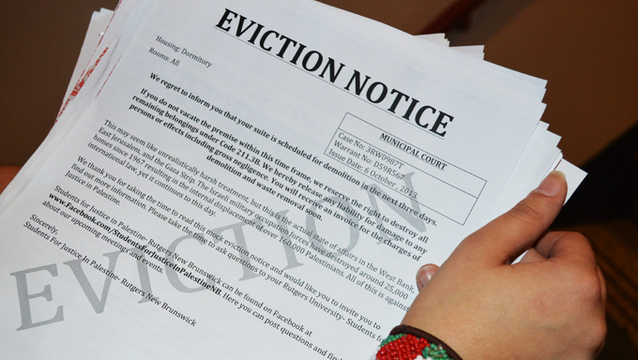
Mock-eviction-notice-Syjil-Ashraf-Targum

The Northeastern University chapter of Students for Justice in Palestine has become the latest student group to face reprimand for organizing around the Palestinian cause. Northeastern has suspended the group until 2015, barring it from meeting on campus and stripping it of any university funding. The move comes just weeks after student activists distributed mock eviction notices across the campus during Israeli Apartheid Week. The notices were intended to resemble those used by Israel to notify Palestinians of pending demolitions or seizures of their homes. We speak to Northeastern Students for Justice in Palestine member Max Geller and Ali Abunimah, co-founder of The Electronic Intifada and author of the new book, “The Battle for Justice in Palestine.” His new book includes a chapter titled “The War on Campus.”

Transcript

          This is a rush transcript. Copy may not be in its final form.

JUAN GONZÁLEZ: The Northeastern University chapter of Students for Justice in Palestine has become the latest student group to face reprimand for organizing around Palestinian issues. Northeastern University has just suspended the group until 2015, barring it from meeting on campus and stripping it of any university funding. The moves comes just weeks after student activists distributed mock eviction notices across the campus during Israeli Apartheid Week. The mock notices were intended to resemble ones used by Israel to notify Palestinians of pending home demolitions or property seizures.

AMY GOODMAN: Northeastern University accused the student group of disregarding university policies over an extended period of time. Michael Armini, Northeastern’s senior vice president of external affairs, said, quote, “The issue here is not one of free speech or the exchange of disparate ideas. Instead, it is about holding every member of our community to the same standards, and addressing SJP’s non-compliance with longstanding policies to which all student organizations at Northeastern are required to adhere.”

We’re joined now by two guests. Max Geller is with us, Northeastern University School of Law student and a member of Students for Justice in Palestine. And Ali Abunimah is with us in studio, co-founder of The Electronic Intifada, author of a brand new book, The Battle for Justice in Palestine. His new book includes a chapter headlined “The War on Campus.” read on and see the video here

REVEALED: How NSA Infects Computers with Malware

 March 13, 2014 at 1:23 AM

nsa-malware

03/12/2014

Ryan Gallagher/Glenn Greenwald/TheIntercept:

Top-secret documents reveal that the National Security Agency is dramatically expanding its ability to covertly hack into computers on a mass scale by using automated systems that reduce the level of human oversight in the process.

The classified files – provided previously by NSA whistleblower Edward Snowden – contain new details about groundbreaking surveillance technology the agency has developed to infect potentially millions of computers worldwide with malware “implants.” The clandestine initiative enables the NSA to break into targeted computers and to siphon out data from foreign Internet and phone networks.

Classification markings on the Snowden documents indicate that NSA has shared many of its files on the use of implants with its counterparts in the so-called Five Eyes surveillance alliance – the United Kingdom, Canada, New Zealand, and Australia.

The covert infrastructure that supports the hacking efforts operates from the agency’s headquarters in Fort Meade, Maryland, and from eavesdropping bases in the United Kingdom and Japan. GCHQ, the British intelligence agency, appears to have played an integral role in helping to develop the implants tactic.

The NSA has a diverse arsenal of malware tools, each highly sophisticated and customizable for different purposes.

One implant, codenamed UNITEDRAKE, can be used with a variety of “plug-ins” that enable the agency to gain total control of an infected computer.

An implant plug-in named CAPTIVATEDAUDIENCE, for example, is used to take over a targeted computer’s microphone and record conversations taking place near the device. Another, GUMFISH, can covertly take over a computer’s webcam and snap photographs. FOGGYBOTTOM records logs of Internet browsing histories and collects login details and passwords used to access websites and email accounts. GROK is used to log keystrokes. And SALVAGERABBIT exfiltrates data from removable flash drives that connect to an infected computer.

read on here

Protest on 3rd anniversary of the Syrian Revolution

manif

Comité Belge pour soutenir la Révolution syrienne

Depuis trois ans, les crimes commis par le régime syrien se multiplient sans fin, avec le soutien de la Russie via leurs armes et leurs services secrets, de l’Iran avec l’envoi de snippers et de leurs gardes républicains,de l’Irak avec les miliciens chiites et du Hezbollah libanais,avec les groupes Islamistes et terroristes infiltrés par l’Iran, la Russie et le régime qui prétendent faire la révolution.

Des millions de réfugiés , de déplacés internes ,de milliers de tués (140.000 selon le dernier décompte de l’ONU qui a décidé de ne plus compter….),de disparus, de torturés, d’emprisonnés, de morts de faim, de manque de soins.

Des listes sans fin…

Qui s’intéresse encore à la situation en Syrie ?

Malgré tout, les Syriens continuent leur révolution, poussés par leur espoir de liberté, de démocratie et d’égalité, même si la communauté internationale assiste passivement et participe indirectement aux crimes.

We invite you

on Saturday March 15 ,

from 4pm to 6pm,

Place Flagey

Ixelles

For the Committee

Bernadette van Zuylen

Hasan Addaher

Women for Gaza

Dear Friends,

The media impact having been considerable, you have no doubt learned that we were NOT able to enter the Gaza Strip where we had been invited by a number of women’s associations on the occasion of International Women’s Day.

Most of us had been held up at the Cairo airport by the Egyptian government, which had despicably carried out Israeli orders, thus showing to the world that it fully collaborates in the Gaza blockade.

The boarder between Egypt and the Gaza Strip is effectively hermetically sealed, and not for security reasons. In reality, as the young people of Gaza, who have in their turn launched an appeal for help (as has the Palestinian Center for Human Rights), have written, security is just a pretext, because the Egypt-Israeli boarder at Taba, where incidents have occurred has not been closed a single day!

But look at what the lackeys of the Israeli occupation have won by blocking us in Cairo!

A huge demonstration that lasted 48 hours at the airport in plain vue of Egyptian passengers and air personnel, who, to the great displeasure of those carrying out the dirty work, showed us their approval and encouragement, proving that they are not the dupes of governmental anti-Palestinian propaganda.

The dozens of women from different countries transformed the checkpoint into a truly public scene and made fools of their jailers in front of the world, as you can judge from these images: http://www.europalestine.com/spip.php?article9150

The Palestinians who had been waiting for us told us how proud they were of our resistance and our solidarity. More than just a visit of a few days, what those women expect of us, all of us, is that we help them to open the huge prison in which they find themselves, that we help them to no longer have to depend on the charity of European or other institutions, that we help them to break the silence about this 21st century concentration camp, that we help them to recover their freedom.

So we invite you to continue the fight for this liberation with them and with us by all the means at our disposal: the boycott campaign against Israel, the public expression of our indignation, our votes for only those electoral candidates who denounce the blockade and who will watch out that businesses in their cities do not sell products illegally exported by the Israeli occupier.

And we can equally demand of all elected officials, of all political parties, of all associations who say “never again” to officially invite Palestinian women from the Gaza Strip to come visit France.

If you wish to debate with us and with the women of Gaza, we invite you to an important meeting on Saturday, 22 March at 17h00 at the Résistances bookstore in Paris. The program will include a videoconference with the women of Gaza and the screening of films showing our being blocked in Cairo and the campaign against the Gaza blockade. All will take place in the presence of a number of women from the Coalition who will give testimony.

Also we wish to inform you that donations received for the benefit of women’s associations in Gaza before our departure will be rapidly transferred to them. We will keep you informed of their exact use.

Best wishes,

CAPJPO-EuroPalestine

More information and videos on http://www.europalestine.com

See also

Israel fait perdre la face au gouvernement égyptien

Voir aussi : Aéroport du Caire : hommes enragés, femmes engagées !

Voir aussi : Quelle ambiance ! Merci Donna pour ces deux vidéos !

Voir aussi :   Pas triste le retour de la Coalition dans les aéroports !

Voir aussi :   Aéroport du Caire : ils en ont eu pour leur argent : !

Voir aussi : Témoignage de Donna en texte et en images :

FULL: Edward Snowden and ACLU at SXSW

War Workers: Vulnerable Foreign Laborers Swindled & Exploited to Toil on U.S. Bases in Afghanistan

Democracy Now

A new investigation by Al Jazeera America looks at the human trafficking
system that brings tens of thousands of foreign laborers to work on
U.S. military bases in Afghanistan. “America’s War Workers” examines how
these laborers regularly end up deceived and indebted, victims of local
 SEE HERE

Syria : Sigh of relief after ISIL retreat

Withdrawal of Islamic State of Iraq and the Levant fighters from northern Syrian town gives residents hope.

The Islamic State of Iraq and the Levant recently withdrew from the town of Azaz [Emma Beals/Al Jazeera]
Azaz, Syria Residents of parts of northern Syria say they are breathing easy again after living under the rule of Islamic State of Iraq and the Levant (ISIL) fighters, who hastily retreated from the area after the threat of attack from other rebel groups.The eight-kilometre stretch of road from the Turkish border to the small town of Azaz in Aleppo province is now cleared of ISIL gunmen. The hardline group’s main checkpoint at the town’s entrance – under ISIL control since early August – has been abandoned.ISIL insignia still cover a concrete barrier jutting out across the road, but the tanks that demonstrated the group’s military strength have vanished. Only a solitary sofa remains on the gravel roadside – where, until late last month, ISIL armed guards were stationed around the clock, restricting all movement in and out of the community.

“It feels like the town is smiling, laughing, happy,” Azaz resident Abu Bilal told Al Jazeera.

Battles between ISIL and its rival, al-Qaeda-linked Jabhat al-Nusra, that began in early January have killed thousands of people – the deadliest fighting among opposition forces since Syria’s civil war began three years ago.

At first united in their opposition against Syrian President Bashar al-Assad’s forces, the two groups fell out with one another due to ISIL’s brutality and its demands for strict adherence to its ideology. In late February, Jabhat al-Nusra leader Abu Mohammed al-Golani warned ISIL to end the infighting among rebel groups or be “expelled” from northern Syria.

Before making the surprise retreat on February 28, ISIL had expanded its control north to just a few hundred metres of the Bab al-Salam camp for internally displaced people, which sits next to the border crossing into Turkey.

In mid-February, the group detonated a car bomb in the camp, killing at least two dozen people and terrifying the already traumatised residents.

Abu Ahmad was living right next to the spot where the vehicle detonated. His family’s tent was destroyed in the explosion. “Thanks to God, none of my family were inside at the time. All the children play near the road,” he said.

As Ahmad speaks, his eight-year-old son clings to his mother like a much younger child would, his eyes a steely blue-grey. But now, with the ISIL fighters gone, the family feels some relief from the constant fear, Ahmad said.

ISIL had demanded strict adherence to Islamic law with public beatings and executions for those who disobeyed. “Now that [ISIL] left, we feel better,” Ahmad said.

Appalling conditions

The camp – erected hastily in late 2012 and not long after eastern Aleppo fell into rebel hands – used to have 6,000 residents, but it now houses 17,000 people. Having fled bombings and ISIL rule in Azaz, the 17,000 residents have been living in appalling conditions while they wait for the chance to return home.

Living next to the border crossing has not been easy for the camp’s residents, and any imagined safety because of its proximity to Turkey is just that. A huge battle between other rebel groups and ISIL took place here last September, in which 4×4 vehicles mounted with heavy machine guns surged towards Azaz to try to capture the town.

Since then, northern Syria has grown much more dangerous. Local and foreign journalists have been kidnapped and executed, NGO workers have been targeted for being “spies”, and residents have gone into hiding from ISIL’s unforgiving rule.

The ISIL abandoned Azaz, but signs of the hardline group remain [Emma Beals/Al Jazeera]

The border crossing, a vital supply route to the camp and the north of the country, has been closed periodically, depending on the perceived threat of ISIL.

With inconsistent access to supplies and a situation so dangerous that many NGOs and journalists have stopped coming, the camp and its residents have largely been left on their own for survival.

The stench in the Bab al-Salam camp is overwhelming at times. A combination of a lack of toilet facilities and waterlogged, swampy ground creates pools of green water and mud next to small dry patches of dirt where children play.

“We don’t feel any safety here. We are always afraid, afraid of [ISIL],” said Abu Muhammad, a father of two young sons from Aleppo. They have been living at the camp for more than a year.

‘Tactical withdrawal’

ISIL has retreated to an area spanning from al-Bab in the west through Manbij and Jarabalus towards its stronghold in Raqqa, in Syria’s northeast.

“Azaz eventually had little strategic value to [ISIL] because it was cut off from the rest of its contiguous territory… and they were constantly under siege from rival factions. So the withdrawal was tactical,” explained Aymenn al-Tamimi, a fellow at the Middle East Forum who studies jihadist groups.

Azaz was home to an estimated 50,000 people before the war, but about 10,000 have fled, many because of the ISIL’s harsh rule.

“They were manipulating the religion, they forced people to do the prayers,” said Abu Bilal, a driver who works in the town. “They’d bring the people and chop their heads off in public. I mean that’s a person with a soul, right?”

Many residents were evasive when asked about life under ISIL, fearful of the group’s return and suspicious of a journalist’s questioning. Despite its retreat, ISIL has left behind loyalists and spies.

Liwa al-Tawhid, the rebel brigade now in control of Azaz, continues to root out support for the group. Loud explosions could be heard recently as ISIL booby-traps left behind were detonated.

A year ago, the town’s main street was desolate as Assad’s forces shelled Azaz with Scud missiles, a form of collective punishment against those who supported rebel fighters who took control of the Mennagh military airport a few kilometres away.

Today the town is bustling. Women walk freely along streets, and fruit and vegetables are available for sale in small shops. A man in a wheelchair sells cigarettes from a card table surrounded by a flock of children. Tobacco products had been banned by ISIL.

Supplies are also making their way back into the Bab al-Salam camp. The day ISIL left town, 200 trucks were waiting at the Turkish side of the Oncupinar border crossing when it opened for the day.

Yet maintaining the high spirits may not be easy. With high expectations for life after ISIL, the challenge for Liwa al-Tahwid and Jabhat al-Nusra will be maintaining order and ensuring access to supplies.

But for now, residents are enjoying their small victory. “It’s cheerful. You can leave town without any troubles. Thank God,” said Abu Bilal with a smile.

source

The Salam School

March 8, 2014 § Leave a comment

DSCI0221

This was published at the National.

Syria is my father’s country, where I spent an important part of my young adulthood, where my son was born. Living there was inspiration for my first novel (though it’s set mainly in London). In fact, I fell in love with the country – with its enormous cultural and historical heritage, its climatic extremes, and its warm and endlessly diverse people. Of course there were moments – for example, visiting a broken man who’d been released after 22 years imprisonment for a ‘political offense’ – when I felt like getting the next plane out. And before too long I did move on, because a stagnant dictatorship was no place to build a future.

Then in 2011 the revolution erupted. This instant of hope was followed by a counter-revolutionary repression of unprecedented ferocity. How to respond? For a long time I wrote and spoke to anyone who would listen on one theme: the necessity of funding and arming the Free Army – civilian volunteers and defectors from Bashaar al-Assad’s military. Nobody did arm them, not seriously, and as a result the Free Army lost influence and Islamist factions filled the gap. Assad’s calculated manipulation of sectarian fears and hatreds produced a Sunni backlash. Al-Qa’ida franchises set up emirates near the Turkish border, and the West increasingly understood the Syrian drama not as a battle for freedom, but as a security issue. In illustration of this fact, I was stopped at Edinburgh airport as I started my most recent trip to the Turkish-Syrian border, in December, and questioned under the UK’s Terrorism Act. “Which side do you support?” they asked me. I explained there are many sides now, but the question seemed to be either/or: either the regime or the jihad – and support for the (genocidal) regime was the answer which ticked the ‘no further threat’ box.

They also asked why I was going. The answer: I was lucky enough to know a group of committed and talented Syrian-Americans, including Chicago-based architect and writer Lina Sergie Attar, interviewed below, founder of the Karam Foundation. Karam delivers aid and opportunity to war-struck Syrian communities, and I was on my way to participate in its Zeitouna programme.

How do you act usefully in the face of a tragedy which unfolds on an incomprehensible scale? Syrians and their friends were forced to address this question as Assad’s genocidal repression transformed the popular revolution into a civil war, and as an unthinkable third of the population were made refugees. Every city except two has crumbled in whole or in part under bombardment. Ancient mosques and churches have been reduced to dust. The country’s multicultural social fabric appeared to dissolve.

storytellingSyrians inside the country were propelled into actions they would have formerly found inconceivable: selling a car to buy a Kalashnikov, leaving a teaching job to join a militia, abandoning a proud home for a tent by a border fence. Some have discovered themselves as beasts driven by fear or prejudice: torturing children in dungeons, raping women at checkpoints, slitting old men’s throats, and firing artillery, scud missiles and sarin gas at their neighbours. Many others have revealed unsuspected reserves of compassion, courage and creativity. I’ve met some of these extraordinary ordinary people. A man, for instance, whose immediate family was annihilated in bombing, who now publishes newspapers for adults and children because he believes the right to self-expression is the only important thing left. A man who stays on after his family fled to run a free bakery without which many would starve. A nurse who serves (unpaid of course) in field hospitals, the blood never dry on his hands, who hasn’t dared cross a checkpoint to visit his mother in over a year.

“It is the greatest of all mistakes to do nothing because you can only do little,” wrote 19th Century clergyman Sydney Smith. “Do what you can.” Hazar Mahayni is a Syrian-Canadian pharmacist, a widow in late middle age bursting with energy and good cheer. In October 2012 she also became the organising intelligence behind the Salam School for refugees in Reyhanli, on the Turkish side of the border. This school was the site for December’s Zeitouna activities.

The school is a rented one-storey villa, with new walls to make more classrooms, a small olive grove, and even a menagerie containing rabbits, hens and two goats. It serves 1200 children who crowd the classes in three three-hour shifts, the youngest first. The demographic stretches from the Damascene bourgeoisie to the poor peasantry, but most are from the rural north, the governorates of Idlib, Hama, and Aleppo.

There are over 700,000 refugees in Turkey, some in camps, others living in towns and cities. Turkish prime minister Erdogan’s government has been much more generous than others in the region, allowing Syrians to set up schools, businesses and charities. In Reyhanli I visited a new orphanage and the Watan wool workshop, which sells knitwear produced by refugee women. Just as they are inside the country, Syrians are organising themselves for survival. In the Salam School, a man interrupted my classes twice to ask, first, which children had no fathers or whose fathers had no work, and second, which children had no gloves.
DSCI0217The last is a necessary question because the Levantine winter is bitterly cold – a dry, bone-deep, biting sort of cold. A winter storm struck while I was there, and children froze to death in the snow-covered camps on the Syrian side. The children in Reyhanli are slightly better off. Depending on their resources, they live in rented houses, rooms, shops or warehouses, often separated from the next family by only a curtain. But most refugees have no school to attend. Very young and ragged children in open-toed sandals beg at the traffic lights.

The Salam School’s children are as noisy, as full of tears and laughter, as children anywhere, but many are traumatised or simply lacking care. In one class, a heavy boy called Abdullah got into three fist fights in the first five minutes. I put him outside for a while, then brought him back and focussed some attention on his work. This was enough to make him smile and cooperate.

The school has a warm, humane, and Islamic atmosphere. I witnessed one instance of Muslim obsessive-compulsive disorder, when a small girl leapt to show a teacher a picture she’d drawn of Cinderella. “I’m glad to see you’ve given her a long skirt,” the teacher said in a kindly tone. “But you should have put a scarf on her head too.” Otherwise the environment was openminded, tolerant and cheerful. One drawback is that everyone (as far as I could see) is a Sunni Muslim – nothing unusual for the rural areas, but city kids used to live in more mixed neighbourhoods. And this isn’t the school’s fault, but the demographics of Assad’s expulsion.

Our days began with revolutionary chants (“The revolutionary generation welcomes you!”) and Quranic recitations. The teachers teach what they can of the Syrian curriculum, stripped of its hagiography of Assad pere and fils and of the propagandistic ‘Nationalism’ subject. Corporal punishment (standard in the old education system) is forbidden, but old habits die hard and it still sometimes occurs. Management and teachers are refreshingly open and honest about these challenges.

Hazar says it’s been difficult to involve the teachers – trained  to follow orders in Assad’s system – in collective decision making, but that now they’re making headway. She sees the development of cooperative self-organisation as a revolutionary cultural process every bit as necessary as winning the physical battles.

The staff includes men who have participated in the actual warfare, like Ustaz Ahmad from Banyas, the coastal city where Assad’s shabeeha militia committed throat-slitting massacres. Ahmad slipped away because he was wanted at checkpoints (“They’re still looking for me,” he laughed. “They think I’m still there…”) and joined the Free Army on Jebel al-Akrad. His group ran out of ammunition and then out of food, so he came to Turkey twenty days before I met him.

Or there was the teacher whose husband was once an officer in the national army. He defected because he didn’t want to murder his neighbours. He was captured. Seven months later he died under torture. His body was thrown in a mass grave.

Given that the teachers themselves are traumatised and have lost almost everything, it’s remarkable that so many can smile – more than in an average British school. A teacher called Abdul-Jabbar wins the prize for the most infectious and enchanted smile, something like a flock of birds raising the spirits of all around.

I was in the school for a week as part of the Karam Foundation’s Zeitouna project. Six months ago a five-member core delivered workshops in the tented classrooms of Atmeh camp, just inside Syria. This time our numbers were up to 40 volunteers, and included obvious foreigners, and this time too al-Qa’ida franchises are kidnapping people in the border areas, so Karam decided for our safety we should work on the Turkish side. A series of fortuitous circumstances established a relationship with the Salaam School.

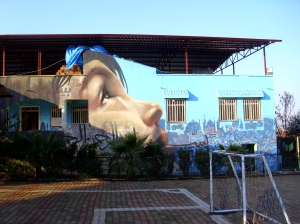
DSCI0027Max Frieder’s Artolution organised large-scale canvas painting (I saw it done but still couldn’t understand how the hands of hundreds of babbling children created pictures that made coherent sense) while the AptART team involved the children in designing and painting a mural for the school wall. The result was impressive, something every child will remember in future years – an uplifted face on a background of calligraphed phrases (In the name of God the Compassionate the Merciful, Cooperating for a Better Future, Love, Hope, Dignity…), upraised hands, grinning faces, and the towers and minarets of a cityscape.

There were workshops in football, calligraphy, digital photography, trust games and journal writing. Game-inventor Rory O’Connor workshopped his wonderful Story Cubes, and left hundreds of these imaginative tools behind to liven Reyhanli’s cold nights. The dental hygiene workshop distributed toothbrushes, while the dental team (all Syrian-Americans) made themselves unpopular by extracting over a hundred teeth daily.

Mine was a storytelling workshop based on the notion that a story needs six things: hero, assistant, problem, secondary obstruction, solution, and conclusion. Among the children’s chosen protagonists were Robin Hood, Batman, my brother the martyr, my father the martyr, and (most often) Sponge Bob. Among the problems to be solved were a dinosaur eating people, a car hitting a pedestrian, my house being shelled, and my cousin stuck in prison.

The activity gave them a way to exercise their fantasy and also to process their real-life stories. And every child has one. When you ask why they came to Turkey, they answer “because Bashaar kept on shelling us,” and then go into specifics. Because we haven’t experienced it, we must imagine here what ‘shelling’ means – not a word in a news story or an element of fantasy-drama but the actual ceiling coming in, a home transformed suddenly into sky cracks and screams. This is what these small children are so matter of fact about, though their eyes flicker and adjust as they speak.

DSCI0059There were stories everywhere I turned. You don’t need a fixer to find victims on the Turkish border, you just ask any man or woman on the street. Even to the last moment, to the cab driver who took me from my friend’s place in Antakya to the airport. Abu Ali was from Lattakia and he happened to know my family. He and his 15-year-old son were arrested together. “They beat my son until he was nearly dead. They beat me until I wished I were dead.” In a cell with 50 others and a hole in the floor as a toilet, which they had to use in front of each other, and nobody was able to wash in the two months Abu Ali was there. Two months of beatings, insults, humiliation, and near starvation. Then father and son were released, for which he thanks God profusely, because “so many die in their prisons.”

This horror has displaced two million outside the country, almost six million inside, and made Syrians the boat people of the decade. While we were there one of our Syrian-American dentists learnt that his nephew had died when the boat he’d hoped would smuggle him to Europe capsized in the winter Mediterranean.

Our work at the Salam School was one drop in a red ocean of suffering which will expand so long as the regime and its backers are permitted to continue their scorched earth policy. Five thousand more refugees leave Syria every day. It puts me in mind of a less optimistic quote, from Henry Thoreau: “There are a thousand hacking at the branches of evil to one who is striking at the root.”

Interview with Lina Sergie Attar

DSCI0066Tell me about the Karam Foundation.

Karam is a non-profit organization founded in 2007. Karam means generosity, and its mission is to spread generosity across the world. Although most directors are Syrian-American, our work was first focused on international aid projects. After 2011, we focussed on Syria’s humanitarian crisis. Karam raised hundreds of thousands of dollars in aid. In 2013, Karam launched a new initiative called Zeitouna.

So what does Zeitouna do?

Zeitouna is a mentorship program for displaced Syrian children. Artist Kinda Hibrawi and I decided to bring them creative mentors to instill a sense of hope. Millions of children have been displaced in the last two and a half years. They have lost everything: their homes, their friends, their communities, even their innocence. Some of them have been displaced for over a year and a half. The lucky ones attend overcrowded, understaffed schools. This is the environment that Zeitouna works within.

zeitouna 2Last year we organized two missions: in the summer, in the Atmeh camp in Syria, and in the winter, the Salam School. We also raised enough funds to build a playground and soccer field in Atmeh, install heating in the Salam School, and send thousands of winterization packages into Syria.

What does Zeitouna mean to the children?

The experience has a profound effect on both children and mentors. I met girls who love science and math and want to become doctors and engineers. It’s important to encourage these girls to stay in school and pursue their dreams despite the hardships. We create powerful bonds with the children. They are the hopes of the future and the ones who will eventually return and rebuild Syria as they desire.

What’s next?

We are planning Zeitouna Summer 2014. Our mission is to reach as many as possible while building lasting bonds with those we have already worked with.

source
Obama to Israel — Time Is Running Out

Mar 2, 2014 2:00 PM ET

        By                

When Israeli Prime Minister Benjamin Netanyahu visits the White House tomorrow, President Barack Obama will tell him that his country could face a bleak future — one of international isolation and demographic disaster — if he refuses to endorse a U.S.-drafted framework agreement for peace with the Palestinians. Obama will warn Netanyahu that time is running out for Israel as a Jewish-majority democracy. And the president will make the case that Netanyahu, alone among Israelis, has the strength and political credibility to lead his people away from the precipice.

In an hourlong interview Thursday in the Oval Office, Obama, borrowing from the Jewish sage Rabbi Hillel, told me that his message to Netanyahu will be this: “If not now, when? And if not you, Mr. Prime Minister, then who?” He then took a sharper tone, saying that if Netanyahu “does not believe that a peace deal with the Palestinians is the right thing to do for Israel, then he needs to articulate an alternative approach.” He added, “It’s hard to come up with one that’s plausible.”

Unlike Netanyahu, Obama will not address the annual convention of the American Israel Public Affairs Committee, a pro-Israel lobbying group, this week — the administration is upset with Aipac for, in its view, trying to subvert American-led nuclear negotiations with Iran. In our interview, the president, while broadly supportive of Israel and a close U.S.-Israel relationship, made statements that would be met at an Aipac convention with cold silence.

Obama was blunter about Israel’s future than I’ve ever heard him. His language was striking, but of a piece with observations made in recent months by his secretary of state, John Kerry, who until this interview, had taken the lead in pressuring both Netanyahu and the Palestinian leader, Mahmoud Abbas, to agree to a framework deal. Obama made it clear that he views Abbas as the most politically moderate leader the Palestinians may ever have. It seemed obvious to me that the president believes that the next move is Netanyahu’s.

“There comes a point where you can’t manage this anymore, and then you start having to make very difficult choices,” Obama said. “Do you resign yourself to what amounts to a permanent occupation of the West Bank? Is that the character of Israel as a state for a long period of time? Do you perpetuate, over the course of a decade or two decades, more and more restrictive policies in terms of Palestinian movement? Do you place restrictions on Arab-Israelis in ways that run counter to Israel’s traditions?”

During the interview, which took place a day before the Russian military incursion into Ukraine, Obama argued that American adversaries, such as Iran, Syria and Russia itself, still believe that he is capable of using force to advance American interests, despite his reluctance to strike Syria last year after President Bashar al-Assad crossed Obama’s chemical-weapons red line.

“We’ve now seen 15 to 20 percent of those chemical weapons on their way out of Syria with a very concrete schedule to get rid of the rest,” Obama told me. “That would not have happened had the Iranians said, ‘Obama’s bluffing, he’s not actually really willing to take a strike.’ If the Russians had said, ‘Ehh, don’t worry about it, all those submarines that are floating around your coastline, that’s all just for show.’ Of course they took it seriously! That’s why they engaged in the policy they did.”

I returned to this particularly sensitive subject. “Just to be clear,” I asked, “You don’t believe the Iranian leadership now thinks that your ‘all options are on the table’ threat as it relates to their nuclear program — you don’t think that they have stopped taking that seriously?”

Obama answered: “I know they take it seriously.”

How do you know? I asked. “We have a high degree of confidence that when they look at 35,000 U.S. military personnel in the region that are engaged in constant training exercises under the direction of a president who already has shown himself willing to take military action in the past, that they should take my statements seriously,” he replied. “And the American people should as well, and the Israelis should as well, and the Saudis should as well.”

I asked the president if, in retrospect, he should have provided more help to Syria’s rebels earlier in their struggle. “I think those who believe that two years ago, or three years ago, there was some swift resolution to this thing had we acted more forcefully, fundamentally misunderstand the nature of the conflict in Syria and the conditions on the ground there,” Obama said. “When you have a professional army that is well-armed and sponsored by two large states who have huge stakes in this, and they are fighting against a farmer, a carpenter, an engineer who started out as protesters and suddenly now see themselves in the midst of a civil conflict — the notion that we could have, in a clean way that didn’t commit U.S. military forces, changed the equation on the ground there was never true.”

He portrayed his reluctance to involve the U.S. in the Syrian civil war as a direct consequence of what he sees as America’s overly militarized engagement in the Muslim world: “There was the possibility that we would have made the situation worse rather than better on the ground, precisely because of U.S. involvement, which would have meant that we would have had the third, or, if you count Libya, the fourth war in a Muslim country in the span of a decade.”

Obama was adamant that he was correct to fight a congressional effort to impose more time-delayed sanctions on Iran just as nuclear negotiations were commencing: “There’s never been a negotiation in which at some point there isn’t some pause, some mechanism to indicate possible good faith,” he said. “Even in the old Westerns or gangster movies, right, everyone puts their gun down just for a second. You sit down, you have a conversation; if the conversation doesn’t go well, you leave the room and everybody knows what’s going to happen and everybody gets ready. But you don’t start shooting in the middle of the room during the course of negotiations.” He said he remains committed to keeping Iran from obtaining nuclear weapons and seemed unworried by reports that Iran’s economy is improving.

On the subject of Middle East peace, Obama told me that the U.S.’s friendship with Israel is undying, but he also issued what I took to be a veiled threat: The U.S., though willing to defend an isolated Israel at the United Nations and in other international bodies, might soon be unable to do so effectively.

“If you see no peace deal and continued aggressive settlement construction — and we have seen more aggressive settlement construction over the last couple years than we’ve seen in a very long time,” Obama said. “If Palestinians come to believe that the possibility of a contiguous sovereign Palestinian state is no longer within reach, then our ability to manage the international fallout is going to be limited.”

We also spent a good deal of time talking about the unease the U.S.’s Sunni Arab allies feel about his approach to Iran, their traditional adversary. I asked the president, “What is more dangerous: Sunni extremism or Shia extremism?”

I found his answer revelatory. He did not address the issue of Sunni extremism. Instead he argued in essence that the Shiite Iranian regime is susceptible to logic, appeals to self-interest and incentives.

“I’m not big on extremism generally,” Obama said. “I don’t think you’ll get me to choose on those two issues. What I’ll say is that if you look at Iranian behavior, they are strategic, and they’re not impulsive. They have a worldview, and they see their interests, and they respond to costs and benefits. And that isn’t to say that they aren’t a theocracy that embraces all kinds of ideas that I find abhorrent, but they’re not North Korea. They are a large, powerful country that sees itself as an important player on the world stage, and I do not think has a suicide wish, and can respond to incentives.”

This view puts him at odds with Netanyahu’s understanding of Iran. In an interview after he won the premiership, the Israeli leader described the Iranian leadership to me as “a messianic apocalyptic cult.”

I asked Obama if he understood why his policies make the leaders of Saudi Arabia and other Arab countries nervous: “I think that there are shifts that are taking place in the region that have caught a lot of them off guard,” he said. “I think change is always scary.”

Below is a complete transcript of our conversation. I’ve condensed my questions. The president’s answers are reproduced in full.

President Barack Obama participates in an interview with Jeff Goldberg in the Oval Office, Feb. 27, 2014.  (Official White House Photo by Pete Souza)
        President Barack Obama participates in an interview with Jeff Goldberg in the Oval Office, Feb. 27, 2014.  (Official White House Photo by Pete Souza)      

Blog at WordPress.com.

Up ↑