Only solution : the ONE STATE solution
April 25, 2014 § 5 Comments
Yassin al-Haj Saleh is a Syrian writer who spent 16 years in the regime’s prisons. In this exclusive for PULSE, Saleh, who has been described as the “conscience of Syria“, discusses the distorted lens through which most people are viewing the conflict.

In the West, Robert Fisk and Seymour Hersh are considered critical journalists. They occupy dissident positions in the English-speaking press. Among Syrians, however, they are viewed very differently.
The problem with their writings on Syria is that it is deeply centered on the West. The purported focus of their analysis – Syria, its people and the current conflict – serves only as backdrop to their commentary where ordinary Syrians are often invisible. For Fisk and Hersh the struggle in Syria is about ancient sects engaged in primordial battle. What really matters for them are the geopolitics of the conflict, specifically where the US fits into this picture.
On the topic of chemical weapons, Fisk and Hersh, completely ignore the antecedents of last summer’s attack on Ghouta .
A reader who relies exclusively on Fisk/Hersh for their understanding of Syria would never know that the Assad regime had used chemical weapons several times before the August 21, 2013 massacre in Ghouta. I was there at the time. I saw victims of sarin gas on two occasions in Eastern Ghouta and I met doctors treating them. The victims were from Jobar, which was hit with chemical weapons in April 2013 and from Harasta, which was hit in May 2013.
It is shocking that investigative journalists such as Fisk and Hersh know nothing about these attacks. They write as if Ghouta was the first time chemical weapons were used in Syria. Their credibility and objectivity is compromised by these omissions.
For these renowned commentators, the entire Middle East is reducible to geopolitical intrigue. There are no people; there is only the White House, the CIA, the British Government, Recep Tayyib Erdogan, the Emir of Qatar, the Iranian regime and of course Bashar Assad and the jihadis.
In Fisk’s myriad articles, one rarely reads about ordinary Syrians (the observation also applies to the late Patrick Seale).
Robert Fisk was once a scourge of American reporters embedding with US forces during the 2003 invasion of Iraq. But he saw no irony in himself embedding with Syria regime forces as they entered Daraya in August 2012.
More than 500 people were killed in a massacre at that time (245 according to Fisk). Who killed them? The rebels, determined Fisk based solely on interviews with regime detainees. Why should local fighters kill hundreds from their own community? Robert Fisk does not provide an answer. Had he spoken to a single citizen without his minders present, he would have learned that they had no doubts about the regime’s responsibility. Indeed, it was an American journalist, Janine di Giovanni, who established that fact shortly thereafter by visiting Daraya on her own.
At the same time when this was happening Human Rights Watch documented ten attacks on bread queues around Aleppo. Fisk did not mention a single one.
During this time Fisk visited a security center in Damascus where he was welcomed by a security official. He was given access to four jihadi fighters, two Syrians and two foreigners. Fisk made a point of mentioning that the prisoners were allowed family visits. As someone who spent 16 years in Assad’s jails and who has firsthand knowledge of these factories of death, I find this claim highly improbable. Fisk’s credulity is risible; he is assisting a shameful attempt to beautify the ugly polices of the House of Assad.
Why has Robert Fisk never attempted to contact people of Eastern Ghouta to ask them what happened there last August? It would have been easy for a person as well-connected as he to convince his friends in the regime, such as Assad’s media adviser Buthaina Shaaban, to facilitate his entrance to the besieged town. He could have met ordinary people for a change without the intimidating presence of regime minders and found out for himself who used the chemical weapons that killed 1466 people, including more than 400 children.
Ignoring local sources of information on the conflict in Syria seems to be a standard practice among many in the West, especially among left wing and liberal commentators. This speaks volumes about their ideological bias. Their dogmatic self-assurance with its veneer of professionalism is not substantively different than the obscurantist self-righteousness of the jihadis.
The Hersh/Fisk narrative unfolds in a historical vacuum: it tells you nothing about the history and character of the regime. You will not learn that the regime has used collective punishment as a policy since the very beginning of the Syrian revolt. That it has used fighter jets, barrel bombs and scud missiles against civilians to cow them; that it has invited foreigners from Lebanon, Iran, Iraq, and other countries to assist in the slaughter.
Nor will you learn about a flourishing death industry in the very places to which Fisk is a welcome visitor. Three months ago he penned an article about Assad’s systematic killing of the detainees in his dungeons, but Fisk reported on this topic in a way that gives us a biopsy of his professional conscience.
Fisk prefaces his report on the regime’s atrocities by warning readers about the horrors that may soon exist “if the insurrection against Bashar al-Assad succeeds.” For most, the significant fact about the photos was the industrial scale killings inside Assad’s jails that they evidenced. But Fisk appeared more obsessed with the timing of the photos, as they appeared a day before the Geneva 2 Conference. Fisk may have been reminded of Nazi Germany by the horrific fate of the 11,000 prisoners, but he still found occasion to expatiate at length about Qatar, whose “royal family viscerally hates Bashar al-Assad”, for funding the investigation. For Fisk, the atrocities were a mere detail in a larger conspiracy whose real victim was Assad’s regime.
To the uninitiated, Fisk’s article might convey the impression that those 11,000 were all that were killed by Assad’s regime and the 20,000 killed in Hama in 1982 were all that that were killed by his father’s. The actual number of victims is eleven times as many for Assad and twice as many for his father. Moreover, these figures ignore the tens of thousands arrested, tortured, and jailed, and the millions who have been humiliated by this regime
By methodically ignoring the Syrian people and by focusing on Al Qaeda, Robert Fisk and Seymour Hersh have done us all a huge disservice. The perspective on Syria portrayed by these writers is exactly the view of Syria that Bashaar Assad wants the rest of the world to see.
– Yassin al-Haj Saleh (born in Raqqa in 1961) is one of Syria’s most prominent political dissidents. In 1980, when he was studying medicine in Aleppo, he was imprisoned for his membership in a pro-democracy group and remained behind bars until 1996. He writes on political, social and cultural subjects relating to Syria and the Arab world for several Arab newspapers and journals outside of Syria, and regularly contributes to the London-based Al-Hayat newspaper, the Egyptian leftist magazine Al-Bosla, and the Syrian online periodical The Republic. Among Saleh’s books (all in Arabic) are Syria in the Shadow: Glimpses Inside the Black Box (2009), Walking on One Foot (2011), a collection of 52 essays written between 2006 and 2010, Salvation O Boys: 16 Years in Syrian Prisons (2012), The Myths of the Others: A Critique of Contemporary Islam and a Critique of the Critique (2012), and Deliverance or Destruction? Syria at a Crossroads (2014). In 2012 he was granted the Prince Claus Award as “a tribute to the Syrian people and the Syrian revolution”. He was not able to collect the award, as he was living in hiding in the underground in Damascus.

niqash | Hoshang Ose | Brussels | 24.04.2014

The idea of a nation of their own is something many Kurdish people would like.
Syrian Kurdish commentator Hoshang Ose discusses possible options for Iraq’s Kurds after the upcoming elections. Should they support the next Prime Minister of Iraq? Or should they stop crying wolf about secession and finally strike out for independence?
Iraq’s political scene is more complex and fragmented than ever. Not only have long standing Shiite Muslim alliances been fraying, Sunni Muslim alliances are also being renegotiated. Election campaigns characterized by confusion, chaos and partisan conflicts reveal this.
Although there are internal problems in places like Kirkuk, the political position of Iraq’s Kurdish people – mostly based in the semi-autonomous region of Iraqi Kurdistan – seems more stable. A part of this stability stems from the fact that Iraq’s Kurds seem to have washed their hands of the current Iraqi Prime Minister Nouri al-Maliki.
Al-Maliki’s regime in Baghdad has accused Iraq’s Kurds of bad behaviour because they have signed contracts with foreign firms to extract oil and also to export oil independently from the rest of Iraq. As a result, al-Maliki has publicly accused local Kurds of stealing Iraqi oil. In return, Iraqi Kurdish leader, Massoud Barzani, has described the recent financial impasse between the two sides as possibly even worse than Halabja – he was referring to the infamous 1988 gas attack on Iraq’s Kurds by former leader Saddam Hussein that killed thousands.
Barzani says that all parties are currently waiting for the results of a US-led negotiation to end the financial impasse. But Barzani told Al Hayat, a leading pan-Arab newspaper, that if the intercession doesn’t work out the Iraqi Kurdish may have no other choice but to strike out for even more independence.
“If our efforts with Baghdad do not bear results, then Kurdistan will be forced to rely on its own revenue, and in that case everything will change,” he told Al Hayat.
Barzani made similar comments to the Arabic-language Sky News channel recently; during an interview he talked about how Iraq’s federal system had failed and how it was important to look at other options for Iraq’s future. He suggested that some sort of confederation between Iraqi Kurdistan and Iraq might be one suitable one.
However such talk of secession is nothing new – Barzani has said these things before. And up until now, they don’t seem to have had much impact on al-Maliki’s regime. In fact, in that interview with Sky News Arabia, Barzani said that al-Maliki was able to maintain his position because he was supported by a deal between the US, Iran, the Iraqi Kurdish and Iraq proper. However recent reports would appear to indicate that Tehran is not as happy with al-Maliki anymore and that they may well be seeking alternative candidates.
The question is: Will the Iraqi Kurdish repeat their alliance with al-Maliki anyway? At one stage they were considered the king makers in Iraqi politics because, although they didn’t win any kind of majority, they held the balance of power between two fairly evenly matched political sides, the Sunni Muslim and Shiite Muslim coalitions.
But over the past eight years Iraqi Kurdish politicians have had plenty of experience of al-Maliki and his government’s broken promises – so it would be hard for them to trust him again. This is why any further talk of secession must wait until after the upcoming general elections, due to be held on April 30. At this stage the Iraqi Kurdish will be able to see in which direction Iraq is heading and to make further decisions based on those new insights.
After the elections, Iraq’s Kurdish politicians are most likely to have two choices.
The first option will be to cooperate with the next Prime Minister of Iraq – especially if it is not al-Maliki. This means the Iraqi Kurdish will return to square one and continue to hear promises and pledges from the new administration. Some of those will certainly be broken, as they have been over the past few years.
Iraqi Kurdistan’s other option will be to truly declare their independence. They certainly need to stop “crying wolf”, so to speak, about leaving Iraq. They may even be willing to give up the disputed area of nearby Kirkuk in order to achieve this.
The Kurdish people are one the largest ethnic groups in the world without an actual homeland and Kurdish living in Iraq, Iran, Syria and Turkey share a language, culture and ethnicity. Many Kurds already call the semi-autonomous region of Iraqi Kurdistan “southern Kurdistan” – and where the majority of Kurds live in Turkey, Iran and Syria are known as northern, eastern and western Kurdistan respectively. For many of them, the idea of a nation of their own, a greater Kurdistan, is something to strive for – and is also one of the biggest conflicts between militant Kurdish fighters who believe in that dream and the governments of the various countries in which they live, such as, for example, Turkey.
However over the past few years the countries that formerly opposed any kind of Kurdish independence are not as focussed on this issue anymore. The Syrian government is too worried about its internal affairs and the Iranians are more concerned about Syria and Iraq’s Shiite Muslim politics. Turkey’s attitude towards the Kurdish people has changed and it’s become a significant economic partner to Iraqi Kurdistan; Ankara is trying to negotiate a settlement with its own Kurdish population.
All of which means that regional conditions seem favourable for the semi-autonomous, northern region to be able to achieve independence.
You can understand a lot about journalists and journalism by examining our professional nervous tics. We all have them – and they tell you a lot about the hidden assumptions that drive the news agenda.
Peter Beaumont, the Guardian’s new Jerusalem bureau chief, and a veteran reporter, is a good liberal journalist with both a broad and deep understanding of the region. In the article below he tells us about the long-awaited reconciliation pact between Fatah and Hamas.
But what does the following little tic tell us, not so much about him but about the news agenda he serves?
After the agreement was announced, Israel cancelled a planned session of peace negotiations with the Palestinians. It also launched an air strike on a site in the north of the Gaza Strip, wounding 12 people including children, which underscored the deep mutual suspicion and hostility that persists.
Israel launched an unprovoked and, it seems, largely indiscriminate attack on Gaza that injured only civilians (as Haaretz reports) because two Palestinian factions signed a piece of paper. And that apparently “underscores the deep mutual suspicion” between Israel and the Palestinians.
Peter, here’s another thing the attack may underscore: Israel’s cynical and determined effort to break the agreement before it has time to take hold.
Talking of comments revealing a lack of self-awareness, how about this corker in the same article from Jen Psaki, a state department official, who called the unity pact “disappointing”?
It is hard to see how Israel can be expected to negotiate with a government that doesn’t believe in its right to exist.
And yet the US seems quite happy to have the Palestinians negotiate with a government, Israel, that has never shown any indication that it believes in the right of Palestine to exist.
www.theguardian.com/world/2014/apr/23/plo-hamas-agree-unity-pact-form-government
– See more at: http://www.jonathan-cook.net/blog/2014-04-24/guardian-wounding-children-proof-of-mistrust/#sthash.FbdGfXbi.dpuf
0
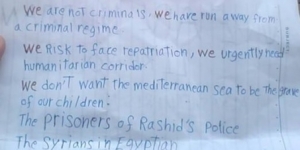
Stopped in the middle of the sea by the Egyptian Coast Guard, aboard a boat that was sinking shortly after the start of its journey to Europe. Locked within the premises of a police station in Alexandria, where the police prevent the arrival of relief supplies of Caritas
WRITTEN by STEFANO PASTA, translated by Mary Rizzo
MILAN- Through WhatsApp, we interviewed Syrian refugees held since 14 April in Al Rashid police station in Alexandria, Egypt. Having failed to reach Europe with a barge, they were handed over to the Egyptian authorities, but now risk transfer to the prison of Al Burj , or – even worse – repatriation to Syria.
What is your situation like today?
Disastrous hygienic conditions are dangerous due to a broken sewer. We are 144 persons living in two rooms measuring only a few meters, one room for women and one for men. We sleep on the ground and we cannot wash. We try to keep calm, but when it happened a few days ago there were moments of tension between us, the police prevented the visits for that day and suspended the coffee and the food brought from outside by Caritas Alexandria. The boys and men are still able to resist in some way, but the women and children are really at the limit; there are two women with heart problems who finished their medicine and they need to get out immediately.
What is the situation of children?
There are 44 children under the age of 12, while the total number of children is 63. There are a few who are trying to play with water bottles and they are the only ones who can get distracted for a moment. At night, however, they find it difficult to sleep. As of yesterday, almost all of them have developed a sort of skin disease that no one can identify. Two children of one and two and a half years, alone with his mother because his father was killed in Syria, were suffering particularly yesterday , they were taken to the hospital five times because they suffer from asthma and staying in this place of detention is equivalent to sleeping in a garbage dump. We are also concerned about another 4 year old girl, suffering from cardiac difficulties, who had begun to complain about the chest pain already in the midst of the sea.
Why did you flee from Syria?
Many of us have fled to avoid conscription in the army of Assad, others are activists against the regime who are risking their lives. Then there are families who have fled their homes because they could not survive in some cities, people are dying of hunger because of the siege of the regular army (regime army), which does not allow the entry of food. There is no bread and milk for the children, while the rice when one can find it, costs almost twenty dollars a kilo. Life like that is simply impossible, that’s why we escaped.
Have you talked with a lawyer or with international authorities?
No, none of us was able to speak with a lawyer or has received a sheet with the written reasons for why we are being detained. We met a lawyer named Ahmad, who initially presented himself as belonging to UNHCR, but then he began to terrorise us by threatening to have us repatriated and he revealed that he works for Egyptian National Security. This is our greatest fear, because it would be tantamount to a death sentence; also return to Lebanon would be very dangerous, since it has already happened that Hezbollah has handed over some refuges to Assad. After a week from the meeting with Ahmad, presented to us is a UN official, at least this is what he is telling us, along with an interpreter, in which we explained how we ended up in the police station.
How did it happen?
What happened before our arrest was a nightmare. We were ready to face the Mediterranean to reach Europe and we had entrusted ourselves to smugglers, who treated us badly, screaming profanities and threatening to beat us with bars, even children. With small boats, we were taken in groups on a larger boat, where we were parked at sea for seven days waiting for it to fill up to 250 people. When we were ready to leave, the same smugglers noticed that the boat was about to sink. It was the worst time since we left Syria: we could die and nobody would know. Then, after a fight broke out between the smugglers on the boat and the organisers were on the ground, we were able to convince them to bring us back; we passed the Coast Guard, but no one saw us. Once on the beach, we ourselves went to the Egyptian authorities, asking for help, but since that day, April 14, we were all arrested, including children.
Have you heard of other refugees detained in Egypt?
Of course, we have detailed information because they are members of our own families. The wife of a man who is here at Al Rashid is held in another place, then we know where the traveling companions arrested with us are. In the police station in Al Montazah there are 22 people, 55 in Chabrakhit and an unknown number – but with so many children – in Miami.
What are you asking for?
We call for the respect of Article 33 of the Geneva Convention, which prohibits any member country the repatriation (refoulement ) of persons to countries where their lives or freedom would be threatened . We ask UNHCR and the European embassies (we initiated contact with the Austrian one) to be able to apply for asylum. We ask the Europeans: would you like your children to have the Mediterranean as their graves? Open a humanitarian corridor, let us save our lives legally.
thank you to Nawal
CLICK ON IMAGE
CLICK ON IMAGE
AND SEE THIS LECTURE BY PIKETTY
On April 17, The Telegraph published a terrible piece on Syria in its News section. I immediately wrote the following letter to the editor; he refused it because it attacked the writer and was too long. The Telegraph published a shorter version today (photo) but here is my full original text.
Sir,
That Peter Oborne has been a fan of Syria’s genocidal dictator for some time is clear; that he presents distortions and fables as facts in a quality publication like The Telegraph, however, goes beyond his right to have an opinion, as morally objectionable as that opinion may be.
Oborne suspects that some of the accounts of the government’s dreadful atrocities “have been exaggerated”; would that include the evidence of the Assad regime’s systematic mass torture and starvation until death of over 11,000 Syrian men, women and children, presented to the Security Council on Tuesday? Would that include the Secretary General’s report on UNSCR 2139, blaming the Assad regime for flouting the legal obligation to lift its numerous sieges on desperate civilian populations? Would that include the irrefutable proofs, documented by international and British media and NGOs, of the Assad regime’s barbaric missile and barrel bomb campaign in every corner of Syria? Would that include the United Nations High Commissioner for Human Rights’ plea to bring the regime to the International Criminal Court and hold it accountable for massive crimes against humanity, now that at least 150,000 Syrians have been killed (including hundreds who were gassed to death in a chemical weapons attack) and nearly 10 million have become refugees, fleeing Assad’s bombs?
The Assad regime’s atrocities are far from exaggerated; on the contrary, we are merely skimming the surface of what the Syrian people have been subjected to for not only three years of uprising, but for over 40 years of brutal dictatorship by the same clan.
It is outright dishonest of Oborne to claim that “jihadist groups make up the opposition” when the Free Syrian Army, formed initially by brave defecting soldiers who refused to carry out Assad’s orders to kill their compatriots, is the only force actually fighting the very jihadists of ISIS who the Assad regime never attacks. When barrel bombs and missiles continue to rain on schools, breadlines, hospitals and homes, the headquarters of these Al Qaeda terrorists have remained miraculously untouched by Assad’s bombs, which he reserves for civilians and the moderate nationalists of the Free Syrian Army.
It behooves honest journalists to give facts, and The Telegraph’s readers should have been told there is no such thing as an independent MP in Assad’s Syria, nor can there be a “free and fair election” when over two thirds of the population have been turned into refugees, are starving, maimed, ill and in no condition to vote – even if they had wanted to take position on this farce which Mr Oborne seems to be the only journalist to describe as “election.”
It is a pity that Mr Oborne fears leaving the comfort of his central Damascene surroundings under the supervision of the Assad regime; we would be happy to put him in touch via phone or Skype with hundreds of Syrians all over the country, or to take him on an actual fact-finding mission to the camps housing millions of Syrian refugees in the region, so that they can tell him, and readers of The Telegraph, why they had to flee the hell which Assad has unleashed on them.
Sincerely,
Rime Allaf
Presidential Advisor
National Coalition of Syrian Revolution and Opposition Forces

 band annie's Weblog