If committed activists needed an additional reason for why what they are doing is essential and just, then the ICJ’s ruling is a chilling reminder of what is at stake here.
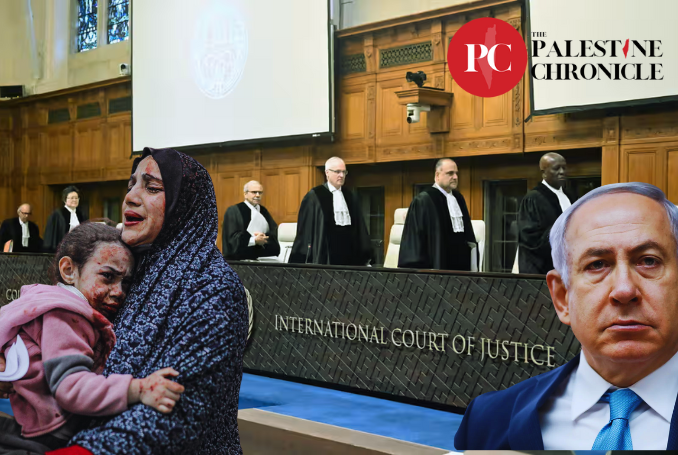
The moral and brave approach by South Africa to the International Court of Justice (ICJ), hoping for a ruling that would bring an end to the genocide of the Palestinians in Gaza, was not matched by the court on Friday, January 26, 2024.
I am not underestimating the significance of the court’s ruling. True, the court confirmed the right of South Africa to approach the ICJ and substantiated the facts it presented, including the assumption that Israel’s actions could be defined as genocide under the terms of the genocide convention.
In the long run, the language and the definitions used by the ICJ in its first ruling will constitute a huge symbolic victory on the way to Palestine’s liberation.
But this is not why South Africa approached the ICJ. South Africa wanted the court to stop the genocide. And therefore, from an operative point of view, the ICJ missed an opportunity to stop the genocide, mainly because it still treated Israel as a democracy and not a rogue state.
Palestinians, and whoever supports any struggle against crimes committed by countries of the global north, ceased a long time ago to be impressed by symbolic actions. Actions against rogue states only are meaningful if they have an operative side to them.
The operative actions suggested by the ICJ are basically a demand from Israel to submit, in one month’s time, a report on measures taken to prevent genocide in Gaza.
No wonder, the Israeli government has already hinted that such an assignment would not be high on its agenda and, most importantly, would not have any impact on its policies on the ground.
Even if the ICJ would have demanded, as it should have, a ceasefire, it would have taken quite a while to implement it, given the Israeli intransigence. But the message to Israel would have been clear – and effective.
License to Commit Genocide
The important thing to remember in any engagement with Israel is that what matters is not how the message is intended but how it is understood by Israeli policymakers.
The Western solidarity with Israel, shown on October 7, 2023, was understood by its policymakers as a free license to commit genocide in Gaza. Similarly, opting for a report instead of action is understood in Israel as a slight slap on the hand, which gives Israel at least another 30 days to continue its genocidal policies.
If this is the case, what would be left of Gaza in a month? What would be the magnitude of the genocide in a month’s time, if not only the West but also the ICJ, refuses to call for an immediate ceasefire? I am afraid that there is no need to answer these terrible questions.
More importantly, the crime has already been committed, it is not as if there is still time to stop it. Therefore, unless the ICJ believes that Israel’s actions be reversed and rectified, it sends a very confused message. It seems to hint that, although the actions may be a crime, if the carnage is limited, then this would be welcomed by the ICJ.
History of Failure in Palestine
The ICJ seemed to lack courage when it refrained from demanding what many countries in the global south and a huge number of people in the global civil society were asking for in the last three months.
If this whole process ends with the usual conclusion that international law has no power to stop the destruction of Palestine and the Palestinians, this will have even a greater impact on the question of Palestine.
In fact, this awareness could severely undermine the confidence, which is already very low, of the global south in the universality of intentional law.
Ever since its final institutionalization after the Second World War, the international law failed to deal properly with colonialism as a crime and was never able to challenge settler colonial projects like Israel.
It also became clear that imperialist policies pursued by the US and Britain, in clear violation of international law, are totally exempt from international law’s jurisdiction. Hence, the US was able to invade Iraq with a stark violation of international law and Britain now plans to send, without fear of reprisal, asylum seekers to Rwanda.
In the case of Palestine, throughout 75 years of the ongoing Nakba, international law – through its official and informal representatives, practitioners and delegations – was completely ineffective. It did not stop the killing of one single Palestinian; it did not lead to the release of one single Palestinian political prisoner, nor did it prevent the ethnic cleansing of Palestine. Indeed, the list of its failures is too long to be detailed here.
But There is Hope
There is a new, important lesson that should shape our activity and inform our hopes for the future.
We already learned that there is no hope for change within Israeli society, a lesson that was ignored by those involved in the so-called peace process.
The failure to understand the DNA of the Zionist society allowed Israel, since its inception, to kill Palestinians incrementally and massively either directly, by shooting them, or indirectly, by denying them basic human conditions for living.
This process, led by the US, was based on the formula that only after “peace” is restored, Israel would be obliged to change its ruthless policies on the ground.
This false paradigm has totally collapsed, even if the Biden Administration attempts, these days, to resurrect it, along with the few Palestinians who, for some reason, still put their faith in the two-state solution.
And now comes the new, important lesson: not only can we not hope for a change within Israel, we cannot rely on international law to protect the Palestinians from genocide.
This, however, does not mean that there is no hope in the future for liberation and decolonization. The Zionist project is in the process of imploding from within.
Israel’s Jewish society is disintegrating, its economy is failing, and its international image is deteriorating.
The Israeli army did not function in October and the government is in tatters and unable to provide basic services to its citizens. Under these circumstances, only wars and cynical Western interests will keep this project alive, but for how long?
And yet, such a process of implosion in history can be long, brutal and violent as it transpires in front of our eyes these days.
And we are not just onlookers. The activists among us understand that we have to double and triple what we already know has to be done.
We continue, outside of Palestine, to try and move the ‘B’ and ‘D’, in Boycott and Divestment, to ‘S’, as in Sanction.
This effort can be intensified by pushing in two directions. On one hand, we should exert more pressure on the governments of the global south to be more active, particularly in the Arab and Muslim worlds. On the other hand, we should find better ways to increase the electoral pressure on our representatives in the global north.
There is no need to tell the Palestinian Resistance what to do to defend itself and its people. There is no need to tell the liberation movement how to strategize for the future. Wherever they are, Palestinians who are involved in the struggle will continue to persevere and be resilient. What they truly need is for any external effort to be more effective, realistic and bold.
One can not but admire what the solidarity movement with Palestine has already achieved, especially in the last three months.
However, if its loyal and committed activists needed an additional reason for why what they are doing is essential and just, then the ICJ’s ruling is a chilling reminder of what is at stake here.
If there is hope to stop the genocide all over historical Palestine, it lies in the ability of the global civil society to take the lead. Because it is far too obvious that governments and international bodies are unwilling or unable to do so.
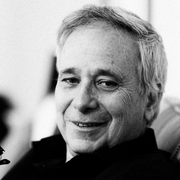
– Ilan Pappé is a professor at the University of Exeter. He was formerly a senior lecturer in political science at the University of Haifa. He is the author of The Ethnic Cleansing of Palestine, The Modern Middle East, A History of Modern Palestine: One Land, Two Peoples, and Ten Myths about Israel. He is the co-editor, with Ramzy Baroud of ‘Our Vision for Liberation.’ Pappé is described as one of Israel’s ‘New Historians’ who, since the release of pertinent British and Israeli government documents in the early 1980s, have been rewriting the history of Israel’s creation in 1948. He contributed this article to The Palestine Chronicle.
https://www.youtube.com/embed/wJcZ4YBUZpY?feature=oembed&The fallout has been growing from the so-called investigation by The New York Times into alleged mass rapes of Israeli women by Hamas fighters on 7 October – as I discuss with my colleague Nora Barrows-Friedman in the video above.
As The Electronic Intifada has reported, Israel’s sensational claims are not backed by any substantial evidence.
Rather, the lurid allegations of sexual violence appear calculated to demonize Palestinians and justify or distract from Israel’s genocide in Gaza.
Yet mainstream media and politicians continue to disseminate this atrocity propaganda without regard for the obvious holes in the Israeli narrative.
The Times article, published in late December, gave added credence to these claims, especially since its lead writer was Jeffrey Gettleman, a Pulitzer Prize-winning reporter.
But as we demonstrated, it is a journalistic fraud.
Members of the family of Gal Abdush, the deceased woman portrayed by Gettleman as a victim of the alleged “broad pattern” of sexual violence have repudiated the article and accused the Times of misleading and manipulating them. They say there is no evidence that Abdush was raped.
Gettleman also relied extensively for “evidence” on ZAKA, an extremist Jewish group that collects bodies and body parts for burial, and whose leaders have fabricated numerous accounts of atrocities from 7 October.
A recent investigation by Israel’s Haaretz newspaper accuses ZAKA of using bodies of people killed on 7 October as props for fundraising and that as part of its effort “to get media exposure, ZAKA spread accounts of atrocities that never happened, released sensitive and graphic photos, and acted unprofessionally on the ground.”
Now some of Gettleman’s colleagues at the Times are also raising questions, wary of being caught in yet another of the newspaper of record’s notorious journalistic scandals.
On 28 January, The Intercept revealed that the Times pulled a high-profile episode of its podcast The Daily that was based on Gettleman’s mass rapes article.
The decision not to air the episode was taken “amid a furious internal debate about the strength of the paper’s original reporting on the subject,” according to The Intercept.
The episode was supposed to go out on 9 January but as criticism of Gettleman’s reporting grew internally and externally, The Daily shelved the original script and put the episode on hold.
A new script was drafted, one that according to The Intercept, “allowed for uncertainty, and asked open-ended questions that were absent from the original article.”
But even that new script “remains the subject of significant controversy” within the Times newsroom and has yet to air. Some New York Times staffers fear “another Caliphate-level journalistic debacle,” The Intercept reports.
That’s a reference to the 2018 multipart podcast Caliphate, which the Timeshad to retract after it turned out that the main character – a Canadian Muslim claiming to have been a former ISIS fighter in Syria – had fabricated his entire story.
But rather than learning the lessons from this – or its false reporting on Iraqi “weapons of mass destruction” that helped pave the way for the 2003 US-led war of aggression against Iraq – the Times leadership appears to be doubling down.
“There seems to be no self-awareness at the top,” one Times staffer told The Intercept.
The newspaper’s editors allowed Gettleman to publish a follow-up article on 29 January, in an attempt to patch up his original story.
As I explain in the video above – a segment from The Electronic Intifada’s livestream of 31 January – Gettleman fails to address the criticisms of his story.
Instead he spins, distorts and provides new claims that lack any credibility – anything but take responsibility for his egregious malpractice and spreading of atrocity propaganda.
In 2011, Hillary Clinton’s State Department disseminated false claims that Libyan forces had been given the drug Viagra so that they could carry out mass rapes as a weapon for war.
These fabrications were part of the Obama administration’s push to justify the US military intervention that overthrew the country’s leader Muammar Gaddafi and, among other things, turned Libya into a haven for human trafficking, including torture and sexual violence.
This week’s event at Columbia University – where Clinton now teaches – is set to be another forum for her to spread atrocity propaganda to justify war, this time on behalf of Israel.
Additional resources on Israel’s “mass rapes” propaganda
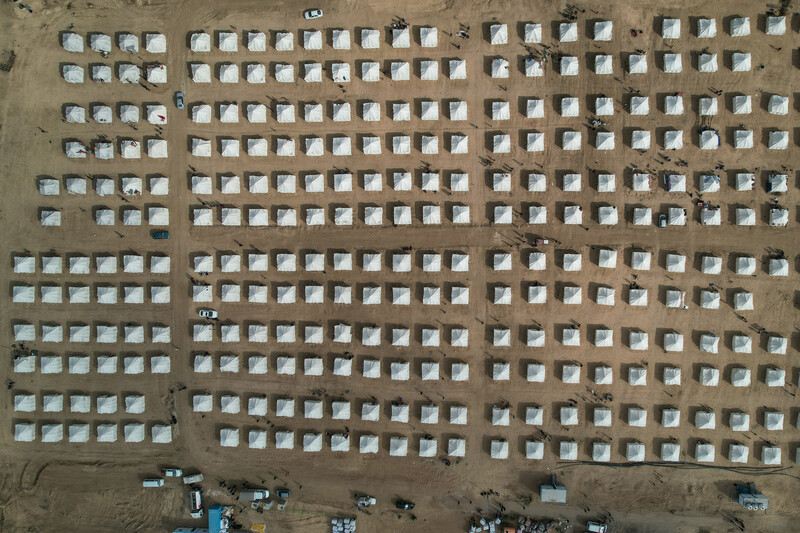
A general view of a tent city in the southern area of Khan Younis, built by Egypt and the Palestine Red Crescent Society, to shelter thousands of Palestinians forcibly displaced by Israel’s genocide in the Gaza Strip. Mohammed TalateneDPA via ZUMA Press / APA images
An Israeli entrepreneur who participated in the genocide in Gaza has pitched a plan to a European firm for the territory’s future.
The Gaza Strip – which the plan assumes would be conquered and controlled by Israel – would be divided into two zones. In the northern zone, Palestinian collaborators would be permitted to live in relative comfort, while those who refuse to serve and obey their Israeli masters would be banished to a southern “area of terror.”
The Electronic Intifada has seen a copy of this so-called “day-after plan.”
The pitch exposes the frightening colonial mindset and condescendingly racist view of Palestinians pervasive in Israel. It also reveals an underlying desire to conquer and control every inch of Palestine, including Gaza.
The plan was submitted by Or Bokobza, an Israeli reserve officer in the Sayeret Matkal elite commando unit, who was deployed in Gaza for several weeks during October and November.
Bokobza lives in New York City, but was in Israel on 7 October when the Palestinian resistance group Hamas led a military operation that destroyed the Israeli army’s Gaza Division, which is responsible for enforcing Israel’s siege on the territory.
Bokobza “immediately reported for duty and was deployed to root out the Hamas fighters that day,” according to a glowing profile in The Wall Street Journal.
Bokobza, who spent eight years in Israel’s army, far longer than the mandatory service requirement, has also participated in “every war since 2005.”
He is also the chief executive of Venn, a company that makes software for large-scale residential landlords to manage, monitor and extract maximum rents and revenue from tenants. It has received $100 million in venture capital, according to The Wall Street Journal.
At least 15 percent of his employees also enlisted as reservists with Israel’s military after the genocidal war on Gaza was declared.
Now Bokobza undoubtedly hopes to profit from the destruction and slaughter – although his proposal is pitched as good for Israel and even good for Palestinians in Gaza.
Another Israeli businessman Eran Haggiag is also named in the proposal, The Electronic Intifada learned. Haggiag is a co-founder of Bokobza’s company Venn.
Post-genocide dreams
Bokobza’s proposal calls for the total destruction of northern Gaza and its reconstruction as a managed colony – Gaza 2.0, where Palestinians who behave according to the rules set by Israel will be allowed to stay. Those who misbehave will be expelled to a hellscape in southern Gaza, or as he calls it, Gaza 1.0 – the “area of terror.”
The plan reads as a cross between a Silicon Valley elevator pitch and the script for a sci-fi horror movie.
But to the extent it purports to be a real plan, it is not the first of its kind. In the early 1990s, when the Oslo accords were signed between Israel and the Palestine Liberation Organization, media hyped that Gaza would turn into a “Singapore on the Mediterranean.”
Such notions were revived again after Israel redeployed its occupation forces to the perimeter of Gaza in 2005 and then began imposing an ever-tightening siege.
The condition behind these pie-in-the-sky promises – whether in Gaza or the West Bank – has always been that Palestinians surrender any hopes of self-determination and instead settle for economic crumbs while Israel retains all real power over their lives.
In the event, under the guise of the “peace process,” Israel began to isolate Gaza and systematically “de-develop” its economy, as scholar Sara Roy describes. At the same time it has accelerated its colonization of the West Bank, corralling Palestinians into ever-shrinking islands of land surrounded by a sea of Israeli settler-colonies.
Bokobza’s vision is in this tradition, albeit with the nightmare softened by the cheerful language of a real estate brochure and sprinkled with upbeat tech charlatanry.
“A week ago I stood in Gaza watching the sunrise over a land destroyed by conflict,” says his proposal submitted to the European firm in late November.
“Gaza is a truly beautiful place, with incredible views, beaches and full of potential,” he says of the killing fields where thousands of dead Palestinians still lie under the rubble of their homes and in makeshift mass graves.
“On 7 October, I put on my army uniform and in that moment I switched from being Or the entrepreneur to Or the soldier and I immediately started to think like a soldier again,” he says.
“You take orders and you execute. You can question the how but not the why, not the big picture or the strategy, I realized that we all put on our army uniform on 7 October and started thinking like soldiers, especially our leaders.”
While participating in the genocide and the bombing and shelling campaign described to be “among the deadliest and most destructive in recent history,” Bokobza dreamed of what to do on the ruins “with the help of the US and certain Arab states” in order to serve Israel’s pipe dream of subduing Palestinian resistance once and for all.
His plan would permanently partition northern and southern Gaza respectively into “the area of hope and the area of terror.”
Bokobza hoped Israel would start implementing the plan as soon as December 2023 and begin turning Gaza into “the poster boy of hope for the Palestinian people.” But that assumed that Israel would quickly defeat the Palestinian resistance and gain control of all or most of Gaza.
That has not happened, however, as the resistance continues to inflict heavy losses on the Israeli invaders in every part of Gaza.
Meanwhile, according to the plan, “the south will serve as a transition area for those awaiting relocation” – an apparent endorsement of ethnic cleansing of those Palestinians who cannot prove their loyalty and utility to Israel.
Residents of this imaginary plan would be recruited “through inspiring brochures that we will drop in the millions from the sky,” which will contain plan details and application procedures.
This plan does not explain how Palestinians displaced, starving, dying of thirst, living with untreated injuries, illnesses and trauma, and cut off from communications, will submit their “applications,” or why they would even consider trusting Israel.
“Applicants will commit to not having any association with terror groups and their residency will be revoked if they do,” Bokobza writes.
Bokobza describes a digital application process and a committee to determine who could live in the proposed Gaza 2.0 made up of Saudis, Emiratis, Americans, Israelis and Palestinian collaborators.
“One mistake and you’re out to the old Gaza without a way to come back for a few years,” Bokobza says, bringing together all the mindsets common to a landlord, prison warden and colonizer.
Helping Joe Biden
Bokobza is not shy that his motivation is entirely Israel’s benefit.
“This is not altruism for the Palestinian people,” he writes, adding that his plan would be the biggest blow to Hamas.
He calls for the Israeli government to begin implementing the project initially, before turning it over to Palestinian collaborators under Israeli supervision – similar to the Palestinian Authority in the occupied West Bank.
Bokobza also hopes that a plan marketed as helping Palestinians will result in “changing sentiment towards Israel in the international community” for the better.
Headlines would, he hopes, “turn to ‘Israel brought a solution’ instead of ‘Israel kills children.’”
Israel has killed tens of thousands of Palestinians in Gaza during its genocide. The United Nations has acknowledged that most victims are women and children.
Bokobza also markets his plan as an effort to bring “a success story” that will aid US President Joe Biden’s reelection campaign.
Destroy everything
Realizing Bokobza’s terrifying vision would begin with the total destruction of all buildings still standing in northern Gaza.
“We have taken over northern Gaza, most of the population evacuated south, we are eliminating all of Hamas’ infrastructure,” he writes.
“We will eliminate any infrastructure in northern Gaza that limits us from building the Gaza of the future.”
He repeatedly calls for total destruction.
“Demolition: Complete demolition of existing structures in Gaza City, paving the way for a fresh start and the construction of a robust infrastructure.”
On reflection, perhaps the closest analogy for this cynical and dystopian vision is Theresienstadt, the Nazi concentration camp that the German government used as a transit camp for Czech Jews who would be deported to death and labor camps across German-occupied Europe.
In Nazi propaganda, Theresienstadt was described as a “spa town,” where elderly Jews could “retire” in safety.
Palestinian children killed in Israeli attacks on Gaza
The Gaza Strip is a graveyard for thousands of children, the United Nations has said.
Since October 7, Israeli attacks have killed at least 10,000 children, according to Palestinian officials. That is one Palestinian child killed every 15 minutes, or about one out of every 100 children in the Gaza Strip.
Thousands more are missing under the rubble, most of them presumed dead.
The surviving children, who have endured the traumatic impact of multiple wars, have spent their lives under the shadow of an Israeli blockade, influencing every aspect of their existence from birth.
A displaced Palestinian child sheltering in a UNRWA school in Rafah in the southern Gaza Strip, Thursday Photo: Ibraheem Abu Mustafa/Reuters
Feb 4, 2024 4:17 am IST Gideon Levy
Two hundred and sixty names of babies whose age was 0; names of babies who didn’t get to celebrate their first birthday, nor will they ever celebrate anything else. Here are some of their names: Abdul Jawad Hussu, Abdul Khaleq Baba, Abdul Rahim Awad, Abdul Rauf al-Fara, Murad Abu Saifan, Nabil al-Eidi, Najwa Radwan, Nisreen al-Najar, Oday al-Sultan, Zayd al-Bahbani, Zeyn al-Jarusha, Zayne Shatat. What dreams did their parents have for them? Then there are hundreds of names of one- and two-year old children; toddlers three or four years of age; children who were five, six, seven or eight, up to the youths who were 17 when they died.
Thousands of names, one after the other, out of the 11,500 children killed by the Israel Defense Forces in Gaza over the last four months. The list flows like credits at the end of a long movie, a mournful tune in the background. The Al-Jazeera network posted the list of names known to it over the weekend, a total of half the 11,500 who were killed, according to Hamas’ health ministry. A child killed every 15 minutes, one out of every 100 children in Gaza.
Around them remained the children who witnessed the deaths of their loved ones, the parents who buried their babies, the people who had extricated their bodies from the fire and rubble, thousands of crippled children and tens of thousands forever in shock. According to UN figures, 10,000 children lost both parents in this war, a war in which two mothers die every hour.
No explanation, no justification or excuse could ever cover up this horror. It would be best if Israel’s propaganda machine didn’t even try to. No stories of “Hamas is responsible for it all,” and no excuses pointing to Hamas hiding among civilians. Horror of this scope has no explanation other than the existence of an army and government lacking any boundaries set by law or morality.
Think of these babies, who died in their cribs and their diapers, of the children who tried to run for their lives to no avail. Close your eyes for a moment and imagine the 10,000 tiny bodies lying side by side; open them and see the mass graves, the overcrowded emergency rooms, with ambulances spewing out more and more children who are rushed in, unclear if dead or alive.
It’s happening, even now, just over a one-hour drive from Tel Aviv. It’s happening without being reported in Israel, without any public debate over the violent rampage Israel has allowed itself to wage in Gaza this time, more than ever before. This is also happening without anyone in Israel reflecting on what will come of this mass killing, on what Israel might gain from it and what price it will pay for it. Don’t bother us, we are killing children.
The clichés are hackneyed and pathetic: “They started,” “there is no choice,” “what would you have us do?” “The IDF is doing everything it can to avoid the killing of innocent people.” The truth is that Israel doesn’t care, it doesn’t even take any interest. After all, Palestinians don’t love their children, and in any case, they would have only grown up to become terrorists.
In the meantime, Israel is erasing generations in Gaza, and its soldiers are killing children in numbers competing with the cruellest of wars. This will not and cannot be forgotten. How can a people ever forget those who killed its children in such a manner? How can people of conscience around the world remain silent over such mass killing of children? The fact that Israel is not deliberating this issue internally, with no tears or conscience in evidence, only desiring more of this war, until a “final victory” is achieved, does not bind the world. The world sees and is shocked.
The truth is, it’s impossible to remain silent. Even Israel, so absorbed in its grief and its concern for the fate of the hostages; Israel, which itself sustained horrors on October 7, cannot ignore what is happening in Gaza. It takes seven minutes to display the list of thousands of dead children, passing at the same speed as their miserable lives did. By the end, one cannot remain silent; these are seven minutes that leave you choked up, distressed and deeply ashamed.
Secretary Blinken admits that the U.S. has been unable to investigate the “evidence” presented by Israel claiming 13 of UNRWA’s 13,000 Gaza employees participated in October 7. Biden took Israel’s word for it anyway.
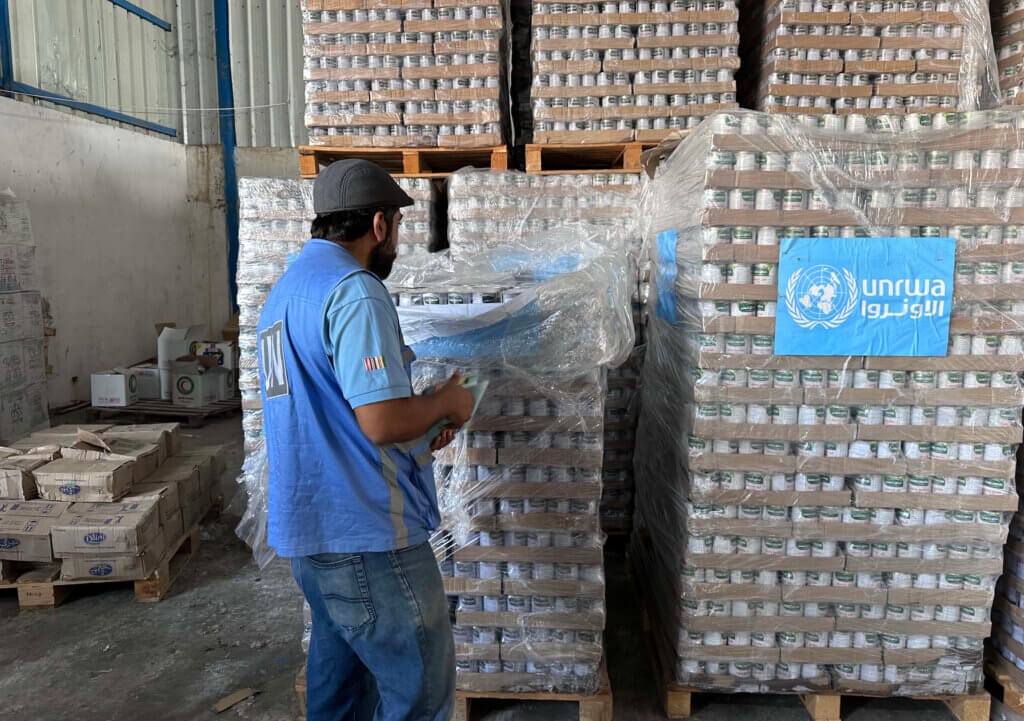
WORKERS OF THE UNITED NATIONS RELIEF AND WORKS AGENCY FOR PALESTINE REFUGEES (UNRWA) PREPARE MEDICAL AID FOR DISTRIBUTION TO SHELTERS, DEIR AL-BALAH, NOVEMBER 4, 2023. (PHOTO: SULIMAN EL-FARA/APA IMAGES)
In the latest demonstration of the boundless cruelty of U.S. President Joe Biden and his despicable administration, they have turned the backbone of what little aid Palestinians in Gaza receive into a political football, to be toyed with and batted around while jeopardizing that support for people who are already near the edge of what any human, however brave, can possibly endure.
It’s the latest in what feels like an eternal cycle of the United States and Israel beating up on the UN Relief and Works Agency (UNRWA) for political gain. There have been many hearings on Capitol Hill over the years bashing UNRWA and calling for either a complete structural overhaul of the agency or its dismantlement and absorption into the larger United Nations High Commission for Refugees (UNHCR).
The root of the attacks, prior to October 7, 2023, has been UNRWA’s unique mission which is to provide humanitarian assistance — including food, housing, medical aid, and the role that has taken up the bulk of its budget for years, education — to Palestinian refugees exclusively. Because of this mandate, Israel and its supporters blame UNRWA for the definition of “refugee” in the Palestinian context, which includes not only those made refugees by the 1948 and 1967 wars, but also their descendants born into refugee status.
Many on the pro-Israel and Israeli right and center believe doing away with UNRWA would essentially allow Israel to do away with Palestinian refugees because they believe UNRWA is the only thing maintaining that generational definition.
They’re wrong, of course. International law is clear on this point, as the UN states: “Under international law and the principle of family unity, the children of refugees and their descendants are also considered refugees until a durable solution is found. Both UNRWA and UNHCR recognize descendants as refugees on this basis, a practice that has been widely accepted by the international community, including both donors and refugee-hosting countries. Palestine refugees are not distinct from other protracted refugee situations such as those from Afghanistan or Somalia, where there are multiple generations of refugees, considered by UNHCR as refugees and supported as such. Protracted refugee situations are the result of the failure to find political solutions to their underlying political crises.”
There’s no ambiguity there, but that hasn’t stopped the controversy. UNRWA has been routinely accused of keeping Palestinians as refugees, not giving them the tools to move on to an independent lifestyle as individuals. This is a key ideological component in the denial of Israel’s responsibility for the ongoing dispossession of Palestinians. It absolves Israel of all responsibility for the ongoing poverty and hopelessness that decades of dispossession, occupation, and siege have wrought on Gaza and the West Bank.
Yet, while American politicians don’t think twice about trying to score points by bashing UNRWA, Israelis have always known that they need the agency, despite all their hateful rhetoric about it. For years, Israel would bash UNRWA mercilessly in the media, but would always tell the United States that its operations were necessary, especially in Gaza. Without UNRWA, Israel would be expected to ensure that a humanitarian catastrophe did not ensue, so Israel needs the agency.
In 2018, emboldened by a reckless U.S. administration under Donald Trump, Netanyahu suddenly changed that position and called for the U.S. to dramatically cut its support of UNRWA. Trump eagerly did so. When Netanyahu made that sudden shift, it surprised and disturbed many in his own government who disagreed with the decision. Just about the only positive step Joe Biden took when entering office was to restore UNRWA’s funding. But Trump’s action made the question of UNRWA’s funding even more politically charged than it had always been.
Unable to investigate
The old cycle seems to be playing out again, but this time, the highly charged politics in Washington are more intricate.
On January 26, Israeli allegations against a dozen UNRWA employees surfaced. The agency immediately fired nine of them and said that two others were dead, hoping their swift and pre-emptive action would stave off rash U.S. actions. Nonetheless, the United States and a host of other countries immediately suspended funding for UNRWA, over the actions of 12 of over 30,000 employees, 13,000 of whom are in Gaza.
It’s worth pausing over that last fact for a moment. Twelve out of 13,000 Gaza employees have caused all of this, and it’s based on evidence that has not been made public. You’d never know that from much of the media coverage, which is, once again, treating Israeli allegations as proven facts. Nor could you tell by the U.S. response. Secretary of State Antony Blinken stated, “We haven’t had the ability to investigate [the allegations] ourselves. But they are highly, highly credible.”
That is a stunning statement. They are simply taking Israel’s word for it, and on that basis, they are suspending aid to nearly two million people who need that aid more than anyone in the world.
Recall that Israel, in October 2021, labeled six Palestinian organizations as being connected to “terrorist groups,” specifically referring to the Popular Front for the Liberation of Palestine (PFLP). The “evidence” Israel presented was so threadbare that European countries dismissed it as baseless, and even the Biden administration, which has repeatedly supported Israeli claims based on no evidence that turned out to be false, could not accept the Israeli charges, though it avoided explicitly calling out Israel’s attempted deception.
Yet now, Israel has presented a “dossier” that contains its case against the twelve UNRWA workers. The actual evidence has not been made public, and even the United States, as noted above, has admitted it can’t verify the Israeli claims. But the U.S. suspended UNRWA’s funding anyway and led seventeen other countries to follow suit.
Not in Israel’s immediate interests
Israel saw matters going in a worrisome direction, however. The funding suspension will still allow UNRWA to operate through February, so there is time to reverse these decisions. And Israel is concerned that if that does not happen, the humanitarian situation will become so dire that Europe and maybe even the United States will not be able to resist the pressure from outraged populations and finally be forced to press for a permanent ceasefire.
Not only would UNRWA’s humanitarian efforts be shut down, but the UNRWA infrastructure that other groups use to distribute aid would also become unavailable. That will significantly accelerate the already crisis-level state of starvation, malnutrition, exposure, infections, curable diseases, lack of clean water, and all the other conditions that are killing Palestinians with accelerating speed, but much more quietly than Israeli bombs and bullets.
Fearing it could be pressed into ending its military operations, an Israeli official told The Times of Israel, “UNRWA is currently the international organization that plays the most dominant role in the entry and delivery of humanitarian aid into Gaza, and because there currently is no alternative, Israel is not pushing to shut down UNWRA.”
The Israeli official made clear what the Netanyahu government’s reasoning was. “If UNRWA ceases operating on the ground, this could cause a humanitarian catastrophe that would force Israel to halt its fighting against Hamas. This would not be in Israel’s interest and it would not be in the interest of Israel’s allies either.”
The United States quickly got the message. Even before the Israeli official spoke to The Times of Israel, U.S. Ambassador to the United Nations Linda Thomas-Greenfield shifted the American tone. “We need to look at the organization, how it operates in Gaza, how they manage their staff and to ensure that people who commit criminal acts, such as these 12 individuals, are held accountable immediately so that UNRWA can continue the essential work that it’s doing,” she said.
It’s not clear what “held accountable” means in this context since UNRWA has already fired the workers in question and even signaled it is open to criminal prosecution of anyone in “acts of terror.” Thomas-Greenfield also said that “fundamental changes” would be needed for funding to be restored. That’s a vague bit of wording that has been used many times in the past in reference to UNRWA. It’s unclear what it means here, exactly, but the general thrust of her speech was that funding should be restored.
“We shouldn’t let [the allegations] cloud the great work that UNRWA does,” Thomas-Greenfield said. “UNRWA has provided essential humanitarian assistance to the Palestinian people and UNRWA is the only organization on the ground that has the capacity to continue to provide that assistance.”
So, it would seem that the United States is prepared to back off of UNRWA and restore the funding, right? And then the other countries, who followed the U.S. down this rabbit hole, would follow it back out.
Well, it might not be that simple. As with everything during an election year, politics make this more complicated.
On January 30, the House Committee on Foreign Affairs held a hearing about UNRWA. The committee heard from one witness, Mara Rudman, who critiqued UNRWA but argued for President Biden’s “pause” on funding, rather than killing the agency. She said, “Is UNRWA, or any of the UN entities perfect? Far from it. The recent termination of 12 UNRWA employees who allegedly participated in the horrific Hamas attacks of October 7, provides one of the more extreme examples. It also shows the need for the ongoing oversight the Biden administration displayed in communicating to the UN that action and thorough investigation was required. For the services UNRWA provides to a desperate population, however, there is no substitute at this time.”
The termination of the twelve employees was a pre-emptive act of desperation and panic. UNRWA was not shown the evidence — merely accusations about the workers. But in this time of incomprehensible human suffering in Gaza, they wanted to do all they can to avoid the worst, so they fired the nine workers who remain alive. It shows how dedicated they are to their mission.
UNRWA submits lists of all its employees in the West Bank and Gaza to Israel. Somehow, Israel had no problem with these twelve, despite their supposedly extensive knowledge of the membership of Hamas and other Palestinian groups. None of this seems to bother Rudman much.
But she was the best of the witnesses, by far. The other three were Richard Goldberg of the Foundation for the Defense of Democracies, a far-right pro-Israel think tank; Marcus Sheff, CEO of IMPACT-se, a right-wing Israeli institution that leads the propaganda campaign against allegedly inflammatory Palestinian textbooks; and Hillel Neuer of the far-right UN Watch, a group whose mission is to paint the UN as a cesspool of antisemitism.
For Biden, the hearings, as well as the general tone and tenor in Washington after years of bashing UNRWA, present a problem. If he doesn’t restore UNRWA’s funding, conditions in Gaza will grow much worse very quickly, and calls for a ceasefire will be overwhelming, as will Biden’s downward trend in polls. If he restores UNRWA’s funding, he will find himself under attack from Republicans as well as some Democrats.
In the wake of the hearing this week, one of Israel’s leading advocates in Congress, Brad Schneider (D-IL), bluntly stated, “We have to replace UNRWA with something else. I support getting rid of UNRWA.”
Not to be outdone in anti-Palestinian animus, the ever-eager AIPAC shill, Ritchie Torres (D-NY) tweeted, “UNRWA, long funded by your tax dollars, has been governing Gaza at the behest of Hamas so that Hamas, which sees governing as a distraction, could dedicate itself to murdering Jews in Israel.”
Had Biden and Secretary of State Antony Blinken not reacted in knee-jerk fashion to the unsubstantiated Israeli allegations, this would be less of a problem. They could have noted that UNRWA immediately fired the workers in question, that it had launched an investigation, and that its work was needed now more than ever. Biden could then have talked about reviewing UNRWA over the coming weeks and months, and made some political show of it without jeopardizing the aid to Gaza, which even the Israeli government doesn’t want to see cut.
But nothing is as familiar to Joe Biden as the own-goal. By suspending the aid to UNRWA, he now has to take positive action to restore it, which will leave him even more vulnerable to bipartisan attack.
Netanyahu, for his part, is not going public with his desire to see UNRWA’s funding continued for a while until a more convenient time for it to be decimated. On the contrary, he is maintains his public call for UNRWA to be terminated, despite the message he conveys more quietly. He is very likely content to undermine Biden as much as he can.
Even government officials from both the Biden administration and the Netanyahu government have been forced to acknowledge the crucial role UNRWA plays. That this has become a political hot potato is not just a testament to Biden’s incompetence, but also to his mindless cruelty and unquenchable hostility to the Palestinian people.
In 2005, Palestinians called on the world to boycott Israel until it complied with international law. What if we had listened?Wed 10 Jan 2024 12.00 CET
Exactly 15 years ago this week, I published an article in the Guardian. It began like this:
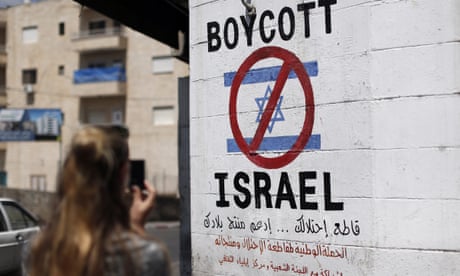
It’s time. Long past time. The best strategy to end the increasingly bloody occupation is for Israel to become the target of the kind of global movement that put an end to apartheid in South Africa. In July 2005 a huge coalition of Palestinian groups laid out plans to do just that. They called on ‘people of conscience all over the world to impose broad boycotts and implement divestment initiatives against Israel similar to those applied to South Africa in the apartheid era’. The campaign Boycott, Divestment and Sanctions was born.
Back in January 2009, Israel had unleashed a shocking new stage of mass killing in the Gaza Strip, calling its ferocious bombing campaign Operation Cast Lead. It killed 1,400 Palestinians in 22 days; the number of casualties on the Israeli side was 13. That was the last straw for me, and after years of reticence I came out publicly in support of the Palestinian-led call for boycott, divestment and sanctions against Israel until it complies with international law and universal principles of human rights, known as BDS.
Though BDS had broad support from more than 170 Palestinian civil society organizations, internationally the movement remained small. During Operation Cast Lead, that began to shift, and a growing number of student groups and trade unions outside Palestine were signing on.
Still, many wouldn’t go there. I understood why the tactic felt fraught. There is a long and painful history of Jewish businesses and institutions being targeted by antisemites. The communications experts who lobby on Israel’s behalf know how to weaponize this trauma, so they invariably cast campaigns designed to challenge Israel’s discriminatory and violent policies as hateful attacks on Jews as an identity group.
For two decades, widespread fear stemming from that false equation has shielded Israel from facing the full potential of a BDS movement – and now, as the international court of justice hears South Africa’s devastating compendium of evidence of Israel committing the crime of genocide in Gaza, it truly is enough.
From bus boycotts to fossil fuel divestment, BDS tactics have a well-documented history as the most potent weapons in the nonviolent arsenal. Picking them up and using them at this turning point for humanity is a moral obligation.
The responsibility is particularly acute for those of us whose governments continue to actively aid Israel with deadly weapons, lucrative trade deals and vetoes at the United Nations. As BDS reminds us, we do not have to let those bankrupt agreements speak for us unchallenged.
Groups of organized consumers have the power to boycott companies that invest in illegal settlements, or power Israeli weapons. Trade unions can push their pension funds to divest from those firms. Municipal governments can select contractors based on ethical criteria that forbid these relationships. As Omar Barghouti, one of the founders and leaders of the BDS movement, reminds us: “The most profound ethical obligation in these times is to act to end complicity. Only thus can we truly hope to end oppression and violence.”
In these ways, BDS deserves to be seen as a people’s foreign policy, or diplomacy from below – and if it gets strong enough, it will eventually force governments to impose sanctions from above, as South Africa is attempting to do. Which is clearly the only force that can get Israel off its current path.
Barghouti stresses that, just as some white South Africans supported the anti-apartheid campaigns during that long struggle, Jewish Israelis who oppose their country’s systemic violations of international law are welcome to join BDS. During Operation Cast Lead, a group of roughly 500 Israelis, many of them prominent artists and scholars, did just that, eventually naming their group Boycott from Within.
In my 2009 article, I quoted their first lobbying letter, which called for “the adoption of immediate restrictive measures and sanctions” against their own country and drew direct parallels with the South African anti-apartheid struggle. “The boycott on South Africa was effective,” they pointed out, saying it helped end the legalization of discrimination and ghettoization in that country, adding: “But Israel is handled with kid gloves … This international backing must stop.”
That was true 15 years ago; it is calamitously so today.
The price of impunity
READ ONhere FOR THE IMAGES. WITHOUT IMAGES SEE BELOW
2009 An explosion from an Israeli airstrike in Rafah, Gaza
2023 A plume erupts during an Israeli bombardment in Rafah
2009 A Palestinian trapped under rubble in Gaza City
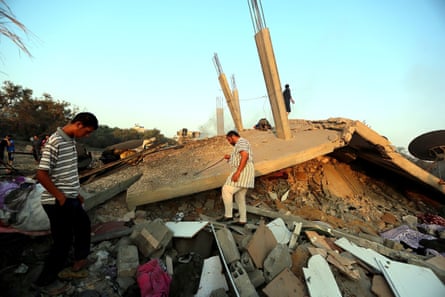
2023 Palestinians after an airstrike on a house in Rafah, Gaza
Reading BDS documents from the mid- and late 2000s, I am most struck by the extent to which the political and human terrain has deteriorated. In the intervening years, Israel has built more walls, erected more checkpoints, unleashed more illegal settlers and launched far deadlier wars. Everything has gotten worse: the vitriol, the rage, the righteousness. Clearly, impunity – the sense of imperviousness and untouchability that underpins Israel’s treatment of Palestinians – is not a static force. It behaves more like an oil spill: once released, it seeps outwards, poisoning everything and everyone in its path. It spreads wide and sinks in deep.
Since the original call for BDS was made in July 2005, the number of settlers living illegally in the West Bank, including East Jerusalem, has exploded, reaching an estimated 700,000 – close to the number of Palestinians expelled in the 1948 Nakba. As settler outposts have expanded, so has the violence of settler attacks on Palestinians, all while the ideology of Jewish supremacy and even overt fascism have moved to the center of the political culture in Israel.
When I wrote my original BDS column, the overwhelming mainstream consensus was that the South African analogy was inappropriate and that the word “apartheid”, which was being used by Palestinian legal scholars, activists and human rights organizations, was needlessly inflammatory. Now, everyone from Human Rights Watch to Amnesty International to the leading Israeli human rights organization B’Tselem have done their own careful studies and come to the inescapable conclusion that apartheid is indeed the correct legal term to describe the conditions under which Israelis and Palestinians lead starkly unequal and segregated lives. Even Tamir Pardo, the former head of the Mossad intelligence agency, conceded the point: “There is an apartheid state here,” he said in September. “In a territory where two people are judged under two legal systems, that is an apartheid state.”
Moreover, many also now understand that apartheid exists not only in the occupied territories, but inside Israel’s 1948 borders, a case laid out in a major 2022 report from a coalition of Palestinian human rights groups convened by Al-Haq. It’s hard to argue otherwise when Israel’s current far-right government came to power under a coalition agreement that states: “The Jewish people have an exclusive and unquestionable right to all areas of the Land of Israel … the Galilee, the Negev, the Golan, Judea and Samaria.”
When impunity reigns, everything shifts and moves, including the colonial frontier. Nothing stays static.
Then there is Gaza. The numbers of Palestinians killed in Operation Cast Lead felt unfathomable at the time. We soon learned that it was not a one-off. Instead, it ushered in a murderous new policy that Israeli military officials casually referred to as “mowing the grass”: every couple of years brought a fresh bombing campaign, killing hundreds of Palestinians or, in the case of 2014’s Operation Protective Edge, more than 2,000, including 526 children.
Those numbers shocked again, and sparked a new wave of protests. It still wasn’t enough to strip Israel of its impunity, which continued to be protected by the US’s reliable UN veto, plus the steady flow of arms. More corrosive than the lack of international sanctions have been the rewards: in recent years, alongside all of this lawlessness, Washington has recognized Jerusalem as Israel’s capital and then moved its embassy there. It also brokered the so-called Abraham accords, which ushered in lucrative normalization agreements between Israel and the United Arab Emirates, Bahrain, Sudan and Morocco.
Palestinians inspect ruins in Khan Younis after Israeli airstrikes in Gaza on 8 July 2014. Photograph: Anadolu/Getty Images
It was Donald Trump who began showering Israel with these latest, long-sought-after gifts, but the process carried on seamlessly under Joe Biden. So, on the eve of 7 October, Israel and Saudi Arabia were on the verge of signing what had been giddily hailed as the “deal of the century”.
Where were Palestinian rights and aspirations in all these deals? Absolutely nowhere. Because the other thing that had shifted during these years of impunity was any pretext that Israel intended to return to the negotiating table. The clear goal was crushing the Palestinian movement for self-determination through force, alongside physical and political isolation and fragmentation.
We know how the next chapters of this story go. Hamas’s horrific 7 October attack. Israel’s furious determination to exploit those crimes to do what some of the government’s senior leaders had long wanted to do anyway: depopulate Gaza of Palestinians, which they currently appear to be attempting through the combination of direct killing; mass home demolition (“domicide”); the spread of starvation, thirst and infectious disease; and eventually mass expulsion.
Make no mistake: this is what it means to allow a state to go rogue, to let impunity reign unchecked for decades, using the real collective traumas suffered by the Jewish people as the bottomless excuse and cover story. Impunity like that will swallow not only one country but every country with which it is allied. It will swallow the entire international architecture of humanitarian law forged in the flames of the Nazi holocaust. If we let it.
A decade of legal attacks on BDS
Which raises something else that has not stayed stable over the past two decades: Israel’s escalating obsession with crushing BDS, no matter the cost to hard-won political rights. Back in 2009, there were many arguments being made by BDS’s critics about why it was a bad idea. Some worried that cultural and academic boycotts would shut down much-needed engagement with progressive Israelis, and feared it would veer into censorship. Others maintained that punitive measures would create a backlash and move Israel further to the right.
So it is striking, looking back now, that those early debates have pretty much disappeared from the public sphere, and not because one side won the argument. They disappeared because the entire idea of having a debate was displaced by one all-consuming strategy: using legal and institutional intimidation to put BDS tactics out of reach and shut the movement down.
To date in the United States, a total of 293 anti-BDS bills have been introduced across the country, and they have been enacted in 38 states, according to Palestine Legal, which has closely tracked this surge. It explains that some legislation targets university funding, some requires that anyone receiving a contract with a state or working for a state sign a contract pledging they will not boycott Israel, and “some call on the state to compile public blacklists of entities that boycott for Palestinian rights or support BDS”. In Germany, meanwhile, support for any form of BDS is enough to get awards revoked, funding pulled, and shows and lectures cancelled (something I have experienced first-hand).
This strategy is, unsurprisingly, most aggressive inside Israel itself. In 2011, the country enacted the Law for Prevention of Damage to the State of Israel through Boycott, effectively nipping the nascent Boycott from Within movement in the bud. The Adalah legal center, an organization working for Arab minority rights in Israel, explains that the law “prohibits the public promotion of academic, economic or cultural boycott by Israeli citizens and organizations against Israeli institutions or illegal Israeli settlements in the West Bank. It enables the filing of civil lawsuits against anyone who calls for boycott.” Like the state-level laws in the US, “it also prohibits a person who calls for boycott from participating in any public tender”. In 2017, Israel began openly barring pro-BDS activists from entering Israel; 20 international groups were placed on the so-called BDS blacklist, including the anti-war stalwart Jewish Voice for Peace.
Meanwhile, across the US, lobbyists for oil and gas companies and gun manufacturers are taking a page from the anti-BDS legal offensive and pushing copycat legislation to restrict divestment campaigns that take aim at their clients. “It points to why it’s so dangerous to permit this kind of Palestine exception to speech,” Meera Shah, a senior staff attorney at Palestine Legal, told the magazine Jewish Currents. “Because not only is it harmful to the Palestinian rights movement – it eventually comes to harm other social movements.” Once again, nothing stays static, impunity expands, and when the rights to boycott and divest are stripped away for Palestinian solidarity, the right to use these same tools to push for climate action, gun control and LGBTQ+ rights are stripped away as well.
In a way, this is an advantage, because it presents an opportunity to deepen alliances across movements. Every major progressive organization and union has a stake in protecting the right to boycott and divest as core tenets of free expression and critical tools of social transformation. The small team at Palestine Legal has been leading the pushback in the US in extraordinary ways – filing court cases that challenge anti-BDS laws as unconstitutional and supporting the cases of others. They deserve far more backup.
Is it finally the BDS moment?
South Africa, 2015
Germany, 2020
United States, 2023
Ireland, 2023
There is another reason to take heart: the reason Israel goes after BDS with such ferocity is the very same reason that so many activists have continued to believe in it despite these multipronged attacks. Because it can work.
We saw it when global companies started pulling out of South Africa in the 1980s. It wasn’t because they were suddenly struck by anti-racist moral epiphanies. Rather, as the movement became international, and boycott-and-divestment campaigns started to affect car sales and bank customers outside the country, these companies calculated that it would cost them more to stay in South Africa than to leave. Western governments began belatedly imposing sanctions for similar reasons.
That hurt the South African business sector, parts of which put pressure on the apartheid government to make concessions to the Black liberation movements that had been rebelling against apartheid for decades through uprisings, mass strikes and armed resistance. The costs of maintaining the cruel and violent status quo were growing higher, including for South Africa’s elite.
Finally, by the end of the 80s, the pincer of pressure from the outside and inside grew so intense that President FW de Klerk was forced to release Nelson Mandela from prison after 27 years, and then to hold one-person-one-vote elections, which carried Mandela to the presidency.
The Palestinian organizations that have kept the flame of BDS alive through some very dark years still place their hope in the South African model of outside pressure. Indeed, as Israel perfects the architecture and engineering of ghettoization and expulsion, it may be the only hope.
That’s because Israel is markedly more insulated from internal pressure from Palestinians than white South Africans were under apartheid, who depended on Black labor for everything from domestic work to diamond mining. When Black South Africans withdrew their labor, or engaged in other kinds of economic disruption, it could not be ignored.
Israel has learned from South Africa’s vulnerability: since the 90s, its reliance on Palestinian labor has been steadily decreasing, largely thanks to so-called guest workers and to the influx of roughly a million Jews from the former Soviet Union. This helped make it possible for Israel to move from the oppression model of occupation to today’s ghettoization model, which attempts to disappear Palestinians behind hulking walls with hi-tech sensors and Israel’s much vaunted Iron Dome air defense.
But this model – let’s call it the fortressed bubble – carries vulnerabilities of its own, and not only to Hamas attacks. The more systemic vulnerability comes from Israel’s extreme dependence on trade with Europe and North America, for everything from its tourism sector to its AI-powered surveillance-tech sector. The brand Israel has fashioned for itself is that of a scrappy, hip, western outpost in the desert, a little bubble of San Francisco or Berlin that just happens to find itself in the Arab world.
That makes it uniquely susceptible to the tactics of BDS, including cultural and academic boycotts. Because when pop stars wanting to avoid controversy cancel their Tel Aviv stops, and prestigious US universities cut their official partnerships with Israeli universities after witnessing the detonation of multiple Palestinian schools and universities, and when beautiful people no longer choose Eilat for their holidays because their Instagram followers won’t be impressed, it undermines Israel’s entire economic model, and its sense of itself.
That will introduce pressure where Israel’s leaders clearly feel little today. If global tech and engineering firms stop selling products and services to the Israeli military, that ups the pressure still further, perhaps enough to shift the political dynamics. Israelis badly want to be part of the world community, and if they find themselves suddenly isolated, many more voters could start demanding some of the very actions that Israel’s current leaders dismiss out of hand – like negotiating with Palestinians for a lasting peace rooted in justice and equality as defined under international law, rather than trying to secure its fortressed bubble with white phosphorus and ethnic cleansing.
The hitch, of course, is that for BDS’s nonviolent tactics to work, the wins cannot be sporadic or marginal. They need to be sustained and mainstream – at least as mainstream as the South African campaign, which saw major corporations like General Motors and Barclays Bank pull their investments, while massive artists like Bruce Springsteen and Ringo Starr joined a quintessentially 80s supergroup to belt out “ain’t gonna play Sun City” (a reference to South Africa’s iconic luxury resort).
The BDS movement targeting Israel’s injustice has certainly grown over the past 15 years; Barghouti estimates that the “labor and farmers unions, as well as racial, social, gender and climate justice movements” that support it “collectively represent tens of millions worldwide”. But the movement has yet to reach a South Africa-level tipping point.
That has come at a cost. You don’t need to be a historian of liberation struggles to know that when morally guided tactics are ignored, sidelined, smeared and banned, then other tactics – unbound by those ethical concerns – become far more appealing to people desperate for any hope of change.
We will never know how the present could have been different if more individuals, organizations and governments had heeded the BDS call made by Palestinian civil society when it came in 2005. When I reached out to Barghouti a few days ago, he was not looking back at two decades of impunity, but on 75 years. Israel, he said, “would not have been able to perpetrate its ongoing televised genocide in Gaza without the complicity of states, corporations and institutions with its system of oppression”. Complicity, he stressed, is something we all have the power to reject.
One thing is certain: the current atrocities in Gaza dramatically strengthen the case for boycott, divestment and sanctions. Nonviolent tactics that many wrote off as extreme or feared would get them labelled antisemitic look very different through the dim light of two decades of carnage, with new rubble piled upon old, new grief and trauma etched in the psyches of new generations, and new depths of depravity reached in both word and deed.
This past Sunday, for his final show on MSNBC, Mehdi Hasan interviewed the Gaza-based Palestinian photojournalist Motaz Azaiza, who risks his own life, day after day, to bring images of Israel’s mass killing to the world. His message to US viewers was stark: “Don’t call yourself a free person if you can’t make changes, if you can’t stop a genocide that is still ongoing.”
In a moment such as ours, we are what we do. So many people have been doing more than ever before: blocking arms shipments, occupying seats of government demanding a ceasefire, joining mass protests, telling the truth, however difficult. The combination of these actions may well have contributed to the most significant development in the history of BDS: South Africa’s application to the international court of justice (ICJ) in The Hague accusing Israel of committing genocide and calling for provisional measures to stop its attack on Gaza.
A recent analysis by the Israeli newspaper Haaretz notes that if the ICJ rules in South Africa’s favor, even if the US vetoes military intervention at the United Nations, “an injunction could result in Israel and Israeli companies being ostracized and subject to sanctions imposed by individual countries or blocs”.
Grassroots boycotts, meanwhile, are already beginning to bite. In December, Puma – one of BDS’s top targets – let it be known that it will terminate its controversial sponsorship of Israel’s national football team. Before that, there was an exodus of artists from a major comics festival in Italy, after it emerged that the Israeli embassy was among the sponsors. And this month, the McDonald’s chief executive, Chris Kempczinski, wrote that what he called “misinformation” was having “a meaningful business impact” on some of its sales in “several markets in the Middle East and some outside the region”. This was a reference to a wave of outrage sparked by news that McDonald’s Israel had donated thousands of meals to Israeli soldiers. Kempczinski has sought to separate the global brand from “local owner operators”, but few people in the BDS movement are persuaded by the distinction.
It will also be critical, as momentum for BDS continues to pick up steam, to be acutely aware that we are in the midst of an alarming and real surge of hate crimes, many of them directed at Palestinians and Muslims, but also at Jewish businesses and institutions simply because they are Jewish. That is antisemitism, not political activism.
BDS is a serious, nonviolent movement with an established governing model. While giving local organizers autonomy to determine which campaigns will work in their areas, the BDS national committee (BNC) sets the movement’s guiding principles and carefully selects a small group of high-impact corporate targets, chosen “due to their proven complicity in Israel’s violations of Palestinian human rights”.
The BNC is also very clear that it is not calling for individual Israelis to be boycotted because they are Israeli, stating that it “rejects, on principle, boycotts of individuals based on their opinion or identity (such as citizenship, race, gender or religion)”. The targets, in other words, are institutions complicit in systems of oppression, not people.
No movement is perfect. Every movement will make missteps. The most pressing question now, however, has little to do with perfection. It is simply this: what has the best chance of changing a morally intolerable status quo, while stopping further bloodshed? The indomitable Haaretz journalist Gideon Levy has no illusions about what it will take. He recently told Owen Jones: “The key is in the international community – I mean, Israel will not change by itself … The formula is very simple: as long as Israelis don’t pay and are not punished for the occupation and not taken accountable for it and don’t feel it on a daily basis, nothing will change.”
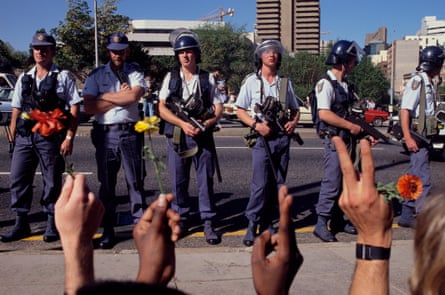
Riot police threaten anti-apartheid student protesters in Johannesburg, South Africa, on 20 August 1989. Photograph: Louise Gubb/Corbis/Getty Images
It’s late
In July 2009, a few months after my original BDS article was published, I traveled to Gaza and the West Bank. In Ramallah, I gave a lecture on my decision to support BDS. It included an apology for failing to add my voice sooner, which I confessed had come from a place of fear – fear that the tactic was too extreme when directed at a state forged in Jewish trauma; fear that I would be accused of betraying my people. Fears that I still have.
“Better late than never,” a kind audience member said to me after the talk.
It was late then; it’s later still now. But it’s not too late. Not too late for all of us to create our own foreign policy from below, one that intervenes in the culture and economy in intelligent and strategic ways – ways that offer tangible hope that Israel’s decades of unchecked impunity will finally come to an end.
As the BDS national committee asked last week: “If not now, when? The South African anti-apartheid movement organized for decades to gain broad international support leading up to the fall of apartheid; and apartheid did fall. Freedom is inevitable. The time is now to take action to join the movement for freedom, justice and equality in Palestine.”
This week police impounded 700 sheep, claiming they had passed through a forbidden zone. To retrieve the animals the shepherds paid 150,000 shekels to the settlers’ regional council
Sheep being freed this week after their owners, shepherds in the Jordan Valley, were forced to pay an exorbitant sum. It’s the latest settler method to embitter Palestinian lives.
Seven-hundred sheep are scampering to freedom. A few pause to gobble weeds, some are actually limping. The dash for freedom evokes the galloping of antelopes in Africa when they ford rivers. Equal measures of unbounded joy and great turmoil. The sheep have just been liberated from the pen that was built specially to hold them after they were impounded by Israel’s security forces. The animals were ambushed when they passed through what has been declared a forbidden zone. Their owners, Palestinian shepherds who reside on the other side of the highway, had to pay the inconceivable, draconian sum of 150,000 shekels (almost $40,000) in cash to the Jordan Valley Regional Council, run by the settlers, in order to get the animals back.
For hours, Border Police troops kept watch over the sheep and the shepherds, until representatives of the latter were able to round up the ransom. It’s not the first time that such gargantuan fines have been levied on Palestinian shepherds here. No such fines, it’s safe to assume, have ever been levied on settlers who own flocks.
This new measure – disproportional punishment aimed at bankrupting the shepherds – fits well with the other methods that have been wielded lately against the pastoral communities in the northern Jordan Valley, with the aim of making their lives miserable and ultimately cleansing the region of their presence. Settler violence, arrests, fences, land expropriations, home demolitions, prevention of pasturing of animals, and all the other means have now been supplemented by this new method. We’ll leave them penniless and maybe then they will leave their lands. The money, it goes without saying, goes straight into the settlers’ coffers, with police backing.
Early in the morning of Monday of this week, Aiman Ada’is and some of his brothers headed out to pasture with the family’s sheep. That’s the custom in this season, when the Jordan Valley is spectacularly carpeted in vivid green. The extended family’s home – a collection of huts, tin shacks, tents and animal pens, lacking electricity or running water – lies opposite the settlement of Masua in the northern part of the valley. The Ha’oved Hatzioni (Zionist Worker) movement established this settlement in 1974, after it had been an outpost of the Nahal brigade of the Israel Defense Forces, and named it for the ancient Jewish custom of lighting torches (masu’ot) on nearby Mount Sartava.
Since then, the shepherd community across from the settlement has been fighting to cling to the land it still has, whatever hasn’t already been seized from it by force. Since the formation of the present government, a little over a year ago, the shepherds’ living conditions have worsened, and since the war began, things have only been more difficult. The violent settlers have donned uniforms to serve in the local emergency squads and as volunteers in the police force, and their behavior has become even more tyrannical. But what happened on Monday this week tops everything.
At around 8:30 A.M., the shepherds passed through the rocky land south of Masua on their way to the grazing lands in the mountains, west of the Jordan Valley highway. A Border Police force, which was already waiting for them, ordered them to stop and escorted the large flock of some 700 sheep to a pen erected by the regional council that morning. The animals were herded into the crowded pen, the shepherds were ordered to retreat eastward a few hundred meters to the edge of the highway, and the festivities began. The shepherds’ families arrived, along with a Palestinian television crew. The latter weren’t allowed to approach the sheep – they had to stand on a distant mound to film them. We too were not permitted to get close to the sheep. The animal pen was now a closed military zone.
The penalty was clear-cut and painful: immediate payment of 150,000 shekels to the regional council, or the sheep would be taken to an unknown destination in the two large trucks that had been brought to the site earlier. The shepherds were fearful for the fate of their sheep. Some of them had left lambs behind at home, waiting for their mothers, and as it was, the sheep were left without water and food for hours, pressed up against each other and probably frightened. The shepherds were no less frightened. The Border Police had arrived in at least five large vehicles, together with a number of local settlers in uniforms who strutted around with the usual lordliness. War or no war in Gaza, here the sheep shall not pass without a proper Zionist response.
The summonses were issued quickly: two demands for payment to the Jordan Valley council, each to the tune of 75,000 shekels, to be paid by Ada’is Shehadeh and Ada’is A’id, the shepherd brothers. “Details of the charge: capture and transporting of animals. Capture of 150 sheep [although the shepherds claim 700]. After Jan. 22, 2024, an additional sum will be added for moving, guarding, feeding. Executed by Roman Pasternak. To be paid by Jan. 22, 2024.”
Not a word about the reason for the seizure of the sheep, if there actually was one, or about the dubious legality of the action. Members of the community knew that if they did not pay the fine immediately, the future of their sheep would be at stake and the amount of the fine would only rise. A crowdfunding operation was immediately launched among the pastoralist communities in the area, and within a few hours, a large black envelope was brought to the site containing 150,000 shekels in cash. But the Jordan Valley Regional Council, headed by David Alhayani, declined to accept a payment of that size in cash.
Time was beginning to run out. Some of the shepherds spread prayer mats on the ground and began to recite prayers. Despair was written on everyone’s face. Volunteers from the Israeli organization Looking the Occupation in the Eye were at the site, among them Rachel Abramovich – wife of the veteran television news commentator Amnon Abramovich – who with the other women in the group is doing inspiring work on behalf of the shepherds. Another arrival was Rabbi Arik Ascherman, from the Torah of Justice organization, who is active here with infinite dedication on behalf of the shepherds’ rights – and he came up with a solution. The NGO would pay the fine with a check and the shepherds would reimburse it with the cash.
After the passage of quite some time, in which phone calls were made and bank transfers executed, the matter was settled. When 150,000 shekels entered the account of the regional council, the Border Police allowed the shepherds to reclaim the sheep. The pen was opened, the sheep stampeded toward freedom. “We are here to separate the sides,” one of the police officers said, without explaining which two sides he meant. “We are the Border Police.”
The Israel Police did not respond to a request for comment from Haaretz.
A few dozen kilometers to the north, close to the Green Line and Beit She’an, is the pastoral community of Ein Hilwa. Alongside each of the concrete slabs that the IDF installed a few years ago at the entrance to it and every other every shepherd community throughout the entire Jordan Valley, bearing the message, “Firing zone, entry prohibited,” someone has also recently stuck Israeli flags in the ground. The lands of these communities were long since annexed to Israel in the eyes of these settlers, who don’t like to be called settlers – some of them are, after all, good kibbutzniks and moshavniks, people of the Labor movement.
The brothers Adel and Kadri Darajma, aged 61 and 57, respectively, live at Ein Hilwa together with their families and their animals. During the past year they lost 200 head of cattle, they relate. Some were impounded, some were stolen, some were killed by settlers. Outside their tents a few cows are grazing – the boniest, thinnest cows I have ever seen, other than in film clips about drought in Africa. As cows are impounded every time they take them out for grazing, the owners are fearful of leaving their compound, and the cattle are dying of hunger. In one case, the brothers relate, and Rabbi Ascherman joins them in the telling, cows were taken by a mysterious hand in the dead of night from the grazing areas and transported far away to land of the Hemdat settlement, where they were impounded by regional council inspectors as strays.
Here, too, the cattlemen were forced to make huge payments to the regional council to redeem their livestock. On January 1, they paid 49,000 shekels, and on January 15, another 143,910 shekels as payment for the “capturing and transporting of cattle.” Attorney Michael Sfard, who represents Hilwa, last week sent a sharply worded letter to council head Alhayani, asserting that the council’s acts of seizing the cattle were illegal, were executed without even minimal explanation, stem from a policy of grave discrimination toward the Palestinian herders who have lived in the area for generations, are accompanied by extraneous considerations that are intended to displace the communities from the region, and are part of systematic and deliberate harassment on the part of the local council and other governmental authorities.
If the money and the animals are not returned immediately, Sfard is threatening, he will instigate legal proceedings against the regional council. Sfard too relates that in at least the case mentioned above, the cows were stolen by settlers and taken to other areas, where they were seized by inspectors from the regional council as strays. In another case, a trap was laid for the Palestinian herders, Sfard says. A settler called them the evening before and told them that their animals could graze in a certain area the next day. When the herders arrived there the next day, inspectors were waiting for them there and seized the cattle.
Council head Alhayani made do this week with a curt response to Haaretz’s query: “The inspectors operated according to the council’s bylaws.” To the question of what justified the draconian punishment, Alhayani didn’t bother to reply.
Support our work: https://democracynow.org/give We continue to look at the International Court of Justice’s interim ruling in South Africa v. Israel with Stockton University professor Raz Segal and human rights lawyer Diana Buttu. We discuss Israeli Prime Minister Benjamin Netanyahu’s response to the ruling, the role of the United States in stymying international action and more. We also hear more from ICJ president Joan Donoghue’s delivery of the ruling, including the court’s acknowledgement of the dire humanitarian crisis in Gaza. Democracy Now! is an independent global news hour that airs on over 1,500 TV and radio stations Monday through Friday. Watch our livestream at democracynow.org Mondays to Fridays 8-9 a.m. ET. Subscribe to our Daily Email Digest: https://democracynow.org/subscribe



 WORKERS OF THE UNITED NATIONS RELIEF AND WORKS AGENCY FOR PALESTINE REFUGEES (UNRWA) PREPARE MEDICAL AID FOR DISTRIBUTION TO SHELTERS, DEIR AL-BALAH, NOVEMBER 4, 2023. (PHOTO: SULIMAN EL-FARA/APA IMAGES)


 band annie's Weblog