Search

band annie's Weblog

I have a parallel blog in French at http://anniebannie.net

What did 7 October achieve?

Basem Naim The Electronic Intifada 5 February 2024

Crowds demonstrate with the Palestinian flag
Millions have come out around the world in support of the Palestinian struggle for freedom, here in Rome on 27 January.  Marcello ValeriZUMAPRESS

As we approach the fifth month of the Zionist aggression against our Palestinian people, it is perhaps useful to take a step back and evaluate both the 7 October Al-Aqsa Flood operation and its aftermath.

Was 7 October legitimate? What did it achieve?

What have we learned from the Zionist reaction? What are the repercussions for all parties, inside or outside Palestine, for local, regional or global actors?

First, it is important to establish that everyone who communicated with the leadership of Hamas before 7 October, from politicians and diplomats to mediators and journalists, heard a clear, unequivocal message: An explosion was only a matter of time.

The reason? Israel was trying to transform what is a political conflict over a Palestinian state, the right of return of Palestinian refugees, and self-determination for the Palestinian people, into a religious conflict pitting Judaism (and Christianity) against Islam.

These policies included Israel’s attempts to exert full control over al-Aqsa mosque, with a view to its eventual demolition; its decades-old attempts to Judaize Jerusalem, expelling Palestinians from their homes and lands; and its de facto annexation of the wider West Bank along with threats to formally annex its illegal settlements.

They also included the continued siege on Gaza, under which the coastal strip and its 2.3 million people were isolated and imprisoned. They included the mistreatment of Palestinian prisoners, which accelerated under Itamar Ben-Gvir, the national security minister.

And they finally included attempts at persuading, under American cover, Arab and Muslim countries to ignore Palestinian rights and normalize relations with the Zionist entity without resolving the Palestinian issue, rendering it a purely domestic Israeli concern.

Hamas leaders conveyed all of these issues to anyone who would listen, but no one took heed. Either they considered warnings of an explosion an empty threat; they had fully adopted the Zionist narrative that Hamas was “deterred” and primarily concerned with consolidating its rule in Gaza; or they were intoxicated by Zionist power.

Operation Al-Aqsa Flood, led by Hamas and other resistance factions, was a response to what was a clear and imminent danger to our national cause, and a reaction to regional and international indifference to Palestine and its people.

Without the preemptive step of 7 October, the Palestinian cause could have been forgotten and erased entirely.

But did it achieve its desired goals?

Incredible resilience

There are two phases to discuss. The first began and ended on 7 October, and the second is what followed and continues to this day.

The goals of 7 October were fully achieved. Al-Aqsa Flood demolished the myth of Israel’s invincible army and all-seeing, all-knowing intelligence agencies, capable of striking in every corner of the region and the world.

All this was done with just a handful of men with simple, limited means but firm faith and fierce resolve.

In the second phase, the Palestinian people have paid a very steep price. But Palestinians have deep faith in their right to a free and dignified homeland.

Alongside a resourceful resistance that has surprised all observers, friends and foes alike, they have thwarted Israel’s plans to crush the resistance, deport Gaza’s population and recover its captives.

After four months, it is clear that the resistance leadership still firmly manages the battlefield with skill and ingenuity, continuing to inflict painful blows on the enemy military.

Despite all the horrors unleashed on our people – over 65,000 tons of explosives have been dropped on Gaza 2.3 million people since 7 October – Israel has failed to break people’s will and attachment to their land.

Our people, despite the pain and suffering, have shown incredible resilience, astonishing the world.

And despite all technological and intelligence efforts from the East and West to locate captives in Gaza, the enemy has failed at every attempt. The Israeli military has managed to kill some captives, along with those who came to their rescue, but no captive has returned to their families except under the conditions and timeline set by the resistance.

The core question is now: What next?

We are still in the middle of a fierce battle and it may be premature to draw conclusions. However, all indicators point in one direction: What comes next will not be the same as what had been before 7 October.

Al-Aqsa Flood and everything that has followed will alter the strategic terms of the conflict in favor of our Palestinian people and their just cause on the national, regional or international levels, as well as for the enemy and its future.

Change at the top

On the national level, our people have regained their vigor and confidence in their ability to overcome the shameful Oslo reality and its catastrophic consequences. Most importantly, the possibility of liberation, return and dismantling Israel’s occupation has become not only possible but very likely.

One of the consequences is that the leadership whose political project failed with the 1993 Oslo accords and brought national calamity cannot remain at the helm.

Opinion polls undertaken since the aggression began confirm this truth. We must turn a new page in our intra-national relations, to build on the battle’s outcomes and rebuild the Palestinian house democratically in light of the new realities established by this battle.

The most important step is to construct the Palestinian political institutions and the Palestinian national project to reflect the changes over the past decades to be truly representative of our people’s aspirations, sacrifices and political experience, especially the disastrous Oslo experience.

On the regional level, Al-Aqsa Flood has had fundamental and strategic repercussions. Most importantly, it disrupted the catastrophic “normalization” project, which would have certainly ended with the erasure of the Palestinian issue.

The 7 October operation demonstrated to those who looked to Israel for support and protection that the Zionist entity is fragile and too weak to even protect itself. The battle has opened a huge divide between the region and its people on one side, and Israel and the possibility of its integration on the other.

This turn of events has revived in people what had almost died due to lean years in the region – rekindling the great hope of return, liberation of holy sites and self-determination.

Gaza has presented an exceptional model of initiative and action despite enormous challenges and obstacles. If besieged Gaza can do this, why can’t we, throughout the Arab homeland, repeat the experience?

This in turn will undoubtedly have fundamental repercussions on how the peoples of the region view themselves and their capacity for action and change, regardless of their political orientations or geographic location.

We can thus expect a new cycle of the Arab Spring in the region since the official response to Gaza’s bloody confrontation has been far from the aspirations of the nation, its peoples and the historical responsibility of the Arab nation to the Palestinian cause.

End the aggression

On the international level, the breakthrough was significant, strategic and irreversible.

Firstly, the Palestinian issue, despite Zionist attempts to bury it, has become a personal cause for millions of people worldwide.

The world has directly witnessed the reality of this racist project, a stark contrast to its claims of representing the West and the values of freedom, democracy and respect for human rights. It has instead revealed itself as a bloody predator, playing the role of victim and extorting humanity for decades.

The significance of this narrative shift lies in Israel’s reliance on two main pillars of support for its survival: its material strength (military and economic) and international acceptance of its legitimacy.

Our people and their resistance have dealt with the first factor. The second has collapsed dramatically in the aftermath of 7 October.

On the official international level, the battle is still in its early stages. Those who founded this malicious project, built and nurtured it for decades within the framework of mutual interests between the Zionist movement and imperialist powers, have rushed to its rescue when it nearly collapsed.

However, we can at least observe important transformations. Many countries have realized that erasing the Palestinian issue and bypassing the Palestinian people is simply not possible.

No one will enjoy security and stability in the region or beyond without resolving this conflict and meeting the inherent rights of the Palestinian people.

As for the Zionist enemy, the battle and its repercussions have deepened severe internal divisions, be they political, social or ideological. One of the main reasons why this battle is continuing is the Israeli leadership’s attempts to escape the consequences of their actions, fearing the day after and the threat of collapse.

Most importantly, 7 October landed a strategic blow to the Israeli public’s faith in its political, security, and military leaderships, and their ability to lead, provide security or protect their citizens.

The resistance and its leadership still firmly hold the reins. On the field, there is still ground to cover in defeating the enemy, forcing it to stop the aggression and withdraw from our beloved Gaza.

At the same time, efforts are ongoing to relieve our people and alleviate this humanitarian disaster.

On the national political level, some are trying to revert us to the political context prior to 7 October, but it should be clear that neither the resistance nor our people will accept the status quo ante or any outcome that does not honor our people’s enormous sacrifices.

Here it may be useful to point out that the two priorities of the resistance at this stage – which it communicates to states and mediators – is to immediately and comprehensively end the aggression and secure the withdrawal of all occupation forces from the entirety of the Gaza Strip, and address the humanitarian catastrophe created by the aggression.

Any proposals that do not immediately achieve these two goals as a first step will not be accepted and will not be successful.

Political process

A medium and long-term political process can begin only later, starting with a prisoner exchange, the lifting of the siege and rebuilding what the occupation has destroyed.

This should then be followed by a reorganization of the Palestinian body politic on foundations that restore the credibility of the original national project, culminating in a political process to end the Zionist occupation, uphold the Palestinian right to self-determination, establish an independent Palestinian state with Jerusalem as its capital and secure the return of refugees in accordance with relevant international resolutions.

Al-Aqsa Flood marked a defining moment and a strategic opportunity, not only for our people but for our Arab and Islamic nations, to regain the initiative in civilization, presenting a different model for managing human affairs.

The West, its leaderships and systems, have failed to protect humanity from fascism, racism and their catastrophic impacts on humanity.

This opportunity must not slip from our hands, or we may, God forbid, have to wait decades for a similar moment. This battle should become a launching pad for our people and their just cause, just as we see massive international transformations with the decline of the unipolar system to a multipolar, or multi-actor, system.

This would be marked by the advance of the Global South, of which we are part, to a position befitting its peoples after centuries of colonization, enslavement, resource plunder and marginalization.

Dr. Basem Naim is a former Palestinian minister of health and a member of the political bureau of Hamas. He has previously appeared and published in several media outlets, including Australia’s ABC network, the UK’s Sky NewsThe GuardianMiddle East EyeAl Jazeera and The Jewish Daily Forward.

Summing up of preceding post : Yes, Peace Is Made With Murderers

The Haaretz article delves into the critical and often overlooked aspect of the Israeli-Palestinian conflict – the potential role of Palestinian prisoners in facilitating a long-term peace settlement, especially in the aftermath of the Gaza war. This consideration is rooted in two primary motivations: the vision articulated by U.S. President Joe Biden for the establishment of a Palestinian state alongside Israel, and the urgent necessity to reconstruct and govern the Gaza Strip effectively post-conflict.

Biden’s vision, as outlined in a Washington Post column, emphasizes revitalizing the Palestinian Authority (PA) to govern a new Palestinian state with enhanced political legitimacy and operational efficiency. This vision is intertwined with the immediate need for a robust governance structure in Gaza to manage the colossal task of rebuilding the territory’s devastated infrastructure and social services, ensuring law and order, and preventing a slide back into violence.

The article highlights the unique position of Palestinian prisoners, who, through their sacrifice and involvement in the national struggle, hold symbolic and practical significance that could be pivotal in governance and peace-building efforts. Drawing on historical examples from Northern Ireland and South Africa, where prisoners played instrumental roles in negotiating and implementing peace agreements, the authors argue for a similar engagement with Palestinian prisoners.

The narrative underscores the complexity of rehabilitating Gaza amid the chaos of war and political fragmentation. It suggests that integrating Hamas into a political framework, possibly within the Palestine Liberation Organization (PLO), could be facilitated by a prisoner exchange, boosting Hamas’s short-term prestige but ultimately aiding in its political integration for long-term stability.

The opposition from Israeli Prime Minister Benjamin Netanyahu to Biden’s blueprint, stemming from a long-standing policy to prevent a unified Palestinian state, is critiqued. The article posits that Netanyahu’s approach, favoring a fragmented governance model based on clans over a centralized authority, is unsustainable and neglects the socio-political realities shaped by the conflict.

The authors propose that the release of security prisoners committed to non-violence could enhance the political legitimacy and administrative capacity of a post-war Palestinian government. They spotlight the broad support among Palestinians for figures like Marwan Barghouti, suggesting that such prisoners, once released, could assume leadership roles conducive to peace and reconciliation.

Reflecting on a comparative study of political-security prisoners in ethno-national conflicts, the article elucidates the distinct impact of prisoners in conflict resolution, contrasting the Oslo Accords’ failure to engage prisoners meaningfully with the successful integration of prisoners in the peace processes of Northern Ireland and South Africa. It emphasizes the prisoners’ role in shaping national consciousness, agenda-setting for resistance movements, and transitioning from armed struggle to negotiation.

The article concludes by advocating for a significant reevaluation of Israel’s stance on Palestinian prisoners, suggesting that engaging with them could form a crucial part of a broader strategy for achieving a two-state solution. It calls for Israel to adopt a more inclusive approach, recognizing the potential of prisoners to contribute to peace-building and governance, thereby aligning with international efforts for a sustainable resolution to the Israeli-Palestinian conflict.

Yes, Peace Is Made With Murderers

Most agreements to resolve ethno-national conflicts don’t survive the test of time. A study of those that have succeeded reveals the secret: They sprang from prisons. Israel needs to take this under consideration for the ‘day after’ the war in Gaza

source : Haaretz A summing up is to be found HERE

מרואן ברגותי ציור קיר

Marwan Barghouti mural in Gaza. He played a key role in drafting the 2006 “prisoners document,” which brought Fatah and Hamas to enter into talks.Credit: Majdi Fathi / ReutersAvraham SelaTomer Schorr-Liebfeld

Jan 25, 2024

The discussion about the “day after” the war in the Gaza Strip necessitates a reexamination of the question of the security prisoners being held by Israel. Not only in the context of an exchange deal in which, it is to be hoped, the Israeli hostages in Hamas captivity will be released in exchange for, among other things, the prisoners incarcerated in Israel; but also in a context that is barely discussed: the role that the Palestinian prisoners can play in shaping the political situation and even in promoting a long-term Israeli-Palestinian settlement.

This has become relevant for two reasons. The first is the political vision set forth by U.S. President Joe Biden in a column this past November in The Washington Post, in which he posited as a strategic aim the establishment of a Palestinian state alongside Israel. According to Biden, it would be governed by a “revitalized” Palestinian Authority, namely one vested with greater political legitimacy and more effective capacity for functioning than the existing PA. That authority would be responsible for governing the Gaza Strip after the vanquishing of Hamas.

The second reason is the urgent need to bring about an efficient system of governance in the Gaza Strip, whose cardinal task will be to rehabilitate and rebuild the administrative and physical infrastructures, which have been utterly devastated. In both of these contexts, Palestinian prisoners can play a role both symbolic and practical.

Already now, before the war has ended, the incomprehensible number of more than 25,000 people have been killed in Gaza; towns, villages, residential neighborhoods and refugee camps have been reduced to rubble; and a humanitarian disaster has been inflicted on the Strip’s two million inhabitants. Even if the international community comes up with the necessary funds, an efficient apparatus will be needed to channel the money into the construction of physical infrastructures and establishment of civilian services, to enforce law and order, and prevent a renewed deterioration into violence, both internally and against Israel.

Rehabilitating the Gaza Strip will be a years-long project, taking place under chaotic social and political conditions. Reason thus leads to the conclusion that no Palestinian government will be able to fulfill its task in the Gaza Strip without the integration of Hamas in a political format. Releasing prisoners in exchange for hostages can be expected to boost Hamas’ prestige in the short term, but it’s likely that in the long run, the mortal blow dealt to its military capabilities and to its leadership in the Strip will weaken the movement and bring about its readiness to take part as a faction within the framework of the PLO, and in partnership with the Fatah-based Palestine Liberation Organization. Indications to that effect on the part of Hamas’ political leadership are already discernible.

Prime Minister Benjamin Netanyahu’s vigorous opposition to Biden’s blueprint is a direct continuation of the policy of separating between the West Bank and the Gaza Strip, which Netanyahu has cultivated since 2009, with the aim of averting the establishment of a Palestinian state. That opposition explains the preference of the security establishment today for a “government of hamulas” (clans) over a central Palestinian authority. This is an untenable conception of governance from every point of view, and one that disregards the rupture of Gaza’s social-political structures wrought by the war.

It’s hardly possible to ignore the weaknesses of the PA and of Mahmoud Abbas, who has headed it since 2005, or to gainsay the need for a reform of the PA’s structure and its personal makeup. However, the PA is the only Palestinian-national framework that can possibly serve as a post-war government in the Gaza Strip. This is not only the view of the West but also of the Arab states, especially those that are likely to donate funds for the Strip’s reconstruction.

A makeshift tent camp in Rafah, Gaza, earlier this month.

One of the most intractable barriers in processes of conflict resolution, as in international humanitarian involvement, is the absence of a central authority that enjoys legitimacy and is vested with enforcement capability. In this context, the release of security prisoners who have committed to abstaining from a return to violence, can bestow political legitimacy domestically on the Palestinian government and bolster its administrative abilities. This, by virtue of their activity on behalf of the national cause, the organizational experience they have gleaned and the broad public support they enjoy among the Palestinian public overall.

Most of the Fatah prisoners who were released before and after the Oslo Accords – among them Marwan Barghouti, Jibril Rajoub, Hisham Abdel Razek, Sufyan Abu Zaydeh and Qadura Fares – unreservedly supported the accords and the principle of establishment of a Palestinian state alongside Israel. They also assumed senior positions in the PA government. Barghouti, who in 2002 was sentenced by Israel to five life terms plus 40 years in prison, is today the only senior Fatah prisoner who has for years enjoyed the broadest support of the Palestinian public. It’s not by chance that he tops the list of the prisoners whose release Hamas is demanding now, perhaps in the hope that he will treat the organization well if and when a reshuffled PA returns to power in the Gaza Strip.

Calls for Barghouti’s release are voiced from time to time, and recently more insistently, by left-wingers in Israel, who believe that, like Nelson Mandela in his country, he can lead the Palestinians to a political settlement with Israel. From personal acquaintance with Barghouti in the 1990s (of co-author Sela), it can be surmised that he will be willing to advance a solution in this spirit, but only on condition that the Israeli government is ready to promote such an agreement. Without that readiness on Israel’s part, his release would only serve to further intensify the conflict with the Palestinians.

The idea that the security prisoners being held by Israel can play a key role in forming an effective PA, and more specifically in promoting a political settlement based on President Biden’s principles, is based on a comparative study we conducted on the role of political-security prisoners in the resolution of protracted ethno-national conflicts. Our paper on that study, which was published last November in the International Studies Quarterly, the flagship of the International Studies Association, examined this subject in the context of three different conflicts: Northern Ireland, South Africa and the Israeli-Palestinian conflict.

The PA is the only Palestinian-national framework that can possibly serve as a post-war government in the Gaza Strip. This is not only the view of the West but also of the Arab states, especially those that are likely to donate funds for the Strip’s reconstruction.

The study points to the disparity between the effective absence of Palestinian prisoners from the Oslo process, and the key role played by prisoners from Northern Ireland and South Africa in resolving those conflicts. In both cases, the prisoners worked to lay the groundwork for negotiations, the ratification of the agreement that emerged, and then its implementation. As such, the agreements reached in Northern Ireland and South Africa differed from most of the accords attained in ethno-national conflicts in the first two decades post-Cold War, which, like the Oslo Accords, reverted to hostilities within a few years of being signed.

Political-security prisoners are not a cause but a consequence of the long conflicts under consideration, but their incarceration generates powerful feelings in their communities, and can potentially shape the future of the conflict in the direction of a settlement or an escalation. The emotional intensity of this subject is reflected in Hamas’ recurring attempts, including in the October 7 attack, to abduct Israeli soldiers and civilians who can then be exchanged for Palestinian prisoners held by Israel. Hence, an intelligent use of the symbolic capital embodied in the prisoner population might contribute much to resolving the conflict, as attested to by the processes undergone in both Northern Ireland and South Africa in this context.

The prisoners of a national struggle are perceived by their public as patriots, and identified with devotion and sacrifice for the sake of the commonality. The story of the longtime prisoners in Israel, like in Northern Ireland and South Africa, paints a similar picture of the prison as a “hothouse of ideas.” It is here that a national consciousness can develop by way of deep and free debate, which includes calling into question basic assumptions and sacrosanct perceptions regarding the national vision and the strategy for realizing it.

Ofer Prison. In decades of Israeli occupation, about a million Palestinians have passed through Israeli detention facilities, constituting about 20 percent of the population.

In both those countries, the long years of living together in close quarters in prison created a distinct community that expanded voluntarily and informally; together with inmates who had served their terms and were released, these prisoners became, over the years, a key power center in their movements’ decision-making processes. In many cases, the prisoners shaped the agenda of the resistance movement on the outside by staging hunger strikes, which then engendered manifestations of revolt and violence outside the prison. Through the social connections that were forged in the prisons, the prisoners succeeded in promoting their interpretation of reality and in transforming the hegemonic discourse of armed struggle into one of negotiations instead.

The Irish Republican Army inmates in Northern Ireland, for example, laid the groundwork for the political process of the 1980s and early 1990s, initially parallel to the use of violence and later by development of a strategy of nonviolent struggle. Subsequently, they effectively gave up the dream of a united Ireland, postponing it to an indefinite time in the future. At the same time, the Protestant leadership was compelled to accept the true and full sharing of power with the Catholics. During the period between the signing of the agreement in Northern Ireland in April 1998 and its ratification a few weeks later by way of referendums held in the two rival communities, the prisoners carried considerable weight in forming a Catholic consensus around the agreement. Furthermore, in the two fraught years that followed the referendums, they played a central role in curbing the “spoilers” who advocated continued violence, and in preventing backsliding of the communities into the cycle of blood.

The first lesson one can take from Northern Ireland and South Africa is the essential importance of prisoners’ participation in legitimizing various aspects of resolution of the conflict, which by its nature entails bitter concessions, perceived as taboo, on certain issues.

In South Africa, Mandela, and through him the other prisoners and the leadership of the African National Congress, came to terms with giving up the ANC’s aspiration to see the country’s resources redistributed, after being apprised of the apprehensions that guided the behavior of the other side. Similarly, in the Israeli-Palestinian conflict, it was the prisoners who were released in the “Jibril deal,” in 1985, who instigated the first intifada and led the PLO leadership, in 1988, to declare an independent Palestinian state on the basis of the United Nations partition resolution of 1947, thereby effectively abandoning the idea of liberating all of Palestine.

In some cases, the prisoners dictated political decisions to their movements. A case in point is the “prisoners’ document” of 2006, which was signed by the jailed leaders of Fatah, Hamas and other organizations in an attempt to end the rift between the PLO-Fatah leadership and Hamas. The document, in whose drafting Marwan Barghouti played a key role, compelled the two rival factions to enter into talks on cooperation on the basis of a platform that accepted the two-states principle. The result was a strategic accord between the factions and the signing of the Mecca Agreement of 2007, even though four months later that concord was voided when Hamas took over the Gaza Strip by force.

The importance of security-political prisoners in efforts to resolve protracted intra-state conflicts stems in large measure from the scope of their sector, which is a consequence of decades of bloody conflict between the state and the group rebelling in society. Thus, in decades of Israeli occupation in the territories, about a million Palestinians have passed through Israeli detention facilities, constituting about 20 percent of the population. In other words, almost every Palestinian family has experienced the incarceration of a family member, neighbor or close acquaintance, so much so that arrest became a formative experience of the whole of Palestinian society. In Northern Ireland and South Africa, the prisoners constituted a smaller though still substantial percentage of the populations.

מרואן ברגותי בבית המשפט, 2012

* * *

The first lesson one can take from the resolution of the conflicts in Northern Ireland and South Africa is the essential importance of prisoners’ participation in legitimizing various aspects of resolution of the conflict, which by its nature entails bitter concessions, perceived as taboo, on certain issues. In Israel, by contrast, the prisoners were not taken into account in any way ahead of the signing of the Oslo Accords. Even afterward, the government consistently objected to the release of prisoners “with blood on their hands,” an approach that weakened the support of the community of prisoners for the entire process.

The second lesson concerns the need for a prior stage in which confidential “feelers” were sent out to prisoner-leaders while they were still incarcerated, even before the start of real negotiations between the sides. These contacts, which in some cases were drawn-out and crisis-ridden, enabled the sides to exhaust fully the negotiating possibilities and to formulate a possible framework for an agreement, even before anything was committed to paper. Whereas in Northern Ireland and South Africa, talks were conducted between government representatives and the prisoners’ leaders for many years before agreements were made, the Oslo Accords were concluded within a short period of just months, and without the leaders of the two sides having had time to examine thoroughly the mutual concessions that they would be required to make even to implement the limited agreement they signed.

The Oslo Accords did in fact represent a vague and not clearly defined blueprint for the strategic goal of the process. Postponing negotiations and decisions on the conflict’s core issues (Jerusalem, refugees, borders, Jewish settlements) to the stage of the final-status negotiations, reflected the fact that there were deep and substantive differences on these issues, which would surface afterward and cause the collapse of the process. Above all, the splitting of the process into two stages exposed it to fierce opposition from both sides. The Palestinian prisoners released after the signing of the Oslo Accords, many of whose comrades remained incarcerated in Israel, were unwilling to grant legitimacy to the process, the more so as it was effectively suspended in the period of the first Netanyahu government (1996-1999).

With the wisdom of hindsight, it’s possible to surmise that a meaningful dialogue with the Palestinian prisoners, who from the outset were exposed to the internal Israeli discourse and enjoyed public influence back home, would have enabled the two sides to get to know each other better, helped them understand the limits of the possible on the other side, and might even have led to a more coherent blueprint for a solution.

The third lesson lies in the importance of reaching agreement on a general amnesty for prisoners who support the accord that is hammered out, and who commit to desisting absolutely from the use of violence. In Northern Ireland and South Africa, a mechanism was worked out for the release of prisoners on just such terms. This helped reduce to a large extent the use of violence by the accord’s opponents, by granting them the possibility of inclusion in the amnesty in return for renouncing violence. As such, the prospect of the prisoners being freed acted as an incentive for all the organizations to join the cease-fire in the most critical period of the agreement’s implementation, when most protracted conflicts slide back into violence.

* * *

Beyond formulation of a political blueprint for the postwar period being a clear American demand, it is also a supreme Israeli interest from both the security and political viewpoints. It is essential for Israel that an effective Palestinian governing institution be established in Gaza in place of Hamas. Moreover, the rehabilitation of life in the Gaza Strip following the physical destruction and the humanitarian crisis caused by the war, is a vital element in creation of a secure border with Israel. In both matters, the international community will play a decisive role, which will in turn obligate the government of Israel to make tough political concessions.

Launching a direct dialogue with the prisoners obligates a conceptual shift by decision makers and other public leaders in Israel – most of whom view the prisoners as terrorist murderers who must serve out their punishments in full.

Israel has the possibility of correcting its approach to the issue of the prisoners, if it wishes to turn over a new leaf in the conflict with the Palestinians. Indeed, the veteran inmates from Fatah are not lovers of Zion, and their support for a settlement on the basis of “two states for two peoples” reflects an acquiescence to the limits of power and an acceptance of reality. Many of them have been incarcerated for decades in Israeli prisons and are fluent in Hebrew and knowledgeable about the history of the State of Israel and about its social and political situation. At the same time, no one need expect that they will make concessions on substantive questions relating to core issues, such as have been put forward by the PLO in the years since the Oslo Accords.

Launching a direct dialogue with the prisoners obligates a conceptual shift by decision makers and other public leaders in Israel – most of whom view the prisoners as terrorist murderers who must serve out their punishments in full. It is self-evident that a necessary condition for holding a dialogue of this kind is readiness by Israel to renew the negotiations on a two-state basis, which according to Biden is “the only way to ensure the long-term security of both the Israeli and Palestinian people” and which is now “more imperative than ever.” In this context we should bear in mind Yitzhak Rabin’s assertion that, “The road to reconciliation leads through the prisons.”

If and when the government of Israel is ready to discuss sincerely the two-state blueprint with the Palestinians, it will do well to adopt the models of Northern Ireland and South Africa on this issue, and begin a dialogue with Barghouti and perhaps with members of other Palestinian organizations while they are still in prison. Doing so will help prepare the ground for their participation in rebuilding the Palestinian Authority, in a way that will gain it broad public support and enable it to function as an effective governmental body. As such, the freeing of the prisoners will be an integral element of a future settlement and make the prisoners practical partners in its acceptance and implementation.

The war to eradicate Hamas rule in the Gaza Strip has restored to the top of the regional and international agenda the “unfinished business” of a resolution to the Israeli-Palestinian conflict. What began with the signing of the Declaration of Principles between the Rabin government and the PLO in September 1993 never even achieved its minimal goals: full autonomy for the Palestinians in most of the West Bank and the Gaza Strip. Even if the renewal of the negotiations with the Palestinians on the two-state blueprint is anathema to the majority of the Israeli public today, the crisis into which Israel was plunged on October 7 emphasizes the necessity of fully exhausting that process.

Tomer Schorr-Liebfeld’s doctoral dissertation, submitted to the Hebrew University of Jerusalem in 2021, is about political prisoners in conflict-resolution processes. Avraham Sela is emeritus professor in the Department of International Relations and a senior research fellow in the Truman Research Institute for the Advancement of Peace, both at the Hebrew University.

Ilan Pappé on YouTube

Attack on Rafah

Decolonizing Israel
New history
Zion : An investigation

Daniel Mahé recorded this on October 8, 2023

Recorded while walking in Bedford Stuyvesant, Brooklyn NY.. Daniel Maté,

Breaking the silence

American former ‘lone soldiers’ who served in the occupied territories return to the U.S. to talk about what they were sent to do. Testimonies start at 9 “

A searing interview with Avichai Sharon and Noam Chayut, both veterans of the Israeli Defense Forces and members of Breaking the Silence. Sharon and Chayut served during the second intifada, an on-going bloodbath that has claimed the lives of over three thousand Palestinians and nine-hundred-fifty Israelis. After thorough introspection, these young men have chosen to speak out about their experiences as self-described “brutal occupiers of a disputed land.” Producer: Sat Gwin

The Unspoken Rule About Zionism Was Broken

Do Zionism quietly, discreetly, under the cover of darkness.

Author

Zachary Foster
February 09, 2024

The Unspoken Rule About Zionism Was Broken

For more than a century, Zionists have understood that the Zionist project involved doing some unpleasant things, and it was best to keep quiet about those things.

Theodor Herzl realized this as early as 1891. He confided in his diary that “we must expropriate gently the private property on the estates assigned to us” and “we shall try to spirit the penniless population across the border,” adding that “the process of expropriation and the removal of the poor must be carried out discreetly.” [Emphasis added].

The State of Israel has broken the unspoken rule. Israeli soldiers have been publishing videos of themselves blowing up dozens of residential neighborhoods in Gaza. Jewish Israeli leaders have been publicly declaring their intention to ethnically cleanse Gaza while Jewish Israeli journalists have been calling on the military to flatten the entire Strip. Prime Minister of Israel Benjamin Netanyahu himself likened Israel’s enemy to Amalek twice, Amalek being the people the Biblical Israelites were instructed to commit a genocide against.

Of course, not all pro-war Israelis have forgotten the rule. The Israeli judge appointed to the ICJ by Israel, Aharon Barak, voted in support of South Africa’s claim about incitement to genocide. For Barak, the problem was not what Israel was doing, the problem was what Israeli leaders were saying. They were violating the unspoken rule about Zionism. When removing Palestinians from their homes, and making it impossible for them to return, best to do it discreetly.

The Zionist leader Jacob Thon (1880-1950), who worked at the Palestine Land Development Co. buying up land from Arabs in the 1910s, believed that “of course” transferring the Arabs to Transjordan was desirable. But, Thon warned, if the Zionists talked about transfer openly their chances of accomplishing it would diminish. Any steps to “transfer” Arabs would have to be taken “privately.”

During the 1920s, Israel Zangwill (1864-1926) frequently wrote and spoke openly of the removal of the Palestinian Arab population of Palestine. In his view, that was necessary to establish a Jewish democratic state, and so Palestinian Arabs often cited Zangwill’s writings as evidence of Zionism’s nefarious aims. Zionist leaders learned an important lesson from Zangwill’s frankness: “under no circumstances should they talk as though the Zionist program required the expulsion of the Arabs, because this would cause the Jews to lose the world’s sympathy,” in Tom Segev’s words.

Golda Meir also understood the importance of doing things quietly. By 1971, Israeli ministers were going on media roadshows in their newly established settlements in the Israeli-occupied West Bank. The Geneva Conventions of 1948 prohibit states from transferring their civilian population onto land occupied in war, something obvious to Meir but apparently not her ministers. “Before we move forward with our discussion,” Meir said at the outset of a 1971 cabinet meeting, “there’s something I’d like to ask. It was our habit that for anything that has to do with settlements, outposts, land expropriations and so on, we simply do and do not talk [about it].”

Until recently, the Israeli government appreciated the importance of doing the expulsions and the expropriations quietly. For more than a decade, Israeli archivists have been scouring the Israeli archives on a hunt for documents related to the expulsion of Palestinians from their homes. Hundreds of documents have been concealed in “a systematic effort to hide evidence of the Nakba,” or Israel’s ethnic cleansing of the Palestinians in 1948.​

Israelis have generally understood that, whenever the matter pertains to removing Palestinians from their homes, or settling Jews in those homes, the actions must be done quietly to avoid attention. That’s why, in November 2020, Israel chose US Presidential election day to carry out its largest forced displacement in over four years, making 73 Palestinians in Khirbet Humsa homeless. That’s also why Israeli Jewish settlers usually take over Palestinian homes in the middle of the night (123456). Incidentally, that’s also why Israel bombs Gaza at night. That’s also why Israel does not allow foreign journalists to enter Gaza and why journalists native to Gaza are so often targeted. They are giving a voice to what Israel doesn’t want you to hear, and they are shining a light on what Israel doesn’t want you to see.

Perhaps Zionism should embrace a new slogan. Do Zionism quietly, discreetly, under the cover of darkness.

Keep reading

"There is no moral equivalency between Israel & Hamas."

“There is no moral equivalency between Israel & Hamas.”

source

BREAKING: YEMENI HOUTHI OFFICIAL STATEMENT

The spokesman of Yemen’s Houthi armed forces, Yahya Saree

“The American and British were involved in the aggression against our country to support the enemy in its aggression against Gaza.

The American-British pretext for launching their aggression against our country, i.e. “protecting international maritime navigation,” is a false pretext

America and Britain suffered great losses on the economic level because they involved themselves in the aggression.

Our forces are targeting American and British ships and battleships in response to the aggression against our country, and we are carrying out effective and effective operations.

American and British involvement is counterproductive for both sides and will not achieve their goals and will not protect Israeli ships.

The American-British involvement made the two countries a targeted force at sea

Instead of the Americans taking a humanitarian stance by bringing medicine and food into Gaza, they risked waging war against us.

The American is the one who caused the militarization of the Red Sea and turned it into another battlefield

Our operations will continue as long as the aggression against Gaza continues, and medicine and food must be brought into the Strip and the war of extermination must be stopped.

There is no other targeted country that can coordinate with us and should not listen to American interference

The American admitted his inability to prevent strikes targeting ships heading to the occupying entity

The 86 American attacks do not limit our country’s capabilities, and our strikes are continuing, effective and very influential.

The American was surprised by the level of tactics in Yemen and our capabilities to support the Palestinian people

The broad popular presence in Yemen is held in high regard by the enemy, especially the American

Hundreds of thousands of mujahideen who have military experience frighten the enemy, and the Americans realize the strength of our army

The American realizes that our army was able to confront all American tactics during the war that lasted 9 years against us.

The American realizes that our people are armed and that our army is ready to interact with the Palestinian people and their oppression

The Americans are not accustomed to having their ships and battleships hit by missiles, so they respond with simple raids that do not affect specific targets.

The American is looking for someone to fight on his behalf in the field and for mercenaries, and does not dare to invade our country and confront our people.

It is important for our people to continue comprehensive action in support of Gaza, and our path is escalatory as long as the aggression against the Strip continues.

The British deal with Yemen with hatred dating back to the days of the old colonialism of Aden.

We appreciate the diplomatic efforts made by Qatar and Egypt to end the war on Gaza

I call on our dear people for two million honorable people to come out in support of Gaza, because we will not leave the squares as long as the people of Gaza are killed.

The launching of ballistic missiles and drones will continue as long as the war continues

 We tell the Palestinian people in all sincerity that they are not alone.”

P.S.

“I say the Houthis are the (biggest) hero of (all) heroes” — Norman Finkelstein

Saudis Contradict Blinken: Want Actual Palestinian State now, not Vague ‘Peace Process’

FARHANG JAHANPOUR 02/08/2024

Oxford (Special to Informed Comment; Feature) – On Tuesday afternoon (6 February 2024), U.S. Secretary of State Antony Blinken took part in a joint press conference with Qatari Prime Minister and Minister of Foreign Affairs Mohammed bin Abdulrahman Al Thani in Doha. The press conference was mainly about the war in Gaza and the possibility of a new pause in the fighting and exchange of hostages and prisoners.

However, Blinken was also asked about his recent meeting with the Saudi Crown Prince Mohammed bin Salman and the possibility of normalisation of relations between Saudi Arabia and Israel. Blinken said (as quoted by the US Department of State): “But with regard specifically to normalization, the crown prince reiterated Saudi Arabia’s strong interest in pursuing that. But he also made clear what he had said to me before, which is that in order to do that two things are required: an end to the conflict in Gaza and a clear, credible, time-bound path to the establishment of a Palestinian state.”

In other words, the Saudis are strongly in favour of normalisation but, in addition to ending the conflict in Gaza, they believe that there should be a “clear, credible, time-bound path to the establishment of a Palestinian state.” This paints a fairly rosy and optimistic picture of Israel-Saudi negotiations and the prospects for normalisation of relations.

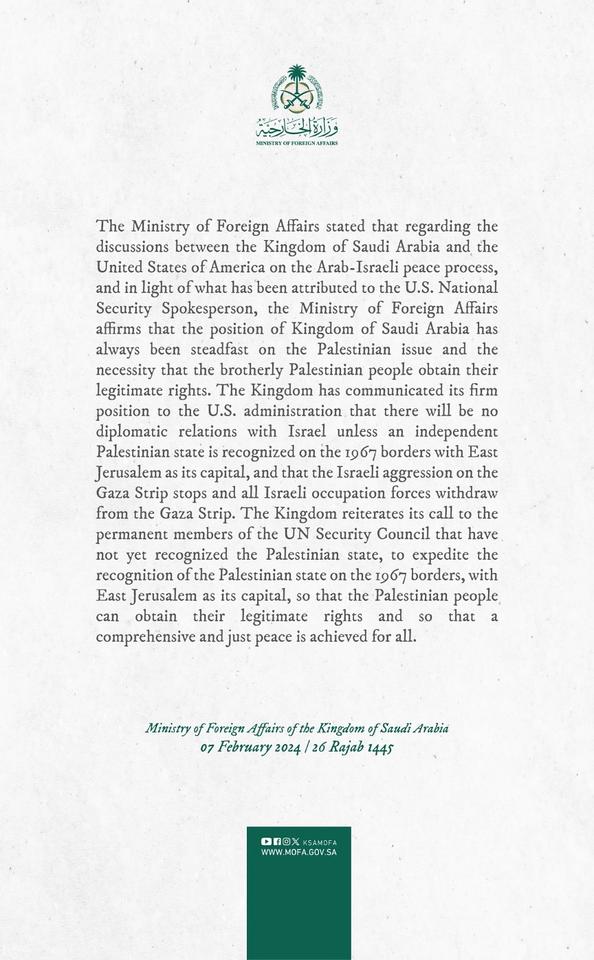
Shortly after that press conference, the Saudi Ministry of Foreign Affairs issued a statement which puts the record straight and which seems to contradict the main thrust of what Blinken said. The difference between what Blinken said and what the statement of the Saudi Ministry of Foreign Affairs stresses is stark and revealing.

There has been a “clear, credible, time-bound path to the establishment of a Palestinian state” for the past 30 years, called the Oslo Accords. However, despite that process, which has been as long as a piece of string, the Israelis and especially Israeli Prime Minister Netanyahu have opposed it and prevented its implementation.

What the Saudis are clearly saying is that they are not happy with a similar process, but want to go back to the Saudi Plan for the establishment of a Palestinian state with East Jerusalem as its capital, as well as a reference to the Palestinian refugee problem and the right of the Palestinians to return to their occupied land.

That plan was adopted unanimously by all the members of the Arab League in 2002 at their summit in Beirut. Subsequently, it was also approved by all 57 states of the Organisation of Islamic Cooperation (formerly known as the Organisation of Islamic Conference) at a summit meeting that was held in Riyadh, including Iran which was represented by President Mahmud Ahmadinezhad. The Palestinian Authority led by Yasser Arafat immediately embraced the plan.

In 2015, Israeli Prime Minister Benjamin Netanyahu also expressed tentative support for the Initiative, but in 2018 he rejected it as a basis for future negotiations with the Palestinians. In his infamous speech at the United Nations’ General Assembly on 22 September 2023 in New York, he held a map of “The New Middle East”, with Palestine completely wiped out. The elimination of Palestinian territories from the map of the Middle East angered the Palestinians and was one of the reasons that led to the 7th October attack by Hamas militants on Israel. Since the start of the Gaza war, Netanyahu has emphatically opposed the establishment of a Palestinian state and has even said that it will reoccupy Gaza for the foreseeable future.

The statement by the Saudi Ministry of Foreign Affairs clearly shows that the Saudis are not happy with Israeli policies and that there will be no prospect of normalizing relations with Israel under the current circumstances.

It states: “The Kingdom has communicated its firm position to the U.S. administration that there will be no diplomatic relations with Israel unless an independent Palestinian state is recognised on the 1967 borders with East Jerusalem as its capital, and that the Israeli aggression on the Gaza Strip stops and all the Israeli occupation forces withdraw from the Gaza Strip. The Kingdom reiterates its call to the permanent members of the UN Security Council that have not yet recognized the Palestinian state, to expedite the recognition of the Palestinian state on the 1967 borders, with East Jerusalem as its capital, so that the Palestinian people can obtain their legitimate rights and so that a comprehensive and just peace is achieved for all.”    

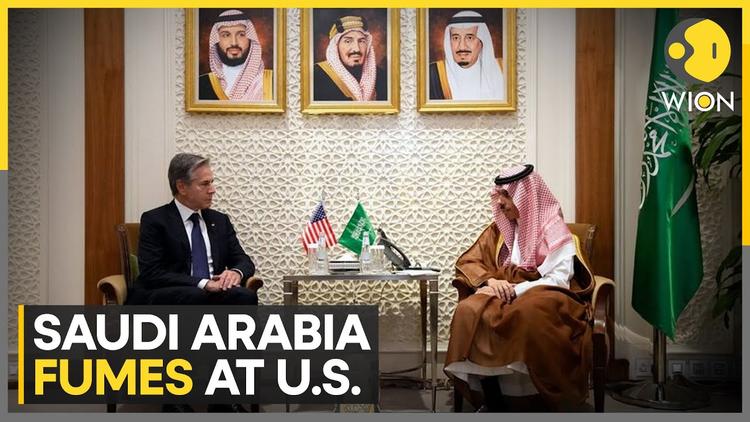
Video: “Saudi Arabia: No Israel ties without recognition of Palestinian state” | Latest English News | WION

Abraham Accords

Towards the end of the Trump Administration (between August 2020 and January 2021), a series of agreements were reached between the UAE, Bahrain, Morocco, Sudan and Israel to normalise their relations, which came to be known as the Abraham Accords. The ceremonies were held with great fanfare on the Truman Balcony of the White House, hosted by President Trump, flanked by Secretary of State Mike Pompeo and his son-in-law Jared Kushner, in order to give the impression that they represented major and historic peace agreements. It should be stressed that at least the first three countries on the list were not at war with Israel and in fact had covert cordial relations with her.

A close examination of the Abraham Accords shows that they were a series of cynical moves to bribe some Arab regimes to normalise relations with Israel by bypassing the Palestinians. Israel’s long-term plan to isolate and bypass the Palestinians by reaching agreements with Arab regimes outside the immediate neighbourhood was enthusiastically championed by Pompeo and Kushner, and behind them by Netanyahu.

The UAE wanted to buy some advanced US weapons, including F-35 fighter jets. They were promised that they would be able to buy them if they normalised relations with Israel. After doing so, the United States reneged because Congress opposed the sale of those sophisticated weapons to the UAE. Once the UAE decided to normalise relations with Israel, little Bahrain also decided to follow suit.

In 1993, Sudan was first added to the list of states that sponsored terrorism, but the overthrow of President Al-Bashir in April 2019 improved relations between Sudan and the United States and in December 2019 the two countries announced their intention to exchange ambassadors. Sudan’s Ambassador to the United States presented his credentials in September 2020.

US government promised to remove Sudan from the State Sponsor of Terrorism (SST) list if the Sudanese government agreed to normalise relations with Israel. Sudan agreed, and on 14 December 2000 the US Government removed Sudan from the SST list, just in time for Sudan to normalise her relations with Israel and to join the Abraham Accords. Of course, after the breakout of the latest civil war in Sudan between various army factions, the situation has gone from bad to worse.

There has been a long-lasting conflict between Morocco and the Polisario Front, backed by Algeria, about the ownership of the Western Sahara. Large parts of Western Sahara were controlled by the Moroccan Government and known as the Southern Provinces, whereas some 20% of the Western Sahara was controlled by the Sahrawi Arab Democratic Republic (SADR), the Polisario state with limited international recognition.

The United Nations officially considers Morocco and the Polisario Front as the main parties to the conflict and has called on them to reach a negotiated settlement. The Obama administration disassociated itself from the Moroccan autonomy plan in 2009 and put the option of an independent Western Sahara on the table. Clearly, the issue had to be settled by the UN negotiation through consultation with both sides. However, Trump unilaterally and illegally gifted the Sahara to Morocco if she normalised relations with Israel.

Then it was the turn of Saudi Arabia, which came under enormous pressure to normalise relations with Israel but, even before the events of 7th October, Saudi Arabia refused to join the Abraham Accords without the acceptance of the two-state solution by Israel. The latest statement by the Saudi Ministry of Foreign Affairs shows that Saudi normalisation of relations with Israel is dead in the water, at least for the time being.

Of course, genuine peace between Israel and the Arab states would be very Welcome, provided that it brought with it positive gains for both sides and was not at the expense of the Palestinians.

Instead of rejecting those phony agreements and pushing for some real and lasting solutions to the Arab-Israeli conflict, the Biden Administration supported those agreements and even pressured Saudi Arabia to join them. The realization of total US support, created a feeling of impunity among the Israeli right-wing government and was responsible for excessive demands by Netanyahu’s latest extreme right government, which contributed to the disastrous terrorist attack on 7th October and Israel’s indiscriminate war and genocide in Gaza.

Given the events of the past four months and the collective punishment that Israeli government has inflicted on Gaza and the West Bank, it would be highly unlikely that any Arab government would dare to normalise relations with Israel due to their fear of their own populations.

A Statement from the Ministry of Foreign Affairs regarding the discussions between the Kingdom of Saudi Arabia and the United States of America on the Arab-Israeli peace process:

Filed Under: FeaturedIsrael/ PalestineJoe BidenSaudi ArabiaUS Foreign Policy

Source : Informed Comment

Blog at WordPress.com.

Up ↑