Search

band annie's Weblog

I have a parallel blog in French at http://anniebannie.net

Rumors Swirling About Israel’s Shocking ‘Endgame’ Plan for Palestinians in Gaza

Nazareth. Jonathan Cook

What is Israel’s endgame in Gaza? It is a question that has been puzzling analysts and observers for some time. But indications of the future Israel and Washington may have in mind for Gaza are emerging.

Desperately overcrowded, short on basic resources like fresh water, blockaded for eight years by Israel, with its infrastructure intermittently destroyed by Israeli bombing campaigns, Gaza looks like a giant pressure cooker waiting to explode.

It is difficult to imagine that sooner or later Israel will not face a massive upheaval on its doorstep. So how does Israel propose to avert a scenario in which it must either savagely repress a mass uprising by Palestinians in Gaza or sit by and watch them tear down their prison walls?

Reports in the Arab and Israeli media – in part corroborated by the Palestinian president, Mahmoud Abbas – suggest that Egypt may be at the heart of plans to solve the problem on Israel’s behalf.

This month the Israeli media reported claims, apparently leaked by Israeli officials, that Egypt’s president, Abdel Fattah al-Sisi, had offered the Palestinian leadership the chance to annex to Gaza an area of 1,600 sq km in Sinai. The donated territory would expand Gaza fivefold.

The scheme is said to have received the blessing of the United States.

‘Greater Gaza’ plan

According to the reports, the territory in Sinai would become a demilitarised Palestinian state – dubbed “Greater Gaza” – to which returning Palestinian refugees would be assigned. The Palestinian Authority of Mahmoud Abbas would have autonomous rule over the cities in the West Bank, comprising about a fifth of that territory. In return, Abbas would have to give up the right to a state in the West Bank and East Jerusalem.

The plan, which would most likely result in significant numbers of Palestinians moving outside the borders of historic Palestine, was quickly dismissed as “fabricated and baseless” by Egyptian and Palestinian officials.

Tayeb Abdel Rahim, a spokesman for Abbas, accused Israel of using the proposal to “destroy the Palestinian cause”, referring to Abbas’ efforts at the United Nations to win recognition of Palestinian statehood on parts of historic Palestine.

But Abdel Rahim’s denial raised more questions than it answered. While rejecting suggestions that Sisi had made such an offer, he made a surprising claim: a similar plan, to resettle Palestinian refugees in Sinai, had been advanced briefly by Sisi’s predecessor, Mohamed Morsi.

Morsi, who served as president for a year from summer 2012 until his ousting by Sisi in a military coup, headed a Muslim Brotherhood administration that tried to strengthen ties to the Hamas leadership in Gaza.

He said the plan was based on a proposal made by Giora Eiland, Israel’s national security adviser from 2004 to 2006. Abdel Rahim appeared to be referring to a plan unveiled by Eiland in 2004 that Israel hoped would be implemented after the withdrawal of settlers and soldiers from Gaza – the so-called disengagement – a year later.

Under Eiland’s terms, Egypt would agree to expand Gaza into the Sinai in return for Israel giving Egypt land in the Negev.

Zionist strategies

The idea of creating a Palestinian state outside historic Palestine – in either Jordan or Sinai – has a long pedigree in Zionist thinking. “Jordan is Palestine” has been a rallying cry on the Israeli right for decades. There have been parallel suggestions for Sinai.

In recent times, the Sinai option has found favour with the Israeli right, especially following the outbreak of the second intifada 14 years ago. Support appears to have intensified after the disengagement in 2005 and Hamas’ victory in the Palestinian national elections a year later.

Notably, the scheme became the centrepiece of the 2004 Herzliya conference, an annual meeting of Israel’s political, academic and security elites to exchange and develop policy ideas. It was then enthusiastically adopted by Uzi Arad, the conference’s founder and a long-time adviser to Benjamin Netanyahu, the current prime minister.

He proposed a three-way exchange, in which the Palestinians would get part of Sinai for their state, while in return Israel would receive most of the West Bank, and Egypt would be given a land passage across the Negev to connect it to Jordan.

A variation of the “Sinai is Palestine” option was dusted off again by the right during Operation Protective Edge, Israel’s 50-day attack on Gaza this summer.

Moshe Feiglin, the Speaker of the Israeli Knesset and a member of Netanyahu’s Likud party, called for Gaza’s inhabitants to be expelled from their homes under cover of the operation and moved into Sinai, in what he termed a “solution for Gaza”.

Did Morsi offer Sinai?

Given that the rationale of the Sinai option is to remove Palestinians from what the Israeli right considers Greater Israel, and such a plan is vehemently opposed by all Palestinian factions, including Hamas, why would Morsi have backed it?

Further, why would he have proposed giving up a chunk of Egyptian territory to satisfy Israeli ambitions, thereby undermining his domestic credibility, at a time when he was fighting for political survival on many other fronts?

One possibility is that Abbas’ office simply made up the story to discredit Morsi and the Muslim Brotherhood, and by extension Abbas’ political rivals in Hamas, and thereby win favour with Sisi.

But few Palestinians or Egyptians appear to have found the claim credible, and Sisi has shown no interest in pursuing this line of attack against Morsi. Why would Abbas fabricate a story that might rebound on him by linking him to underhanded moves by Egypt, Israel and the US?

There are two further pieces of the jigsaw suggesting that there may be more to the Sinai story than meets the eye.

The first are comments made by Abbas shortly before the Israeli media began reporting the alleged offer by Sisi, as rumours started circulating in the Arab media.

Abbas signalled at a meeting with Fatah loyalists on August 31 that a proposal to create a Palestinian state in Sinai was still of interest to Egyptian officials.

He reportedly said: “A senior leader in Egypt said: ‘a refuge must be found for the Palestinians and we have all this open land.’ This was said to me personally. But it’s illogical for the problem to be solved at Egypt’s expense. We won’t have it.”

The Times of Israel website said it had subsequently confirmed the comments with Abbas.

The Palestinian leader made similar remarks on Egyptian TV a week earlier, when he told an interviewer an Israeli plan for the Sinai had been “unfortunately accepted by some here [in Egypt]. Don’t ask me more about that. We abolished it, because it can’t be.”

What about Mubarak?

The second clue was provided in a barely noticed report in English published last month on the website of the Arab newspaper Asharq Al-Awsat, headquartered in London but with strong ties to the Saudi royal family.

It claimed that in the later years of his presidency, Egypt’s Hosni Mubarak came under concerted and repeated pressure from the US to cede territory in Sinai to the Palestinians to help them establish a state.

The article, based on information reportedly provided by an unnamed former Mubarak official, stated that pressure started to be exerted on Egypt from 2007.

The source quoted Mubarak as saying at the time: “We are fighting both the US and Israel. There is pressure on us to open the Rafah crossing for the Palestinians and grant them freedom of residence, particularly in Sinai. In a year or two, the issue of Palestinian refugee camps in Sinai will be internationalized.”

In Mubarak’s view, according to the report, Israel hoped that, once Palestinians were on Egyptian soil, the combined area of Sinai and Gaza would be treated as the Palestinian state. This would be the only territory to which Palestinian refugees would be allowed to return.

Anticipating later statements by Abbas’ office, the Egyptian source said a similar proposal was put to Morsi when he came to power in 2012. A delegation of Muslim Brotherhood leaders travelled to Washington, where White House officials proposed that “Egypt cede a third of the Sinai to Gaza in a two-stage process spanning four to five years”.

US officials, the report stated, promised to “establish and fully support a Palestinian state” in the Sinai, including the establishment of seaports and an airport. The Brotherhood was urged to prepare Egyptian public opinion for the deal.

Pieces of the jigsaw

So what sense can we make of these various pieces of the jigsaw?

Each in itself can be discounted. The Asharq al-Awsat report is based on an anonymous source and there may be Saudi interests at work in promoting the story. Likewise, the Israelis could be waging a disinformation campaign.

But taken together, and given that Abbas appears reluctantly to have conceded key elements of the story, it becomes much harder to ignore the likelihood that the reports are grounded in some kind of reality.

There seems little doubt – from these reports and from the wider aspirations of the Israeli right – that a Sinai plan has been crafted by Israel’s security establishment and is being aggressively advanced, not least through the current leaks to the Israeli media. It also looks strongly like variations of this plan have been pushed more vigorously since 2007, when Hamas took exclusive control of Gaza.

Israel’s current rationale for the Sinai option is that it undermines Abbas’ intensifying campaign at the United Nations to seek recognition of Palestinian statehood, which Israel and the US adamantly oppose.

It also seems plausible, given the strength of its ties to Israel, that the US is backing the plan and adding its considerable weight to persuade the Egyptian and Palestinian leaderships.

Harder to read, however, is whether Egypt might have responded positively to such a campaign.

An Egyptian analyst explained the expected reaction from Sisi and his generals: “Egypt is relentlessly trying to keep Gaza at bay. Tunnels are being destroyed and a buffer zone is planned. Bringing more potentially hostile elements closer to Egypt would be a dangerous and reckless move.”

This is true enough. So what leverage do Israel and the US have over Egypt that might persuade it to override its national security concerns?

Turning the screw

Aside from the large sums of military aid Washington gives to Egypt each year, there is the increasingly pressing matter for Cairo of dire fuel shortages, which risk inflaming a new round of street protests.

Israel has recently discovered large offshore deposits of natural gas, which is it is ready to export to its neighbours. It is already quietly agreeing deals with the Palestinian Authority and Jordan, and is reported to be in advanced discussions with Egypt.

Is this part of the pressure being exerted on Egyptian leaders to concede territory in Sinai? And has it been enough to make them overlook their security concerns?

Finally, there is the Palestinian leadership’s role. Abbas has said firmly he will not countenance such a deal. How might Israel think it can change his mind?

One controversial possibility, which throws a very different light on the events of this summer, is that Israel may hope it can “soften up” Palestinian opinion, especially in Gaza, by making life even less bearable than it already is for the population there.

It is noticeable that Israel’s large-scale operations attacking Gaza – in the winter of 2008-09, 2012 and again this year – started shortly after Israel and the US, according to Asharq al-Awsat, began turning the screws on Mubarak to concede part of Sinai.

The massive and repeated destruction of Gaza has the added advantage for Israel that it would allow Cairo to cast its offer of a small slice of the Sinai to the Palestinians as a desperately needed humanitarian gesture.

The success of Israel’s approach requires isolating Gaza, through a blockade, and inflicting massive damage on it to encourage Palestinians to rethink their opposition to a state outside historic Palestine. That precisely fits Israeli policy since 2007.

The Sinai option may be difficult to confirm at this stage but we should keep it firmly in mind as we try to make sense of unfolding events in the region over the coming months and years.

A version of this article first appeared in Middle East Eye
 

Jonathan Cook won the Martha Gellhorn Special Prize for Journalism. His latest books are “Israel and the Clash of Civilisations: Iraq, Iran and the Plan to Remake the Middle East” and “Disappearing Palestine: Israel’s Experiments in Human Despair.”

source

Macbeth in Syria- Act4 part I


CHORUS: Oppressed land of ours! You cannot have the sweet name of mother now that you have become a tomb for your sons.

From orphans, from those who mourn, some for husbands, some for children, at each new dawn a cry goes up to outrage heaven.

To that cry heaven replies as if moved to pity, oppressed land, it would proclaim your grief for ever.

The bell tolls constantly for death but no-one is so bold as to shed a vain tear for the suffering and dying.

Oppressed land of ours! My homeland, oh,my homeland!

syria-hordes

New-photographs-from-Syria-show-devastation-of-civil-war_lg

pict69

Isil’s reign of terror rooted in the political culture of Iraq and Syria

Isil’s extreme cruelty and filmic savagery has shocked the world, but it is not very different from what leaders of Iraq and Syria – and to some extent their colonial predecessors – have been doing to local people for decades


Isil’s ‘Caliph’ Abu Bakr al-Baghdadi

By Richard Spencer, Dohuk, northern Iraq

7:00PM BST 04 Oct 2014

The beheading of Alan Henning was not Isil’s first, as we all know full well, nor will it be the last. But by ignoring pleas for mercy from across the Muslim world, the group set any doubt to rest as to the nature of its need for video horror violence.

That violence is in part religious – a public insistence that its own ultra-aggressive interpretation of Islam is more “authentic” than the wishy-washy versions of Muslim politicians, scholars and ordinary people who want to live peacefully and get on with the modern world.

It demands recognition that Islam can be spread by the sword in the 21st century, just as much as it was in the 7th.

The violence is also rooted in the political culture of Iraq and Syria, the countries from which Islamic State of Iraq and the Levant has sprung.

The extreme cruelty with which Isil’s “Caliph” Abu Bakr al-Baghdadi and his predecessors have avenged themselves on Westerners has revealed a culture of violence to an international public. But it is not very different from what these countries’ leaders – and to some extent their colonial predecessors – have been doing to local people for décades.

Most importantly and specifically, the violence reflects a need to show a continuous momentum. Success, however horrific, breeds success; if you depend on apparently psychopathic behaviour to press your advance, you need to recruit more psychopaths, and to show it works.

A United Nations report last week showed the importance of this sense of momentum. The headlines were full of the admirable words of Human Rights reportage: it talked of “gross abuses of human rights that have been perpetrated by Isil and associated armed groups, with an apparent systematic and widespread character”.

What that doesn’t capture is the constant movement and repetition of Isil’s actions, the reiteration of its overwhelming purpose. The greater the violence, the more the idea that this is a zero-sum game, a question put to Sunni Muslims of whether they want to be winners or losers, is rubbed home.

In June, The Sunday Telegraph reported how an Isil pickup truck killing party swept through Turkmen Shia villages in northern Iraq, killing scores of people at random – old men gunned down outside their homes, women shot dead as they fled. Any sign of trying to hide was doubly punished.

That is, by now, the well-recognised modus operandi of the group, showing their followers that they have the strength and ruthlessness to lead.

But as with everything Isil does, there was a twist.

Six weeks after the Telegraph interviewed survivors in a half-built mosque where they had taken refuge in a town nearby, Isil came back.

The jihadists set off a car bomb near the building site, killing 12 of those inside, including Abdulwahid Reza Kahir, the patriarch of one of the families.

An old man in a turban and farmer’s robe, already mourning the random killings of his son, cousins, nephews, including a 15-year-old: there was no precisely definable military or political purpose to his death, other than to show that, for jihadists, anything is possible.

There will be no end to the harrying of the enemy, an idea that is writ through the history of conquest.

It is easy to say that the national psychosis which gave rise to Isil was triggered by the American and British invasion of 2003. There is of course some truth in that: al-Baghdadi’s inspiration is Isil’s founder, Abu Musab al-Zarqawi, who also ordered the filming of decapitations of western hostages, sawing off the head of the American Nicholas Berg himself.

Abu Musab al-Zarqawi (Reuters)

Zarqawi was already a local al-Qaeda leader, but his particular brand of filmic savagery, mostly inflicted on Iraqi Shia, flourished in the lawlessness and increasing sectarianism of the country in the wake of the invasion. It is a platitude that the absence of order allows deranged men to prosper.

The defeat of Saddam Hussein also fed into the widespread Middle Eastern perception that Sunni Islam is under particular threat in the Arab world, is suffering an Arab equivalent of what the Chinese call “a century of humiliation”: colonial rule, the existence of the state of Israel and its repeated defeat of its (Sunni) Palestinian enemies, the economic catastrophes represented by Egypt and Yemen.

For those with ethnic or sectarian inferiority complexes – in this case both – there is a primal appeal in seeing your foe kneel before you and die.

However, the idea that politics is not just occasionally violent, but requires of its essence demonstrative violence, long predates 2003.

The modern Iraqi state is founded upon it. When the royal family, imposed by the British Empire in its dying days, was overthrown by a coup in 1958, the prime minister was not only shot dead with the king.

His corpse was dragged through the streets of Baghdad, publicly hanged and then burned.

The fate of the coup leader, Abdul Karim Qasem, when he was in turn overthrown five years later, is even more reminiscent of Isil’s approach to the media. He was shot on live television, and the state network’s camera rested on his bloodied corpse for the rest of the day, army officers occasionally intruding to insert a knife to prove his death for the viewer.

The lawlessness, in other words, is not just a product of the absence of a state, but written into the state. In Syria next door, ordinary people routinely tell stories of similarly pointless horrors, that served some political purpose while having little apparent rationality, from long before the civil war.

One Christian friend describes watching, as a child, her nine-year-old playmate next door being lined up against a wall and executed, after the Muslim Brotherhood uprising in 1982.

Another describes how a secret school truant smoking session in a Damascus cemetery was broken up by police who wrongly thought the teenagers were drug dealers. One boy disappeared, arriving home without his finger nails a few days later.

These are just stories plucked at random.

In war, everything escalates. The same regime that did these “small”, local crimes then began mutilating corpses of teenagers who opposed it. In 2011 one 13-year-old boy was sent home without his penis. From then on, anything was possible, impunity was written into the code of conduct. Impunity’s apotheosis was the attack by a regime militia on the town of Baniyas, where among the 400 victims, many of them children with their throats cut, was a pregnant woman whose body had been cut out so her foetus could be killed too.

Like Isil, the militia’s leader boasted publicly for the camera of what he was about to do.

These victims were, in the nature of the war, Sunni. The need to see your enemy kneel and die in a pool of blood is common to both extremes.

Can the West do anything to stop this? It should only try with humility. It is all too easy to find pictures on the Internet of Western soldiers – French, Italian, even British – posing for pictures with the heads of their colonial victims in the all-too-recent past.

There is no start point to the cycle of violence.

We do, however, have the experience of putting back together what is psychologically broken, as Syria and Iraq undoubtedly are. Whether that can be done from the air, or even in the halls of the United Nations, is another matter.

source


Before going back to the gloomy news

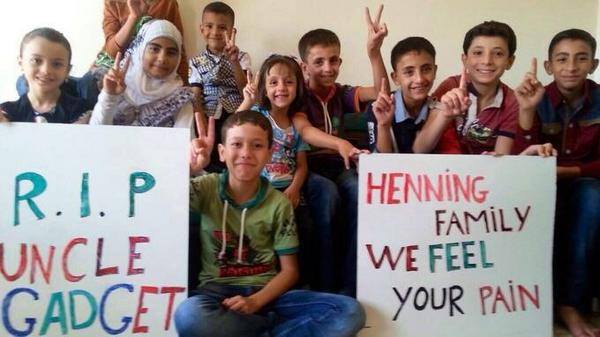
Syrian children thank Alan Henning

henning

Mr Henning was delivering aid to Syria when he was kidnapped, as Paul Wood reports
The Salford taxi driver was delivering aid to Syria in December when he was kidnapped and then held hostage by IS.

IS threatened to kill him in footage last month showing the death of Briton David Haines, and in this video they threaten US aid worker Peter Kassig.

David Cameron said Britain would do all it could “to hunt down these murderers and bring them to justice”.

The prime minister said the killing of father-of-two Mr Henning, 47, showed “how barbaric and repulsive” IS was.

“My thoughts and prayers tonight are with Alan’s wife Barbara, their children and all those who loved him,” he said.

“Alan had gone to Syria to help get aid to people of all faiths in their hour of need.”

Mr Henning’s wife Barbara had this week appealed for her husband’s release, saying: “He is innocent.”

Volunteer Mr Henning was on his fourth aid mission to Syria when he was captured within minutes of arriving in the country last December.

Alan Henning
Alan Henning

The prime minister will be briefed by intelligence and security chiefs on Saturday.

Downing Street said the “barbarity” of the act “underlines why it is right for Britain to join in the attacks against IS”, according to BBC assistant political editor Norman Smith.

“It is also pointed out that ministers have known for some time the risk to Western hostages and cannot allow that to determine British foreign policy,” our correspondent added.

Number Ten has declined to comment on the possible use of special forces in the fight against IS.

‘Generous character’

IS has previously released videos showing the apparent beheading of two US journalists, James Foley and Steven Sotloff, and British aid worker Mr Haines.

The video released on Friday is yet to be verified, but it appears to show Mr Henning kneeling beside a militant, who is dressed in black, in a desert setting.

The footage ends with an IS fighter threatening a man they identify as Mr Kassig.

In a statement, Mr Kassig’s family said he had converted to Islam and referred to him as Abdul Rahman Kassig.

The family asked people around the world to pray for his release and that of “all innocent people being held hostage in the Middle East and around the globe”.

They also asked people to pray for Mr Henning’s family, adding: “We have read about his work and his generous character with great respect and admiration.”

Mr Henning’s friend Majid Freeman described him as a “selfless, humble, courageous individual” who had simply wanted to help others.

Mr Freeman, who was with him on the convoy when he was captured, told BBC Radio 4’s Today programme: “He was helping the innocent people the rest of the world had abandoned.

“It doesn’t make sense to kill him.”

‘British accent’

BBC security correspondent Gordon Corera said the footage was similar to previous videos released by IS, though slightly shorter.

He said it included a reference to last week’s vote by UK Parliament to authorise air strikes against IS in Iraq.

Like previous videos it features a militant with an apparently British accent, he added.

Alan Henning

The UK Foreign Office said in a statement: “We are aware of the video and are working urgently to verify the contents.

“If true, this is a further disgusting murder.

“We are offering the family every support possible; they ask to be left alone at this time.”

The US said it was evaluating the video and if proved real, it was “another demonstration of the brutality” of the militant group.

Grey line

Analysis

Alan Henning with convoy members and ambulance

Frank Gardner, security correspondent, BBC News

David Cameron’s vow to catch the jihadist killers of Alan Henning and bring them to justice would seem to match the mood of the nation.

But judging by the track record of previous such cases of hostages being murdered overseas, this promise has little likelihood of being fulfilled.

Tony Blair made the same pledge after Ken Bigley from Liverpool was beheaded in 2004, Gordon Brown did the same when tourist Edwin Dwyer was kidnapped and killed in the Sahara, and Mr Cameron vowed to punish those who besieged the Algerian gas plant last year.

According to the Crown Prosecution Service, there has not been one single case of any murderers of British hostages ever being brought to justice in Britain.

Profile: Alan Henning

Henning’s home town ‘stunned’

8 reminders of how horrible Syrian President Bashar al-Assad has been to his people

(AFP/Getty Images)

In the shadow of the Islamic State, which has taken over large parts of Syria and Iraq — and has made beheading a thing it does — the world seems to have forgotten about the evil deeds of Syrian President Bashar al-Assad.

Many Syrians are upset that US President Barack Obama decided to intervene to stop the brutality of the Islamic State, but refrained from using its robust military force to stop the brutality of the Syrian government. Some US allies even believe that it is Assad who is actuallythe root of the problem. It is the terror of the Syrian leader that allowed room for the terror of the Islamic State, the story goes.

“Why now?” one Syrian told a writer for Buzzfeed reporting from Turkey, near the Syrian border. “Is it because of the crime of the beheading of two American journalists? Or is it because this is really a terrorist group that terrorizes people in Syria? If so, then the regime has committed more crimes than ISIS. With much cruelty. People are dead in the prisons by the thousands. What about this?”

There was a time — in 2011 — when Syrians were peacefully calling for simple democratic reforms. Then Assad’s security forces decided they would have none of it and violently cracked down on civilian demonstrators. An armed rebel alliance arose as a result, full-blown civil war erupted, foreign extremists entered the country, religious extremism took hold and all hell broke loose.

Through it all, Assad continued to massacre Syrians. The United Nations says nearly 200,000 have been killed since fighting began. But no matter what Assad did — mass murdering civilians, torturing children, killing American journalist Marie Colvin — the United States refrained from intervening.

read here

US Strikes In Syria

TUESDAY, SEPTEMBER 23, 2014

Since 2011 Assad has progressively escalated his war against the Syrian people. His regime set the daily killing quotas, they escalated from small arms fire to tanks, cannon, rockets and airplanes. As the days turned into weeks and the months turned into years we were subjected to the same diatribe demanding that innocent unarmed people die for the principles of those watching them from a thousand miles away. Anybody who thought otherwise was dismissed as a warmonger. The chemical attacks came, and still the world did nothing. Then ISIS emerged, it almost overran the north of Syria before the Free Syrian Army along with Jabhat al Nusra pushed it out, and it went on to overrun most of Iraq. Then the world took notice but that was only because ISIS were about to commit the mother of all massacres against the Azidis of Iraq. Nobody complained about the airstrikes against ISIS in Iraq. Today those airstrikes began in Syria, and like earthworms after the rain the people who were silent before have now appeared and are able to speak.

Now they wring their hands in anguish. They pray for Syria. They wish there was another way. They worry about the innocents whose lives would be lost if the US led strikes against Syria materialised. Maybe to them a death by a US made bomb is a far worse fate than being killed by a Russian made one. So they shake their heads, “No, this won’t do at all. It is one thing to watch a country bleed white over the course of three years, but to have the United States cauterise the cancer that is ISIS immediately, well that’s just outrageous”.

There’s only one reason why the United States is bombing ISIS in northern Syria, and that’s because the Assad regime gunned down innocent protesters in 2011. In his first speech after the protests in Deraa, and when his regime could no longer pretend like nothing was happening, he ranted and raved about a terrorism that didn’t exist in Syria yet. He warned, no he threatened, that Syria will turn into another Afghanistan. He abandoned the north east of Syria, he struck oil deals with ISIS, he deliberately avoided bombing their headquarters whilst raining his wrath on the parts of Syria in control by the Free Syrian Army. His army obliterated parts of Homs, and eviscerated Aleppo, in a scorched earth policy that his soldiers spray-paint christened as “Assad or this country burns”. If there is anybody who holds the moral blame for all that has befallen Syrians since then, it is this bankrupt regime and its Russian and Iranian backers.

Syrians have had three years of this murder. Three years of his apologists using smoke and mirrors and every trick in the book to paralyse the international community and prevent it from doing anything about the barrel bombs and the chlorine bombs dropping on the heads of civilians. Again and again the spectre of Iraq is raised, not so that anybody can learn anything, but to frighten anyone from action, however much needed, to help Syrians. The anti-imperialist camp must, at any cost, oppose intervention in Syria and they are pathologically incapable of comprehending its necessity. Others will get on to the moral high horse and say that strikes on Syria will lead to innocent lives being lost. Of course, they don’t seem to mind much that the very next day those lives could be lost either by an overzealous ISIS fanatic enforcing his apocalyptic vision of a utopian society, or that death could come by Assad’s barrel bombs or rocket attacks or air strikes. No, for that they can only offer the potential victims a lot of moral anguish, hand wringing and anxiety as they are crushed between Assad and ISIS. Heaven forbid that anybody interfere, that anybody try to do something.

Last year many of those same people cheered with joy that strikes against the Assad regime were averted after he used chemical weapons against the Syrian people. Since then the death toll in Syria has risen to over 200,000. But they have nothing to say about that. They’ve been too busy spending the last year basking in the warm glow of their own self righteousness. Since then Assad and his Shiite allies have managed to push back the Free Syrian Army (without ever challenging ISIS seriously) and ISIS has emerged from a fringe lunatic group to a lunatic messianic state controlling an area larger than the size of England. The non-interventionists are responsible for this turn of events, and they are responsible for the rise of ISIS. They offered no solutions, only obstacles. They don’t have a position you can criticise. They just insist that nobody have a position either, that Syrians die for the principles of somebody else; somebody who can rubber-stamp the revolution and say, “Yes, you’re a bonafide revolution and we approve of you”, and say to them, “We will sing your praises in post-graduate Middle East courses across the Western world for all time, and write books about your sacrifices”. 

The fact is non-interventionists have no right to talk about who may or may not get hurt in Syria, to pretend to be concerned for the innocent, and they have no right to hold the moral high ground after the debacle we’ve seen in Syria for the last twelve months. This is a disaster, step aside and let someone do something about it.  

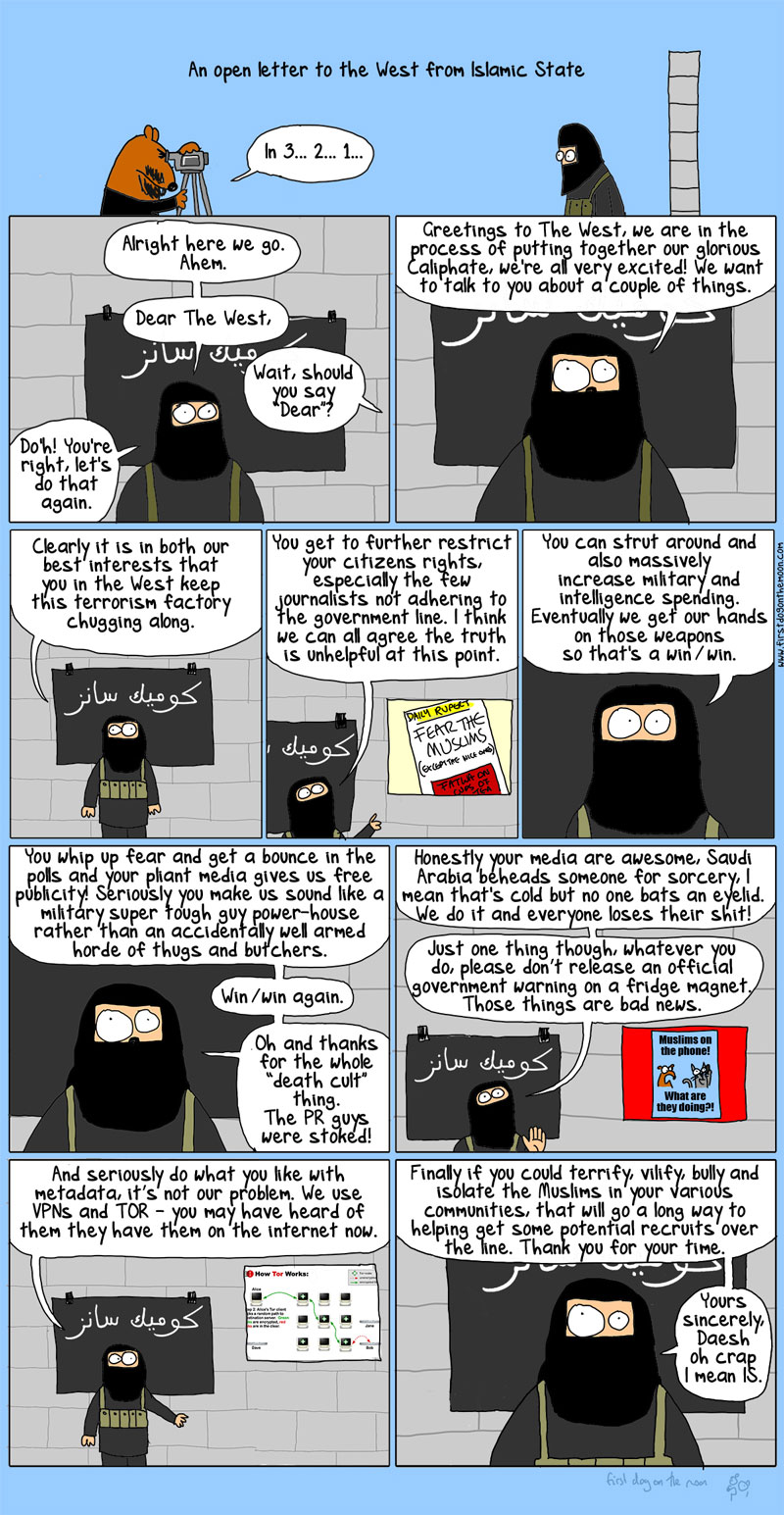
First dog On The Moon

firstdog-isis-800w
SOURCE

Three Monsters

September 23, 2014 

threemonstersPart of me, of course, is happy to see bombs fall on the heads of the international jihad-fascists tormenting the Syrian people (I refer to ISIS, not the Shia jihad-fascists fighting for Assad, who I’d love to see bombed too). Mostly, I’m just disgusted. In the name of disengagement the West not only refused to arm and supply the democratic Syrian opposition – even as Assad launched a genocide against the people – the United States actually prevented other states from providing the heavy weapons and anti-aircraft weaponry the Free Army so desperately needed. It was obvious what would happen next. The Free Army – and the Syrian people – were increasingly squeezed between Assad and the ISIS monster. And now the Americans are bombing both Iraq and Syria. This is where ‘disengagement’  and ‘realism’ has brought us.

ISIS, like Assad, can be hurt from the air but defeated only on the ground. Obama and the Congress have just agreed to spend $500 million on training 5000 vetted members of the Free Syrian Army – the same people that Obama mocked as irrelevant “pharmacists, farmers and students” a few months ago. The training won’t be finished for eight months, and anyway will be of little use. The Free Army now houses some of the best, most battle-hardened fighters in the world. They don’t need training; they need weapons. In the present balance of forces, in any case, the wounds inflicted by America’s photogenic bombing run may not translate into any improvement on the ground. Only Syrians can improve things on the ground.

The West was not moved to act by 200,000 (at least) slaughtered, or nine million homeless, or by barrel bombs, rape campaigns, starvation sieges or sarin gas. It was only moved when an American was beheaded. The inconsistency is noted well by Syrians. In some quarters, an assault on ISIS which is not accompanied by strikes on Assad and aid to the Free Army will be perceived as a Western-Shia-Assadist alliance against persecuted Sunnis. This could increase the appeal of ISIS and successor Sunni extremist groups.

ISIS has many parents, but the first of these, in Syria at least, is Assad. He released extremists from prison while he was assassinating unarmed democrats. He sectarianised the conflict by setting up sectarian death squads and by bringing in Iran-backed Shia militias from Iraq and Lebanon. His scorched earth policy made normal life impossible in the liberated areas, creating the vacuum in which organisations like ISIS thrived. And until this June, he had an effective non-aggression pact with ISIS, not fighting it, buying oil from it. From January, on the other hand, all opposition militias – the Free Army groups and the Islamic Front groups – have been fighting ISIS (and losing thousands of men in the struggle). These fighters are not about to become an on-the-ground anti-ISIS militia, as the Americans seem to want. They know the truth – that both states, the Assadist and the psychotic-Islamist, are absolute enemies. There’s no destroying one without the other. And both must be destroyed by Syrian hands, not by foreign planes.

Worth reading Yassin al-Haj’s comment, from here:

I am ambivalent about a Western attack against ISIS.

On the one hand, I would like to see this thuggish gang wiped from the face of the earth. ISIS is a criminal organization that has killed thousands of Syrians and Iraqis while leaving intact another criminal organization—the Assad regime—that is responsible for the deaths of close to 200,000 people. ISIS has destroyed the cause of the Syrian revolution as much as the Assad regime has destroyed our country and society.

On the other hand, an attack against ISIS will send a message to many Syrians (and Iraqis and other Arabs) that this intervention isn’t about seeking justice for heinous crimes, but is rather an attack against those who challenged Western powers. This will lead to more resentment against and suspicion of the outside world, which is the very nihilist mood on which ISIS capitalizes and profits.

Western powers could have avoided this had they helped the Syrian resistance in its battle against the fascist Assad regime. The right thing to do, ethically and politically, is to build a coalition against both ISIS andthe Assad regime, and to help Syrians bring about significant changes in their country’s political environment.

Let me finally say that I am very skeptical of the plans and intentions of the American administration. ISIS is the terrible outcome of our monstrous regimes and the West’s role in the region for decades, as much as it is the result of grave illnesses within Islam. Three monsters are treading on Syria’s exhausted body.

—Yassin al-Haj Saleh, one of the leading writers and intellectual figures of the Syrian uprising, imprisoned from 1980 to 1996 for left-wing activities, now living in exile in Istanbul

source

Blog at WordPress.com.

Up ↑