Search

band annie's Weblog

I have a parallel blog in French at http://anniebannie.net

Benjamin Netanyahu ridiculed over appearance at Paris solidarity march

Benjamin Netanyahu, centre, at the solidarity march in Paris

Benjamin Netanyahu, centre, at the solidarity march in Paris Photo: Yves Herman/Reuters

Benjamin Netanyahu is facing a storm of criticism because of his “embarrassing” behaviour at Sunday’s mass solidarity march in Paris and his calls for French Jews to emigrate to Israel following last week’s deadly attack on a Jewish supermarket.

The Israeli prime minister was seen elbowing his way to the front of the parade of world leaders and also unsuccessfully tried to jump to the head of queue waiting for a bus that was to take guests to the starting point.

After he failed to get on the first bus, a nervous-looking Mr Netanyahu – accompanied by what appeared to be an Israeli security team – wasshown on French video footage waiting for the next one.

During the march, Mr Netanyahu waved to the crowd in response to a pro-Israel shout from a woman spectator, a gesture some Israeli commentators deemed to be at odds with the sombre mood.

The alleged gaffes were further compounded by reports that the Israeli leader attended the event in defiance of a request to stay away from Francois Hollande, the French president, who reportedly did not want it overshadowed by the Israeli-Palestinian conflict.

Mr Netanyahu initially agreed but changed his mind after learning that two political rivals – Avigdor Lieberman, the Israeli foreign minister, and Naftali Bennett, the industry minister and leader of the Jewish Home party – were going.

His insistence on attending prompted the French authorities to invite Mahmoud Abbas, the Palestinian Authority leader, as a counterweight, reported the liberal Israeli newspaper Haaretz.

The most serious criticism has been levelled at his call for members of France’s Jewish community – the largest in Europe – to move to Israel for safety reasons following last Friday’s attack on a kosher supermarket in Paris, in which four Jews were killed.

Even before his plane departed for Paris, Mr Netanyahu issued a statement saying that he planned to tell French Jews who wanted to emigrate to Israel that they would be “welcomed with open arms”.

That is said to have offended Mr Hollande, who attended a rally at Paris’ grand synagogue on Sunday night with Mr Netanyahu but pointedly left before the Israeli leader addressed the audience.

Mr Netanyahu’s appeal for emigration, echoed by some other Israeli politicians, was criticised by European Jewish leaders and – implicitly – by Reuven Rivlin, the Israeli president, who said aliyah (emigration) should be born out of choice and Zionist feelings rather than fear of anti-Semitism.

Rabbi Menachem Margolin, director of the European Jewish Association, said that instead of calling for Jews to emigrate after anti-Semitic attacks, Israel should “employ every diplomatic and informational means at its disposal to strengthen the safety of Jewish life in Europe”, an Israeli website reported.

Ben Caspit, an experienced Israeli commentator, mocked Mr Netanyahu’s attempt to portray Israel as a safe haven. “Are the Jews of Paris more threatened than us?,” he asked in Maariv newspaper. “All of Israel’s territory is targeted by thousands of accurate and heavy rockets and missiles that could be fired on our heads in the next flare-up with Hizbullah. Just this past summer, Tel Aviv (Tel Aviv!) was a city that was bombed for 50 days. So the French should flee here?”

source

OPINION: The Paris Killings – A Fatal Trap for Europe

In this column, Roberto Savio, founder and president emeritus of the Inter Press Service (IPS) news agency and publisher of Other News, argues that the wave of indignation aroused by last week’s terrorist attack on French magazine Charlie Hebdo runs the risk of playing into the hands of radical Muslims and unleashing a deadly worldwide confrontation.

ROME, Jan 12 2015 (IPS) – It is sad to see how a continent that was one cradle of civilisation is running blindly into a trap, the trap of a holy war with Islam – and that six Muslim terrorists were sufficient to bring that about.

It is time to get out of the comprehensible “We are All Charlie Hebdo” wave, to look into facts, and to understand that we are playing into the hands of a few extremists, and equating ourselves with them. The radicalisation of the conflict between the West and Islam is going to carry with it terrible consequences

Roberto Savio

The first fact is that Islam is the second largest religion in the world, with 1.6 billion practitioners, that Muslims are the majority in 49 countries of the world and that they account for 23 percent of humankind. Of these 1.6 billion, only 317 million are Arabs. Nearly two-thirds (62 percent) live in the Asia-Pacific region; in fact, more Muslims live in India and Pakistan (344 million combined). Indonesia alone has 209 million.

A Pew Research Center report on the Muslim world also inform us that it is in South Asia that Muslims are more radical in terms of observance and views. In that region, those in favour of severe corporal punishment for criminals are 81 percent, compared with 57 percent in the Middle East and North Africa, while those in favour of executing those who leave Islam are 76 percent in South Asia, compared with 56 percent in the Middle East.

Therefore, it is obvious that it is the history of the Middle East which brings the specificity of the Arabs to the conflict with the West. And here are the main four reasons.

“We are falling into a deadly trap, and doing exactly what the radical Muslims want: engaging in a holy war against Islam, so that the immense majority of moderate Muslims will be pushed to take up arms … instead of a strategy of isolation, we are engaging in a policy of confrontation”

First, all the Arab countries are artificial creations. In May 1916, Monsieur François Georges-Picot for France and Sir Mark Sykes for Britain met and agreed on a secret treaty, with the support of the Russian Empire and the Italian Kingdom, on how to carve up the Ottoman Empire at the end of the First World War.

Thus the Arab countries of today were born as the result of a division by France and Britain with no consideration for ethnic and religious realities or for history. A few of those countries, like Egypt, had an historical identity, but countries like Iraq, Arabia Saudi, Jordan, or even the Arab Emirates, lacked even that. It is worth remembering that the Kurdish issue of 30 million people divided among four countries was created by European powers.

As a consequence, the second reason. The colonial powers installed kings and sheiks in the countries that they created. To run these artificial countries, strong hands were required. So, from the very beginning, there was a total lack of participation of the people, with a political system which was totally out of sync with the process of democracy which was happening in Europe. With European blessing, these countries were frozen in feudal times.

As for the third reason, the European powers never made any investment in industrial development, or real development. The exploitation of petrol was in the hands of foreign companies and only after the end of the Second World War, and the ensuing process of decolonisation, did oil revenues really come into local hands.

When the colonial powers left, the Arab countries had no modern political system, no modern infrastructure, no local management.

Finally, the fourth reason, which is closer to our days. In states which did not provide education and health for their citizens, Muslim piety took on the task of providing what the state was not providing. So large networks of religious schools and hospital were created and, when elections were finally permitted, these became the basis for legitimacy and the vote for Muslim parties.

This is why, just taking the example of two important countries, Islamist parties won in Egypt and Algeria, and how with the acquiescence of the West, military coups were the only resort to stopping them.

This compression of so many decades into a few lines is of course superficial and leaves out many other issues. But this brutally abridged historical process is useful for understanding how anger and frustration is now all over the Middle East, and how this leads to the attraction to the Islamic State (IS) in poor sectors.

We should not forget that this historical background, even if remote for young people, is kept alive by Israel’s domination of the Palestinian people. The blind support of the West, especially of the United States, for Israel is seen by Arabs as a permanent humiliation, and Israel’s continuous expansion of settlements clearly eliminates the possibility of a viable Palestinian State.

The July-August bombing of Gaza, with just some noises of protest from the West but no real action, is for the Arab world clear proof that the intention is to keep Arabs down and seek alliances only with corrupt and delegitimised rulers who should be swept away. And the continuous Western intervention in Lebanon, Syria, Iraq, and the drones bombing everywhere, are widely perceived among the 1.6 billion that the West is historically engaged in keeping Islam down, as the Pew report noted.

We should also remember that Islam has several internal divisions, of which the Sunni-Shiite divide is just the largest. But while in the Arab region at least 40 percent of Sunni do not recognise a Shiite as a fellow Muslim, outside the region this tends to disappear, In Indonesia only 26 percent identify themselves as Sunni, with 56 percent identifying themselves as “just Muslim”.

In the Arab world, only in Iraq and Lebanon, where the two communities lived side by side, does a large majority of Sunni recognise Shiites as fellow Muslims. The fact that Shiites, who account for just 13 percent of Muslims, are the large majority in Iran, and the Sunni the large majority in Saudi Arabia explains the ongoing internal conflict in the region, which is being stirred by the two respective leaders.

Al-Qaeda in Mesopotamia, then run by Abu Musab al-Zarqawi (1966–2006), successfully deployed a policy of polarisation in Iraq, continuing attacks on Shiites and provoking an ethnic cleansing of one million Sunnis from Baghdad. Now IS, the radical caliphate which is challenging the entire Arab world besides the West, is able to attract many Sunnis from Iraq which had suffered so many Shiite reprisals, that they sought the umbrella of the very group that had deliberately provoked the Shiites.

The fact it is that every day hundreds of Arabs die because of the internal conflict, a fate that does not affect the much larger Muslim community.

Now, all terrorist attacks in the West that have happened in Ottawa, in London, and now in Paris, have the same profile: a young man from the country in question, not someone from the Arab region, who was not at all religious during his teenage years, someone who somehow drifted, did not find a job, and was a loner. In nearly all cases, someone who had already had something to do with the judicial system.

Only in the last few years had he become converted to Islam and accepted the calls from IS for killing infidels. He felt that with this he would find a justification to his life, he would become a martyr, a somebody in another world, removed from a life in which there was no real bright future.

The reaction to all this has been a campaign in the West again Islam. The latest number of the New Yorkerpublished a strong article defining Islam not as a religion but as an ideology. In Italy, Matteo Salvini, the leader of the right-wing and anti-immigrant Lega Nord has publicly condemned the Pope for engaging Islam in dialogue, and conservative Italian pundit Giuliano Ferrara declared on TV that ”we are in a Holy War”.

The overall European (and U.S.) reaction has been to denounce the Paris killings as the result of a “deadly ideology”, as President François Hollande called it.

It is certainly a sign of the anti-Muslim tide that German Chancellor Angela Merkel was obliged to take a position against the recent marches in Dresden (Muslim population 2 percent), organised by the populist movement Pegida (the German acronym for “Patriotic Europeans Against the Islamisation of the West”). The marches were basically directed against the 200,000 asylum seekers, most of them from Iraq and Syria, whose primary intention, according to Pegida, was not to escape war.

Studies from all over Europe show that the immense majority of immigrants have successfully integrated with their host economies. United Nations studies also show that Europe, with its demographic decline, requires at least 20 million immigrants by 2050 if it wants to remain viable in welfare practices, and competitive in the world. Yet, what are we getting everywhere?

Xenophobic, right-wing parties in every country of Europe, able to make the Swedish government resign, conditioning the governments of United Kingdom, Denmark and Nederland, and looking poised to win the next elections in France.

It should be added that, while what happened in Paris was of course a heinous crime, and while expression of any opinion is essential for democracy, very few have ever seen Charlie Hebdo and its level of provocation. Especially because in 2008, as Tariq Ramadan pointed out in The Guardian of Jan. 10, Charlie Hebdo fired a cartoonist who had joke about a Jewish link to the French President Nicolas Sarkozy’s son.

Charlie Hebdo was a voice defending the superiority of France and its cultural supremacy in the world, and had a small readership, which it obtained by selling provocation – exactly the opposite of the view of a world based on respect and cooperation among different cultures and religions.

So now we are all Charlie, as everybody is saying. But to radicalise the clash between the two largest religions of the world is not a minor affair. We should fight terrorism, be it Muslim or not (let us not forget that a Norwegian, Anders Behring Breivik, who wanted to keep his country free of Muslim penetration, killed 91 of his co-citizens).

But we are falling into a deadly trap, and doing exactly what the radical Muslims want: engaging in a holy war against Islam, so that the immense majority of moderate Muslims will be pushed to take up arms.

The fact that European right-wing parties will reap the benefit of this radicalisation goes down very well for the radical Muslims. They dream of a world fight, in which they will make Islam – and not just any Islam, but their interpretation of Sunnism – the sole religion. Instead of a strategy of isolation, we are engaging in a policy of confrontation.

And, apart from September 11 in New York, the losses of life have been miniscule compared with what is going on in the Arab world, where just in one country – Syria – 50,000 people lost their lives last year.

How can we so blindly fall into the trap without realising that we are creating a terrible clash all over the world? (END/IPS COLUMNIST SERVICE)

(Edited by Phil Harris)

The views expressed in this article are those of the author and do not necessarily represent the views of, and should not be attributed to, IPS – Inter Press Service. 
source

ALIF

Tariq Ramadan @ Democracy Now on Charlie Hebdo massacre

CLICK ON IMAGE
6873491-10507098


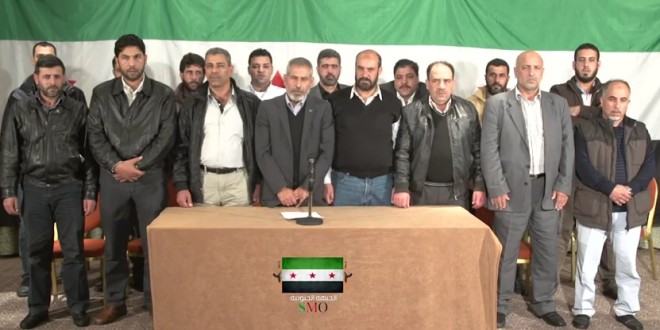
The Free Syrian Army – Southern Front

 Untitled6753423324546-660x330

Transitional Phase
10.12.2014

STATEMENT NO. 4

THE TRANSITIONAL PHASE

The collapse of the current Assad led regime will not be the end of the Syrian people’s revolution. The end of the regime will be only the start of a new and, hopefully, final phase of the people’s struggle for freedom. In order to ensure that the final phase succeeds the establishment of a new national model of governance based on respect for human dignity and a rebirth of Syria’s tremendous potential will be initiated.  It is imperative that all nationalist forces commit to a course of action during the period of transition from authoritarianism that will fulfil the popular will.

Therefore,

The Southern Front announces that it will dedicate its efforts during the period of transition following the collapse of the regime to supporting:

First: the protection of all Syrian citizens, their property and their rights without any distinction of religion, culture, ethnicity, or political affiliation in accordance with International Humanitarian Law and the international standards of Human Rights.

Second: the maintenance of Syrian state institutions, including all ministries and military institutions.

Third: the integrity of the economic and service infrastructure of the state, including telecommunications, energy, water, and public and private transportation networks.

Fourth: the establishment of a process of inclusive, national, political reconstruction.


GENERAL FRAMEWORK


1- The Civil Defence Force:

Once the Assad regime collapses, the Southern Front of the Free Syrian Army intends to transition from a military organization into a civilian defence force to contribute to establishing the appropriate conditions to enable a successful political transition in Syria. Among the primary objectives of a civilian defence force will be: protecting all citizens, maintaining all state institutions, and securing the infrastructure for the economic prosperity of the country.

The Joint Command of the Southern Front is currently preparing itself for the moment of transition and is committed to implementing a detailed day-after plan to protect Damascus (the seat of government), prevent looting, protect citizens and state employees, and ensure that governmental institutions remain fully operational.

2- The Transitional Administration:

To guide the period of transition, the Southern Front will support efforts to establish a Transitional Administration. The Southern Front believes that no current state employees, identified for their competence and loyal service to the state, should be excluded from continuing to serve. In addition, the Transitional Administration should be open to senior defected government officials who return to the country to help in its reconstruction. The Southern Front, which by this time will have transformed into the the Civil Defence Forces, will support such an interim governing arrangement granted that it is non-political, and led by technocrats whose terms will end upon the completion of the interim or transitional phase. .

The first task of the Transitional Administration will be announcing the cessation of all military operations and demanding foreign fighters to leave the country within a specified period of time. The Transitional Administration will also take steps to ensure that state institutions continue their routine work. It will announce to government officials including the judicial authority that their work will be guaranteed within the framework of the General Law. The civilian police will be requested to continue their work. The armed forces will be requested to remain temporarily in their barracks until security and order restored.

The current constitution will be immediately suspended and replaced by the original constitution of 1950 as an interim constitution until the drafting of a permanent constitution for the country that shall be approved by a popular referendum.

To ensure neutrality with respect to key decisions that need to be made during the critical transitional period, the Transitional Administration should issue an immediate appeal to the United Nations to form a “Syrian Transitional Phase Office” in Damascus as soon as possible with a special envoy of the UN Secretary General. This Office will be necessary to advise the Transitional Administration, coordinate foreign aid, and identify key requirements for the transition. It is also needed to recommend and supply experts and advisers to help rebuild the institutions of the state.

To ease the pressure on the Transitional Administration, and to benefit from the best Syrian minds and intellects in guiding the transition, the “Syrian Transitional Phase Office” will be requested to appoint a Syrian Advisory Committee composed of qualified professionals to draft a framework and plans for the transitional period, according to a specific timetable. The Office will also request the presence of a UN observer missions and specialist teams.

The key tasks for UN and the Syrian Advisory Committee will be:

First: to establish the High Electoral Commission.

Second: to oversee general elections to choose an “interim” legislative authority within six months, paving the way for the formation of a constituent committee for the drafting of the constitution.

Third: to form a constituent committee to draft the permanent constitution for the country within one year.

Fourth: to hold a public referendum on the constitution after the completion of the work of the constituent committee.

Fifth: to implement national elections for a new parliament and government.

All bodies formed by the “Syrian Transitional Phase Office” or by the Advisory Committee should be independent bodies. They should advise the Transitional Administration, but they should not be subject to it or overlap with it. The mandate of the Transitional Administration should be considered officially over after the holding of elections for a new parliament and government.

Long Live Free Syria

The Southern Front

source

10.12.2014

If You’re in Cairo: Doum Storytelling Nights

Starting tomorrow in Cairo, you can attend the “Doum Storytelling Nights,” a return to the art of oral storytelling:By Mona Elnamourydoum1This storytelling night event — at Bayt al-Sennari, Sayda Zainab — is carried out by the Seshat series for creative writing workshop, which now hosts around fifty writers of different ages and both sexes.The workshop, which is a “Doum” project, has been moderated by novelist Sahar Elmougy.Elmougy has been at the center of reviving cultural interest in the art of oral storytelling ever since her first feminist storytelling venture about women and memory “Qalat al-Raweya” (“The Female Narrator Said”), a 2009 project of revisioning/ rewriting folk tales from a feminist perspective. After that, there was “Ana al-Hekaya” (“I am the Tale”). Co-establishing the non-profit Doum Cultural Fundation with novelist Khaled Alkhamisi helped Elmougy further the idea of culturally engaging with as many people as possible. Doum’s mission is to foster critical thinking in Egypt by producing cultural material capable of reaching as many people as possible.The idea of the workshop has been to create a common field among writers to develop their creative and critical capacities and tools. It developed beyond the literary output of the workshops into creating a human bridge between the writer and the audience; the stories become interactive areas of identification and awakening. Away from the clichés of the aloof cultural product in books or in isolated cultural forums, the Doum Storytelling Project assures both writers and audience that they can find a basic unifying ground in which there is neither barriers nor discrimination.The content of the upcoming event constitutes everyday stories centered on our life experiences, feelings, expectations, and aspirations, all braided into one overarching narrative. The stories seem to point out that as many roads there are — roads of loneliness, union, answers, or questions — they are still familiar and human, and they still intersect.The first Doum storytelling events took place during Ramadan 2014, and they conveyed many themes, gratitude among them. They were such a pleasant surprise. Preceded by months of training and awakening great narrative potential of the selected narrators, the upcoming event, “Ping-Pong,” is even more professional and sophisticated.

Attending Ping-Pong at Bayt al-Sennari, you are promised a performance that will push you to laughter, tears, and wonder. More important it will push you to think and rethink of sentences that will sound wonderful and astonishing though they are familiar. You will be haunted by questions for a long time while driving, bathing, and making coffee or when you put your heads on your pillows at night. Questions are all that matter.

doum2

Dr. Mona Elnamoury is a lecturer at the faculty of Arts, English Dept., Tanta University. She also teaches at the MSA in the faculty of Languages and Translation, and has translated Ursula LeGuin into Arabic and is part of the Seshat continous creative writing workshop and storytelling project. She also writes.

source

Camille Saint-Saëns. Danse macabre

The composition is based upon a poem by Henri Cazalis, on an old French superstition: Zig, zig, zig, Death in a cadence, Striking with his heel a tomb, Death at midnight plays a dance-tune, Zig, zig, zig, on his violin. The winter wind blows and the night is dark; Moans are heard in the linden trees. Through the gloom, white skeletons pass, Running and leaping in their shrouds. Zig, zig, zig, each one is frisking, The bones of the dancers are heard to crack— But hist! of a sudden they quit the round, They push forward, they fly; the cock has crowed.

According to the ancient superstition, “Death” appears at midnight every year on Halloween. Death has the power to call forth the dead from their graves to dance for him while he plays his fiddle (represented by a solo violin with its E-string tuned to an E-flat in an example of scordatura tuning). His skeletons dance for him until the first break of dawn, when they must return to their graves until the next year.

The piece opens with a harp playing a single note, D, twelve times to signify the clock striking midnight, accompanied by soft chords from the string section. This then leads to the eerie E flat and A chords (also known as a tritone or the “Devil’s chord”) played by a solo violin, representing death on his fiddle. After which the main theme is heard on a solo flute and is followed by a descending scale on the solo violin. The rest of the orchestra, particularly the lower instruments of the string section, then joins in on the descending scale. The main theme and the scale is then heard throughout the various sections of the orchestra until it breaks to the solo violin and the harp playing the scale. The piece becomes more energetic and climaxes at this point; the full orchestra playing with strong dynamics.Towards the end of the piece, there is another violin solo, now modulating, which is then joined by the rest of the orchestra. The final section, a pianissimo, represents the dawn breaking and the skeletons returning to their graves.

The piece makes particular use of the xylophone in a particular theme to imitate the sounds of rattling bones. Saint-Saëns uses a similar motif in the Fossils part of his Carnival of the Animals.
[from Wikipedia]

Settlers: Deport US consulate staff

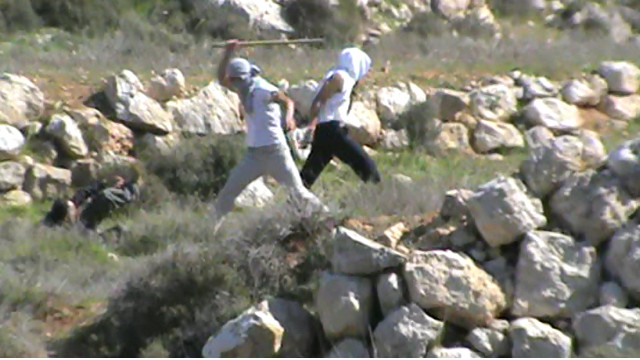
settlerviolence

Settlement leaders are demanding that Israel deport American consulate staff who clashed with settlers Friday, according to the settler-affiliated news site Arutz 7.


According to Yossi Dagan, acting head of the Samaria Regional Council, the council of northern West Bank settlements, US consulate security guards threatened settlers with a handgun and an M16 rifle.

A confrontation broke out between security personnel from the US consulate in Jerusalem and settlers from the Ramallah-area Adei Ad outpost in the West Bank on Friday, after settlers hurled stones at two vehicles from the consulate.

The consulate staff arrived to the area at the inviation of the village of Turmus Ayya to examine thousands of olive tree seedlings which were uprooted Thursday night. Some of the seedlings belong to Palestinians who are also US citizens.

The Consulate security guards arrived at the agricultural lands to examine the scene and rule out any security risks, while the delegation members waited behind in the village. Settlers claimed they arrived to the area without coordination and brought Palestinians into their territory, saying the American visit was coordinated with the Israeli Civil Administration for next week.

According to police, the settlers pelted the convoy with rocks.

Dagan, wrote to the acting Israeli interior minister that the US consulate security guards crossed all red lines “and participated in a provocative tour with the Palestinians without any coordination as required with the IDF and police, and pulled out a firearm and threatened Israeli civilians.”

“I request that in view of the serious and criminal conduct, that these [US] security guards and officials be deported,” he added.

A State Department spokesman in Washington said US authorities were “deeply concerned” about the stone-throwing incident.

“We can confirm a vehicle from the Consulate General was pelted with stones and confronted by a group of armed settlers today in the West Bank, near the Palestinian village of Turmus Ayya,” said the US State Department spokesman according to AFP.

The spokesman added that “I do want to correct one thing proactively from some of the reporting I’ve read on this incident. No American personnel drew their weapons in the course of these events. What has been reported suggesting otherwise is inaccurate.”

Adei Ad is an unregulated Israeli outpost that was established in 1998 by a group of yeshiva students from the settlement o f Shvut Rachel. The settlement was established on land owned by Palestinians and is also considered illegal under Israeli law. In 1999 Israeli Prime Minister Ehud Barak ordered the outpost dismantled, although it never happened.

On 10 December 2014, Palestinian Minister Ziad Abu Ein died in a confrontation with Israeli soldiers during a a protest march to plant olive trees on this site.

source

Meet the woman JPMorgan Chase paid one of the largest fines in American history to keep from talking

Alayne-Fleischmann-Chase

She tried to stay quiet, she really did. But after eight years of keeping a heavy secret, the day came when Alayne Fleischmann couldn’t take it anymore.

“It was like watching an old lady get mugged on the street,” she says. “I thought, ‘I can’t sit by any longer.'”

Fleischmann is a tall, thin, quick-witted securities lawyer in her late thirties, with long blond hair, pale-blue eyes and an infectious sense of humor that has survived some very tough times. She’s had to struggle to find work despite some striking skills and qualifications, a common symptom of a not-so-common condition called being a whistle-blower.

Fleischmann is the central witness in one of the biggest cases of white-collar crime in American history, possessing secrets that JPMorgan Chase CEO Jamie Dimon late last year paid $9 billion (not $13 billion as regularly reported – more on that later) to keep the public from hearing.

read article at Rolling Stone here

Blog at WordPress.com.

Up ↑