Search

band annie's Weblog

I have a parallel blog in French at http://anniebannie.net

Avigdor Feldman, a Lonely Lawyer

Uri Avnery
December 19, 2015

A Lonely Lawyer
avi2

BY NOW EVERY ISRAELI has seen the TV clip several times – showing a 14-year
old Arab girl being shot dead near the central market of Jewish Jerusalem.

The story is well known: two sisters, 14 and 16 years old, have decided to
attack Israelis. The clip, taken by a security camera, shows one of them,
clad in traditional Arab garb, jumping around on the sidewalk, brandishing a
pair of scissors.

The whole thing looks almost like a dance. She is jumping around aimlessly,
waving the scissors, threatening no one in particular. Then a soldier aims a
pistol at her and shoots her. He runs to the girl and kills her while she is
lying helplessly on the ground. The other girl is grievously wounded.

The soldier was lauded for his bravery by the Minister of Defense, a former
army Chief of Staff, and by his present successor. Throughout the political
establishment, not a single voice was raised against the killing. Even the
opposition was silent. 

THIS WEEK one person raised his voice. Avigdor Feldman, a lawyer, informed
the Attorney General that he was going to apply to the Supreme Court, asking
it to open a criminal investigation against the soldier. He wants the court
to order the authorities to investigate all cases in which soldiers and
civilians have shot and killed “terrorists” after they had already become
unable to act.

In today’s Israel, this is an act of incredible courage. Advocate Feldman is
no crackpot. He is a well-known lawyer, prominent especially in the field of
civil rights.

I got to know him when he was still at the start of his career. He was still
a “stageur” – a lawyer who has finished his studies but is not yet a fully
licensed advocate – working in a friend’s office. He represented me in
several minor court cases, and even then I was struck by his sharp mind.

Since then, Feldman has become a prominent civil-rights lawyer. I have seen
him several times pleading in the Supreme Court, and noticed the reactions
of the court. When Feldman speaks, the judges stop their day-dreaming and
doodling and follow his arguments with rapt attention, interrupting him with
sharp questions, obviously enjoying the judicial jousting. 

Now Feldman has done what nobody else has dared to do: taking the army by
the horns and challenging the high command.

In Israel, that is close to lèse majesté.

SINCE THE beginning of October, Israel has been experiencing a wave of
violence that has not yet acquired an official name. Newspapers call it a
“wave of terrorism”, some speak of “the intifada of the individuals”.

Its outstanding characteristic is that it lacks any organization. It is not
planned by a group, no orders are transmitted from above, no coordination
between cells is necessary.

Some Arab teenager takes a knife from his mother’s kitchen, looks for a
uniformed person in the street and stabs him. If no soldier or policeman is
available, he stabs a settler. If he sees no settler around, he stabs any
Israel he can find. 

If he drives a car, he just looks for a group of soldiers or civilians
waiting by the road and runs them over. 

Many others just throw stones at a passing Israeli car, hoping to cause a
fatal accident. 

Against such acts, the army (in the occupied territories) and the police (in
Israel proper or in annexed East Jerusalem) is almost helpless. In the two
earlier intifadas and in between, the security organs incredibly caught
almost all perpetrators. This was achieved because the acts were committed
by groups and organizations. Almost all of these were sooner or later
infiltrated by Israeli agents. Once one of the perpetrators had been caught,
he or she was induced to inform on the others – either by bribes, “moderate
physical pressure” (as our courts call torture) and such.

All these proven measures are quite useless, when a deed is carried out by a
single person, or by two brothers, acting on the spur of the moment. No
spies. No traitors. No prior signs. Nothing to work on.

The Israeli security services have tried to work out a typical profile of
such perpetrators. To no avail. There is nothing common to all or most of
them. There were several 14 year old teenagers, but also a grandfather with
children and grandchildren. Most did not appear in any anti-terrorist
database. Some were religious radicals, but many others were not religious
at all. Some were females, one a mother. 

What pushed them? The official Israeli stock answer is: sedition. Mahmud
Abbas incites them. Hamas incites them. The Arab media incite them. Almost
all these “incitements” are routine reactions to Israeli actions. And
anyway, a young Arab does not need “incitement”. He sees what’s going on
around him. He sees terrifying nightly arrests, Israeli troops invading
towns and villages. He does not need the lure of the virgins awaiting the
martyr in paradise. 

SINCE THERE is no immediate remedy, politicians and other “experts” fall
back on “deterrence”. Foremost method: summary execution.

This was first discovered in April 1974, when an Israeli bus was hijacked by
four inexperienced Arab youngsters. It was stopped near Ashkelon and
stormed. Two of the four were killed in the shooting, but two were captured
alive. Three photographers took their pictures alive, but later the army
announced that they were also killed in the fighting.

This was a blatant lie, protected by army censorship. As the editor of
Haolam Hazeh magazine, I threatened to go to the Supreme Court. I was
allowed to publish the photos, and a giant storm erupted. The chief of the
Security Service (Shin Bet or Shabak) and his assistants were indicted, but
pardoned without a trial.

In the course of the scandal, a secret directive came to light: the then
Prime Minister, Yitzhak Shamir, had issued an oral directive saying that “no
terrorist should remain alive after committing a terrorist act”. 

Something like that must be in force now. Soldiers, policemen and armed
civilians believe that this is an order: terrorists must be killed on the
spot.

Officially, of course, soldiers and others are allowed to kill only when
their own lives or the lives of others are in direct and immediate danger.
According to the laws of war, as well as Israeli law, it is a crime to kill
enemies when they are wounded, handcuffed or otherwise unable to endanger
lives.

Yet almost all Arab perpetrators – including the wounded and the captured –
are shot on the spot. How is this to be explained?

Most frequently, the facts are simply denied. But with the proliferation of
security cameras, this becomes more and more impossible.

An argument often used is that a soldier has no time to think. He has to act
quickly. A battlefield is no courtroom. A soldier often acts instinctively.

Yes and no. Very often indeed there is no time to think. He who shoots first
stays alive. A soldier has the right – indeed, the duty – to defend his
life. When in doubt, he should act. No one needs to tell me that. I have
been there.

But there are situations when there is no doubt at all. If a handcuffed
prisoner is shot, it is clearly a crime. To shoot a wounded enemy, lying
helplessly on the ground, like the girl with the scissors, is disgusting.

These are clearcut cases. If the Minister of Police (now called Minister for
Interior Security) says in the Knesset that the girl-killer had no time to
think – he lies. 

I dare to say that this minister, Gilad Ardan, an aggressive he-man who did
his glorious army service as a desk officer in the army personnel
department, has a bit less battle experience than I. What he said in the
Knesset is rubbish.

The soldiers shoot and kill because they think that their superiors want
them to. Probably they have been told to do so. The logic behind this is
“deterrence” – if the perpetrator knows that he is going to be killed for
sure, he may think twice before doing it.

There is absolutely no evidence for this. On the contrary, the knowledge
that he or she, the perpetrators, are probably going to be shot on the spot,
just pushes them on. Becoming a shahid, a martyr, will make their family and
the entire neighborhood proud.

Ah, say the deterrers, but if we also destroy the house of the perpetrator’s
family, they will think twice. Their family will beg them to abstain. Sounds
logical?

Not at all. There is absolutely no evidence for this, either. Quite the
contrary. Becoming the parents of a shahid is such an honor, that it
overrides the loss of the family home. Especially if funds provided by Saudi
Arabia and the other Gulf states will pay indemnities. 

It is the clearcut opinion of the security experts that this kind of
collective punishment does not work. On the contrary, it creates more
hatred, which will create more shahids. In short, counter-productive. 

The top army and security service commanders do not hide their opposition to
these measures. They are overruled by politicians and commentators who seek
popularity.

SUMMARY EXECUTIONS and collective punishments are, of course, diametrically
opposed to the international Laws of Warfare. Many Israelis despise these
laws and ignore them. They believe that such naive laws should not hinder
our army in the defense of our country and us.

This argument is based on ignorance.

The laws of warfare were initiated after the 30-year war, in the first half
of the 17th century, which brought untold misery to central Europe. When it
was finished, two thirds of Germany was destroyed and the one third of the
German population wiped out.

The originators of the laws, in particular a Dutchman called Grotius,
started from the sensible assumption that no law will hold if it prevents
the prosecution of war. A nation fighting for its life will not observe any
law that hinders it doing so. But in wars, a lot of atrocities are committed
which serve no military purpose at all, just out of hatred or sadism.

It is these acts – acts that serve no military purpose – that are forbidden
by the international laws of war. Both sides suffer from them. Killing
prisoners, letting the wounded perish, destroying civilian property,
collective punishments and such help no side. They just satisfy sadistic
impulses and senseless hatred.

Such acts are not just immoral and ugly. They are also counterproductive.
Atrocities create hatred, which creates more shahids. Dead prisoners cannot
be interrogated and provide no information, which may be essential for
forming new strategies and tactics. Cruelty is just another form of
stupidity.

Our army knows all this. They are against. But they are overruled by
politicians of the more detestable kind, which we have in abundance.

CONNECTED WITH this subject is the persecution of an organization called
“Breaking the Silence”. 

This was formed by soldiers who, upon their release, started to publicize
their experience in the occupied territories, things they did and things
they saw. This has become a big operation. Their meticulous adherence to the
truth has gained the respect of the army, and testimony given by them is
respected by the army General Attorney’s office and often acted upon.

This has now led to a furious incitement campaign against the group by the
demagogues of the extreme Right. It has been accused of treason, of
“besmirching our boys”, of aiding and abetting the terrorists and such. Many
of the accusers are former office soldiers and shirkers, who accuse former
combatants.

This week the Rightist demagogues furiously attacked the President of
Israel, Reuben Rivlin, for committing treason. His crime: he appeared at a
political conference organized in New York by the liberal Israeli newspaper
Haaretz, where Breaking the Silence was also invited. 

Rivlin is a very nice, very humane person. As President he is insisting on
full equality for Arab citizens. But he also entertains very right-wing
opinions and objects to giving up an inch of “Eretz Israel” territory for
peace. Yet no right-wing politician has come to his aid against the wild
accusations.

Breaking the Silence does not stand alone. Fascist groups – I use the term
with some hesitation – accuse many peace and human rights organizations of
“treason”, citing the fact that several of them do receive donations from
European governments and organizations. The fact that Israeli right-wing and
downright fascist organization receive vastly more money from Jewish and
Christian Evangelist organizations abroad does not matter.

ALL THIS shows how courageous Advocate Feldman is in his efforts. 

As we say in Hebrew: All honor to him. 
The Facetious Chronicles of Al-Sisi the Fascisi

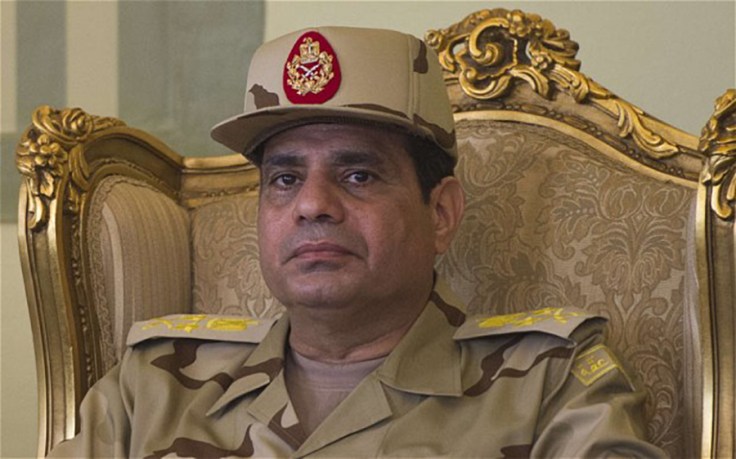
The Egyptian Neroah churns a half-smile while Cairo slow-burns and Egypt dies. AFP PHOTO / KHALED DESOUKIKHALED DESOUKI/AFP/Getty Images

It turned out to be true. It was the most disgusting capricious report one could imagine, so much not only I but also so many other Syrian activists could not believe it, but it turned out to be true. Al-Sisi, the Wankertator of Egypt, and the jaundiced junta supporting him, did in fact hoist this attached banner in the streets of Cairo.

The banner shows  smiling Al-Sisi sporting his military uniform standing next to a child waving at the dead body of Aylan, the Syrian Kurdish child who drowned off the cast of Turkey in September 2015, and whose death brought international attention to the plight of Syrian refugees, at least for a few weeks, before governments decided to ignore it again. The text accompanying the banner said: “A child who lost his army.”

For those who don’t get how macabre this gesture is, bear in mind that Aylan and his family were trying to escape the violent and bloody repression of the Assad regime’s army, the army that was to be protecting them, when their boat overturned and they drowned. Al-Sisi’s people are standing the truth on its head in order to justify their repression at home and their support of the maniacal regime of Bashar Al-Assad.

There is something so macabre and anathematic about dictators’ continued existence in this day and age, something that poisons the soul and militates against one’s own sense of humanity. No justification works anymore. They are neither father figures, nor modernizers, nor peacemakers, but maniacal ravishers and a deadly plague. Yes, they have some popular support, but some people are willing to make peace with cancer knowing that they would die of it, but, no matter what they think, they have no right to kill the rest of us. Because this particular cancer does not discriminate. This applies to Al-Sisi’s supporters as well as those of his earlier Islamist iteration: Mursi, the little horsy that couldn’t deceive enough people for a long enough time to sacralize his Islamist agenda in the form of a constitution.

Being critical of both sides of Egypt’s malaise wins me no admirers neither in Egyptian or Syrian circles. Some Syrians expect me to support Mursi and oppose Al-Sisi based on their positions towards the Syrian conflict, not their overall policies and worldview. But no can do.

When Al-Sisi mounted his coup, I was sad and wrote something like this on Facebook page: this is what the Muslim Brotherhood’s blind hubris managed to accomplish – it facilitate a return to military rule. I don’t support coup d’état’s but I cannot support religious autocracy, even if its wannabe founders came as a result of a popular vote. Indeed, the inability to understand that winning an election does not entitle one to rule as he and his party pleased, refashioning the state in their image and according to their particularistic vision, this inability does emanate from wishful stupidity but from willful blindness and Machiavellian machinations. Willingness to compromise is the only way out of this crisis, but many people cannot handle compromise it seems, and nuance is not something that they are used to. To them, I cannot be against Al-Sisi’s coup and not for MB. I am either for this side, or that side. And being with a side means treating its representatives as heroes. And our heroes are always saints, our villains perfectly villains, the ones inside and the ones outside. And our victimhood, for we are victims after all, we must be victims seeing how weak and insignificant we are, there is no denying this, not by any stretch of the imagination, our victimhood is always a perfect undeserved one, one to which we did absolutely nothing to contribute. It’s always the other’s fault: the others inside, and the others outside. That makes all of us guilty, therefore, none of us is.

So, here it is Egypt a victim of terrorism, but that infamous recent terrorist attack didn’t happen. This is probably why Egypt needs to maintain its position on the list of worst offenders against journalists.

source

Syria’s Opposition Conferences: Results and Expectations

Syria’s Opposition Conferences: Results and Expectations

Posted by: ARON LUND FRIDAY, DECEMBER 11, 2015

Now they’re all done—three conferences for three sets of self-proclaimed representatives of the Syrian opposition. One in Damascus, one in Syrian Kurdistan, and one in the Saudi capital of Riyadh. For a thorough background, have a look at Wednesday’s post on Syria in Crisis. For the latest on what did and didn’t happen, read on.

THE USUAL FARE FROM DAMASCUS

The government-approved conference in Damascus was billed as a meeting of what was termed the “patriotic opposition” and it took place under the slogan “Voice of the Interior,” Sawt al-Dakhel. Some moderate old school dissidents were in attendance, but most delegates were Assad-friendly reformists, non-revolutionary civil society figures, government-linked tribal leaders, or others of that general inclination. One of the best-known participants, Majd Niazi, is such a stalwart ally of the government that she was discreetly dropped from a series of Kremlin-sponsored negotiations earlier this year because the other participants found it impossible to take her so-called opposition party seriously.

As I wrote on Wednesday, the meeting in Damascus was essentially a media ploy, set up to delegitimize the meeting in Riyadh and broadcast images of an ostensible internal opposition criticizing the foreign-backed exiles. Some of the participants are undoubtedly sincere in their politics, but the meeting itself had nothing to do with independent anti-government forces organizing themselves.

The conference drew little attention except in Syrian state media and that reporting consisted mostly of quotes from delegates who attacked the Riyadh conference. According to a private newspaper owned by the president’s cousin, most speeches were about condemning foreign intervention, including one given by an Iranian diplomat.

THE KURDISH COUNTER-CONFERENCE

The meeting in Syrian Kurdistan was more deserving of the opposition label, although its participants have little in common with most of the people meeting in Riyadh. The conference had originally been advertised for the city of Rumeilan, but it seems it ended up being moved to nearby Derik, known as Malikiya in Arabic. More than a hundred delegates took part.

This conference too, was organized largely in response to the meeting in Riyadh, after Turkish pressure made sure to exclude the dominant Kurdish force in Syria from those talks. Since 2012, Syrian Kurdistan has been under the control of groups loyal to the Iraq-based leadership of the Kurdistan Workers’ Party, or PKK. They use a variety of acronyms and front groups when operating in Syria, but the most recent one—which includes a few smaller Arab and Syriac groups—is a military umbrella organization called the Syrian Democratic Forces, or SDF.

The PKK leadership has played its cards beautifully since the Syrian war began. Having muscled out all Kurdish rivals, the group now receives military backing from the United States through the SDF, while other groups in the PKK sphere, such as the Democratic Union Party, or PYD, work hand in hand with Russia. They have hostile relations with nearly all of the mainstream Arab opposition, not to mention the jihadists, but this is offset by tense yet working ties to Assad. Materially speaking they have done better than any other group in the war. Though they would have been a very poor fit for the delegation chosen in Riyadh, as they are at daggers drawn with most of the other armed groups invited there, the Kurds would seem perfectly placed to benefit from any future peace talks. But instead, due to Turkey’s relentless hostility to the PKK—regardless of the acronym du jour—they fear being excluded altogether.

Now, to outmaneuver Ankara and ensure Kurdish participation in the peace talks, whether as a part of the mainstream opposition or in a separate third-force role—which would frankly speaking be a better fit—the PKK has started to reconfigure its political approach. Using the new SDF coalition, the organization strives to conceal its own commanding role while adding non-Kurds to the group and presenting it as a national opposition alliance rather than as a narrow regional or ethnic project. In this way, they’re playing to what could be a critical mass of interested actors, collectively able to override Turkish objections: Americans, Europeans, Russians, Iranians, and the Syrian government.

To this end, the Derik conference has elected a political counterpart to the SDF, a 42-member body which will be known as the Democratic Syrian Assembly. While most of the groups involved in the conference were either PKK fronts or closely tied to the PKK and its network in Syria, there were also a few other local groups and figures tolerated by the PKK loyalists, as well as a number of Arab and Syriac dissidents.

Of the non-local, non-PKK delegates, most appear to be linked in one way or another to the industrious exile dissident Haitham Mannaa. A leftist intellectual and human rights activist based between Paris and Geneva, Mannaa recently split from the National Coordination Body, a moderate coalition based in Damascus (its remaining leadership has grown close to the Russians and the group took part in the Riyadh conference). He then enlisted the help of his allies in exile and in Syria to create three new organizations: his own Qamh Movement, the Gathering of the Pact for Dignity and Rights, and the more broadly-based Cairo Group. All of which were present in Derik.

THE RIYADH CONFERENCE

Now, let’s move on to the main course: the Riyadh conference. Wrapped up on time, on December 10, the event was met with widespread and unsurprising acclaim from the organizing governments and other nations sympathetic to the Syrian opposition. “We welcome the positive outcome of the gathering of the Syrian opposition in Riyadh,” wrote the U.S. State Department in a congratulatory message, hailing the “broad and representative group of 116 participants.”

At the meeting, a final statement was adopted that laid out the principles for the upcoming negotiations with the government of Syrian President Bashar al-Assad. Among them, according to a widely circulated draft, was “faith in the civilian nature of the Syrian state and its sovereignty over all of Syria’s territory, on the basis of administrative decentralization.” The document also expressed a commitment to “a democratic mechanism through a pluralistic system that represents all segments of the Syrian people, men and women, without discrimination or exclusion on a religious, sectarian, or ethnic basis,” organized by way of “free and fair elections.” The delegates promised to “work to preserve the institutions of the Syrian state, although it will be necessary to reorganize the structure and formation of its military and security institutions.” There would be a state monopoly on armed force. They condemned terrorism and stressed their refusal of “the presence of any foreign fighters.”

Regarding the upcoming talks, the delegates expressed their readiness to engage in a UN-supervised political process such as that described in the November 14 Vienna communiqué, which calls for Syrian-Syrian negotiations by January 2016 and a ceasefire by June of the same year. However, they asked the international community to “force the Syrian regime to perform measures ascertaining its good faith before the start of the negotiating process,” such as an end to death sentences and starvation tactics and a release of prisoners. The start of a ceasefire was linked to the creation of a transitional government, as sketched out in the Geneva Communiqué of 2012. Regarding the most crucial question of all, the conference stated that “Bashar al-Assad and his clique” have to leave power at the start of the transition—not at the end of it.

Last but not least, the delegates also agreed to create a High Negotiations Committee, tasked with electing and overseeing a team of 15 negotiators who will face the government delegation and decide the future of the country. And that, of course, was where it got tricky.

AHRAR AL-SHAM PULLS OUT

Syrian opposition meetings are typically marred by any number of angry walkouts, but in this case there were only two.

The first came in the form of Haitham Mannaa’s last-minute announcement of a boycott. It was slightly disingenuous as by that time it was already clear that Mannaa’s allies were headed to the Kurdish conference instead. Most of the people involved shrugged it off.

A more damaging blowup came when Ahrar al-Sham, the most powerful and most hawkish Islamist armed group among the attendees, was asked to sign off on the agreement. Having already criticized the inclusion of Russia-friendly groups like the National Coordination Body, Ahrar al-Sham balked at what it saw as a watered down and secular-leaning statement and a High Negotiations Committee stacked with anti-Islamist, doveish, and borderline regime-friendly factions.

The armed rebels at the meeting—various Free Syrian Army groups, Ahrar al-Sham, the Islam Army, Ajnad al-Sham, and others—had been pushing to demand half of the seats on the High Negotiations Committee. They got a third instead and most were fine with that. But just as the talks were being wrapped up, around four or five a clock in the afternoon, Ahrar al-Sham issued a public statement saying they were withdrawing from the conference. This caused serious concern among both dissidents and organizers, since Ahrar al-Sham’s integration with the rebel mainstream was one of the main goals of the Riyadh conference.

Different sources at the conference have provided me with different accounts and chronologies, but it appears that the Ahrar al-Sham delegate, Labib Nahhas, who is one of the group’s most well-known doves, simply decided to go ahead and attend the signing ceremony anyway—perhaps after securing support from one or more leaders who were not present. The signing took place at around half past six that evening and Nahhas put his name down as a representative of Ahrar al-Sham.

Then, the confusion began. When reporters pointed out out that Nahhas’s signature was on the document, several high-ranking Ahrar al-Sham leaders (who were not present in Riyadh) responded on social media by confirming their decision to withdraw and not sign. At the time of writing, the fog hasn’t quite cleared, but it appears that Nahhas was more or less acting on his own in signing the statement and that Ahrar al-Sham’s leadership in Turkey and Syria has indeed opted to boycott the meeting. Several sources tell me that this is a manifestation of a longstanding struggle between hawks and doves inside Ahrar al-Sham. But there also seems to be an external element to the conflict. Ahrar al-Sham’s leaders and members inside Syria are being pressured by their Nusra Front allies to abandon all peace talks. But, their leaders are simultaneously browbeaten by foreign diplomats who insist that the group must firmly commit to the UN process or risk losing support, and that it may even end up on a terrorist black list.

If Ahrar al-Sham backs away from Nahhas’s signature, or tries to hedge its bets, it would not necessarily be fatal to the outcome of the Riyadh conference. The group might be dragged onboard again later—and, for the moment, the Saudis and other organizers are simply going to proceed as if there were no dispute, in the hope that Ahrar al-Sham’s leaders will come around in the end. Ahrar al-Sham might also decide that ambiguity is in its best interest and simply let all sides believe what they like. But if the group ends up publicly distancing itself from the conference, it would be very bad news for anyone who had hoped to see broad-based unity and a credible diplomatic delegation emerging from the meeting in Riyadh.

THE HIGH NEGOTIATIONS COMMITTEE

Even though the Riyadh conference has ended, there are still last-minute fixes being done to the composition of the High Negotiations Committee. Several versions of its membership are currently circulating. What seems to have been agreed upon is a list of 34 members. It originally stood at 32, after the addition of extra rebels, but is now up two more after negotiations and renegotiations.

Of the 34 members, nine come from the National Coalition, Syria’s main alliance of politicians in exile. They include people like current National Coalition President Khaled Khoja, his predecessor George Sabra, veteran dissidents like Riad Seif and Soheir al-Atassi, Mohammed Farouq Teifour of the Muslim Brotherhood, the Kurdish politician Abdelhakim Bashar, and the former Syrian prime minister Riad Hejab.

Another five are drawn from the National Coalition’s main rival, the much smaller and more moderate National Coordination Body. Among them are Safwan Akkash, a communist politician who serves as the group’s secretary, and the veteran Nasserite dissidents Mohammed Hejazi and Ahmed al-Esrawi.

Nine others are listed as independents, though many of them are in fact linked to political groups. There, we find Louai Hussein, an Alawite leftist intellectual and former prisoner of conscience, who is the head of the Building the Syrian State Movement, a small pacifist group. There’s also Ahmed al-Jarba, a former National Coalition president with strong ties to Saudi Arabia.

Finally, eleven members are drawn from the armed rebel groups, up from six when the conference began. It remains somewhat unclear how their seats are going to be distributed and whether they will be at the free disposal of certain groups or tied to individuals elected at the conference. Several names have been mentioned, however, including Mohammed Alloush of the Islam Army and Labib Nahhas, the Ahrar al-Sham delegate (it remains to be seen whether he will take his seat). There are also representatives of various Free Syrian Army factions, apparently including Bashir Menla of the Jabal Turkman Battalion and Hassan Hajj Ali of the Suqour al-Jabal Brigade.

THE COMPOSITION OF THE COMMISSION

While the list isn’t yet confirmed, a few things stand out. The most obvious problem is the fact that Abdelhakim Bashar was the only Kurd elected to the Higher Negotiations Committee. Bashar is a senior leader of the National Coalition and closely aligned with the Kurdistan Democratic Party in Iraq, which backs his Kurdish National Council.

Abdulbaset Sieda, himself a Kurd and active in Kurdish nationalist causes for decades, is not happy. “Many Kurds are bothered by this,” he tells me. “To have only one Kurd among 33 or 34 persons elected, that’s completely unacceptable.” He puts some of the blame on the Kurdish National Council itself, saying that it should have tried to secure places for a delegation of its own in Riyadh, to ensure Kurdish representation through the electoral system. With no pre-arranged constituency for Kurdish participation, the voting procedure took care of the rest.

“Every delegation was allowed to appoint its own representatives after negotiating their number of seats on the Higher Negotiations Committee,” explains Sieda. “The National Coalition ended up with nine seats at its disposal, so we tried to create a pluralistic ticket and make sure that we appointed one Kurd, one Alawite, one Christian, one member of the Muslim Brotherhood, one representative of the clans, and so on. Among the nine, we appointed Abdelhakim Bashar.”

“The National Coordination Body also had a Kurdish member in their delegation to Riyadh, Khalaf Dahoud—he is close to the PYD—but they did not put him in their five-person quota. I don’t know why. Then there were a few Kurds among the independents, but since the independents were from many different groups and could not decide beforehand who should hold their eight or nine seats, they had to hold an internal vote about it. That ended with no Kurd being appointed on their ticket either.”

“Now, the idea is that the High Negotiations Committee will appoint a delegation to meet the government,” says Sieda, clearly troubled by the outcome of the vote, although he says it happened more by accident and oversight than by design. “Hopefully we can correct the error then by making sure there are Kurds among the negotiators.”

At the moment, however, the Higher Negotiations Committee is overwhelmingly Arab, despite a couple of Turkmen dissidents (Khaled Khoja and Bashir Menla). On the other hand, there are at least some representatives of all the main religious minorities, including Alawites (such as Mondher Makhous), Christians (Hind Qabawat), and Druze (Yahia Qodmani). Bedouin tribes are also represented, Salem al-Meslet being a prominent figure in the Jabbour tribe and Ahmed al-Jarba a leader of the eastern Shammar confederation. More generally speaking, the political portion of the list has a strong secular streak, although this will be significantly diluted by the eleven rebel appointees.

As for the catastrophic under-representation of women—only Hind Qabawat and Soheir al-Atassi, as far as I can tell—it is unfortunately standard fare in Syrian politics. And non-Syrian politics too, for that matter.

source

The Miracle of Israel – Open Letter to David Grossman

Philosopher Lieven De Cauter carefully listened to the lunch talk of the great writer David Grossman today in Passa Porta. Writing down all he said in his notebook, he was perplexed by the wisdom of his words. But afterwards he suddenly felt utterly sad. In order to find out why, he went back to his note book and wrote an open letter to the great writer.

Dear David Grossman,

you said wonderful words during your lunch talk in Passa Porta today, words of great wisdom. I filled four pages of my note book with them. How come I felt so utterly sad when I left? Maybe the answer is in my notebook.

I will not retell the story of you latest novel, A horse walks into a bar, the plot of which you told us in such a subtle way. ‘Literature’, you said, at the end of this introduction, ‘does not judge, literature is a second chance’. Beautiful. When your interviewer gave you a quote from the book from Pessoa ‘It is enough to exist, in order to be perfect’, you said: ‘To be complete means to live with the cracks, the losses, the contradictions’. And you added another quote: ‘Nothing more whole than a broken heart’. Beautiful.

‘Dovele, the main character, keeps the score of the people in the audience who leave when he breaks out in his painful story, why?’, the interviewer asked. You replied: ‘It is natural that people don’t want to look into the wounds of others. But some people stay and do look’. Beautiful. I want to be one of them, a higher voice in me said.

On the question why the book is political, you replied that it is political; that you cannot turn your back to a tormented, abnormal situation. ‘Most Israeli’s turn their back on what happens. My book The smile of the land was the first novel on the occupation and not many have been written since [Israeli novels you meant, no doubt]  and Yellow wind was a book on life in the occupied territories. You told us how you went to Dheisheh camp, and that people had never seen an Israeli without a uniform, and how a grandmother looking like yours, took you into her concrete hut and told you her story. How they were expelled.

And then you said between nose and lips (as we say), ‘whether they were expelled or ran away, remains still dubious’. Well. Would you not run away, when villages are attacked by the Hagana at night and thirty houses are blown up with the people in them? That is quite a convincing argument to ‘spontaneously’ run away, isn’t it? Please let’s not beat around the bush on this: the Nakba, the foundation of Israel was an ethnic cleansing. Israel is literally based on a crime against humanity. The story that they just ‘ran away’, is miraculous, because till the present day it is and remains the only ethnic cleansing that is not recognized by the international community (according to your compatriot Ilan Pappe). And this ethnic cleansing and land grabbing is ongoing. Does that not bother you?

‘Politics, we must confront politics’, you continued, ‘we are the victims of politics, we are the victims of politicians that do nothing, that keep the status quo, after 40 years of occupation (well over 60 years I would say, but that can be debated). I do not think they do nothing, the colonization of the Westbank is ongoing, even heightened. That is not doing nothing, is it?

‘Between despair and apathy, there is a gap’, you said, ‘between daily life and reality, and this gap is filled with extremism’. Beautiful words. Words that increasingly apply to Europe too. ‘Israel is not an exiting place anymore to build a normal life, this is a danger to our democracy’.

Then the interviewer asked how one can live with trauma. ‘A thousand times Dovele has told his story to himself. We become trapped in our own stories, striking ones, “legislative stories”, you called them. We have to massage them and look and them with a sceptical eye. Under every story there is another story. There is an archaeology of stories. If we allow this flexibility, we can give up the story, the frustration is not to be fossilized, trapped into the story, otherwise we live frozen lives’. Beautiful words. And then you added: not only individuals are trapped into legislative stories, but also nations, myths. Like the myth that Israeli’s are victims.

Like your character, Dovele, you told us that ‘walking on your hands is useful.’ It is a way to invert the perspective. ‘To reformulate the world is the task of the artist and this reformulation echoes in the heart of the reader… the writer stresses the nuances in those stories. All the stories have been told, how to tell the stories, so they can move us, make a movement in us, change us?’ Beautiful.

The interviewer returned to the theme of trauma, and the Shoah. ‘The people who survived were lucky and felt guilty about it, and there was no place for them in the new Israel, they were victims from the past (very much the theme of your book See under: love)…’ ‘Netanyahu is a magician in stirring up the contemporary dangers with the shadows of the past’. ‘But’, you said, at the end, ‘One of the miracles of Israel is the reinvention of Hebrew, the coming home after 2000 years to our country from a diaspora of 70 countries, founding a democracy 3 years after the Shoah’. These last words left me speechless. This ‘legislative story’, this myth of return has been revealed a fiction by Shlomo Sand (in How the Jewish people was invented) and others, and moreover, this ‘miracle’ is based on a crime against humanity, the Nakba, the ethnic cleansing of Palestine, a crime that is ongoing. And about Israel being a democracy, we can discuss. Ilan Pappe was expelled for saying that the founding of Israel was an ethnic cleansing. Not very democratic.

There was only time for one question afterwards: ‘How do you see the future of Israel?’

You said: ‘I cannot afford the luxury of despair….  They make us believe that war is the only possible reality, that war is some sort of divine fate… The extremists have taken power on both sides, but I believe the belligerent way is against our interest. I believe in dialogue, in agreement, it will not be a fast process, but I believe in the educational power of compromise, it might take generations, I do not believe in absolute justice, I believe in the power of routine, of everydayness, Palestinian and Israeli s playing football together, playing music together like Daniel Barenboim’s orchestra. Our war cannot be won. Only normalcy can save us. Now we have no normalcy, we have no normal life, we have a limited life, not a complete life… But do not misread me, we need a strong army, for we are surrounded by big enemies, but only peace can save us. But not a naïve peace, a binational state [the one state solution] will only create an apartheid system.’ Again I was speechless. Do you not know that it is an apartheid system already? And a ruthless one, with hideous crimes every day. You must know.

The ‘Belgian Academic and Cultural Boycott of Israel’ (BACBI) convinced KASK, an art school in Ghent, where you speak tonight, not to accept the money from the Israeli Embassy that sponsors your trip. But does it change anything? For you are an ambassador for Israel either way. Is this a contradiction that makes you complete? Was your advice for question time, ‘literature not politics please’, not your turn to look away?

Now I understand why the Israeli embassy is willing to sponsor your trips: you are the best ambassador Israel can dream of. For you are the human face of Israel, a living testimony of its ‘miracles’. And while you do your critical-melancholic talks, on contradictions and the sceptical view on myths, the net result is hasbara [apologetic explanations defending Israel]. It is must be that what made me so sad.

With utmost respect

Lieven De Cauter, philosopher


Live stream David Grossman: http://www.passaporta.be/en/relive/live-stream/


Richard Sidey


His website http://www.richardsidey.com/

Tehran Symphony Orchestra Leaves Stage rather than Bow to Demand to Ban Female Members

DECEMBER 2, 2015

Women-of-Tehran-Symphony-Orchestra

The Tehran Symphony Orchestra cancelled a performance that had been planned for the closing ceremony of an international wrestling event on November 29, 2015, after the authorities objected to the presence of women musicians among the orchestra members.

The Iranian Student News Agency’s (ISNA) report of the incident suggested that the women musicians had not fully observed the hijab, or female head covering.

“I said all of us will perform together or we will leave the hall,” ISNA quoted Ali Rahbari, the orchestra’s artistic director. “Some tried to resolve the problem but eventually they said the women cannot be allowed to perform, so I said we will not perform.”

Rahbari described the treatment of women musicians as “embarrassing” and added, “The women musicians were going to perform the country’s national anthem. Why shouldn’t they? I have said many times that I was born in this country and I know very well where the red lines are. As long as I’m the director of this orchestra, I will not allow this kind of treatment.”

The head of the Wrestling Federation, Rasoul Khadem, wrote a letter to Culture and Islamic Guidance Minister Ali Jannati, indicating that his organization had not opposed to the concert, and he issued a new invitation for the orchestra to perform the national anthem at another international wrestling event in Tehran in January.

“This incident has left a negative impact on public opinion and among art lovers in the country,” Khadem added.

During the past year there have been several concert cancellations, mostly in the provinces. But on January 15, 2015, Shahrvand daily reported an incident in Tehran, involving Alim Qasimov and his daughter Ferghana, prominent singers from the Azerbaijan Republic. They were planning to perform a duet in Tehran for three nights. The first two nights went by without any problem. On the third night, the police refused to allow Qasimov’s daughter to perform publicly, only allowing the concert to proceed without her.

“I respect Iran’s laws but nowhere in the world are women artists treated in such a way,” Alim Qasimov told the audience in an expression of apology on stage.

Afterwards, Culture and Islamic Guidance Ministry Spokesman Hossein Noushabadi said the Qasimov concert had all the necessary permits. “Unfortunately when undue interferences happen on the margins, it will have security implications,” he added.

A week before the Qasimov concert, the prominent musician Majid Derakhshani was stopped airport security forces at Imam Khomeini International Airport in Tehran on his way to Dubai and told he was banned from leaving the country. He had previously been interrogated by Iran’s Intelligence and Public Security Police about his formation of an all-female musical group, the Mah Banoo Ensemble.

On September 2, 2014, the Shargh daily reported that the presence of women musicians at live performances had been banned in 13 provinces. Pirooz Arjomand, who was at the time in charge of the music department at the Ministry of Culture and Islamic Guidance, opposed the ban and said it went against the Ministry’s policies. “Separating women is a kind of gender segregation. Other institutions may have a problem with women on stage but this does not reflect the view of the Guidance Ministry,” he stated.

During President Rouhani’s term in office dozens of concerts have been cancelled despite having permits from the Ministry of Culture and Islamic Guidance. The cost has not just been monetary: the citizens of Iran have been deprived of these many musical performances by renowned and beloved artists.

source


Tammam Azzam

Tammam Azzam’s latest exhibition ‘The Road’ from 18 January – 3 March 2016 at Ayyam Gallery Dubai (11, Alserkal Avenue). Exhibition will feature the artist’s first series of paintings produced since leaving Damascus four years ago. Read more:http://bit.ly/1OpCKWL

tammam

Human, a masterpiece by Yann Arthus-Bertrand

Turn on the Closed Captions (CC) to know the countries where the images were filmed and the first name of the interviewees.

What is it that makes us human? Is it that we love, that we fight? That we laugh? Cry? Our curiosity? The quest for discovery? 
Driven by these questions, filmmaker and artist Yann Arthus-Bertrand spent three years collecting real-life stories from 2,000 women and men in 60 countries. Working with a dedicated team of translators, journalists and cameramen, Yann captures deeply personal and emotional accounts of topics that unite us all; struggles with poverty, war, homophobia, and the future of our planet mixed with moments of love and happiness. 

Watch the 3 volumes of the film and experience #WhatMakesUsHUMAN. 

….

Yann Arthus-Bertrand

Little boy who gave $20 to vandalized mosque receives a special surprise

the-muslim-guy.jpg

Jack Swanson receives a “Thank you” package in the mail after doing a good deed.

A little boy in south Texas did something pretty great last week, and the news spread quickly across the world, via social media. Seven-year-old Jack Swenson took $20 from his piggy bank and decided to give it to a community mosque that had been grossly defaced during a Muslim hate crime.

Twenty dollars might not seem a lot to some, but to Jack Swanson, it was a life’s savings.  And to Faisal Naem, a board member from theIslamic Center of Pflugerville, Jack’s gift was comparable to “$20 million” to the Muslim community.

Screen_Shot_2015-11-19_at_5.39.14_PM.png
Jack Swanson shakes hands with Faisal Naem, a board member of the Islamic Center of Pflugerville, TX after presenting the mosque with his treasure.

What many didn’t know last week was that Jack Swanson was saving his pennies for an Apple iPad. Ardalan Iftikhar heard about the story and said he was moved to tears. Known to some on social media as The Muslim Guy, Iftikar contacted Jack’s mother, Laura Swanson, and within days, Jack received a package in the mail along with this note from Iftikhar:

‘Dear Jack, you had saved $20 in your piggybank for an Apple iPad. But then a local Islamic mosque was vandalised. So you donated your $20 to this local Texas mosque. Because of your amazing generosity & kind heart. ‘Please enjoy this Apple iPad with our sincere thanks :-). Love The American Muslim Community.’

Jack Swanson will most likely always remember how his kindness was received by many around the world. What a wonderful lesson to learn so young — that when we give to others, from our hearts, expecting nothing in return, the good often comes back to us, multiplied. Thank you, Jack, for this lovely reminder.

Blog at WordPress.com.

Up ↑