By Lars Jellestad, Photos by Nikolai Linares
January 27, 2016
This article originally appeared on VICE Denmark
On Tuesday, January 26th a majority vote in the Danish Parliament ratified an extensive tightening of Danish asylum laws, in an attempt to make Denmark a less attractive destination for refugees and immigrants. Among other things, bill L87 extends the mandatory waiting period for the right to family reunification from one to three years, cuts asylum seekers’ financial support by 10 percent and shortens residency permits for future seekers of asylum in Denmark. And then there’s of course the widely reported fact, that the bill will also allow police officers to confiscate refugees’ valuables. This is in order to finance their stay in the country while they seek asylum.
That’s the part of the new law that Danes have dubbed “The Jewellery Act” as well as what’s caused most of the international outrage surrounding the controversial act.Denmark has not received this kind of attention since the newspaper Jyllands-Postendecided to publish cartoons of the Prophet Muhammad ten years ago. And just like back then, it’s not the type of international attention that has people popping champagne corks in the offices of local tourist agencies.
One could argue the legitimacy of international media juggernauts comparing Danes to the Nazis, who stripped Jews of large amounts of gold and other valuables. But the fact remains that Danish police can now frisk a person seeking asylum in Denmark, and confiscate certain valuables that person may have in their possession.
Regarding the new law, Danish Prime Minister Lars Løkke Rasmussen stated, that “the point is to make sure everyone is held to the same standards, be they asylum seekers or Danes – those standards being that you provide for yourself, if you are able.” However, policemen are only allowed to confiscate valuables that exceed a value of 10000 kroner (£1022) and that are not of sentimental value. This begs the question of how deep the real-life implications of this law will actually run.
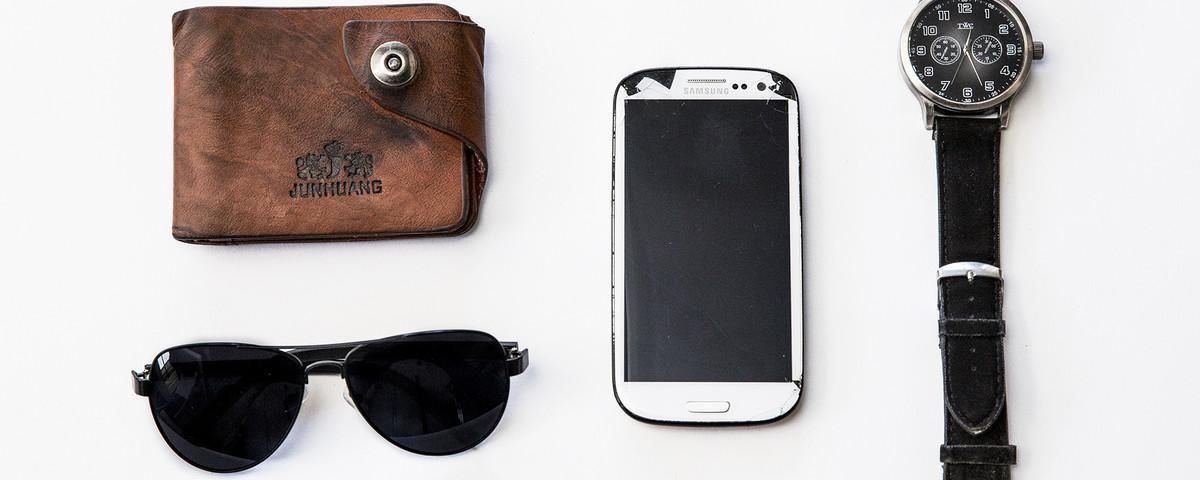
To get an idea of what valuables refugees had with them upon their arrival in Denmark, VICE Denmark visited an old hospital in the port town of Helsingør that has been repurposed into an asylum centre for approximately 150 refugees. This is what five of the guys that agreed to speak to us claimed to have been carrying with them when they first got there.

Abdul Khader is a 44-year-old Syrian man. He came to Denmark five months ago. His most important possession is the black bracelet, given to him by his 16-year-old daughter. She is currently in Turkey with her two siblings and their mother. Abdul Khader estimates that these items constitute a combined value of about 1500 kroner (£153).
Subhe Mohammad hails from Syria, and is 40 years old. He has been in Denmark for four months. His wife and three children still reside in Syria. His most important possession is his phone, which is filled with photos of his children. Subhe Mohammad estimates that his valuables have a combined value of about 1700 kroner (£173).
Laith Wadea is 31 years old and comes from Iraq. He has been in Denmark for five months. In Iraq, he worked as a teacher and a blacksmith. His most cherished personal possession is his silver necklace with a Virgin Mary medallion, that was given to him by his mother. Aside from the necklace, he also owns an iPhone 6 and a fake watch. He estimates that his possessions are worth a grand total of about 6000 kroner (£613).
Nashet Blank is a 40 years old. He travelled from Syria to Denmark four months ago with his wife and three children. They sold all of their valuables to be able to travel through Europe – their wedding bands included. His phone and wallet mean nothing to him. He estimates that the combined value of his personal effects can’t be more than 500 kroner (£51).
Ahmad Farman is 25 years old and from Iraq. He came to Denmark five months ago. All of his possessions are of equal importance to him, though his phone contains several photos that are especially significant to him. He estimates that it’s all worth a total of 1500 kroner (£153).


- Kevin Lamarque/Reuters
In a meeting with members of Syria’s opposition in Saudi Arabia on Saturday, US Secretary of
State John Kerry demanded that rebels accept a set of preconditions dictated byRussia and Iran in order to participate in peace talks, according to an explosive report by thedaily pan-Arab newspaper Al Hayat.The terms Kerry reportedly asked the opposition Saudi-backed High Negotiation Committee (HNC) to accept — including a “national unity government” instead of a transitional governing body that would phase Syrian President Bashar al-Assad out of power — represent “a scary retreat in the US position,” opposition sources told the head of Al Hayat’s Damascus bureau, Ibrahim Hamidi.
According to translations provided by multiple Middle East analysts on Twitter, Kerry told the opposition delegation that, based on an “understanding” he had reached with Russian Foreign Minister Sergei Lavrov, Assad has the right to run for reelection and there will be no set timetable for his departure.
That stands in contrast to the White House’s previous position that while Assad does not have to go immediately, the timing of his departure should be addressed during negotiations.
Kerry also signaled the Obama administration’s endorsement of a four-point peace plan for Syria created by Iran, a staunch ally of Assad. The plan calls for an immediate ceasefire, the establishment of a national unity government, the anchoring of minority rights in the constitution, and internationally supervised presidential elections in Syria.
Thomson Reuters

UN Syria envoy Staffan de Mistura pushed for the national ceasefire on Monday, saying in a press conference from Geneva that “the condition is it should be a real ceasefire and not just local.”
The ceasefire would apply to all warring parties but the ISIS and Al-Qaeda affiliate Jabhat al-Nusra. As Al Hayat has noted, that implicitly would grant legitimacy and “an official status” to the Shiite militias Iran has built in Syria to support Assad.
Including minority rights in the constitution, meanwhile, would serve as an attempt to “anchor sectarian tensions” between Sunni and Shiite Muslims within a legal framework.
So far, it is not going anywhere. Members of the HNC reportedly rejected Kerry’s demands and have threatened to boycott the negotiations altogether. They reiterated that they will not attend the talks until the government halts air strikes and ends its sieges of rebel-held territory, in accordance with UN resolution 2254, adopted last month by the UN Security Council.
Abdalrhman Ismail/Reuters

The terms of that resolution have failed to materialize, but Kerry apparently pressured the opposition into attending the talks anyway. Rebel sources told Al Hayat that Kerry went one step further and threatened to cut off US aid to rebel groups if they failed to show up at the negotiating table.
On Monday, Kerry reiterated that preconditions are a nonstarter for negotiations. But he categorically denied that he had threatened to cut off aid to the rebel groups.
“The position of the United States is and hasn’t changed. We are still supporting the opposition, politically, financially and militarily,” he said, according to The Associated Press. “We completely empowered them. I don’t know where this is coming from.”
He noted, however, that “it’s up to the Syrians to decide what happens to Assad,” effectively echoing Russian officials.
Nawaf Obaid, an Al Hayat columnist and visiting fellow at Harvard’s Belfer Center for Science and International Affairs, further noted the meeting’s most significant and “shocking” points in a series of tweets on Sunday:
1) #US agrees to #Iranian four point peace plan for #Syria announced by #Iran foreign minister @JZarif in 2014 http://www.themedialine.org/new-from-the-arab-press/irans-four-point-plan-for-syria/ …
2) #US agrees that Haytham Manaa, Saleh Muslim & Qadri Jamil will be invited by #DeMistura to attend #Geneva talks in consultative capacity
Former Syrian opposition leader Hadi Albahra noted, too, that the reports circulating about Kerry’s requests for the HNC were “not fully accurate.”

Hassan Hassan put it bluntly: “US officials are telling Syrians what extremists have been telling them for years — the US isn’t your friend.”
Bernie Sanders exposes the reality of US Politics. We think it was his level of honesty and transparency that made this speech go viral. Read more: http://bit.ly/1P1GXQh
Posted: 18 Jan 2016 06:27 AM PST
My column in the Guardian:
Australia first introduced onshore detention facilities in 1991 at Villawood in Sydney and Port Hedland in Western Australia. Mandatory detention came in 1992. Bob Hawke’s government announced it was because “Australia could be on the threshold of a major wave of unauthorised boat arrivals from south-east Asia, which will severely test both our resolve and our capacity to ensure that immigration in this country is conducted within a planned and controlled framework”.
More than 20 years later, the rhetoric has only worsened against the most vulnerable arriving from Syria, Afghanistan, Iraq and Sri Lanka. Policies that years ago seemed unimaginable, such as imprisoning refugees on remote Pacific islands, are the norm and blessed with bipartisan support.
The sad reality is Australia’s refugee policies are envied and copied around the world, especially in Europe, now struggling to cope with a huge influx of refugees from the Middle East and Africa. Walls and fences are being built across the continent in futile attempts to keep out the unwanted. A privatised security apparatus is working to complement the real agenda. Australia is an island but it has long implemented remote detention camps with high fences and isolation for its inhabitants.
As a journalist and activist who has publicly campaigned against Canberra’s asylum policies for over a decade, this brutal reality is a bitter pill. In early 2014 I called for UN sanctions against Australia for ignoring humanitarian law and willfully abusing refugees in its case both on the mainland and Nauru and Manus Island. I still hold this view but must recognise facts; the international mood in 2016 for asylum seekers is hostile. As much as I’d like to say that my homeland is a pariah on the international stage, it’s simply not the case.
When Denmark recently introduced a bill to take refugees’ valuable belongings in order to pay for their time in detention camps, this was remarkably similar to Australia charging asylum seekers for their stay behind bars. Either directly or indirectly, Europe is following Australia’s draconian lead.
Consider the facts in Europe: after Sweden and Denmark reintroduced border controls, a borderless continent is now in serious jeopardy. The Schengen agreement – introduced in 1985 to support free movement between EEC countries – is on the verge of collapse. In early January, the European Union admitted it had relocated just 0.17% of the refugees it pledged to help four months earlier. In 2015 more than 1 million people arrived by boat in Europe.
This mirrors Australia’s lacklustre efforts to resettle refugees in its onshore detention camps. Figures released by the Department of Immigration and Border Protection in December found that asylum seekers had spent an average of 445 days behind barbed wire. In both Australia and Europe there’s general acceptance of these situations because those seeking asylum have been so successfully demonised as potential terrorists, suspiciously Muslim and threatening a comfortably western way of life.
Germany, a nation that took in more than 1 million refugees in 2015 despite being unprepared for the large numbers, is now facing a public backlash against Chancellor Angela Merkel’s welcoming stance, leading to fear and rising far-right support. Australia has taken far fewer people with little social unrest and yet still unleashed over two decades a highly successful, though dishonest, campaign to stigmatise boat arrivals. The result is the ability of successive Australian governments to create an environment where sexual abuse against refugees is tolerated and covered up. A politician is unlikely to lose his job over it.
Europe and Australia promote themselves as regions of openness. It’s an illusion when it comes to refugee policy. Hungary’s prime minister, Viktor Orban, despite his bombastic and discriminatory attitude towards refugees and Jews, is increasingly viewed across Europe as providing necessary warnings of the continent’s struggles. EU officials in Brussels told the New York Times that Orban was often right but wished he hadn’t couched his comments in conspiracy theories. Too few in Hungary are publicly resisting this wave of racism.
“Whenever Hungary made an argument the response was always: ‘They are stupid Hungarians. They are xenophobes and Nazis,’” Zoltan Kovacs, a government spokesman, told the Times. “Suddenly, it turns out that what we said was true. The naivete of Europe is really quite stunning.”
Brussels has proposed an Australian-style border force to monitor the EU’s borders and deport asylum seekers. Germany and France support the move. This proves that the most powerful nations have little interest in resolving the reasons so many people are streaming into Europe (such as war and climate change) and prefer to pull up the drawbridge. Former Australian prime minister Tony Abbott encouraged Europe to turn back the refugee boats and it seems Brussels is listening. Europe is also copying Australia’s stance of privatising the detention centres for refugees.
None of this worries Rupert Murdoch’s Australian. In light of the New Year’s Eve sex attacks in Cologne, the paper editorialised in early 2016 that Europe must avoid “reckless idealism” and embrace an “enlightened world” where gender equality is accepted by all. The outlet has not expressed similar outrage with the immigration department’s blatant disregard for refugee lives. It’s also unclear how pushing for military action in Iraq, Syria, Libya, Afghanistan and other Muslim nations, pushed by the paper for years, contributes to an “enlightened world”.
It’s comforting to think of Australia as a global pariah on the world stage, pursuing racist policies against asylum seekers from war-torn nations. But it’s untrue. Canberra’s militarised “solution” to refugees is admired in many parts of Europe because it represents an ideology far easier to process and sell than identifying and adapting to changing global migration patterns.
None of this should stop activists fighting for a more just outcome, in both Australia and Europe, but today it’s more likely European officials will ask Australian officials for advice on how to “stop the boats” than chastise it for mistreating a raped refugee.
Australia has become an inspiration for all the wrong reasons.
See Mallence Bart Williams speak on the contradiction of charity sent to Africa, the need of Afrca’s resources that supplies the world economy and how we change the way we view the way we “help” Africa and it’s people.
Posted: 15 Jan 2016 10:58 AM PST
Switzerland joins Denmark in confiscating the assets of refugees. Why not? Go ahead, take everything. From Damascus to Berlin, the journey of a Syrian refugee, or any refugee, is to be exploited thoroughly. The road to sanctuary, dignity and self respect as a human being lies through a gauntlet of lies, abuse and degradation. Syrians have to debase themselves utterly before they are worthy of pity. Why not? It starts from home. It starts from a country where you are fleeced as soon as you start trying to make a living. As early as you can remember you are taught in Syria that to get by you have to bribe somebody. Nothing is impossible, and when something isn’t working properly, be it a university exam that you just can’t seem to pass, to a job or work transaction that seems to never progress, it’s all about finding the man at the choke point, the man who wants a favour.
In the days when Syrians could, only just, travel the world and return back, they were greeted by the fat security officials at the airport who would single a suitable “victim”, someone with a Syrian passport, of course. It wouldn’t do to show somebody with a real passport, a human being’s passport, how barbaric we are. No, that wouldn’t do at all. But a Syrian or Arab is OK, because he could be exploited.
“Have you any presents for us?” the official would ask, rubbing his hands. If you don’t understand what he means, he’ll make you understand. He’ll um and ah, at the things in your suitcase. “Oh this wouldn’t do at all. Oh this might need to be taxed. Oh this might be banned under the new security regulations”, he’d say. Then, out of sheer frustration, you would pay him. Something, anything. Cigarettes would do, anything. Just pay so you can be on your way.
You leave the stable called Syria behind, and you get people smugglers, you get corrupt soldiers on the border. If you aren’t driving an expensive car and look average, border police make you wait in the sun and keep you “in line” while beating you with rubber hoses – that’s what they did on the border crossings to Lebanon by the way. You make it somewhere else, like Turkey, and you pay somebody to find you a flat, you pay them extra, just a place, any place. They raise the prices. If somebody else pays them more, you get turfed out. Then you have to pay money for visas, for transport, for “arrangements”. It might pay off, it might not. You might end up as fish food in the sea, or your body turns into a leaky bag of skin and fluids after you suffocate in a refrigerator in wheels somewhere on a motorway in Austria.
Why not? Let’s exploit Syrians, everybody else has. These refugees are “rich”, “they have money”. They are all “coming to rape European women” after all. Besides, they have diseases, they “hide terrorists” amongst each other. Why not? Fleece them. Maybe next Europe can start putting refugees in specially walled off compounds, and force them to wear special badges – no, badges won’t do, it’ll be special identity cards or papers. To mark them as special, to watch, to keep an eye on. Why not? A people with no home, no sanctuary, no respect or dignity even from their own, why should anybody else respect them? Why not also force Syrians – because that’s what the word ‘refugee’ has become synonymous with – to walk barefoot across Europe, wearing sack cloth and with ash on their heads? That way everyone can be sure that they really are desperate and worthy of assistance.

Egyptian Novelist Ahmed Naji and Editor Tarek al-Taher Will Go Back to Court in ‘Public Morals’ Case
Experimental novelist Ahmed Naji and Akhbar al-Adab editor Tarek al-Taher will return to court in February for another trial after their acquittal earlier this month:

Naji announced on Facebook and Twitter yesterday that prosecutors had challenged the January 2 acquittal in the case of whether an excerpt from Naji’s novel The Use of Life had harmed public morals. He and al-Taher, he said, will be retried. The trial is set to resume February 6, and both could face jail time.
The Associated Press reportedthat their lawyer, Mahmoud Othman, said “Naji faces up to two years in prison and a fine of up to 10,000 Egyptian pounds ($1,245) if found guilty of violating a law against publishing material deemed contrary to public morals.”
During the first case, the prosecution had asked for the maximum penalty, which is two years in prison.
The case began when an Akhbar al-Adab reader filed a lawsuit, claiming his health was harmed by an excerpt of Naji’s novel. Prosecutors decided to take up the reader’s complaint against the excerpt.
Naji’s experimental novel, which mixes elements of a prose and a graphic novel, was published in 2014 and was approved by Egyptian censors. Novels published in Egypt don’t have to pass through this step, but Naji’s novel was published in Lebanon and imported into Egypt.
The excerpt in question was published in Akhbar al-Adab in August 2014. Throughout the case, the prosecutor has conflated fact and fiction, suggesting that writing fiction about an act was essentially the same as admitting to having done it.
“The prosecutor is dealing with it as if it’s my own confession,” Naji said in a Skype interview last November. The prosecutor has already referred to the characters in the novel as though they were real people, Naji said. Because drug use is discussed, the prosecutor has threatened that he could add charges against Naji for “dealing with hash.”
During the case, the prosecution asserted that “the defendant went too far with his intellectual abnormality by describing sinful sexual relationships using terms that turn humans into animals that chase after their desires,” according to Egypt’s Association for Freedom of Thought and Expression. The case was less about the sexual acts themselves and more about the sorts of words that Naji used to describe them.
After the acquittal, Othman told Mada Masr that the testimonies of former Egyptian culture minister Gaber Asfour, head of the Egyptian Writers Union Mohamed Salmawy, and internationally acclaimed novelist Sonallah Ibrahim strengthened his case. Now, this groundwork will have to be laid all over again.
As Naji wrote on Facebook: We’ll start again from scratch and reinvent the wheel in order to explain what’s creative freedom and what’s literature again.
Naji also thanked all who’d supported him and his editor through the first trial, and said he hoped the support would continue through this appeal.
Also:
From translator Elisabetta Rossi: What’s the Real Nature of Ahmed Naji’s Novel ‘The Use of Life’?
From author Youssef Rakha: Busted: The Trial of Ahmed Naje
 band annie's Weblog