justicewheels — 20 juin 2010 — Israeli occupation forces today in Beit Jala engaged in beatings, burning of fields, and attacking peaceful demonstrators, bystanders, and reporters. Two young Palestinains: Mohammed Masalma and Thaer Mahmoud were injured after severe beatings with hands and clubs (they were both near their homes and not participating in the demonstration). Several demonstrators were also roughed-up. Occupation enforcers also attacked six reporters and prevented them from doing their job of covering the event: Yousef Shahin (Palmedia), AbdelHafith Hashlamon (European News Aghency), Nasser AlShayukhi (associated Press), Mamon Wazwaz (APA), Musa AlShaer (France Press), and Najeh Hashlamon (ABA). The Israeli occupation forces (thugs) also aimed their gas canisters at dry fields managing to set a fire that engulfed an olive grove (fortunately, the Palestinian fire department quick response saved most of the field and the nearby homes). The apartheid forces also aimed tear gas at far away homes in Beit Jala to send a message of fear to the local population. And Israeli Occupation ‘intelligence’ Officer Fadi came at the end to mock us and call out my name with his loud speaker.
transcript
JUAN GONZALEZ: We go now to Afghanistan, where the Ministry of Mines has announced Thursday it is taking the first steps toward opening the country’s vast mineral resources to international investors. News of Afghans’ mineral reserves made headlines earlier this week when the New York Times detailed findings of the Pentagon and US Geological Survey that Afghanistan has at least $1 trillion in untapped mineral wealth. Afghan officials suggested the reserves could be worth as much as $3 trillion.
Meanwhile, back on Capitol Hill, debate over the US war effort continues. Senior Pentagon and military officials spoke to lawmakers Wednesday to urge patience and support for their operations. The head of US Central Command, General Petraeus, told the Senate Armed Services Committee that the war was moving in the right direction, and they were on track to begin withdrawing forces from Afghanistan by next summer.
GEN. DAVID PETRAEUS: The conduct of a counterinsurgency operation is a roller coaster experience. There are setbacks, as well as areas of progress or successes. It is truly an up and down, when you’re living it, when you’re doing it, even from from afar, frankly. But the trajectory, in my view, has generally been upward, despite the tough losses, despite the setbacks.
AMY GOODMAN: For more on the ongoing US war in Afghanistan, the longest-running war in American history, we’re joined now here in New York by author Tom Engelhardt. He is the creator and editor of the website TomDispatch.com. His latest book is called The American Way of War: How Bush’s Wars Became Obama’s. His latest post on TomDispatch “Call the Politburo, We’re in Trouble: Entering the Soviet Era in America.”
What do you mean? Welcome to Democracy Now!, Tom.
TOM ENGELHARDT: What I mean is that in the Cold War, which we’ve largely forgotten at this point, the Soviet leaders made a kind of a basic miscalculation. They mistook military power for global power. They poured all their money functionally into their military. They got stuck in Afghanistan, very much like us, for ten years. In the meantime, their budget deficits were going up. They were growing—their indebtedness to other countries was growing. Their infrastructure was beginning to crumble. The very society they had built was beginning to crumble. And when the Red Army came out of Afghanistan—it limped out in 1989, after a decade—it basically returned to a country that didn’t exist, because within two years the Soviet Union collapsed.
In Washington, this caught everybody by surprise. Everybody expected the Cold War to go on and on. When American leaders saw this happen, they declared victory. The world was without an enemy at this point. And they—in one of the more striking decisions, I think, that’s been made in many, many years, they decided then to follow the Soviet path. And they began—and they put the so-called peace dividend in a ditch, and they began to pour money, successive administrations, as we know, up through the Bush administration into today, into the American military, while budget deficits rose, indebtedness rose, infrastructure crumbled, and the society began to—you know, began to weaken. Now, the United States is not the Soviet Union. It was always by far the more powerful country. And it isn’t today the Soviet Union in 1989 or 1991. But it is striking that our leaders, in declaring victory, decided to go down, in essence, the Soviet path, which was the path to implosion.
JUAN GONZALEZ: You spend quite a bit of time on the book in one chapter talking about the language of war and how the American media portrayed Muslim resistance fighters in other wars, initially in the first war in Afghanistan against the Soviets—
TOM ENGELHARDT: Yes, yes, yes.
JUAN GONZALEZ: —and in Chechnya, as well. Could you talk about the language of war?
TOM ENGELHARDT: Well, you know, if you go back, in the 1980s, of course, we were supporting many of the very people we’re now fighting. And at that point, they were not Muslim extremist whatevers. They weren’t Islamic totalitarians. They were—well, the President said it at the time. That was President Reagan. He called them “freedom fighters.” And when you look at the language in the press for these very same people doing many of the very same things, they were—it just happened to be against the Soviets—car bombs, camel bombs, bike bombs, suicide attacks, so on and so forth. I mean, and this included Osama bin Laden and so on and so forth. They were portrayed as resistance fighters. You no longer—you would never say the word “resistance” fighter with—put with the Taliban, nor, to give you an example in the Iraq war—it was very interesting. The phrase that the military often used for those they were fighting in Iraq and Afghanistan is they referred to them as “anti-Iraqi forces” or “anti-Afghan forces,” as if they were foreigners. And, of course, nobody would refer to us as anti-Iraqi forces or foreign forces or anything of the sort.
I mean, there’s a whole language that goes with American-style war. To give you just a simple example, and you hear it relatively often, when things start to go badly, American officials—Robert Gate said it relatively recently—say, let’s put an Afghan mask—an Afghan face on the war. And that’s just a commonplace thing. And it means, let’s get an Afghan out front. But if you think about that phrase for a minute, an Afghan face is, of course, a mask over really an American war. And often the words that they use, the images that they use, are very telling, if you just look barely under them, about what they think about who’s actually running what war. I mean, you can really see in our language that we feel this is ours, it should be ours, you know, it’s our war. I mean, this has—the Afghans are ancillary to the war we’re fighting.
AMY GOODMAN: How do you propose pulling out? How do you propose Obama get out?
TOM ENGELHARDT: Well, let me say, as a start, that one of the problems with answering a question like this is, you know, basically, we’ve never tried it. I mean, in other words, it’s like talking about peace. All the money goes into war. So, you know, and in addition, as you try to get out, as was true in Vietnam for years, future fantasies are put forward: you know, there’s going to be a bloodbath, terrible things will happen. We don’t know what actually will happen in Afghanistan, if we were to pull out. We know what’s happening now, and it’s quite terrible, and it’s actually devolving. I mean, I think it’s perfectly reasonable, whether you—I mean, you could simply announce a withdrawal, a reasonable withdrawal schedule, and pull out American troops. You could offer—you could offer money. We really don’t know. I think it’s very unlikely, for instance, that the Taliban would simply take over the country. They didn’t the last time. They might get part of the country, but not all of it. We really don’t know what would happen. We just know that this will otherwise be a trillion-dollar war, which, like the Soviet war, will go on forever and ever. I mean, the Soviets, from about 1986 on, for about the last three or four years, they wanted to get out. The Soviet leadership, you look at their documents, they want to get out, but they can’t muster the will. They keep worrying, will Afghanistan be stable?, etc., etc. It goes on for years. And the problem isn’t how will we get out of Afghanistan, but when Obama decides he wants to, it’s going to be difficult.
JUAN GONZALEZ: And this most recent announcement about the vast mineral wealth—
TOM ENGELHARDT: Yes.
JUAN GONZALEZ: —in Afghanistan, especially coming, the timing of it, as the war is actually not progressing as well as the Obama administration had hoped, is it your sense that this was more sort of rallying the corporate and financial elites of the world to take more renewed interest in supporting the US effort?
TOM ENGELHARDT: I’m want convinced it’s going to have that effect, actually. First of all, as you can see from the Times today—the Times had a piece on it today—and as was true with Iraq, it’s very hard to get Western, these big Western mining companies, to come into a situation where, you know, the lithium that they’re talking about is basically under lands that basically are Taliban-controlled right now. They don’t want to send their people in there. The people who might come in are the Chinese, maybe, who would be willing to take more risks, or various state mining interests that we wouldn’t be interested in. So I’m not sure this is a great benefit in that sense.
Secondly, you know, to get—in a country with almost no infrastructure and no mining infrastructure to get anything out of the ground there, I mean, I’m sure you’re talking a—you’re not talking about now, you’re not talking about something striking that’s going to happen now. I think—yeah, I mean, it was a kind of a good news story at a bad news time, and it is significant that there’s all this stuff under Afghanistan, which was known—
AMY GOODMAN: It’s not as if it wasn’t known.
TOM ENGELHARDT: No.
AMY GOODMAN: And the question is why it’s being raised as a story now, if not to justify the US’s continued presence, that maybe the US can get these natural resources.
TOM ENGELHARDT: Let’s point out that it was known by the Russians. You know, in the Russian war, the Russians knew this. I mean, I’m struck by one small thing. Mikhail Gorbachev, the Russian leader who did finally get them out, his term for Afghanistan was “the bleeding wound.” Our Afghan war commander recently referred to his kind of pet offensive in the small southern area of Marjah, where they threw in 15,000 troops in the spring, declared it a victory, and now find out that things are not going well, he’s called it a “bleeding ulcer.” There is kind of an eerie parallel there, and it reminds us that both countries will now have been in a war in Afghanistan, a place known as the graveyard of empires, for a decade.
AMY GOODMAN: You talk about, finally, garrisoning of the planet.
TOM ENGELHARDT: Yes. Well, the American way of war, which is the title of my book, is based on something that, in the United States, we have basically no interest in. Unless a base closes in the United States, and then there’s an enormous uproar, a military base, we really don’t think about much our basing policy around the world. And yet—
AMY GOODMAN: Ten seconds, then we go to a web special after.
TOM ENGELHARDT: And yet, we have maybe up to 1,200 bases, depending on what you’re counting, maybe even more, around the world. We basically garrison the planet. Washington is a war capital. We are in a state of war. We don’t know it.
AMY GOODMAN: Tom Engelhardt, congratulations on your new book, The American Way of War: How Bush’s Wars Became Obama’s. We’re going to continue this after the show and put it up at democracynow.org.
Egypt opposition angered at government for allowing the fleet of more than 12 ships to cross Egyptian manned waterway, Al-Quds Al-Arabi reports.
By Jack Khoury

More than twelve United States Naval warships and at least one Israeli ship crossed the Suez Canal towards the Red Sea on Friday, British Arabic Language newspaper Al-Quds Al-Arabi reported Saturday.
A U.S. warship.
According to the report, thousands of Egyptian soldiers were deployed along the Suez Canal guarding the ships’ passage, which included a U.S. aircraft carrier.
The Suez Canal is a strategic Egyptian waterway which connects between the Mediterranean Sea and the Red Sea.
According to eyewitnesses, the U.S. battleships were the largest to have crossed the Canal in many years, Al-Quds reported.
Egyptian opposition members have criticized the government for cooperating with the U.S. and Israeli forces and allowing the ships’ passage through Egyptian territorial waters.
They said they viewed the event as Egyptian participation in an international scandal, and added that the opposition would not sit with its arms crossed while the country allowed a fleet of U.S. and Israeli military ships to cross.
CulturesofResistance — 11 juin 2010 — To DOWNLOAD THIS VIDEO :
tc.indymedia.org/files/flotilla-footage/index.html
On the night of Sunday, May 30, showing a terrifying disregard for human life, Israeli naval forces surrounded and boarded ships sailing to bring humanitarian aid to the blockaded Gaza Strip. On the largest ship, the Mavi Marmara, Israeli commandos opened fire on civilian passengers, killing at least 9 passengers and wounding dozens more. Others are still missing. The final death toll is yet to be determined. Cultures of Resistance director Iara Lee was aboard the besieged ship and has since returned home safely.
Despite the Israeli government’s thorough efforts to confiscate all footage taken during the attack, Iara Lee was able to retain some of her recordings. Above is raw footage from the moments leading up to and during the Israeli commandos’ assault on the Mavi Marmara.
See also exchange of mails about Flotilla flap at the UN HERE
Same text but illustrated :
Jason Ditz
AntiWar
2010-06-18 08:02:00
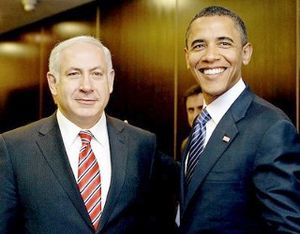
The Israeli government made an announcement today that they had agreed to a “significant” easing of the Gaza blockade, allowing items like food and toys into the region in larger amounts and even allowing some construction materials in. The announcement was met, predictably, with US State Department praise.
But is the announcement real, or was it done purely for PR purposes? While Israel released its announcement, in English, following the meeting, they also released a Hebrew version for local media consumption at the same time, and the two versions are starkly different.
While the English-only version, the version sent to all foreign diplomats, claims that the decision “was made,” the Hebrew version that the Israeli press got insisted that the meeting just included ministers voicing their opinions on a possible easing and that no vote ever took place on any particular draft.
Why is this happening in a church basement?
by Philip Weiss on June 18, 2010 · 69 comments
On Tuesday night in the basement of the Advent Lutheran Church on the Upper West Side in NY, an ad hoc group of Jews sponsored a forum about “Jewish perspectives” on the Boycott, Divestment and Sanctions campaign (BDS), with a panel of four Jews, two for and two against, and about 200 people jammed into the sweaty basement.
The event soon morphed into a spirited discussion about Zionism, and is there such a thing as a Jewish democratic state; and the most obvious question came up halfway through, Why is this happening in a church? Gail Miller of Jews Say No answered, “A number of us approached every synagogue and every Jewish center in the city” and were turned down repeatedly– later Miller specified that they had gone to six synagogues and two Jewish centers.
So much for free debate inside the Jewish community.
Amnesty International has accused the Israeli authorities of subjecting jailed nuclear whistleblower Mordechai Vanunu to cruel, inhuman or degrading treatment by holding him in solitary confinement.
The 56-year-old, who spent 18 years in prison for revealing details of the country’s nuclear arsenal to The Sunday Times in 1986, was sent back to jail for three months on 23 May on charges of contact with a foreign national, and almost immediately placed in solitary confinement. Amnesty is calling for his immediate and unconditional release.
Amnesty International Middle East Programme Director Malcolm Smart said:
“Mordechai Vanunu should not be in prison at all, let alone be held in solitary confinement in a unit intended for violent criminals.
“He suffered immensely when he was held in solitary confinement for 11 years after his imprisonment in 1986 and to return him to such conditions now is nothing less than cruel, inhuman or degrading.”
Vanunu is held in Ayalon Prison in central Israel. His lawyer revealed to Amnesty International that he has been placed in an isolated cell, ostensibly to protect him from other prisoners. For years, Vanunu has been portrayed by some Israeli media and politicians as a traitor and an enemy of the state for disclosing Israeli efforts to develop nuclear weapons, and he says he has received death threats.
Malcolm Smart said:
“Mordechai Vanunu is a prisoner of conscience. The prison authorities might claim that he has been put in isolation to protect him from the risk of attack by other inmates, but if the Israeli government is really concerned for his safety it should release him without delay.”
After Vanunu, a former technician at Israel’s nuclear plant near the southern town of Dimona, revealed details of the country’s nuclear arsenal to The Sunday Times in 1986, he was subsequently abducted by Mossad agents in Italy and secretly taken to Israel, where he was tried and sentenced to a prison term of 18 years, the first 11 years of which he spent in solitary confinement.
Since his release in 2004, the Israeli authorities have subjected Vanunu to police supervision under the terms of a draconian military order, which is renewed every six months.
According to the order, he is banned from communicating with foreigners, including journalists. He cannot leave the country and is forbidden from approaching foreign embassies. He must also inform the authorities if he wishes to change his address.
Malcolm Smart added:
“The restrictions on Mordechai Vanunu arbitrarily limit his rights to freedom of movement, expression and association and are therefore in breach of international law. They should be lifted and he should be allowed to start his life again as a free man.”
Mordechai Vanunu’s brother, Meir Vanunu, told Amnesty yesterday (17 June):
“It is very traumatic for Mordechai to be put again in solitary confinement and subjected to harassment. These are the same conditions he was kept under previously for 18 years and there is no justification for it after 24 years of suffering.
“We fear for the impact this will have on his health. Now is the time for Mordechai’s true freedom – he should be allowed to travel and leave Israel. He should never have been put in this situation in the first place.”
The harsh conditions of the dangerous criminals unit in Ayalon Prison mean Vanunu can only leave his cell for one hour every day to walk in the prison courtyard. He cannot currently make telephone calls from the prison unless he submits information about the person he wishes to call to the prison authorities – something he refuses to do on principle. As a result, he has had no contact with friends or fmily since the beginning of his current imprisonment.
His lawyer Michael Sfard was able to visit him and told Amnesty: “Mordechai Vanunu is suffering from isolation. He should not be made to pay a price because of the enmity of others towards him.”
AlJazeeraEnglish — June 14, 2010 — In the early hours of Monday, May 31, the Israeli navy intercepted a flotilla of boats carrying thousands of tonnes of aid to Gaza. Nine passengers on the Mavi Marmara – the flotilla’s largest boat – were killed. This much we know. In the aftermath of the event, accounts from both sides have diverged wildly. Israel claims that it acted in self-defence against a group of “violent extremists” linked to al-Qaeda and Hamas, intent on breaching the military blockade of Gaza. The activists say they were frightened for their lives after being shot at from helicopters in the dark of night, their raised white flag ignored. They say Israel’s attack on their ship in international waters was unexpected and disproportionate. Examining claim and counter claim, A Vourney of Life and Death includes an exclusive interview with the captain of the Mavi Marmara, those on board the ships and previously unseen footage.

