“…the Zionist movement has … convinced most Israeli and Zionist Jews of the correctness of Nakba denial. That is, that the Nakba never really happened and that the history of the founding of Israel was nothing other than the heroic struggle of a people to survive.”
9 August 2010
Lawrence Davidson argues that the phenomenon of Holocaust questioning in Iran and elsewhere in the Muslim countries is directly linked to Israel’s cynical exploitation of the Holocaust to justify its policies and bludgeon its critics.
On 5 August 2010 Israel’s Ha’aretz newspaper, citing a story by the Iranian news agency Fars, reported that a non-governmental organization in Iran had “launched a website with cartoons about the Holocaust aimed at undermining the historic dimensions of the mass murder of Jews”. Israelis and Zionists reacted angrily to this announcement.
Spokesmen at Yad Vashem, Israel’s national Holocaust museum, stated that the website was “yet the latest salvo emanating from Iran that denies the facts of the Holocaust and attempts to influence those who are ignorant of history”. The Ha’aretz report also noted, somewhat resentfully, that “since the 1979 Islamic revolution, Iran has not acknowledged Israel as a sovereign state and even refrained from using the name Israel, instead referring to the Jewish state as the Zionist regime”.
This is obviously a hot issue and so I will begin my examination of this report by stating that the Holocaust is a proven factual event and the number of six million Jewish victims killed is roughly accurate. Histories based on detailed research on this subject include the early classic study by Raul Hilberg, The Destruction of the European Jews, first published in 1961 and followed later by his Sources of Holocaust Research (2001). Other recent works include David Engel’s The Holocaust: the Third Reich and the Jews (1999) and S. Hochstadt, Sources of the Holocaust – Documents in History (2004). There are many other works as well.
Writer Susan Abulhawa discusses Palestine and the power of the novel
22.7.2010
Words by Rebecca Louder
On the morning of May 31st, mere hours after the Israeli flotilla attack, the Grapevine met with Palestinian-American writer Susan Abulhawa at her hotel. Susan was in Reykjavík on her way back from the Lillehammer Literature Festival in Norway. She held a small event at The Culture House to promote her latest book, Mornings In Jenin, a newly edited version of her first publication The Scar of David. The book follows the story of several generations of Palestinian characters and their personal struggles with location, identity, family and human rights. In America, her book has caused a controversial response for its pro-Palestinian stance, but she has continued to be outspoken on the topic despite the backlash. The writer seemed distraught as the charged events of the morning loomed over our interview.
How do you think fictional works can impact the global discourse on Palestinian-Israeli relations?
I think that writers, artists, musicians, poets and filmmakers in any society of conflict have a unique role to play in bringing the issues in the headlines to a human level. That’s the power of art and literature, in general—to remind us of our common humanity and that there are human beings who live the headlines and experience them in ways that are not abstract, in ways that a reader would experience them. You can take an individual through history through the lives of characters that they can get to know, that they can love or hate or what have you. Regardless, they get to know them and they can see conflict and the politics or the history through their eyes. That’s the beauty of a novel, as opposed to non-fiction or history textbooks that have more of a sterile, distant prose.
What is your personal experience in all of this?
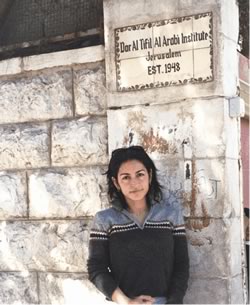
My parents were refugees of the 1967 Six Day War. Neither of them can really return to their place of birth nor live in the homes where they were born, or even visit their parents’ graves. I lived in Jerusalem when I was a little girl. Actually there’s a chapter in the book based on that, it’s called ‘The Orphanage.’ That’s really the only part of the book that is autobiographical. The entire historic background is non-fictional. It was real important to me that the historic background and the historic characters, the locations, the seasons, the fruits, etcetera, that all be real. The characters are fictionalised.
Your work has been quite controversial in the past. Why do you think that is?
I think anything that humanises Palestinians or criticises what Israel is doing creates a fury, basically. People try to shut you up. It’s not just me; it’s anybody, whether it’s academics, intellectuals, artists, what have you. That’s kind of a trend. There’s always a campaign of character assassination in trying to marginalise people.
Pro-Palestine sentiments are often deemed as being terrorist-sympathetic or anti-Semitic. Have you had these accusations launched at you?
Precisely. I think everybody who expresses this has. I don’t accept it. I’m neither a terrorist nor an anti-Semite. There’s nothing in anything I do or say that would indicate that. I think readers are smarter than that. I think they’ll see that when they read the book.
How has the book been received?
In Norway, and other European countries it’s gotten really good reviews. In America it has gotten limited reviews, but what it has gotten has been very good. Most journalists and reviewers in the United States just don’t want to touch it.
It’s not the first time. There was this wonderful play called My Name Is Rachel, it was based on the life of Rachel Corrie [American activist with the International Solidarity Movement who was crushed to death by an IDF bulldozer in 2003]. They managed to shut that down. There’s all this art by Palestinians, beautiful stuff that just reflects what’s inside of them, what they see, what their lives are about. It gets shut down. There have been several instances in the United States where that has happened. It’s because there are very powerful forces in the United States that don’t want Palestinians to appear human, because then it becomes harder to justify killing them. It becomes hard to justify raining death on this civilian population that really has nowhere to go and nowhere to run.
What is your hope for the region?
Of course there is hope. To me the solution is, and always has been, very clear. It’s the simple application of international law and the application of the universality of human rights. The declaration that Palestinians are human beings who are worthy of human rights. We are the native people of that land. We’ve been there for centuries, if not millennia, and everything has been taken from us. When the international community has the will to give more than just words and say that yes, we deserve the same rights that are accorded to the rest of humanity. That’s where the solution lies.
The West claims to value certain principles of human decency and equality, that they apply in their own countries yet support something entirely different in Israel. For example, nowhere in the West would any country allow the construction of neighbourhoods and settlements where only a certain group of people were allowed to live. No one would accept a housing unit for whites-only or having a road where only whites could travel, and yet that’s what Israel does. It’s a situation where human worth is measured on ones religion.
Palestine had always been a place where people of various religions lived. It had been a multi-cultural, multi-ethnic place and that’s the ideal, isn’t it? It should not be a place of exclusivity. It’s important that my words not be interpreted that Israelis should be kicked out or anything like that, because I don’t advocate that. That’s their country now. People were born there and live there. That’s where they’re from.
Why do you think the international community allows these human rights violations?
You’ll have to ask them. I don’t know. It’s hypocritical, it’s outrageous, actually. Luckily, the people of these nations are not necessarily on board and people of various countries are taking matters into their own hands. They are boycotting Israel and Israeli goods, and this flotilla, the Free Gaza movement, these boats have been travelling to Gaza from Cyprus carrying people from all over the world. These are ordinary citizens who have made history because they refuse to be silent in the face of what’s happening in Gaza.
People are literally and intentionally being starved to death in Gaza. Food is not allowed in or out, the economy has completely collapsed, the education system has completely collapsed. Eighty percent of Gazan children suffer from post-traumatic stress disorder, a crippling psychological disease and entire generations are being lost. The international community is doing nothing about it. Ordinary citizens are taking matters into their own hands and delivering boatloads of aid. Then today we find out that Israel in fact boarded that flotilla and killed a few people. So it remains to be seen whether the international community will yet again be silent.
Do you have any hope that they won’t be?
Well, they’re already condemning it, but they always do. They give lip service to it and then they do nothing. So I don’t place any hope or faith in any of these leaders or the so-called official international community, but I do place a lot of hope and faith in the international community that’s made up of world citizens and people of conscience to speak up and not to let this continue. People can’t really say “I didn’t know”. It’s everywhere. Israel has been held above the law. They have committed war crimes for over six decades and have done so with impunity.
This is where literature comes in, in my opinion. In the West when you say ‘Palestinian,’ people automatically conjure these really negative images and that is in large part due to this propaganda campaign over the years to paint Israel as this poor, vulnerable nation that’s just trying to defend itself when in fact it is the aggressor. Israel manages to paint Palestinians as these crazy, irrational aggressors, and that it’s just defending itself against this principally unarmed civilian population. Palestinians have nowhere to run. It has no navy, no army, no air force.
But when I think of Palestine, I think of a beautiful people. I think of a long suffering and enduring nation that despite everything gets up every morning and goes to those damn checkpoints, tries to get to work, tries to get to school and go about their daily lives. I think of a rich culture and good music and good food and stupid jokes and proverbs. I think of human beings, and that’s what I hope this book shows.
—
Doctor Hida, a survivor of the 1945 atomic bomb at Hiroshima, continues to care for some of the other quarter of a million survivors. Using rarely-seen archival footage, Atomic Wounds shows the existence of ABCC, a laboratory that was set up in 1946 by American scientists on the spot of the disaster to study the effects of the bomb on thousands of survivors. The film shows how the terrible danger of radiation was minimized by successive American administrations in the 50s-70s so that nuclear power could be freely developed, with no concern for public health.
BETHLEHEM (Ma’an) – Hezbollah leader Hassan Nasrallah will reveal “thunderous news” Monday revealing that Israel was behind the assassination of Lebanese Prime Minister Rafiq Hariri, a party official said Saturday.
Hezbollah spokesman Ibrahim Mousawi told Ma’an that the evidence would be “comprehensive, revealing conclusive information” implicating Israel in the car bombing that killed Hariri in 2005.
A UN special tribunal set up to investigate the assassination will reportedly blame Hezbollah. Reports suggest that the tribunal will announce its findings before the end of 2010.
Speaking to reporters last Tuesday, Nasrallah said a Hezbollah team spent months compiling information on what he described as Israeli efforts to implicate the Shiite movement.
Syrian President Bashar Al-Assad and Saudi Arabian King Abdullah met in July with Lebanon’s President Michel Suleiman in an effort to diffuse the mounting political tension over possible indictments over the assassination.
(Stockholm, August 4, 2010) It has been over two months since Israel’s 31 May 2010 deadly assault on the Freedom Flotilla and little to nothing has been done to hold Israel accountable for its savage attack that led to the killing of nine of our colleagues, or to end Israel’s continued violations against the Palestinian people, especially the 1.5 million residents of Gaza. Therefore, we are continuing our global, grassroots effort to stand up to Israel’s ongoing intransigence, including planning our next direct action, plans to enlarge our coalition to include groups from around the world who want to join us, as well as intensify our efforts to mobilize for the new Freedom Flotilla 2.
The world must continue to demand that Israel cooperate with the UN Human Rights Council’s investigation committee to ensure independence, thoroughness, credibility, and justice for the victims.
We have real concerns with the new UN panel tasked by Secretary General Ban Ki Moon to investigate Israel’s raid. as an apparent attempt to downgrade the UN Human Rights Council’s investigation, which Israel has yet to accept. The Secretary General’s new panel will have a very limited mandate of evaluating only current national investigations by Israel and Turkey, and therefore will hardly meet international standards for being impartial, and thorough.
Moreover, the appointment of ex-Colombian President Alvaro Uribe as its vice-chair further corrodes the legitimacy of this UN panel. Not only is the Uribe government on record stating a desire to strengthen Colombia’s military relationship with Israel, but President Uribe’s own human rights record in Columbia should be a matter for investigation as evidenced by the report from the Fellowship of Reconciliation. http://forusa.org/content/report-military-assistance-human-rights-colombia-us-accountability-global-implications.
The United Nations must not be involved in any attempt to whitewash atrocities or to preempt international legal action on behalf of the victims of the flotilla. Israel’s alleged easing of the closure on Gaza has been purely cosmetic, intended only to deflect criticism from its illegal policies. Expanding the list of items permitted into Gaza does not address the most fundamental concern of the people there – freedom of movement. Hundreds of thousands of men, women, and children are still denied the right to travel freely for medical care, educational opportunities, or even to reunite with family members in other parts of the occupied Palestinian territory. What we demand is an immediate and complete lifting of the closure including a lifting of the travel ban as well as the ban on exports from Gaza. We also demand that Israel release, unconditionally, our captured vessels and stolen equipment.
Israel and our respective governments must know that we represent a growing movement of international civilians unwilling to stand idly by while Israel continues to act with impunity — killing, maiming, jailing, stealing, and assaulting the very basics of our common humanity. Israel has not only deliberately created a humanitarian crisis in Gaza, but it has created a crisis of human rights and human dignity in all of Palestine that the world must address.
This is why our flotilla aimed to challenge the very policies that have left Palestinians in need of humanitarian aid, and not just to deliver essential goods to Gaza. It is why, in the coming months, we will send larger and larger flotillas to Gaza.
Michael Oren makes stuff up. But the NY Times doesn't have to publish it.
On 06.26.10, By Max Blumenthal
Nearly a month after publishing Israeli Ambassador the US Michael Oren’s apologia for the flotilla massacre, the NY Times has yet to correct two of the most glaring lies Oren made. The first of Oren’s deceptions was his assertion that “religious extremists embedded among those on board were paid and equipped to attack Israelis.”
The notion that al-Qaeda affiliated mercenaries were on board the Mavi Marmara was discredited as soon as the IDF Spokesman’s Office changed a headline on a press release about terrorist “mercenaries” to read, “Attackers of the IDF Found Without Identification Papers.” The headline was quietly altered on June 3, the same day the Times published Oren’s op-ed. Shouldn’t their fact checkers and editors been better informed?
The second of Oren’s lies was at least as ludicrous as his first. He wrote:
Also found on the boat were propaganda clips showing passengers “injured” by Israeli forces; these videos, however, were filmed during daylight, hours before the nighttime operation occurred.
If this was true, then where were the clips? Why hasn’t the IDF released any footage to support Oren’s claim? Probably because such clips do not exist anywhere. As far as I can tell, they were never on the website of the IDF Spokesman’s Office or the Israeli Foreign Ministry. The footage is not even available on YouTube. So where are they? Certainly the IDF would have wanted to publish anything that supported its version of events. But they could not conjure anything to bolster Oren’s bizarre claim (which seemed to suggest that the killing and maiming of flotilla passengers by Israeli commandos was simply “propaganda” and therefore never happened).
Unless Oren or the Israeli military can produce the “propaganda clips” Oren mentioned, the New York Times should be compelled to retract the falsehoods it published. The Times Public Editor Clark Hoyt can be reached at public@nytimes.com or (212) 556-7652
David Rovics has written an evocative song called “All Aboard the Mavi Marmara.” The Free Gaza team has added images in tribute to the nine brave men on board who gave their lives in pursuit of justice for the Palestinians.