Search

band annie's Weblog

I have a parallel blog in French at http://anniebannie.net

Friday Films: ‘The Open Door,’ Based on a Novel by Latifa Zayyat

Arabic Literature (in English)

Every Friday, ArabLit suggests a new classic film-book combination — for you to watch and read — until we run out of steam about 20 weeks in:This week’s film is The Open Door, based on the 1960 novel by pioneering author-activist Latifa al-Zayyat. The Arab Writers Union listed this coming-of-age novel as one of the Top 105 books of the 20th century. Al-Zayyat was a political prisoner in 1949 and again in 1981, but then won Egypt’s highest state-sponsored literary prize a few months before her death in 1996. She was also co-winner of the inaugural Naguib Mahfouz Medal for Literature for The Open Door.It’s set during al-Zayyat’s first political awakening, in the decade post-WWII, during the last fight against British colonial rule, and it centers aorund Layla and her brother Mahmud. In a retrospective on Al-Jadid, al-Zayyat’s debut novel was remembered by critic Farida al-Naqash as “an expression of a new wave in the Arabic novel, one that combines poetic realism with committed literature.”You can read an excerpt, trans. Marilyn Booth, online.The novel was adapted into a 1964 film by Henry Barakat starring megastar Faten Hamama.

Previous Friday films:

The Mountain, based on a novel by Fathi Ghanem

Miramarbased on a novel by Naguib Mahfouz

A Touch of Fear, based on a novella by Tharwat Abaza

The Impossible, based on a novel by Mostafa Mahmoud

The Sixth Daybased on a novel by Andrée Chedid

The Land, based on a novel by Abdel Rahman Al-Sharqawi, translated as Egyptian Earth

Al-Harambased on a novel by Yusuf Idris

I’m Free, based on a novel by Ihsan Abdel Quddous

A Beginning and an End, based on the novel by Naguib Mahfouz

For Bread Alone, based on the novel by Mohamed Choukri

Gate of the Sun, based on the novel by Elias Khoury

The Dupesbased on Ghassan Kanafani’s Men in the Sun

Diary of a Country Prosecutor, based on a novel by Tawfiq al-Hakim

Adrift on the Nile, based on a novel by Naguib Mahfouz

A Nightingale’s Prayerbased on a novel by Taha Hussein

 Kit Katbased on the novel The Heron by Ibrahim Aslan, available in translation by Elliott Colla.

The Egyptian Citizen, based on Yusuf al-Qa’id’s award-winning novel War in the Land of Egypt

The Lamp of Umm Hashem, inspired by a novella by Yahia Haqqi

Interview with Shir Hever


You went to Berlin to the Free University. Why?

I actually live in Heidelberg, although I’m writing my PhD at the Free University of Berlin. I followed my partner who found a job in Germany. The very large emigration from Israel of young and educated people has meant that much of my family and friends have already left Israel, and Berlin is actually a favorite destination, where I meet many of my old friends from Jerusalem and Tel-Aviv.

What motivated you to research Israel’s military sector and to support BDS? Did your upbringing and family background have a role in this, or was it something you came to later in life?
I did grow up in a leftist and critical family, and was taught to ask questions from a young age. I went to a very militaristic school, so I was taught a Zionist perspective as well, but I didn’t want to take part in the occupation directly as a soldier. In order to try to be a non-combat soldier, I volunteered for a year of social service in the town of Sderot, and there I had time to think about politics, to hear from my friends who were drafted into the army, and to see aspects of Israeli society that I never knew existed. I decided not to do any military service. By pretending to be crazy I easily received an exemption, like thousands do every year.
Only in university, however, did I become aware of the Palestinian side of the story, when Palestinians were invited by a political group called “The Campus Will Not Stay Silent” to speak about their experiences during the Second Intifada. I started to become politically active and joined the Alternative Information Center, a joint Palestinian-Israeli organization.
Supporting BDS came naturally as I was part of the group of activists who were considering various strategies of combating the occupation. As an economist, I felt that BDS can have a very strong impact on the Israeli economy and society and was something that empowers Palestinians to use non-violent resistance.
Choosing my research topics was done in an activist environment, and I would usually write reports and studies on matters upon requests from activists. After writing my book on the political economy of Israel’s occupation, I realized that the Israeli military industry and Israeli arms exports are very important to complete the picture, to explain how Israel’s occupation fits into global interests, and so I chose this as a topic for my PhD.

It is said that the Israeli population is becoming more mentally and psychologically isolated from the rest of the world. Is that also your experience?
Absolutely not. Israelis strongly depend on a feeling of being part of the “west,” and part of Europe (even though Israel is not in Europe). The fascination of Israelis with the European Football Cup, with the Eurovision etc. is one aspect of this, but also the desire to travel in the world, to consume western culture, etc. I admit that when BDS started, I did not imagine that its most powerful impact would be precisely in the sphere of culture. Whenever a famous artist cancels a performance in Israel, the reactions are very powerful, because Israelis don’t want to feel isolated. The fact that Israelis are willing to pay double the prices for tickets to performances of artists who choose to violate BDS and perform in Israel is a testimony to that fact. Actually, this is the reason for BDS being a successful tactic; it targets a sensitive nerve of Israel’s culture, the need to be included.

Listening to Netanyahu and Lieberman, we get the impression here that the division between Jews and Palestinians in Israel itself is increasingly growing. Is that true?
On the political level, yes of course. The Israeli government is not ashamed to call for separation, and to demonize Palestinians as a group. On the local and personal level, there are also many cases of Palestinians and Jews working together, becoming friends, creating families together. Separation is never 100% successful. It is true that many Israeli Jews have little contact with Palestinians and know very little about them. Very few Israeli Jews bother to learn Arabic. But Palestinian Israelis, on the other hand, have frequent contact with Israeli Jews, speak good Hebrew and have a very good understanding of Jewish culture and politics.

How can you explain that an Israeli general has compared the situation in his country with Germany of the 1930s?
Major-General Yair Golan is well-known for being very direct and not too careful with what he says. In a lecture he gave in 2007 he admitted that the Wall of Separation’s main purpose is to separate populations, and security only comes as a second priority.
Currently Israel is witnessing a fierce struggle between two competing elite groups. The old military elite in Israel (to which Golan belongs) is in a state of crisis, losing much of its influence over the government and the business sector.
The military elite is not leftist, progressive or opposed to the occupation, but it believes in creating an “intelligent” occupation, a careful and planned use of force in order to keep the Palestinians under control. They are afraid of the populism of the Israeli government and how it encourages unbounded brutality of Israeli soldiers against Palestinians. Golan hinted that such populism and brutality are not signs of strength of Israel, but actually signs of weakness.
His statement was severely criticized, and gave the government the opportunity to make more populist statements. Minister of Defense Ya’alon (also a member of Israel’s military elite, and former commander of the army) was forced to resign and was replaced by Lieberman, who is not a member of the military elite.

Does militarism and war (also) serve to cover the tensions within Israeli Jewish society?
I wouldn’t say militarism and war, but rather an obsession with security. Israel hasn’t fought a real conventional war since 1973, instead it is constantly engaged in asymmetrical conflicts in civilian areas, where Israeli soldiers use heavy armaments in civilian areas. But the constant fear of retaliation, the threat of real and imagined terrorism, are exploited very cynically by the Israeli government to distract from the burning social issues in Israel.
A good example of this is the 2011 attack on an Israeli bus in the midst of large social protests in Israel. Netanyahu quickly announced that the attackers came from Gaza, and ordered a bombing against Gaza, killing five Palestinians. Even though the attackers did not come from Gaza, Palestinians chose not to react to the Israeli killing of innocent Palestinians, because such retaliation would serve the desire of Netanyahu to suppress the social protests. I think that we can learn from this example how well Palestinians understand Israeli society. Interestingly, the social protests ended eventually with very little effect, and the security issue continues to dominate Israeli political discourse.

If we look at the big military companies such as the Israeli Aerospace Industries (IAI) and Elbit, do they account for a large share of the Israeli economy?
The arms sector is a large section of Israel’s industrial sector, and the two biggest arms companies are the government-owned IAI, and the private Elbit Systems. There are conflicting numbers from various sources, and I estimate that 11% of Israel’s total exports are security and military exports, to which these two companies contribute more than half. Of course this is very significant for the Israeli economy, and no other country in the world has arms as such a high proportion of its total exports (not even the U.S, the world’s largest arms exporter). Nevertheless, one must remember that the majority of Israel’s exports, and industrial companies and workforce are civilian.

How is the Netherlands (and the EU) most complicit in supporting the Israeli military industrial complex? Through its subsidies and financing, its scientific research, its global production facilities, its purchases of Israeli military products and services, or its provision of tax havens for the companies’ profits?

All of the above, but the complicity is not just in helping to fund the Israeli arms industry, but also by legitimizing it. When Dutch and European politicians promote security cooperation projects with Israel, they are fully aware that the Israeli arms industry is based on the Israeli military experience in the Occupied Palestinian Territory, technologies developed in the course of repression of Palestinian resistance and control over a large population denied its basic rights. Therefore, all these ties between European and Israeli arms companies send a message that Europe accepts Israel’s occupation and even seeks to learn from it. This was said by General Yoav Galant (currently Israel’s minister of housing), that “foreign governments are hypocritical. On the one hand they criticize our actions, but then they come to us to learn how we do it.”

BDS campaigns in Europe have the potential to be a powerful force given that the EU traditionally has been one of Israel’s largest markets. Is this where you think BDS efforts can be most effective – or rather in the US or elsewhere?
In the end, the most effective BDS campaigns are not necessarily the ones that have the biggest monetary effect, but those that get the attention of the Israeli public. U.S-based BDS was very effective in making Israelis feel that “even our closest ally is changing its opinion on us,” but so did BDS actions in Germany. Europe remains Israel’s largest target both for exports and for imports, but BDS doesn’t seek to change that. BDS is not a tool to harm the Israeli economy, but to achieve political change through pressure.
The Netherlands play a very important role because of the importance of the Rotterdam port to Israel’s exports to Europe, especially of agricultural produce, which is of great symbolic significance. If the Netherlands will impose more strict controls over that import, it has a direct impact on the Israeli illegal colonies in the Jordan Valley, which is the most fertile land in all of Palestine.

Is BDS a bigger threat for the economy of Israel or for its image?
BDS does not seek to harm the Israeli economy, but to convince Israelis that it is unsustainable to violate international law. I don’t believe that the Israeli government will continue with its policies of apartheid and occupation long enough for BDS to cause a long-term damage to the Israeli exports. When Israeli companies will start moving to other countries to avoid BDS, the Israeli government will either collapse, or change its policies. The majority of the Israeli public today (unlike the situation in the 1970s and 1980s) is no longer willing to make great sacrifices for the sake of Zionism.
The Israeli image, however, is already strongly affected by BDS. The strength of BDS is that it is a movement based on research and information, and that through BDS, activists are able to educate the public about the situation in Palestine, and disseminate materials. The image of Israel in the world is changing as a result, and this is something that has no less of an effect on Israeli decision makers than the economic impact.

What could be important focus points for organizations such as docP and Stop de Wapenhandel (Stop the Arms Trade)?
In my experience, it is a very bad idea for someone from Israel/Palestine to tell organizations what their focus should be. Surely you know better than me who is your audience, what kind of message will be more effective to reach them and what they can do and organize locally. Palestine solidarity groups work in a wide variety of contexts – from student groups to church groups, from labor unions to social justice and environmental movements. My only recommendation would be to choose projects that can have an impact inside Israel, projects that involve major and well-known Israeli companies, politicians, etc. And that each such project should be accompanied by research. Activists can only be successful if they have a lot of information that they can disseminate as part of their activity. It is never enough to say “let’s boycott this company because it is Israeli.” You must explain why.

Shir Hever

DocP |  source


Israeli MPs try to assault Haneen Zoabi


This 9-minute video, showing Israeli Jewish MPs’ reaction to a speech by Haneen Zoabi today, offers a very revealing insight into how Israel’s tribal democracy works. And it isn’t pretty.

Even in the British parliament, which is imploding at the moment, it is impossible to imagine scenes like these.

Zoabi made the speech after Israel agreed this week very belatedly to pay compensation to the families of nine humanitarian activists killed by Israeli commandos in 2010 on the Mavi Marmara, as it plied international waters on its way to deliver aid to Gaza. In fact, it would be more accurate to say Israel assassinated the activists, as a way to deter others from following in their wake.

The Marmara was a Turkish vessel and the compensation was part of Israel’s reconciliation deal with Turkey.

Zoabi was the only Israeli MP on the ship, and was accused of treason by Knesset members for participating in the aid flotilla. She became public enemy number one and received many death threats at the time, including some barely veiled ones from Jewish MPs.

All the exchanges in this video are in Hebrew, but that doesn’t really matter. You don’t need to understand the language to understand what is going on. One Jewish MP, Oren Hazan, of Netanyahu’s Likud party, heckles Zoabi non-stop for more than four minutes, with the Speaker doing nothing more than politely asking him to calm down and refrain from interrupting.

Remember that Palestinians MPs are regularly ejected from the Knesset for far less than this kind of barracking and violation of parliamentary protocol. Notice also that the Knesset TV spends as much time, if not more, focusing on the heckler than Zoabi, implicitly legitimising his anti-democratic behaviour.

But when Zoabi accuses the soldiers of “murder” at about 4.30-min into the video, all hell breaks loose. A dozen or more Jewish MPs rush to the podium and start circling Zoabi like a pack of baying hyenas. By this stage, when Zoabi is being physically threatened by a number of MPs in the parliament chamber, you might think it would be time for some of them to be forcefully ejected, if only to indicate that this subversion of the democratic process will not be tolerated. But not a bit of it. They are treated with kid gloves.

The Knesset guards simply try to block the violent Jewish MPs from reaching the single Palestinian MP in their sights, presumably fearful that were she to be physically assaulted that might make headline news and make Israel look bad.

Paradoxically, the only MP you can see on the film being pushed out of the Knesset chamber is Zoabi’s party leader, Jamal Zahalka, who from the look of things is interceding because he’s worried she is in danger. Hazan was finally removed, though after more than eight minutes of heckling, threats and belligerence.

Another paradox: Zoabi and her fellow party MPs have only recently been allowed to speak in the Knesset again, after the ethics committee (dominated by Jewish MPs) suspended them for several months because of their “unacceptable” political views.

I doubt very much that any of these Jewish MPs, even though they have threatened and tried to physically harm another MP, one from the wrong tribe, will suffer any consequences at all for their behaviour.

Zoabi said in her speech: “I stood here six years ago, some of you remember the hatred and hostility toward me, and look where we got to. Apologies to the families of those who were called terrorists. The nine that were killed, it turns out that their families need to be compensated. I demand an apology to all the political activists who were on the Marmara and an apology to MK Haneen Zoabi, who you’ve incited against for six years. I demand compensation and I will donate it to the next flotilla. As long as there’s a siege, more flotillas need to be organized.”

In addition to the violent reception from MPs visible on film, there was widespread incitement from other MPs. Michael Oren, who a while back was Israel’s ambassador to the US, sounded like Avigdor Lieberman as he said Zoabi’s speech proved she was not loyal and should be permanently stripped of her parliamentary status, under a soon-to-be-passed Suspension Law.

In true colonial style, the government’s chief whip, David Bitan, was reported to have told Palestinian voters in Israel after Zoabi’s speech: “We need to make sure she doesn’t stay in the Knesset. We’ve had enough of this and she doesn’t even represent you properly.”


Brexit is Only the Latest Proof of the Insularity and Failure of Western Establishment Institutions

Glenn Greenwald

The decision by UK voters to leave the EU is such a glaring repudiation of the wisdom and relevance of elite political and media institutions that – for once – their failures have become a prominent part of the storyline. Media reaction to the Brexit vote falls into two general categories: (1) earnest, candid attempts to understand what motivated voters to make this choice, even if that means indicting one’s own establishment circles, and (2) petulant, self-serving, simple-minded attacks on disobedient pro-leave voters for being primitive, xenophobic bigots (and stupid to boot), all to evade any reckoning with their own responsibility. Virtually every reaction that falls into the former category emphasizes the profound failures of western establishment factions; these institutions have spawned pervasive misery and inequality, only to spew condescending scorn at their victims when they object.

The Los Angeles Times‘ Vincent Bevins, in an outstanding and concise analysis, wrote that “both Brexit and Trumpism are the very, very wrong answers to legitimate questions that urban elites have refused to ask for thirty years”; in particular, “since the 1980s the elites in rich countries have overplayed their hand, taking all the gains for themselves and just covering their ears when anyone else talks, and now they are watching in horror as voters revolt.” The British journalist Tom Ewing, in a comprehensive Brexit explanation, said the same dynamic driving the UK vote prevails in Europe and North America as well: “the arrogance of neoliberal elites in constructing a politics designed to sideline and work around democracy while leaving democracy formally intact.”

In an interview with The New Statesman, the political philosopher Michael Sandel also said that the dynamics driving the pro-Brexit sentiment were now dominant throughout the west generally: “a large constituency of working-class voters feel that not only has the economy left them behind, but so has the culture, that the sources of their dignity, the dignity of labour, have been eroded and mocked by developments with globalisation, the rise of finance, the attention that is lavished by parties across the political spectrum on economic and financial elites, the technocratic emphasis of the established political parties.” After the market-venerating radicalism of Reagan and Thatcher, he said, “the centre left” – Blair and Clinton and various European parties – “managed to regain political office but failed to reimagine the mission and purpose of social democracy, which ­became empty and obsolete.”

Three Guardian writers sounded similar themes about elite media ignorance, stemming from their homogeneity and detachment from the citizenry. John Harris quoted a Manchester voter as explaining thatif you’ve got money, you vote in. If you haven’t got money, you vote out,” and Harris added: “most of the media . . . failed to see this coming. . . . The alienation of the people charged with documenting the national mood from the people who actually define it is one of the ruptures that has led to this moment.” Gary Younge similarly denounced “a section of the London-based commentariat [that] anthropologised the British working class as though they were a lesser evolved breed from distant parts, all too often portraying them as bigots who did not know what was good for them.” Ian Jack’s article was headlined “In this Brexit vote, the poor turned on an elite who ignored them,” and he described how “gradually the sight of empty towns and shuttered shops became normalised or forgotten.” Headlines like this one from The Guardian in 2014 were prescient but largely ignored:

Though there were some exceptions, establishment political and media elites in the UK were vehemently united against Brexit, but their decreed wisdom was ignored, even scorned. That has happened time and again. As their fundamental failures become more evident to all, these elites have lost credibility, lost influence, and lost the ability to dictate outcomes.

Just last year in the UK, Labour members chose someone to lead Tony Blair’s party – the authentically left-wing Jeremy Corbyn – who could not have been more intensely despised and patronized by almost every leading light of the British media and political class. In the U.S., the joyful rejection by Trump voters of the collective wisdom of the conservative establishment evidenced the same contempt for elite consensus. The enthusiastic and sustained rallying, especially by young voters, against beloved-by-the-establishment Hillary Clinton in favor of a 74-year-old socialist taken seriously by almost no DC elites reflected the same dynamic. Elite denunciations of the right-wing parties of Europe fall on deaf ears. Elites can’t stop, or even affect, any of these movements because they are, at bottom, revolts against their wisdom, authority and virtue.

In sum, the west’s establishment credibility is dying, and their influence is precipitously eroding – all deservedly so. The frenetic pace of online media makes even the most recent events feel distant, like ancient history. That, in turn, makes it easy to lose sight of how many catastrophic and devastating failures western elites have produced in a remarkably short period of time.

In 2003, U.S. and British elites joined together to advocate one of the most heinous and immoral aggressive wars in decades: the destruction of Iraq; that it turned out to be centrally based on falsehoods that were ratified by the most trusted institutions, as well as a complete policy failure even on its own terms, gutted public trust.

In 2008, their economic worldview and unrestrained corruption precipitated a global economic crisis that literally caused, and is still causing, billions of people to suffer – in response, they quickly protected the plutocrats who caused the crisis while leaving the victimized masses to cope with the generational fallout. Even now, western elites continue to proselytize markets and impose free trade and globalization without the slightest concern for the vast inequality and destruction of economic security those policies generate.

In 2011, NATO bombed Libya by pretending it was motivated by humanitarianism, only to ignore that country once the fun military triumph was celebrated, thus leaving a vacuum of anarchy and milita rule for years that spread instability through the region and fueled the refugee crisis. The U.S. and its European allies continue to invade, occupy and bomb predominantly Muslim countries while propping up their most brutal tyrants, then feign befuddlement about why anyone would want to attack them back, justifying erosions of basic liberties and more bombing campaigns and ratcheting up fear levels each time someone does. The rise of ISIS and the foothold it seized in Iraq and Libya were the direct by-products of the west’s military actions (as even Tony Blair admitted regarding Iraq). Western societies continue to divert massive resources into military weaponry and prisons for their citizens, enriching the most powerful factions in the process, all while imposing harsh austerity on already suffering masses. In sum, western elites thrive while everyone else loses hope.

These are not random, isolated mistakes. They are the by-product of fundamental cultural pathologies within western elite circles – a deep rot. Why should institutions that have repeatedly authored such travesties, and spread such misery, continue to command respect and credibility? They shouldn’t, and they’re not. As Chris Hayes warned in his 2012 book Twilight of the Elites, “given both the scope and depth of this distrust [in elite institutions], it’s clear that we’re in the midst of something far grander and more perilous than just a crisis of government or a crisis of capitalism. We are in the midst of a broad and devastating crisis of authority.”

It’s natural – and inevitable – that malignant figures will try to exploit this vacuum of authority. All sorts of demagogues and extremists will try to re-direct mass anger for their own ends. Revolts against corrupt elite institutions can usher in reform and progress, but they can also create a space for the ugliest tribal impulses: xenophobia, authoritarianism, racism, fascism. One sees all of that, both good and bad, manifesting in the anti-establishment movements throughout the U.S., Europe, and the UK: including Brexit. All of this can be invigorating, or promising, or destabilizing, or dangerous: most likely a combination of all that.

The solution is not to subserviently cling to corrupt elite institutions out of fear of the alternatives. It is, instead, to help bury those institutions and their elite mavens and then fight for superior replacements. As Hayes put it in his book, the challenge is “directing the frustration, anger, and alienation we all feel into building a trans-ideological coalition that can actually dislodge the power of the post-meritocratic elite. One that marshals insurrectionist sentiment without succumbing to nihilism and manic, paranoid distrust.”

Corrupt elites always try to persuade people to continue to submit to their dominance in exchange for protection from forces that are even worse. That’s their game. But at some point, they themselves, and their prevailing order, become so destructive, so deceitful, so toxic, that their victims are willing to gamble that the alternatives will not be worse, or at least, they decide to embrace the satisfaction of spitting in the faces of those who have displayed nothing but contempt and condescension for them.

There is no one, unifying explanation for Brexit, or Trumpism, or the growing extremism of various stripes throughout the west, but this sense of angry impotence – an inability to see any option other than smashing those responsible for their plight –  is undoubtedly a major factor. As Bevins put it, supporters of Trump, and Brexit, and other anti-establishment movements “are motivated not so much by whether they think the projects will actually work, but more by their desire to say FUCK YOU” to those they believe (with very good reason) have failed them.

Obviously, those who are the target of this anti-establishment rage – political, economic and media elites – are desperate to exonerate themselves, to demonstrate that they bear no responsibility for the suffering masses that are now refusing to be compliant and silent. The easiest course to achieve that goal is simply to demonize those with little power, wealth or possibility as stupid and racist: this is only happening because they are primitive and ignorant and hateful, not because they have any legitimate grievances or because I or my friends or my elite institutions have done anything wrong. As Vice’s Michael Tracey put it:

Because that reaction is so self-protective and self-glorifying, many U.S. media elites – including those who knew almost nothing about Brexit until 48 hours ago – instantly adopted it as their preferred narrative for explaining what happened, just as they’ve done with Trump, Corbyn, Sanders and any number of other instances where their entitlement to rule has been disregarded. They are so persuaded of their own natural superiority that any factions who refuse to see it and submit to it prove themselves, by definition, to be regressive, stunted and amoral.

Indeed, media reaction to the Brexit vote – filled with unreflective rage, condescension and contempt toward those who voted wrong – perfectly illustrates the dynamics that caused all of this in the first place. Media elites, by virtue of their position, adore the status quo. It rewards them, vests them with prestige and position, welcomes them into exclusive circles, allows them to be close to (if not themselves wielding) great power while traveling their country and the world, provides them with a platform, fills them with esteem and purpose. The same is true of academic elites, and financial elites, and political elites. Elites love the status quo that has given them, and then protected, their elite position.

Because of how generally satisfied they are with their lot, they regard with affection and respect the internationalist institutions that safeguard the west’s prevailing order: the World Bank and IMF, NATO and the west’s military forces, the Federal Reserve, Wall Street, the EU. While they express some piecemeal criticisms of each, they literally cannot comprehend how anyone would be fundamentally disillusioned by and angry with these institutions, let alone want to break from them. They are far removed from the suffering that causes those anti-establishment sentiments. So they search and search in vain for some rationale that could explain something like Brexit, or the establishment-condemning movements on the right and left, and can find only one way to process it: these people are not motivated by any legitimate grievances or economic suffering, but instead they are just broken, ungrateful, immoral, hateful, racist and ignorant.

Of course it is the case that some, perhaps much, of the support given to these anti-establishment movements is grounded in those sorts of ugly sentiments. But it’s also the case that the media elites’ revered establishment institutions in finance, media and politics are driven by all sorts of equally ugly impulses, as the rotted fruit of their actions conclusively proves.

Even more important, the mechanism that western citizens are expected to use to express and rectify dissatisfaction – elections – has largely ceased to serve any corrective function. As Hayes, in a widely cited tweet, put it this week about Brexit:

But that is exactly the choice presented not only by Brexit but also western elections generally, including the 2016 Clinton v. Trump General Election (just look at the powerful array of Wall Street tycoons and war-loving neocons which – long before Trump – viewed the former Democratic New York Senator and Secretary of State as their best hope for having their agenda and interests served). When democracy is preserved only in form, structured to change little to nothing about power distribution, people naturally seek alternatives for the redress of their grievances, particularly when they suffer.

More importantly still – and directly contrary to what establishment liberals love to claim in order to demonize all who reject their authority – economic suffering and xenophobia/racism are not mutually exclusive; the opposite is true: the former fuels the latter, as sustained economic misery makes people more receptive to tribalistic scapegoating. That’s precisely why plutocratic policies that deprive huge portions of the population of basic opportunity and hope are so dangerous. Claiming that supporters of Brexit or Trump or Corbyn or Sanders or anti-establishment European parties on the left and right are motivated only by hatred but not genuine economic suffering and political oppression is a transparent tactic for exonerating status quo institutions and evading responsibility for doing anything about their core corruption.

Part of this spiteful media reaction to Brexit is grounded in a dreary combination of sloth and habit: a sizable portion of the establishment-liberal commentariat in the west has completely lost the ability to engage with any sort of dissent from their orthodoxies, or even to understand those who disagree with them. They are capable of nothing beyond adopting the most smug and self-satisfied posture, then spouting clichés to dismiss their critics as ignorant, benighted bigots. Like the people of the west who bomb Muslim countries and then express confusion that anyone wants to attack them back, the most simple-minded of these establishment media liberals are constantly enraged that the people they endlessly malign as ignorant haters refuse to vest them with the respect and credibility to which they are naturally entitled.

But there’s something deeper and more interesting driving the media reaction here. Establishment journalistic outlets are not outsiders. They’re the opposite: they are fully integrated into elite institutions, are tools of those institutions, and thus identify fully with them. Of course they do not share, and cannot understand, anti-establishment sentiments: they are the targets of this establishment-hating revolt as much as anyone else. These journalists’ reaction to this anti-establishment backlash is a form of self-defense. As NYU Journalism Professor Jay Rosen put it last night, “journalists today report on hostility to the political class, as if they had nothing to do with it,” but they are a key part of that political class and, for that reason, “if the population — or part of it — is in revolt against the political class, this is a problem for journalism.”

There are many factors explaining why establishment journalists now have almost no ability to stem the tide of anti-establishment rage, even when it’s irrational and driven by ignoble impulses. Part of it is that the internet and social media have rendered them irrelevant, unnecessary to disseminate ideas. Part of it is that – due their distance from them – they have nothing to say to people who are suffering and angry about it other than to scorn them as hateful losers. Part of it is that journalists – like anyone else – tend to react with bitterness and rage, not self-assessment, as they lose influence and stature.

But a major factor is that many people recognize that establishment journalists are an integral part of the very institutions and corrupted elite circles that are authors of their plight. Rather than being people who mediate or inform these political conflicts, journalists are agents of the forces that are oppressing them. And when journalists react to their anger and suffering by telling them that it’s invalid and merely the by-product of their stupidity and primitive resentments, that only reinforces the perception that journalists are their enemy, thus rendering journalistic opinion increasingly irrelevant.

Brexit – despite all of the harm it is likely to cause and despite all of the malicious politicians it will empower – could have been a positive development. But that would require that elites (and their media outlets) react to the shock of this repudiation by spending some time reflecting on their own flaws, analyzing what they have done to contribute to such mass outrage and deprivation, in order to engage in course correction. Exactly the same potential opportunity was created by the Iraq debacle, the 2008 financial crisis, the rise of Trumpism and other anti-establishment movements: this is all compelling evidence that things have gone very wrong with those who wield the greatest power, that self-critique in elite circles is more vital than anything.

But, as usual, that’s exactly what they most refuse to do. Instead of acknowledging and addressing the fundamental flaws within themselves, they are devoting their energies to demonizing the victims of their corruption, all in order to de-legitimize those grievances and thus relieve themselves of responsibility to meaningfully address them. That reaction only serves to bolster, if not vindicate, the animating perceptions that these elite institutions are hopelessly self-interested, toxic and destructive and thus cannot be reformed but rather must be destroyed. That, in turn, only ensures that there will be many more Brexits, and Trumps, in our collective future.

Our Story In 2 Minutes

“Jewish Brigade” email threatens BDS activists

A number of Palestine solidarity activists have received a threatening email from a group calling itself “Brigade Juive,” French for “Jewish Brigade.”

Anyone receiving this or a similar email should not click on any links in it and should not open any attachments.

These emails may contain malware – malicious programs that are used to harm computer users and compromise networks.

They should report to local authorities anything they consider a threat.

The email begins in French with the words “Dear boycotter.”

It then says in English, “We have are [sic] a very particular set of skills, skills We [sic] have acquired over a very long career. Skills that make us a nightmare for people like you.”

It concludes in French, “In brief, you boycotters should understand, now we will scalp you one by one, group by group, association by association.”

The email contains a link to a website for the Brigade Juive, an extremist Jewish group that purports to defend Israel and Jewish communities. The website also purports to “expose” activists with the boycott, divestment and sanctions (BDS) movement for allegedly nefarious activities.

The group’s name appears to be a reference to the Jewish Brigade that fought with British forces during the Second World War and whose members helped colonize Palestine as part of the Zionist movement.

On its Facebook page, Brigade Juive claims to have sent the email to more than 8,000 addresses.

The group also claims that its violent threat of “scalping” activists is “used in the figurative sense.”

The harassment comes as Israel’s government has ramped up its own threats and intimidation against activists.

Given the history of violence by far right-wing Jewish groups, the apparent threat is being taken seriously.

The Electronic Intifada has been sent independent reports of the email being received by activists in Europe, some of whom are reporting it to authorities on the basis that it constitutes a threat of violence.

Association France Palestine Solidarité, an advocacy group for Palestinian rights, also sent an alert to members urging them to report the threatening email to DICRA, the French interior ministry’s body to combat racism and anti-Semitism.

Extreme anti-Palestinian groups in France have a history of using online attacks against their targets.

Gregory Chelli, the former Jewish Defense League hacker known as Ulcan, in 2014 reportedly launched a cyber attack against the website of Rue89 after French reporter Benoît Le Corre wrote a critical profile of him.

Ulcan is known to have been involved in several malicious attacks targeting BDS activists in France, one of which possibly precipitated the death of Le Corre’s father.

Practice good security

Activists, journalists and others should make it a priority to always practice good online security.

Here are some resources:

Palestinian prisoner placed in admin. detention — after serving 15 years

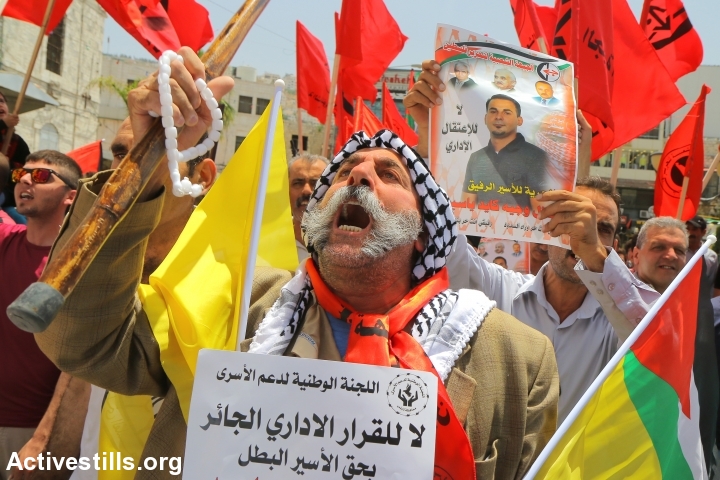
Palestinians take part in a protest in solidarity with the Palestinian prisoner Bilal Khaled, Nablus, West Bank, June 14, 2016. (photo: Ahmad al-Bazz/Activestills.org)

Edo Konrad

972mag.com |

Bilal Kayed was supposed to be released from Israeli prison after serving a nearly 15-year sentence. Instead, he was placed under indefinite detention without charges or trial.

Photos and text by Ahmad al-Bazz/Activestills.org

Palestinian prisoner Bilal Kayed was meant to be released from Israeli prison on Monday after serving 14.5 years. Instead Israeli military authorities decided to put him in administrative detention for a period of six months, which means he will be held indefinitely without charge or trial.

On Tuesday dozens of Palestinians took part in a solidarity protest in the West Bank city of Nablus. Kayed’s detention came as a shock to his family and relatives. ”His lawyer called us to say that he will not be released today,” said his brother Mahmoud Kayed, adding that only a few hours later did they discover that he was put in administrative detention.

During the protest the demonstrators chanted against the decision, while raising photos of Kayed along with Popular Front for the Liberation of Palestine (PFLP) flags, the leftist Palestinian party to which he belongs.

Administrative detention is a procedure that Israel uses to imprison detainees based on secret evidence, without charging them or allowing them to defend themselves at trial. Administrative detention orders may be renewed indefinitely.

The family confirmed that their son is planning on starting a hunger strike to protest his administrative detention. According to a statement released by the PFLP on Monday, its members in prison will begin an initial two-day hunger strike in solidarity with Kayed. “The hunger strike is just the beginning in a series of escalating steps to be implemented by all comrades in Zionist prisons and detention centers,” said the statement.


The mother of the Palestinian prisoner Bilal Kayed (center) takes part in a protest in solidarity with her son, Nablus West Bank, June 14, 2016. (photo: Ahmad al-Bazz/Activestills.org)

Kayed, 34, has been imprisoned by since December 2001 on charges of membership in the PFLP, as well as participation in activities against the State of Israel. He was 19 years old at the time of his arrest. Kayed is now among 750 Palestinians held in administrative detention without charge or trial.

Last Friday Israeli authorities placed a Palestinian prisoners’ rights activist under administrative detention for six months, 40 days after he was first detained and taken in for interrogation.

Mohammed Abu Sakha (photo: Courtesy of Addameer)


Hasan Safadi, who works as media coordinator for Addameer, an NGO that supports Palestinian prisoners in both Israeli and Palestinian prisons, was set to be released from detention on June 10 by order of Jerusalem’s Magistrate’s Court, after paying NIS 2,500 in bail and obtaining third-party guarantees. Later the same day, however, Israeli Defense Minister Avigdor Liberman signed an administrative detention order against Safadi, effectively overriding the court’s decision.

On Monday Israeli military authorities also renewed the administrative detention of Palestinian circus trainer and clown Mohammad Abu Sakha for an additional six months, from June 13 to December 12. Abu Sakha is known for working with special needs children in the West Bank, and runs the Palestinian Circus School. He was first arrested on December 14, 2015 while he was crossing Zaatara military checkpoint near Nablus on his way to work in the village of Birzeit, near Ramallah.

For additional original analysis and breaking news, visit +972 Magazine’s Facebook page or follow us on Twitter. Our newsletter features a comprehensive round-up of the week’s events. Sign up here.

© 2010 – 2016 +972 Magazine


The Reason The Orlando Shooter Committed His Crime

Is Assad Delusional?

Photo: A vehicle drives near a road sign that shows the direction to the historic city of Palmyra in this picture provided by SANA on March 24, 2016. REUTERS/SANA/Handout via Reuters

In a matter of months, Bashar Assad’s reading of the Syrian war was transformed. In a June 7 speech to Syria’s Parliament, he vowed to retake “every inch” of Syria, dismissing negotiations with the opposition as a trap. In contrast, less than a year ago in July 2015, Assad gave a very different speech. Then, having lost a great deal of territory to the insurgency, he admitted his forces had to cede some areas of Syria to save more important ones. US State Department spokesperson Mark Toner said Assad’s latest speech “[showed] once again how delusional, detached, and unfit he is to lead the Syrian people.” Unfit he may be, but is Assad misreading his situation so severely? What did his speech reveal about his calculations and prospects in Syria?

The single most significant military development between the two speeches is Russia’s entry into the war. Russian air power, artillery, and training helped stabilize key frontlines near the Alawite heartland in northwest Syria. Aided by Iranian forces, Russia nearly destroyed the rebels in critical Aleppo province, weakened the insurgency around Damascus, and halted a rebel offensive in the south. The resulting respite allowed the regime to finally attack the Islamic State (ISIS) in earnest, retaking the strategic city of Palmyra and advancing on Tabqa. Capturing the latter would place regime forces within an hour’s drive from ISIS’s capital in Raqqa city, possibly beating Kurdish and Arab forces to the claim of destroying the ‘caliphate.’

Thus, Assad’s strategic situation improved dramatically between speeches, without his making any serious concession to either his foreign patrons or Syrian rivals. Fighting ISIS might convince foreign governments to embrace or at least tolerate him as a partner against terrorism. It also makes the United States a de facto partner in that effort, since US policy is to fight ISIS but not the regime. Presently the groups succeeding most against ISIS are the Kurdish-dominated Syrian Democratic Forces (SDF), a handful of increasingly-beleaguered insurgent groups in Aleppo province, and now the regime. The United States is allied to the first, ambivalent toward the second, and will tolerate the third.

Of course, Assad is a long way from winning the war. The insurgency remainsadaptable and dangerous in key geographies. Assad still does not control all or even the majority of Syria. Rebels are particularly strong in Idlib, but are also a significant force in southern Syria and Damascus suburbs. The regime will struggle to uproot an entrenched ISIS from Raqqa and Deir al Zour cities as well, especially if the anti-regime insurgency remains active elsewhere. These challenges, as well as limited manpower and resources, a destroyed economy, and a deeply aggrieved population, do seem to indicate that Assad might be out of touch.

It is indeed difficult to imagine the regime ruling over all of Syria, and if Assad truly believes this will happen he is likely mistaken. Less delusional however is his nearer goal of ending the insurgency as a strategic threat to his regime. For this to happen, insurgent supply lines would have to be severed; foreign rivals distracted, divided, or deterred; major pro-opposition areas depopulated; and at least one generation of largely-Sunni Arab Syrians terrorized into submission. Additionally, at least one capable foreign patron would need to stay committed to the regime’s survival, and face no decisive international resistance or competition. This summarization is of course a good approximation of today’s realities. The opposition is not beaten yet, but it will be unless both the rebels and their backers shift their strategy dramatically.

Assad is not the only or even the strongest actor in the pro-regime coalition of course. Iran and Russia saved the regime from defeat, and are still responsible for its survival. Iran and Hezbollah presumably do not want to maintain an expeditionary force in Syria until Assad reconquers the entire country. Russia is in Syria only to break the opposition’s will and force it to make terms with Assad, not reconquer the country for him. These differences explain Mr. Toner’s statement that “[The United States] still believe[s] that Russia, and Iran can at least appeal to those in the regime who still have influence on him to refrain from letting this political process, this cessation of hostilities, fall completely apart.”

One would think Assad’s reliance on Iran and Russia would prevent him from dictating the mission or strategy to either, seeing as his forces can neither take nor hold territory without their support. Oddly enough however, Assad seems to be doing exactly that. For example, Russian air power led to a cessation of hostilities early this year that favored the regime. This began a political process that, while stacked against the opposition, nonetheless served Russian interests by creating a vehicle for translating the regime’s military gains into political ones. Yet Assad’s forces simply ignored the ceasefire, along with Russian commitments to facilitate humanitarian aid flows to besieged populations.

Even as Russia presents a limited agenda (a pro-Assad one, to be sure) with narrow goals, Assad’s statements and his forces’ actions confirm his maximalist aspirations to reconquer Syria. Differences are real enough that on at least one occasion, Russian air support appeared to waiver amid regime overreach in Aleppo. Yet this support always resumes when the regime’s position appears in danger. Russia does not believe Assad can win Syria, but it cannot allow him to lose the war either. The practical result for Assad is the same: he does not need to budge on his goals. 

Assad—weaker than both Iran and Russia—seems to play a spoiler role in the regime coalition, and perhaps a leading role in a sense. The most likely explanation for this is that Iran and, to a lesser degree, Russia simply cannot allow Assad to fall, lest their regional security architecture collapse with him. By pushing harder and farther in the war, Assad does raise the costs and risks to his allies. However, by placing his own forces in danger, he compels his patrons to back him up or risk losing what is, after all, also their war. Thus, the often-cited gaps between the positions of Assad, Iran, and Russia are analytically interesting but, at this stage of the war, not decisive or policy-relevant. 

The Assad regime is probably not going to rule all of Syria again. On this point, Assad is both overestimating his capabilities and underestimating much of the population’s hatred for him. Per Mr. Toner’s remarks, he is certainly unfit to lead the Syrian people, but local, regional, and international realities show he is not losing the war on the insurgency, and he is not at a stalemate either. The Assad-Iran-Russia coalition is on course to ending the rebellion as a strategic threat to regime survival. The delusion is not Assad’s confidence, but the belief that his deep dependence on foreign patrons doom him to failure. They will not and cannot deliver all of Syria to him, but without foreign intervention on the opposition’s side they may well deliver enough of it.

Faysal Itani is a senior fellow with the Atlantic Council’s Rafik Hariri Center for the Middle East.

see also Assad is a delusional madman: Khalid Khoja

Blog at WordPress.com.

Up ↑